Home Blog Page 4

Bill reconfiguring BARMM parliamentary districts approved

COTABATO CITY — The Bangsamoro Parliament approved before dawn on Tuesday a measure reconfiguring the 32 parliamentary districts in the autonomous region, a requisite of its first ever elections since its creation in 2019.

The first ever electoral exercise in the Bangsamoro region was deferred until March 2026, after the Supreme Court declared unconstitutional the two related enabling measures meant to reconfigure the parliamentary districts in the autonomous region.

Sulu had seven parliamentary districts while still one of the six provinces in the Bangsamoro region, now covering only Maguindanao del Norte, Maguindanao del Sur, Lanao del Sur, Basilan and Tawi-Tawi provinces and the cities of Lamitan, Marawi and Cotabato.

Jet L. Lim, floor leader and spokesperson of the 80-seat parliament in the Bangsamoro Autonomous Region in Muslim Mindanao (BARMM), told reporters on Tuesday that regional lawmakers made sure that the Parliament Bill 415 is “constitutionally sound” and attuned to the Supreme Court’s guidance on the setting up of the parliamentary districts in the region after having taken Sulu out of BARMM.

Parliament Bill 415, which regional lawmakers approved on third and final reading, during an extensive session that culminated after midnight on Monday, allocated nine parliamentary districts in Lanao del Sur, five each in Maguindanao del Norte and Maguindanao del Sur, and four each in Basilan and Tawi-Tawi.

It also established three parliamentary districts in Cotabato City and two in the Bangsamoro Special Geographic Area (SGA) in Cotabato province.

The SGA covers 63 barangays that originally belonged to different towns in Cotabato province, whose residents voted in favor of the inclusion of their ancestral domains in the contiguous areas into the core territory of the Bangsamoro region during a plebiscite in 2019.

Members of the BARMM parliament, among them Naguib G. Sinarimbo, former regional local government minister, said they made sure that the Parliament Bill 451 legitimizes the conduct of the first regional elections in the autonomous region, slated in March this year.

“This bill was crafted to directly address the legal issues raised by the Supreme Court pertaining to the setting up of the parliamentary districts in the Bangsamoro region,” Mr. Sinarimbo said.

Mr. Sinarimbo said the measure ensures the conduct of BARMM’s first parliamentary elections within the High Tribunal’s prescribed timeline.

All 80 members of the BARMM parliament are functioning as presidential appointees, without electoral mandate, since the region’s creation in 2019. — John Felix M. Unson

Infra spending, consumption expected to stay weak — HSBC

Workers are seen in a construction site in Manila. — PHILIPPINE STAR/RUSSELL PALMA

THE ECONOMY may struggle to reach its potential this year as the flood control corruption scandal continues to dampen infrastructure spending, with corresponding spillover effects on consumption, HSBC Global Investment Research said.

HSBC Global said gross domestic product (GDP) growth will likely come in at 4.7% in 2025 with the fourth-quarter reading possibly ending at or under 4% with “risks tilted to the downside.”

“(I)f public infrastructure spending continues to dip by 40% in November and December, there is a risk that growth can go below 4% for the fourth quarter of 2025,” HSBC economist for ASEAN Aris D. Dacanay said at a briefing on Tuesday in Taguig City.

HSBC’s projections fall below the Department of Economy, Planning, and Development’s 4.8%-5% for the year.

The infrastructure corruption scandal that cast a cloud over Public Works officials, legislators, and private contractors triggered a review of public works spending, with knock-on effects on household consumption, dragging down economic growth to an over four-year low of 4% in the third quarter.

In October, infrastructure spending dropped for a fourth straight month, falling 40.1% year on year to P65.9 billion. It also fell 16.2% from September.

Household consumption growth slowed to 4.1% in the three months to September from 5.3% in the second quarter and 5.2% a year earlier, the Philippine Statistics Authority (PSA) reported.

The PSA is set to release fourth-quarter GDP data on Jan. 29. 

Mr. Dacanay noted the continued slowdown may cause GDP growth to settle at 5.2% by year’s end, towards the lower end of the government’s 5%-6% target band.

“Consumption will likely be slow in 2026, even when wages are increasing, because families, households in the Philippines usually tend to rein in their spending to prepare for the uncertain times ahead, whatever may come,” he said.

He said Bangko Sentral ng Pilipinas (BSP) expectations that the economy will begin to recover by the latter half of 2026 will materialize only if the government implements institutional reforms. 

The recovery will happen “if we’re able to push through with the necessary institutional reforms,” he said. “But at the status quo… I don’t think so.”

Nevertheless, the BSP may have enough leeway to further reduce key borrowing costs this year to spur demand, Mr. Dacanay said.

HSBC sees scope for a sixth straight 25 basis-point (bp) cut from the Monetary Board within the first quarter, even if the Federal Reserve decides to hold its rates steady.

“With consumption strong, growth strong, unemployment not really so bad but inflation becoming sticky, we’re not forecasting the Fed to cut rates further… Even if the Fed doesn’t cut rates, we do think the BSP will do the unprecedented and narrow its differential with the Fed by 50 basis points,” he said.

The Monetary Board capped off 2025 with a fifth consecutive 25-bp reduction at its December meeting, bringing the benchmark policy rate to an over three-year low of 4.5%. This brought its total cuts to 200 bps since it began its easing cycle in August 2024.

The central bank has noted that the current easing cycle is nearing its end, but BSP Governor Eli M. Remolona, Jr. still left the door open for another 25-bp cut at the next meeting on Feb. 19.

However, he noted a sixth straight cut may be “unlikely” considering current economic data and as the current policy rate is approaching their neutral rate. — Katherine K. Chan

Farmers yet to feel benefits of improved agricultural trade balance, analysts say

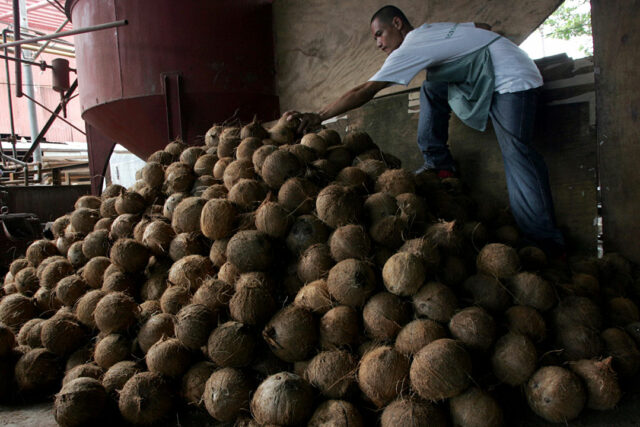
A Filipino worker inspects coconuts at a plantation in Quezon province in this picture taken on Aug. 11, 2004. — REUTERS

By Vonn Andrei E. Villamiel

THE Philippines’ agricultural trade deficit narrowed to a 21-month low in November, driven by a surge in exports and a pullback in imports, but analysts said the improvements have yet to trickle down to farmers, who continue to grapple with persistently low farmgate prices.

The Philippine Statistics Authority, citing preliminary data, said the trade deficit in agricultural goods shrank 20% year on year in November to $806.34 million. Agricultural exports rose 18.9% to $806.18 million.

Imports of farm commodities dipped 4.4% year on year to a five-month low of $1.61 billion. The decline was driven largely by a 51.5% drop in cereal imports, following a four-month rice import ban that began in September.

For the first 11 months, the agricultural trade deficit totaled $10.3 billion, narrowing about 4.6% from a year earlier.

Agricultural exports in the year to date amounted to $8.33 billion, up 18.8%, exceeding the full-year 2024 total of $7.75 billion.

Despite the narrower deficit and stronger export performance, an analyst said there is little reason to celebrate, particularly from the perspective of producers.

“There is an expected slight decrease in our agriculture trade deficit last year, given the unprecedented volume of imports of rice, pork, and chicken in 2024,” Jayson H. Cainglet, executive director of the Samahang Industriya ng Agrikultura, told BusinessWorld via Viber.

In 2024, the Philippines imported a record 4.8 million metric tons (MMT) of rice, up from around 3.6 MMT in 2023, as traders accelerated purchases amid concerns over weaker harvests caused by El Niño and La Niña.

The Bureau of Animal Industry also reported that the Philippines imported a record 1.45 MMT of meat in 2024, up 20.43%, driven by higher pork and chicken meat purchases.

“The narrower deficit can be attributed to a higher base in 2024, and its impact was felt by producers last year through the huge drop in farmgate prices,” Mr. Cainglet said.

He added that improvement in the trade balance should be felt by domestic producers through strong farmgate prices, especially for commodities that directly compete with imports.

“From the producers’ perspective, the tangible measurement of our trade deficit in agriculture is how traders and trader-importers are setting prices at the farmgate for import-favored commodities like rice, pork, chicken and vegetables,” he said.

Mr. Cainglet said that with cheaper imports and a lowered tariff regime, however, farmgate prices of major agricultural commodities have been pushed close to, or even lower than, production costs.

Danilo V. Fausto, president of the Philippine Chamber of Agriculture and Food, Inc., also said gains from improved trade balances have yet to be felt at the farm level.

Improvements in farmgate prices and farmer incomes are not yet apparent, he told BusinessWorld via Viber.

Still, Mr. Fausto said a healthier trade balance could eventually support demand and productivity, especially if accompanied by stronger support for farmers.

“The improved trade balance will steer up demand and productivity. Therefore, there is a need to increase support for agricultural export champions,” he said.

Mr. Fausto added that reforms should focus on strengthening backward linkages, including more efficient access to raw materials and improved logistics, to bring down production costs.

NIA launches Swiss challenge for First Gen’s 120-MW Nueva Ecija pumped-storage project

FIRSTGEN.COM.PH

THE National Irrigation Administration (NIA) is inviting counter-proposals for a Swiss challenge to the 120-megawatt (MW) Aya Pumped-Storage Project at the Pantabangan Dam complex in Nueva Ecija, whose original proponent is First Gen Hydro Power Corp.

The Swiss challenge invites bidders to improve on the terms proposed for the unsolicited development, operation, and maintenance project, with First Gen Hydro holding the option to match any counter-proposals.

First Gen Hydro, a unit of Lopez-controlled First Gen Corp., signed a memorandum of understanding with the NIA in 2019 to develop the project.

In the bid notice, the NIA said prospective challengers can purchase a complete set of tender documents from Jan. 13 to 19 for a non-refundable fee of P75,000.

Interested parties must indicate their intent to challenge by Jan. 27, with a pre-challenge conference scheduled on Jan. 31.

The counter-proposals are due on Feb. 3, during which the proposals will also be opened and examined for completeness. — Vonn Andrei E. Villamiel

Palay farmgate price falls 24.6% in 2025

PHILIPPINE STAR/ KJ ROSALES

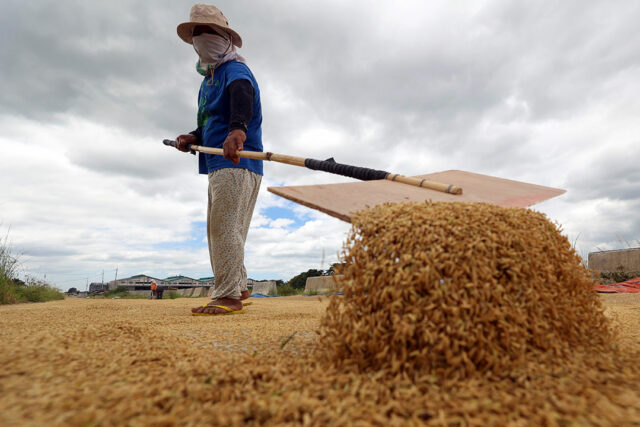
THE farmgate price of dry palay (unmilled rice) dropped 24.6% in 2025 to a national average of P17.70 per kilo, according to preliminary data from the Philippine Statistics Authority.

The highest palay prices in 2025 were posted in the Bangsamoro Autonomous Region in Muslim Mindanao at P20.67 per kilo, the only region to register a price above P20.

The lowest palay price last year was logged in Calabarzon at P14.14 per kilo, well below the P21.30 average in 2024. The 33.6% decline was the biggest of any region in 2025.

In Central Luzon, the top rice producing region, the average farmgate price of palay in 2025 was P17.13 per kilo, down 28.8%.

Cagayan Valley, another major producer of the staple grain, posted an average farmgate price of P16.48 per kilo, down 30.3%.

The Department of Agriculture said the steep drop in palay farmgate prices was due to excess rice supply following record import volumes in 2024 and large shipments in early 2025. — Vonn Andrei E. Villamiel

Proposed upgrades to Mindoro port expected to improve farm logistics

PORT OF ABRA DE ILOG, OCCIDENTAL MINDORO FB PAGE

THE Department of Agriculture (DA) said the deepwater port being planned for Abra de Ilog, Occidental Mindoro will address logistics bottlenecks to the benefit of farmers and fisherfolk in the province.

The DA said the port, to be implemented by the Philippine Fisheries Development Authority, is designed to accommodate large vessels and improve the movement of agricultural products between Mindoro, Luzon, and export markets.

Agriculture Secretary Francisco P. Tiu Laurel, Jr. was quoted in a statement as saying that the port will address high logistics costs, which he described as a key contributor to food inflation.

“Shipping in bulk reduces costs from inputs to final products, making modern port infrastructure critical in addressing high food prices,” the DA said.

According to the DA, the port will expand the current roll-on/roll-off (Ro-Ro) facility in Abra de Ilog, which links Mindoro to Batangas.

Planned upgrades include a finger pier, modern fish market, cold storage and ice plants, warehouses, wastewater treatment facilities, solar power systems, and reefer vans to help reduce post-harvest losses and meet export-grade food safety standards.

The DA said the project could relieve congestion at the Batangas port and shorten shipping times, potentially positioning Abra de Ilog as a cost-efficient transshipment hub for agricultural commodities.

Construction is also expected to create jobs, while long-term operations could attract logistics providers, processors, and other support businesses, the DA said.

According to the DA, construction is expected to take about 24 months once approved. — Vonn Andrei E. Villamiel

PPA awards P550-M Bohol port expansion project

JFAPCONSTRUCTION.COM

THE Philippine Ports Authority (PPA) said it awarded a P550.67‑million contract to expand and upgrade Bohol’s Tubigon Port in Bohol to Ormoc-based JFAP Construction.

In a notice of award posted on Tuesday but dated Dec. 18, the regulator said 13 construction companies submitted proposals for the project.

Tubigon Port serves as an alternative to Tagbiliran port. It links to other major economic regions and handles passenger ferry services.

The contractor for the project was given 720 calendar days to complete the expansion and reconstruction of the port, the PPA said.

The PPA is expecting stronger growth in cargo and passenger traffic this year, enabled by investments in port efficiency.

For 2026, the PPA said it is expecting cargo volume to come in 4.03% stronger at 320.94 million metric tons, driven mainly by higher foreign cargo shipments.

The PPA said foreign cargo volume is expected to rise 4.28% to 202.73 million metric tons in 2025. Domestic cargo volume is expected to rise 3.61% to 118.22 million metric tons.

Passenger traffic is expected to grow 5.78% to 87.26 million, the PPA said, after logging 82.49 million passengers in the first 11 months of 2025.

The PPA logged a record of 6.28 million passengers during the Christmas and New Year travel season, the strongest numbers since its establishment in 1974. The surge was logged between Dec. 15 and Jan. 5. — Ashley Erika O. Jose

Electronic connector firm’s Batangas expansion expected to add 600 jobs

FPIP.COM

TE Connectivity Manufacturing Philippines, Inc. will add 600 jobs with the opening of its second facility in Sto. Tomas, Batangas, the Philippine Economic Zone Authority (PEZA) said.

“With investments worth approximately P4 billion, TE Connectivity’s expansion underscores its confidence in the Philippines as a competitive and strategic production and innovation hub,” PEZA said in a social media post on Tuesday.

The company inaugurated Plant 2 at the First Philippine Industrial Park (FPIP) Special Economic Zone last week.

“The plant will focus on the development, research, and manufacturing of electronic connectors and interconnection devices —critical technologies powering today’s digital infrastructure,” it said.

“The company projects about 600 employment opportunities in addition to its existing workforce of approximately 500, supporting inclusive and high-value job generation in the region,” it added.

PEZA sees TE Connectivity’s expansion helping strengthen FPIP’s reputation as an emerging hub for advanced manufacturing in South Luzon.

“Expansions like TE Connectivity Plant 2 signify stronger confidence in the Philippines by powering technology and shaping the country’s role in the rapidly evolving global innovation and artificial intelligence ecosystem,” it added. — Justine Irish D. Tabile

PHL economy to ‘rebound’ in 2026 — BMI 

THE Philippine economy is expected to grow faster this year, lifted by reduced export dependence and a rebound in public expenditures amid a flood control controversy, Fitch Solutions unit BMI said.

“We expect the Philippine economy to rebound in 2026 from a low base in 2025, aided by its lower dependence on exports, and a recovery in government spending following recent corruption allegations,” BMI Asia Country Risk Analyst Brandon Ong said in a webinar on Tuesday.

The Philippines, a domestically driven economy, has been paying a 19% reciprocal US tariff since August on many goods alongside Cambodia, Malaysia, Thailand, and Indonesia.

The corruption scandal weighing down infrastructure spending has curbed government spending and dented business and consumer confidence.

BMI projected Philippine GDP growth to accelerate to 5.2% in 2026 from an estimated 4.9% in 2025.

BMI’s forecasts are within the government’s revised 5-6% target band for 2026 but short of the 5.5-6.5% range for 2025.

Economy Secretary Arsenio M. Balisacan has said that economic growth may have slowed to between 4.8% and 5% in 2025.

The Philippine Statistics Authority (PSA) will release fourth-quarter and 2025 GDP data on Jan. 29.

Mr. Ong noted that China’s slowdown is likely to ripple across Asia due to the interconnectivity of regional economies.

“Exceptions do emerge in economies where we project firmer domestic demand in 2026, including Japan, Indonesia, the Philippines, South Korea, and Australia,” he said.

As for Japan and Indonesia, fiscal stimulus will be supportive to growth, he added.

BMI said Asia’s growth is set to slow in 2026 as the boost from export front-loading wanes and US tariffs start to bite. 

“The stronger 2025 base will further amplify the slowdown. We forecast regional growth to slow to 4.0% in 2026, from 4.3% in 2025,” it said in a report. — Aubrey Rose A. Inosante

BCDA 2025 cash revenue at P14.1 billion, beating target

THE Bases Conversion and Development Authority (BCDA) said cash revenue amounted to P14.1 billion last year, up 20.9% and beating the P10-billion target.

“The strong performance underscores BCDA’s solid liquidity position and improved cash generation, supported by increased private-sector activity in its economic zones and the strategic use of land assets for priority national infrastructure projects,” it said in a statement on Tuesday.

Cash revenue refers to actual collections received within the year.

“BCDA’s 2025 cash revenue was generated from a combination of land dispositions, lease arrangements, concession fees, and investment-related receipts across BCDA-administered economic zones,” it added.

“These were supported by higher private-sector investment, improved performance of transport-related concessions, and continued investor uptake in strategic growth areas such as New Clark City and Camp John Hay,” it added.

Of the revenue total, P3.29 billion is expected to be remitted to support the Armed Forces of the Philippines Modernization Program. — Justine Irish D. Tabile

Honda 2025 motorcycle sales top 1 million units

Honda Philippines reiterates focus on ‘top-notch’ customer service. — PHOTO FROM HONDA PHILIPPINES, INC.

HONDA PHILIPPINES, Inc. (HPI) said motorcycle sales totaled 114,772 units in December, bringing the 2025 retail sales total to 1.04 million.

“The strong full-year performance reflects sustained trust in HPI’s high-quality, innovative, and reliable motorcycle products,” HPI said in a statement on Tuesday.

“Through its wide-ranging lineup, HPI continues to support everyday journeys — bringing efficiency, performance, and peace of mind to customers,” it added.

According to HPI, the top five models were the CLICK125, ADV160, BeAT, TMX125 Alpha, and XRM125 DS.

“Our strong performance in 2025 reflects the continued trust of Filipino riders and the strength of our diverse product lineup,” according to Takeshi Kobayashi, president of HPI.

“We remain committed to delivering innovative and dependable motorcycles that support the daily lives, work, and aspirations of our customers,” he added.

For 2026, the company said that it will focus on offering products that balance performance, efficiency, and comfort. — Justine Irish D. Tabile

PHL milled rice output expected to fall 0.57% to 12.3 MMT by USDA

PHILIPPINE STAR/KRIZ JOHN ROSALES

PHILIPPINE MILLED RICE output is expected to decline 0.57% to 12.3 million metric tons (MMT) in marketing year (MY) 2025-2026, the US Department of Agriculture (USDA) said.

In a report, the USDA said milled rice production during the MY, which runs between July 2025 and June 2026, is expected to decline from 12.37 MMT in the previous MY.

The USDA has said that the Philippines is expected to report weaker-than-expected fourth-quarter output due to typhoon-related losses and challenging post-harvest conditions.

The USDA said the Philippines will remain the top rice importer, with imports in the MY projected at 5.5 MMT, up 51.72%.

Rice consumption is projected to increase to 17.6 MMT from 17.4 MMT in the previous MY, while ending stocks are also estimated at 3.09 MMT from 3.79 MMT previously.

Meanwhile, the USDA said corn production in the current MY is projected to decrease 0.72% to 8.27 MMT.

Corn imports to the Philippines are projected to increase 41.79% to 1.9 MMT.

Wheat imports in the current MY are projected to rise 19.67% to 7.6 MMT. — Vonn Andrei E. Villamiel