Home Blog Page 5

Philippines likely to be East Asia and Pacific region’s third fastest-growing economy until 2027

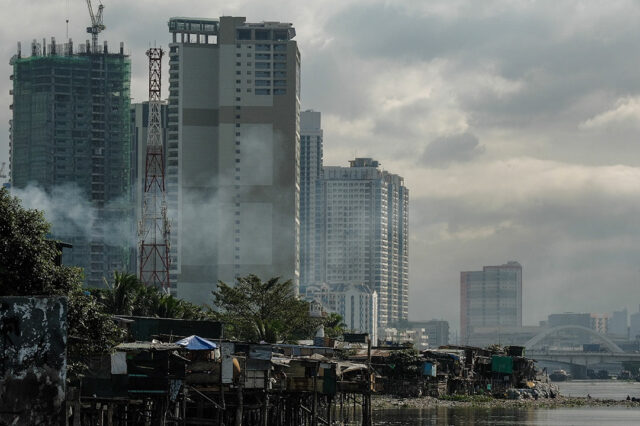
High-rise buildings tower over shanties in Parola, Tondo, Manila, Jan. 11, 2025. — PHILIPPINE STAR/RYAN BALDEMOR

The Philippines is projected to be the third fastest-growing economy in the East Asia and Pacific region this year and in 2027, according to the World Bank.

The multilateral lender kept its growth forecast for the country until 2027, unchanged from its December projection.

In its bi-annual Global Economic Prospects report, the multilateral lender said the Philippine gross domestic product (GDP) is expected to expand by 5.3% in 2026 and 5.4% in 2027.

“In the Philippines, planned structural reforms are likely to boost investment and productivity, but concerns around governance remain,” the World Bank said on Wednesday.

The Philippines is expected to be the third-fastest-growing economy in the East Asia and Pacific region until 2027, it said.

Vietnam is projected to grow by 6.3% this year, followed by Mongolia (5.6%), and the Philippines (5.3%), Indonesia (5%), Samoa (4.4%), China (4.4%), Cambodia (4.3%), Malaysia (4.1%), and Marshall Islands (4.1%).

For 2027, Vietnam is still poised to be the fastest economy at 6.7%, followed by Mongolia (5.5%), the Philippines (5.4%), Indonesia (5.2%), Cambodia (5.1%), China (4.2%), Malaysia (4%), and Laos (3.9%). – Aubrey Rose A. Inosante

UK’s foreign minister to urge NATO to focus on Arctic in Finland and Norway visit

GREENLAND’s flag flutters on a tourist boat as it sails past icebergs near Ilulissat, Greenland, Sept. 13, 2017. — REUTERS

LONDON — Britain’s foreign minister will visit Finland and Norway on Wednesday, where she will call for NATO to step up its work in the Arctic to safeguard regional interests against Russia.

Yvette Cooper’s Arctic Circle tour follows renewed threats by US President Donald Trump to take over Greenland, an autonomous territory of the Kingdom of Denmark. The Danish and Greenlandic foreign ministers will meet US Vice President JD Vance and Secretary of State Marco Rubio on Wednesday.

Britain’s Prime Minister Keir Starmer has said he stands with Denmark in its defense of Greenland.

Ms. Cooper’s trip will focus on Russia, which the foreign office described in a statement as the “greatest threat” to Arctic security.

In Finland, Ms. Cooper will meet border guards defending NATO’s eastern flank with Russia, while in Norway she will visit marines taking part in a live training exercise.

The high north, which includes Greenland, is home to key shipping routes and critical infrastructure such as undersea cables, making the region vital to Britain’s security, the foreign office said.

“The UK and Norway share a determination to ensure Russia does not succeed in its illegal war of aggression,” the foreign office said, adding that Russia posed a threat through its military activity, risks to undersea infrastructure and the use of its “shadow fleet”.

Britain last week provided support to the US in its operation to seize a Russian-flagged oil tanker in the North Atlantic.

“Arctic security is critical to protecting Britain and NATO,” Ms. Cooper said, urging the military alliance to enhance efforts to defend Euro-Atlantic interests against “hostile states who seek to meddle” in the high north.

“Coming together as an alliance allows us to unify and tackle this emerging threat,” she added, noting that climate change has opened new shipping routes, exposed valuable resources, and turned the region into a “hotspot” for geopolitical competition.— Reuters

North Korea’s Kim Yo Jong says South’s hopes for better relations are an illusion

REUTERS

SEOUL — North Korea’s Kim Yo Jong, the sister of leader Kim Jong Un, said on Tuesday South Korea’s hope for an improvement in relations is an illusion that cannot be realized, state media KCNA reported.

The leader’s powerful sister, who is a director of North Korea’s ruling party, criticized a comment attributed to a South Korean government official on Tuesday that Seoul saw a chance of talks resuming with Pyongyang based on her recent reaction to an alleged drone incursion into her country.

“In conclusion, it has already gone wrong in their expectation,” Ms. Kim was quoted by KCNA as saying.

“As far as Seoul’s various hope-filled wild dreams called ‘repair of (North-South) relations’ are concerned, they all can never come true,” Ms. Kim said.

The official at South Korea’s Unification Ministry, which oversees relations with North Korea, told reporters that Kim Yo Jong seemed to have toned down her statement at the weekend when she urged Seoul to investigate drones flown to the North.

South Korea had “committed a grave provocation by infringing upon North Korea’s sovereignty,” Kim Yo Jong said in the statement published late on Tuesday, echoing her earlier criticism over the drones, according to KCNA.

“I make it clear once again to the hooligans of the enemy state,” she said, demanding a South Korean government apology and a pledge never to let similar incidents from occurring.

The administration of South Korean President Lee Jae Myung has been seeking to improve ties with Pyongyang, but so far its overtures have been rebuffed by its neighbor.— Reuters

Takaichi and Lee end first day of summit on a high note with drum session

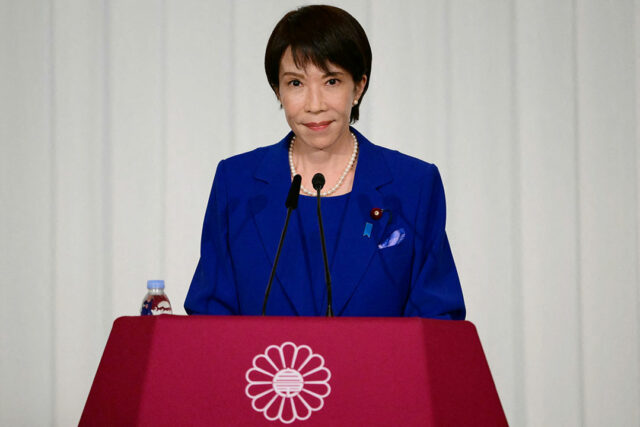
Sanae Takaichi, the newly elected leader of Japan’s ruling party, the Liberal Democratic Party (LDP), attends a press conference after the LDP presidential election in Tokyo on October 4, 2025. — YUICHI YAMAZAKI/POOL VIA REUTERS

TOKYO — Japanese Prime Minster Sanae Takaichi and South Korean President Lee Jae Myung rounded off their summit meeting on Tuesday with an unexpected jam session where the two played drums along to some K-pop hits.

In a short video posted on the Japanese Prime Minister’s office YouTube channel on Wednesday morning, the two leaders played the drums to global hits from the likes of BTS and Kpop Demon Hunters.

Ms. Takaichi, a keen drummer and fan of heavy metal, complemented Mr. Lee’s new found chops.

“The president learned to play the drums in just 5, 10 minutes,” she said in the video.

“Although our tempos were a bit different, we both tried to match the rhythm together – we will create a future-oriented relationship with one heart,” Mr. Lee posted on X on Wednesday morning.

While ties between Tokyo and Seoul have often been strained in the past, Ms. Takaichi and Mr. Lee have forged a friendlier relationship and on Wednesday morning the two also visited Horyuji Temple in Nara, Ms. Takaichi’s hometown.

In statements on Tuesday, Ms. Takaichi and Mr. Lee said they aimed to deepen security and economic ties in the face of growing tensions in East Asia and to continue “shuttle diplomacy”, with Ms. Takaichi next due to visit South Korea.— Reuters

Philippine FDI net inflows plunge nearly 40% in October

LANTERNS inspired by the Philippine flag line the street in San Fernando, Pampanga. Net inflows of foreign direct investment into the Philippines dropped to a three-month low in March. — PHILIPPINE STAR/WALTER BOLLOZOS

By Katherine K. Chan, Reporter

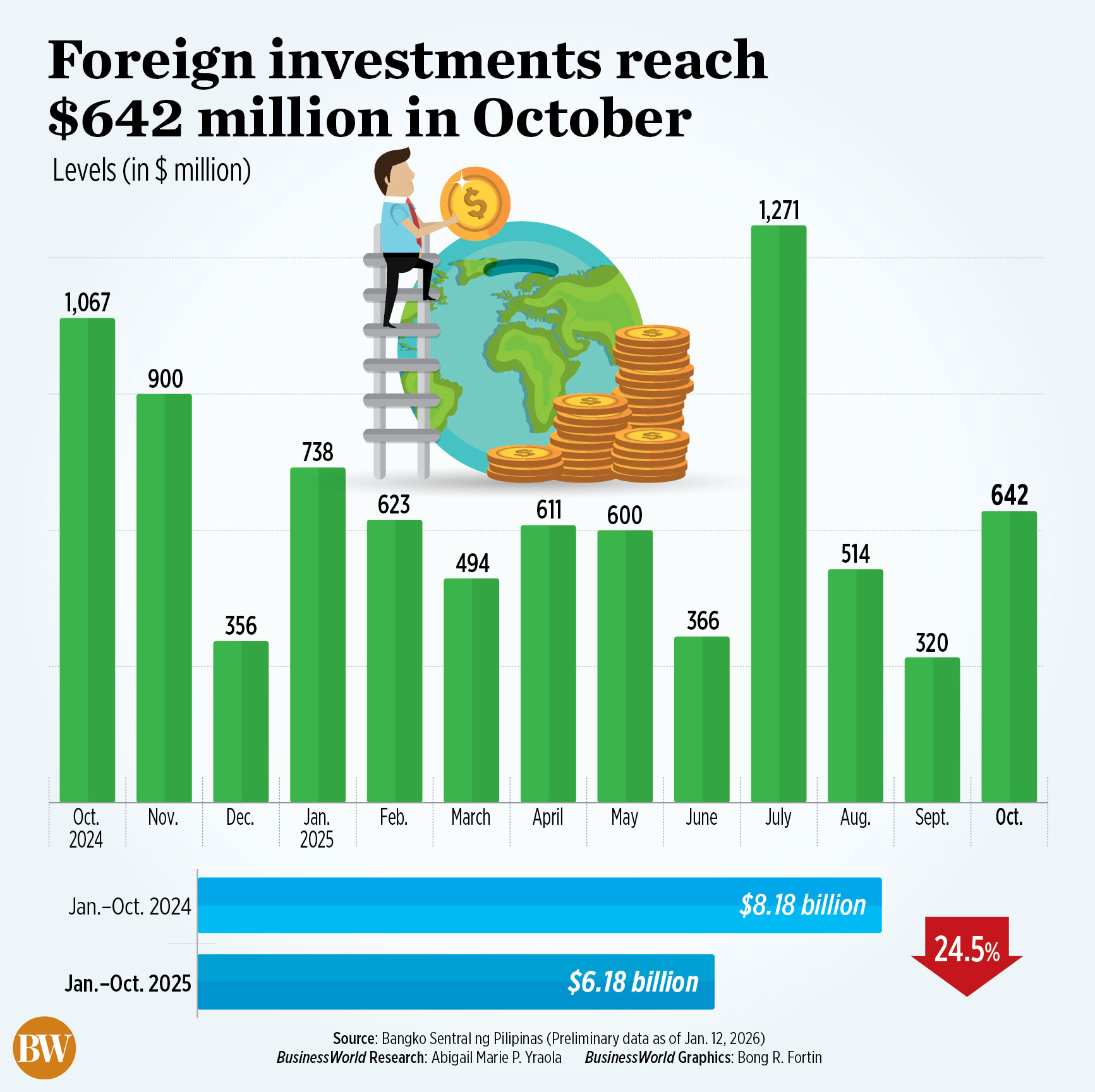
NET INFLOWS of foreign direct investments (FDI) into the Philippines plunged nearly 40% year on year in October, as foreigners’ net investments in debt instruments slumped.

Based on preliminary Bangko Sentral ng Pilipinas (BSP) data, FDI net inflows declined by 39.8% to $642 million in October from $1.067 billion in the same month in 2024.

Despite this, October saw the highest monthly FDI level in three months or since the $1.271-billion net inflows posted in July.
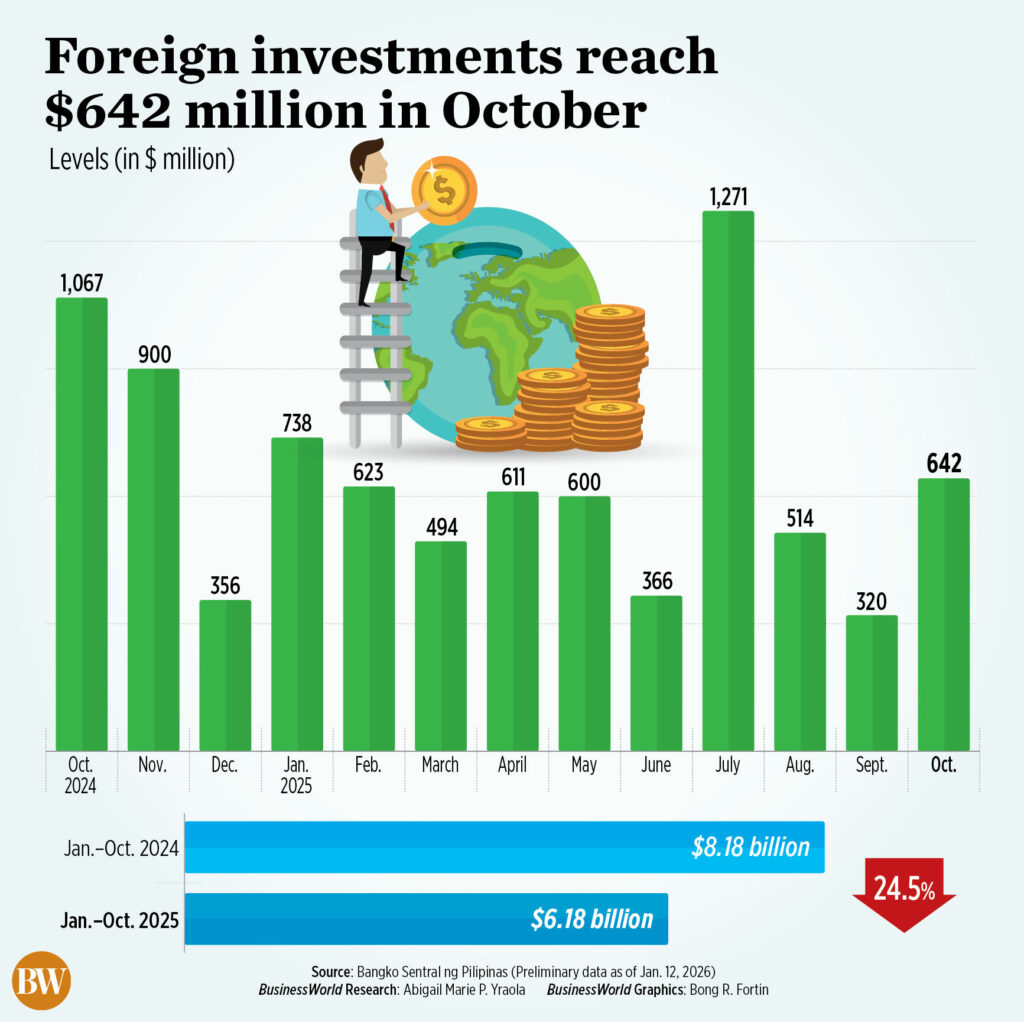
Month on month, inflows more than doubled (100.6%) from the five-year low of $320 million in September.

“Foreign direct investments into the Philippines posted net inflows of $642 million in October 2025,” the BSP said in a statement released late on Monday. “Japan was the top source of FDIs, while corporations engaged in financial and insurance activities were the biggest recipients of FDIs during the month.”

The year-on-year decline came as nonresidents’ net investments in debt instruments plummeted by an annual 50.7% to $437 million from $888 million.

However, this was tempered by higher inflows recorded across other FDI components.

Investments in equity and investment fund shares jumped by 14.5% to $205 million in October 2025 from $179 million in the same month in the previous year.

Nonresidents’ net investments in equity capital, other than the reinvestment of earnings, jumped by 17.1% to $117 million in October from $100 million a year earlier.

Broken down, equity capital placements grew by 10.7% to $135 million in October from $122 million a year ago, while withdrawals dropped by 17.4% to $19 million from $23 million a year ago.

Meanwhile, reinvestment of earnings rose by 11.3% year on year to $88 million in October from $79 million a year ago.

HSBC economist for ASEAN Aris D. Dacanay noted that the annual drop indicated that the ongoing corruption scandal curbed FDI inflows, prompting investors to adopt a cautious “wait-and-see” stance.

“I think it does show that it is affected by the scandal,” he told a press briefing on Tuesday. “The dip in itself has led foreign investors to have this wait-and-see approach on what’s happening in the Philippines. So, I can’t say that it doesn’t (affect FDIs). What I have to say is that it won’t totally reverse it.”

Last year, a series of widespread flooding across the country exposed multiple anomalous flood control projects and embroiled Public Works officials, lawmakers and private contractors in corruption allegations. 

Mr. Dacanay said the Philippines’ favorable demographics, tariff advantage and strong business process outsourcing sector will keep FDIs on track and could even help attract more investments into the country’s export-oriented industries.

On the other hand, Jonathan L. Ravelas, a senior adviser at Reyes Tacandong & Co., said the October figures suggest that corporate financing decisions weighed more on foreign investments than political factors. 

“Month on month, though, we bounced back simply because September was (at) a five‑year low — so October looked stronger as funding cycles normalized,” he said via Viber. “The flood control scandal added noise, but the data show the bigger driver was corporate financing decisions, not politics.” 

10-MONTH SLIDE
Meanwhile, BSP data also showed that FDI net inflows fell by 24.5% to $6.179 billion as of October from $8.184 billion in the comparable year-ago period.

“Net foreign direct investments declined year on year for the month of October 2025 (-39.8%) and from January-October 2025 (-24.5%) amid external risk factors particularly Trump’s higher tariffs, trade wars (and) protectionist policies that slowed down the US and global economy,” Rizal Commercial Banking Corp. Chief Economist Michael L. Ricafort said in a Viber message. 

Nonresidents’ investments in equity and investment fund shares amounted to $2.11 billion in the 10 months to October, 14.5% lower than the $2.468 billion a year earlier.

Investments in equity capital, other than the reinvestment of earnings, slid by 29.8% to $1.022 billion during the period from $1.456 billion in the prior year.

This as placements dropped by 16.4% year on year to $1.599 billion as of October from $1.912 billion a year ago. On the other hand, withdrawals climbed 26.5% to $577 million from $456 million a year ago.

Most equity capital placements in the 10-month period came from Japan, the United States and Singapore.

“Industries that received most of these investments were manufacturing, wholesale and retail trade, and real estate,” the central bank said.

Meanwhile, nonresidents’ reinvestment of earnings increased by 7.6% to $1.088 billion as of October from $1.011 billion.

However, net investments in debt instruments dropped by 28.8% to $4.069 billion in the period ending October from $5.717 billion a year ago.

Mr. Ravelas said the BSP’s forecast of $7 billion in FDI net inflows by end-2025 remains within reach, especially if investments stabilize in the last two months of the year.

“What will help? Strong capital from Japan, the US, and Singapore, continued investments in manufacturing, retail, and real estate, and clearer governance signals that reassure investors. If we stay focused on stability and reforms, the Philippines can keep pulling in long‑term capital despite the noise,” he added.

FDIs account for foreign investors’ investments in local businesses where they hold at least a 10% equity capital, as well as investments by a nonresident subsidiary or associate in its resident direct investor. It can be in the form of equity capital, reinvestment of earnings or borrowings.

The BSP’s FDI data cover actual investment flows, compared to the Philippine Statistics Authority’s foreign investments data which include investment commitments that may not be fully realized in a given period.


Philippines inks FTA with UAE

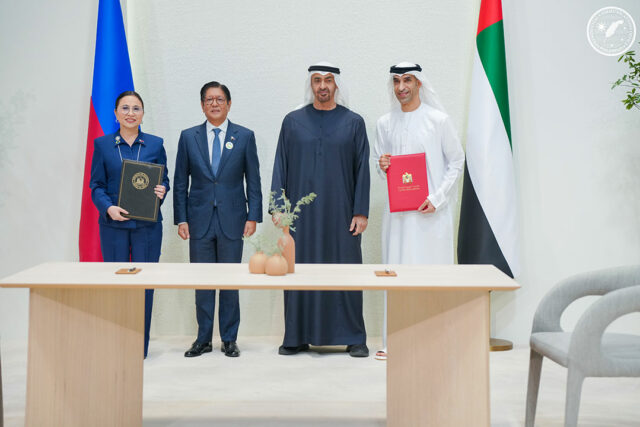
THE PHILIPPINES and the United Arab Emirates (UAE) on Tuesday sealed a landmark free trade agreement to boost trade, investment, and jobs. In photo (from left) Trade Secretary Ma. Cristina A. Roque, President Ferdinand R. Marcos, Jr., UAE President Sheikh Mohamed bin Zayed Al Nahyan and UAE Minister of State for Foreign Trade Dr. Thani bin Ahmed Al Zeyoudi during the signing ceremony in Abu Dhabi. — MALACAÑANG HANDOUT

THE PHILIPPINES and the United Arab Emirates (UAE) signed on Tuesday a landmark free trade agreement (FTA) which is expected to boost Philippine exports to the Gulf state by more than 9.13%, expand market access, and create new opportunities for Filipino professionals and businesses.

President Ferdinand R. Marcos, Jr. witnessed the signing of the Comprehensive Economic Partnership Agreement (CEPA) alongside UAE President Sheikh Mohamed bin Zayed Al Nahyan on the sidelines of the Abu Dhabi Sustainability Week 2026 Summit, according to a statement from Mr. Marcos’ office.

Trade Secretary Ma. Cristina A. Roque signed the pact on behalf of Manila, while UAE Minister of State for Foreign Trade Dr. Thani bin Ahmed Al Zeyoudi signed for the UAE. 

The CEPA marks the Philippines’ first free trade deal with a Middle Eastern country, signaling a strategic push to broaden its global trade footprint.

The deal aims to reduce tariffs, increase investment flows and facilitate the participation of Filipino micro, small and medium enterprises across sectors, including information technology and business process management, healthcare, education, tourism and construction.

The agreement also covers digital trade, sustainable development, intellectual property, competition and consumer protection, government procurement, and technical cooperation. 

Among key Philippine exports expected to benefit are bananas, pineapples, canned tuna, electronics and machinery.

Bilateral trade between Manila and Abu Dhabi reached nearly $1.83 billion in 2024. The UAE ranked as the Philippines’ 18th largest trading partner and accounts for almost 39% of Philippine exports to the Middle East. 

The CEPA is expected to complement Manila’s existing network of trade agreements with Japan, South Korea, the European Free Trade Association, and the Association of Southeast Asian Nations, as well as the Regional Comprehensive Economic Partnership.

It will also reinforce prior bilateral agreements, including the Investment Promotion and Protection Agreement.

Rizal Commercial Banking Corp. Chief Economist Michael L. Ricafort said the new deal is significant as the Middle East is a “very promising market” due to the region’s affluence.

“This could provide a more conducive environment for further diversification of Philippine export market to more affluent markets around the world, especially the untapped ones through optimization of FTA opportunities, as well as supportive of the further diversification of more Philippine export products/winners, such as tropical fruits and other agricultural products,” he said via Facebook Messenger.

The Philippines and the UAE established diplomatic relations in 1974.

First Lady Louise Araneta-Marcos, Foreign Affairs Secretary Ma. Theresa P. Lazaro, Acting Finance Secretary Frederick D. Go, and Special Envoy to the UAE for Trade and Investment Kathryna Yu-Pimentel also attended the signing. — Chloe Mari A. Hufana

Philippines targets 4.3% of GDP for infrastructure spending this year

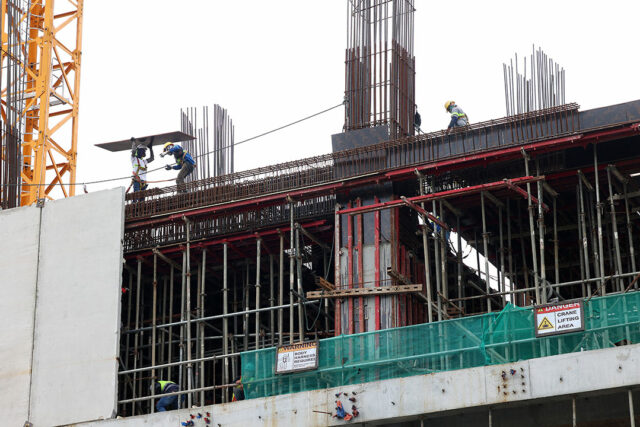
CONSTRUCTION of the Philippine Cancer Center located in Quezon City is underway. — PHILIPPINE STAR/MIGUEL DE GUZMAN

By Chloe Mari A. Hufana, Reporter

THE DEPARTMENT of Budget and Management (DBM) cut its infrastructure spending target to 4.3% of gross domestic product (GDP) this year from 5.1% previously, as a corruption scandal weighed on government spending and economic growth last year.

The lower target translates to about P1.3 trillion in infrastructure outlays, Acting Budget Secretary Rolando U. Toledo said on Tuesday, signaling a more cautious spending stance as the government works to restore confidence and streamline disbursements.

“Based on our approved General Appropriations Act, we’re looking at achieving our infrastructure target as [a percentage of our] GDP at 4.3%, and even at a nominal level, that is equivalent to P1.3 trillion,” he told a Palace briefing in mixed English and Filipino.

Infrastructure spending has been a key pillar of President Ferdinand R. Marcos, Jr.’s growth strategy, though execution slowed last year due to budget adjustments and project bottlenecks amid a massive graft scandal involving flood control projects.

The government had earlier set a target of 5.1% of GDP for infrastructure spending in 2026, equivalent to P1.56 trillion, lower than the 2025 target of 5.3% of GDP or P1.51 trillion.

In 2024, infrastructure spending accounted for 5.8% of GDP or P1.545 trillion.

Mr. Toledo said the government is still determined to boost investments in infrastructure in the medium term.

He said there is little risk of delays in infrastructure projects this year, after a “clean” budget process.

“There is no reason for us to delay,” Mr. Toledo said, adding that the 2026 national budget contains no “ghost projects” and that allocations across programs are fully specified, supporting the government’s ability to meet its infrastructure goals.

Mr. Marcos on Jan. 5 signed a record P6.793-trillion national budget amid a graft scandal, which has prompted tighter scrutiny of public spending and a more cautious approach to the release of funds for infrastructure and other major projects.

John Paolo R. Rivera, a senior research fellow at the Philippine Institute for Development Studies, said slower public works spending may temper economic momentum because infrastructure has one of the highest multiplier effects in the economy.

“It may cap growth momentum, as public works have one of the highest multiplier effects in the economy,” he said via Viber.

“The more cautious stance may help restore governance credibility, but it also means less crowding-in of private investment, weaker job creation in construction and allied sectors, and slower productivity gains,” he added.

Economy Secretary Arsenio M. Balisacan last week said economic growth in the Philippines likely eased to between 4.8% and 5% in 2025, reflecting the impact of the graft scandal on the economy.

The Philippine Statistics Authority is set to publish official fourth-quarter and full-year 2025 GDP figures on Jan. 29.

Without faster execution, improved project selection, or stronger private investment to offset the slowdown, the Philippines’ economic growth could fall short of its potential even as confidence gradually improves, Mr. Rivera said.

Michael L. Ricafort, chief economist at Rizal Commercial Banking Corp., said higher government spending — particularly on infrastructure — is likely to be the primary driver of economic growth in 2026.

He expects authorities to accelerate public works as early as the first quarter to make up for underspending last year, which he said was partly due to tighter anti-corruption measures and governance reforms.

A catch-up spending program could help bolster investor confidence and sentiment, Mr. Ricafort said, reinforcing the growth outlook.

He said prospective interest rate cuts by the US Federal Reserve and the Bangko Sentral ng Pilipinas would lower borrowing costs, supporting credit demand, investment and overall economic expansion.

Solar Philippines faces P24-B penalties over terminated RE contracts

STOCK PHOTO | Image from Pixabay

SOLAR PHILIPPINES Power Project Holdings, Inc. is facing P24 billion in fines for its failure to deliver nearly 12,000 megawatts (MW) of renewable energy (RE) over the last two years, according to the Department of Energy (DoE).

“Out of the 17,904 MW of terminated contracts for 2025 and 2024… Solar Philippines would be 11,427 MW. That’s more or less equivalent to 64% of the terminated contracts,” Energy Secretary Sharon S. Garin said in a press chat on Tuesday.

Ms. Garin said the DoE terminated 33 service contracts held by Solar Philippines, a company founded by businessman-turned-politician Rep. Leandro L. Leviste, due to project delays.

These service contracts could have supplied 11,427.83 MW of capacity to the grid.

The DoE said it seeks to collect around P24 billion in penalties from Solar Philippines which covers contractual obligations, performance bonds and financial obligations arising from the revoked contracts.

“We have consistently sent notices even show-cause orders request for them to renew their bonds. We have not received any response from the company,” she said.

Sought for comment, Mr. Leviste has yet to respond as of press time.

The DoE said it has recorded nearly 18,000 MW worth of potential capacity from 163 terminated and relinquished service contracts

Ms. Garin said that 70 contracts were terminated and relinquished in 2024 and 93 contacts in 2025.

These terminated and relinquished contracts were composed of hydro, solar, wind, geothermal, and biomass that were awarded after application and green energy auctions (GEAs).

“This could have covered actually the annual increase of our electricity demand in the country. Unfortunately, we had to cancel these contracts. They’re not complying with the requirements and in accordance with their GEA contract. This is why we had to cancel them because they really woundn’t move,” Ms. Garin said.

Under the revised omnibus guidelines governing the award and administration of RE contracts issued in 2024, the Renewable Energy Management Bureau can recommend termination of the contract if the RE developer failed to secure and submit needed requirements.

The RE developer has 30 calendar days to explain in writing why its contract should not be terminated. The developer whose RE contract was terminated may request for reconsideration.

Ms. Garin said that the revoked contracts will be open to other developers who are interested to apply or through the open and competitive selection process (OCSP).

OCSP allows the DoE to award RE contracts in pre-determined areas through competitive bidding. These are locations identified as having high potential for RE development, including hydro, geothermal, and wind resources.

Ms. Garin said that terminating contracts is not to “scare off investors” but to make sure “we have the right investors” in the Philippines.

“What we want are really legitimate investors that have the financial, technical, and legal capacity to embark on a contract and an energy project in the Philippines. This is why we are cleaning it up,” Ms. Garin said.

Despite this, Ms. Garin said the issue will not affect the country’s goal to increase the share of RE in the power generation mix in the next five years.

“That’s immovable. The RE targets for 2030, 2040, and even 2050 for us are nonnegotiable,” Ms. Garin said. “So, it is in effect that’s the responsibility of DoE to catch up with.”

Jose M. Layug, president of the Developers of Renewable Energy for AdvanceMent, Inc., said that RE service contract holders (RESCs) have no reason not to pursue development of their projects given the different markets available.

“Thus, DoE’s cancellation of non-moving RE contracts for justifiable reasons is a good signal to serious investors. It shows DoE’s firm resolve to ensure that projects indeed are developed and areas are freed up for investors with financial capability,” he told BusinessWorld via Viber.

“We hope the DoE moving forward should grant RESCs only to financially and technically qualified applicants,” he added. — Sheldeen Joy Talavera

Listed airlines seen posting mixed results in 2026

STOCK PHOTO | Image from Pixabay

By Ashley Erika O. Jose, Reporter

LISTED Philippine airline companies are likely to show uneven performance in 2026, buoyed by resilient travel demand and fleet expansion, but constrained by high costs and external risks, analysts said.

“We expect listed Philippine airline companies, such as Cebu Pacific and Philippine Airlines, to deliver generally improving but still uneven results, underpinned by strong domestic and international travel demand and route expansion,” Unicapital Securities, Inc. Research Head Wendy B. Estacio-Cruz said in a Viber message.

For 2026, the International Air Transport Association (IATA) expects the airline industry in Asia to sustain growth, driven by strong passenger and cargo demand.

Toby Allan C. Arce, head of sales trading at Globalinks Securities and Stocks, Inc., said airline companies may post mixed results, with the potential for solid revenue growth but continued pressure on profitability.

“Demand for air travel is expected to remain structurally strong, supported by sustained leisure travel, gradual recovery in business travel, and expanding middle-class travel in emerging markets,” he said.

Ms. Estacio-Cruz noted that airlines’ continued route expansion and the addition of more fuel-efficient aircraft would increase revenues, load factors, and cargo volumes.

Stronger revenue growth is projected this year as carriers adapt to softer yields by expanding ancillary services and maintaining high load factors through efficient fleet utilization, according to IATA.

“We see profitability remaining constrained by thin margins, intense competition, peso volatility, and structurally high operating costs such as aircraft leases, labor, and airport fees,” Ms. Estacio-Cruz said.

In a separate report, IATA flagged supply chain disruptions, climate change, cyber threats, and artificial intelligence as additional challenges to the sector.

In December, local airlines were affected by an Airbus software update, grounding several aircraft. The Transportation Department reported 93 flights were affected — 82 canceled and 11 delayed — impacting at least 14,000 passengers.

IATA also noted a record-high backlog of aircraft orders, creating a mismatch between demand and production. The association said this constraint is unlikely to ease before 2031-2034.

Local carriers have significant aircraft orders: Cebu Pacific has ordered up to 152 Airbus aircraft valued at P1.4 trillion ($24 billion), expected to arrive by 2029, while Philippine Airlines is preparing for nine Airbus A350-1000s and 13 A321 New Engine Option (NEO) deliveries.

Mr. Arce said passenger demand is likely to remain resilient this year, supported by the normalization of international and long-haul travel and expanded route networks.

“Capacity rationalization and tighter industry discipline may help sustain yields, especially if aircraft delivery delays persist and limit oversupply. Airlines with newer, more fuel-efficient fleets stand to benefit from lower unit costs,” he said.

The Civil Aeronautics Board (CAB) reported that air passenger volume rose 6.25% to 46.84 million in the nine months ending September 2025. Domestic passengers totaled 24.95 million, up 5.36%, while international passengers reached 21.89 million, up 7.25%.

PAL Holdings, Inc., operator of Philippine Airlines, posted a 33.58% rise in attributable net income to P9.03 billion for the first nine months of 2025.

Cebu Air, Inc., operator of Cebu Pacific, recorded an attributable net income of P5.03 billion for the same period, reversing a net loss of P12.05 billion a year earlier.

“Overall, listed airline companies in 2026 are likely to show uneven performance rather than broad-based strength. Well-capitalized carriers with efficient fleets, strong route networks, and diversified revenue streams may post relatively strong results, while airlines with high leverage, older aircraft, or heavy exposure to cost inflation may struggle to convert demand growth into sustainable profitability,” Mr. Arce said.

Ms. Estacio-Cruz added that the sector’s performance remains closely affected by external variables beyond the control of airlines, making earnings visibility more uncertain than in many other industries. “We maintain a moderately positive view, with 2026 performance hinging more on cost discipline and operational efficiency than on demand growth alone,” she said.

GSIS studies PSE proposal to revive stock investment loans

JOSE ARNULFO A. VELOSO — BW FILE PHOTO

THE Government Service Insurance System (GSIS) said it is studying the Philippine Stock Exchange’s (PSE) proposal for state-run pension funds to revive stock investment loans and other financial products, with a framework that emphasizes member protection and operational oversight.

GSIS President and General Manager Jose Arnulfo “Wick” A. Veloso said the pension fund recognizes the potential of such programs to expand retirement investment opportunities and strengthen the Philippine stock market.

“The PSE’s call comes at a time when our markets need institutional support and our members deserve broader investment opportunities for their retirement,” he said in a statement on Tuesday.

“Our responsibility is to ensure that any program we implement protects retirement security while genuinely contributing to market health.”

Rather than launching the program immediately, GSIS is proposing a phased study and pilot approach. Central to the framework is the accreditation of licensed, reputable stockbrokers to perform functions they are best equipped for: assessing whether the program is suitable for each member, evaluating their comfort with risk, providing investment advice, and handling stock purchases and sales.

“Pension funds manage pooled investments and benefits administration. Brokers manage individual client accounts and capital market transactions,” Mr. Veloso said.

“Accrediting qualified market professionals to conduct these functions allows the GSIS to focus on governance, oversight, and loan structuring while members receive expert guidance.”

The framework sets clear eligibility rules and loan limits based on salary, length of service, and existing retirement savings to prevent members from borrowing beyond their capacity.

Mandatory disclosures will ensure members understand that the prices of financial products and the amounts they borrow may be affected by market gains or losses.

The GSIS also plans to integrate the program with the Personal Equity and Retirement Account (PERA) and other tax-advantaged retirement programs under Republic Act No. 9505.

Pilot testing will validate the systems, measure members’ understanding of the program, and assess feasibility before broader rollout.

“We are not opposed to innovation. We are insisting on precision. A pilot allows us to build evidence, refine protections, and scale responsibly,” Mr. Veloso said.

The pension fund will work with the PSE, market regulators, and other stakeholders to develop all program elements, which will be reviewed and approved by the GSIS Board of Trustees, he also said. — Aaron Michael C. Sy

PCC clears NTT UD Asia stake in Cebu Landmasters’ Luzon arm

CEBULANDMASTERS.COM

THE PHILIPPINE Competition Commission (PCC) has cleared Singapore-based real estate firm NTT UD Asia Pte. Ltd. to acquire a 40% stake in Cebu Landmasters, Inc.’s (CLI) Luzon subsidiary, CLI Luzon Ventures, allowing the Visayas-Mindanao developer to proceed with its planned residential and mixed-use expansions in Luzon.

In a regulatory filing on Monday, CLI said the PCC approved NTT UD Asia’s proposed subscription to 40% of voting shares of CLI Luzon Ventures, which is tasked with leading the company’s developments in Luzon.

NTT UD Asia, a unit of Japan’s NTT Group, partnered with CLI in 2024 for a P9.2-billion residential project in Cebu IT Park, Cebu City.

CLI said it is earmarking P12 billion for the initial construction of its two maiden Luzon projects. The first project, planned along Ortigas Avenue Extension in Pasig City, will include mainly residential units with mixed-use spaces.

For its upcoming horizontal residential developments, CLI is looking at southern Luzon provinces such as Batangas and Cavite.

Last year, CLI marked its first Luzon presence with a 329-square-meter office space at the CWC Design Center in Makati City.

CLI currently manages 131 projects across 17 cities, including residential developments, offices, hotels and resorts, co-living and co-working spaces, mixed-use projects, and large-scale townships.

CLI Chairman and Chief Executive Officer Jose R. Soberano III said the company is targeting to launch its first Luzon project by 2026.

In the first nine months of 2025, CLI posted a 6% increase in consolidated net income to P3.1 billion from P2.9 billion a year earlier.

At the local bourse on Tuesday, CLI shares closed unchanged at P2.49 apiece. — Beatriz Marie D. Cruz

SEC broadens eAMEND portal coverage

SEC.GOV.PH

THE Securities and Exchange Commission (SEC) has issued a memorandum expanding the scope of corporate amendments that can be filed through its eAMEND portal and imposing penalties for late submission of hard-copy documents.

The new guidelines reclassify applications that were previously under simple processing as complex transactions and designate filings under regular processing as highly technical transactions, according to Memorandum Circular No. 3, Series of 2026.

The changes aim to improve procedural efficiency, reduce the administrative burden on corporations, and align with the Ease of Doing Business and Efficient Government Service Delivery Act of 2018.

Under the revised rules, simple processing now covers a broader range of amendments. These include changes to prefatory clauses, corporate or business names, primary and secondary purposes, principal office addresses, terms of existence, the number of board members or trustees, certain share features unless tied to capital stock changes or reclassification, and selected by-law provisions such as fiscal year, audit rules, membership rights, meeting procedures, and quorum requirements.

The SEC also allows up to four by-law provisions to be amended under simple processing, as well as other amendments it may determine eligible.

“This expanded coverage replaces the previous limited scope of simple processing and is intended to reduce procedural burden, improve accessibility, and enhance efficiency, with all approved applications to be issued a digital certificate through the eAMEND portal,” the memorandum read. Physical certificates are released only after a post-evaluation.

Late submission of the hard-copy documents within 15 calendar days from the issuance of the digital certificate can result in penalties of up to P5,000 or cancellation of the application with forfeiture of fees.

Regular processing, now classified as highly technical, will include applications for new by-laws, amendments of by-laws concerning five or more provisions, corporate dissolution through shortening of corporate terms, amendments to articles of partnership, dissolution of partnerships, and all types of corporate conversions. Partnership applications are considered complex transactions but still go through regular processing.

The SEC also noted that non-compliance with directives issued after review may result in the abandonment of applications under regular processing.

The eAMEND portal, launched in July 2024, was designed to streamline the filing, processing, approval, and payment of corporate amendment applications. The revised guidelines clarify classifications, expand the range of amendments covered, and formalize new procedures for fees, certificates, and penalties, ensuring more consistent and timely processing of corporate filings. — Alexandria Grace C. Magno