Home Blog Page 3869

Central bank posts lower net profit at end-Sept. due to higher expenses

BW FILE PHOTO

THE CENTRAL BANK’S net income fell in the first nine months of the year, mainly due to increased expenses, preliminary data showed.

The Bangko Sentral ng Pilipinas’ (BSP) net profit dropped by 76.38% to P22.34 billion in the first nine months of 2023 from P94.58 billion in the same period last year.

The central bank’s revenues grew by 8.16% year on year to P131.1 billion in the nine-month period from P121.21 billion.

Broken down, the BSP’s interest income rose by 25.9% to P144.19 billion as of September from P114.53 billion a year prior.

However, miscellaneous income, which includes trading gains, fees, penalties, and other operating income, stood at a net loss of P13.06 billion versus the P11.15-billion net profit in the first nine months of 2022.

Meanwhile, the central bank’s total expenses surged by 69.74% to P156.57 billion at end-September from P92.24 billion a year ago.

This came as interest expenses more than doubled, jumping by 132.6% to P123.95 billion in the period from P53.29 billion a year prior.

Other expenses incurred dropped by 16.23% to P32.63 billion from P38.95 billion a year earlier.

Meanwhile, the BSP posted a net loss from foreign exchange rate fluctuations worth P25.44 billion at end-September, a reversal of the P28.97-billion gain in the same period last year.

Separate central bank data showed the total assets held by the BSP inched down by 0.1% to P7.33 trillion as of end-September.

Liabilities also slipped by 0.48% to P7.19 trillion.

Meanwhile, the central bank’s net worth rose by 24.95% to P136.99 billion at end-September from P109.64 billion a year ago. — AMCS

The Boy and the Heron is an autobiographical reflection by Hayao Miyazaki in the twilight of his life

THE BOY AND THE HERON —IMDB.COM

MUCH about Hayao Miyazaki’s latest film,  The Boy and the Heron, remained a mystery until its premiere in Japanese theaters on July 14.

The title Kimi tachi wa do ikiruka, or “How do you live?,” was revealed in 2017. (The Boy and the Heron is the English title.) No trailer was produced for a Japanese audience and there were no announcements regarding the film’s plot, voice actors or production team. The involvement of Joe Hisaishi, who has been composing music for Miyazaki’s films since Nausicaä of the Valley of the Wind (1984), was confirmed on July 4, a mere 10 days prior to the film release.

Mystery served as a strategic promotional tool for the film. After the release on July 14, Studio Ghibli discouraged the public from making any comments about the film’s contents on social media. No pamphlet — a popular publication typically available at Japanese movie theaters — was produced for this film. An official guidebook was only made available for sale at the start of November.

Miyazaki wanted the audience to see his film with no preconceived expectations.

A COMING-OF-AGE STORY
Genzaburo Yoshino’s novel How do you live? was published in 1937, four years before Japan joined the second world war. The book follows a teenage boy as he navigates the big questions about how to live your life through interactions with his friends, housekeepers and family, particularly an uncle who acts as a guide. It was originally intended to be an ethics book for young adults, rather than a work of literature, and Miyazaki held a deep fondness for the book during his childhood.

While the film is an original story and not a remake of the novel, it shares numerous similarities. Both narratives feature a teenage boy on a coming-of-age journey, seeking the meaning of life, and are set in a similar historical era.

The novel unfolds in the 1930s, a period when Japan was increasingly embracing militarism. The animation film is set during the second world war, likely in 1944 or 1945, following the Fall of Saipan when American military aircraft began civilian-targeted firebombing. The film’s main character, Mahito, experiences the tragic loss of his mother in a fire, presumably caused by firebombing, early in the story.

While the historical background of the film is obvious to a domestic audience in Japan, it may not be immediately apparent to many foreign viewers. There is no guiding narrative to explain the historical background in the film. Miyazaki’s use of the title from the novel reflects on Yoshino’s anti-war stance, but this connection is not clear in the English title.

The new title, The Boy and the Heron, is unrelated to the Japanese original. It was possibly crafted to appeal to an international audience unfamiliar with the novel. Here, the boy symbolizes Miyazaki himself, a child who, having lost his mother and been compelled to leave Tokyo during wartime evacuations, continues to yearn for motherly comfort.

The boy embarks on a journey into an alternate world. A talking heron disrupts his journey, yet is crucial for the journey to reach completion. The encounter with the heron poignantly depicts how we can simultaneously embody friendship and opposition, mirroring the complexities of the real world.

The story serves as both a life lesson and an autobiographical reflection constructed by Miyazaki in the twilight of his life. It is a journey through time, an endeavor where he traverses decades to delve into his memories. For fervent Miyazaki enthusiasts, it offers a treasure trove that unveils the roots of his upbringing.

But the raw portrayal of Miyazaki’s past emotions might evoke discomfort. Some may feel reluctant to witness Miyazaki in such a vulnerable state, exposing aspects of himself they may not have anticipated encountering.

Born in 1941, the year when Japan entered the second world war, Miyazaki might have felt compelled to document his memories. Only a small fraction of today’s generations lived through the war; even fewer retain personal memories of that time. The opportunity to learn firsthand from direct experiences and oral histories is rapidly dwindling.

AWAITING ANOTHER FILM
After 2013’s The Wind Rises, Miyazaki spent 10 years creating The Boy and the Heron. During this time, speculations this might be his final film circulated in Japanese media.

Now 82 years old, Miyazaki has surprised many by already confirming his motivation to embark on his next cinematic endeavor. Despite his age, he has made clear his intent to create another film.

But The Boy and the Heron feels like the concluding work of his long journey, packed with messages to younger generations. His unusual request to not share any details of the film on social media suggests he wants his audience to individually consider the important issue of how to live your own life. While it is nice to feel connected, there should also be time to be on your own, and think.

Tets Kimura is an adjunct lecturer, Creative Arts, at Flinders University.

Top 10 news stories on power and electricity of 2023

For this column, here are the top 10 power and electricity news stories of 2023.

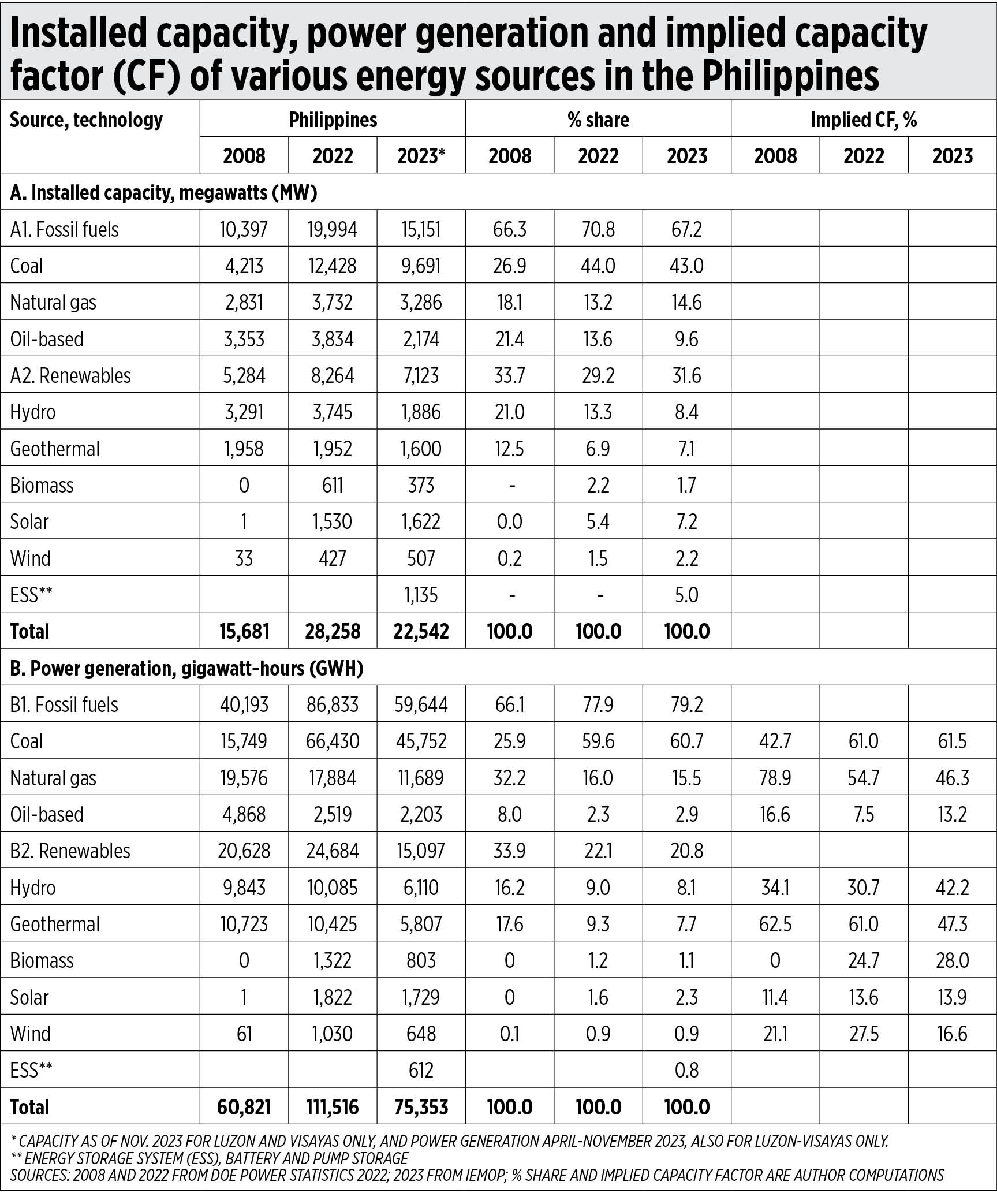
1. Philippine power generation is back to a yearly increase of five terawatt-hours (TWH) after a big decline during the 2020 lockdown dictatorship. In 2022, generation reached 111.5 TWH or 111,500 gigawatt-hours (GWH), according to the power statistics released by the Department of Energy (DoE) in mid-2023. This is almost double the 60.8 TWH in 2008 when the Renewable Energy (RE) Act or RA 9513 was enacted. According to the 2023 data from the Independent Electricity Market Operator of the Philippines (IEMOP), the Luzon and Visayas grids have produced 75.4 TWH for April-November alone.

2. Of the 111.5 TWH generated in 2022, 60% of it came from coal plants, 16% from (Malampaya) natural gas, and 9% each from geothermal and hydro. Solar and wind combined contributed only 2.5% of total, this after 14 years of political favoritism, fiscal incentives and tax exemptions, and energy mandates.

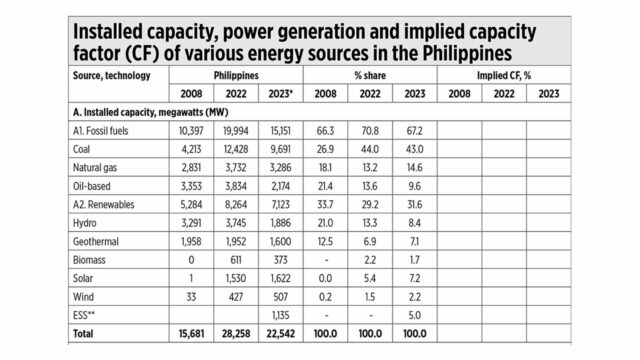
3. Coal was tops when considering the implied capacity factor, which is the ratio or percent of actual electricity generated by a given energy source in a given year, measured as: Capacity factor for the year (in %) = Generation in TWH/(installed capacity in MW x 24 hours/day x 365 days/year). Coal had 61%, natgas had about 50%, wind had about 23%, and solar had only 14%, which is very low and inefficient (see the table).

Items four to 10 were selected reports from BusinessWorld and mostly written by Sheldeen Joy Talavera:

4. The expansion of energy reserves and power capacity as seen in these reports: “DoE to resume certification of projects for expedited permits” (Nov. 6), “Malampaya exploration raises prospect of gas supply expansion, BMI says” (Nov. 9), “PHL coal, oil reserves valuation rises sharply as gas dwindles” (Nov. 23). We should have continuously expanding oil, gas and coal reserves via endless exploration and drilling. As shown in the table, fossil fuels contribute about 79% of total power generation in the country. A reduction in their share with no significant increase from non-fossil fuel sources would mean regular, wide-ranging blackouts in the country.

5. The endless lobbying for power de-generation, deindustrialization and degrowth economics: “Coal power phaseout by 2035, gas by 2040 deemed feasible” (Nov. 15), “ACEN, partners to retire coal plant in the Philippines” (Dec. 5), “DoE calls for accelerated retirement, repurposing of coal-fired power plants” (Dec. 6), “USAID helping PHL regulator effect clean energy transition” (Dec. 10), “Gov’t urged to develop timeline to retire coal-fired power plants” (Dec. 10).

As discussed above, coal is the main workhorse for power generation. It is why even climate and RE activists have 24/7 electricity, and yet coal is the most demonized energy source. The double talk is like when tens of thousands of climate leaders who demonize fossil fuels use lots of fossil fuels to fly from all around the world to the UN’s Conference of Parties (COP) annual meetings.

6. There have been good moves towards nuclear power development in the Philippines: “US, Philippines ink landmark deal on nuclear cooperation” (Nov. 17), “Nuclear deal seen addressing PHL need for baseload power” (Nov. 19), “House approves bill creating nuclear regulator” (Nov. 22).

At least two big generation companies, MGen and Aboitiz Power, have made explicit advocacies to develop nuclear energy in the future. Good move, guys.

7. The National Grid Corp. of the Philippines (NGCP) continues to be behind schedule in their transmission development projects in the country: “System impact studies approved for 32,000 MW worth of power projects” (Nov. 14), “NGCP seeks resolution of TRO on Panay-Guimaras tower sites” (Nov. 30), “NGCP sees Cebu-Bohol 230-kV link project completed in 2024” (Dec. 5).

8. News on energy pricing and regulations: “ERC caps NGCP allowable revenue at P36.7B annually, well below amount sought by grid” (Nov. 8), “ERC integrates with energy one-stop shop system” (Dec. 13), “Spot power prices fall in early Dec.” (Dec. 14).

The ERC, or Energy Regulatory Commission, is also reviewing the secondary price cap or price control at the wholesale electricity spot market (WESM). I hope that the ERC moves to abolish all forms of price controls there. The most expensive electricity is no electricity — blackouts — and the resulting damaged production, appliances, and inconvenience to people and businesses. If the spot price can jump to, say, P40/kWh for three hours due to transmission or generation problems and blackouts of three hours are avoided, then that is worth it. The average price can go down later.

9. Stories on Meralco being the largest electricity distributor in the Philippines: “Meralco baseload bid attracts interest from power providers with 3,000 MW in capacity” (Nov. 21), “Meralco starts bidding for 1,200-MW power supply” (Dec. 1). Securing huge power supply contracts from huge new power plants to ensure medium to long-term power security and stability are good moves by Meralco. Meralco’s electricity sales growth generally mirrors overall GDP growth. In Q1-Q3 2023, Meralco sales growth was 4.4%, not far from the overall GDP growth of 5.6% over the same period.

10. The DoE created an Energy Efficiency Excellence (EEE) Award for LGUs. The province of Iloilo was ranked the highest, and they will be rewarded by the DoE at the Hilton Hotel on Dec. 19. Iloilo Provincial Board Member Rolando Distura will receive the award on behalf of the Iloilo Provincial government. Mr. Distura was a former Mayor of Dumangas municipality and was one of our wedding godfathers when I got married in Iloilo City in 2005. Congratulations, Ninong.

We should prioritize energy realism, not alarmism. We should prioritize sustained economic growth, wealth creation and job creation for our people, not ecological central planning, not climate-related restrictions, taxation, and regulations.


Bienvenido S. Oplas, Jr. is the president of Bienvenido S. Oplas, Jr. Research Consultancy Services, and Minimal Government Thinkers. He is an international fellow of the Tholos Foundation.

minimalgovernment@gmail.com

NUSTAR Convention Center, Fili Hotel help raise Cebu City’s profile as a MICE destination

Fili Hotel NUSTAR Cebu and NUSTAR Hotel Façade.

THE NUSTAR Convention Center and Fili Hotel are helping raise the profile of Cebu City as a premier MICE (meetings, incentives, conferences, exhibitions/events) destination.

The two properties are located within the NUSTAR Resort, a nine-hectare, world-class integrated resort.

The NUSTAR Convention Center, which opened in June, is the largest and most modern convention center in Visayas and Mindanao. It has three ballrooms — the NUSTAR Grand Ballroom, the Fili Ballroom, and the NUSTAR Ballroom — as well as nine well-equipped meeting spaces which occupy a total area of 7,378.2 square meters (sq.m.).

Fili Hotel, the country’s first homegrown five-star hotel brand, is owned and operated by Robinsons Hotels and Resorts.

“What makes the NUSTAR Convention Center so enticing is its versatility,” Cristina Ong-Cruz, director for marketing and sales of Fili Hotel, said. “At our NUSTAR Grand Ballroom, for example, our clients and prospects are simply enthralled with the elegant, pillarless space that can comfortably seat 1,760 guests in a banquet setup, while even more can be accommodated in a theater setup, with up to 3,290 guests or delegates.”

The 492.8-sq.m. Fili Ballroom has a capacity of 340 guests in a round banquet setup.

The NUSTAR Ballroom, which offers 676 sq.m. of space, can seat 430 guests in a banquet setup or as many as 800 theater-style.

Fili Hotel has 379 rooms and suites. It also has a wide array of food and beverage outlets, such as Mott 32 modern Chinese restaurant; Xin Tian Di; Il Primo, an Italian-themed steakhouse; Fina; Fili Cafe; and Axis Bar.

AbaCore board agrees to sell land for P80M

ABACORE Capital Holdings, Inc. said its board had approved the sale of land with a total contract price of P80.31 million.

In a stock exchange disclosure, the listed holding company said its board had agreed to the land sale of its subsidiary covering a total land area of 13.3 hectares.

The land is located at Brgy. Kalingatan Loob, Mataas na Kahoy, Batangas and Brgy. San Salvador, Lipa City, the company said, adding that the contract price is set at P80.31 million with the cost at P18.31 million for a gain of P57.18 million.

Further, its board also approved the renewal of a loan from the Luzon Development Bank with an additional P30 million, increasing its total loan to P80 million, the company said.

In September, the company said it is investing in a 15-hectare property at Simlong, Batangas as the listed firm aims to increase its investment properties.

According to the company, the target investment property is “at a discount of around P225 million to the most recent appraised value.”

AbaCore is a listed holding company that has interests in sectors such as tourism, real estate, financial services, and energy.

At the local bourse on Monday, shares in the company gained one centavo or 1.15% to end at 88 centavos apiece. — Ashley Erika O. Jose

MCBL launches new life insurance product

MANULIFE CHINA BANK LIFE Assurance Corp. (MCBL), the bancassurance partnership between Manufacturers Life Insurance Co. (Phils.), Inc. (Manulife Philippines) and China Banking Corp., has launched an insurance plan offering life protection with guaranteed cash payouts.

MCBL AssureMax comes in two basic plans with a benefit period of 20 years or up to age 65, MCBL said in a statement on Monday.

AssureMax 20 is available for ages 0-65, while AssureMax 65 is for ages 0-45.

“With high protection and guaranteed returns offered by AssureMax, we want to provide Filipinos a smarter way to save, wherever they may be in their life journey. AssureMax is designed for our customers who aim to save up to purchase a new home, finance their children’s education or prepare for their retirement while ensuring insurance coverage,” MCBL President Neil Bowyer was quoted as saying.

“AssureMax is also tailor-fit for those who simply want to grow their investments or diversify their financial portfolios so they can reach their life goals,” he added.

MCBL AssureMax is available for five- or 10-year payment terms with guaranteed life protection equivalent to 200% of the plan’s face value.

It also offers a cash payout of 10% of the plan’s face value every two years starting the end of the seventh year for the five-year term and at the end of the 11th year for the 10-year plan.

Owners of the policy may also get additional earnings through non-guaranteed dividends.

MCBL AssureMax has a guaranteed maturity benefit equal to 100% of the face amount, which will be paid out at the end of the policy term.

The product also has pre-selected add-ons, including accidental death, payor’s, and hospital income benefits, among others.

MCBL’s premium income stood at P2.38 billion in the first quarter, Insurance Commission data showed. Its net income was at P258.21 million in the period. — AMCS

Democracy and climate politics are set to collide next year

JAROSLAW KWOCZALA-UNSPLASH

AS THE DUST settles on the COP28 climate summit that concluded last week in Dubai, a sobering reality is looming. After the legalistic niceties of environmental diplomacy, the dirtier business of political maneuvering is going to consume the world’s democracies over the next 12 months. In 2024, climate will be on the ballot in a way we’ve rarely seen.

Voters in countries representing more than 40% of the world’s population — and roughly the same share of emissions — will go to the polls between now and the end of next year. In places, that offers the prospect to break gridlocks on climate and energy policies. In others, it may offer an opportunity for a climate-denying backlash. Far too few places show a decent chance of accelerating the transition to clean energy in the way advocated by the COP28 agreement. Here’s a review of some of the key events.

COAL AND THE POLLS
Two of the world’s three biggest democracies face elections in the first half of 2024, but neither offers a strong prospect of change. India and Indonesia have made positive noises lately about switching to clean power. Prime Minister Narendra Modi of India has promised 500 gigawatts of renewables by 2030 and President Joko Widodo in Indonesia has signed up for a $20-billion deal to retire the nation’s coal generators early.

In each case, however, coal’s deep political, economic and social roots have stymied efforts at reform. Elections aren’t likely to change that dynamic: Modi is well ahead in the polls, while the frontrunner in Jakarta, Prabowo Subianto, is essentially a continuity candidate who’s picked Widodo’s son as his running mate.

EMERGING CLIMATE LEADERS
Prospects are moderately better in two other leading emerging markets equally wedded to fossil fuels: Mexico and South Africa. In the former, poll-leading Claudia Sheinbaum, a protégé of current President Andrés Manuel López Obrador, is a former climate scientist who’s contributed to reports from the Intergovernmental Panel on Climate Change. It remains unclear, however, whether that background will lead to a switch from López Obrador’s policies, which have favored state oil company Pemex and a growing dependence on gas imported from the US.

In South Africa, the ruling African National Congress faces the first prospect of losing since democratic elections began in 1994. In energy terms, that would almost certainly be good news. The opposition Democratic Alliance’s support of private and solar generation, in contrast to the ANC’s death pact with the corruption-riddled, financially incontinent Eskom Holdings SOC Ltd., offers the best prospect for the country to emerge from its current cycle of power cuts and pollution.

POLLUTING AUTHORITARIANS
Next is a group of nations where the prospects of real democratic elections seem remote. In Bangladesh and Pakistan, incumbent governments have favored energy policies wedded to imported natural gas. The ripples of Russia’s invasion of Ukraine have pushed LNG prices out of reach, leading to power cuts, savage increases in electricity bills, and often violent protests.

Jailed opposition leaders in each country have offered the promise of more balanced, cleaner energy policies, but the electoral system remains heavily weighted against them. Elections of sorts will also be held in two of the world’s biggest historic oil exporters — Russia and Venezuela — though the chances of real change in either country seem remote in the extreme.

CROUCHING TIGERS
In Taiwan, polls appear to be tightening between the incumbent center-left DPP and center-right KMT ahead of the Jan. 13 vote. On paper, the opposition has a mildly more progressive climate policy, since its spurning of the DPP’s anti-nuclear stance gives a lower fossil fuel share in 2030. In practice, it’s an open question whether either side will succeed in implementing their green energy policies.

South Korea also has legislative ballots in April, but they’re unlikely to break the gridlock that has pitted the unpopular center-right President Yoon Suk Yeol against a more climate-focused assembly for the past two years.

TROUBLED ATLANTIC WATERS
The core developed countries of North America and Europe may be the place where major change is most likely, but in most cases the mood music isn’t positive for climate action. Right-wing, climate denialist parties in Europe such as the Alternative for Germany and Dutch PVV have seen strong performances in recent opinion surveys and votes. Even so, it’s likely the left-right coalition in the European Parliament will remain in control even if such factions make a strong showing in elections due June 9.

The UK probably offers the best prospect of major positive change, with opposition leader Keir Starmer well ahead in the polls. He’s promised to turn the country into a “clean energy superpower,” in stark contrast to Prime Minister Rishi Sunak, who has torn up his predecessors’ green-tinged policies.

Set against that, however, is the most substantive climate poll of the year, the US presidential election due Nov. 5. Donald Trump’s first term in office failed to break a long-standing trend of falling emissions. Even so, it’s impossible to overstate the contrast a second term would present to the policies of President Joe Biden, who’s promised a zero-carbon grid and mostly electric new car fleet by 2035. In climate diplomacy, where Washington’s on-again, off-again alliance with Beijing has been essential to bringing other nations to the table over the past three years, the return of a more sinophobic administration would be further bad news.

CLIMATE IN THE DOLDRUMS
That’s not what the world needs right now. Thanks to the rapid greening of the power sectors in China, Europe, and the US, and the speedy uptake of electric vehicles, there’s a real prospect that emissions globally peak next year or the year after. To build on those gains and accelerate the path to net zero, however, further political will is needed to ratchet up policies that are still driving the world to more than 2 degrees Celsius of warming. The bonanza of elections due in 2024 is unlikely to deliver that.

BLOMBERG OPINION

Entertainment News (12/19/23)


SB19’s Josh Cullen releases new single

THE UPBEAT track “Get Right” by P-pop star Josh Cullen features additional production from Ocho the Bullet and UK-based No Rome. The new single by Mr. Cullen is an electro-pop banger that proclaims his creative independence. The SB19 rapper and vocalist said that he aims to make a dent in a highly competitive industry as a solo act. “Basically, it’s a declaration of my return, confidently showcasing my understanding of the game. The lyrics reflect my resilience, self-assurance, and the realization of how the industry operates.” The track also marks a significant departure from the vibe and songwriting style of Mr. Cullen’s previous releases, integrating EDM, hip-hop, and hyper-pop influences with a bass-heavy production. “Get Right” is out now on all digital music platforms worldwide via Sony Music Entertainment.


Newport’s two shows this December

FOR the Christmas season, Newport World Resorts is providing plenty of entertainment options. One of them is Richard Poon’s Christmas concert full of holiday tunes, accompanied by a 16-piece big band. Christmas with Richard Poon and His 16-Piece Big Band concert will be held at the Newport Performing Arts Theater (NPAT) on Dec. 22. To end the year, some of original Pilipino music’s (OPM) finest will take center stage in The Grand Countdown to 2024. It will be headlined by Sharon Cuneta and Ogie Olcasid, together with Jona, Arthur Nery, and Katrina Velarde. The New Year’s extravaganza also treats revelers to lavish feasts and numerous raffles on Dec. 31 at the Marriott Grand Ballroom. Tickets for both shows are available at all TicketWorld and SM Tickets outlets.


XG unveils fourth single

HIP-HOP/R&B-inspired girl group XG is returning with their fourth single, “Winter Without You,” accompanied by an official music video. The track conveys the emotion of reminiscing about distant loved ones during the holiday season, with a soulful and harmonious winter R&B vibe. It features electric keyboards and distinctive vocal effects, a departure from XG’s usual style. The seven distinct personalities of XG harmonize on this song. It is one of the milestones leading up to XG’s 2024 World Tour. “Winter Without You” is now available on all streaming platforms.


Korean action series A Shop For Killers on Disney+

A COLLEGE student faces off against assassins, murder drones, and more as the result of her guarded uncle’s hidden past in A Shop For Killers starring Lee Dongwook and Kim Hyejun. Disney+ will kick off 2024 with the action series on Jan. 17. A Shop For Killers is the latest Korean Original series to be part of the ever-expanding library of content available on Disney+. The eight-part series will stream exclusively on the platform.


Scrubb Live in Manila prices released

THAI alt-pop powerhouse Scrubb hold their debut show in Manila on Feb. 10, 2024. According to event organizer GNN (formerly Gabi Na Naman Productions), fans can buy tickets at Ticketmelon for the following tiers: SVIP tickets at P5,200, VIP tickets at P3,200, and Gen Admission tickets at P1,800. Both SVIP and VIP packages have fan benefit inclusions with varying perks. The Thai alt-pop act will be performing songs off the official soundtrack of 2gether: The Series, the TV hit that catapulted its young lead actors Vachirawit Chivaaree (Bright) and Metawin Opas-iamkajorn (Win) to global stardom. The soundtrack for the series includes 18 songs from Scrubb, along with a few notable ones from the main actors.

RLC starts work on new tower for AmiSa Private Residences

RLC Residences recently broke ground for the fourth tower of AmiSa Private Residences in Mactan City, Cebu.

“We are very excited to start bringing to life the fourth tower of AmiSa Private Residences. This development has a very special place to our hearts given its unique features and resort-like offerings. We believe our clients are also excited to call this haven their own where they can enjoy a relaxing life in Cebu,” RLC Residences Vice-President for Project Management Emmanuel Arce said in a statement.

Located at Punta Engano, AmiSa Private Residences is a leisure residential development. Units have balconies where residents can enjoy unobstructed views of the beach.

The first three towers of AmiSa Private Residences have been completed.

Philippines faces high risk of ecological threats

The Philippines scored 4.5 (out of 5) in the 2023 edition of the Ecological Threat Report (ETR) by the Institute for Economics and Peace. This meant that the country is at “severe” risk of natural disasters, food and water insecurity, and rapid population growth.


Philippines faces high risk of ecological threats

How PSEi member stocks performed — December 18, 2023

Here’s a quick glance at how PSEi stocks fared on Monday, December 18, 2023.


Philippines secures P14.5-B pledges; Marcos launches investments office

PRESIDENT FERDINAND R. MARCOS, JR. — PRESIDENTIAL COMMUNICATIONS OFFICE

By Kyle Aristophere T. Atienza, Reporter

THE PHILIPPINES announced on Monday that it secured investment pledges amounting to P14.5 billion during a business event organized by the Philippine trade department in Tokyo while President Ferdinand R. Marcos, Jr. was there over the weekend.

Malacañang also announced that the President issued a Dec. 15 executive order creating an office that would be responsible for providing him with strategic advice on economic concerns, including inflation and investment opportunities.

The P14.5-billion investment commitments in the form of memorandums of understanding (MoUs) could generate a total of 15,750 job opportunities, the Presidential Communications Office (PCO) said in a press release following a Department of Trade and Industry (DTI)-led event on the sidelines of the Association of Southeast Asian Nations (ASEAN)-Japan summit attended by Mr. Marcos in Tokyo.

The Chief Executive said the investment commitments secured by Manila on Monday and during his official visit to Japan in February now sum up to P771.6 billion and could generate 40,000 jobs.

Citing information from Presidential Adviser on Investment and Economic Affairs Frederick D. Go, the PCO said 20 companies have given the President updates on their pledges during his February trip.

The parties involved include the Bases Conversion and Development Authority (BCDA) and Japan Overseas Infrastructure Investment Corp. for Transport and Urban Development (JOIN), which will collaborate on studies relevant to the development of the New Clark City.

The BCDA is also partnering with Manila Japanese School (MJS) for the renewal of its lease in a four-hectare site at the Bonifacio Global City for another 25 years, the PCO said.

Other investors include Ibiden Co. Ltd and Japan Aviation Electronics Industry Ltd., which will both infuse foreign direct investments (FDIs) in the Philippines’ electronics manufacturing sector. They seek to increase production by modernizing their Philippine facilities, the PCO said.

Among the companies that have FDI commitments to the Philippines include Medley Inc., Minebea Mitsumi Inc., Nitori Holdings Co. Ltd and Tsuneishi Shipbuilding Co. Ltd.

“They are investing for business process outsourcing (BPO) operation, expansion of furniture and home furnishing chain, as well as production improvement and replacement of aging Philippine facilities,” the PCO said.

It said DMCI Project Developers Inc. is pursuing a joint venture with Japan’s Marubeni Corp. for property development projects

EO49 CREATES INVESTMENT, ECONOMIC AFFAIRS OFFICE
Meanwhile, the PCO said in a separate release that Mr. Marcos has signed an executive order creating the Office of the Special Assistant to the President for Investment and Economic Affairs (OSAPIEA), which will be led by Mr. Go.

Mr. Marcos cited the need to establish “a robust monitoring system to ensure a holistic and cohesive approach to addressing the diverse economic challenges currently confronting the nation.”

“There is a need to further strengthen the existing mechanisms for formulation, coordination and implementation of the Government’s economic initiatives, plans, policies and programs,” he said in Executive Order (EO)No. 49, which was signed by the President on Dec. 15.

The office will be headed by a Special Assistant to the President for Investment and Economic Affairs with the rank of a secretary.

The office will advise the Philippine leader on economic matters and concerns, including, among others, the increasing prices of key commodities.

It will also be responsible for ensuring that investment pledges being secured by Manila are “realized and come to fruition.”

The Special Assistant to the President for Investment and Economic Affairs will serve as Chairperson of the Economic Development Group (EDG), while the Secretaries of the National Economic and Development Authority (NEDA) and Department of Finance (DoF) shall serve as Vice Chairpersons.

“The SAPIEA shall work with the EDG, and identify the priority programs, activities and projects (PAPs) in the Philippine Development Plan (PDP) 2023-2028, as well as monitor, review and evaluate the progress of priority initiatives and PAPs of the administration,” the PCO said.

As chairman of the EDG, Mr. Go will supervise, on behalf of the President, the NEDA, DoF, DTI, the Department of Budget and Management, and their respective attached agencies such as the Board of Investments, Philippine Economic Zone Authority, Securities and Exchange Commission, “to ensure effective and efficient implementation of their respective priority initiatives and PAPs.”

“The said agencies are required to regularly report and coordinate with the SAPIEA on priority initiatives and PAPs,” the PCO said.

With his new position, Mr. Go will also sit as a member of NEDA Board, Investment Coordination Committee, Social Development Committee, Committee on Infrastructure, and Development Budget Coordination Committee.

The PCO did not immediately respond when asked if Mr. Go could stay on as Robinsons Land chief executive officer and president if he is appointed to the Cabinet-level post.

The creation of the OSAPIEA is in line with the implementation of the Philippine Development Plan for 2023 to 2028, the PCO said.