Home Blog Page 3736

inDrive commits to app improvement after LTFRB suspension

RIDE-HAILING app inDrive, operated by RL Soft Corp., will make improvements to its application following a temporary suspension by the Land Transportation Franchising and Regulatory Board (LTFRB),  the transport network company said on Thursday.

“During our recent engagement with the LTFRB, productive discussions transpired and we are now in the process of further developing our application to ensure that there is no confusion amongst our users,” inDrive said in a statement.

The ride-hailing app announced in December that it had secured accreditation from the transport regulator.

“As part of these ongoing improvements, we will be temporarily pausing our service operations,” the company said.

“This is a necessary step to ensure that our enhancements are implemented effectively and align with both our users’ needs and regulatory standards,” it added.

The goal is “to provide a fair, transparent, and accessible service while upholding the highest standards of regulatory compliance and user satisfaction.”

The regulator’s decision to suspend the ride-hailing app was due to alleged fare haggling violations. The LTFRB has given inDrive 15 days to present its proof of compliance.  

“Haggling of fares not only goes against the principles of transparency but also jeopardizes the welfare of both passengers and drivers. We take these allegations seriously and are conducting a thorough investigation to determine the extent of the violation,” the LTFRB said.  

For its part, the ride-hailing app said: “We at inDrive acknowledge the recent concerns raised by the LTFRB regarding our fare system.”

“We affirm our company’s commitment to provide better alternatives in transportation while ensuring compliance with all regulatory standards, and we are actively collaborating with the authorities towards this end,” it added.

Based on its website, inDrive has presence in 46 countries such as the Philippines, Indonesia, Malaysia, and Thailand. — Revin Mikhael D. Ochave 

Who invented butter chicken? Indian judge to rule on dispute over global favorite

THE RECIPE of Moti Mahal’s “Signature Butter Chicken” can be found on its website. — MOTIMAHAL.IN

NEW DELHI — Butter chicken — one of India’s best-known dishes globally — is delicious and apparently also contentious, with two Indian restaurant chains doing battle in court over claims to its origins.

The lawsuit — which has become a hot topic in India — was brought by the family behind Moti Mahal, a famed Delhi restaurant brand that has counted late US President Richard Nixon and India’s first Prime Minister Jawaharlal Nehru among its guests.

It claims restaurant founder, Kundan Lal Gujral, created the curry in the 1930s when the restaurant first opened in Peshawar before it moved to Delhi. In a 2,752-page court filing it has sued rival chain Daryaganj, accusing it of falsely claiming to have invented the dish as well as dal makhani, a popular lentil dish that is also laden with butter and cream.

The Gujral family is seeking $240,000 in damages, also alleging that Daryaganj has copied the layout of Moti Mahal’s website and “the look and feel” of its restaurants.

“You cannot take away somebody’s legacy … The dish was invented when our grandfather was in Pakistan,” said Monish Gujral, managing director at Moti Mahal.

Daryaganj — which was established relatively recently in 2019 — counters that its late family member, Kundan Lal Jaggi, had partnered with Gujral to open the Delhi restaurant in 1947, and the dish was invented there. That gives it the right to also lay claim to the creation of the dish, it argues.

Daryaganj shared with Reuters a faded, hand-written partnership document registered in 1949 to back its argument.

The dispute has captured the nation’s attention with Indian TV broadcasters running segments on the history of the dish and debate raging on social media.

“It’s an offbeat, unique case. You really don’t know who created the first dish of butter chicken. The court will be hard pressed and will need to rely on circumstantial evidence,” said Ameet Datta, an intellectual property lawyer at India’s Saikrishna & Associates.

Testimonies of people who can link the brand to the dish they consumed decades ago could be critical proof, Ameet Datta added.

Made with tandoor-cooked chicken pieces mixed in a tomato gravy with dollops of cream and butter, the dish was ranked 43rd in a list of world’s “best dishes” by TasteAtlas as rated by nearly 400,000 users. It was the second-ranked Indian food after butter garlic naan bread. The two are often paired together.

The case was first heard by the Delhi High Court last week and the next hearing is scheduled for May. — Reuters

Coins.ph targets to double active users

COINS.PH, a virtual currency provider, is targeting to double its active users this year as it gears up for its expansion to other regions.

Coins.ph Chief Executive Officer (CEO) Wei Zhou said the fintech company now has over 18 million users, 10 years after its launch in 2014. However, only around one million or two million of these users are active on a monthly basis, which the firm is seeking to double by end-2024.

“This year, we’re going to have a major campaign to recall these users back. Our app itself wasn’t perfect, but as we make it better, we hope to recall the lost users,” he said. “In terms of total number of users, hopefully we can double that. I think that’s possible.”

Mr. Zhou added that more Coins.ph users exited the platform in 2023 as it was a “challenging year” for cryptocurrencies, with players choosing not to invest in the market.

Jen Bilango, country manager for the Philippines of Coins.ph, said the firm is optimistic about doubling its user base as it expects to onboard more clients globally and not just in the Philippines.

The global expansion of Coins.ph is fueled by its rapid acquisition of licenses in various regions such as Europe, Latin America, Australia, and Africa, the company said.

“By securing licenses across various continents, we uphold our pioneering spirit in delivering regulated and compliant digital asset services, a legacy we’ve proudly established in the Philippines,” Mr. Zhou said.

They are also looking to expand into the Middle East where there are about two million overseas Filipino workers (OFWs) and some $10 billion in remittance inflows from the area, he added.

Ms. Bilango said the company has helped facilitate cross-border transactions and remittance services for OFWs through the adoption of stablecoins, a type of cryptocurrency backed by a reserve asset.

“We made strategic partnerships that can provide better solutions for sending and receiving money abroad,” she said.

The fintech firm was able to address two pain points of sending money back home, namely the slow speed of reaching receivers in the Philippines and the high fees senders are usually charged, Ms. Bilango said.

“Through stablecoins, we were able to address this. Since we’re using blockchain technology, it’s fast and it’s cheap,” she said.

She added that Coins.ph is looking to form a global partnership with Circle, one of the biggest stablecoin issuers in the United States.

Meanwhile, Mr. Zhou said Coins.ph is also set to integrate the Solana chain by February for access to projects and assets.

Coins.ph also recently rolled out support for the Universal Money Address. This allows users to send and receive Bitcoin using simplified, e-mail-like addresses rather than a complex string of alphanumeric characters that typically comprise wallet addresses.

“Our vision as we expand globally is to bridge the gap between the fiat world and the emerging digital asset economy,” Mr. Zhou said. “We do this by creating easy on and off-ramps and simplifying access to innovation so that every individual and business anywhere in the world can participate and thrive through safe and secure digital asset services by Coins.”

“Even as Coins.ph now looks globally, we continue to be committed more than ever in investing in the Philippine market and our Filipino customers,” Ms. Bilango added.

Coins.ph was the first cryptocurrency exchange platform to be regulated by the Bangko Sentral ng Pilipinas (BSP). It holds both Virtual Currency and Electronic Money Issuer licenses from the BSP. — Keisha B. Ta-asan

Italy migrants on path to fashion careers

REUTERS

ROME — Less than two years ago, 35-year-old Yuliia Dobrohurska was fearing for her life under the threat of Russian bombings in her Ukrainian hometown of Konotop.

Now she is dreaming of a career as a fashion jeweler in Italy, the country where she has taken refuge.

Ms. Dobrohurska wore some of her creations on Saturday as she walked down the catwalk of the “Refugees live fashion show,” organized by a Rome health authority, alongside professional models.

The event, which presented eight outfits and matching jewelry made by refugees, concluded a six-month course for 19 women and men who escaped war, violence and human rights violations, and now aspire to become fashion designers.

Flush with her success, Ms. Dobrohurska sees boundless opportunities opening up before her.

“I can’t imagine what I can’t make and what I can’t do here in Italy,” she told Reuters.

During the course organized by the Maiani fashion academy in Rome, she learned engraving, wax casting and embossing techniques to make jewelry.

She will now start an apprenticeship at a jeweler’s in the Italian capital.

The Maiani academy is part of a network of 110 organizations which use the motto “culture is health” to promote the integration into employment of asylum seekers and refugees from 95 countries through arts and crafts.

While a career in high fashion may be a glittering final goal, the courses were above all an opportunity for the migrants to integrate into Italian culture and learn the language while seeking an outlet for their talents.

Saturday offered the chance to “showcase the beauty of these products made, designed and produced by the refugees,” said Giancarlo Santone, a psychiatrist who works with the Rome Health department that organized the event.

“We are really pleased because we have seen the results on the health of these people who are victims of war and extreme violence,” he added. “The benefits are really remarkable.” — Reuters

Family companies are experiencing heir loss

MAX RAHUBOVSKIY-PEXELS

FAMILY COMPANIES are the hidden engines of the global economy. More than 90% of all companies are family companies. These include many of the world’s biggest organizations such as LVMH Moet Hennessy Louis Vuitton SE in France and Samsung Electronics Co. in South Korea. A third of companies in Standard & Poor’s 500 index and 40% of the largest companies in France and Germany have a strong family element.

Yet thanks to a combination of demographics and changing social mores, many family firms now face the ultimate threat to their survival: a shortage of heirs. Good riddance, you might say, after watching the psychopathic antics on Succession. That ignores the importance of the best family firms not just as engines of progress and innovation, but as repositories of public trust, especially at a time when trust in capitalism is at an historically low ebb.

Even if family companies grow to be behemoths like Succession’s Waystar RoyCo, family companies are inherently fragile organizations. This is partly because they are so prone to family feuds but also because producing a capable heir is hard. Nonfamily companies have the advantage of choosing successors from the entire universe of management talent. Family-run companies are restricted by DNA.

This restriction was manageable in the pre-modern era when birth rates were high and arranged marriages common. Family patriarchs approached marriage and reproduction with the same discipline that they approached any other business. The Rothschilds were the maestros of arranged marriages — the five branches of the family in different European countries married each other to keep the wealth in the family and solidify business deals — but you can find versions of the same dynastic strategies across the business world.

Today, the twin pillars of the old order are eroding. The birth rate is below replacement level in much of Europe and large parts of Asia. The Chinese birth rate has fallen still further since the end of the “one-child” policy in 2016, from 1.8 in 2017 to 1.09 in 2022. South Korea’s fertility rate fell from 1.1 in 2017 to 0.8 in 2022. Love-marriages are growing in popularity across the world, despite the potential problems that they bring in terms of ill-considered decision-making and talentless, indolent in-laws. A few places still retain the old ways: Some 60% of marriages in India are still arranged, and many Arab business families have a superfluity of heirs thanks to plural marriage. But even in India the fertility rate has fallen to 2.05 births per woman, and mores in the Arab world are changing fast.

The heirs that remain are much less inclined to follow their fathers into the family business. The brightest ones go off to elite universities and business schools and frequently put down their roots in big cities. The less talented ones who stay at home may be willing to take over the company but are often not up to the job. Two other demographic factors compound the problem of the shortage of heirs. Patriarchs and matriarchs now live much longer and may not be willing to concede control until they are in their seventies or even beyond. Divorce is much more common, so heirs may have divided loyalties and complicated relationships with their fathers and mothers.

Morten Bennedsen, an authority on family companies who teaches at the University of Copenhagen and INSEAD in France, says that he frequently encounters family heirs who are in agony: They don’t want to disappoint their parents (who have given them the best educations money can buy), but they don’t want to go back to running their family businesses. This is particularly true of heirs whose businesses are in remote parts of their native countries but who have been introduced to a cosmopolitan lifestyle from an early age.

The greatest novel about family businesses is Thomas Mann’s Buddenbrooks (1901), which tells the story of the decline and dissolution of a company in Lubeck due to a combination of bad business decisions and disappointing heirs. Research from the IFO Institute and the Foundation for Family Businesses, both based in Munich, demonstrates that the “Buddenbrooks problem” is becoming systemic in Europe’s most important economy.

The generation that built Germany’s Mittelstand companies into powerhouses is beginning to retire: One IFO/FFB survey found that 43% of German family businesses are due to transfer control or shares to an heir. Another survey found that that only 42% of family businesses do not have an heir lined up from within the family. A third found that only 34% had succeeded in managing a transition within the family in recent years, and only a quarter had managed to find a family member to sit on the supervisory board. The overall impression is of a collapse of dynastic energy: ageing owners, a shortage of willing or able heirs, poor succession planning, reluctant handovers to professional managers or forced sales to outsiders.

China also faces a severe succession problem. The problem is not as far advanced as Germany’s: China’s entrepreneurs only got to work building the country’s economic might in the 1980s. But if anything, the problem will be bigger. The one-child policy has simultaneously reduced the supply of available heirs and given them a dangerous sense of entitlement. Many of these little princes and princesses were educated abroad (or continue to live abroad) while the companies that produced their wealth are based in obscure parts of the country and specialize in unglamorous and often dirty businesses. Who wants to inherit an oil-processing plant in Mongolia when you can live off the interest in Mayfair?

Other prime candidates for Buddenbrooks syndrome can be found in many places. The Italian economy is dominated by family companies, but the fertility rate in 2020 was 1.24 per woman. The Parsi community is India’s most business-friendly ethnic minority, claiming three out of the country’s top 10 billionaires, but, thanks to persistently low birth rates, there are only 70,000 of them left. (Tata Sons Pvt. Ltd., India’s biggest company and a Parsi stronghold, has long since run out of Sons and is controlled by a foundation.)

Does the shortage of family heirs matter? And if so, is there anything that can be done about it? Randall Morck, of the University of Alberta, points out that the best performing firms are founder-controlled firms, followed by professionally managed firms followed by heir-managed firms. So why not let corporate evolution take its course and bring in professional managers to run the company? Or sell out completely and live off the interest?

There are numerous answers to this: Family firms have a longer-term perspective than professionally managed firms; they have deeper roots in local communities; they thrive in areas that require “taste” such as luxury and newspapers; they represent repositories of skills that have been built up over generations; and, in an age of collapsing trust in capitalism, family companies are trusted more than other forms of companies. Wolfgang Munchau’s Eurointelligence blog even speculates that the shortage of heirs might help to drive Germany’s deindustrialization because the Mittelstand companies have played such a vital role in investing in the country’s industrial infrastructure, even if it means enduring lower profits in the short-term. But their most persuasive reason for being relies on the case for pluralism: The wider the range of corporate forms available the better. If family firms can harness the natural desire to build a legacy for your children to business creation, then so much the better.

There are three clear ways to improve the possibility of a successful succession. The first is to go back in time — re-create arranged marriages or invent clever ways of keeping talent within the family. The University of Alberta’s Morck has produced fascinating research on how Japanese companies have a long tradition of adult adoption. Patriarchs who don’t think their children are up to the job adopt a high-flying employee. Firms run by adopted heirs perform better than both firms run by blood-related heirs and firms run by professional managers.

The second is to use modern management techniques to improve the chances of finding a successful heir. Claudio Fernandez-Aroaz, a Harvard Business School professor who worked for the executive search company Egon Zehnder for many years, argues that family patriarchs need to break with their old habit (notably fixating on their eldest sons) and think more imaginatively on family succession: Include all the children in the search for a successor and focus on competences and promise rather than on the narrow metric of experience.

The third is to pick and mix different elements of professionally managed and family-managed family companies. Families can continue to be involved with “their” companies without a family member taking over as CEO. Family members can exercise influence in all sorts of less direct ways — by sitting on boards (or supervisory boards in Germany), by choosing board members to represent their interests, by keeping a close eye on the professional managers they hire, or by having a few members of their family working for the company in lesser positions. Mario Daniele Amore, of HEC Paris, points to an interesting trend in Japan, a country leading the way in dealing with the low-fertility future: Family firms hire a non-family CEO for the short-term until the controlling family can identify a suitable family successor.

The first suggestion is not as eccentric as it might sound. The future belongs to those who show up for it: A growing proportion of the next generation will be made up of members of religious minorities such as Hasidic Jews or conservative Christians who have large numbers of children. The Hasidic population of Israel is set to increase from 13% today to 15% by 2050. These groups tend to favor both arranged marriages and family businesses.

Chinese families are going some of the way toward the Japanese adoption model by broadening the pool of family successors to include uncles, cousins, and more distant family members. Executive search firms also report an uptick in requests, particularly in Asia, for them to find suitable wives or husbands for designated family heirs. Surely a market exists for a hybrid of LinkedIn and Tinder for the inheriting classes.

Still, a combination of two and three is more likely to find favor with today’s cosmopolitan business heirs. Family companies already have one important demographic change on their side to compensate for all the negatives: Women are now routinely considered to be fitting heirs. This is particularly striking in Asia where women are more likely to rise to the top of family companies than they are to rise to the top of professionally managed companies or consultancies. Janmejaya Sinha, of the Boston Consulting Group, points out that women play a prominent role in some of India’s flagship family companies: The founder of India’s biggest soft drinks company, Parle Agro Pvt., has handed over management of the company to two of his three daughters, while the founder of a leading hospital chain, Apollo Hospitals Enterprise Ltd., subcontracts much of the management to his four daughters.

A more flexible approach to what makes for successful family involvement, including sitting on the board or mentoring professional managers, will add another advantage. The spirit of Buddenbrooks hangs heavily upon the family business world, not least in Germany and China. Yet with a combination of clever management, subtle thinking about what we mean by the “family” and enthusiastic mixing and matching of company forms, we can keep the spirit of family business alive even in a world in which the birth rate is falling and young people insist on marrying for love rather than corporate advantage.

BLOOMBERG OPINION

Ayala Land: Four malls to undergo phased renovations

LISTED property developer Ayala Land, Inc. (ALI) announced on Tuesday a two-year renovation plan for four of its malls: Glorietta, Greenbelt, TriNoma, and Ayala Center Cebu.

“We have four major flagship projects this year, which are renovations,” Mariana Beatriz Zobel de Ayala, ALI executive director and senior vice-president for leasing and hospitality, told reporters.

“The malls will undergo renovations in phases to avoid a complete halt, with most of them planned over a two-year project,” she added.

The renovation aims to create additional leasable areas and enhance open and common spaces, she noted.

“We’ve taken a step back to really understand our target market, what their needs are, what they’re looking for, how we might be able to excite and surprise them in a different way,” Ms. Zobel said.

Themes for the renovation include refreshing the look, improving navigation, and integrating outdoor spaces for better usability, she added.

“We’re using those learnings to rethink the physical experience, which is again, things like the facade, navigation through the mall, but then also the soft side of the experience like the stores, and also how we engage with the customer,” Ms. Zobel said.

For the first nine months, ALI saw a 38% increase in its attributable net income to P18.4 billion on the back of a 15% jump in revenues to P98.9 billion.  

Shares of ALI dropped by 35 centavos or 1.01% to P34.15 apiece on Thursday. — Revin Mikhael D. Ochave 

How Philippine trade resilience compares with its peers in the region

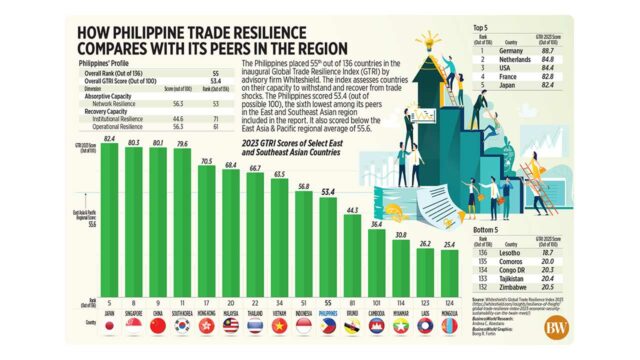
The Philippines placed 55th out of 136 countries in the inaugural Global Trade Resilience Index (GTRI) by advisory firm Whiteshield. The index assesses countries on their capacity to withstand and recover from trade shocks. The Philippines scored 53.4 (out of possible 100), the sixth lowest among its peers in the East and Southeast Asian region included in the report. It also scored below the East Asia & Pacific regional average of 55.6.


How Philippine trade resilience compares with its peers in the region

Hopeful about vanilla

How fast time flies! 2024 is here. Finally, the Vanilla Industry Development Association (VIDA), a group of farmers, professionals, academe, hobbyists with the goal of making the Philippines a quality producer of vanilla, is now registered with the Securities and Exchange Commission and recognized by the Department of Agriculture (DA).

Early in January, a productive meeting of VIDA officers, namely President Basil Bolinao, Vice Chairman Reynaldo Lantin, Treasurer Pablito Villegas, and director Arsenio “Toto” Barcelona, and the officers of DA and the Bureau of Plant Industry (BPI), namely Regine Patino, Joe Zalde Samson, Jr. and Noly Garcia, was held with special guest, former Undersecretary Evelyn La Viña. As vanilla growing in the Philippines is just starting, we were encouraged when Ms. Evelyn told us the beginnings of cacao then and where it is now — winning gold awards! The vision is to start the vanilla industry right, with the correct planting variety material, proper protocols in cultivation, and timely harvesting, curing, and processing to produce Philippine quality vanilla. Action needed is to complete the Vanilla Roadmap and organize a Vanilla Forum soon.

A positive development is that DA is providing 1,200 vanilla seedling materials for VIDA members. The seedlings are already with BPI, being seasoned and for distribution within three to six months to ensure mortality rate is reduced. Training is also expected to be provided through the support of the DA Agricultural Training Institute and BPI.

Vanilla, the spice derived from vanilla orchids that originated from Mexico vines, thrives well in the Philippines. I know from experience, as Ester Manuel of Batangas gave me some vanilla cuttings years ago and the cuttings just grew in my Antipolo garden despite “neglect.” Joji Gamboa Lim, the Natural Farm Jadam “guru,” confirms seeing the vanilla plants flower in my garden. Unfortunately, they were left unattended. Joji is active in vanilla planting in Davao. In early 2023, I asked vanilla enthusiast Sheena Fideli to help me with my vanilla project.

Vanilla flowering was monitored, and some vines flowered in February to March last year. Monitoring is important as four hours is the window available to hand pollinate the vanilla flower to result in vanilla beans. After eight to nine months, we harvested a few vanilla beans last week. Some farms are already way ahead and knowledgeable on how to harvest, cure, process the beans, such as Vilelas farm of Maila Toreja, Milea Bee Farms, Nene Belegal Castillo, and Melvin Awid in Sarangani, among others. Ed Cleofe Ballesteros of Luntiang Republika is also farming vanilla scientifically in Cavite.

Maria Diaz of Green Balai in Bataan advised that the Bataan Farm Tourism Agriculture Cooperative is forming a vanilla group and would like to link up with VIDA, with a member already in vanilla production. There is enough interest in vanilla all over to invite an industry expert from a vanilla producing country and teach practitioners about harvesting, curing, and processing to complement what some of us are now doing, which is mostly experimental and based on our own readings, as well as watching YouTube tutorials.

The Philippine vanilla industry is still in its infant stage. Baby steps have been taken. It takes four years for vanilla to flower and be productive. Production for those that started to plant last year will be in 2026 or 2027. We can dream of world-class quality Philippine vanilla starting with the right foundation and with private and public collaboration. Why not?

Meanwhile, Jan. 24 marked a new beginning for FINEX with the inauguration of Augusto “Toti” Bengzon, Ayala Land, Inc. chief finance officer (CFO) and FINEX 2019 CFO of the Year, as FINEX president during an event with the theme “Transformational Growth through Sustainability, Diversity and Digitalization.” The inducting officer and guest speaker was Mariana Zobel de Ayala, executive director of Ayala Corp., who delivered an insightful message.

The views expressed herein are the author’s own and do not necessarily reflect the opinion of her office as well as of FINEX.

Serving with President Toti are distinguished FINEX board members Ador Abrogena (Independent Director, AIA Investment Management), Gemma Cheng (House of Investments CFO/COO), Edith Dy Chiao (Director, Hildebrand Associates Business Corporation), Editha Estacio (SGV Partner), Joey Gomez (Senior Consultant, RCBC), Carlo Lazatin (CEO DES Financing Corp.), Senen Matoto (Management Consultant), Tony Boy Ongsiaco (CEO, Powernet Systems), Mignon Ramos (Managing Director of Roadmaps + Beyond Inc.), Paul San Pedro (CEO, Sterling Bank), Benny Soliven (Managing Partner, BV Partners), Wilson Tan (Chairman/ Managing Partner SGV), Stephanie Zulueta (Finance Head, PDS Group of Companies).

Before we know it, we will be in the midst of the activities for the year. As Ms. Mariana said: “Imagine it better and make it a a reality!”

May 2024 be our best year ever, with God’s favor!


Flor G. Tarriela was former PNB chairman and now serves as board advisor. A former undersecretary of Finance, she is lead independent director of Nickel Asia Corp., director of LTG, Inc. and FINEX. A gardener and an environmentalist, she founded Flor’s Garden in Antipolo, which is now an events destination.

Entertainment News (01/26/24)


Robinsons Malls OK’s free use of co-events spaces

THOSE looking for a space to hold community gatherings, seminars, group studies, business meetings, rehearsals, exhibitions, or workshops can now look into Robinsons Malls’ Co-Events Spaces, which are free venues equipped with basic amenities. They can be found in Robinsons Metro East, Robinsons Naga, Robinsons Galleria Ortigas, Robinsons Las Pinas, Robinsons Imus, Robinsons Gen. Trias, and Robinsons Dasmarinas. To book the spaces, download and register on the RMalls+ App, head to the RVoucher section, and look for the Co-Events Space voucher. Reservations must be made at least three days before the activity.


QCShorts 2024 calls for submissions

QCINEMA International Film Festival is now accepting submissions for #QCShorts 2024. The festival is offering six production grants, each valued at P350,000, to support emerging filmmakers. All Filipino citizens aged 18 and above are qualified to submit their pitches for narrative fiction, animation, or experimental entries, with a maximum total running time of 20 minutes, including opening and closing credits. Deadline for submission is Feb. 25. For more details visit https://qcinema.ph/submissions/qcshorts2024/.


Nicole Laurel Asensio to launch EP

SINGER and composer Nicole Laurel Asensio is all set to launch Mind Over Matter, an extended play record of three original compositions “that depict a wandering psyche aching for atonement and acceptance,” according to a release. While it will be released online on streaming platforms on Jan. 26, there will be a launch party on Jan. 30 at 19 East, located on East Service Road, Parañaque City. There will be special guest performances by Ang Bagong Luto ni Enriquez and Iwi Laurel. Entrance fee is P500. Mind Over Matter will stream on all music platforms online.


City of Dreams presents The CompanY

CENTERPLAY, City of Dreams Manila’s contemporary entertainment bar, will feature Filipino music group The CompanY as this month’s Concert Series performer. Their one-night only concert on Jan. 31 at 9 p.m. is set to highlight the award-winning vocals of Moy Ortiz, Annie Quintos, Sweet Plantado, and OJ Mariano. Formed in 1985, The CompanY is best known for their contemporary jazz and acapella repertoire. The four-member vocal harmony group is behind hit songs “Muntik na Kitang Minahal,” “Now That I Have You,” and the ballad “Everlasting Love.” Tickets to the upcoming concert cost P2,500, consumable. For more information, visit cityofdreamsmanila.com.


Jesse McCartney drops new single, teases EP

SINGER-songwriter Jesse McCartney, who first came onto the scene as a teen heartthrob and later became celebrated for chart-topping hits, has released a new single, “Faux Fur.” The track has a retro R&B groove and funk, layered with soulful vocals. The release teases his upcoming extended play, All’s Well, which is scheduled for release on April 5. The new song is one of two tracks co-produced by Andrew Dixon, drawing inspiration from the nostalgic sounds of R&B. “Faux Fur” is now available on all streaming platforms.

Selecting between shortlisted job candidates

We’ve shortlisted the top two candidates for a managerial position. The difference between them is minimal — a few decimal points in our scoring system. Is there a good way of resolving the tie in coin-toss situations like this? — Mad Scientist

A coin flip is an accepted tool for breaking ties in sports and elections. Between two job candidates, there are other options available.

One option is to conduct a final round of face-to-face interviews using a common set of questions for the two candidates, who are to be interviewed separately. You can do a panel interview where department heads or their representatives are tasked to assess the candidates.      

You can have about 20 questions in a form that includes a space for the rating by the interviewers. For example, each interview answer is graded on a scale of one to 10, 10 being the highest.

Even if you have already chosen your best candidate, one option is to delay a decision pending the completion of pre-employment documents (like an NBI clearance), medical clearance and background investigation.

Further, you must understand that many interview questions are predictable, especially to managerial applicants. They may have done it many times before as interviewers for their organizations. The key is to formulate questions that are unpredictable but still relevant to the job.

UNPREDICTABLE QUESTIONS
The first thing to do is to identify the key elements of the managerial job. What are the critical requirements to make a job holder successful? Is it leadership? Initiative? People skills? Technical competence? Problem-solving? Decision-making? Don’t ask the same questions you’ve raised during the first few rounds of the hiring process.

Instead, ask open-ended but direct-to-the point questions. You can create your own key questions that are likely to bring out characteristics of an ideal candidate. Take note, however that you should connect these questions to what’s happening in your organization, including its management style, without telegraphing your internal problems:

Leadership. Give one specific example of how you transformed the performance of your department resulting in improved profitability and sustainability. This question focuses on the applicant’s results orientation. It’s difficult to fake an answer as the question requires detailed information on “profitability” and “sustainability.”

Initiative. Tell us about a performance milestone that was unprecedented in your organization, either among your peers or predecessors. This is designed to surface any “black swan” experiences. While it’s difficult to find unprecedented accomplishments for every applicant, the answers provide clues on whether the applicant strives to do extraordinary things.

People skills. Who is more important to you — the customer or employees? Management experts will always tell you that the right answer is employees. There’s truth to the maxim that if you treat your workers well, they will treat customers better. Douglas Conant is right: “To win in the marketplace, you must first win the workplace.”

Technical competence. If your assistant has an emergency situation and can’t report for work, can you perform his task given your best customer’s tight deadlines? Can you perform the same tasks, no matter how difficult? This question explores whether a manager can demonstrate mastery of his direct reports’ tasks.

Problem-solving. Tell me about a complex issue that you solved without incurring major expenses that prompted your boss to give you a bonus, a commendation, or a promotion. This  measures creativity in resolving issues without throwing additional resources at the problem.

Decision-making. There are two applicants for one job. Both are equally competent and have nearly identical qualifications. How would you decide? What objective approach would you take to identify the best candidate for the job?

OTHER OPTIONS
When an applicant gives you an obscure answer, probe for clarification until you reach a point where you can conclude they have or don’t have the experience needed. You can also make the final interview process more interesting if you can assign one or two interviewers to intentionally create stressful situations for the applicants.

This means throwing applicants off-balance. The method sometimes involves asking questions in a loud, threatening voice. You can also pretend to be in possession of reliable information that would prove negative for the candidate’s image. Propose to call a former boss right there to gauge the applicant’s reaction to a situation where the ex-boss is asked whether he would recommend the candidate or not.


Attend Rey Elbo’s Feb. 23, 2024 public program on “How Management Lost its Labor Cases in 2023” about the new decisions of the Supreme Court. Chat with him via Facebook, LinkedIn, X (Twitter) or e-mail operations@reyelbo.consulting for details.

DINKS are dinks

ORIGINAL PHOTO FROM PEXELS-COTTONBRO-STUDIO

“Why Would Someone Willingly Call Themselves a DINK?,” asks a befuddled Medium writer Sydel Brown. And indeed, it’s a proper question to make, considering that Green’s Dictionary of Slang defines “dink” as “the penis, esp. of a small boy or, if small, of an adult.”

However, in today’s context, DINK stands for something else, albeit not entirely different. Something celebrated by media, TikTok “influencers,” and most of the “woke” community. DINK, described best by the Daily Wire’s Matt Walsh, “is an acronym that stands for ‘dual income, no kids.’ These are the ‘childless by choice’ folks. Those who get married, and could have kids, but choose instead to have a barren, sterile relationship focused entirely on their own superficial wants and desires.”

To be clear, DINK does not refer to married couples that want to have children but, as fate would have it, are unfortunately unable to. No. DINKS are couples who can have children but proudly declare not wanting to have them. For the most self-centeredly banal of reasons.

Again, Walsh’s depiction is most accurate: “Most of them follow the same format: bragging about having all of the sleep, free time, and finances to… buy bulk snacks at Costco. Really. They are making videos providing unsolicited lists of the things that make their lives fulfilling and somehow Costco makes the cut. For what it’s worth. I like to buy cereal wholesale too, but I’m not going to make it my whole identity. Either way, pretty much everything revolves around their increased ability to buy stuff.”

But all this mindless prideful commercialism comes at a cost. As previously pointed out here (“Population collapse and the RH Law mistake,” March 2022; citing “Fertility, mortality, migration, and population scenarios for 195 countries and territories from 2017 to 2100,” The Lancet, July 2020), the world’s population is already shrinking to alarming levels.

Thus, “the global population was projected to peak in 2064 at 9.73 billion (8.84–10.9) people and decline to 8.79 billion (6.83–11.8) in 2100.” Total fertility rates (TFR) for several countries are expected to fall drastically: “By 2050, 151 countries were forecasted to have a TFR lower than the replacement level (TFR <2·1), and 183 were forecasted to have a TFR lower than replacement by 2100. Twenty-three countries in the reference scenario, including Japan, Thailand, and Spain, were forecasted to have population declines greater than 50% from 2017 to 2100.”

Even more disconcerting is the expected aging global population: “with 2.37 billion (1.91–2.87) individuals older than 65 years and 1.70 billion (1.11–2.81) individuals younger than 20 years, forecasted globally in 2100.”

China just experienced a 70% drop in its birthrate from 2017 and is expected to see its population halved by 48% by the end of this century, with India (expected 1.09 billion by 2100) and Nigeria (791 million) overtaking China’s predicted 732 million people. As The Lancet points out: “A sustained TFR lower than the replacement level in many countries, including China and India, would have economic, social, environmental, and geopolitical consequences.”

The Philippines itself has depreciating age demographics: in 2022, 58.1% or 844,909 of newborn Filipinos were born illegitimate. The Philippine Statistics Authority also reported that the Total Fertility Rate of Filipino women aged 15 to 49 years declined from 2.7 children per woman in 2017 to 1.9 children per woman in 2022, effectively placing the Philippines below the replacement fertility level of 2.1. The security, economic, and social problems that an aging population coupled with an improperly formed youth deprived of both biological parents can bring, if unaddressed, could be catastrophic.

And yet, the DINK mindset isn’t damaging only at the macro-societal level but also at the personal, individual level, harmful ironically even to DINKS themselves. Wendy Wang, Research Director for the Institute for Family Studies warns: “Don’t listen to proudly and deliberately childless couples: Children are good for marriage and for society.”

The message “that marriages are better without children and children are a big time drain and financial burden … is misleading. Among Americans ages 18 to 55 (the group who are most likely to have young children at home), married adults with children are the happiest. Nearly four in 10 married parents (37%) say they are very happy with their lives, compared with 27% of married, childless adults (the happiness level among unmarried adults is much lower), according to the 2022 General Social Survey. When it comes to marital quality, married parents also have an advantage over their childless peers: 63% of married parents are very happy about their marriage, compared with 57% of married and childless couples.

Even in the 18-to-34 age group, to which the featured TikTok couples appear to belong, married couples with children are far more likely than their childless peers to say they are very happy with their lives (43% vs. 30%).

It is true that children require a considerable amount of care, and married parents have less free time compared with their childless peers and single adults, but research shows that more free time doesn’t always translate to more happiness. Even though they have less free time, married parents tend to spend more of the free time they do have socializing with others and less time in front of screens, and these factors contribute to their higher levels of happiness” (“‘DINKs’ Should Rethink Their Anti-Child Views,” National Review, December 2023).

Even in that one particular aspect that DINKS love bragging about — their supposedly unbridled sex life (see, for example, “Why we’re putting off having children: We have sex four times a week and lie-ins every weekend — why ruin things?,” Daily Mail, March 2023) — they still get wrong. Married couples with kids apparently have more and enjoy more sex than their childless counterparts:

“There’s one group of adults who consistently have sex more often than any other, and it might come as a surprise to those who think having young children is all about sleep deprivation and mopping mashed food off the furniture. American couples in households with children under the age of six report having sex over 80 times per year, according to a new study led by the University of San Diego, more than those with no kids, and those with older kids.” (“The couples having the most sex in America all have this in common,” Medium, March 2017; citing “Declines in Sexual Frequency among American Adults,” 1989-2014,” Twenge, et.al., 2017).

DINK’s simply have no advantage over that of being married with kids, especially if one considers the concomitant damage and utterly vapid empty existence that such a lifestyle brings. Matt Walsh is precisely on point:

“I’m a SISK — single income, six kids — and I can do you one better. I buy whatever snacks I want for myself, whenever I want them, whether from Costco or anywhere else. My children do not prevent me from indulging in that way. The only difference is that, if anyone asked me to provide a list of the things I love most about my life, I wouldn’t cite the fact that I can buy snacks for myself. Not because I can’t buy snacks, but because that’s a rather banal detail that I wouldn’t think worth mentioning.

“And yet, for DINKs, snacks and Costco play, apparently, a central role in their lives. On their deathbeds, while they’re lying there alone with no one to mourn them or care that they’re dying, or remember them when they’re gone… when the hospice nurse asks them to pass along a final piece of wisdom, they will look up and with their final, dying breath, whisper: ‘Get a Costco membership. They have great deals on Cheez-Its’.”

Perhaps it’s no coincidence then that the American Heritage Dictionary defines a “dink” as a “stupid, annoying, or contemptible person.”

The views expressed here are his own and not necessarily those of the institutions to which he belongs.


Jemy Gatdula read international law at the University of Cambridge. He is the dean of the Institute of Law of the University of Asia and the Pacific, and is a Philippine Judicial Academy lecturer for constitutional philosophy and jurisprudence.

https://www.facebook.com/jigatdula/

Twitter  @jemygatdula

ePLDT says new chief sales officer Regino to drive multicloud sales strategy

RICARDO “REGGIE” REGINO

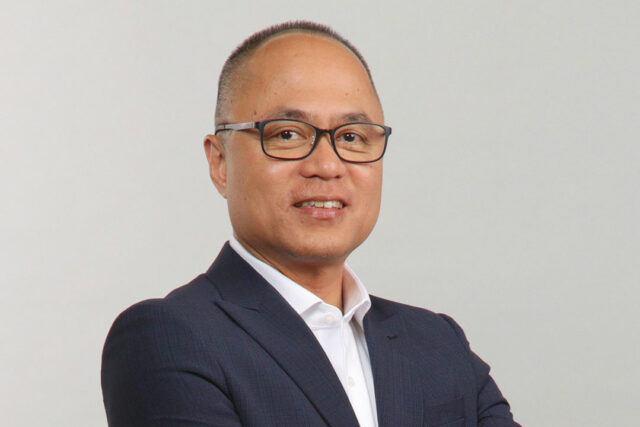
ePLDT, Inc., the information and communications technology (ICT) subsidiary of PLDT Inc., named Ricardo “Reggie” Regino as its vice-president and chief sales officer on Thursday.

“In this new role, Mr. Regino will be responsible for developing and executing ePLDT’s go-to-market strategy and building a high-performing sales organization,” ePLDT said in an e-mailed statement.

“Mr. Regino brings over 25 years of international ICT experience,” it added.

Before joining ePLDT, Mr. Regino held executive roles at Crayon Philippines, IBM Philippines, and Microsoft Philippines. 

In these positions, he was responsible for leading sales strategy, consulting, brand management, customer relationship management, operations, service delivery, and business development, ePLDT said.

“In my dialogues with customers, we learned that cloud migration has become an integral facet of every digital transformation journey,” Mr. Regino said.

“I am pleased to be part of ePLDT as we help our customers realize their digitalization thrusts with our secure outcome-based multicloud solutions,” he added.

Cloud migration is “the process of moving data, application, and workloads from an on-premises data center to a cloud-based infrastructure or from one cloud environment to another,” according to IBM.

ePLDT currently supports local enterprises and government agencies.

Hastings Holdings, Inc., a unit of PLDT Beneficial Trust Fund subsidiary MediaQuest Holdings, Inc., has a majority stake in BusinessWorld through the Philippine Star Group, which it controls. — SJT