Home Blog Page 3706

Strikes poised to ground flights at major German airports

BERLIN — Strikes threatened to ground flights on Thursday at some of Germany’s biggest airports, including the global hub Frankfurt, in the latest wave of industrial action by transport workers to hit Europe’s largest economy, officials said.

The labor union Verdi has called for strikes by security staff at airports across the country as it raises pressure on the government in wage talks.

“The security checkpoints outside the transit area will be closed. It is therefore not possible to board flights from Frankfurt,” airport operator Fraport said in a statement.

All passengers who had planned to start their journey in Frankfurt were therefore asked to not come to the airport, Fraport said, adding that 1,050 departures and arrivals had been scheduled originally.

A spokesperson for Berlin Brandenburg’s airport said all departures would be canceled on Thursday but that flights would go back to normal on Friday at the start of the winter holidays in Germany’s capital.

Hamburg Airport said it would take similar measures. “All 126 departures on Thursday will be canceled or will take place without passengers,” the airport said, adding that cancellations and delays are also to be expected for arrivals. — Reuters

Maya is #1 Digital Bank in PHL

Maya now stands as the #1 Digital Bank in the Philippines, revolutionizing the industry with its unified payments and banking services on one digital platform. In 2023, Maya saw a remarkable increase in users, with 3 million depositors, more than double the previous year, and a deposit balance reaching P25 billion, a 69% increase from 2022.

Its innovative approach sets Maya apart, turning everyday transactions into opportunities for customers to earn more through high-interest savings. This unique strategy has helped Maya capture 57% of the digital banking depositors, based on the latest September 2023 data from the Bangko Sentral ng Pilipinas (BSP).

Maya’s loan services have grown exponentially, disbursing P22 billion last year from P3 billion in 2022. This success is due to Maya’s innovative use of customer transaction data to make quick and efficient lending decisions.

“We’re redefining how Filipinos interact with their money,” said Shailesh Baidwan, Maya Group President and Maya Bank Co-Founder. “Our all-in-one platform is a response to the real, daily financial needs we’ve seen and heard from our customers, and we’re committed to bringing them even more innovative solutions.”

Maya is the Philippines’ only digital bank app to seamlessly offer savings, credit, e-wallet, crypto, insurance, investment, and rewards. As of early 2024, it is the #1 top-rated consumer finance app with a 4.8 rating on the App Store and 4.5 on Google Play, beating other leading apps.

Maya’s model has garnered global acclaim, earning accolades such as Best Digital Bank in the Philippines at the World Digital Bank Awards, World’s Best Consumer Digital Bank Awards, and Retail Banking Awards, and recognition in Forbes Magazine‘s World’s Best Banks list.

Making Finance a Part of Life

“Banking shouldn’t be a chore, and that’s what we’re changing at Maya,” said Angelo Madrid, President of Maya Bank. “Every payment you make on the Maya app — it’s not just a transaction, it’s a step towards bigger savings and smarter credit. That’s our mission, making finance a seamless part of daily life.”

Customers can earn up to 14% interest on their savings and, for eligible users, borrow up to P250,000 through regular use of the Maya app.

Maya’s approach has also attracted collaborations with major brands like Smart Communications and Lazada, providing customers additional benefits and rewards. Both brands ran campaigns offering an extra 1% savings interest rate p.a. whenever users transact via Maya.

Madrid anticipates users to engage even more with the app as Maya has expanded its product portfolio with wealth-building services such as Maya Funds, Maya Stocks, Maya Time Deposit Plus, and Maya Crypto.

Accelerating SME Banking in PH

Replicating its success in consumer banking, Maya is also reshaping SME banking in the Philippines. It is powering SMEs to accept various payment methods offline and online, using this vast data to offer lucrative savings and instant credit options.

Maya Business unveiled in 2023 the breakthrough 1-2-3 Grow Bundle, enabling SMEs to get a credit line of up to P2 million within just three months of using Maya for payment acceptance. On top of that, SMEs can accept digital payments at affordable rates and earn a 2.5% interest rate on their deposit accounts.

Maya is the #1 Fintech Ecosystem in the Philippines, with Maya, the #1 Digital Bank, and Maya Business, the #1 Omni-Channel Payment Processor. To learn more about Maya, check out maya.ph and mayabank.ph. Follow Maya at @mayaiseverything on Facebook, Instagram, YouTube, and TikTok and @mayaofficialph on Twitter.


Spotlight is BusinessWorld’s sponsored section that allows advertisers to amplify their brand and connect with BusinessWorld’s audience by enabling them to publish their stories directly on the BusinessWorld website. For more information, send an email to online@bworldonline.com.

Join us on Viber at https://bit.ly/3hv6bLA to get more updates and subscribe to BusinessWorld’s titles and get exclusive content through www.bworld-x.com.

Mainstream news media is imploding. That’s a good thing

MARKUS WINKLER - UNSPLASH

It’s really not going well for the “progressive left.” After all those millions of dollars poured into ensuring that the movie Barbie earned money (thus avoiding the very public humiliation of Disney’s recent Little Mermaid which flopped spectacularly at the box office), the very feminist, very woke, very anti-masculinity crowd went into full meltdown just a few days ago after Margot Robbie and Greta Gerwig failed to secure Oscar nominations for best actress and best director, respectively, only to see Ryan Gosling snag a nomination for best supporting actor.

Perhaps the only thing that could have enraged the Barbie crowd more, thus pushing the amusement factor to 11, is if Ryan Gosling had been nominated for best actress instead. Which in today’s so-called gender fluid, inclusive society is not as far out an idea as it sounds.

In any event, another interesting meltdown occurred just last week when Taylor Lorenz appeared in a viral video where she laments that the “entire journalism industry is basically in a free fall.” She then rattles of the mass layoffs at the LA Times (including its politics section, considering it’s a US election year), and emphasizes that the foregoing followed “months and months and months of layoffs in the media industry, in fact tens of thousands of journalists have been laid off in the past year.” Perhaps even more depressing (for her, anyway) is that “pretty much the entire digital media ecosystem that… a lot of Millennial journalists came up in has been completely hollowed out.”

And she’s not wrong: publications like the New York Times to the Washington Post indeed laid off mass numbers of its employees. CNN Philippines itself just shut down its operations last week, following in the footsteps of BuzzFeed News which closed down last year.

And the list of news media being gutted goes on and on: Insider, Forbes, New York Daily News, Paramount, Condé Nast, and Sports Illustrated (see “Mainstream media bloodbath: News outlets slash jobs as business suffers,” Axios, January 2024).

And yet, while expressing sympathy with the thousands of ordinary employees that lost their employment and source of income, one feels little to lament about the closure of such news media itself. Because for an industry that owes its existence to the trust of its readers and viewers, most of news media decided instead to play the arrogance card and take advantage of that trust.

Rather than being merely the observer and then objective reporter of what’s happening on the field, today’s journalists got the bizarre idea (from who knows where) that they are as good or even better than the actual players and thus inserted themselves in the game. This despite the fact that no one actually wanted to see them on the field.

Hence, the prevalence of “media bias,” the “tendency of news media to report in a way that reinforces a viewpoint, worldview, preference, political ideology, corporate or financial interests, moral framework, or policy inclination, instead of reporting in an objective way (simply describing the facts). A media outlet may reveal bias in how it reports specific news stories or which stories they choose to cover, i.e., deem more important than others to cover or emphasize” (“What is media bias?,” All Sides, February 2022).

In short, most news media departed from being the mere objective reporter of news to becoming propagandists of their own personal (oftentimes aligned with corporate) political ideology — which is mostly of the woke, “progressive,” Left point of view.

Hence, the appallingly (and heavily selectively censored) coverage on the COVID-19 lockdowns, their grotesque push for mandatory vaccination (with their even more grotesque acquiescence to terminate the employment and education of those refusing vaccination), their fanatical push for climate change policies, their anti-Christian stance, and their maniacal advocacy for the LGBT and trans ideology.

And journalism’s arrogant bias — particularly in the area of politics — kept growing more and more brazen. Back in 2004, BusinessWeek reported: “On the liberal end, Newsweek had an astonishing rating of 72 — that’s 33 points more liberal than the House median.

Other highly liberal outlets included The New York Times, Time magazine, the CBS Evening News, USA Today, and NBC Nightly News. These scores ranged from 62 to 64, about 25 points above the House median.” (“The Liberal Media: It’s No Myth,” BusinessWeek, June 2004).

By near present day, the leftist bias of journalists is a given. Oftentimes it is disguised: “‘We observed a lot of subtle differences in the words they choose when they cover the same high-level topics,’ says Hanjia Lyu, a computer science PhD student who was the lead author of the study. ‘For example, when covering abortion issues, Reason tends to use the term ‘abortion law,’ while CNN underscores its ideological position by using the term ‘abortion rights.’ On a higher level they are both talking about abortion issues, but you can feel the subtle difference in the words that they choose’.” (“Study of headlines shows media bias is growing,” University of Rochester, July 2023).

However, for particular political or social issues, journalists just straight out let their bias show. Witness the several times Joe Biden fell while walking (sometimes even as much as three times at one stretch) during a public event: “As of Friday afternoon, the homepages of MSNBC, CBS News, Washington Post, Los Angeles Times and New York Times had no mention of Biden’s stumbling incident earlier in the day at Joint Base Andrews. According to various organizations that monitor the media, CNN devoted 15 seconds to the incident and MSNBC about a minute.”

And yet when Donald Trump happened to simply walk slowly down a ramp after delivering a West Point graduation address in 2020, “CNN devoted 22 minutes and 13 seconds to Trump’s walk down the ramp, and MSNBC devoted 28 minutes and 42 seconds to the story.”

Basically, the supposed “objective,” “free and fair” news media treated Biden’s fall as “simply a slip, something we’ve all done at one time or another. But with Trump … it was treated as a sign of potential serious health questions” (“Media stumbles: Its bias shows in covering Biden v. Trump,” The Hill, March 2021).

Also don’t forget news media’s unapologetic reportage on Jussie Smollett and the copycat hate crime hoaxes, as well as the “mostly peaceful” riots of BLM.

And of course, there’s the classic, “we’re supposed to believe it’s unbiased” headline by Time magazine on President Ferdinand Marcos, Jr.: “The World should be worried about a dictator’s son’s apparent win in the Philippines” (May 2022).

The point is, “despite journalists’ denials, it’s now pretty much a fact that journalism is one of the most left-wing of all professions. But until recently, that wasn’t thought to be true of financial journalists — who have a reputation for being the most right-leaning and free-market-oriented among mainstream journalists. If that was ever true, it sure isn’t today, a new study suggests,” said Investor’s Business Daily in a November 2018 editorial (“Media Bias: Pretty Much All Of Journalism Now Leans Left, Study Shows”).

“Researchers from Arizona State University and Texas A&M University questioned 462 financial journalists around the country. They followed up with 18 additional interviews. The journalists worked for the Wall Street Journal, the New York Times, Washington Post, Associated Press and a number of other newspapers,” it continued.

Unfortunately, the bias comes with a cost and the cost is paid by the ordinary citizen: “The profound leftward ideological bias of the Big Media is the main reason why America now seems saturated with ‘fake news,’” said the Investor’s Business Daily piece. One saw this most clearly during the COVID coverage, with news media masking their fanaticism behind supposed fact-checkers to stop any report or opinion going against the COVID pro-lockdown/mask/vaccination narrative.

However, if people cannot trust news media, then where should they get their information from? The answer: from various sources giving unfiltered information, clearly delineating opinion commentary from news reportage, for which the people are then free to weigh the information they received on their own and deciding what to believe for themselves.

As it should be. That’s the entire point of a free society, with free speech and a free press.
Make no mistake, a free press is necessary to society and there are still news sources that remain trusted by the people. Some examples — the Daily Wire, a news organization co-led by Ben Shapiro, is experiencing an expansion. The Heritage Foundation also reported raising more money in 2023 than in previous years.

And certainly, a silver lining is that — what with the layoffs in many news media and the closure of CNN Philippines — Elon Musk’s X (formerly Twitter) is still very much around. The views expressed here are his own and not necessarily those of the institutions to which he belongs.

The views expressed here are his own and not necessarily those of the institutions to which he belongs.


Jemy Gatdula read international law at the University of Cambridge. He is the dean of the Institute of Law of the University of Asia and the Pacific, and is a Philippine Judicial Academy lecturer for constitutional philosophy and jurisprudence.
https://www.facebook.com/jigatdula/
Twitter @jemygatdula


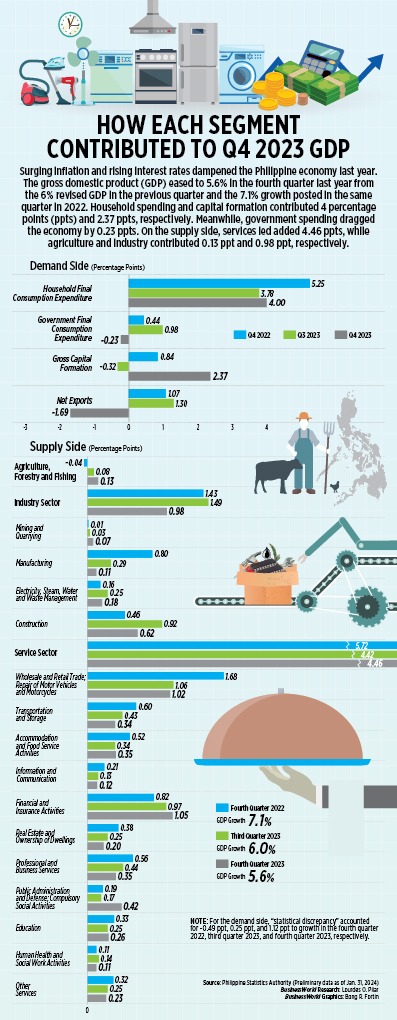
How each segment contributed to Q4 2023 GDP

Entertainment News (02/02/24)


Free admission to Yuchengco Museum

VISITORS can enter the Yuchengco Museum for free until Feb. 2. On view are works by National Artist Fernando Amorsolo, the exhibits Buhay Rizal, Jet Leyco’s Capturing the World, Glenn Bautista’s Blue Horizons, and Filipino Modernists, plus the Flip Your Biz mini bazaar. The Yuchengco Museum is on the ground floor of RCBC Plaza at the corner of Gil Puyat and Ayala Aves. in Makati.


Muni-Muni Stories podcast launches remix season

WITH a new episode released every Monday in February, the latest season’s line-up for the Muni-Muni Stories podcast features discussions on film soundtracks, music genres, audience reception, and the legacy of iconic songs and periods. It is co-produced by the Filipinas Heritage Library and Podcast Network Asia, with the goal of celebrating Pinoy musical heritage. The episodes are: “Celeste Legaspi’s ‘Saranggola ni Pepe’ and Gary V’s ‘Hataw Na’,” “Up Dharma Down and the soundtrack of Alone/Together,” “The rap film Respeto and the music of Francis M,” and “Joey Ayala and the soundtrack of Liway.” For inquiries e-mail asklibrarian@filipinaslibrary.org.ph.


Pasinaya Festival adds venues

THE PASINAYA Open House Festival of the Cultural Center of the Philippines (CCP) has additional venues for its 20th year: there will be events held in Tagum in Davao Del Norte, in Iloilo City, at Circuit Makati, and the Film Development Council of the Philippines’ (FDCP) Cinematheque Centre in Iloilo. Along with these new venues, the festival will be held simultaneously on Feb. 3 and 4 at the CCP Complex, at 14 museum and gallery partners around Metro Manila, at the FDCP Cinematheque in Manila, and the Iloilo Museum of Contemporary Arts in Iloilo City. With an experience-all-you-can, pay-what-you-can scheme, participants can join 30-minute workshops in various art disciplines conducted by leading artists, resource persons, and teachers, or watch as many shows, screenings, and activities as they can.


Manila Pianos Artist Series presents Dingdong Fiel

A PRE-Valentine’s Day concert, Alles Liebe, part of the Manila Pianos Artist Series, will feature romantic piano pieces performed by pianist Dingdong Fiel. On Feb. 4 at the Manila Pianos showroom in Ronac Lifestyle Center, Paseo de Magallanes, Makati City, Mr. Fiel will take on select piano works by Pachelbel, Respighi, Bruckner, Scarlatti, Mozart, Chopin, Scriabin, Mahler, Franck, Kapustin, and Piazolla. The regular ticket price is P1,500 while seniors and students can avail themselves of tickets for P1,000. For more details, visit the Manila Pianos Artist Series Facebook page.


Glorietta to hold Chinese New Year celebration

THIS YEAR, the Chinese New Year festivities at Makati’s Glorietta Mall will be inspired by the vibrant Chinatown and feature immersive installations from Feb. 5 to 11 at the Glorietta Activity Center. First is the Lucky Lake, a virtual lake that shoppers can wish upon and gain prizes from by presenting a minimum single-purchase receipt of P500 from any Glorietta merchant. A Temple of Festivities offers fortune telling, zodiac horoscopes, tarot and palm readings for insights on what the Year of the Wood Dragon will bring. The Food and Fortune Fair will provide a diverse selection of lucky charms and oriental treats that shoppers can purchase. On Feb. 10, 6 p.m., Glorietta will have a fireworks display to culminate the celebrations.


Bituin Escalante to perform at Circuit Makati

IN CELEBRATION of Arts Month and as part of the special activations for 10 Days of Art, the JZA HALL Concert Series kicks off with With Love… Bituin. This special Valentine’s concert features Bituin Escalante and her jazz band who will perform timeless classics at the Jaime Zobel de Ayala Hall located at the 5th Level of the Samsung Performing Arts Theater in Circuit Makati on Feb. 15. There will be a dinner by chef Gilbert Pangilinan at 6 p.m., followed by the performance at 8 p.m. Tickets are available via Ticketworld.


SB19’s PABLO drops new song

THE NEWEST song by SB19 member PABLO, titled “Akala,” is another collaboration between the singer and his real-life brother Josue of Radkidz, who also co-produced his previous viral hits “Determinado” and “Gento.” For the new track, the P-Pop star blends hip-hop sensibilities with trap beats and atmospheric production. “Akala” is out now on all streaming platforms.

The best onboarding program

ELBONOMICS: Orientations must avoid disorienting anyone.

I’m a newly hired human resource (HR) supervisor tasked to create the best possible orientation program for new employees. So, how do we make it the “best” program? — Lone Ranger.

The “best” orientation program is one that follows Winston Churchill’s maxim on public speaking: “It should be like a woman’s skirt. Long enough to cover the subject and short enough to create interest.” This means that you don’t have to cover everything in one sitting. You must weigh the risks of delivering a short and hurried presentation and a long and boring one.

Today, we call an employee orientation program “onboarding,” the process of introducing newcomers to the organization and its workers and managers.

The trick is to have balance. Stick to the basics and don’t make it too long — otherwise new employees might end up bored to death. Cover only what’s important. You can take a cue from this by learning the most-inquired-about topics by previous worker intakes. Remove anything that creates a tedious classroom atmosphere.

The onboarding program must be done in half a day, preferably in the afternoon. Leave the morning session for informal icebreakers to help establish rapport between and among the new employees and their respective line leaders, supervisors or managers.

Give all new workers a printed copy of the Code of Conduct, employee handbook or similar policies that they must sign and acknowledge. Give them a package of company merchandise like branded T-shirts or coffee mugs.

During the meal break, offer lunch in the company cafeteria or a nearby restaurant. Don’t offer buffets; their overloaded bellies might render them inattentive during the afternoon session.

Consider a follow-up session after the first four to six months of employment. That gives them the time to ask questions that may have arisen from their initial experience of work. Allow them to ask questions to clarify matters, with the caveat that sensitive and confidential issues must be discussed only in private.

Whatever you do, the most important goal of onboarding is to create and maintain a positive and healthy work environment. Imagine a company with high turnover among first-year employees, which can probably be blamed on the incompetence of HR and line executives.

ADVANTAGES

An onboarding program is essential before all new workers start doing their respective jobs. It’s a warm-up exercise to avoid unpleasant situations at work, especially during their first year of employment. Thus, the new workers must be briefed on the specific do’s and don’ts to better align them with the Vision, Mission and Values (VMV) of the organization.

Onboarding is a must for all — big or small companies, regardless of their industry. Being busy is not a good reason to skip it. There are many reasons for this, including the following:

One, it reduces or eliminates startup costs. A fully organized process can help new employees understand the general expectations of an organization. The process includes informing them of their job description, work standards and short-term goals.

One important part is the grievance system that allows new workers to elevate an issue to HR or higher-ups. However, this must not be over-emphasized, to avoid creating the impression that boss-subordinate conflict is prevalent in the organization.

Two, it promotes bottom-up communication. HR must emphasize that all employees, old and new hires, may bring up any work issues directly to their boss. The line executive is the right person to resolve almost anything that pertains to work relations.

Onboarding sessions must discuss the appeals process. If a new hire is not satisfied with the resolution offered by the boss, the matter may be brought to HR, which can intervene to resolve the matter.

Three, the onboarding process saves time for all. If the process is done systematically, there will be no misunderstanding between the new hires and their bosses. The boss is also saved the trouble of having to teach workers how to do their jobs properly.

The process need not be limited to in-person orientation. The organization must have an online system to which new hires can refer anytime, even outside office hours. Consider an intranet site where frequently asked questions are answered.

Last, it helps develop positive work attitudes. The onboarding process allows the new hires to start with best foot forward. Sessions can start with the company’s VMV statements. HR can also give specific examples on how current employees have benefited from the organization’s approach to work, resulting in fast-track promotions or merit increases.

A good onboarding program must be highly interactive. This means allowing the new hires to ask questions or explore the difficult issues that they may encounter. This helps them build their confidence in the organization, pushing them to come back the next day, staying there ideally until retirement.

Bring REY ELBO’s leadership program called Superior Subordinate Supervision to your line leaders. For info, chat with him on Facebook, LinkedIn, X (Twitter) or send e-mail to elbonomics@gmail.com or via https://reyelbo.com

Cebu Landmasters to launch first Luzon project in second half

LISTED PROPERTY developer Cebu Landmasters, Inc. (CLI) is aiming to launch its first project in Luzon by the second half of this year, a company official said.

The company’s first Luzon project will feature 2,000 homes spanning 25 hectares, CLI Chief Operating Officer Jose Franco B. Soberano told reporters on Jan. 28.

“We’re starting in Bicol, in Naga City. But we’re still finalizing the property. But hopefully we can launch in the second half of this year… We’re preparing the design,” he added.

CLI previously said that the first project of its planned Luzon expansion would feature its economic housing brand Casa Mira.

The project’s construction will begin by the third or fourth quarter, Mr. Soberano said.

The project is expected to be completed after three years, he added.

“We already mastered what we’re doing in Visayas and Mindanao. We feel that our brand of real estate can be done (in Luzon). We want to show what we can do,” Mr. Soberano said.

CLI’s portfolio consists of residences, offices, hotels and resorts, mixed-use developments, and townships.

On Thursday, CLI shares retreated by one centavo or 0.38% to P2.63 apiece. — Revin Mikhael D. Ochave

How PSEi member stocks performed — February 2, 2024

Here’s a quick glance at how PSEi stocks fared on Thursday, February 2, 2024.


NEDA sees new taxes as necessary to achieve PHL transformation goals

PHILSTAR

THE National Economic and Development Authority (NEDA) cited the need for new tax measures to achieve fiscal consolidation, which will keep the Philippines on track with its plans for extensive economic and social transformation.

The recommendation was made late Wednesday with the release of the Philippine Development Report 2023, which outlines strategies going forward for meeting the government’s development goals.

“The fiscal targets for 2023 are likely to be met. However, sustaining this achievement until 2028 would be challenging without the prompt enactment of new tax measures,” it said.

The government is hoping to reduce its debt-to-gross domestic product (GDP) ratio to below 60% by 2025 and bring down the deficit-to-GDP ratio to 3% by 2028.

“The (current) proposed tax measures, which include excise taxes on sweetened beverages, VAT on digital service providers, and a new fiscal regime for mining, are expected to generate over P900 billion in additional revenue from 2024 to 2028,” it said.

“The Executive and Legislative branches need to closely collaborate to ensure that the resulting measures do not lead to revenue shortfalls,” it added.

The NEDA position on taxes apparently runs counter to the Department of Finance’s (DoF) announcement that no new consumption-based taxes are planned this year, with the tax collection arms of the government instead focusing on increasing their collection efficiency.

NEDA added that “economic and social transformation” will depend on a strong fiscal foundation, finding more growth drivers, and accelerating innovation, sustainability, and digitalization.

The report also called for fast-tracking other reforms and improving efficiency in state spending through expedited procurement and digitalizing processes, among others.

“The government’s rightsizing program will also be pursued through restructuring to address new priorities, as well as through merging or abolishing government agencies to create a more efficient bureaucracy,” it said.

“These reforms, when implemented fully, are expected to ease the fiscal burden as indicated by, say, declining government deficits and overall public debt as a proportion of national income or GDP,” it added.

The report noted that while most fiscal targets are on track, macroeconomic targets are “slightly below or falling below the target.”

The economy grew by 5.6% in 2023, falling short of the government’s 6-7% full-year target.

“There have been significant improvements in the labor statistics, but much work needs to be done in generating quality employment,” it added.

NEDA also cited the need to “expand the economic pie.”

“The factors that constrained demand growth in 2023 may continue to persist in 2024. However, there are potential solutions that can be implemented to address these issues,” it said.

The report noted that household spending was dampened by elevated inflation.

“For 2024 and beyond, a multi-pronged solution is being proposed, recognizing that the issue has arisen due to a combination of external and domestic factors,” the NEDA said.

“The solution will involve a blend of strategic trade policy, targeted production subsidies, demand management, and confidence-building communication, along with productivity-enhancing strategies,” it added.

NEDA also called for ensuring food security through adopting a “value-chain mindset.”

“The first node is to ensure an adequate food supply. The solution must be to improve the productivity of the agriculture, fishery, and forestry (AFF) sector. This requires more responsive R&D, as well as more timely and accurate information and forecasting models, and extension services.”

It also recommended improving access to quality education to address learning losses; building sustainable settlements and well-planned communities; and accelerating digital transformation.

The government must also focus on improving the business climate to attract trade and investment, promote competition, and ramp up infrastructure. — Luisa Maria Jacinta C. Jocson

Use RE as a means to attract more mining investment, US official says

STOCK PHOTO | Image by Maria Maltseva from Pixabay

WIND and solar power must be harnessed not just for the sake of the environment, but also to attract foreign investment in mining, particularly in critical minerals, a US State Department official said.

“The Philippines can take a vulnerability, that we all have, and pursue our desire to diversify our critical minerals supply chain, to attract investment to bring more jobs to the Philippines, and not make countries choose between economic growth and environmental degradation,” State Department Undersecretary for Economic Growth, Energy, and Environment Jose W. Fernandez said at a virtual news briefing.

“We had long discussions on critical minerals with the Philippines, (which) after Indonesia has the largest reserves of nickel in the world,” he said.

He said the US is interested in partnering to set up projects that would boost the Philippines’ processing of cobalt and copper.

High energy costs are keeping miners and semiconductor companies from investing in the Philippines, Mr. Fernandez said.

“This is an opportunity to take a vulnerability and make it… an opportunity… turn it into an advantage (considering) that the Philippines has ample wind, and obviously has ample sun,” the US official said.

“It’s something that I know is already on the minds of the government to try and promote and incentivize offshore wind in the Philippines,” he said.

The Philippines has potential offshore wind resources of 178 gigawatts, with large parts of the coast windy enough to power turbines, the Board of Investments (BoI) has said.

On Dec. 21, the BoI issued a certificate of endorsement to Ivisan Windkraft Corp. for its 450-megawatt Frontera Bay Wind Power Project off Cavite, which is poised to become the Philippines’ first offshore wind project.

The project is expected to help the government achieve its target of producing 15.3 gigawatts of clean energy by 2030 under the Philippine Development Plan.

The government is aiming to raise renewable energy’s (RE) contribution to the energy mix to 35% by 2030 and to 50% by 2040. RE currently accounts for 22% of the energy mix.
As of October, the DoE has awarded at least 1,300 RE contracts with total potential capacity of 130,880.8 megawatts.

Mr. Fernandez on Tuesday met with Energy Secretary Raphael M. Lotilla and discussed possible US-Philippine cooperation in renewable energy and civil nuclear energy.

He also met with Finance Secretary Ralph G. Recto to discuss US-Philippine tie-ups in critical minerals, semiconductors and energy security.

In November, the State Department said it will collaborate with the Philippines in exploring the expansion of the semiconductor industry in the context of the CHIPS Act of 2022, a US law that seeks to build US capability in developing and manufacturing semiconductors. — John Victor D. Ordoñez

DTI banking on investment from companies fleeing China

By Justine Irish D. Tabile, Reporter

THE Department of Trade and Industry (DTI) said it is counting on capturing a share of investment from companies exiting China, including those from Taiwan, Japan and South Korea.

Trade Secretary Alfredo E. Pascual said at the Italian Chamber of Commerce in the Philippines Business Luncheon on Thursday that slower growth in China is making investors take a long look at Philippines.

“Previously, some countries in Southeast Asia benefited from China’s strong growth. This has driven investment in these countries, particularly Vietnam, due to its proximity to China,” Mr. Pascual said.

“But, in the current context, where there is slower China growth and a geopolitical situation that has encouraged re-shoring, friend-shoring, or de-risking, companies from Taiwan, Japan, and South Korea are (on the move),” he said.

He said that the Philippines’ market access to Southeast Asia and US markets will be the driver, citing favorable geography as a distinct advantage.

“Given its strategic location in Asia, the Philippines could be a platform for companies to access the 690 million-strong Southeast Asian consumer market,” he said.

“Our proximity to these growing economies can allow it to enter (more) supply chains and be part of inter-country economic systems,” he added.

The economy grew 5.6% last year, though it missed the 6-7% target for the year. Mr. Pascual said that growth still outpaced that of China (5.2%), Vietnam (5%), and Malaysia (3.8%).

“While the Philippine economy performed well despite geopolitical challenges in 2023, we are rallying for an even better outcome this year,” he said.

Mr. Pascual said growth in 2024 will also be driven by private consumption with inflation easing, oil prices falling, and demand rising for Philippine exports as bottlenecks ease.

“Meanwhile, a broad-based expansion in all major sectors of the economy led by services and industry is expected to drive growth on the supply side,” he said.

PEZA approves P2.21B worth of investments in Jan.

THE Philippine Economic Zone Authority (PEZA) said it approved 12 projects worth P2.21-billion investments in January.

“We are proud to have closed more than P2 billion worth of investments in the first month for 2024 and confident of securing more investment already in PEZA’s pipeline and awaiting approval in the coming months,” PEZA Director General Tereso O. Panga said in a statement.

PEZA said that the investments were approved during the investment promotion agency’s first board meeting at the Baguio City Economic Zone (BCEZ) between Jan. 25 and 27.

Of the 12 new and expansion projects, PEZA said seven are export enterprises, four are information technology (IT) enterprises, and one is a facilities business.

The approved investments are expected to generate $69.62 million worth of exports and generate 1,337 direct jobs.

PEZA said the projects are expected to be built in the Cavite Economic Zone, Cavite Technopark–Special Economic Zone (SEZ), Laguna Technopark, Lima Technology Center–SEZ, Carmelray Industrial Park II–SEZ, Laguna Technopark Annex–SEZ, and First Philippine Industrial Park.

They will also locate in Giga Tower Bridgetowne IT Park in Quezon City, Southwoods Mall in Laguna City, Panorama Tower in Bonifacio Global City, and Jazz IT Center in Makati City.
PEZA has a target of P202 billion in investment approvals this year, which would represent a 15% increase on the P175.71 billion worth of investments approved in 2023.

Mr. Panga said the stretch target is P250 billion, close to its peak results of P250 billion to P300 billion.

He described the January approvals as “good enough, because we just came back from an investment mission. We hope to increase it further at the next board meeting.”

“There are new ones coming in and I think you will be surprised because we will be accepting more big-ticket projects,” he added.

PEZA attended this year’s Consumer Electronics Show (CES) in Las Vegas in a bid to attract more investment from the US. Some of its prospects are involved in electric vehicles, healthcare, cloud data centers, smart devices, robotics, defense and aerospace, garments, and other export manufacturing industries.

“The companies are in different stages of the investment cycle, so some would still be very fluid, but trust that PEZA always follows through with our leads,” he said.

At last year’s CES, PEZA was able to generate P1.4 billion in investment pledges. The US was the third-largest source of locator investments of PEZA last year, accounting for 14.82% of the total. — Justine Irish D. Tabile

ADVERTISEMENT
ADVERTISEMENT