YIELDS on government securities (GS) traded in the secondary market fell last week as the temporary ceasefire between the United States and Iran improved risk sentiment, helping offset domestic inflation concerns.
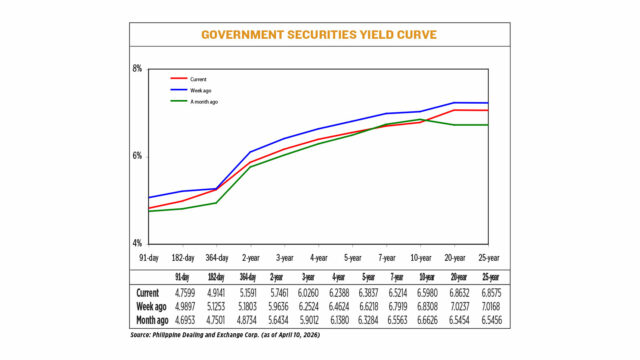
GS yields, which move opposite to prices, fell by 19.92 basis points (bps) on average week on week, based on PHP Bloomberg Valuation Service Reference Rates data as of April 10 published on the Philippine Dealing System’s website.
Rates fell across all tenors. At the short end, rates of the 91-, 182-, and 364-day Treasury bills (T-bills) declined by 22.98 bps, 21.12 bps, and 2.12 bps week on week to 4.7599%, 4.9141%, and 5.1591%, respectively.
At the belly, the two-, three-, four-, five-, and seven-year Treasury bonds (T-bond) saw their rates decrease by 21.75 bps (to 5.7461%), 22.64 bps (6.026%), 22.36 bps (6.2388%), 23.81 bps (6.3837%), and 27.05 bps (6.5214%), respectively.
Lastly, at the long end, yields on the 10-, 20-, and 25-year debt decreased by 23.28 bps (to 6.598%), 16.05 bps (6.8632%), and 15.93 bps (6.8575%), respectively.
GS volume traded reached P68.18 billion on Friday, lower than the P69.43 billion recorded a week earlier.
Debt yields went down week on week despite growing domestic inflation concerns as the US and Iran agreed on a temporary ceasefire, Security Bank Corp. Trust Asset Management Group Chief Investment Officer Noel S. Reyes said in an e-mail.
“Bond yield movement has been a factor of how inflation will be affected as a result of the continued oil supply situation in the Middle East due to the war. The 4.1% CPI (consumer price index) print confirmed the concerns and spillover to downstream sectors, [such as the] transport of goods and services, logistics, and expectations for it to continue to rise. Had it not been for the ceasefire, a correction of yields lower this week could not have been attained,” he said.
“Our GS market moved on expectations of inflation impact and potential BSP (Bangko Sentral ng Pilipinas) action as a consequence of the war and high oil supply prices directly, and on second-round effects to other products and services.”
He added that a huge bond maturity last week also helped bring yields down from their recent highs as players sought to reinvest their liquidity.
Debt yields corrected lower as the US-Iran ceasefire caused global oil prices to decline and the peso to return to the P59 level against the greenback, which could help ease inflationary pressures, Rizal Commercial Banking Corp. Chief Economist Michael L. Ricafort said in a Viber message.
“Even before the said two-week ceasefire, there was already some demand after most of the long-term PHP BVAL yields already reached the peak around March 23-24, since much of the bad news or risk of escalation of the war in the Middle East were already priced in by then,” he said.
The US and Iran failed to reach an agreement to end their war despite lengthy talks that concluded on Sunday in the Pakistani capital Islamabad, jeopardizing a fragile ceasefire, Reuters reported.
Each side blamed the other for the failure of the 21-hour-long negotiations to end fighting that has killed thousands and sent global oil prices soaring since it began over six weeks ago.
The talks in Islamabad, after a ceasefire earlier in the week, were the first direct US-Iranian meeting in more than a decade and the highest-level discussions since the 1979 Islamic Revolution.
Iran’s semi-official Tasnim news agency said that “excessive” US demands had hindered reaching an agreement. Other Iranian media said there was agreement on a number of issues but that the Strait of Hormuz and Iran’s nuclear program were the main points of difference.
Despite the differences in Islamabad, three supertankers fully laden with oil passed through the Strait of Hormuz on Saturday, shipping data showed, in what appeared to be the first vessels to exit the Gulf since the US-Iran ceasefire deal.
Hundreds of tankers are still stuck in the Gulf, waiting to exit during the two-week ceasefire period.
Meanwhile, Philippine headline inflation quickened to 4.1% in March, faster than the central bank’s expected 3.1%-3.9% print for the month, as oil prices soared amid the Middle East war.
This was up sharply from the 2.4% in February and 1.8% in the same month a year ago, making it the fastest and the first time that it breached the BSP’s target since July 2024.
The Philippines is a net oil importer, sourcing the bulk of its oil from the Middle East.
The BSP said inflation risks have “significantly” grown amid the conflict, adding that a sharp and prolonged oil price shock could trigger spillover effects, second-round impact, and risk disanchoring expectations.
The central bank earlier said it expected inflation to accelerate past its target band by April, with its full-year forecast now at 5.1%.
The Monetary Board last month maintained its policy rate at 4.25% in an off-cycle meeting as it reassured markets while it continues to assess the economic impact of the Middle East war. Its next review is on April 23.
For this week, Mr. Ricafort said developments in the Middle East conflict will remain in focus.
“Everything is still fluid despite the ceasefire. This temporary break is fragile and could easily end ahead of the deadline. Inflation is still sure to rise as on top of second-round effect, there is also the low base last year,” Mr. Reyes added. — Abigail Marie P. Yraola with Reuters