Home Blog Page 322

DMCI Mining says nickel output up 33% in 2025; Long Point mine set to start operations

DMCIHOLDINGS.COM

DMCI MINING CORP. said its nickel ore production rose 33% to 2 million wet metric tons (WMT) in 2025, driven by higher output from its Zambales mines and initial operations at its Long Point project in Palawan.

Ore shipments also grew 31% year on year to 1.9 million WMT, the company’s second-highest shipment level, it said in a statement over the weekend.

The company cited improving market conditions and operational gains. Average benchmark Philippine free-on-board (FOB) prices for 1.5% grade laterite nickel ore increased 26% to $45.70 per WMT in 2025 from $36.30 in 2024.

“The combination of our record production, strong prices and the continued progress of our Long Point development gives us solid growth prospects, both for the company and for our host communities,” DMCI Mining President Tulsi Das C. Reyes said.

In August 2025, Berong Nickel Corp. (BNC), a DMCI Mining subsidiary, secured a 25-year mineral production sharing agreement for its Long Point Nickel Project in Aborlan, Palawan, covering 2,177 hectares.

“We are confident that in the very near future, we can get the Palawan mine open. We are just waiting for permits. Two to four weeks, we can start mining,” Mr. Reyes told reporters.

With the Palawan project and the two existing Zambales mines, DMCI Mining expects stronger output in 2026. “I think we will have a historic year this year. Prices have been strong. If everything is done right, we can ship out 3 million tons this year,” he said.

BNC has also rehabilitated over 174 hectares at its Quezon mine under the country’s first approved Final Mine Rehabilitation and Decommissioning Plan (FMRDP) for a nickel operation. The Quezon mine, which operated from 2006 to 2021, produced 10.4 million WMT of nickel ore, generated more than 1,600 jobs, and contributed about P2.8 billion to the economy.

The company said BNC has exceeded its Year 3 rehabilitation targets, with the program on track for completion in 2027, after which the restored area will be turned over to the government.

Apart from BNC, DMCI Mining operates mines in Zambales through Zambales Diversified Metals Corp. and Zambales Chromite Mining Company, shipping nickel ore to China and other international markets.

DMCI Mining is a subsidiary of listed holding firm DMCI Holdings, Inc. — Vonn Andrei E. Villamiel

Bespoke glasses anyone?

HERIAN BOCCALI

WHILE Herian Boccali’s eyewear business may have started in 2016, one may well say that Mr. Boccali has been working in the optical industry since the day he was born.

Mr. Boccali was in the Philippines from Feb. 5 to 8, specifically at Rustan’s Makati where, at the beauty floor, he conducted bespoke eyewear consultations for Rustan’s customers — especially for those who could afford them. After all, his ready-to-wear line for his brand, Herian, already costs P42,500 a pair. Made with buffalo horn or acetate, each pair is handmade at his workshop in Florence.

Mr. Boccali, dressed in a chic but definitely utilitarian denim work vest with matching pants (paired with deck shoes with a heel), wore one of his creations: a heavy, rounded ultramarine pair with a little white gold arm, signifying their handmade nature.

When we pointed out that his experiences began with his mother’s own optical shop, he corrected us by saying that his grandfather started the business, placing him in the third generation of the business. “We are in the same world,” he said, though his work differs by having his glasses created from start to finish all by hand.

“The idea to develop something unique for my client is born inside me, for a long time,” he said in an interview. “The most difficult thing is to process a way to make (something) one-for-one for my client.” After all, “Glasses are not just accessories, but an integral part of the wearer’s identity,” he said.

Glasses are a necessary tool, enabling one to see the world more clearly. But in his hands, the tool becomes art, and part of this is due to their unique, handmade quality. “The possibility to personalize (means) that we help to make the identity of the client they want (expressed) in their pair of glasses.”

“Everybody has their own identity,” he said.

BESPOKE EXPERIENCES
Jackie Avecilla, head of marketing for Rustan Commercial Corp., said that Mr. Boccali went to the Philippines due to a chance encounter with Anton Huang, president and chief executive officer (CEO) of SSI Group and Rustan Commercial Corp. According to Ms. Avecilla, Mr. Huang had been walking around Florence and stepped into his shop, after which they got to talking about the brand, ending with Mr. Huang commissioning a pair of glasses for himself. Mr. Huang then extended an invitation for Mr. Boccali to come to the Philippines.

Mr. Boccali’s presence in the store may have been limited for a limited time only (though his ready-to-wear line will stay on display and for sale for two months, or while supplies last), but his presence heralds a renewed thrust for Rustan’s to add more to the shopping experience.

“We’ll have more,” said Ms. Avecilla of these intimate experiences with artisans and makers. “Not just with glasses, but also with fashion and other (departments)… even up to our home brands.

“One of the thrusts for Rustan’s and the vision of our president and CEO is to bring in brands like these, that are more bespoke, that are more tailor-fit for our customers,” she said. “It’s the kind of brand that you can’t find anywhere else.

“It’s not popular… but I think that’s the beauty of it, really. It’s understated luxury,” she said. — Joseph L. Garcia

TP LaunchPad marks breakthrough year with over 19,000 students reached

TP in the Philippines marked a record year for TP LaunchPad, its flagship student empowerment program, reaching over 19,000 students across 40+ partner schools to bridge the gap between academic institutions and the growing IT-BPM industry. The program champions skills development resources such as mock interviews and training, mentorship sessions, job fairs, and site tours to prepare students for IT-BPM careers.

TP has also formalized a strategic partnership with Mapua Malayan Colleges Laguna (MMCL) and its digital learning arm, Mapua Malayan Digital College (MMDC). This collaboration will prepare future graduates for a career in IT-BPM through curriculum integration, and empower TP employees who wish to pursue further studies with MMDC through employee scholarships.

Teleperformance in the Philippines is part of the TP Group, a global leader in digital business services, which consistently seeks to blend the best of advanced technology with human empathy to deliver enhanced customer care that is simpler, faster, and safer for the world’s biggest brands and their customers.

The Group’s comprehensive, AI-powered service portfolio ranges from front-office customer care to back-office functions, including operations consulting and high-value digital transformation services. It also offers a range of specialized services such as collections, interpreting and localization, visa and consular services, and recruitment process outsourcing services. The teams of multilingual, inspired, and passionate experts and advisors, spread in close to 100 countries, as well as the Group’s local presence allows it to be a force of good in supporting communities, clients, and the environment.


SparkUp is BusinessWorld’s multimedia brand created to inform, inspire, and empower the Philippine startups; micro, small and medium enterprises (MSMEs); and future business leaders. This section will be published every other Monday. For pitches and releases about startups, e-mail to bmbeltran@bworldonline.com (cc: abconoza@bworldonline.com). Materials sent become BW property.

BSP says tighter due diligence for large withdrawals only needed once per client

A MAN counts a wad of Philippine peso bills in Makati City, Metro Manila, Philippines, Sept. 19, 2018. — REUTERS/ELOISA LOPEZ

THE BANGKO SENTRAL ng Pilipinas (BSP) said banks only need to conduct enhanced due diligence (EDD) once per customer for cash withdrawals over P500,000 and not per transaction to prevent delays.

In a circular dated Feb. 6, the central bank clarified that clients only need to submit supporting documents once to verify the legitimacy of their covered transactions.

“In implementing the enhanced due diligence requirements under BSP Circular No. 1218, BSFIs (BSP-supervised financial institutions) shall conduct EDD for cash withdrawals exceeding P500,000 on a per customer basis, instead of per transaction basis,” the BSP said. “This shall cover the customer’s usual business transactions.”

“BSFIs must ensure that EDD procedures do not unduly delay legitimate transactions by streamlining processes and providing branch personnel with targeted training to promote consistent, efficient, and effective implementation.”

The BSP said banks may also employ a due diligence process tailored to a customer’s risk profile, nature of business, and transaction patterns. This can be applied to their other transactions like inter-branch or interbank cash requirements, or loan disbursements.

“Meanwhile, more rigorous EDD shall be applied when transactions deviate from a customer’s expected behavior or present heightened risks,” it said.

In September last year, the BSP issued a circular imposing a P500,000 ceiling on cash withdrawals due to emerging anti-money laundering risks from the flood control corruption scandal.

It allows clients to withdraw a maximum of P500,000 or its equivalent in foreign currency at once or via multiple transactions within one banking day. However, withdrawals above the threshold may still be allowed if customers show a legitimate business purpose.

BSFIs must review these transactions by performing EDD based on the documents provided by a client. — Katherine K. Chan

Affordable and accessible healthcare is a fundamental Constitutional right

PHILIPPINE STAR/RYAN BALDEMOR

The Supreme Court decision on the unconstitutional transfer of the PhilHealth (Philippine Health Insurance Corp.) funds was not just about voiding it and returning to PhilHealth the P60 billion that the National Government took away.

The Court upheld the position of the petitioners that the General Appropriations Act (GAA) approved by Congress, signed by the President, and implemented by the Department of Finance (DoF) violated the right to health.

To quote the Supreme Court decision (page 107, Dec. 5. 2025): “Special Provision 1(d) of the 2024 GAA and DoF Circular No. 003-2024 infringed the people’s right to health and right to an affordable, sustainable, and accessible public healthcare insurance.”

The new Solicitor General, Darlene Marie Berberabe, acknowledged this key message from the unanimous decision of the Supreme Court. She said that the Supreme Court “has now clarified the Constitutional path.”

HEALTH AS A FUNDAMENTAL RIGHT
The Supreme Court decision cited two articles in the Constitution that link the right to health (Article II Section 15 and Article XIII Sections 11, 12, and 13) which means it is not a right that stands alone but is intertwined with other Constitutional provisions, elevating it to a fundamental and Constitutional right.

The Marcos Jr. government said the right to health is too broad and multifaceted, therefore difficult to implement.

The Court could not have been clearer: “Indeed; Article XIII, Section 11 of the Constitution holds this facet of the right to health as a prime goal, and specifically mandates the State to endeavor to make health services available to all at affordable costs. As the right to have affordable and accessible healthcare for all has been raised to the level of constitutional or fundamental right, it has become a core content or the minimum standard of the right to health.”

By removing resources from the health system, the government violated this fundamental right.

The Court went even further and said that the right to affordable and accessible health for all is self-executing, without a need for an enabling law.

The Court praised the Universal Health Care Act (UHCA) for its clarity:

“Nonetheless, the UHCA was enacted precisely to give this right a clear and unequivocal connection to the right to health and a specific structure or form. One of the purposes of the UHCA is to provide a comprehensive set of quality and cost effective, promotive, preventive, curative, rehabilitative and palliative health services to the Filipino people. In other words, the UHCA was enacted to transform Article XIII, Section 11 of the Constitution into reality and to realize universal healthcare, which means, healthcare for all Filipinos implemented through the structural framework of a sustainable public healthcare insurance system — the National Health Insurance Program (NHIP) — which ensures the provision of individual-based health services.”

The Court admonished government that the 10-year implementation period in the UHCA “is not a license to stray — even momentarily — from its mission.”

Chief Justice Gesmundo also told the government that the phrase “endeavor to make essential goods, health and other social services available” should not be an excuse for delaying UHCA. The word “endeavor,” he pointed out “was not intended by the Constitutional Commissioners to serve as a convenient excuse for the State to be complacent in promoting our people’s right to health and healthcare.”

Cited in the decision, Justice Jhosep Lopez wrote: “Unfortunately, even prior to Special Provision l(d) and DoF Circular No. 003-2024, progress towards the fulfillment of the UHCA’s unequivocal mandate — the progressive realization of universal healthcare for all Filipinos — has been sluggish at best.”

GOV’T ALMOST DESTROYED NHIP
The illegal act of removing funds from PhilHealth did not only retard health improvements. It also disregarded and violated many other provisions of the UHCA.

According to the Supreme Court “this ingenious move came, too, with the chilling threat to the very security and viability of the continued operations of the NHIP [National Health Insurance Program], as it completely overlooked systematic safeguards, e.g., the setting of actuarially estimated ceilings and consideration of the Provision for ICL [Insurance Contract Liabilities], put in place specifically for special industries like the insurance business. Not only did this realignment of funds snatch aspirations for healthcare advancement, it threatens to destroy, too, the existing program which Filipinos currently have to live with.”

The Supreme Court called this another breach of the Constitutional right to health: “Verily, it is clear that the people’s right to health was not merely deprioritized — it has been, with respect, brazenly disregarded.”

With this decision, the Supreme Court has agreed that the violation of the right to health does not need proof of denial or lack of health services or benefits. To emphasize, “Rather, it is sufficient to demonstrate that a government action — specifically, the diversion of PhilHealth’s ‘reserve funds’ through Special Provision l(d) and DoF Circular No. 003-2024 — has materially undermined the core legal and ethical obligations enshrined in the UHCA, particularly Section 11. It constitutes an infringement of the statutory and constitutional commitment to affordable and accessible healthcare for all Filipinos.”

WILL GOV’T FOLLOW CONSTITUTIONAL PATH?
The Executive and the Legislative branches of government have been told not to deviate from assuring the Constitutionally guaranteed right to health, specifically affordable and accessible health for all.

Yet, what we see is insubstantial compliance without accountability from government. The boast that the P60 billion has been returned sounds hollow in the face of the deliberate defunding of UHCA and PhilHealth to the tune of P356 billion from 2023-2025. For 2026, PhilHealth’s budget remains deficient, with the GAA failing to fund fully the contributions of the indirect contributors such as the indigents, senior citizens, persons with disabilities, and others with no capacity to pay.

While Congress and Malacañang has defunded PhilHealth, they have significantly increased the budget for MAIFIP (Medical Assistance to Indigent and Financially Incapacitated Patients), a form of political patronage, from the originally proposed budget of P24.2 billion to P51.6 billion.

And so, the Supreme Court decision continues to be ignored. Government continues to violate the right to affordable and accessible health for all Filipinos. And it does so “brazenly.”


Jeepy Perez, a doctor of medicine, specializes in public health administration, primary healthcare, and has worked with nine health secretaries and three NEDA secretaries since 1992. He has worked on community-based health programs, the Philippine local health systems, TB program, health information systems, and public and private reproductive health and family planning programs in the Philippines. He was undersecretary for Population and Development and executive director of the country’s Commission on Population and Development up to Sept. 8, 2022, when he retired. He occasionally writes for Action for Economic Reforms.


PLDT Enterprise expands satellite connectivity via Starlink

STOCK PHOTO | Image by Hunter Masters from Unsplash

PLDT INC. said its corporate arm PLDT Enterprise is strengthening its presence in satellite-enabled connectivity by leveraging Starlink services, following its accreditation as an authorized reseller for both public and private sectors.

“Within a year of deployment, Starlink has reached customers across the public sector, agriculture, banking, and other key industries — underscoring the accelerating adoption of satellite connectivity as a practical, enterprise-grade solution, particularly in underserved locations,” PLDT Senior Vice-President and Enterprise Business Head Patricio S. Pineda III said in a statement on Sunday.

PLDT Enterprise said its service is being used by government agencies and enterprise customers, supporting mission-critical operations and providing digital connectivity for key sectors such as education, healthcare, and disaster response.

Since becoming an authorized Starlink reseller, the PLDT unit has integrated Starlink’s low-earth-orbit (LEO) satellite technology into its portfolio of enterprise-grade internet solutions.

“We have been delivering it as part of a fully managed, end-to-end connectivity ecosystem across the PLDT Enterprise Business Group — integrating fiber, wireless, managed SD-WAN, cybersecurity, data centers, and cloud solutions — allowing businesses to achieve resilience and scale through a single, trusted partner,” Mr. Pineda said.

The company said Starlink connectivity can now be deployed not only as primary access in remote locations but also as backup for critical operations, as LEO satellites provide standalone service capabilities.

According to a global network intelligence and connectivity insights firm, the Philippines is now the sixth-largest market for Starlink.

The 2025 Global Satellite Broadband Performance Report by Ookla noted that since 2019, SpaceX has launched 10,790 satellites, serving 9.2 million satellite internet customers globally. Starlink’s largest markets are the United States, Mexico, Indonesia, Brazil, and Canada, with the US accounting for 22.5% of customers and the Philippines 4.2%.

Hastings Holdings, Inc., a unit of PLDT Beneficial Trust Fund subsidiary MediaQuest Holdings, Inc., has a majority stake in BusinessWorld through the Philippine Star Group, which it controls. — Ashley Erika O. Jose

High-value crop export drive to require scaled-up output

PHILSTAR FILE PHOTO

By Vonn Andrei E. Villamiel

INCREASED PRODUCTION and the development of higher-quality varieties are critical to expanding high-value crop exports, as the Philippines signaled plans to diversify its agricultural export portfolio, analysts said.

“We should scale up new planting so we can have more opportunities to go to other markets abroad. The government should produce quality seedlings of export-oriented commodities to achieve higher productivity and quality of produce,” Former Agriculture Secretary William D. Dar told BusinessWorld via Viber.

He said an increase in production volume and quality is needed to make Philippine agricultural products more globally competitive.

In a statement last week, the Department of Agriculture (DA) said it is seeking to broaden the country’s export base by promoting 10 additional high-value crops, — asparagus, avocado, cacao, calamansi, coffee, dragon fruit, durian, okra, pomelo, and rambutan.

The Philippine Statistics Authority, citing preliminary data, said several of the identified crops are already present in overseas markets, although export values remain relatively small and are concentrated in a few destinations.

Calamansi and calamansi products posted the highest export value among the 10 crops at $11.76 million in 2025, with China as the top market. Durian followed with $8.82 million, also largely shipped to China.

Coffee and coffee products exports in 2025 amounted to $7.51 million, with the US, Taiwan, and Canada being the major markets.

Exports of chocolate and chocolate preparations hit $6.53 million in 2025, with major markets including Indonesia, Japan, Thailand, and Malaysia. Okra exports were valued at $3.75 million, primarily going to Japan, while avocado exports amounted to $2.44 million, with South Korea and Japan as leading destinations.

Mr. Dar said crops with an established export base, such as durian and avocado, stand to benefit the most from aggressive promotion, provided that supply is increased.

Former Agriculture Undersecretary Fermin D. Adriano, however, cautioned that some of the crops identified by the DA might face challenges.

“Asparagus requires temperate weather. We also need a better avocado variety that has little stemmy root inside,” he told BusinessWorld via Viber.

Mr. Adriano added that calamansi may be less convenient for consumers in some markets compared with lemon-derived products, while rambutan has limited export prospects, judging by the export performance of top producer Thailand.

He identified ube (purple yam) and pili nuts as other potential export crops. In 2025, ube and ube preparations recorded exports worth $1.65 million, mainly to the US, while pili exports were valued at $36,000, with shipments largely limited to Saudi Arabia.

Mr. Adriano also raised concerns over funding and institutional support, saying that about 70% of the DA’s budget is allocated to rice, limiting resources for export-oriented crops.

He cited the lack of a clear engagement strategy with the private sector and questioned whether current research and development efforts adequately support varietal improvement and productivity in high-value crops.

Philip C. Young, Agriculture assistant secretary for export development, told BusinessWorld that the DA will consolidate the management of export-oriented high-value crops under a single office, which he will head.

Crops to be covered by the new office include the 10 identified by the DA for export promotion. At present, initiatives for all high-value crops are under the High-Value Crops Development Program.

Mr. Young said DA officials are scheduled to meet this month to finalize the functions, organizational structure, personnel, and budget requirements of the proposed office.

“It’s under organization, that new office, but we are already preparing some framework and program for the commodities,” he said by phone.

New York Fashion Week spotlights American brands that have bucked luxury slowdown

MODELS present creations from the Ralph Lauren Spring 2026 collection during New York Fashion Week in New York City, Sept. 10, 2025. — REUTERS FILE PHOTO/ANGELINA KATSANIS

NEW YORK — New York Fashion Week (NYFW) will kick off the month-long fashion show season on Wednesday, at a time when some US labels are finding new popularity even as the luxury industry struggles with a global slowdown.

Among the closely watched catwalk shows will be Ralph Lauren and Coach, both of whom have bucked the trend and are enjoying strong demand, with preppy styles in and some shoppers opting for more affordable handbags after sharp price hikes at the likes of Chanel and Dior.

Efforts to reform NYFW are underway after the event suffered from a decline in sponsorship from big brands, with some large labels opting to stage shows outside the usual calendar.

“It is our goal to make it easier for designers to be able to show a collection and not have to worry about where do we get the funds,” said Imad Izemrane, co-founder and chief executive officer of N4XT Experiences, which has been working on improving NYFW. Changes already implemented in September included setting up a central venue for shows to avoid visitors crisscrossing the city and getting stuck in traffic.

Ralph Lauren’s show takes place on Tuesday at the Jack Shainman Gallery, ahead of the official start of NYFW on Wednesday when designer Rachel Scott will show her debut collection for Proenza Schouler.

Among the other names on the agenda are Carolina Herrera and Michael Kors, while young Romanian designer Lorena Pipenco will close the week with her brand Pipenco’s debut show. Overall some 60 labels will host catwalk shows or designer presentations at NYFW, which runs from Feb. 11 to 16. — Reuters

How minimum wages compared across regions in January

(After accounting for inflation)

In January, inflation-adjusted wages were 21.5% to 27% lower than the current daily minimum wages across the regions in the country. Meanwhile, in peso terms, real wages were lower by around P91.16 to P149.05 from the current daily minimum wages set by the Regional Tripartite Wages and Productivity Board.

Nissan Zeal

A Nissan Z is parked on the pitlane at Clark International Speedway. — PHOTO BY KAP MACEDA AGUILA

Brand celebrates legacy, community with first-ever festival in PHL

By Joyce Reyes-Aguila

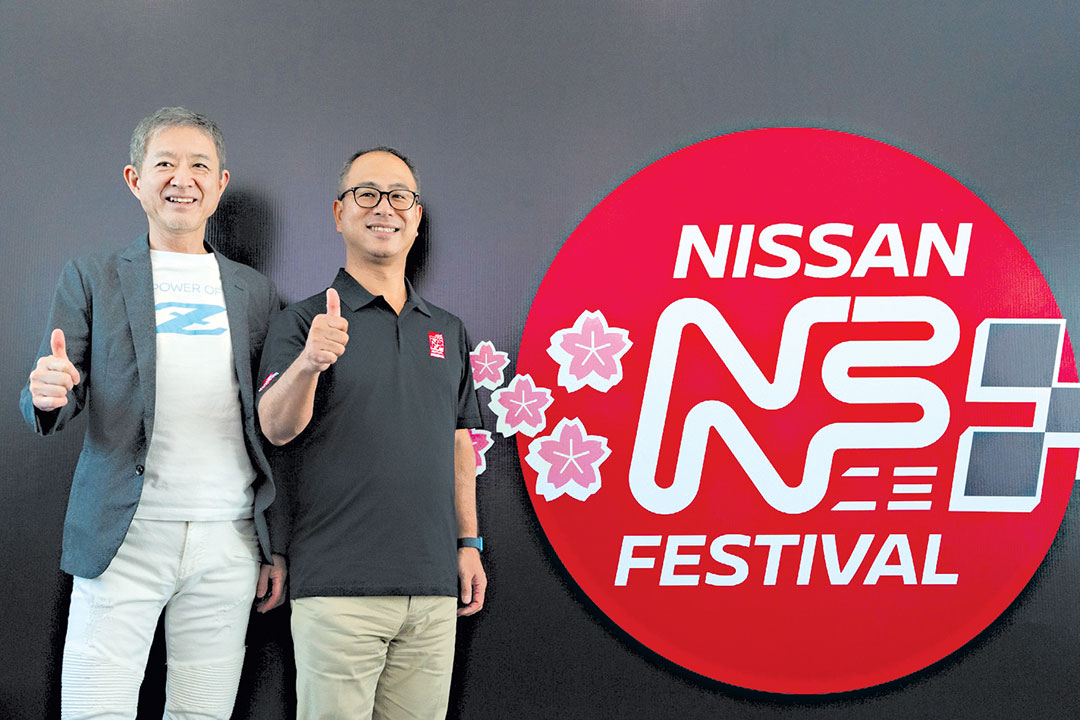
NISSAN PHILIPPINES, INC. (NPI) pulled all the stops for its brand enthusiasts with the staging of the country’s first Nissan Festival. Over 1,700 fans, car club members, and visitors gathered at the Clark International Speedway last Feb. 1 to celebrate their passion for everything the marque stands for.

Nissan Philippines President Masao Tsutsumi described the event as a “great milestone” where Nissan fans had the chance “to drive, see, and touch the cars which are really the inspiration and heart of Nissan. This event will increase their affinity to the brand and will be an opportunity for them to (reaffirm) their love for Nissan.”

The Nissan Festival, pillared on the theme “Driven by Passion, Powered by Legacy,” featured a parade of 50 vehicles from various car clubs and 10 heritage vehicles that showcased iconic Nissan nameplates from the past and present. Nissan Philippines also flew in Hiroshi Tamura, considered the godfather/father of the GT-R. “I’ve said it in the past and still believe that the GT-R is a car that represents the essence of Nissan DNA. Our passion toward creating exciting products and our willingness to take on extreme challenges have been represented in this car,” he expressed in a past interview for Nissan’s global website.

Three lucky festival participants experienced the track through a ride-along session with the legendary Mr. Tamura, a product specialist who had also been once involved with the iconic Nissan Maxima/Cefiro model earlier in his career.

In a press conference, Mr. Tamura, now retired from Nissan but still eagerly functioning as a brand ambassador, recalled how the Hakosuka (a combination of the Japanese words for “box” and “skyline”) GT-R, launched in 1969, inspired him to design the vehicle’s future models. “The first-ever (car) racing motor was screaming,” he recalled to members of the press and content creators. “(It was driven by) Mr. Kunimitsu Takahashi, super legendary driver, who won the race. It served as an inspiration for (and an experience that) imprinted on me when I was 10 years old. That’s Nissan’s first invitation for me (to be with the brand) and create a GT-R.”

The afternoon session at Nissan Festival was highlighted by driving exhibitions headlined by Nissan brand ambassador Matteo Guidicelli, motorsports celebrity Marlon Stockinger, F4 Motul racer and brand ambassador Iñigo Anton, and drifter Ashley Sison.

Mr. Tsutsumi confirmed that Nissan Philippines will be “bringing many new models to the Philippines” with “many new technologies and advanced powertrains. All of these are to further strengthen our confidence and presence in the Philippines. I would really like every Nissan fan here in the Philippines to be excited and be proud Nissan owners and drivers.”

In response to a question from “Velocity” on what segments he forecasts will be strong for the brand in 2026, the executive teased that the brand “can create demand generation in a new segment with (its) model launches this year.” According to Mr. Tsutsumi, Nissan Philippines will launch all its new vehicles at the Philippine International Motor Show (PIMS) from June 4 to 7 at the World Trade Center in Pasay City.

Following a dip in pickup sales last year because of the Capital Markets Efficiency Promotion Act (CMEPA) which effectively restored the excise tax to the segment, the president expressed confidence that the segment will “show recovery sooner or later as it is very much a necessary segment in Filipino life, so demand should come.”

He added, “Nissan struggled (last) year because a lot of our business comes from pickup trucks, and sales were impacted.” The brand’s pickup model, the Nissan Navara, had the second-highest sales for the brand locally last year, after the Nissan Terra and followed by the Livina and Urvan, according to the executive.

Meanwhile, In an exclusive interview with “Velocity,” NPI Product Marketing Assistant General Manager Sherwin Kuan revealed that the brand’s to-be- launched vehicles will include “several electrified models because that’s what the market is looking for. It’s going to be a mix — not just BEVs (battery electric vehicles). Filipinos are so open now to owning one (of the electrified options). They’re able to realize the advantages of having a hybrid vehicle or BEV. We hope the Nissan customers from before will really consider these for their next car.”

With the success of the first-ever Nissan Festival, Mr. Kuan reaffirms the value of community for Nissan Philippines. “We want to continue reconnecting with our past customers, and we want to keep building our brand toward the future.”

Debt yields decline on within-target inflation

YIELDS on government securities (GS) traded at the secondary market closed mostly lower last week as players continued to bet on a rate cut by the Bangko Sentral ng Pilipinas (BSP) this month, with inflation staying within target in January despite a slight uptick.

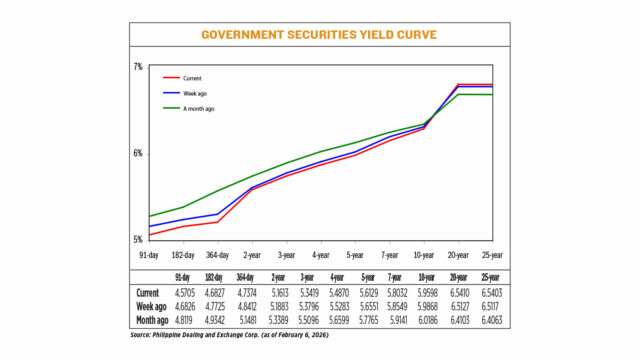
GS yields, which move opposite to prices, declined by an average of 4.32 basis points (bps) week on week, based on the PHP Bloomberg Valuation Service Reference Rates as of Feb. 6 published on the Philippine Dealing System’s website.

At the short end, yields ended lower across all tenors, with the 91-, 182-, and 364-day Treasury bills (T-bills) declining by 11.21 bps, 8.98 bps, and 10.38 bps week on week to fetch 4.5705%, 4.6827%, and 4.7374%, respectively.

At the belly, rates of the two-, three-, four-, five-, and seven-year Treasury bonds (T-bonds) likewise dropped by 2.7 bps (to 5.1613%), 3.77 bps (5.3419%), 4.13 bps (5.487%), 4.22 bps (5.6129%), and 5.17 bps (5.8032%), respectively.

Meanwhile, the long end was mixed, as yields on the 20- and 25-year debt inched up by 2.83 bps to 6.541% and 2.86 bps to 6.5403%, respectively, while the rate of the 10-year tenor dropped by 2.7 bps to 5.9598%.

GS volume traded decreased to P46.61 billion on Friday from P118.3 billion a week prior.

“Philippine GS yields moved lower week on week as January inflation, while slightly higher at 2%, remained well within the BSP’s target and did not materially change the policy outlook,” the first bond trader said.

“Combined with a softer growth backdrop, this kept demand strong, particularly at the short to belly of the curve, as investors continued to look for safe-haven placements.”

The second bond trader said the faster-than-expected inflation print caused yields to tick higher last week, but these increases weren’t enough to fully reverse the gains from the market’s rally following the earlier release of weak gross domestic product (GDP) growth data.

Philippine headline inflation accelerated to 2% in January from 1.8% in December, but slowed from the 2.9% in the same month last year. This was the fastest in 11 months or since 2.1% in February 2025.

It was also higher than the 1.8% median forecast from a BusinessWorld poll of 18 economists, but was within the BSP’s 1.4%-2.2% estimate for the month.

The central bank said in a statement that inflation remains benign and reiterated that their monetary easing cycle could end soon, with further cuts to be limited and data-dependent.

BSP Governor Eli M. Remolona, Jr. earlier said a cut is possible at the Monetary Board’s Feb. 19 meeting if they see the need to support domestic demand.

Philippine GDP growth slowed to a five-year low of 4.4% last year, missing the government’s 5.5%-6.5% target amid the fallout from a corruption scandal that affected both public and private spending.

The Monetary Board has reduced benchmark rates by 200 bps since August 2024, bringing the policy rate to 4.5%.

“Markets were also defensive ahead of the jumbo 10-year issuance on Feb. 18. Pricing the new 10-year bond would be key to where the yield curve will shift in the coming weeks,” the second trader said.

The Bureau of the Treasury announced on Friday that it will auction off new 10-year benchmark bonds, through which it wants to raise at least P30 billion. The offer also has an exchange offer component.

A rate-setting auction is scheduled for Feb. 18, with the offer period set to run until Feb. 20, unless adjusted by the Treasury. The bonds will be issued on Feb. 23.

For this week, the second trader said the yield curve will remain well supported, especially at the belly, amid strong liquidity.

“Markets will monitor data outside of the US like the US payroll numbers to be released on Feb. 11. Given no significant data releases locally, local bonds would likely trade in sympathy to US bond yield movements.”

“Looking ahead, yields are expected to stay supported, with market focus on BSP guidance, and global developments, including US rate expectations, while the announced 10-year supply is largely seen as already priced in,” the first trader added. — Heather Caitlin P. Mañago

How to get the regular Juan and Juana to wear Pinoy tela

A BLOUSE from the DoST-PTRI Kawayarn (a play between the Tagalog word for bamboo, “kawayan” and “yarn”) exhibit, Sept. 2024.

HOW TO GET Philippine Tropical Fabrics into the mainstream was one of the major topics during the 2026 National Textile Convention (TELACon).

One of these ways is to mandate its use in law, and this is already a requirement for government workers. Republic Act No. 9242, otherwise known as the Philippine Tropical Fabrics (PTF) Law, prescribes the use of PTFs for uniforms.

But what most people don’t know is that besides uniforms the law also covers “and for the purposes which require the use of fabrics in government offices and functions.”

Julius Leaño, Jr., director of DoST-PTRI (Department of Science and Technology – Philippine Textile Research Institute), said during the Jan. 29 talk at the Philippine International Convention Center, “Mainstreaming PTF, Government Uniforms and Beyond,” that the use of PTFs covers everything that has cloth: from table linens to upholstery. “Anything that’s textile-based in any government office must be made of PTF.” 

The law defines PTFs as fabrics containing natural fibers produced, spun, woven, or knitted and finished in the Philippines. At least 5% of the textile fibers used must be produced in the Philippines, the most popular being abaca, pineapple, banana, silk, and bamboo.

Mr. Leaño said that there is some confusion and overlap between using PTFs and indigenous textiles, such as the handloom-woven products by various groups around the country. “They may be used as accents,” he said, though using handloom woven products does not necessarily mean that they are compliant with the law. Thus a circular from the Civil Service Commission in 2024 revised the dress code for government offices to use traditional Filipiniana dress on Mondays — this is when those handwoven products can be used — but for the rest of the week, more standard fabrics incorporating the aforementioned fibers can be used.

He said that a report from the Civil Service Commission says that 48% of government offices are in compliance with RA 9242 — however, PTRI’s own report says that only 2% are actually compliant. But “once the private sector involvement [in manufacturing these fabrics] comes in, 98% [compliance will come] in a blink of an eye,” he says.

PIÑA CAMOUFLAGE?
Using PTF goes beyond the civil servants’ polo barong though — coming soon will be camouflage uniforms for the army.

Charmaine Diaz is the founder and chief executive officer of CKDiaz Worldwide Enterprise, a company that makes government uniforms as well as uniforms for the army, and they are working to comply with the law for the latter. She said that the rollout of camouflage uniforms incorporating PTF for the Philippine Armed Forces may begin next year.

It took some time to develop them due to the unique specifications and testing that army uniforms have to go through. They learned that fabric made with abaca proved durable, while pineapple fiber had antibacterial properties, doing away with the extra cost of antibacterial coatings and finishing. However, they are still limited by a lack of a standard for battle dress attire.

Matthew “Chuck” Lazaro, vice-president and director of Asia Textile Mills Inc., which produces and processes these natural plant fibers, said that affordability is one of the roadblocks to these fabrics hitting the mainstream. But while clothes made with PTF may be more expensive than mass-produced Chinese garments, he and Kingsmen Corp. (another clothing manufacturer) President Kristine Racho-Orobia reiterate that they’re still cheaper than other imported brands — and that the public might as well spend that money at home.

Mr. Lazaro said that they can actually supply more fiber, with 80,000 tons of pineapple fiber available. However, it remains expensive because of other costs including labor, and he thinks farm automation might speed up and reduce the costs of production.

HINDI NA MAKATI
Ms. Racho-Orobia tackled one issue that the regular customer may consider before wearing Philippine fabrics. “Hindi naman makati eh (it’s not itchy),” she said, referring to the stereotype that these fabrics can be uncomfortable. “Nowadays, with the way we treat it right now, hindi na siya makati (it’s no longer itchy),” Mr. Lazaro agreed.

Ms. Racho-Orobia, wearing a white blouse made of pineapple fiber, said that she will begin to boast of the fabric’s make, attaching the word “Philippine” to describe it — in the same way she used to say, “Egyptian cotton” or “French lace.”

On the issue of affordability, she said that one can make up a capsule wardrobe, and veer away from the overconsumption of fast fashion. “You don’t need to buy a lot of clothes,” she said.

Just good ones. — Joseph L. Garcia