Home Blog Page 3099

PEZA expects locators to thrive within Luzon Economic Corridor
THE Philippine Economic Zone Authority (PEZA) said many of its locators will thrive when the Luzon Economic Corridor infrastructure initiatives are put in place, citing the strengthening of interconnectivity between Central Luzon and Calabarzon.

In a statement on Thursday, PEZA Director General Tereso O. Panga said about 1,600 PEZA-registered manufacturing, service, and export-oriented companies are based in 137 economic zones (ecozones) in Metro Manila, Clark, and Batangas.

“As such, we look forward to the infrastructure projects that will strengthen the connections between these industrial export hubs,” Mr. Panga said.

The Luzon Economic Corridor is a project of the Philippines-US-Japan trilateral agreement that aims to improve the links connecting Subic Bay, Clark, Metro Manila, and Batangas.

The initiative aims to attract investment in high-impact infrastructure projects in the region, including rail, port modernization, agribusiness, and clean energy and semiconductor supply chains.

In particular, Mr. Panga said that the projects to be implemented under the initiative will not only enhance the ease of doing business but also increase the output of companies based in the ecozones.

“We are positive that this will de-clog and decongest logistical pinch points in Luzon, which serves as a major challenge to our locator companies and even to potential investors,” said Mr. Panga.

“It will lead to the seamless flow of products and materials from and into the zones and will also enhance the country’s attractiveness as an investment destination,” he added.

To complement the Luzon Economic Corridor, PEZA said that it is planning to open more ecozones beyond Calabarzon into the Bicol Region as connectivity to that region improves.

“Bicol already has airports in strategic locations that complement these upcoming infrastructure trade highways. The only major component lacking is international seaports on the eastern seaboard of the Philippines,” PEZA added.

Mr. Panga cited the need for east-coast seaports to de-risk trade by shortening the distance goods have to travel to Taiwan, South Korea, the US, Japan, Australia, New Zealand, and other Pacific destinations.

“It will create new growth areas that will uplift the lives of millions in the region and will have an economic impact on Southeastern Visayas as well,” he added. — Justine Irish D. Tabile

Construction starts on NSCR Calamba depot

DOTR PHOTO

THE Department of Transportation (DoTr) said construction has started on the North-South Commuter Railway (NSCR) train depot in Banlic, Calamba, Laguna.

“We mark significant progress since June last year in land development and other preparatory works such as geotechnical investigation, fencing, clearing, erecting temporary project site offices and access roads,” Transportation Secretary Jaime J. Bautista added in a statement on Thursday. 

The DoTr said the ground has been broken in Banlic, part of the project’s contract package S-07.

The depot will be built on 24.5 hectares and will include a control center, stabling yard, maintenance shop, and ancillary buildings.

This contract package is valued at P16.9 billion and is scheduled to be completed in 2028.

Last month, the Philippine National Railway said construction progress on the northern section of the NSCR is at 60%.

The 147-kilometer NSCR will connect Malolos, Bulacan with Clark International Airport, and Tutuban, Manila with Calamba, Laguna.

The P873-billion project is being co-financed by the Japanese International Cooperation Agency and the Asian Development Bank. It will have 35 stations and three depots. — Ashley Erika O. Jose

Tarlac landfill redevelopment seen creating 30,000 jobs 

METRO CLARK WASTE MANAGEMENT FACEBOOK PAGE

THE Bases Conversion and Development Authority (BCDA) said on Thursday that the redevelopment of the 100-hectare landfill in Tarlac serving the Clark is expected to result in the creation of 30,000 jobs.

In a statement, the state-owned corporation said that it has presented to Tarlac’s local government units (LGUs) its plans to redevelop the Kalangitan sanitary landfill once it is turned over and decommissioned.

“The 100-hectare landfill area will be rezoned under our New Clark City Master Development Plan,” BCDA President and Chief Executive Officer Joshua M. Bingcang said. 

“We estimate about 30,000 jobs to be generated from the industrial redevelopment of the area,” Mr. Bingcang added.

The BCDA said that LGUs in Tarlac have expressed support for the redevelopment of the sanitary landfill in Capas, Tarlac, into a “more productive and high-impact project that will accelerate growth in the province and provide jobs to more Filipinos.”

“Governor Susan A. Yap, as well as Capas Mayor Roseller B. Rodriguez, welcomed the BCDA’s plan, noting the economic impact on the people of Tarlac,” it added.

The landfill is operated under a 25-year contract between the BCDA and Metro Clark Waste Management Corp. (MCWMC) which will end in October.

The BCDA’s statutory counsel, the Office of the Government Corporate Counsel, has rendered an opinion that extending the contract would violate the Build-Operate-Transfer Law, the regulatory framework in force when the project was  awarded.

“Moreover, the BCDA maintains that a sanitary landfill is no longer consistent with the government’s vision of transforming New Clark City into a premier investment and tourism destination,” the BCDA said earlier.

In preparation for the end of MCWMC’s contract, the BCDA has identified available facilities that Tarlac LGUs may tap to address the province’s solid waste management requirements.

Earlier, BCDA Chairman Delfin N. Lorenzana identified three facilities in Pampanga that may replace the Kalangitan landfill — Eco Protect Management Corp.’s sanitary landfill, Florida Blanca Enviro Park Project Corp.’s sanitary landfill, and Prime Integrated Waste Solutions, Inc.’s materials recovery facility.

Together, the three waste management facilities have a daily capacity of 11,000 metric tons, which Mr. Lorenzana said will be sufficient for the requirements of the LGUs in the Clark area.

“The BCDA and Provincial Government of Tarlac also discussed the initiatives undertaken by both parties to modernize solid waste management services in the province,” the BCDA said. — Justine Irish D. Tabile

USDA upgrades rice import forecast for PHL to 4.7 MMT

BW FILE PHOTO

THE US Department of Agriculture (USDA) has raised its Philippine rice import forecast by 11.9% to 4.7 million metric tons (MMT), citing rising demand and lowered tariffs.

In its Grains: World Markets and Trade Report, the  Philippine import estimate rose from the 4.2 MMT forecast issued in May.

“Total imports are estimated higher on increases for the Philippines, Kenya, and Iraq,” it said.

Rice imports for the Philippines last year amounted to 3.62 MMT, undershooting the USDA forecast of 4.6 million MMT.

The USDA sees domestic rice consumption at 17.4 MMT this year, against the 16.8 MMT estimate for 2023.

The National Economic and Development Authority (NEDA) Board approved a plan to lower tariffs on industrial and farm goods, including the further reduction of rice import tariffs to 15% from 35% until 2028.

The Philippines has imported 2.17 million metric tons (MT) of rice as of June 6, according to the Bureau of Plant Industry (BPI), or about half of the USDA’s projection for the year.

The majority of the country’s rice imports are from Vietnam and Thailand, which account for 72.7% and 15.3% of total imports, respectively.

Vietnam had supplied 1.52 million MT as of May, while shipments from Thailand totaled 319,740.74 MT.

In January, the Philippines and Vietnam signed an agreement giving the Philippines a quota of 1.5 to 2 MMT of rice annually for five years.

Asked to comment, Leonardo A. Lanzona, an economics professor at the Ateneo De Manila, said lowered tariffs will drive up rice imports.

“Imports are already higher even without this new trade policy. The lower tariffs are just accelerating the trend,” Mr. Lanzona said in a Messenger chat.

Federation of Free Farmers National Manager Raul Q. Montemayor said that the effects of El Niño on crops may be more severe than estimated, which could also lead to an increase in imports.

“The impact of El Niño on the second quarter crop is higher than estimated, so import requirements will be larger to fill the gap,” he said in a Viber message.

Last week, the government weather service, known as PAGASA, announced the end of El Niño, adding that conditions in the tropical Pacific have returned to El Niño Southern Oscillation (ENSO)-neutral levels.

Weather conditions that are classified as neither El Niño nor La Niña are considered to be ENSO-neutral.

Agricultural production rose 0.05%  during the first quarter, weighed down by El Niño, according to the Philippine Statistics Authority.

“The lowering of tariffs will also make it more profitable for importers to bring in rice even beyond the domestic shortfall, contrary to assurances that this will not happen,” Mr. Montemayor added.

Rizal Commercial Banking Corp. Chief Economist Michael L. Ricafort said that preparations for La Niña could also lead to an increase in rice imports during the rest of the year.

“The preemptive measures to increase local supply and better manage inflation and inflation expectations (involve importing more rice),” Mr. Ricafort said in a Viber message.

In its final advisory, PAGASA said that chances of La Niña setting in are 69% between July and September.

The Philippines imports about 20% of its rice requirement each year. — Adrian H. Halili

Palay farmgate price jumps 30% in May

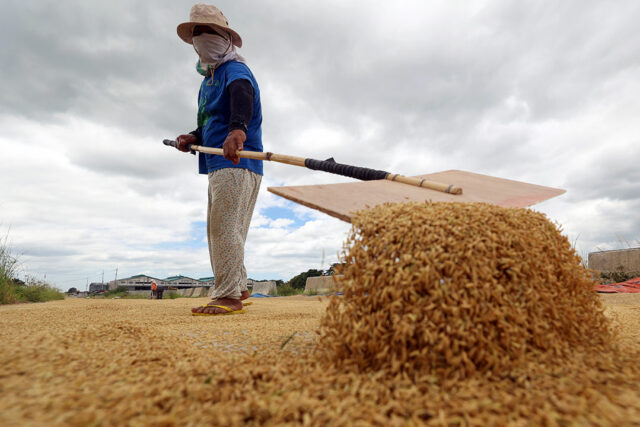
A farmer dries rice grains in Baliuag, Bulacan, Oct. 9, 2023. — PHILIPPINE STAR/KRIZ JOHN ROSALES

THE farmgate price of palay, or unmilled rice, rose 30.2% year on year to an average of P24.81 per kilogram in May, according to the Philippine Statistics Authority (PSA).

The PSA reported that all regions recorded year-on-year growth in farmgate prices during the month.

The highest prices in May were posted in the Western Visayas, where palay prices rose 39.7% to P27.76 per kilo.

The lowest farmgate price was recorded in the Eastern Visayas at P19.56 per kilo, up 11.7% year on year.

In April, the National Food Authority Council raised its purchasing price for palay in order for government procurement to remain competitive with prices offered by private traders.

The buying price for dry and clean palay was raised to P23 to P30 per kilo and that for fresh palay to P17 to P23 per kilo, depending on location and how the grain is graded.

On a month-on-month basis, the PSA said that the average farmgate price rose 1% from April.

The PSA said nine regions posted higher farmgate prices month on month, while seven regions posted declines.

Northern Mindanao and Central Visayas reported the highest month-on-month rises to 7.9%. The average farmgate prices in those regions were P26.66 and P27.28 per kilo, respectively.

Ilocos Region saw a 2.9% decline month on month in May. — Adrian H. Halili

NCR building materials price growth slows in May

A WORKER cuts metal in a construction area in Binondo, Manila, March 24, 2022. — PHILIPPINE STAR/ RUSSELL PALMA

PRICE GROWTH of construction materials in the National Capital Region (NCR) eased further in May, the Philippine Statistics Authority (PSA) reported on Thursday.

According to preliminary data, year-on-year growth of the construction materials wholesale price index (CMWPI) slowed to 0.6% from 0.7% in April.

The May reading was also far below the 6.6% growth posted in May 2023.

The May outcome was the lowest year-on-year growth on record after the 2018 rebasing.

At the end of April, CMWPI growth averaged 0.9%, against 7.9% in the same period last year.

“The slower year-on-year growth in construction materials wholesale prices in Metro Manila may have to do with lower global crude oil and other global commodity prices,” Rizal Commercial Banking Corp. Chief Economist Michael L. Ricafort said in an e-mail.

He added that higher global interest rates could have slowed global trade and economic activity, leading to lower demand for commodities including those used in construction.

Slower growth was recorded in nine commodity groups: G.I. sheets (3.1% from 3.2%), hardware (2.7% from 3%), electrical works (1.7% from 2.6%), painting works (1.6% from 1.9%), plywood (1.4% from 1.5%), structural steel (1.1% from 1.6%) doors, jambs, and steel casements (0.9% from 1%), PVC pipes (0.7% from 0.9%), and lumber (0.4% from 0.5%).

The slowdown in CMWPI growth was attributed to the slower annual increase in electrical works prices, the PSA said.

Three commodity groups posted stronger price growth in May: fuels and lubricants, 15.3% from 10.9%; metal products, 1% from 0.7%; and plumbing fixtures and accessories/waterworks, 0.5% from -0.2%.

Mr. Ricafort expects global and Philippine interest rates to affect prices going forward.

“The possible cut in Fed and Philippine interest rates later in 2024 and 2025 could lead to some pick up in demand and prices of construction materials,” he said.

The Fed kept its policy rate at 5.25-5.5% on Wednesday, signaling rate cuts being delayed to as far back as December, Reuters reported on Thursday. — Karis Kasarinlan Paolo D. Mendoza

Delegation to Thailand studies upgrades to Region II corn, dairy

DA.GOV.PH

THE Department of Trade and Industry (DTI) said its Cagayan Valley regional office and the Ilagan City government mounted an investment mission to Thailand to seek modernization opportunities for the region’s corn and dairy industries.

In a statement on Thursday, the department said that DTI Region II officials and representatives from Ilagan City, the capital of Isabela province, “explored further mechanization and development opportunities for the corn industry.

“The itinerary included visits to private companies and government-operated facilities in Thailand which employ advanced machinery and export-quality corn products,” the DTI said.

“This visit aimed to assess the feasibility of integrating Thai technologies into Ilagan City’s existing infrastructure,” it added.

Ilagan City produces 155.77 million kilograms of corn per season, representing 2.1% of the country’s output and 13.9% of Isabela province’s.

“With 33% of its land dedicated to agriculture, the city government is actively pursuing initiatives to transform corn production into a sustainable and lucrative enterprise for its residents,” the DTI said.

The delegation visited Thailand’s National Corn and Sorghum Research and Development Center at Kasetsart University. 

It also visited the Thai Danish Dairy Farm, operated by the Ministry of Agriculture and the Cooperative Farming Promotion Organization.

The delegation also visited the KU Beef and River Kwai meat and corn processing facilities, to investigate how to increase production in Region II.

“The visit builds on previous initiatives, including DTI Region II’s visit to the Hualam Collective Farm in 2022. This encouraged the DTI to form a technical working group and explore opportunities in export-quality corn silage production in Ilagan City,” the DTI said. — Justine Irish D. Tabile

Public financial management roadmap to help upgrade gov’t services — DoF

DOF.GOV.PH

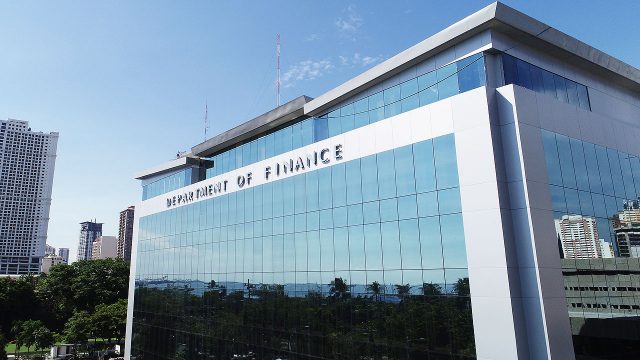
THE PUBLIC financial management reform roadmap will help improve government services through digitalization, the Department of Finance (DoF) said.

“This will serve as the country’s strategic blueprint that will enable a fully digitalized, efficient, and transparent public financial management system, ensuring faster and more effective government services,” Finance Secretary Ralph G. Recto said in a statement.

The Public Financial Management (PFM) Reforms Roadmap 2024-2028 is set to be presented to the President this month.

The Asian Development Bank (ADB) provided technical assistance to the government for the roadmap.

Core reform areas include stronger planning and budgeting linkages; cash management; public asset management; accounting and auditing; PFM capacity building; and digital PFM.

“To ensure that national and regional development priorities are aligned, the roadmap focuses on enhancing information technology (IT) systems for planning and budgeting,” the DoF said.

“Implementing a modernized system for the release of payments is also emphasized to improve the accuracy of cash flow programming and cash releases,” it added.

The roadmap also seeks to reinforce the implementation of the eGovPay platform.

ADB Philippine Country Director Pavit Ramachandran was quoted as saying that the government should also look into the digitalization of tax mobilization and expenditure management efforts. — Luisa Maria Jacinta C. Jocson

Gov’t reviewing water subsidies for poor

BW FILE PHOTO

THE Department of Environment and Natural Resources (DENR) said its Water Resources Management Office is in the process of reviewing water subsidies to better target low-income households.

“We want a targeted subsidy… those who are really in need of lower price of service,” Undersecretary Carlos Primo C. David said on the sidelines of a seminar hosted by Maynilad Water Services, Inc. in Quezon City  on Thursday.

The concessionaires of Metropolitan Waterworks and Sewerage System (MWSS), Maynilad and Manila Water Co., Inc., implement a Lifeline Rate program with discounted rates for residential customers who consume 10 cubic meters or less per month.

“We used to think that if a household is low-income, water use is only minimal as they do not have washing machines, cars to clean or gardens to tend to,” Mr. David said.

“But in truth, when we did our study, it seems that many low-income households utilize more water than 10 cubic meters per month,” he added.

He said many low-income households have many users.

The push for review was based on a study of 3,000 customers of both Maynilad and Manila Water between February and March, Mr. David said.

Maynilad estimated that 25% of its billed customers avail of the Lifeline Rate. With a customer base of around 1.5 million connections, its Lifeline Rate customers would total around 375,000.

Manila Water said its Lifeline Rate customers as of May numbered 58,246 connections.

Separately, Mr. David said the National Water Resources Board approved the MWSS request for a water allocation of 52 cubic meters per second (cms) for June 16-30.

For June 1-15, the MWSS had a water allocation of 51 cms. — Sheldeen Joy Talavera

Immigration bureau, Pagcor urged to shut down illegal online gaming firms

Several Chinese who illegally worked at a Philippine Offshore Gaming Operator (POGO) were deported by the Philippine government in this photo taken in February. — PHILIPPINE STAR/EDD GUMBAN

THE IMMIGRATION bureau and gaming regulator should work together to shutter illegal Philippine Offshore Gaming Operators (POGO) and cancel the visas of foreign workers linked to crimes, a senator said on Thursday.

“Aside from security concerns raised on POGO operations near our military bases, reports on some 250 others operating without licenses should prompt our concerned authorities to conduct a crackdown on these illegal entities,” Senator Jose “Jinggoy” P. Estrada said in a statement.

“Through the cooperation of the Bureau of Immigration and Philippine Amusement and Gaming Corp. (Pagcor), they should not hesitate to shut down illegal or unlicensed POGOs,” he added.

Immigration spokesperson Dana Krizia M. Sandoval and Pagcor did not immediately reply to separate requests for comment via Viber and e-mail.

Mr. Estrada’s call comes after the reported discovery of Chinese military uniforms in a POGO hub raided by authorities in Porac, Pampanga in northern Philippines last week.

Defense Secretary Gilberto C. Teodoro, Jr. on Wednesday said criminal syndicates posing as POGOs, which are mostly Chinese gambling companies that operate online casinos from the Philippines, are national security threats and must be stopped.

“We should stop these criminal activities operating out of our base, which weaken our financial standing, our country ratings (and) corrupt our society,” he said in a statement.

Several congressmen on Tuesday filed a bill that seeks to ban POGOs and impose a 10-year jail sentence on those that continue to operate under a ban.

Senator Sherwin T. Gatchalian earlier filed a similar bill, saying POGO links to crime outweigh their economic benefits.

“In addition to the proliferation of heinous crimes associated with POGOs, the industry has raised serious national concerns that must be associated promptly and with strong political will,” he said in a separate statement on Thursday.

“As Defense secretary, he (Mr. Teodoro) possesses privileged information and intelligence that convinced him to make that statement,” Mr. Gatchalian said.

The Senate is in the middle of a probe into crimes linked to these gambling operations.

The Ombudsman has ordered a six-month suspension on Bamban City Mayor Alice L. Guo over her alleged involvement in human trafficking and other crimes linked to POGOs in Tarlac.

The mayor has denied the allegations. Her lawyer on June 3 said the business permit issued to one POGO in her province was above board and based on Pagcor recommendations.

About 4,000 people were victimized by POGO-related crimes in the first half of last year, the Philippine National Police said in October.

The presidential palace in April ordered the Anti-Money Laundering Council to freeze the assets of a POGO hub in Tarlac province in northern Philippines, where 868 POGO workers were rescued during a March 13 raid after the company was linked to human trafficking and torture crimes.

Meanwhile, in an advisory on Thursday, the Department of Foreign Affairs (DFA) said Chinese nationals applying for temporary visitor’s visas must now submit their Chinese social insurance record certificates.

The certificates must be valid for at least six months.

Chinese students with proof of enrollment and retirees above 55 years old are exempted from the requirement.

“The additional visa requirement is part of the DFA’s continuing efforts to enhance its visa policies and regulations for the safe and efficient entry of foreign visitors,” the agency said.

Economists have said offshore gambling operators complicate Philippine efforts against money laundering and work against its ambition to become an investment hub.

The Philippines has been under the Financial Action Task Force’s (FATF) gray list of countries under increased monitoring for dirty money since 2021, in part due to its loosely regulated gaming sector.

Congress under ex-President Rodrigo R. Duterte passed a law taxing POGOs to legalize them, despite mounting concerns about the social costs of gambling.

The sector has grown exponentially since 2016, as operators capitalized on the country’s liberal gaming laws to target customers in China, where gambling is banned.

At their peak, POGOs employed more than 300,000 mostly Chinese workers, before a coronavirus pandemic forced many of them to transfer operations elsewhere. — John Victor D. Ordoñez

Speaker: Senate agreed to rice tariff law changes

PHILIPPINE STAR/RYAN BALDEMOR

By Kenneth Christiane L. Basilio and John Victor D. Ordoñez, Reporter

SENATORS have agreed to amend the law that gave local traders control over rice imports, Speaker and Leyte Rep. Ferdinand Martin G. Romualdez said in a statement on Thursday after a meeting between leaders of the Philippines Senate and House of Representatives.

The Senate would discuss proposed changes to the Rice Tariffication Law of 2019 independently and not rely on the version approved by the House, the Speaker said.

“A key focus of the meeting was the amendments to the Rice Tariffication Law, identified as a top priority,” Mr. Romualdez said.

Senator Cynthia A. Villar, who heads the agriculture committee, would file her own version of the bill, he added.

It was not clear whether senators at the meeting had agreed to restore the National Food Authority’s (NFA) power to import and sell rice at subsidized prices.

The House last month approved on final reading changes to the law including restoring the NFA’s power to import the staple during national emergencies.

Congressmen fast-tracked the approval of the bill amid spiraling rice prices. The House bill also increased the Rice Competitiveness Enhancement Fund to P15 billion from P10 billion.   

Ms. Villar earlier bucked the House proposal to reinstate the NFA’s ability to directly import and sell rice.

Her Senate Bill No. 2601 seeks to extend RCEF’s validity to 2031 and provide financial aid to farmers who till fewer than two hectares of land.

The bill does not touch the NFA’s regulatory powers unlike House Bill (HB) No. 10381, which will expand its regulatory and importation functions.

Retail prices of regular-milled rice averaged P48 to P51 per kilo, while well-milled rice was P52 to P55 per kilo in Metro Manila markets, according to the Department of Agriculture. Premium rice costs P52 to P62 per kilo, while special rice averaged P57 to P65 per kilo.

“Amending the Rice Tariffication Law is a crucial step towards ensuring food security and economic stability for our farmers,” Mr. Romualdez said.

Also on Thursday, Ms. Villar called on the Agriculture department to improve its implementation of the P30-billion national rice program this year, saying the agency should stop buying overpriced hybrid seedlings that fail to boost rice output.

At a Senate hearing, the lawmaker told Agriculture officials to stop buying “rejected” hybrid seedlings from overseas that often fail to grow on local soil.

“These hybrid seedlings are very expensive at P250 per kilo compared with local inbred seedlings that are only 30 pesos per kilo,” she said in Filipino.

“You were not effective in the national rice program, yet you buy hybrid seedlings worth P15 billion and chemical fertilizer worth P10 billion,” she added.

This came after Agricultural Undersecretary Asis G. Perez asked that they be allowed to directly manage the rice program instead of assigning the task to an ad hoc group.

At the hearing, Philippine Institute for Development Studies (PIDS) research fellow Roehlano M. Briones said that aside from extending the rice fund, Congress should also allot more budget for underfunded programs such as small water impounding and support for organic fertilizer production.

He also opposed the plan to restore the NFA’s power to import and sell rice, which he said could open the door for corruption.

“Imports are still a more cost-effective option for procuring buffer stocks,” he said, adding that rice imports should be assigned to another agency with the authority to import and incorporate modalities such as the ASEAN Plus Three.

ASEAN Plus Three is an agreement between Southeast Asian countries to cooperate on ensuring emergency rice reserves that can be accessed by signatory countries.

Senator Maria Imelda “Imee” R. Marcos has opposed the proposal to bring back the NFA’s import powers, saying the agency had failed to boost rice stocks.

Marcos signs property valuation measure into law

PRESIDENT FERDINAND R. MARCOS, JR. — PCO.GOV.PH

By Kyle Aristophere T. Atienza, Reporter

PRESIDENT Ferdinand R. Marcos, Jr. has signed into law a priority bill that seeks to fix inconsistencies in the country’s property valuation, while offering limited amnesty on interests, surcharges and penalties for unpaid real property tax.

The two-year amnesty on interests and penalties for taxpayers with unpaid real property tax would “encourage long-term and consistent tax compliance,” he said at a signing ceremony for the law at the presidential palace on Thursday.

The amnesty does not cover delinquent real properties that have been disposed of at a public auction, are covered by a compromise agreement and subject to a pending lawsuit.

The Real Property Valuation and Assessment Reform Act allows the use of a single valuation system that should reflect prevailing market values and comply with international standards. It must be used by all local governments.

The Philippine Valuation Standards will be led by the Bureau of Local Government Finance (BLGF), according to the law.

The law insulates property valuations from politics by transferring the power of approving the schedule of market values to the finance secretary of the local council.

It creates central and regional consultative committees that will set and adopt international valuation standards.

The reform will address overregulation and overlapping policies by professionalizing the assessors and separating the technical and political aspects of the valuation process, Finance Secretary Ralph G. Recto said in a statement.

“The new law will not only foster investor confidence and public trust in the government’s valuation system but also increase local government units’ revenue generation and resource mobilization, helping them fund their service delivery requirements,” he added.

Each local government must have a real property valuation unit, according to the law.

For the first year of the approved schedule of market values, any increase in real property taxes would be limited to 6%.

Local government may enact an ordinance to limit the increase in real property taxes for the succeeding years.

The law will “reduce undervaluation and overvaluation of real properties, resulting in more equitable pricing,” John Paolo R. Rivera, president and chief economist at Oikonomia Advisory & Research, Inc. said in a Facebook Messenger chat. “This will mitigate extreme losses and windfall profits.”

Meanwhile, Mr. Marcos signed into law another priority measure creating the Negros Island region. It removes Negros Occidental and Bacolod City from Western Visayas, and Negros Oriental and Siquijor from Central Visayas, to form their own separate region.

The law creates regional offices in Negros Occidental and Negros Oriental covering agriculture, peace and order, governance, human development, infrastructure and industry.

It tasks a technical working group to develop a roadmap for the region’s development.

“This union is long overdue and makes very practical sense, especially on Negros Island, where people are located on one island but are governed under separate administrative regions,” Mr. Marcos said in a separate speech.

“Our people are eagerly awaiting the passage of the 17 priority bills certified by LEDAC (Legislative Executive Development Advisory Council), which we will be discussing very, very soon,” he said.

If passed, these bills would “steer our national development and improve the conditions of our fellow countrymen,” he added.

ADVERTISEMENT
ADVERTISEMENT