Home Blog Page 3098

The Boys Season 4 plunges into political polarization

IMDB
IMDB

LOS ANGELES — Amazon Prime Video’s Emmy-winning satirical superhero show The Boys follows a team of misfit vigilantes who call themselves “The Boys” who fight against corrupt superpowered people called “Supes.”

For Season 4 of the series, show creator Eric Kripke wants to give a useful warning about following the wrong leaders, especially when it comes to those who strive to divide people, like Homelander, the most powerful “Supe” who believes humans should be subservient to superpowered individuals.

“It very nicely holds up a mirror to where we are right now. The point I think the show is trying to make is that there’s this intense polarization, there’s this intense kind of us versus them, demonization of the other side, this idea that there can only be one winner and one loser,” Mr. Kripke said.

“I think the point the show is trying to make is we’re all being manipulated into that position through algorithms and social media. And disinformation and billionaires and politicians because it serves them financially and politically, to have us all be angry at each other,” he added.

Season 4 stars Antony Starr, who plays Homelander, the petty leader of the “Supes,” Karl Urban as William Butcher, the high-strung leader of “The Boys,” Jack Quaid, Erin Moriarty, Chace Crawford, Laz Alonso, Tomer Capone, Jessie T. Usher, and Karen Fukuhara.

This season, which premieres on Thursday, leans into heavy political topics like abortion, racism, feminism, and other subjects that are also points of contention in the 2024 US elections.

The storyline is inspired by an arc in the comic book that follows a fictional presidential election that leads to a plot to overthrow the president.

Homelander takes on a strong voice that highlights the political right while the Starlight, played by Jessica Jones actor Ms. Moriarty, highlights the political left, particularly advocating for the rights of women this season.

“I want female characters that are as flawed as they are powerful,” Ms. Moriarty said. “I want them to exist because otherwise those powerhouse females in real life are not going to,” she added.

Mr. Starr, who hails from New Zealand, is fascinated by his character Homelander’s psychology and how Season 4 of the The Boys explores its superpowered antagonist like never before.

“It comes down to isolation. He’s the loneliest man in the world because he believes there’s no one like him. So, it’s always about trying to find connection and trying to find a way out of that prison,” Starr said. “We go home and find out what that was for this guy and why he is what he is,” Starr added.

Homelander coming to terms with his mortality is a central focus.

“(Homelander) is disgusted by the parts of him that are human. But because he’s a human, those parts are inevitable and they keep rearing up,” Mr. Kripke said. — Reuters


BayaniPay secures $3-million funding for expansion

FACEBOOK.COM/BAYANIPAY

GLOBAL PAYMENT solution platform BayaniPay is aiming to expand its services to at least four countries in the Southeast Asian region as it targets to lead the digital solution space in the Philippines by yearend, its top official said.

This comes after the company secured seed funding of $3 million, which will help boost its expansion and bankroll new services, BayaniPay Chief Executive Officer Winston L. Damarillo said during a press briefing on Thursday.

“We have to win the field. We are getting a lot of requests. Now, our mission this year is to lead the market here in the Philippines and we think we will get that before the end of the year,” Mr. Damarillo said.

The funding round included existing investors such as Wavemaker Partners, PTGB, and Talino Venture Studios.

The company is planning to bring its services to Indonesia, Malaysia, Thailand and Singapore, Mr. Damarillo said, adding that the company is working to secure additional capital and partners in its target areas. 

“We already started, in fact, part of my trips back to Asia now including Indonesia, Malaysia, Thailand, and Singapore, is that we’re actually starting that now. What we’re seeking, in addition to capital, are partners in those local areas,” he said. 

Earlier, the three investors had also provided a total of $6.6 million in seed funding for BayaniPay, giving it additional capital to expand its bills payment service to accommodate global transactions.

With these newly secured funds, BayaniPay will also launch this month Bayani GlobalPay, which it described as an embedded banking service designed to enable businesses and major billing entities to efficiently reach their customers on a global scale.

“Bayani GlobalPay features two embedded banking solutions: GlobalPay, a white-label service that provides nonfinancial institutions with a custom payment platform, and GlobalPay Express, an all-in-one payment portal for payment management. Institutions may choose between these two solutions based on their needs and requirements,” it said. 

Based in Los Angeles, BayaniPay is a collaboration among Talino Ventures, The Asian Journal, EastWest Bank, and Wavemaker Partners. — Ashley Erika O. Jose

Population decline isn’t the problem. Hungry kids are

STOCK PHOTO | Image by Nathan Dumlao from Unsplash

HUMANITY is about to turn a major population corner, according to a new estimate. A recent article in the Lancet predicts that by 2030, we’ll no longer be reproducing fast enough to replace ourselves.

We aren’t about to go extinct, but this is an unexpected trajectory. As recently as 2017, the United Nations predicted human numbers wouldn’t peak until 2100 when we’d reach more than 11 billion people. According to the new estimate, our numbers could rise from the current 8.1 billion to a maximum of just 9.5 billion before declining by the early 2060s.

While a catastrophic population explosion used to seem inevitable, women’s increasing levels of education and reproductive freedom have staved off some of the worst predictions of the 20th century. That’s actually something to celebrate: We’re not about to suffer a population overshoot and run out of food, as sometimes happens to animals in the wild — and as was predicted in the 1968 book, The Population Bomb.

But the relative number of older people will skyrocket around the world, causing anxiety among some economists, and some political leaders want more people to have more kids. On the other side, some environmentalists argue for pushing population to drop faster to slow global warming and loss of habitat for other species and ultimately for us humans. At the core of the debate are big, unanswered questions: Is 9.5 billion too many people? Will the population subsequently fall to a number that’s too low? Is there a right number of humans?

Maybe instead of focusing on the number of children people are having, policymakers should focus on the fact that too many children worldwide aren’t getting adequate nutrition, education, or medical care. Even now, though humans grow enough food to feed everyone, roughly one person in 10 is chronically undernourished — that’s scientific jargon for “hungry all the time” — and more than one child in five is stunted (too short) because of chronic hunger and infections.

After all, as demographer and mathematician Joel Cohen explains, the “right number of people” question depends on yet more questions, among them: What would be the accepted standard of material wealth? How much inequality would be acceptable? Would it be okay to build cities in areas prone to catastrophic flooding and earthquakes? Do people prefer parking lots or parks?

Cohen says the new Lancet estimate is credible. “This is really the most serious piece of work in the business about what has happened and what to expect,” he said. “There are lots of connections to climate, religion, economics, politics — but the fact is that fertility has been going down and is likely to continue to go down.”

Fertility is usually measured by looking at the number of children born each year to women of each age, from 15 to 55. But the Lancet model follows cohorts of women born each year — counting the babies born to women who turned 15 in 1950, then 16 in 1951, and so on — up until the time they turn 50. “Cohort fertility is a much better summary of the real experience of real women,” Cohen said. The new projection also factored in the estimated effects on education and access to contraception, both of which have a big effect on reducing fertility.

Attempts by some governments to encourage parenthood with economic incentives or abortion restrictions are failing, Cohen said. He pointed to a paper in the Journal of the American Medical Association showing that in the US, rates of voluntary sterilization rose after the Supreme Court’s Dobbs decision revoked national abortion rights. Though cause and effect aren’t proven, he said it’s possible that restrictive abortion laws are “pushing people out of reproduction … which I don’t think is the intended effect.”

It’s impossible to know all the unintended consequences of trying to engineer the population to grow, or shrink, but there’s no downside to taking better care of the children we already have.

The focus of future policy should be to help people have the number of kids they want, when they want, with whom they want. In her new book Sex and the Planet, University of Utah bioethicist Margaret Pabst Battin starts with a thought experiment: What would happen if everyone had access to reliable, safe, free, foolproof long-term contraception, so that getting pregnant would only happen if a woman or couple opted in?

Right now, 45% of pregnancies worldwide (and a higher proportion in the US) are unplanned, and some of those lead to the 73 million abortions that take place every year. With reliable long-term birth control, the rates of abortion would plummet, as would the rates of teen pregnancy. Birth rates in many regions would go down, which would prevent rapid population growth. People would not need to resort to permanent sterilization.

Gloom and doom sells, of course, which is why population trends always tend to be framed as impending disasters — whether they are baby booms or baby busts. If we can’t agree whether we’re facing too many or too few people, perhaps it’s a good time to help people have the number of children they think is right for them.

BLOOMBERG OPINION

Pru Life UK launches insurance product offering guaranteed annual payouts

PRU Life Insurance Corporation of UK (Pru Life UK) has launched a traditional insurance product that provides a guaranteed annual payout and family protection.

PRULifetime Income offers a guaranteed 5% yearly payout of the sum assured from the end of the sixth policy year or until maturity, regardless of market conditions, Pru Life UK Philippines said in a statement on Thursday.

Policyholders will also have 200% insurance coverage until age 100.

PRULifetime Income has a minimum coverage amount of P250,000 payable for five or 10 years.

“This product is the ideal option for parents planning for their child’s education, individuals with big purchase plans or travel goals and those who want a financially secure retirement,” the insurer said.

The product can also provide non-guaranteed dividends starting in the third policy year and can be paid in cash, applied to premium due or left to accumulate interest.

“Many Filipinos now look for regular streams of income to pursue their life goals without the fear of financial instability. We want to accelerate value creation for our customers by delivering diverse financial products and solutions tailored to address their evolving and unique needs at every life stage. PRULifetime Income guarantees lifelong payouts plus double insurance coverage, helping customers achieve financial security,” Pru Life UK Executive Vice-President and Chief Customer & Marketing Officer Allan M. Tumbaga said.

Pru Life UK’s premium income stood at P46.19 billion in the first quarter, latest data from the industry regulator showed, while its net income was at P4.36 billion. — AMCS

Questions applicants ask that (some) employers hate

I’m scheduled to sign a job offer for a high-ranking post in a meeting with the chief executive officer (CEO) of a medium-sized business. To help me decide on the offer, I’m planning to ask a few questions. Could you suggest any questions I could ask? — Last Dance.

I would like to think that you’ve already considered everything related to your current age, employment, marital status, career goals, among other things. If you’re above 50 years old, holding a lucrative job for at least 10 years, enjoying your work, and on the verge of being appointed to the next level, then why leave in favor of an unknown employer?

The only thing that may still influence your decision is if the CEO’s answers are to your liking. That’s assuming that the CEO tells you the truth. It’s simple: When in doubt, then don’t.

So, how would you put the CEO on the spot so he reveals what you need to know? You can ask many intelligent questions. However, you have to ask them with charm, diplomacy, maturity, and respect, in order to get honest answers in an unguarded moment.

HARDBALL QUESTIONS
Ask for the CEO’s permission. Also, ask about the amount of time you have. The bottom line is to build confidence and rapport with and at the same time respect the CEO’s busy schedule. Whatever you do, be calm and work efficiently down this list of questions. Be warned: some of them may not be to the CEO’s liking.

One, what is your management style? This question is important for those who don’t want to be micromanaged. A hint of a dictatorial style is enough for some people to lose interest in a future job regardless of how lucrative the pay is.

Two, how do you reward excellent performance? What’s the average time needed by an executive to get a promotion? If you don’t mind, could you give an example of some people within that category?

Three, do you have a formal policy on promotion? In the absence of such of vital information from the company’s website, it’s wise to pick up clues on such a policy from what the CEO reveals about succession planning, promotion from within, business continuity, among others.

Four, what’s the average executive turnover rate? What’s the reason for this vacancy? This should have been asked earlier with the human resource (HR) department. But there’s no harm to check again with the CEO, to see if he is on the same page as his own HR people.

Five, why did you not choose to promote from within? Current employees should have been given the first crack at the job. If not, then why not? Probe deep as management must be presumed to be responsible for not creating opportunities for incumbents.

Six, what are the skills I possess that can’t be found here? This is an ace question that could raise your salary expectations. If the CEO is truthful, then the company could be right in choosing you. A dull answer is a good reason to decline the offer.

Seven, what are the prospects of this company becoming an industry leader? This could backfire on you as the CEO may address the same question to you. Therefore, be ready to dig up as much information about the industry, even to the point where you end up knowing more than the CEO.

Eight, what is the most difficult part of this job? Or what is the easiest? Before asking those questions, you must know the answers as well. This allows you to detect any red flags and decide whether those issues are deal-breakers.

Nine, is the pay package the most important part of the job? Again, this could be asked of you. Decide based on your personal values which include mutual respect and trust, among other things.

Ten, what kind of information would you keep away from me? You need to know basic information to perform your job well. You must also understand that there are things you should not know.

Some CEOs may understand your doubts. Others may not appreciate that you are giving up something to plunge into the unknown. Understand the whole situation before making any commitments. These questions may even put some doubt into the mind of the CEO.

If that happens, then you would be in luck. It’s far better to stay at a comfortable job than jump into a new situation with many unknowns.


Bring Rey Elbo’s “Kaizen Blitz” program to your management team and know how to solve problems without spending much money. Contact him on Facebook, LinkedIn, X or e-mail elbonomics@gmail.com or via https://reyelbo.com

Member of famous Motown group Four Tops sues hospital for racial discrimination

COMMONS.WIKIMEDIA.ORG

THE LEAD SINGER of the celebrated Motown group the Four Tops has sued a Michigan hospital, claiming he was put into restraints and denied treatment for a serious heart problem after medical personnel did not believe that he was a member of the group.

Alexander Morris, who joined the Four Tops in 2018, accused Ascension Macomb-Oakland Hospital of racial discrimination and negligence in a lawsuit filed in federal court this week.

Mr. Morris was taken to the hospital’s emergency room in April 2023 with chest pain and difficulty breathing.

When he told a nurse and a security guard that he was a member of the Four Tops and had security concerns over fans and stalkers, the lawsuit contends, staff members assumed he was mentally ill. Mr. Morris was taken off oxygen despite a history of heart problems, placed in restraints, and referred to a psychiatrist, according to the lawsuit.

A security guard told Mr. Morris to “sit his Black ass down” when Mr. Morris tried to prove his identity, according to the lawsuit.

Mr. Morris eventually convinced a nurse by showing her a video of a recent Four Tops performance, after which his restraints were removed and he was put back on oxygen, the lawsuit said.

The hospital offered Mr. Morris a $25 gift card to a local supermarket as compensation for his experience, which he declined, according to the lawsuit. He is seeking at least $150,000 in damages.

Ascension, the nonprofit company that operates the hospital, declined to comment specifically on the lawsuit but said, “We remain committed to honoring human dignity and acting with integrity and compassion for all persons and the community. We do not condone racial discrimination of any kind.”

The Four Tops were a leading Motown group in the 1960s, with hits such as “Reach Out I’ll Be There” and “I Can’t Help Myself (Sugar Pie Honey Bunch).” Three of the original four members have died. The fourth, Abdul “Duke” Fakir, continues to perform with the group. — Reuters

EEI Corp., Concrete Stone enter supply deal for infra projects

PHILSTAR FILE PHOTO

LISTED construction company EEI Corp. has signed a deal with Concrete Stone Corp. (CSC) to supply the former’s precast concrete needs nationwide.

EEI and CSC signed a memorandum of understanding on June 10, the listed construction company said in a statement to the stock exchange on Thursday.

Under the agreement, CSC will fulfill EEI’s precast concrete requirements for multiple mega infrastructure projects nationwide.

“We look forward to a strong collaboration that bolsters our commitment to deliver quality and remarkable infrastructure projects that shape the Philippine landscape and contribute to the country’s connectivity, economic growth and nation-building,” EEI President and Chief Executive Officer Henry D. Antonio said.

EEI has business interests in construction and engineering services, with expertise in the construction of infrastructure, buildings, and industrial and electromechanical facilities.

One of the company’s mega-infrastructure projects in the pipeline is Metro Rail Transit Line 7 (MRT-7) financed by the Ang-led conglomerate San Miguel Corp.

MRT-7 will have 14 stations from Quezon City to San Jose del Monte, Bulacan. It is estimated to carry 300,000 passengers daily in its first year, and up to 850,000 passengers daily in its 12th year.

CSC is engaged in the production and supply of construction solution materials. Its products include aggregates, precast, cement, and asphalt. The company is the manufacturing arm of the Chua Group’s Industry Holdings and Development Corp.

On Thursday, EEI stocks dropped by 0.21% or one centavo to P4.86 apiece. — Revin Mikhael D. Ochave

There is no right to divorce in international law

FREEPIK

Of course there isn’t. Just like same sex “marriage,” like abortion, like contraceptives, there is no international law out there that makes divorce a demandable international human right.

International law comes about with the convergence of several “sources”: treaties, customs, or general principles. Ignore the nonsense that some progressive, supposedly prestigious, law schools indoctrinate their students with — that human rights are allegedly sui generis and therefore follow different rules (which conveniently cannot be described with particularity) — the law on marriage is pretty straightforward.

The point is that there is no treaty or custom that imposes divorce as a demandable international human right.

Some may argue that customary international law on divorce does exist, considering that only two States (supposedly) are still without — thankfully — a divorce law: the Vatican and the Philippines. Which therefore translates to 193 (out of 195) countries having a divorce law or permitting divorce.

But the very fact that the Philippines (and the Vatican) refuses to have a divorce law thus negates the idea that there is international customary law requiring a divorce law. Something analogous to the international law principle called the Baxter Paradox, the fact that a holdout persists and is allowed to persist demonstrates the absence of customary international law.

That and the fact that all 193 countries that do have a divorce law never entered into a treaty that says divorce is a demandable human right, thus negating the presence of opinion juris, thus further negating the idea of the existence of customary international law on divorce.

The only treaty, of note, regarding divorce is the Hague Convention on the Recognition of Divorces and Legal Separations, which was concluded by the Hague Conference on Private International Law. The Hague Divorce Convention, as it is summarily called, regulates the recognition of divorces and legal separations, assuming such has been effected according to the legal process in the state the divorce was obtained.

Nevertheless, while the Hague Divorce Convention works to recognize divorces (and legal separations) had in one Contracting State vis-à-vis another Contracting State whose legal proceedings are officially recognized in that State and are legally effective there, nevertheless, the Convention does not apply to “findings of fault or to ancillary orders pronounced on the making of a decree of divorce or legal separation,” particularly that regarding financial obligations or child custody.

More specifically, the Hague Divorce Convention provides recognition of divorces only if:

(1) the respondent had his habitual residence there; or (2) the petitioner had his habitual residence there and one of the following further conditions was fulfilled — a) habitual residence was for at least one year prior to the institution of proceedings; or b) the spouses last habitually resided there together; or (3) both spouses were nationals of that State; or (4) the petitioner was a national of that State and one of the following further conditions was fulfilled — a) the petitioner had his habitual residence there; or b) he had habitually resided there for at least a year within the two years preceding the institution of the proceedings; or (5) the petitioner for divorce was a national of that State and both the following further conditions were fulfilled — a) the petitioner was present in that State at the date of institution of the proceedings and b) the spouses last habitually resided together in a State whose law, at the date of institution of the proceedings, did not provide for divorce. (Article 2).

What need emphasizing at this point is that only 20 States are parties to the Hague Divorce Convention and the Philippines is not one of them. Even then, a Contracting State “may refuse to recognize a divorce when, at the time it was obtained, both the parties were nationals of States which did not provide for divorce and of no other State” (Article 7). Such is significant because it again removes the possibility of opinion juris for any contention of a custom because an express treaty provision actually allows a country to opt out from recognizing a divorce.

On the other hand, “marriage” is a demandable international human right, as the UN Declaration of Human Rights (Article 16) provides:

1. Men and women of full age, without any limitation due to race, nationality or religion, have the right to marry and to found a family. They are entitled to equal rights as to marriage, during marriage and at its dissolution.

2. Marriage shall be entered into only with the free and full consent of the intending spouses.

3. The family is the natural and fundamental group unit of society and is entitled to protection by society and the State.

In any event, even assuming there is an international law making divorce a demandable right, such will still not prevail over our Constitution, which recognizes marriages as “inviolable” and “shall be protected by the State,” thus removing any possibility of a divorce law in the country.

The views expressed here are his own and not necessarily those of the institutions to which he belongs.


Jemy Gatdula is the dean of the Institute of Law of the University of Asia and the Pacific and is a Philippine Judicial Academy lecturer for constitutional philosophy and jurisprudence. He read international law at the University of Cambridge.

https://www.facebook.com/jigatdula/

Twitter  @jemygatdula

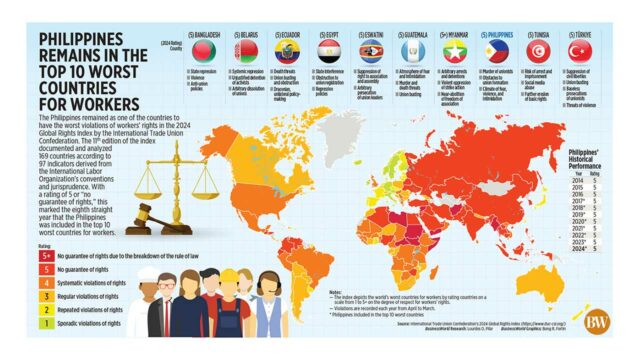
Philippines remains in the top 10 worst countries for workers

The Philippines remained as one of the countries to have the worst violations of workers’ rights in the  2024 Global Rights Index by the International Trade Union Confederation. The 11th edition of the index documented and analyzed 169 countries according to 97 indicators derived from the International Labor Organization’s conventions and jurisprudence. With a rating of 5 or “no guarantee of rights,” this marked the eighth straight year that the Philippines was included in the top 10 worst countries for workers.

Philippines remains in the top 10 worst countries for workers

PSEi member stocks performed — June 13, 2024

Here’s a quick glance at how PSEi stocks fared on Thursday, June 13, 2024.


Peso gains on US consumer inflation data

THE PESO rose against the dollar on Thursday following the release of May US consumer price index (CPI) data overnight.

The local unit closed at P58.58 per dollar on Thursday, strengthening by 10 centavos from its P58.68 finish on Tuesday, Bankers Association of the Philippines data showed.

The peso opened Thursday’s session stronger at P58.48 against the dollar. Its weakest showing was at P58.69, while its intraday best was at P58.47 versus the greenback.

Dollars exchanged increased to $1.32 billion on Thursday from $1.05 billion on Tuesday.

The market was closed on Wednesday for the Independence Day holiday.

The peso rose against the dollar after the US inflation report for May was unchanged, Rizal Commercial Banking Corp. Chief Economist Michael L. Ricafort said in a Viber message.

“There was strengthening of most Asian currencies, including the Philippine peso, as the dollar softened due to the milder-than-expected US inflation data,” Security Bank Corp. Chief Economist Robert Dan J. Roces likewise said in a Viber message.

“Furthermore, the Federal Reserve’s indication of maintaining higher interest rates for an extended period and postponing the initiation of cuts to December has contributed to this trend,” he added.

The dollar edged up on Thursday, recovering some of the previous day’s losses after the Federal Reserve forecast just one rate cut this year, although softer-than-expected US inflation tempered some of those gains, Reuters reported.

Price action in the currency market was relatively subdued on Thursday, compared with the previous day, when the dollar fell almost 1% at one point in the immediate wake of the release of the CPI data, before ending the day with a 0.5% loss — still its largest in two weeks.

US consumer prices were unchanged in May from April, against market expectations of a 0.1% rise.

Inflation rose at an annual rate of 3.4%, still well above the Fed’s target of 2%.

Later on Wednesday, the Federal Reserve left the funds rate on hold at 5.25-5.5% and policy makers’ median projection for the number of cuts this year fell to just one, from three in March.

Despite the Fed’s projections, markets stuck with pricing in almost two 25-basis-point rate cuts this year, which helped reverse some of the losses in the dollar.

US Fed Chair Jerome H. Powell struck a familiar tone in his news conference and stressed policy makers would be sensitive to economic data. Although less cuts were projected for this year, policy makers had them penciled for 2025 or 2026.

For Friday, Mr. Ricafort sees the peso moving between P58.45 and P58.65 per dollar. — AMCS with Reuters

PSEi falls to 6,300 level on Fed cut view, US CPI

BW FILE PHOTO

PHILIPPINE SHARES dropped for a third consecutive session on Thursday, with the main index falling to the 6,300 level anew, following dovish statements from the US Federal Reserve chief and the release of US May inflation data.

The Philippine Stock Exchange index (PSEi) declined by 0.3% or 19.24 points to close at 6,390.83 on Thursday, while the broader all shares index dropped by 0.2% or 7.05 points to end at 3,443.

“Philippine shares continued to tumble as investors digested the latest policy announcement from the Fed and May inflation data, which pointed to easing pricing pressures,” Regina Capital Development Corp. Head of Sales Luis A. Limlingan said in a Viber message. “As expected, the Fed kept interest rates unchanged. However, the Fed’s projections showed only one rate cut is anticipated this year, citing still elevated levels of inflation.”

US consumer prices were unexpectedly unchanged in May as cheaper gasoline and other goods offset higher costs for rental housing, but inflation remains too high for the Fed to start cutting interest rates before September, Reuters reported.

The unchanged reading in the consumer price index (CPI) last month followed a 0.3% increase in April, the Labor department’s Bureau of Labor Statistics reported. In the 12 months through May, the CPI advanced 3.3% after increasing 3.4% in April.

Fed policy makers on Wednesday projected only a single quarter-percentage-point reduction in borrowing costs, with the easing cycle possibly not starting before December.

The PSEi dropped as “April’s balance of trade deficit seemed to have weighed on investor sentiment as this poses depreciation risks to the already weakened Philippine peso,” Philstocks Financial, Inc. Research and Engagement Officer Mikhail Philippe Q. Plopenio added in a Viber message.

The country’s trade deficit widened to $4.76 billion in April from the $3.44 billion deficit in March, the government reported on Tuesday. This was the widest in five months or since the $4.77-billion gap in November 2023.

The majority of sectoral indices ended lower on Thursday. Mining and oil dropped by 1.01% or 90.52 points to 8,790.19; holding firms went down by 0.93% or 52.95 points to 5,583.53; industrials declined by 0.57% or 52.02 points to 8,997.05; and financials retreated by 0.4% or 7.92 points to 1,960.27.

Meanwhile, property gained by 1.03% or 25.12 points to 2,448.34, and services rose by 0.01% or 0.11 points to 1,953.36.

Value turnover rose to P4.95 billion on Thursday with 289.83 million shares changing hands from the P3.3 billion with 400.9 million issues traded on Tuesday.

Decliners outnumbered advancers, 110 versus 73, while 48 names were unchanged.

Net foreign selling went down to P245.48 million on Thursday from P742.96 million on Tuesday.

The market was closed on Wednesday, June 12, for the Independence Day holiday. — R.M.D. Ochave with Reuters

ADVERTISEMENT
ADVERTISEMENT