Home Blog Page 309

Globe prices P25‑billion preferred shares at 6.12%-6.76%

BW FILE PHOTO

GLOBE TELECOM, INC. has set the price for its P25‑billion follow-on preferred share offering, with Series A and B shares yielding 6.1179% and 6.7631% per annum, respectively, as part of a plan to redeem perpetual capital securities and fund capital expenditures.

In a regulatory filing on Wednesday, Globe said the offering consists of 12.5 million non-voting preferred shares at P2,000 apiece, including 7.5 million shares and an oversubscription allotment of 5 million shares.

The shares will be issued in two tranches, with the Series “A” Non-Voting Preferred Shares carrying a dividend rate of 6.1179% per annum, and the Series “B” Non-Voting Preferred Shares having an initial dividend rate of 6.7631% per annum.

Gross proceeds from the offering will total P25 billion if the oversubscription option is fully exercised, Globe said.

The Ayala-led telecommunications company said it plans to use proceeds to redeem all or a portion of Globe’s perpetual capital securities and to fund part of its capital expenditure program, according to the company’s preliminary offer term sheet.

BPI Capital Corp., BDO Capital & Investment Corp., and China Bank Capital Corp. are the joint lead issue managers, underwriters, and bookrunners. First Metro Investment Corp. and Security Bank Capital Investment Corp. are also acting as underwriters and bookrunners.

Globe said the offer period will run from Feb. 13-20, with the issue date scheduled for March 2, 2026.

For 2026, Globe expects low- to mid-single-digit revenue growth, following a decline in 2025.

The Ayala-led telecommunications company reported a 4.12% drop in net income in 2025 to P23.3 billion from P24.3 billion in 2024, weighed down by higher depreciation and interest expenses and lower revenues for the year.

Globe said it anticipates capital expenditures to remain below $1 billion, citing a disciplined approach to capital optimization and a focus on extracting greater returns from prior network investments while continuing network expansion.

At the stock exchange on Wednesday, Globe shares closed unchanged at P1,730 apiece. — Ashley Erika O. Jose

PSALM says 2025 debt dropped P13.4 billion to P260.6 billion

ORIGINAL BACKGROUND PHOTO FROM FREEPIK/PRESSFOTO

STATE-RUN Power Sector Assets and Liabilities Management Corp. (PSALM) reported a P13.4-billion decrease in its financial obligations for 2025, citing privatization and collection initiatives.

This brings PSALM’s remaining debt to P260.6 billion as of Dec. 31, 2025, compared with P247 billion at the end of 2024, the company said in a statement on Wednesday.

The state-led firm also reported payments of P20 billion in interest and other charges, and remitted P9 billion in dividends to the National Government.

PSALM attributed the debt reduction to several transactions, including the privatization of the Caliraya-Botocan-Kalayaan hydroelectric power plants, which generated a portion of P36.3 billion.

The company added that collections from fees on the concession of transmission assets, administration of independent power producer contracts, and the privatization of select real estate assets also contributed to lowering its obligations.

PSALM reported a 92.28% collection efficiency, representing P15.88 billion in power sales collections.

“These achievements strengthen PSALM’s financial position geared towards the completion of its mandate within its extended corporate life in support of the Philippine energy sector,” said PSALM President and Chief Executive Officer Dennis Edward A. Dela Serna.

Mr. Dela Serna said the agency remains fully committed to further reducing its obligations through sustained privatization efforts and innovative asset and liability management strategies.

Created under Republic Act No. 9136, or the Electric Power Industry Reform Act of 2001, PSALM is mandated to privatize government-owned power assets and manage the proceeds to settle the financial obligations of the National Power Corp.

The agency’s corporate term, initially set to expire in June 2026, has been extended by 10 years after a measure granting the extension lapsed into law in April 2025.

Compared with its peak debt of P1.24 trillion in 2023, PSALM has reduced its obligations by 79%, or P980 billion, as of end-December 2025.

The company attributed the decline to “effective financial management and long-standing strategy of channeling privatization proceeds toward debt reduction.”

To date, PSALM has generated P959.6 billion in privatization proceeds, with P888.7 billion already collected.

Last year, Mr. Dela Serna announced a 10-year plan to liquidate remaining liabilities through several measures. — Sheldeen Joy Talavera

DoTr in talks with Arkia for direct Philippines-Israel flights

ARKIA.COM

THE Department of Transportation (DoTr) is in talks with Arkia Israeli Airlines Ltd., the operator of Arkia, to arrange direct flights between the Philippines and Israel.

“There is one airline, Arkia. It is a Tel Aviv airline. We are so interested to have direct flights between Manila and Israel,” Transportation Acting Secretary Giovanni Z. Lopez told reporters on the sidelines of a media briefing on Wednesday.

The announcement follows the agency’s plan to launch direct flights between Manila and Israel as part of its efforts to expand international connectivity and strengthen bilateral ties.

“Hopefully, we can sort out the requirements. But I think, usually, it takes like another six months,” he said, adding that both the Civil Aeronautics Board and the Civil Aviation Authority of the Philippines are coordinating with the airline.

Arkia is Israel’s second-largest airline and operates flights to Western Europe, the Mediterranean, and Asia.

The Philippines and Israel previously said they are exploring further collaboration to boost tourism and strengthen economic relations.

Israel has been involved in a nearly three-year conflict with Hamas after the group launched an attack on southern Israel on Oct. 7, 2023. The violence is part of the decades-long Israel-Palestine conflict, which has seen repeated bouts of violence, mass displacement, and stalled peace efforts.

The Philippines currently maintains Alert Level 2 over Israel amid heightened tensions. Non-essential travel is restricted, and Filipinos are advised to avoid public places and prepare for possible evacuation. — Ashley Erika O. Jose

Double your luck

CHINA BLUE SET MENU

A choice from Conrad’s Prosperity and Abundance menus

WITH TWO set menus for the Lunar New Year (which falls on Feb. 17), Conrad Manila’s China Blue by Jereme Leung might double your luck: and if you can afford it, you must already be lucky to begin with, because one menu costs P49,888 (the Prosperity Set), and the other costs P69,888 (the Abundance Set) both for a group of 10 diners.

During a tasting on Feb. 4, their executive Chinese chef, Khor Eng Yew, emphasized the lucky ingredients they are using for the set menus: there’s sea moss for wealth, prawns for happiness, a money bag stuffed with mushrooms and dried oysters for the same reason, beef for strength, and fish for a smooth transition.

The meal started with a Yee Sang set (P3,588++, which one can order separately), a lucky salad with salmon, meant to be tossed high with chopsticks until you make a mess (the higher the toss, the higher the levels of luck).

For our tasting, they combined elements from both menus, the better for us to taste more. Our soup, taken from the Prosperity set, was a Braised Dry Scallop Fish Lip and Seafood with Assorted Mushroom and Sea Moss Soup. It smelled pungent, a little bit bitter and faintly medicinal, but that’s how we like it. From the same menu came a Barbecue Roasted Duck with Mandarin Orange Sauce. Absolutely delectable, with a smoky taste on its skin, the rather succulent duck (lucky us — the seniors at our table avoided it for its glistening fat, so we had more helpings) was given some spark with the orange sauce.

Other main courses included a Wok-fried King Prawn with Butter Black Pepper Gravy Sauce (a very strong flavor), Steamed Live Sea Garoupa with Bell Pepper and Pickled Olive Sauce (from the Abundance set; light and delicate, in contrast to the prawn before), a comforting and fragrant Baked US Beef Short Rib in a Honey and Sweet Vinegar Sauce, and the money bags. These were little dumplings in bean curd skin with dried oysters and mushrooms, which burst and flowed forth in the mouth after a bite.

The dessert, symbolizing togetherness, was a chilled Mandarin Orange Jelly and Honey Pearl with Citrus Sorbet and a Coconut Brown Sugar Nian Gao, stuffed in a faux Mandarin orange.

“For me, important (to be) happy,” Mr. Yew said about the lucky nature of his dishes.

NEW YEAR, NEW SITES
Conrad Manila’s new general manager, Rupert Hallam (he started last September) told BusinessWorld about plans to build another events space in the hotel, located below its helipad. As part of his term as general manager, he says he plans to improve their spa and wellness offerings, and possibly open a new restaurant.

As for the events space, it will offer 360-degree views of the bay and the city. “It’s going to be very different because it’s going to be specifically targeted at the social side of the business,” he said, citing weddings, engagements, and other celebrations. The new events space will be named after Admiral George Dewey (the former namesake of the stretch of road now named Roxas Boulevard).

“You come to a hotel, and you’ve got a ballroom. It’s four walls, a ceiling, and a floor. It’s a box, to put it bluntly,” he said. “But this one is something completely different,” with glass walls, an outdoor space, and a garden.

The Lunar New Year menus are available at China Blue from Feb. 11 to March 3. — Joseph L. Garcia

Jollibee Group taps First Gen for renewable energy in commissaries

Jollibee Group’s C3 facility in Laguna — JOLLIBEEGROUP.COM

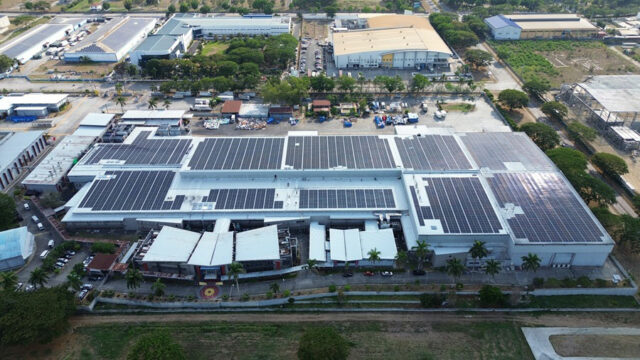
FOOD GIANT Jollibee Group has partnered with Lopez-led power producer First Gen Corp. to source renewable energy for its commissaries in the Philippines.

In a statement on Wednesday, First Gen said it is supplying 11 megawatts (MW) from its geothermal power plant in Bicol, enabling the fastfood chain’s commissaries to operate on 99% renewable energy.

By harnessing renewable energy, the Jollibee Group is expected to cut greenhouse gas emissions by 70% across the covered sites, First Gen said.

The deal builds on the two companies’ partnership in 2023, when 17,000 solar panels with more than 9 MW of capacity were installed at its commissaries and distribution sites in Parañaque and Laguna.

First Gen also provided a remote energy monitoring system to optimize electricity usage at the logistics hub.

“Behind every meal we serve is a long chain of work that begins in our commissaries. How we power these facilities matters. By shifting to renewable energy, we are ensuring our operations remain reliable and consistent as we grow,” Jollibee Group Philippines Chief Executive Officer Joseph C. Tanbuntiong said.

Jollibee Group operates over 10,000 stores and cafés in 33 countries, managing 19 brands.

Its portfolio includes nine wholly owned brands — Jollibee, Chowking, Greenwich, Red Ribbon, Mang Inasal, Yonghe King, Hong Zhuang Yuan, Smashburger, and Tim Ho Wan; five franchised brands in the Philippines — Burger King, Panda Express, Yoshinoya, Common Man Coffee Roasters, and Tiong Bahru Bakery; and stakes in other ventures such as The Coffee Bean & Tea Leaf, Compose Coffee, SuperFoods Group (Highlands Coffee), Milksha, and interests in Tortazo LLC (US) and Botrista.

First Gen Chief Customer Engagement Officer Carlos Lorenzo L. Vega said the shift to geothermal and solar power “reflects the Jollibee Group’s disciplined approach to growth” by investing in reliable energy systems.

First Gen is an independent power producer with a total installed capacity of over 3,700 MW across natural gas, geothermal, hydropower, wind, and solar technologies. — Sheldeen Joy Talavera

Term deposit yields inch down on BSP cut bets

PHILIPINE STAR/IRRA LISING

YIELDS on the Bangko Sentral ng Pilipinas’ (BSP) seven-day term deposits edged down on Wednesday amid strong demand as still benign inflation and slow growth fueled easing hopes.

Total tenders for the term deposit facility (TDF) reached P132.961 billion, above the P110-billion offer and the P121.841 billion in bids for the same offer volume last week.

The bid-to-cover ratio stood at 1.2087 times, higher than the 1.1076 ratio recorded in the previous auction.

The central bank fully awarded its P110-billion offering.

Accepted yields for the one-week tenor ranged from 4.45% to 4.505%, narrowing from the 4.45% to 4.5185% logged the prior week. With this, the average accepted rate inched down by 0.44 basis point (bp) to 4.4923% from 4.4967% a week ago.

TDF yields continued to go down on Wednesday as the market anticipates another rate cut from the BSP next week following a benign January inflation print and the weak economic growth posted last year, Rizal Commercial Banking Corp. Chief Economist Michael L. Ricafort said via Viber.

BSP Governor Eli M. Remolona, Jr. earlier said a cut is possible at their policy meeting on Feb. 19 if they see the need to support domestic demand.

On Wednesday, Mr. Remolona said inflation returning within the target range and expectations of economic recovery amid the return of confidence may have narrowed their easing space.

Philippine gross domestic product growth slowed to a five-year low of 4.4% last year, missing the government’s 5.5%-6.5% target due to the economic fallout from a corruption scandal that stalled both public and private spending.

However, the central bank last week reiterated that it was nearing the end of its current easing cycle, with further cuts to be limited and data-dependent, even as the inflation outlook remains benign.

The Monetary Board has lowered benchmark rates by 200 bps since August 2024, bringing the policy rate to 4.5%.

Headline inflation accelerated to 2% in January from 1.8% in December but slowed from the 2.9% in the same month last year. This was the fastest in 11 months or since 2.1% in February 2025, which was also the last time the consumer price index was within the BSP’s 2%-4% annual target.

Analysts have said that the BSP may have room to ease its policy stance further to help stimulate economic activity as inflation remains low despite the January uptick.

The central bank uses the TDF and BSP bills to mop up excess liquidity in the financial system and better guide market rates towards the policy rate.

It last auctioned off both the seven-day and 14-day deposits on Oct. 29. It has not offered 28-day term deposits for over five years to give way to its weekly offerings of securities with the same tenor.

Based on the BSP’s latest monetary policy report, its market operations have absorbed P1.5 trillion in liquidity from the market as of mid-November 2025, with 5.4% of this being siphoned off via the term deposit facility. — Katherine K. Chan

Love is in bloom

SALPICON DE MARISCOS

LAS FLORES, part of The Bistro Group, is cooking up something romantic for Valentine’s Day. Executive Sous Chef Pablo Ramirez created the “Love in Bloom” set menu (P2,395 per person) with the sensations and motions of love in his mind.

During a tasting on Feb. 6 at the Las Flores Uptown Ritz branch, Mr. Ramirez said, “We created the menu based on… sensations, let’s say,” he said. These sensations include freshness, warmth, some oomph, then finally, a kiss: “The last one will be the one that reminds you of a kiss. Soft. Full of flavors.”

The first course, a Salpicon de Mariscos, has mussels, squid, and shrimp tossed in a light lemon vinaigrette with tomatoes, bell peppers, and onions. The effect is lacy, delicate, and tangy.

The Croqueta de Manchego, with spinach and aioli, had a very pronounced salty Manchego cheese flavor, lighter and easier to eat than other croquettes in the city. Lightly molded (definitely by hand and with love), it collapses easily enough in the mouth. The Iberico Secreto was a shoulder from an Iberian pig, lightly seared in butter, and accompanied by cauliflower purée and chimichurri sauce. It’s nice, savory, and simple — but we will say that it needs a little more oomph for excited lovers’ tongues on Feb. 14.

The dessert that Mr. Ramirez described as a kiss was the Crema Catalana, a custard with a caramelized sugar crust and gently burnt local orange and lemon. In this he was right that it was soft and full of flavors.

OTHER BLOOMING THINGS
Well, love’s not the only one blooming for the Bistro Group when it comes to its Spanish restaurant lineup. These include Las Flores and the more specialized Rumba, but also La Lola Churreria, which closed sometime before the COVID-19 pandemic (under different ownership). It reopened last year in Las Piñas, now under the Bistro Group.

Meinard Pasco, Group Marketing Head for the Bistro Group’s Spanish concepts said about the reopening, “We believe in the brand. There were a lot of customers looking for it (during) the pandemic,” he said, and it turns out that brands do listen to social media rants (citing those posts as part of the clamor for its return).

He also discussed the enduring popularity of Spanish cuisine in this country, an ex-colony: “The familiarity with the flavors of Spanish cuisine is always there,” he said. “Some of the flavors are similar to ours.”

On another note, he points out that the Spanish concept kitchens are headed by Spanish (or -adjacent) chefs. For example, Mr. Ramirez, an Argentinian, grew up in Spain’s Basque region. “As much as possible, we would like for the dishes to be authentic.”

The Las Flores Valentine’s set menu can be found at their branches in Greenbelt 3, Uptown Ritz, One McKinley Place, S Maison, Okada Manila, and Podium. — Joseph L. Garcia

Fruitas allocates P120 million for 2026 expansion

FRUITASHOLDINGS.COM

FOOD AND BEVERAGE kiosk operator Fruitas Holdings, Inc. has earmarked P120 million for capital expenditures in 2026, targeting the opening of up to 100 new branches under its House of Fruitas brand.

“The Company may increase this investment should there be an acceleration in the growth of the Philippine economy, further supporting its long-term growth objectives,” the company said in a disclosure on Wednesday.

Of the P120-million budget, about P90 million will go toward expanding its store network, P20 million for upgrading commissaries, and P10 million for logistics, including delivery trucks.

For 2026, Fruitas aims to expand its store network with a mix of kiosks, community stores, and restaurants, targeting roughly even openings throughout the year.

“These initiatives are aligned with the Company’s strategy and are expected to drive revenue growth and enhance brand visibility,” the company noted.

In November 2024, Fruitas acquired a 60% stake in the Mang Bok’s brand for P8.86 million, marking its entry into the roasted chicken segment. Fruitas’ subsidiary Balai ni Fruitas, Inc. also completed its purchase of the Sugarhouse cake and pastry brand in the same year.

In 2023, Fruitas acquired the Ling Nam noodle house brand and the Fly Kitchen cloud kitchen company.

On Wednesday, Fruitas Holdings closed at P0.67 per share, unchanged from the previous trading day. — Alexandria Grace C. Magno

Adapt to thrive, not just survive

PRESIDENT and CEO of Investphil Renold Verano on the The RJ Ledesma Podcast. — FACEBOOK.COM/RJLEDESMAPODCAST

Adapt or die. It’s a saying that often comes up when talking about entrepreneurial adaptability — the ability to adjust strategies and business models in response to changing markets, customers, and challenges. Entrepreneurs who have mastered adaptability are able to innovate or pivot their business to stay ahead of the competition.

The more I speak to entrepreneurs, the more I am convinced that adaptability is key to their success. It’s often a crucial element in a company’s survival. I’ll take that statement a step further. Top entrepreneurs don’t adapt to just survive. The best adapt to thrive.

Renold Verano, President of Investphil Realty and Development Corp., is an entrepreneur who embodies adaptability, and I was lucky to connect with him during the most recent National Convention of Filipino Homes. Today, Investphil is a real estate developer best known for its projects in Palawan, but its success has catapulted it into partnerships with other developers in Laguna, Rizal, Bacolod, and Lipa. Yet over Mr. Verano’s 28-year career in real estate, this fast-growing company has undergone tectonic shifts in its mission and its business model numerous times. And, as many entrepreneurs may relate to, it all began when Mr. Verano was a real estate broker.

Join me as I take a closer look at Renold Verano’s remarkable entrepreneurial journey, and find out what you can learn about entrepreneurial adaptability from this master of the real estate industry. Highlights of our conversation follow, or watch the full interview on the RJ Ledesma Podcast.

ADAPT TO SURVIVE
Armed with a broker’s license, Mr. Verano set out not to create a real estate development empire but simply to sell homes. Eventually, as a real estate broker, success came as he partnered with other brokers to build a brokerage. He soon learned that he could sell 20 or even 50 homes in a day.

It was at this point when, as he worked with one developer, Renold’s company ran out of inventory of homes to sell.

“The shift of the business really happened when we sold out a project nung isang (of one) developer. Then I found out, wala na pala kaming mabebenta, wala nang (there was nothing left for us to sell, there was no) source of commission.”

Left hanging with a fleet of 20 vehicles and their car loans, Mr. Verano knew he had to change his business to survive. He calls these moments of adaptation “shifts.”

“That was the lowest moment of my career,” Mr. Verano said. “We were going nowhere. So, if I don’t shift and do something now, baka lalo akong mahirapan (if would be even harder) in the next six months kasi bumababa na yung commission  (because commissions were going down). So, that’s why I started doing build and sell.”

From there, Mr. Verano entered construction, starting slowly with three to five properties. Over time, he would develop and build entire subdivisions. He estimates that in his long career he has sold thousands of homes and condominiums.

MASTER OF ENTREPRENEURSHIP
Looking back at these shifts from brokerage to construction company to full-blown real estate developer, Mr. Verano said that it is constant learning that enabled his entrepreneurial adaptability.

“It took me five years to really know how to sell,” he said. “Then after learning how to sell, it took me about another five years to learn how to train people and manage people. And then, nagde-develop na ako (I started to develop), it took me another five years to really learn how to really develop properly.”

It is this humility to constantly seek skills and knowledge that led him to pursue a Masters of Entrepreneurship degree at the Ateneo Graduate School of Business. And it was there where Mr. Verano underwent another shift — one that would take Investphil to the next level.

Mr. Verano recalls a conversation with one of his professors about focusing his company on what makes them successful. “I have construction,” he said. “We sell for other developers… We also process the loan of developer partners. So, I decided, no, we will let go of the business that doesn’t help us survive the company… We focused on, saan ba talaga tayo kumikita (where are we really making money from)? That’s when we started letting go of our developer partners and focusing on projects na mismo ni (that were by) Investphil.”

By locking in to real estate development, he redefined the focus of his business and renewed and expanded its mission and its purpose.

LESSONS FROM AND ADAPTABLE ENTREPRENEUR
Beyond entrepreneurial adaptability, there are so many lessons we can learn from Renold Verano’s journey with Investphil.

1. Focus on what the market wants. As a real estate developer, Mr. Verano wasn’t interested in maximizing profits at the cost of the customer. His experience as a broker taught him what the market wanted. And Investphil would deliver.

“Ninety plus percent of Filipinos prefer a house with an excess lot,” he explained. That’s why Investphil homes have a modest garden in front and a multi-purpose area in the back. Giving the market what they want may seem obvious, but it is often forgotten or ignored by too many businesses. For Investphil, it has translated into a gold rush of sales.

“Kaya nga sabi ko, ang concept natin (that is why I say that our concept) is we bring high-end to the low-cost market. Hindi kami nagbebenta ng bahay, para lang ma-fulfill ’yung dream nila, para lang kumita kami (We’re not selling houses just to fulfill their dreams, just so we can make money.) Right now, it’s more of a mission na (that), our goal is to deliver homes where people build on their dreams.”

2. Teams are built on trust. Throughout our conversation, Mr. Verano was quick to share credit with his partners and his team.

“It really takes a team to progress as a big organization,” he said. “’Yun ’yung sinasabi nila (that is what they say), you can run fast. But, to run longer, to run further, you need a team.”

3. Be humble. Renold Verano ended our discussion with a lesson in humility. While it may seem off-topic, it is actually at the heart of his success. After all, it is humility that allowed him to pursue shifts in business models that didn’t work. It is also humility that is at the core of entrepreneurial adaptability. It led him to partner with others, and it directed him towards seeking learning when he needed it.

“It also takes a lot of humility,” he concluded, “constant humility to learn from people who are more experienced than you. That’s actually the most important. Because you will find success and failure. But the way you sustain your growth and your failure, the way you recover, is by being humble to people who supported you.”


RJ Ledesma (www.rjledesma.com) is a Hall of Fame Awardee for Best Male Host at the Aliw Awards, a multi-awarded serial entrepreneur, motivational speaker, and business mentor, podcaster, an Honorary Consul, and editor-in-chief of The Business Manual. Mr. Ledesma can be found on LinkedIn, Facebook and Instagram. The RJ Ledesma Podcast is available on Facebook, Spotify, Google and Apple Podcasts. Are there entrepreneurs you want Mr. Ledesma to interview? Let him know at ledesma.rj@gmail.com.


Insurance sector books higher premiums

BW FILE PHOTO

THE INSURANCE INDUSTRY’s combined premium income increased by 14.1% last year, with the life sector making up 80% of the total, the Insurance Commission (IC) said on Tuesday.

The combined premium income of life and nonlife insurers and mutual benefit associations (MBAs) stood at P502.64 billion in 2025, up from P440.53 billion in 2024, based on the latest data based on submissions from 129 out of 131 active companies.

The life insurance sector accounted for 80.22% of total premiums, while nonlife insurers and MBAs contributed 16.41% and 3.37% to the total, respectively.

Insurance penetration, or the ratio of insurance premiums to the gross domestic product (GDP), reached 1.79%, up from 1.67% in 2024.

Insurance density, or the average spending of each individual on insurance, climbed to P4,414.58 from P3,894.03 in the previous year.

The combined net income of the industry increased by 15.1% year on year to P64.79 billion in 2024.

Total assets expanded by 7.93% to P2.66 trillion last year from P2.47 trillion in 2024.

The industry’s invested assets also increased by 8.01% to P2.38 trillion from P2.21 trillion.

Total liabilities rose by 7.54% year on year.

Meanwhile, benefits paid by the insurance sector rose by 2.37% to P164.16 billion last year from P160.35 billion in 2024, with the life insurers paying out P121.88 billion and nonlife companies shelling out P34.05 billion.

The industry’s combined net worth grew by 9.5% to P530.45 billion from P484.39 billion.

“The industry’s growing capacity to meet policyholder needs was supported by stronger balance sheets,” the IC said. “This financial resilience further strengthens confidence that insurers can continue supporting beneficiaries when they need it most.”

“Backed by effective regulation and strong collaboration across the sector, the insurance industry is poised to sustain its growth and expand its contribution to both economic development and the protection of lives, properties, and livelihoods of the Filipino people in the years ahead.”

LIFE INSURERS
Meanwhile, life insurers are optimistic about the sector’s continued growth this year on steady demand for protection and wealth management despite weak economic prospects.

“I think in general, the sector has the same type of optimism because you do see that once wealth starts to increase, people first go to savings, then life insurance. And wealth in the Philippines is in general still increasing, so you will continue to see that take-up,” Philippine Life Insurance Association, Inc.

(PLIA) President and EastWest Ageas Life Insurance Corp. President and Chief Executive Officer Sjoerd Smeets told BusinessWorld on the sidelines of an event late last month.

Mr. Smeets said the life sector’s growth has been stable in the past years, even with the coronavirus pandemic.

However, the weak economic environment at present has led to some uncertainty, causing some Filipinos to delay their insurance purchases.

“The economic impact in the Philippines, especially in the third and fourth quarters, has translated into lower spending in supermarkets, lower spending in shopping malls, and people holding back certain investments. Life insurance is one of them because it’s not a very small purchase,” he said. “So, people hold back a little bit, but I think it’s more of a temporary thing.”

He said they saw the same trend during the coronavirus pandemic, which was followed by a surge in demand as the economic situation improved.

As the newly elected PLIA president, Mr. Smeets said he aims to focus on ensuring holistic growth for the sector that would benefit both companies and customers.

He added that as part of efforts to increase insurance penetration in the country, they want to propose tax benefits for life insurance policies, which they will discuss with the Insurance Commission.

“Life insurance is very critical… So, we need to make sure that people understand that principle and that becomes actually easy. That it’s like saving, but then if you can incentivize that, you can really increase the insurance penetration,” he said.

“So that would be, in the end, [a good thing] for the customers. They would need to pay less to invest in life insurance.”

They are also working on ensuring a smooth transition to the Philippine Financial Reporting Standards 17 ahead of the 2027 deadline, he added. — Aaron Michael C. Sy

Yusen Logistics shifts to 100% renewable energy with ACEN RES

ACENRES.COM

GLOBAL SUPPLY chain provider Yusen Logistics Philippines, Inc. has partnered with ACEN Renewable Energy Solutions (ACEN RES), the retail electricity supply unit of ACEN Corp., to transition to renewable energy.

In a statement on Wednesday, ACEN said it finalized a power supply deal with Yusen Logistics to provide 100% renewable energy to the company’s head office in Parañaque City.

Yusen Logistics President Mitsutaka Matsubara said the deal forms part of its goal to reduce greenhouse gas emissions by 45% by 2030 and achieve net zero emissions across all its services by 2050.

The Philippine operation is part of Yusen Logistics Co., Ltd., a logistics and supply-chain company founded in 1955 in Japan. The company provides ocean and air freight forwarding, warehousing, distribution services, and supply chain management.

Yusen Logistics Philippines has established a wide presence across Metro Manila, Northern and Southern Luzon, Visayas, and Mindanao.

The deal is being facilitated under the government’s green energy option program, a mechanism that allows eligible electricity end-users to directly choose and source 100% of their power requirements from licensed renewable energy suppliers.

Sheila Mina, vice-president and head of account management at ACEN RES, said Yusen Logistics’ shift to renewable energy “demonstrates decisive leadership in decarbonizing the logistics sector.”

ACEN RES currently dominates the sector with a 57% market share. The company sources its power from ACEN, the Ayala group’s listed energy platform, which currently has 7 gigawatts of attributable renewable energy capacity.

ACEN also has a significant presence in Australia, Vietnam, India, and Lao PDR, along with strategic investments in Indonesia and other markets. — Sheldeen Joy Talavera

Ayala Foundation taps Aussie curator to lead new Makati Art Center

ARTIST’S rendering of Kontempo: Center for Contemporary Art. — AYALA FOUNDATION AND WHY ARCHITECTURE

THE AYALA Group’s social development arm, Ayala Foundation, has selected Reuben Keehan as the incoming artistic director for Kontempo, a contemporary art center planned for Circuit Makati.

“We envision Kontempo as a space that fosters curiosity and creativity, where people of all ages can engage with contemporary culture through a rich, multidisciplinary range of artistic expression,” Ayala Foundation Chairman Fernando Zobel de Ayala said in a statement on Wednesday.

According to the Ayala Foundation, Mr. Keehan, the curator of Contemporary Asian Art at Queensland Art Gallery | Gallery of Modern Art (QAGOMA) in Australia since 2011, will relocate to the Philippines later this year.

He contributed to the Asia Pacific Triennial of Contemporary Art starting from its seventh edition, work which involved collaborations with artists and institutions in Asia and the Pacific, including the Philippines.

The Ayala Foundation, which has managed cultural programs for over 60 years, which includes the Ayala Museum, will oversee Kontempo.

Kontempo, named using Filipino orthography for “contemporary,” will include three gallery spaces totaling about 2,500 square meters (sq.m.), plus 15,000 sq.m. of open green space for installations and public use.

Currently under construction, Kontempo is located next to the Pasig River, in the area which was formerly the riverside park of the Circuit Makati development. What is now Circuit used to be the Santa Ana racetrack from 1937 to 2009.

Kontempo’s design is from WHY Architecture, led by Kulapat Yantrasast, and the Philippine firm Lor Calma & Partners, led by Ed Calma.

The center plans exhibitions, commissions, research, education, and community programs. According to the Ayala Foundation’s statement, the art center “aligns with the Philippine government’s revitalization of the 25-kilometer Pasig River Esplanade.”

“I am deeply honored to take on the role of artistic director,” said Mr. Keehan in a statement. “The Philippines has long been a vital and dynamic force within contemporary art and culture in the region, and the idea of Kontempo as a connective hub that brings artists and audiences together, encourages dialogue across disciplines, and links the Philippines with the wider world is what drew me to this project.”

Mr. Keehan’s appointment will be effective once standard clearance and compliance procedures are completed. — Alexandria Grace C. Magno

ADVERTISEMENT
ADVERTISEMENT