Home Blog Page 2918

JICA rules out G2G deals for PHL renewable projects

STOCK PHOTO | Image from Freepik

By Ashley Erika O. Jose, Reporter

THE JAPAN International Cooperation Agency (JICA) said government-to-government (G2G) agreements are not a feasible route for investments in Philippine renewables, adding that its preferred approach is to attract investment from Japanese companies.

“We do not have so-called flagship projects because the energy sector is operated and dominated by the private sector. It is difficult for us to create and formulate projects on a G2G basis and ODA (official development assistance) support,” JICA Chief Representative in the Philippines Takema Sakamoto told BusinessWorld.

The Electric Power Industry Reform Act (EPIRA) of 2001 sought to restructure the power industry via deregulation and privatization of most state-owned power generation and transmission assets.

JICA’s role would take the form of facilitating private sector involvement, Mr. Sakamoto said, citing the recently-signed deal between Light Rail Manila Corp. (LRMC) and the Sumitomo Corp. and Hankyu Corp. for technical assistance in the operation and maintenance of the Light Rail Transit Line 1 (LRT-1) system. 

“This is our direct intervention to the private sector, not G2G-based support, just like the LRT-1 investment. This is a PSIF (private-sector investment finance) scheme, which could be adaptable to the energy sector,” he said.

Mr. Sakamoto said JICA has been in discussions with the Department of Energy (DoE) about future collaboration particularly in renewable energy.

The DoE and JICA are looking at partnering for offshore wind projects, pumped storage hydropower, grid stabilization and energy projects for off-grid areas, he said.

“This year I have acknowledged the start of a new technical cooperation project to list candidate areas for pumped hydropower generation,” he said.

Grid stabilization is also being studied as a potential area for partnership to better accommodate new renewable energy supply, Mr. Sakamoto said, adding that the possibility of off-grid energization has also been put forward for consideration.

Trademark filings on track to exceed 2023 totals this year

THE INTELLECTUAL Property Office of the Philippines (IPOPHL) said Wednesday that it is confident that trademark filings will post growth this year, based on the 7% rise in filings in the first half.

On the first day of the first Philippine Trademark Conference, IPOPHL Director General Rowel S. Barba said that trademarks account for the majority of the country’s intellectual property (IP) filings.

“Trademark filings from January to June have hit 21,751, comprising 86% of the total IP filings of 25,263 for the same period,” Mr. Barba said in his opening remarks.

“Given that we have already reached the year’s halfway mark, I am confident that the number of trademark applications for 2024 will soar even higher than last year’s,” he added.

The first-half trademark filings totaling 21,751 represent a 7% increase from a year earlier.

Mr. Barba said that most of the trademark filings were from the pharmaceutical, agriculture, scientific research information, and communication industries.

“This is a mix of foreign and local filings,” he added.

He said that the first half performance is also consistent with the growth of trademark filings since 2021. Filings first surpassed pre-pandemic levels in 2022.

This year, IPOPHL is targeting trademark filings of 46,148, up 10%.

“We can credit this to the continuing information or IP awareness campaign being conducted by IPOPHL and to the improved economic condition of the country,” he added.

He said the improving environment has encouraged the opening of new micro, small, and medium enterprises (MSMEs), on which IPOPHL is focusing for trademark registration.

In his keynote speech, Trade Secretary Alfredo E. Pascual said that trademarks create a level playing field, allowing MSMEs to compete with more prominent and established brands.

“By protecting their unique identities and products, MSMEs can enhance their market presence, attract investment, and expand their reach. This, in turn, translates into job creation, increased exports, and overall economic growth for our country,” Mr. Pascual said. — Justine Irish D. Tabile

Temperature-regulated hatchery in the works for bangus industry

BRUCE WARRINGTON-UNSPLASH

THE NATIONAL Fisheries Research and Development Institute (NFRDI) said it hopes to seal an agreement with the Department of Science and Technology (DoST) to build a temperature-regulated hatchery for milkfish (bangus).

The NFRDI said that the P5 million hatchery project, to be pursued in partnership with the Bureau of Fisheries and Aquatic Resources (BFAR), will seek to address production challenges during colder periods.

“The production of milkfish in hatcheries in the Philippines is affected by seasonal variations, particularly during colder months when environmental changes result in lower or no egg production by the milkfish broodstock,” NFRDI Executive Director Lilian C. Garcia said in a statement.

The NFRDI said that the project is seeking to establish a cost-effective and reliable heating system to maintain optimal water temperature in broodstock tanks.

She said that the hatchery technology being considered is a Recirculating Aquaculture System (RAS) equipped with a heat pump and an electric heater, with automated water-quality monitoring.

“This intervention aims to create a conducive breeding environment for milkfish broodstock by maintaining optimum water quality in tank-based facilities,” Ms. Garcia added.

The project is set to run until June 30, 2025, and will be funded with a DoST grant-in-aid.

The selected site is a BFAR-National Fisheries Development Center in Dagupan City.

“The project is expected to benefit the aquaculture industry in the Philippines, consumers of milkfish, and metals, engineering and allied industries involved in aquaculture,” the NFRDI said. — Adrian H. Halili

Loss and Damage Fund hosting to benefit PHL coastal dwellers

PHILSTAR

THE DEPARTMENT of Environment and Natural Resources said the Philippine hosting of the Loss and Damage Fund (LDF) board could ultimately produce dividends in the form of limiting the climate damage to Philippine coastal communities.

Environment Minister Maria Antonia Yulo-Loyzaga said that the fund would have a front-row seat to the action in the disaster-prone Philippines and decide to support disaster mitigation measures.

“For us in the Philippines, many coastal communities will also be affected and continue to be affected now by combination of sea level rise, tidal impacts, and of course, the way they use the land around where they live…they will need to be relocated eventually,” she said on the sidelines of a post-SONA briefing.

The Philippines was selected to host the LDF board, beating out seven other countries.

Last year, developed countries, mainly responsible for most of the world’s carbon emissions, pledged about $700 million towards the LDF.

Ms. Yulo-Loyzaga added that the initial pledges would be used to get the LDF up and running.

“The contributions themselves are yet to come,” she said.

Citing the United Nations, she said that the LDF would need about $200 to $300 billion annually until 2030.

“So this is a large number. We know that these are ambitious goals, but we need to strive to actually reach them,” she said. “Hopefully, the board will provide that platform for us to actually approximate what the real needs are… in order for us to address loss and damage,” she added.

The LDF is tasked with assisting developing countries that are particularly vulnerable to the adverse effects of climate change.

In his State of the Nation Address (SONA) Monday, President Ferdinand R. Marcos Jr. urged Congress to pass an enabling law facilitating the Philippines’ participation in the LDF board.

Ms. Yulo-Loyzaga said that the Philippines will set up a secretariat and provide technical staff and facilities.

“That has been budgeted for, and we just have to tap the budget once the ratification of the privileges and immunities are given to the board through the Senate and Congress,” she added. — Adrian H. Halili

Business registrations up 6% in first half

ILOILO CITY GOVERNMENT 

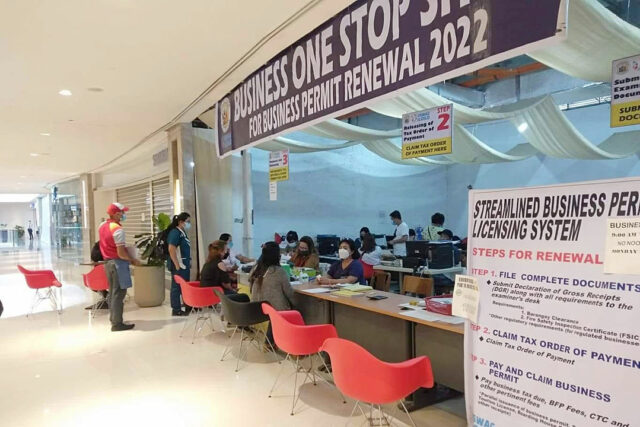
THE DEPARTMENT of Trade and Industry (DTI) said business name registrations rose 6% to 679,118 in the first half, with rapid growth noted in e-commerce enterprises.

Digital PH Group Undersecretary Mary Jean T. Pacheco said momentum is carrying over from a record performance in 2023.

“We had a banner year last year when we got the highest number of registrations of close to 984,330 business names, and the good news is that the momentum continues,” Ms. Pacheco said at a briefing recently.

She added that online businesses accounted for 17,000 of the total registrations during the half, nearly equaling their full-year total of 18,000 in 2023.

The DTI also attributed the growth in registrations to traditional businesses like sari-sari stores, as well as a strong performance by the Calabarzon region.

“This remarkable growth in business name registrations… signals a growing economy, increased job opportunities, and a brighter future for the Philippines. The DTI continues to encourage aspiring entrepreneurs to take advantage of the opportunities available and contribute to the nation’s economic growth,” she added.

Ms. Pacheco said the DTI is encouraging online micro-entrepreneurs to register as barangay business enterprises (BMBEs) to gain exemption from the Bureau of Internal Revenue’s Revenue Regulations No. 16-2023.

The DTI said that the regulations require electronic marketplaces and digital financial service providers to withhold an income tax of 1% on half of the gross remittances to online sellers.

However, BMBEs and those with a gross remittances of less than P500,000 a year are exempt from withholding, it added.

“We want to ensure that online micro-entrepreneurs are aware of the valuable benefits that BMBE registration offers,” Trade Secretary Alfredo E. Pascual said.

“By registering as a BMBE, online merchants can not only enjoy income tax exemption but also gain access to other resources that can help their businesses grow, in line with the intent of the BMBE law,” he added.

BMBEs are also exempt from the Minimum Wage Law and can access special credit windows and capacity-building programs.

Republic Act No. 9178 defines a BMBE as a business entity engaged in the production of agro-processing, trading, and services whose total assets do not exceed P3 million. — Justine Irish D. Tabile

PHL 73rd in strength-of-passport ranking

THE PHILIPPINE passport was ranked 73rd in terms of visa-free access to other countries, according to the Henley Passport Index (HPI) released Wednesday.

HPI reported that the Philippine passport grants its holder visa-free access to 67 countries.

“The Philippine passport has been fairly consistent on the Henley Passport Index with a slight trend upwards,” Henley & Partners Managing Director and Head for Southeast Asia Scott Moore said in a briefing Wednesday.

“The Philippine economy is growing on average between six to seven and a half percent annually over the past decade, and we anticipate this growth will continue.”

He noted the ”strong correlation” between a country’s visa-free tally and its economic prosperity.

The Philippines ranked 83rd in 2021, 77th in 2022, 78th in 2023, and 73rd in January and July 2024.

“As the economy continues to grow and develop, the passport score should continue to trend upward. It’s important to keep in mind that the Philippines is growing definitely at a higher rate than the established Western countries,” Mr. Moore said.

The visa-free destination count of 67 represented a fall of two countries after Armenia and Togo changed their rules from “visa-on-arrival for everyone” to “e-visa for everyone,” he said.

Singapore was rated the “strongest” passport with visa-free access to 195 countries, while Afghanistan was at the bottom of the list, placing 103rd with a visa-free tally of 26 countries visa-free.

“The gap is widening between countries at the top of our index and countries at the bottom of the index, which right now is Afghanistan… that is a gap of 169 countries, which is also larger than it ever has been before,” he said.

France, Germany, Italy, Japan, and Spain dropped to joint second place with visa-free access to 192 countries.

Meanwhile, Austria, Finland, Ireland, Luxembourg, Netherlands, South Korea, and Sweden were at joint third with visa-free access to 191 countries.

This was followed by Belgium, Denmark, New Zealand, Norway, Switzerland, and the UK were in joint fourth with visa-free access to 190 countries.

Australia and Portugal were tied for fifth with visa-free access to 189 countries. — Aubrey Rose A. Inosante

Green Climate Fund to release $4.14M for PHL climate projects

PHILIPPINE STAR/KRIZ JOHN ROSALES/PPA POOL

THE GREEN Climate Fund (GCF)  has approved $1 billion worth of climate-related projects worldwide, of which $4.14 million will support Philippine “green entrepreneurs,” the Department of Finance (DoF) said.

A total of 17 funding proposals for adaptation and mitigation projects, as well as six new accredited entities were approved by the GCF Board in its recent meeting, the DoF said in a statement.

The proposals cover coastal resilience, sustainable agricultural systems, ecosystem restoration, and climate technologies.

Among the approved projects was the regional $221.22-million Collaborative Research and Development Business (R&DB) Programme for Promoting the Innovation of Climate Technopreneurship.

The project aims to support technology transfer and improve the ecosystem for climate technology by empowering entrepreneurs in the Philippines, Cambodia, Indonesia, Laos, and Vietnam.

The five countries will each receive $4.14 million, DoF said.

“The Programme will be divided among the recipient countries, allowing Philippine green entrepreneurs to leverage global technological expertise, thus accelerating climate-resilient development in the country,” it added.

Of the total cost, $104.47 million will be financed by GCF grants and equity, while the remaining $116.74 million provided by co-financer contributions.

This brings the GCF’s total grants to the Philippines to $139.9 million, of which $137.7 million consisted of project grants.

The Philippines is currently implementing four readiness activities with the GCF, the DoF also said.

The Readiness and Preparatory Support Program (RPSP)   builds the capacity at the DoF as the National Designated Authority (NDA) in developing a monitoring, reporting and verification framework, conducting country portfolio analysis, establishing a GCF Philippines website, launching training modules, training project development personnel, and organizing a national stakeholder conference.

RPSP 2 aims to strengthen the capacities of the Land Bank of the Philippines (LANDBANK) and Development Bank of the Philippines (DBP) as Direct Access Entities developing high-quality project concept notes.

The Climate Resilient Recovery Readiness Support assists government agencies in integrating climate-resilient strategies in paradigm-shifting projects.

Finally, the Agriculture Sector Readiness promotes climate finance mechanisms and implements the Koronivia Joint Work on Agriculture priorities in Southeast Asia through knowledge sharing.

Finance Undersecretary Maria Luwalhati C. Dorotan Tiuseco also showed support for the mainstreaming of REDD+ results-based payments, “which will allow to integrate the funding modality into the regular project and program activity cycle of the Fund.” — Beatriz Marie D. Cruz

Price freeze ordered in NCR after state of calamity declaration

PHOTO BY BERNARD HERMANT

THE DEPARTMENT of Trade and Industry said Wednesday that a price freeze is in effect on basic necessities in the National Capital Region (NCR) due to the state of calamity declaration in the wake of Typhoon Carina and the southwest monsoon.

“The price freeze, effective immediately, aims to protect consumers from unjust price increases during this time of crisis,” Trade Secretary Alfredo E. Pascual said.

“We are committed to ensuring that basic goods remain affordable and accessible to all affected residents,” he added.

The price controls cover rice, corn, bread, fresh vegetables, root crops, pork, beef, poultry, eggs, milk, coffee, sugar, cooking oil, salt, laundry soap, detergent, firewood, charcoal, candles, and medicines.

“We have activated our monitoring teams to strictly enforce the price freeze. Those found violating the law will face severe consequences, including imprisonment and substantial fines,” Mr. Pascual said.

“We urge all establishments to comply with the price freeze and prioritize the well-being of our fellow citizens during this difficult time,” he added.

The price freeze will be in effect during the state of calamity, the DTI said.

“The DTI is closely coordinating with its National Capital Region (NCR) office to monitor the situation and guarantee the availability of essential goods,” it added.

In a separate bulletin Wednesday, the government weather service, known as PAGASA, said that the super typhoon is expected to leave the Philippine Area of Responsibility by early Thursday. — Justine Irish D. Tabile

How sustainable development changes business practices

More and more companies are beginning to understand and recognize the importance of sustainable development for long-term success and stability. But what is sustainable development and how does it affect us?

The concept of sustainable development was first introduced in the late 1980s due to the increasing social and environmental issues that come with economic progress. A United Nations (UN) 1987 paper, Report of the World Commission on Environment and Development: Our Common Future, defines sustainable development as “development that meets the needs of the present without compromising the ability of future generations to meet their own needs.’ The key is finding a balance where economic growth supports, rather than sacrifices, the well-being of individuals and communities.

GLOBAL EFFORTS IN PROMOTING SUSTAINABILITY
In 2015, UN member states agreed to adopt 17 sustainable development goals or SDGs —”global goals” that help the world achieve sustainable development. These goals serve as a call to action to improve everyone’s lives by 2030 as companies strive and thrive in a dynamic business landscape. The SDGs aim to address a wide range of global challenges, among which are those related to poverty, education, healthcare and gender equality.

Currently, sustainable development is being championed by various international organizations, including the United Nations Conference on Trade and Development (UNCTAD), the International Financial Reporting Standards (IFRS) Foundation and the Sustainability Accounting Standards Board (SASB). They develop frameworks and guidelines to help companies integrate sustainable practices into their business operations.

PHL EMBRACES SUSTAINABLE DEVELOPMENT
To practice sustainable development, companies should begin by being socially and environmentally conscious and responsible in how they use their resources. In the Philippines, companies can reflect this commitment in various initiatives within and outside business operations:

• When working with suppliers, vendors and other third parties, choose to work with those with strong ethical practices, particularly with all those in the supply chain that comply with the law and adhere to high standards of business ethics.

• Observe transparency throughout the supply chain to ensure that materials are sourced in an environmentally responsible manner and are not harmful to society.

• Integrate sustainability clauses into contracts or agreements to set clear expectations on environmental performance and social responsibility from their stakeholders.

• Use renewable energy sources to further reduce the environmental impact of energy consumption and support the global shift towards clean energy.

• Engage with communities where the business operates to help you assess the social and environmental implications that the business may have on these communities.

REPORTING REQUIREMENTS FOR SUSTAINABILITY
On Oct. 21, 2022, the Financial and Sustainability Reporting Standards Council (FSRSC) established the Philippine Sustainability Reporting Committee (PSRC) to render technical assistance to the former in the adoption and issuance of guidelines for sustainability reporting in the Philippines.

In 2019, the Securities and Exchange Commission (SEC) introduced sustainability reporting guidelines for Publicly Listed Companies (PLCs). The guidelines were crafted to ensure transparency and accountability among publicly listed companies by requiring them to disclose their sustainability practices and impacts. Under SEC Memorandum Circular No. 4, Series of 2019, PLCs are required to submit sustainability reports along with their annual reports.

At present, to comply with the sustainability reporting guidelines and standards, publicly-listed companies are asked to do the following:

• Include non-financial data when providing a comprehensive view of their overall business performance. Specifically, this involves disclosing detailed information on how sustainability is integrated into their governance structures, strategic planning, risk management processes, and performance metrics.

• Present sustainability reports at the same time as financial statements, allowing stakeholders to receive all relevant information in a timely manner.

• Include data from previous periods in sustainability reports to evaluate the progress and effectiveness of the company’s sustainability initiatives, to provide information on whether a company is improving, stagnating or regressing in its sustainability efforts.

• Explicitly state compliance with IFRS Sustainability Disclosure Standards to indicate that the company is adhering to the internationally recognized guidelines for sustainability reporting. This promotes the company’s credibility and reliability of the information provided on its sustainable practices.

The journey towards sustainable development is an ongoing process that demands commitment and collaboration among the government, business, communities and the larger society. The government’s support through its regulatory frameworks is crucial in setting the direction of the country’s pursuit towards a more sustainable future for all. For micro, small and medium-sized enterprises (MSMEs) and large corporations, their industrial and other business development programs must be designed in ways that would also mean progress for everyone. On the other hand, our society must be more involved in advocating for a sustainable lifestyle and in supporting businesses that are implementing sustainable business practices.

By understanding the principles of sustainability and integrating them in business development programs, companies can not only contribute to economic growth but also to a healthier environment and equitable society for current and future generations.

The views or opinions expressed in this article are solely those of the author and do not necessarily represent those of Isla Lipana & Co. The content is for general information purposes only, and should not be used as a substitute for specific advice.


Jose Angelo A. Chiuco is a Senior Manager at PricewaterhouseCoopers Business Services Philippines Co., Ltd., a Philippine member firm of the PwC network.

jose.angelo.chiuco@pwc.com

Eala ascends to career-best 143rd in world tennis rankings

ALEX EALA — FACEBOOK.COM/ALEXEALA

ALEX EALA rose to a career-best ranking of No. 143 in the Women’s Tennis Association (WTA) after winning two titles in Spain.

Ms. Eala jumped 12 places from her previous career high of No. 155 last week.

The Filipina started at No. 1180 upon entering the women’s circuit in 2020 at the peak of her junior career. In the juniors, she peaked at No. 2 in the world rankings.

She also jumped 37 places in the doubles, ranking 208th from 245th last week.

Ms. Eala won both the singles and doubles tournaments of the elite W100 Vitoria-Gasteiz in Spain over the weekend.

Ms. Eala, 19, first bagged the doubles title with long-time partner Estelle Cascino of France following a 6-3, 2-6, 10-4 win over Bulgaria’s Lia Karatancheva and Latvia’s Diana Marcinkevica in the final.

It’s the third pro doubles title for Ms. Eala and she all won it this year. She and Ms. Cascino also won the W75 Croissy-Beaubourg in France in March while Ms. Eala partnered with Latvia’s Darja Semenistaja in winning the W50 Pune in India in January.

Later on,  the No. 5 seed Ms. Eala rounded out her weekend by drubbing No. 7 seed Victoria Jimenez Kasintseva of Andorra, 6-4, 6-4, for her fifth pro singles crown without losing a single set in the tournament.

Ms. Kasintseva was the former world No. 1 player in the girls’ circuit, just ahead of Eala, before their encounter in the women’s play this time. — John Bryan Ulanday

China to challenge US for medal bragging rights amid doping row

PARIS — China arrives at the Paris Olympics expecting the torrent of gold medals that has become common for the Asian sporting powerhouse in recent decades but with the shadow of a doping row hanging over the delegation.

The team could win as many as 34 golds and 86 total medals in Paris, according to Nielsen’s Gracenote projections, and could pose a threat to American hopes of topping the table for the fourth straight Summer Games.

China brought 405 athletes to compete in 236 events in Paris, their largest for a Summer Olympics outside the country.

The country has won a total of 263 gold medals since shooter Xu Haifeng won the first at the Los Angeles Olympics in 1984, when China was finally welcomed into the Summer Games fold.

Diving, shooting, swimming, table tennis, artistic gymnastics and badminton are the key medal-winning sports but Gracenote predicts top contenders in 20 other sports.

Gracenote uses a statistics model based on available results data from key global and continental competitions since the previous Games in Tokyo.

China’s Olympic ambitions, however, have been overshadowed by a doping row that implicated 23 of its swimmers, many of whom are competing in Paris.

The 23 swimmers tested positive for trimetazidine (TMZ), a medication that increases blood flow to the heart in competitions before the Tokyo Olympics, but were later cleared by a Chinese investigation, which said they were inadvertently exposed to the drug through contamination.

The World Anti-Doping Agency (WADA) did not find any wrongdoing in its own investigation of the cases, triggering a US investigation and wider suspicions from swimmers in other countries.

China has repeatedly denied the doping allegations. A spokesperson of China’s Foreign Ministry, when asked about the US investigation into the doping scandal at a regular briefing on July 10, said China trusts the conclusion reached by the independent Swiss prosecutor and supports WADA’s governance.

“This non-existent case that the US keeps selling and the attacks it hurls at the international organization are all about degrading fine Chinese athletes and obstructing their participation in the Paris Olympics,” the spokesperson said.

China’s Chef de Mission Gao Zhidan, who is also the sports minister, said at a delegation departure ceremony earlier this month that China would aim to make sure there are zero doping incidents during the Paris Olympics.

The Olympic Games is usually one of China’s top national events, attracting hundreds of millions of viewers at home who hope to celebrate the country’s top performing athletes with great anticipation and patriotism.

The doping row, which comes at a time when China’s relations with the US and EU have been fraught with geopolitical and trade tensions, has chilled the mood of some sports fans back home.

Many on social media are also ridiculing Paris for offering no air-conditioners and very basic food options in the Olympic Village, which the city did to protect the environment.

“If Paris had consulted with each delegation and see who might need what, it would have been better,” said Hu Xijin, the former chief editor of local paper Global Times, on Weibo. “But Paris is a bit ‘haughty’ — ‘I’m the host therefore I should play by my rules’… Not only will athletes not have air conditioners, they will also sleep in cardboard beds and eat mostly vegetarian food cos I want the Olympics to be a big lesson for green living’,” Hu said. — Reuters

Solar Spikers hope to ride wave of massive upset

EXCEPT probably for Capital1 Solar owners Milka and Mandy Romero and battle-scarred coach Roger Gorayeb himself, nobody really believed that the Solar Spikers would make a dent in the Premier Volleyball League (PVL)  Reinforced Conference.

On a stormy but memorable Tuesday night at the PhilSports Arena, Mr. Gorayeb and his team silenced the doubters after they pulled off perhaps the biggest victory in their brief history as a PVL franchise.

A mammoth 26-24, 25-20, 25-18 shocker over Petro Gazz, the defending champion and two-time Reinforced Conference titlist, gave Capital1 not just its first victory this conference but also earned it the respect it has long sought.

“Who would have thought na mai-i-straight sets namin, they’re always looking at us as a low-level team, tapos maka-straight sets kami to a more experienced team,” said an emotional Mr. Gorayeb.

Malaking bagay sa amin iyon, morale-booster sa mga bata iyon,” he added.

The league suspended play Wednesday due to inclement weather.

Mr. Gorayeb credited rock-solid defense and a lethal weapon straight from Russia — Marina Tushova — for the victory.

Ang lakas ng depensa namin, maski ako nagulat eh. Last time, we were struggling sa counter-attack. Ngayon hindi kami nag-struggle kaya masaya ako,” said Mr. Gorayeb, whose team succumbed to Akari, 25-18, 27-25, 22-25, 25-14, in its first outing Thursday.

Si Marina (Tushova) sinapian, birthday yata nito. Ang ganda nilaro niya,” he added referring to the crisp-hitting import’s masterful 24-point performance.

The early success was made more special since the team was only formed six months ago when the Romero sisters picked Mr. Gorayeb to mentor the team. — Joey Villar

ADVERTISEMENT
ADVERTISEMENT