
How PSEi member stocks performed — July 31, 2024

Here’s a quick glance at how PSEi stocks fared on Wednesday, July 31, 2024.
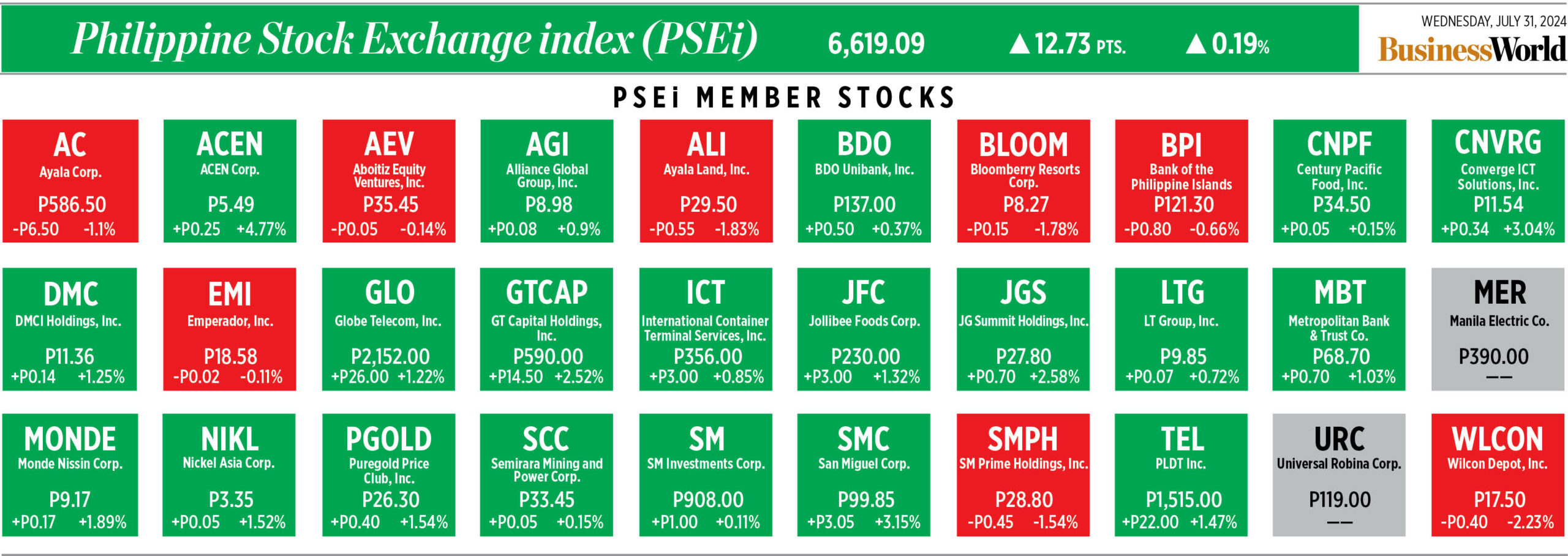

Here’s a quick glance at how PSEi stocks fared on Wednesday, July 31, 2024.
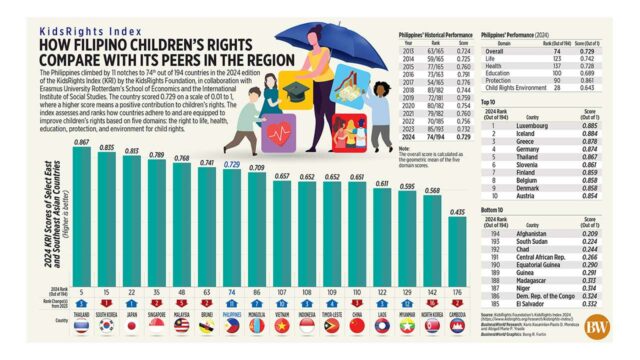
The Philippines climbed by 11 notches to 74th out of 194 countries in the 2024 edition of the KidsRights Index (KRI) by the KidsRights Foundation, in collaboration with Erasmus University Rotterdam’s School of Economics and the International Institute of Social Studies. The country scored 0.729 on a scale of 0.01 to 1, where a higher score means a positive contribution to children’s rights. The index assesses and ranks how countries adhere to and are equipped to improve children’s rights based on five domains: the right to life, health, education, protection, and environment for child rights.


The release of Ipo dam’s water is a precautionary step to prevent further disaster due to the torrential rains brought by the Super Typhoon Carina (Gaemi)-enhanced Southwest Monsoon on July 24, according to the Philippine Atmospheric, Geophysical, and Astronomical Services Administration (PAGASA).
“Yung ang iniiwasan nila (dam operators), yung mag-collapse yung dam…Maraming mamamatay or maraming mawawasak [The dam operators are trying to prevent the dam from collapsing. Many people could die, or a lot of property could be destroyed],” PAGASA’s Hydrologist Juan Elmer S. Caringal said in a phone interview.
The release of dam waters is one of the preservation measures, as most Luzon dams are over 50 years old, which exceeds the United Nations’ recommended safe age limit, he explained.
Mr. Caringal also noted that the release of water from Ipo Dam coincided with the continuous torrential rains.
“Yung pinakawalan ng Ipo, maliit lang naman na volume… ang nangyari nga lang kasabay (ito) ng malalakas na pagulan. So, kung baha na is nadagdagan pa ng kaunti [The amount of water released by Ipo Dam was actually quite small, but it coincided with heavy rainfall. So, it adds a bit if it’s already flooding],” he explained.
Dams in Luzon also function as floodgates, regulating the volume of rainfall from mountains and watersheds before it is released into various waterways in Luzon, Mr. Caringal added.
On July 24, Ipo released 61 cubic meters per second (cms) of dam waters in Bulacan as its level increased slightly to 101.53 meters from its normal high-water level of 101.00 meters, according to the report of PAGASA.
Meanwhile, at least 207 areas across 16 cities and municipalities in Bulacan were affected by the onslaught of the Super Typhoon Carina-enhanced Southwest Monsoon and the earlier Typhoon Butchoy.
Areas including Balagtas, Bocaue, Bulakan, City of San Jose Del Monte, Calumpit, Guiguinto, Paombong, Pandi, Malolos City, Hagonoy, and other key municipalities, according to the report of the National Disaster Risk Reduction and Management Council on Wednesday.
The Governor of Bulacan appealed to the national government to construct a mega dike project extending from Bataan to Cavite.
“Mataas ang dagat sa atin, lubog na tayo talaga… Ganon ang ginawa ng Korea, talagang gumawa sila ng mahabang mahabang mega dike para i-block (ang baha) [The sea level is high here, and we are really flooded… That’s what Korea did; they built a long, extensive mega dike to block the flooding],” Daniel R. Fernando, Bulacan Governor said in an interview fr TV5.
Since last year, Mr. Fernando has been pushing for the Bataan, Cavite mega dikes which he believes will be the permanent solution to Bulacan’s flooding problem. – Edg Adrian A. Eva

THE PESO surged against the dollar on Wednesday after Japan’s central bank unexpectedly hiked rates.
The local unit closed at P58.365 per dollar on Wednesday, strengthening by 28 centavos from its P58.645 finish on Tuesday, Bankers Association of the Philippines data showed.
The peso opened Wednesday’s session stronger at P58.58 against the dollar, which was already its worst showing for the day. Its intraday best was at P58.35 versus the greenback.
Dollars exchanged rose to $1.295 billion on Wednesday from $1.23 billion on Tuesday.
The peso rose against a broadly weaker dollar after the Bank of Japan (BoJ) cut raised rates and signaled more increases within the year, Rizal Commercial Banking Corp. Chief Economist Michael L. Ricafort said in a Viber message.
The peso tracked the yen’s strength against the dollar after the BoJ decision, a trader said in a phone interview.
“There was profit taking and position trimming ahead of the Federal Open Market Committee’s policy announcement,” the trader added.
The Bank of Japan raised interest rates in a mostly unexpected move on Wednesday and unveiled a detailed plan to slow its massive bond buying, taking another step towards phasing out a decade of huge stimulus, Reuters reported.
The decision, which defied dominant market expectations for the BoJ to stand pat on rates, takes its short-term policy rate to levels unseen since 2008.
BoJ Governor Kazuo Ueda did not rule out another interest rate hike this year and signaled the bank’s readiness to steadily hike borrowing costs to levels deemed neutral to the economy in coming years.
The hawkish comments pushed the dollar below 151 yen for the first time since March, as markets awaked to the reality that Japan was finally eyeing a full-fledged rate hike cycle.
Japan’s shift to tighter monetary policy also contrasts sharply with the broad swing to lower interest rates by other major economies, with the Federal Reserve expected to signal later on Wednesday that it will cut rates in September as US price pressures moderate.
At the two-day meeting ending on Wednesday, the BoJ’s board decided to raise the overnight call rate target to 0.25% from 0-0.1% in a 7-2 vote.
It also decided on a quantitative tightening plan that would roughly halve monthly bond buying to 3 trillion yen ($19.6 billion), from the current 6 trillion yen, as of January-March 2026.
The yen rallied to 150.88 to the dollar on Mr. Ueda’s comments in choppy trade.
The decision comes as the Fed looks increasingly set on cutting interest rates, reversing an aggressive tightening cycle that drove up the dollar and caused a painful yen sell-off for Japan.
For Thursday, the peso’s movement against the dollar will largely depend on the Fed’s policy statement overnight, the trader said.
Meanwhile, Mr. Ricafort sees the peso moving between P58.25 and P58.45 per dollar on Thursday. — BMDC with Reuters
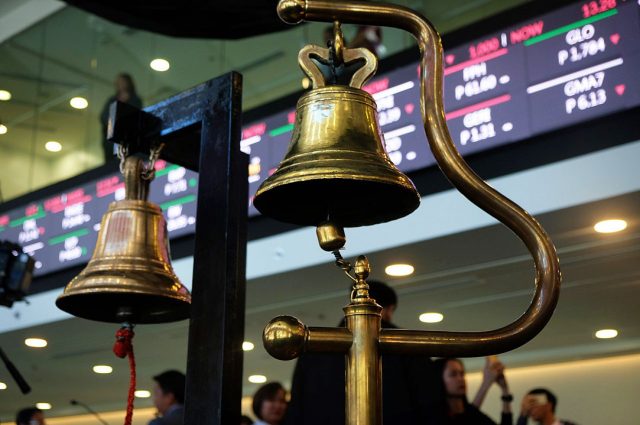
PHILIPPINE SHARES rebounded on Wednesday on bargain hunting as investors awaited the outcome of the US Federal Reserve’s policy meeting, which was set to be announced overnight.
The Philippine Stock Exchange index (PSEi) rose by 0.19% or 12.73 points to end at 6,619.09 on Wednesday, while the broader all shares index gained by 0.27% or 9.94 points to close at 3,597.71.
“Along with our Asian peers, the local bourse gained as investors bought bargains after the two consecutive days of market decline,” Philstocks Financial, Inc. Research Analyst Claire T. Alviar said in a Viber message.
“Investors were also awaiting the Fed’s meeting to gauge the future direction of interest rates and to know how dovish the Fed’s stance might be,” she added.
Asian indexes ended higher on Wednesday after the Bank of Japan raised interest rates in a mostly unexpected hawkish pivot, sparking gains for the Japanese yen, Reuters reported.
MSCI’s broadest index of Asia-Pacific shares outside Japan added over 1%, with Japan’s benchmark Nikkei closing up 1.5% at its highest for a week.
A Federal Reserve rate decision is due later in the day, with markets expecting the US central bank to stand pat on rates but indicate cuts are on the way.
Markets are fully pricing in a Fed rate cut of 25 basis points (bps) in September, with roughly 68 bps of easing priced in for the year.
“Philippine shares closed modestly higher following consecutive sessions of profit taking to close the month of July. Price action got a boost from Wall Street as traders rotated out of mega-cap technology stocks and braced for the Fed’s monetary policy decision,” Regina Capital Development Corp. Head of Sales Luis A. Limlingan added in a Viber message.
“According to CME’s FedWatch Tool, Fed funds futures indicate a strong likelihood that central bankers will keep rates steady at the 5.25% to 5.5% range. However, traders will primarily be watching for any hints from [Fed Chair Jerome H.] Powell about potential rate cuts in the near future,” he said.
Almost all sectoral indices closed higher, with property being the lone decliner, dropping by 1.24% or 32.37 points to 2,574.25.
Meanwhile, mining and oil rose by 1.66% or 136.23 points to 8,322.09; industrials increased by 0.98% or 90.02 points to 9,269.16; services went up by 0.8% or 16.10 points to 2,017.25; holding firms added 0.38% or 22.20 points to end at 5,776.77; and financials climbed by 0.07% or 1.55 points to 1,990.27.
“Among the index members, ACEN Corp. was at the top, increasing by 4.77%, while Wilcon Depot, Inc. was at the bottom, losing 2.23%,” Ms. Alviar said.
Value turnover rose to P5.62 billion on Wednesday with 421.19 million shares changing hands from the P4.63 billion with 739.53 million issues traded on Tuesday.
Advancers beat decliners, 92 to 86, while 63 issues were unchanged.
Net foreign selling went down to P19.79 million on Wednesday from P607.78 million on Tuesday. — R.M.D. Ochave with Reuters
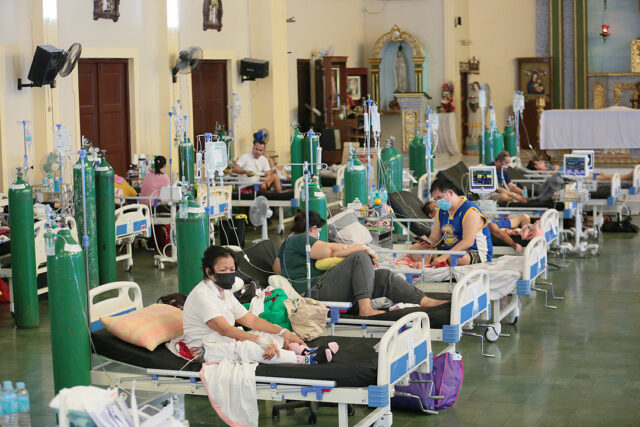
THE Development Budget Coordination Committee (DBCC) will be asked to explain to Congress the reduction in proposed budgets for agriculture, health, and social welfare, Deputy Speaker and Quezon Rep. David C. Suarez said at a briefing.
“This will be tackled as we progress into the budget hearings,” “We have a DBCC briefing next week, and we will surely ask the Executive department to explain these deductions,” Mr. Suarez said.
On Monday, the administration proposed a P6.352-trillion national budget for 2025, equivalent to 22.1% of gross domestic product.
The Department of Budget and Management (DBM) said the reductions are apparent when comparing the proposed 2025 budget with the funding approved by Congress in the budget bill it passed for 2024, known as the General Appropriations Act (GAA).
Budget Secretary Amenah F. Pangandaman said, however, that comparing on a like-for-like basis — the budgets proposed by the government in 2024 and 2025, known as the National Expenditure Program (NEP), “you will notice that there is actually an overall increase for the agencies concerned,” adding that government-proposed allocations are mostly higher across the board.
Ms. Pangandaman, responding via Viber to queries about the budget adjustments, said the 2024 GAA reflects changes made by legislators “and therefore does not reflect the original criteria the DBM used to evaluate agency proposals.”
“Furthermore, changes such as (project completions) or shifting priorities, as requested by agencies, contribute to what seems like a decrease in funding,” she added.
Next year’s NEP allocation for the Department of Health is P223.19 billion, against the 2024 GAA funding level of P246.75 billion. The 2025 NEP proposal remains higher than the P204.6 billion the DBM submitted to Congress last year.
The budget for agriculture, which includes the Department of Agriculture and the Department of Agrarian Reform, is P211.38 billion, lower than the 2024 GAA total of P221.7 billion and the P221.86 billion proposed in the 2024 NEP.
The House of Representatives will begin its budget deliberations next week, legislators said on Tuesday.
The 2025 proposed budget for the Department of Social Welfare and Development of P230.1 billion reflects a 7.2% decline compared to the GAA level of P248.1 billion this year.
Manila Rep. Ernesto M. Dionisio said he is not alarmed by the funding adjustments, noting the opportunity to make changes when the GAA is legislated.
“It’s only a proposal, and sometimes the reductions don’t necessarily mean anything negative,” he said at the same briefing Mr. Suarez spoke at. “Sometimes, we have projects that were accomplished… that don’t need to be funded anymore.”
The House will look at augmenting the proposed funds for the agencies concerned if they deem it necessary, Surigao del Norte Rep. Robert Ace S. Barbers said in the same briefing. “If we see programs that need more funding based on our scrutiny, then we’ll augment the funds.”
Meanwhile, it remains uncertain whether a provision in the 2024 budget authorizing the government to claim unutilized funds from government-owned and -controlled corporations (GOCCs) will be included in next year’s budget.
“We can’t say until the process is done. It will undergo a long and thorough process (before we can say if it’ll be included),” said Mr. Suarez.
However, Mr. Suarez is “very supportive of that principle” as funds remitted by GOCCs due to the so-called cash sweeps could help fund unexpected projects. “The Chief Executive has to be given enough elbow room to address these unforeseen events that might require funds to address.” — Beatriz Marie D. Cruz, Kenneth Christiane L. Basilio
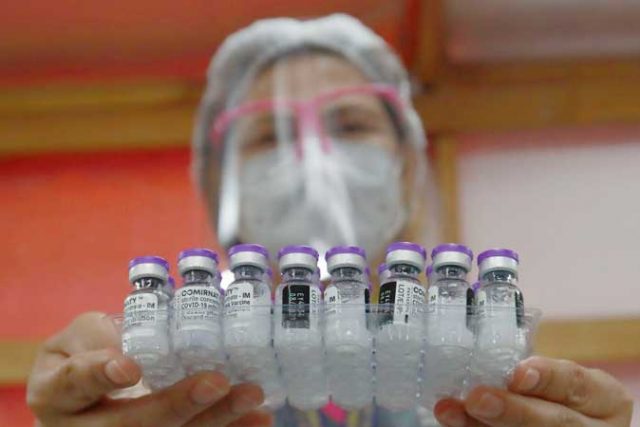
A SPECIAL economic zone in Victoria, Tarlac that will specialize in pharmaceutical-industry locators is expected to attract P400 million worth of investments, according to the Philippine Economic Zone Authority (PEZA).
At a briefing on Wednesday, PEZA Director General Tereso O. Panga said that the developer of Victoria Industrial Park, which was proclaimed the country’s first pharmaceutical ecozone, will also expand its own ointments business within the zone.
“The developer is also in the pharmaceutical business; they are the owners of the Katinko Group. In fact, as we speak, they’re already undergoing construction of their manufacturing facility,” he said.
“And so with that, and as a result of our recent mission to India and the setting up by the Food and Drug Administration (FDA) of a laboratory in Victoria, Tarlac, we’re eyeing some locators; I cannot tell for sure how many,” he added.
Melissa Y. Yap, chief executive officer of Katinko manufacturer Greenstone Pharmaceutical, said that the company has a manufacturing plant up and running at the Victoria site.
The plant, spanning 2,000 square meters, supplements the manufacturing capacity of the company’s three facilities in Cavite.
“We are also looking into going global, to create a path for global brands made in the Philippines, and PEZA is enabling us to do that,” Ms. Yap said.
She said new facilities in the works will produce medicine, cosmetics, and home-care products.
“We are expanding our product lines, and since each kind of product requires a different system, we really want to build new plants to be able to create various kinds of products that we can share with the world,” she said.
“Usually for one factory, the investment is around P100 million to P200 million, depending on the machinery that we put in,” she said, adding that the new operations will launch within two years.
Mr. Panga said the investment promotion agency’s recent mission to India has resulted in investment commitments from Indian companies.
“We met with nine pharma companies, and they’re big in India. So far, five have expressed interest in exploring and putting up their own facilities,” Mr. Panga said.
The five companies were identified as USV Private Limited, Scimplifi, NephroPlus, Glenmark Pharmaceuticals, and Shilpa Medicare, which have established a trading presence in the Philippines.
He said NephroPlus, which has the backing of the World Health Organization, is furthest along on its plans to put up dialysis centers in the Philippines.
“They are planning to put up 200 dialysis centers, and we asked them to locate inside economic zones (which are) quite proximate to city centers, for which they’ll be investing, I think, close to P500 million,” he added.
In terms of jobs, Ms. Yap said that the company is planning to increase staffing to 1,000. The overall personnel target for all locators in the Victoria Industrial Park is 10,000.
“The goal for the Victoria Industrial Park is to really bring in labor-intensive factories and to really create viable alternative jobs for the farmers so they will have regular income in between planting and harvesting seasons,” she added.
Ms. Yap said that the park can accommodate 20 to 25 locators at a hectare each, with plans to expand by another 30 hectares.
Separately, Mr. Panga said PEZA is in talks with the Department of Labor and Employment and the IT and Business Process Association of the Philippines (IBPAP) to absorb any workers that will be displaced by the shutdown of Philippine Offshore Gaming Operators (POGOs).
“We have this big segment within IBPAP, which is into gaming, so we see complementary activities with the POGOs, because some of them are involved in software development and some are in backroom operations. I think they can easily migrate to the information technology (IT) sector,” he said.
He said POGO talent can readily be taken on by IBPAP given the bullish outlook for the industry. — Justine Irish D. Tabile

THE Department of Agriculture (DA) said on Wednesday that the sale of government-subsidized rice to the general public will be launched at four KADIWA centers in Metro Manila starting Aug. 1.
Agriculture Assistant Secretary and Spokesperson Arnel V. de Mesa said that the so-called Rice for All program will launch at KADIWA outlets in Malabon, Caloocan, Food Terminal, Inc. in Taguig, and the Bureau of Plant Industry in Manila.
“The stocks will come from commercial sources and can be imported or domestically grown depending on which traders participate,” Mr. De Mesa said at a briefing.
Well-milled rice will sell for P45 per kilogram, with premium rice fetching P52 kilo. Purchases are limited to 25 kilos per person per day.
Commercial outlets sell imported well-milled rice prices in Metro Manila for between P51-P53 per kilo, while domestically grown well-milled rice fetched between P45 and P55 as of July 30, according to DA price monitors.
Imported premium rice in Metro Manila markets was selling for P53-60 per kilo, while the domestically grown equivalents were priced at P50-P58.
Prices at KADIWA outlets “will be adjusted depending on the movement of rice prices but will definitely be lower than retail prices in general,” Mr. De Mesa added.
He said that more outlets will be added later in August.
Mr. De Mesa said the government could also extend the P29 subsidized-rice program for 34 million vulnerable individuals, including persons with disabilities, solo parents, and senior citizens, as well as those below the poverty line.
“The objective of this Rice for All program is to make cheaper rice available. This is one of the initiatives of government to lower the impact of food items on inflation,” Mr. De Mesa said.
According to the Philippine Statistics Authority, inflation eased to 3.7% in June, with rice inflation accounted for 42.5% of overall inflation. Rice inflation eased to 22.5% from a month prior.
To lower rice prices the government reduced the import tariff on rice to 15% until 2028, via the issue of Executive Order (EO) No. 62.
Mr. De Mesa said that the DA is expecting prices to drop by August, judging from the higher import volumes approved by the Bureau of Plant Industry (BPI).
He said that the tariff cut itself is expected to lead to a P6 to P7 per kilo price reduction.
As of July 20, rice imports amounted to 2.39 million metric tons (MT), according to the BPI. For July, as of the 20th of the month, rice imports totaled 56,118 MT.
He said that traders are currently taking a “wait and see attitude” pending a Supreme Court’s decision on EO 62, the legality of which is being contested by farmers, who claim the order was issued without the consultation needed to implement tariff adjustments. — Adrian H. Halili

THE Light Rail Transit Authority (LRTA), which operates Light Rail Transit Line 2 (LRT-2), said revenue for the first half rose 30.7% to P622.61 million as ridership grew during the period.
In the six months to June, the LRTA posted gross revenue of P622.61 million, after carrying 25.89 million passengers, up from 23.18 million a year earlier.
Its June revenue was P98.16 million, up 26.6% from a year earlier but down 7.4% compared to May.
Ridership in June was 4.08 million, up 7.7% year on year.
In 2023, LRTA reported gross revenue of P1.1 billion after carrying 49.43 million passengers.
LRT-2 is an east-west commuter line connecting Manila to Antipolo, Rizal.
For 2024, LRTA expects its ridership to grow 2.6% to 50.7 million, with daily average ridership expected to increase to 140,444 from 136,921. — Ashley Erika O. Jose

THE volume of catch landed at regional fishports rose 54.1% year on year during the second quarter, according to the Philippine Fisheries Development Authority (PFDA).
In a report, the PFDA said the landed catch was 186,557.96 metric tons (MT) during the three months, up from 121,062.55 MT a year earlier.
“During the months of April to June, the PFDA, through its Regional Fish Ports (RFP), showed immense growth in fish unloading,” it added.
On a quarter-on-quarter basis, fish volumes fell 38.5% compared with the first quarter.
The daily average volume rose 54.1% to 2,050.09 MT.
Vessel arrivals fell to 19,919, against the 24,050 reported a year earlier.
It said that the opening of various fishing grounds lead to the greater use of the PFDA’s port facilities. — Adrian H. Halili

THE Philippine Chamber of Commerce and Industry (PCCI) said on Wednesday that the proposed Philippine Nutrient Profile Model (NPM) put forward by the National Nutrition Council (NCC) needs to undergo impact studies.
The business group was responding to the NCC announcement that it would adopting the NPM of the Pan-American Health Organization (PAHO).
“We all agree that we should have a comprehensive NPM as a crucial step toward enhancing our countrymen’s physical health and mental acuity and promoting their overall well-being,” PCCI President Enunina V. Mangio said.
“However, any efforts to revise or implement NPM must be science- and research-based and not merely patterned on the PAHO model that was designed for specific countries with their dietary patterns and needs.”
She said that the PCCI supports the Philippine Chamber of Food Manufacturers, Inc. which called for a focus on more urgent nutritional concerns.
“Given the high incidence of poverty in our country, it is essential to give due consideration to approaches that increase the availability and accessibility of food rather than narrowing the food choices that our people can make,” Ms. Mangio said.
Rita Palabyab, co-chair of PCCI’s Agriculture Committee, said that the model must be implemented in a manner that empowers individuals to make informed dietary choices.
“We adhere to scientific research and data-driven insights as the basis of the model that can help Filipinos adjust their nutritional intake and live healthier and more productive lives,” Ms. Palabyab said.
She said that the proposed Philippine NPM, which targets prepackaged foods, overlooks the role of food processing in ensuring a safe and stable food supply.
“The policy development process thus far has not adequately considered the significant contribution of the agri-food sector to GDP, which amounts to $126.7 billion, with food and beverage manufacturing accounting for 46%,” she added. — Justine Irish D. Tabile
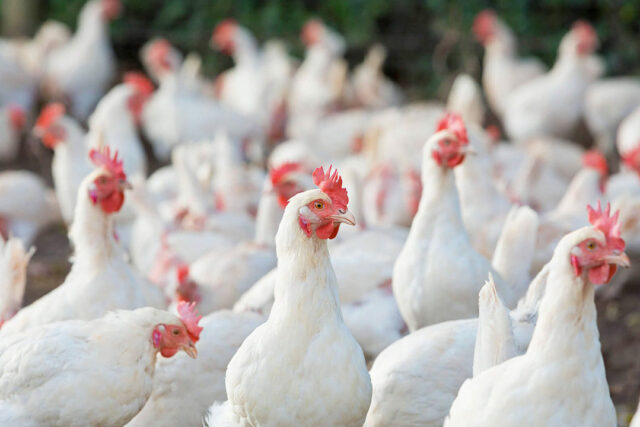
THE Department of Agriculture (DA) said on Wednesday that it lifted a temporary ban on imports of poultry and poultry by-products from Japan.
In Memorandum Order No. 31, the DA said the ruling follows an official report by the Japanese government to the World Organization for Animal Health (WOAH).
“This order is hereby issued to lift the temporary ban on importing domestic and wild birds and their products, including poultry meat, day-old chicks, eggs and semen originating from Japan,” the DA said.
It added that all reported Highly Pathogenic Avian Influenza (HPAI) cases have been resolved, with no additional outbreaks reported after June 2.
“The H5N1 strain could spread rapidly among bird population, including poultry that is a multibillion-peso industry in the Philippines,” the DA added.
In January, the DA barred Japanese poultry imports following a reported outbreak.
Japan’s Ministry of Agriculture, Forestry and Fisheries reported the HPAI outbreak to the WOAH on Nov. 28.
“Based on the evaluation of the DA, the risk of contamination from importing live poultry, poultry meat, day-old chicks, eggs and semen is negligible,” it added. — Adrian H. Halili
