Home Blog Page 280

Peso soars to near five-month high as US-Iran talks soothe sentiment

BW FILE PHOTO

THE PESO jumped to a near five-month high against the dollar on Wednesday, supported by easing geopolitical concerns amid ongoing negotiations between the United States and Iran.

The local unit strengthened by 12.5 centavos to close at P57.861 versus the greenback from its P57.986 finish on Monday, data from the Bankers Association of the Philippines showed.

This was the peso’s strongest finish in close to five months or since it ended at P57.461 on Sept. 24, 2025.

The local currency opened Wednesday’s trading session a tad stronger at P57.94 against the dollar. Its weakest showing was at P58.04, while its intraday high was at P57.84 against the greenback.

Dollars traded rose to $1.046 billion from $896.5 million on Monday.

The peso was supported by easing global crude oil prices amid continued negotiations between the US and Iran, Rizal Commercial Banking Corp. Chief Economist Michael L. Ricafort said in a Viber message.

Oil prices steadied in Asian trade on Wednesday after falling about 2% in the previous session as investors assessed progress in US-Iran talks but remained cautious about the prospects of a final deal that could ease supply concerns, Reuters reported.

Brent futures rose 15 cents or 0.22% to $67.57 a barrel by 0737 GMT, while US West Texas Intermediate crude was up 12 cents or 0.19% at $62.45. Both are around two-week lows.

Iran and the US reached an understanding on Tuesday on main “guiding principles” in talks aimed at resolving their longstanding nuclear dispute, but that does not mean a deal is imminent, Iranian Foreign Minister Abbas Araqchi said.

But the dollar was broadly higher on Wednesday as geopolitical risks kept markets on edge and investors awaited minutes from the US Federal Reserve for signals on future rate cuts.

With many markets in Asia closed for Lunar New Year holidays, investors were looking ahead to the Fed’s readout of its last meeting and other key US economic data for trading catalysts.

The dollar index, which measures the greenback against a basket of currencies, rose 0.1% to 97.23 after a two-day advance.

The Fed’s Open Market Committee issues minutes from its January meeting later on Wednesday, while the Commerce department will release durable goods data for December and on Friday will issue its first estimate for fourth-quarter gross domestic product. Chicago Fed President Austan Goolsbee said on Tuesday that the central bank could approve “several more” rate cuts this year, depending on inflation.

“The peso appreciated further to recent highs amid expectations of a downbeat US durable goods report overnight,” a trader said in an e-mail.

For Thursday, the trader said the peso could weaken due to potentially hawkish statements in the Fed minutes and uncertainty ahead of the Bangko Sentral ng Pilipinas’ policy meeting. Both the trader and Mr. Ricafort see the peso moving between P57.75 and P58 per dollar. — Aaron Michael C. Sy with Reuters
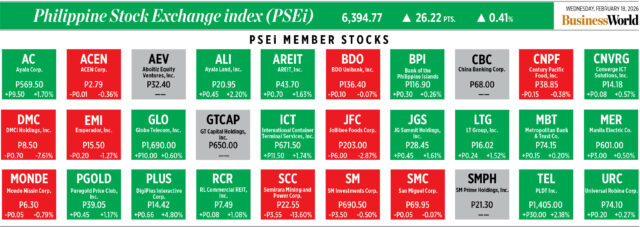
How PSEi member stocks performed — February 18, 2026

Here’s a quick glance at how PSEi stocks fared on Wednesday, February 18, 2026.


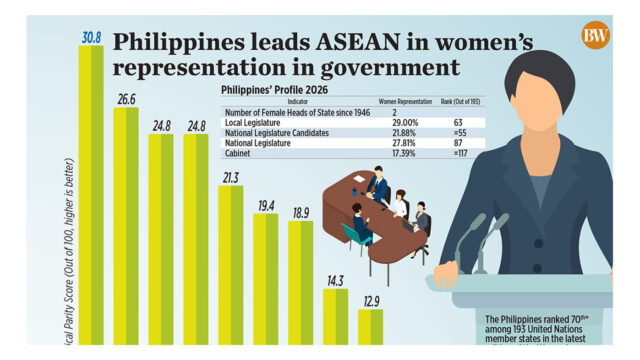
Philippines leads ASEAN in women’s representation in government

The Philippines ranked 70th* among 193 United Nations member states in the latest edition of the Women’s Power Index by think tank Council on Foreign Relations. On a scale of 0-100, where 100 represents women having at least 50% representation in all levels of government, the Philippines scored 30.8, ahed of other Association of Southeast Asian Nations (ASEAN) member states. The index measures the proportion of women’s representation in the government, which focuses on the numerical presence of women rather than their impact or policy preferences.

Bargain hunting lifts PSEi before rate decision

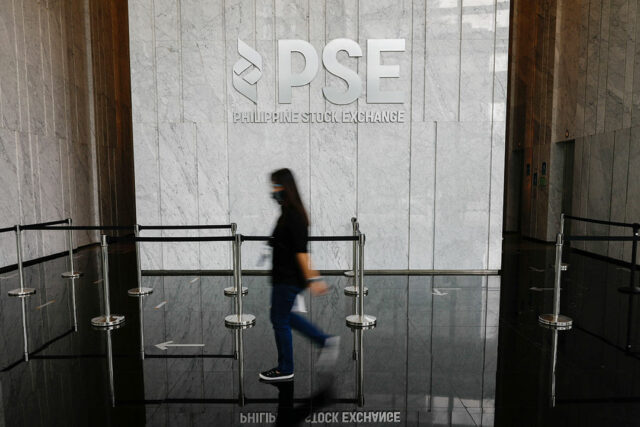
The lobby of the Philippine Stock Exchange in Taguig City, Sept. 30, 2020. — REUTERS

STOCKS closed higher on Wednesday as investors bought cheap stocks after the market’s three-day slide and before the Bangko Sentral ng Pilipinas’ (BSP) policy meeting, where a rate cut is widely expected.

The benchmark Philippine Stock Exchange index (PSEi) rose by 0.41% or 26.22 points to close at 6,394.77, while the broader all shares index went up by 0.41% or 14.76 points to end at 3,542.05.

“The thinly-traded Philippine market snapped a three-day losing skid as investors positioned ahead of tomorrow’s Monetary Board decision, at which the BSP is expected to deliver another 25-bp (basis point) rate cut, driven by lackluster fourth-quarter 2025 economic growth and anchored by the cushioning effect of the depreciating dollar,” AP Securities, Inc. said in a market note.

“The PSEi ended higher as bargain hunters stepped in following three consecutive days of decline. Investors appeared to position themselves ahead of the BSP policy rate decision tomorrow,” Regina Capital Development Corp. Head of Sales Luis A. Limlingan likewise said in a Viber message. “The rebound was driven by selective buying in key index names amid cautious optimism over the central bank’s next move.”

All 16 analysts in a BusinessWorld poll expect the Monetary Board to cut benchmark borrowing costs by 25 bps for a sixth consecutive meeting at Thursday’s review to bring the policy rate to 4.25%.

The BSP has lowered benchmark borrowing costs by 200 bps since its easing cycle began in August 2024.

“The positive cues from Wall Street and the strengthening of the peso also helped in the climb,” Philstocks Financial, Inc. Research Manager Japhet Louis O. Tantiangco added in a Viber message.

The peso jumped by 12.5 centavos to close at P57.861 versus the dollar on Wednesday, data from the Bankers Association of the Philippines showed. This was the currency’s best close since September last year.

Most sectoral indices closed in the green on Wednesday. Services rose by 1.64% or 43.60 points to 2,691.96; property increased by 0.91% or 19.87 points to 2,191.28; mining and oil went up by 0.35% or 63.98 points to 17,918.75; financials climbed by 0.17% or 3.64 points to 2,141.23; and holding firms advanced by 0.07% or 3.54 points to 5,055.15.

Meanwhile, industrials fell by 0.71% or 65.32 points to 9,023.44.

“DigiPlus Interactive Corp. was the day’s index leader, climbing 4.8% to P14.42. Semirara Mining and Power Corp. remained as the main index laggard, plunging 13.6% to P22.55,” Mr. Tantiangco said.

Advancers outnumbered decliners, 101 to 93, while 63 names closed unchanged.

Value turnover dropped to P5.19 billion on Wednesday with 943.82 million shares traded from the P5.28 billion with 1.04 billion issues that changed hands on Monday.

Net foreign buying was at P467.67 million, a turnaround from the P90.80 million in net selling in the previous session. — Alexandria Grace C. Magno

VP Sara to run for President in 2028; Bongbong wishes her ‘good luck’

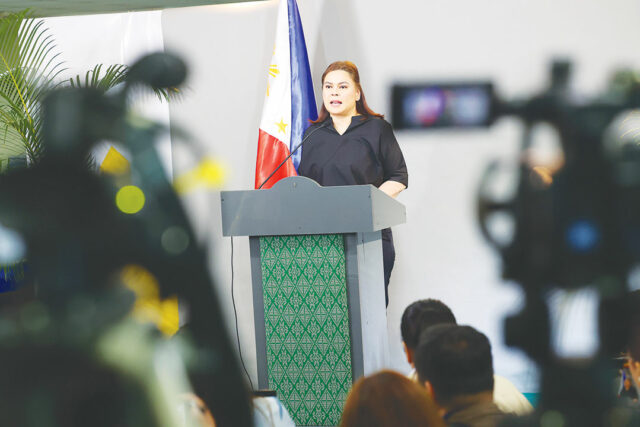
VICE-PRESIDENT SARA DUTERTE-CARPIO. — PHILIPPINE STAR/MIGUEL DE GUZMAN

By Adrian H. Halili and Chloe Mari A. Hufana, Reporters

PHILIPPINE Vice-President (VP) Sara Duterte-Carpio on Wednesday said she would run for President in 2028, becoming the first major political figure to declare her intention to seek the country’s top post amid an escalating feud with President Ferdinand “Bongbong” R. Marcos, Jr.

“I am Sara Duterte, I will run for President of the Philippines,” she said in a prepared statement in Filipino. She declined to answer questions after.

The 1987 Constitution limits Mr. Marcos to a single six-year term, and he has yet to endorse a successor.

Before announcing her presidential ambition, Ms. Duterte said running with Mr. Marcos in 2022 was a mistake, accusing him of failing to fulfill his campaign promises and of being complicit in what she described as a large-scale corruption scheme involving the 2025 national budget.

“I cannot kneel before every Filipino to ask for forgiveness,” said Ms. Duterte, who is facing a fresh impeachment bid in the House of Representatives. “Instead, I offer my life, my strength and my future in service to our nation.”

“In the first months of our terms, I saw Bongbong Marcos, Jr.’s lack of loyalty, both in the promises he made during the campaign, and in his sworn duty to the people,” she added.

Mr. Marcos wished the Vice-President “good luck,” Palace Press Officer Clarissa A. Castro told a news briefing.

She said Ms. Duterte should apologize for her shortcomings during her tenure as Education secretary, including alleged corruption, the use of confidential funds, overseas travel expenses, and remarks against the President.

“She should first apologize for the issues of corruption and alleged embezzlement of confidential funds of her two offices at that time — the Office of the Vice-President and the Department of Education,” Ms. Castro said in Filipino. “She should also apologize for all the slander instead of working and helping the government.”

Ms. Duterte served as Education chief from 2022 to 2024 after the Marcos-Duterte tandem won a landslide victory under the “UniTeam” banner. She left the Marcos Cabinet amid allegations of irregularities in the Education department, the government’s largest agency by budget.

Congressmen revived impeachment complaints against her earlier this month, and Ms. Duterte now faces three separate cases at the House. “If there is still an impending impeachment, it is because of her own actions,” Ms. Castro said.

Ms. Duterte has denied wrongdoing.

The rift between Mr. Marcos and Ms. Duterte has widened in recent months following policy disagreements and political tensions between their camps.

The political dispute has also unfolded against the backdrop of the arrest of her father, former President Rodrigo R. Duterte, by the International Criminal Court over charges of crimes against humanity related to his anti-drug campaign.

The House impeached her last year but the Supreme Court voided the proceedings for violating her right to due process.

‘SMARTER’ MOVE
Anthony Lawrence A. Borja, a political science professor at De La Salle University, said the Vice-President’s move could heighten tensions in Congress and pressure lawmakers who have yet to take sides amid the impeachment complaints at the House.

“If they are spooked in favor of Duterte, then the impeachment deliberations might slow down,” he said in a Facebook Messenger chat. “If the Marcos camp decides to apply a strong hand to ensure loyalty, then it becomes a question of whether it can provide enough incentives to keep legislators in line.”

Hansley A. Juliano, a political science lecturer at the Ateneo de Manila University, said lawmakers should consider pursuing electoral violation cases instead of impeachment.

“It would be smarter to subject her to electoral violation cases that can be traced back to her previous runs,” he said via Messenger chat. “Previous Presidents have been subjected to this to bolster potential bans on running.”

Meanwhile, opposition Senator Ana Theresia Hontiveros-Baraquel said the “united opposition,” composed of leaders from the Liberal Party and reform-oriented groups, had yet to name its standard-bearer for the 2028 elections.

“We are in the process of setting our own timeline,” she told a news briefing. “Even before this recent important development, we were continuing to level off and agree on what our qualifications were in our ranks.”

Ms. Hontiveros said they expect to announce their candidate by the end of the year or in the first quarter of 2027. She added that their preferred presidential bet should demonstrate a commitment to anti-corruption, good governance, stronger economic growth, national unity and sovereignty.

The senator has said she remains open to running for President in 2028 if the united opposition reaches a consensus around her candidacy.

Duterte 2028 bid won’t halt impeachment — lawmaker

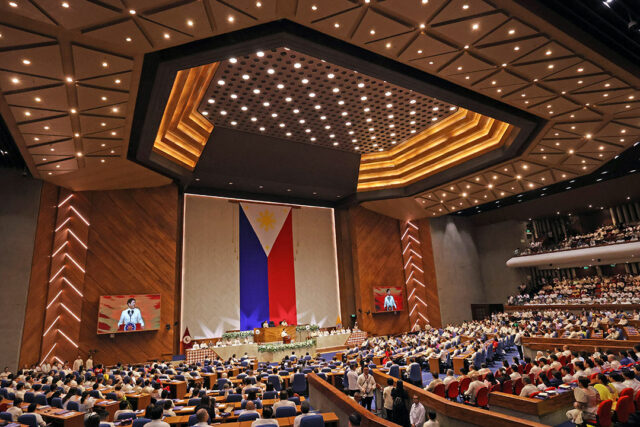
PHILIPPINE STAR /KJ ROSALES

By Kenneth Christiane L. Basilio, Reporter

PHILIPPINE Vice-President Sara Duterte-Carpio’s decision to run for President in 2028 is unlikely to derail impeachment proceedings at the House of Representatives, a congressman said on Wednesday.

“It’s a strategic decision to strengthen her following, especially because there are impeachment complaints against her,” Senior Deputy Majority Leader and Iloilo Rep. Lorenz R. Defensor told reporters.

He said the complaints would likely move forward procedurally but might struggle to secure the required one-third vote in plenary needed to send the articles of impeachment to the Senate.

“As of right now, I cannot see getting one-third of endorsements from the members of the House of Representatives,” he said. “But I can tell you it will reach the Committee on Justice.”

He added that the complaints would likely be referred to the committee for determination of sufficiency in form and substance. “It will not affect how the process will go on in terms of hearing it, in terms of deliberations in the Committee on Justice,” he added.

Political analysts said the House is expected to proceed cautiously to avoid repeating missteps that led the Supreme Court to void earlier impeachment proceedings against Ms. Duterte.

“The House has strong institutional incentives to demonstrate procedural rigor and constitutional fidelity,” Arjan P. Aguirre, an assistant political science professor at the Ateneo de Manila University, said in a Facebook Messenger chat before Ms. Duterte’s news briefing on Wednesday where she announced her presidential ambition.

A transparent process, he said, could help restore credibility after what some viewed as errors in the earlier impeachment attempt.

Ms. Duterte faces three impeachment complaints over the alleged misuse of P612.5 million in confidential and intelligence funds allocated to the Office of the Vice-President and the Department of Education when she served as secretary.

The complaints are expected to be referred to the House Justice Committee within the deadline set by the High Court after it nullified the previous proceedings. The tribunal ruled that the earlier impeachment did not comply with constitutional requirements, including the one-year bar rule.

“The defining factor in this impeachment is the Supreme Court decision,” Edmund S. Tayao, president and chief executive officer of Political Economic Elemental Researchers and Strategists, said via telephone. “It changes everything.”

Last year, more than one-third of lawmakers backed a fourth complaint that was sent directly to the Senate, effectively impeaching Ms. Duterte. Her trial was halted after the Supreme Court ruled the process unconstitutional.

Mr. Tayao said the ruling reshaped how impeachment is handled, stressing due process and clarifying how session days are counted. “The net effect of that decision is that impeachment is no longer mainly a political instrument,” he said. “It’s no longer just about numbers. They are now weighing the evidence.”

Batangas Rep. Gerville R. Luistro, who heads the Justice committee, earlier said the body would apply strict constitutional standards similar to those used in evaluating impeachment complaints against President Ferdinand R. Marcos, Jr., which were dismissed.

Mr. Aguirre said grounding the process in evidence and due process could reduce perceptions that impeachment is being used for partisan ends. He noted that documentary records tied to budget allocations could bolster the complaints against Ms. Duterte.

Ederson DT. Tapia, a political science professor at the University of Makati, said extended hearings could let lawmakers build a clearer factual record. “A long, drawn-out process allows for evidence-building, narrative framing and sustained public engagement,” he said via Messenger. “It creates space for institutional legitimacy rather than the perception of haste.”

He added that as political camps position themselves for 2028, impeachment carries electoral implications. “A process seen as vindictive could backfire. A process seen as transparent and evidence-driven could reinforce legitimacy.”

Ranjit Singh Rye, an OCTA Research fellow and assistant professor at the University of the Philippines, said prolonged scrutiny could affect Ms. Duterte’s standing as a presidential contender.

“Daily hearings, document disclosures, witness testimonies and sustained coverage can gradually affect how undecided voters view her viability,” he said in a Viber message.

“When a sitting Vice-President is not just viable but poll-leading, impeachment is no longer viewed purely as an accountability mechanism. It becomes a high-stakes political decision with presidential-cycle consequences,” he added.

Mr. Marcos is limited to a single six-year term and has yet to name a preferred successor, setting the stage for an extended contest as the next presidential cycle approaches.

OSG: Duterte surrender to ICC was lawful

FORMER PRESIDENT RODRIGO R. DUTERTE — PCOO

By Erika Mae P. Sinaking

THE Philippine government lawfully arrested and surrendered former President Rodrigo R. Duterte to the International Criminal Court (ICC) in compliance with both international and domestic laws, the Office of the Solicitor General (OSG) said.

In a statement dated Feb. 17, Solicitor General Darlene Marie B. Berberabe said the OSG told the Supreme Court of the Philippines that Mr. Duterte’s 2025 transfer to The Hague was a valid exercise of executive power.

“The OSG maintained that the government acted in accordance with both international law and Section 17 of Republic Act No. 9851,” Ms. Berberabe said, referring to the Philippine law on crimes against international humanitarian law, genocide and other crimes against humanity.

“It stressed that the legal requirements for surrender of the former President were met, namely: another court or international tribunal is conducting the investigation or prosecution; surrender is in the interest of justice; and surrender complies with applicable laws and treaties,” she added.

The OSG was responding to a 2025 petition filed by Mr. Duterte and Senator Ronald M. dela Rosa, along with habeas corpus petitions filed by the former president’s children after his arrest at the Ninoy Aquino International Airport.

In a supplemental memorandum in January, the OSG urged the court to dismiss the petitions, arguing that because Mr. Duterte is in the Netherlands, any Philippine court order would have no “extraterritorial effect.”

Separately, the OSG asked the high court to reject a plea by Mr. dela Rosa to block a potential ICC warrant against him.

“The OSG further noted that Senator dela Rosa failed to show the existence of any ICC arrest warrant against him, much less any imminent government action to enforce one,” the solicitor general said.

The OSG added that “absent a concrete governmental act” affecting the senator’s rights, there is no due process violation that would justify a temporary restraining order or injunction.

Mr. dela Rosa, recently identified as a “co-perpetrator” in an ICC charge sheet, has been absent from the Senate after Ombudsman Jesus Crispin C. Remulla spoke of a possible arrest warrant tied to his role in the Duterte administration’s anti-drug campaign.

The OSG’s affirmation comes days before the ICC’s Pre-Trial Chamber I is set to begin a confirmation of charges hearing on Feb. 23 to determine whether the crimes against humanity case will proceed to trial.

DepEd eyes trimesters by SY 2026-2027

Students answer test questions at a state high school in Manila. — REUTERS

By Almira Louise S. Martinez, Reporter

THE Department of Education (DepEd) aims to implement a proposed shift to a trimester system by school year (SY) 2026-2027, following consultations with education stakeholders.

“If ever this will be implemented by June, we need ample time for teacher training and orientation,” DepEd Assistant Secretary Jerome T. Buenviaje told BusinessWorld in an interview on Wednesday. He said consultations are expected to conclude before the end of the school year.

Under the proposal, the first trimester will run from June to September, the second from September to December, and the third from January to March. Each term will include an opening block, an instructional block and an enrichment block.

The opening block, or the first week of classes, will focus on orientation and assessments. Formal instruction will run for 55 days, from the second to the 11th week. A two-week enrichment block will follow, covering the department’s Academic Recovery and Accessible Learning program and in-service training for teachers.

Mr. Buenviaje said the trimester system allows about 60 instructional days per term, compared with 40 to 45 days under the quarterly setup. The added buffer is meant to address class disruptions and ensure lessons are completed.

Data from the Second Congressional Commission on Education (EDCOM II) showed that out of an average 191 class days per year, about 42 are lost to suspensions, alongside more than 150 legislated school activities.

Philippine Business for Education Chairman Ramon R. Del Rosario said the shorter gaps between terms could pose challenges for struggling students. “There’s no gap,” he said, noting that catch-up work would have to be integrated into the next term’s workload.

Alliance of Concerned Teachers Chairperson Ruby Bernardo raised concerns about teacher workload and readiness, citing possible adjustments in competencies, report cards and assessment systems.

DepEd said the proposed calendar could raise the number of school days to 201.

Separately, DepEd aims to address part of its 165,000 classroom backlog by building 106,000 classrooms through the Public-Private Partnership (PPP) School Infrastructure Project.

DepEd Undersecretary Ronald U. Mendoza said the agency seeks to narrow the deficit within five years. PPP classrooms can be completed in one to two years, compared with up to seven years under traditional procurement.

The new PPP school infrastructure phases, covering multiple regions nationwide, are scheduled for implementation from 2026 to 2031.

AFP backs US agreement to boost defense posture

BRP Diego Silang, USS Dewey, HMAS Towoomba and BRP Teresa Magbanua at this year’s first multilateral maritime cooperative activity in the South China Sea. — EDWARD BUNGUBUNG/ARMED FORCES OF THE PHILIPPINES

THE Armed Forces of the Philippines (AFP) on Wednesday expressed support for initiatives to enhance the country’s defense capabilities following a strategic dialogue with the US.

“The AFP supports initiatives that enhance our defense capability, interoperability and readiness in accordance with existing agreements and Philippine laws,” military spokeswoman Francel Margareth A. Padilla said in a Viber group chat.

The talks focused on strengthening Manila’s defense posture, including the deployment of advanced US missile and unmanned systems amid tensions in the South China Sea. Last year, Navy-Marine Expeditionary Ship Interdiction System missile platforms were deployed to the Philippines for joint Balikatan exercises and remain in an undisclosed location.

“Any deployment of allied systems is intended to strengthen training, improve domain awareness and support our collective defense posture,” Ms. Padilla said.

The agreement also includes expanding multilateral cooperation through maritime exercises, joint operations and enhanced security coordination.

Both countries aim to improve joint readiness, interoperability and response capacity for contingencies, including civilian-led disaster management. The dialogue also touched on bolstering the Philippines’ energy sector to support economic and defense priorities.

These developments occur amid rising tensions with Beijing over disputed features in the South China Sea. China claims almost the entire waterway under a U-shaped nine-dash line, overlapping with the Philippines’ exclusive economic zone. Manila rejects these claims, citing the 2016 Permanent Court of Arbitration ruling in its favor.

“These efforts contribute to our mission of protecting Philippine sovereignty, securing our national territory, and maintaining peace and stability in the region,” Ms. Padilla added. — Adrian H. Halili

Marcos still undecided about ICI

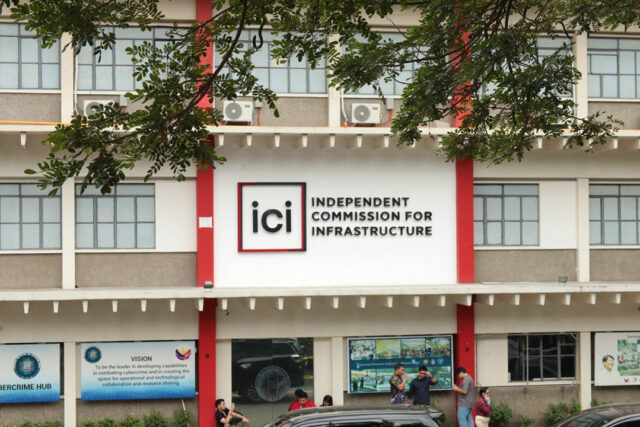
ICI office facade — BW FILE PHOTO

PRESIDENT Ferdinand R. Marcos, Jr. is still undecided on the fate of the Independent Commission for Infrastructure (ICI), the body he created to probe anomalous Public Works projects, the Palace said on Wednesday.

“We are still studying it — the report provided is quite thick,” Palace Press Officer Clarissa A. Castro told a news briefing in Filipino. “We will be able to provide an update on what will happen soon, and if ICI continues, we will also provide their status.”

The ICI first submitted the 125-day accomplishment report on Feb. 6. Its fate is in limbo as it awaits Mr. Marcos’ decision.

Created under Executive Order No. 94 on Sept. 11, 2025, the body was the President’s first concrete move after he unraveled a massive corruption within government officials and private contractors, specifically on flood control projects.

According to the report, the body filed nine referrals with the Ombudsman involving 65 people and coordinated referrals of 66 more individuals with the Department of Justice.

Mr. Marcos urged Congress to prioritize the passage of a bill establishing an Independent People’s Commission to probe, document and prosecute corruption in government infrastructure projects. — Chloe Mari A. Hufana

No info on ex-Rep. Co — Palace

SCREENSHOT of former Party-list Rep. Zaldy Co’s statement posted on his facebook account. — FACEBOOK.COM/REPZALDYCO

PHILIPPINE authorities have no new information on the whereabouts of former lawmaker Elizaldy S. Co, Malacañang said on Wednesday, amid a multi-agency effort to secure his arrest and return.

Palace Press Officer Clarissa A. Castro said there are no fresh updates on Mr. Co’s location, adding that the government would again seek information from the Department of the Interior and Local Government and the Presidential Anti-Organized Crime Commission on the status of the requested cooperation from the International Criminal Police Organization (Interpol).

Amid questions over which agency is leading the pursuit, the Department of Foreign Affairs (DFA) stressed that Mr. Co’s arrest and repatriation require a “whole-of-government approach.”

In a statement read by Ms. Castro, the DFA said the process involves “coordinated law enforcement and judicial processes, particularly Interpol coordination.”

The DFA reaffirmed its commitment to the rule of law and said it stands ready to provide diplomatic assistance within its mandate and established protocols.

It also urged the public to share any information on Mr. Co’s whereabouts to support ongoing efforts.

The former lawmaker was initially believed to be in Portugal, but recent court documents filed with the Philippine Supreme Court suggested he may be in Sweden. 

Mr. Co, who was formerly the House Appropriations chair, is wanted for his hand in anomalous flood control projects in the country.

Meanwhile, Acting Justice Secretary Fredderick A. Vida clarified on Wednesday that the Department of Justice no longer has the authority to unilaterally allow or deny travel for former Public Works Secretary Manuel M. Bonoan, following the issuance of a precautionary hold departure order.

Mr. Bonoan told reporters on Monday that he submitted a letter to the panel requesting permission to return to the US to accompany his wife for a medical procedure.

“We noted of his letter,” Mr. Vida told reporters in an ambush interview. “Those covered by a precautionary hold departure order must get permission from the court before traveling.”

Mr. Bonoan, along with four other respondents in a flood control plunder case, is under a Manila court-issued travel restriction while the investigations continue.

Justice spokesperson Raphael Niccolo L. Martinez said in a separate briefing that the panel of prosecutors approved Mr. Bonoan’s motion — not his travel request.

He said Mr. Bonoan had asked the panel to allow him to file his counter-affidavit earlier than the original schedule of Feb. 23, submitting it on Feb. 16. — Chloe Mari A. Hufana and Erika Mae P. Sinaking

House leaders back admin agenda

PHILSTAR FILE PHOTO

TOP LAWMAKERS of the House of Representatives on Wednesday declared full support for President Ferdinand R. Marcos, Jr.’s push to address basic needs, pledging passage of legislation that will improve housing, water and electricity for Filipinos.

The House leadership said it stands ready to institutionalize the Marcos administration’s “on-the-ground initiatives” to address basic needs and will push bills aimed at helping the Philippines industrialize and drive growth.

“Housing, water security and affordable electricity are nation-building priorities,” Deputy Speakers Ziaur-Rahman Alonto Adiong, Jefferson F. Khonghun and Francisco Paolo P. Ortega V said in a joint statement.

“The House will make sure our legislative output strengthens these programs and protects their long-term impact,” they added.

The push to improve basic services comes in the second-half of Mr. Marcos’ term.

The lawmakers are also pushing for the passage of House Bill No. 2700, the proposed Free Electricity for Low-Consumption Households Act.

“The approach ties together the administration’s programs on housing, irrigation and power: deliver services on the ground, then sustain and broaden them through legislation, with clear accountability for every peso spent,” they said.

It would institutionalize a direct government subsidy to cover the electricity bills of qualified households. The bill also exempts the subsidized portion from the 12% value-added tax.

The proposed measure also seeks to dismantle the existing cross-subsidy system and replace it with a direct government subsidy aimed at making power more affordable and more equitable nationwide. — Adrian H. Halili

ADVERTISEMENT
ADVERTISEMENT