Home Blog Page 265

Design redefined: PIFS and Interior & Design Manila 2026 set to transform Filipino living spaces this March

As the boundaries between work, wellness, and home continue to blur, the Philippines’ premier design events are returning to address the evolving needs of the modern Filipino. The Philippine International Furniture Show (PIFS) and Interior & Design Manila (IDM) will take place back-to-back at the SMX Convention Center Manila from March 5 to 7, 2026, from 10:30 a.m. to 6:30 p.m. This year’s showcase is a must-visit for a society seeking “Curated Wellness” and “Modern Heritage,” serving as the ultimate compass for the future of Philippine design.

Proudly supported by the Ayala Foundation, the entire event champions Filipino artistry and social impact. A major highlight is the Fashion Pavilion, a curated space showcasing sought-after Philippine brands and couture collections. These pieces feature the work of the Ayala Foundation’s beneficiary artisan communities, allowing visitors to acquire designs from celebrated names while supporting sustainable livelihoods.

The synergy of lifestyle and artistry reaches its peak with KARIKTAN: A Furniture Fashion Show. This groundbreaking runway event features elite partnerships between top fashion designers and furniture brands, including:

  • Mak Tumang x JB Woodcraft 
  • Philip Torres x Albero 
  • Ditta Sandico x Calfurn 
  • Marlon Tuazon x Philiana 
  • Mich Viray x P&B 
  • Frederick Policarpio x Las Palmas 
  • Rhon Balagtas x Venzon Cris 
  • Adrian Sahagun x A. Garcia 

For professionals, the event offers specialized CPD seminars and design talks by the Philippine Institute of Interior Designers (PIID) while the Philippine Institute of Architects (PIA) hosts its prestigious 93rd PIA National Convention. Attendees can also discover the industry’s future at the 3rd OBRA Edition: Student Design Competition, featuring next-gen makers and disruptive new styles. To facilitate global trade, a dedicated Business Matching Networking Event will cater to both Foreign and Local Trade Buyers.

As the Philippines prepares to host the ASEAN Summit this November, PIFS and IDM 2026 serve as a critical preview of the region’s creative strength. By showcasing the pinnacle of Filipino craftsmanship now, the event reinforces the country’s leadership in the ASEAN design ecosystem, setting the stage for the international dialogue on prosperity and culture to follow.

To participate, register to gain access to the expo at https://live.vx-events.com/events/pifsidm. With a wealth of discoveries lined up, the public is encouraged to pre-register before March 4, 11:59 p.m., to get a FREE entrance pass, as on-site tickets will be P300 per day.


Spotlight is BusinessWorld’s sponsored section that allows advertisers to amplify their brand and connect with BusinessWorld’s audience by publishing their stories on the BusinessWorld Web site. For more information, send an email to online@bworldonline.com.

Join us on Viber at https://bit.ly/3hv6bLA to get more updates and subscribe to BusinessWorld’s titles and get exclusive content through www.bworld-x.com.

FNG launches Grow 1,000 initiative at Riverpark in Cavite

In the photo, from left to right: Commercial Business Group Head Charmaine Bauzon, Technical Execution Group Head Hiroshi Sumi, Chief Financial Officer Yazzy Moya, Vice-Chairman Yusuke Hirano, HR and Admin Group Head Maryann Amamampang, GTCAP SVP and Accounting & Financial Control Head Reyn Manon-og, Urban Planning and Design Group Head Ar. Gilbert Berba, and Marketing Group Head Catherine Bengzon

Federal Land NRE Global, Inc. (FNG), the joint venture between Federal Land, Inc. and Japan’s Nomura Real Estate Development Co., Ltd., marked a significant milestone with the successful kickoff of Grow 1,000: Planting 1,000 trees for a greener, stronger future, at Riverpark, Federal Land’s 600-hectare master planned estate, on Jan. 31, 2026.

During the event, participants planted native and climate-resilient trees across 10,000 square meters of the estate, including portions of the future Central Park, envisioned as a green artery connecting neighborhoods, commercial areas, and open spaces throughout the district.

Beyond its environmental benefits, Grow 1,000 also served as a people-powered movement, engaging more than 150 employees and volunteers from FNG, Federal Land, Inc., and GT Capital Holdings, Inc. The activity reinforced collaboration across teams, strengthened corporate stewardship, and deepened employees’ connection to the communities they help build.

Building a Riverpark that’s rooted in nature

A curated mix of endemic and climate-resilient species — such as Rambutan, Guava, Sampaloc, Salingbobog, Malakatmon, Kapok, Agarwood, and African Tulip — was selected with the guidance of landscape experts Cypress Bomanite, to ensure biodiversity, long-term viability, and ecological relevance. Participants also received hands-on training through a live planting demonstration to help ensure each tree’s healthy growth.

“Every tree we put into the ground today represents cleaner air, stronger communities, and a reminder that small actions, when done together, create lasting impact,” said Federal Land and FNG HR and Admin Group Head Maryann Amamampang.

To complete its overall target, FNG will continue planting in the coming months, expanding its tree-growing initiative across an additional ~19,000 square meters of land, ensuring that the goal of 1,000 thriving trees is fully achieved. This expansion underscores the company’s long-term commitment to nurturing nature as a core pillar of Riverpark’s development.

Riverpark is Federal Land’s largest mixed-use development, designed as a self-sustaining, smart, and lifestyle-enhancing community. The newly planted trees will become part of an expanding network of parks, greenways, and open spaces that support cleaner air, urban cooling, biodiversity, and healthier living.

A first step in a long-term vision

Grow 1,000 begins the groundwork for future environmental programs, green infrastructure, and nature-integrated developments in Riverpark. Upcoming projects within the estate include Japaninspired residential neighborhoods such as Yume at Riverpark, the Riverpark North Commercial District, and the UNIQLO Logistics Facility, among other residential, commercial, and institutional developments.

As Riverpark continues to transform into a vibrant hub in Cavite, FNG reaffirms its commitment to building a future-ready community where nature, innovation, and human-centric design converge.

Discover the future of living with FNG at https://fng.ph/ and learn more about Riverpark at https://riverpark.ph/.


Spotlight is BusinessWorld’s sponsored section that allows advertisers to amplify their brand and connect with BusinessWorld’s audience by publishing their stories on the BusinessWorld Web site. For more information, send an email to online@bworldonline.com.

Join us on Viber at https://bit.ly/3hv6bLA to get more updates and subscribe to BusinessWorld’s titles and get exclusive content through www.bworld-x.com.

Philippine central bank faces huge uncertainty in policymaking, says governor

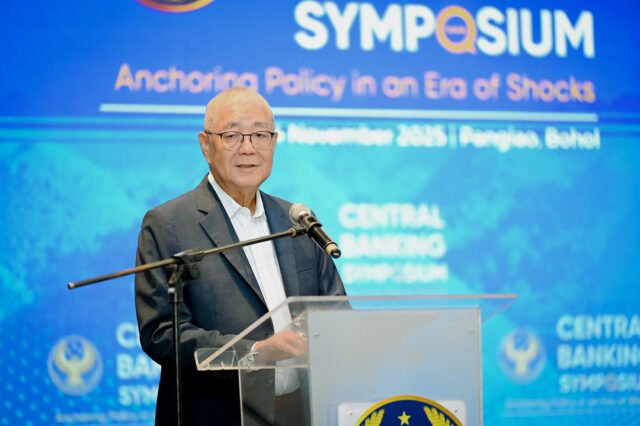
BANGKO SENTRAL ng Pilipinas Governor Eli M. Remolona, Jr. during the Central Banking Symposium in Panglao, Bohol on Nov. 24, 2025. -- Credit: Bangko Sentral ng Pilipinas
MANILA – Philippine central bank Governor Eli M. Remolona Jr. on Friday reiterated that policymakers face a “large element of uncertainty” which could complicate decision-making.
The Philippine central bank cut its key rate for a sixth straight time on Thursday to support growth.
Here are some key points from Remolona’s appearances on CNBC and One News.
  • Inflation is under control, giving the central bank “leeway to do something about growth”.
  • The central bank watches the Philippine peso, but it does not worry about day-to-day volatility.
  • There are risks to inflation, but the probability of risk factors materialising is low.
  • Uncertainty stems from how fast confidence in the economy will return.
  • “We are at the point where monetary policy cannot do much more, but things are very uncertain.”

— Reuters

Amidst volatility: Preparing Philippine business for global economic realignment

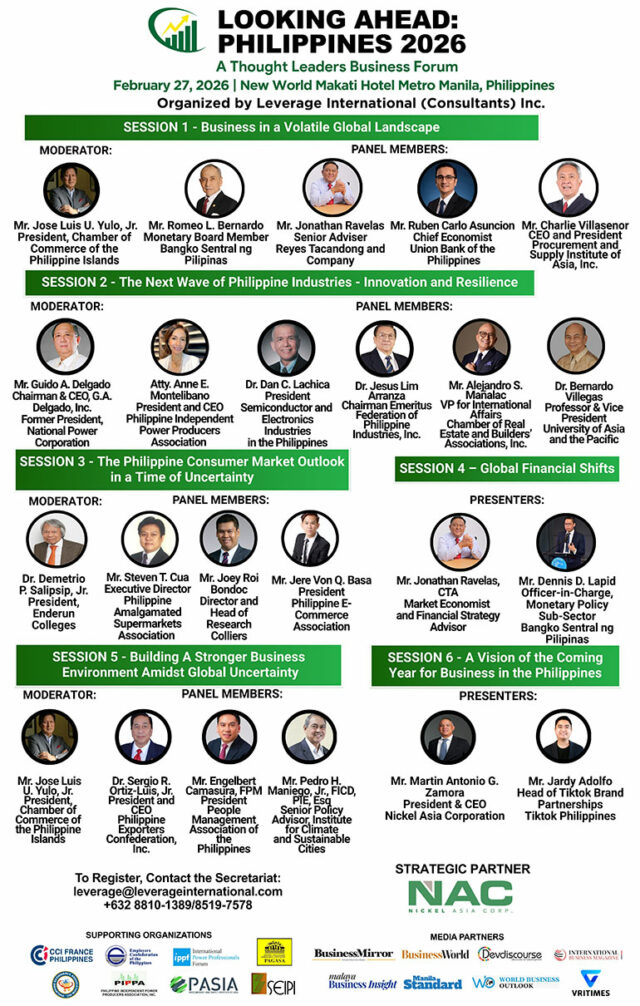
As the world faces escalating geopolitical risks, shifting trade alliances, and technological disruption, the Philippine government and business leaders are preparing to navigate a more volatile global economic landscape. In response, a landmark series of panel discussions will bring together thought leaders, industry experts, and policymakers to chart strategies for resilience, innovation, and competitiveness.

Looking Ahead: Philippines 2026 will feature high-level dialogues on economic trends, industry innovations, consumer behavior, and financial shifts that are shaping the business environment in the Philippines and across the globe.

Agenda Highlights:

  • Session 1 — Business in a Volatile Global Landscape
    Explore how global economic instability, shifting trade alliances, and emerging technologies are reshaping businesses — and learn how Philippine enterprises can stay competitive. Panelists include Mr. Romeo L. Bernardo (Monetary Board Member of Bangko Sentral ng Pilipinas), Mr. Jonathan Ravelas (Senior Adviser of Reyes Tacandong and Company), Mr. Ruben Carlo Asuncion (Chief Economist of Union Bank of the Philippines), and Mr. Charlie Villasenor (CEO and President of the Procurement and Supply Institute of Asia, Inc.), moderated by Mr. Jose Luis U. Yulo, Jr., President of the Chamber of Commerce of the Philippine Islands.
  • Session 2 — The Next Wave of Philippine Industries: Innovation and Resilience
    Sectoral leaders will discuss positioning industries for growth amid supply risks, volatile energy markets, and technological disruption. Panelists include Atty. Anne E. Montelibano (President and Chief Executive Officer of the Philippine Independent Power Producers Association), Mr. Alejandro S. Mañalac (VP for International Affairs of the Chamber of Real Estate and Builders’ Associations, Inc.), Dr. Dan C. Lachica (President of the Semiconductor and Electronics Industries in the Philippines), Dr. Jesus Lim Arranza (Chairman Emeritus of the Federation of Philippine Industries, Inc.) and Dr. Bernardo Villegas (Professor & Vice-President of the University of Asia and the Pacific), moderated by Mr. Guido Alfredo A. Delgado, former President of the National Power Corporation.
  • Session 3 — The Philippine Consumer Market Outlook in a Time of Uncertainty
    Experts will examine trends in consumer confidence, demand, and market behavior amidst global and local uncertainties. Panelists include Mr. Steven T. Cua (Executive Director of the Philippine Amalgamated Supermarkets Association), Mr. Joey Roi Bondoc (Director and Head of Research of Colliers), and Mr. Jere Von Q. Basa (President of the Philippine E-Commerce Association), moderated by Dr. Demetrio P. Salipsip, Jr., President of Enderun Colleges.
  • Session 4 — Global Financial Shifts
    Discussions into shifting global currency power and their implications for Philippine policy and economic strategy, featuring Mr. Jonathan Ravelas, Market Economist and Financial Strategy Advisor; and Mr. Dennis D. Lapid, Officer-in-Charge of the Monetary Policy Sub-Sector of Bangko Sentral ng Pilipinas.
  • Session 5 — Building a Stronger Business Environment Amidst Global Uncertainty
    Discussions will focus on policy, talent development, and sustainability to ensure Philippine industries remain competitive. Panelists include Mr. Jay A. Acar, (Acting Regional Director of the National Capital Regional Office, Department of Trade and Industry), Dr. Sergio R. Ortiz-Luis, Jr. (President and Chief Executive Officer of the Philippine Exporters Confederation, Inc.), Mr. Engelbert Camasura (President of the People Management Association of the Philippines), and Mr. Pedro H. Maniego, Jr., FICD, PIE, Esq (Senior Policy Advisor of Institute for Climate and Sustainable Cities), moderated by Mr. Jose Luis U. Yulo, Jr.
  • SESSION 6 — A Vision of the Coming Year for Business in the Philippines
    This series of sessions is a must-attend for business leaders, policymakers, and investors seeking to understand emerging risks and opportunities. By convening sectoral experts and authorities, the event provides actionable insights to strengthen Philippine business resilience, drive innovation, and seize opportunities for growth in an uncertain world.

Access the LOOKING AHEAD: PHILIPPINES 2026 Agenda here: https://drive.google.com/file/d/1dJv-IGZFqxqRVpkhDkAnuMMEXdi0sHPv/view?usp=sharing

For registration and additional information, please visit our website at https://lookingahead.leverageinternational.com, or contact the Secretariat at leverage@leverageinternational.com or call +(632) 8519-7578 or +(632) 8810-1389.


Spotlight is BusinessWorld’s sponsored section that allows advertisers to amplify their brand and connect with BusinessWorld’s audience by publishing their stories on the BusinessWorld Web site. For more information, send an email to online@bworldonline.com.

Join us on Viber at https://bit.ly/3hv6bLA to get more updates and subscribe to BusinessWorld’s titles and get exclusive content through www.bworld-x.com.

Filinvest Land marks milestone in sustainable infrastructure with DTI recognition of country’s first complex energy efficiency project

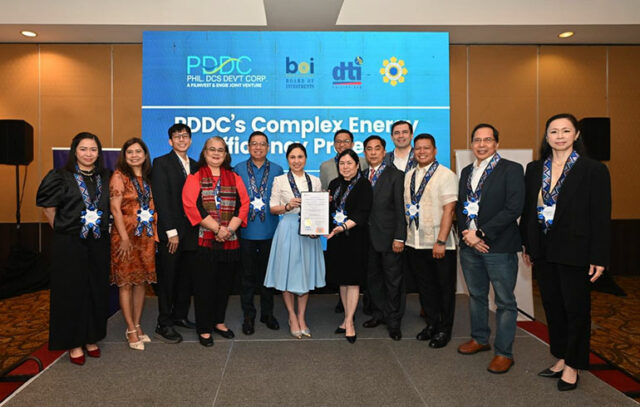
L-R, Row 1: Festival Mall General Manager Yvette Dizon; Filinvest Land, Inc. CFO Ana Venus A. Mejia; Department of Energy’s EUMB Director Patrick T. Aquino; IDS BoI Executive Director Ma. Corazon Halili-Dichosa; DTI Undersecretary and BoI Managing Director Dr. Ceferino Rodolfo; DTI Secretary Ma. Cristina A. Roque; Filinvest Dev’t Corp. CEO Rhoda “Chiqui” A. Huang; Filinvest Dev’t Corp. COO Ysmael V. Baysa; PDDC General Manager Jonathan Urbano; Philippine Energy Efficiency Alliance President Alexander Ablaza; Filinvest FilREIT Corp. President & CEO Maricel Brion-Lirio; L-R, Row 2: Filinvest Pro-Excel Property Managers, Inc. First Vice-President and COO Bienvenido Cruz; and ENGIE Services Philippines Managing Director Jean-Baptiste Dreanic

Filinvest Land, Inc. (FLI) continues to strengthen its position as one of the country’s leading champions of sustainable urban development, as its joint venture with ENGIE, Philippine DCS Development Corp. (PDDC), receives a Certificate of Registration from the Department of Trade and Industry (DTI) through the Board of Investments (BoI) for the country’s first Complex Energy Efficiency project to qualify under the CREATE MORE Act.

The Certificate of Registration enables third-party project developers such as PDDC to avail of fiscal incentives and regulatory support for qualified energy-efficient infrastructure projects. It recognizes PDDC’s large-scale investment in district cooling systems and underscores the government’s confidence in Filinvest Land’s strategy of embedding sustainability into the design, construction, and long-term operation of its developments, reinforcing FLI’s commitment to low-carbon growth, climate resilience, and responsible urban development.

At the heart of the project is a P400-million district cooling modernization project across key Filinvest estates in Alabang, including advanced infrastructure at its flagship Festival Mall and at Quest Hotel Clark under Filinvest Hospitality. At Festival Mall, the system delivers up to 36% reduction in energy consumption, maintains optimal indoor temperatures of 23°C-24°C, and generates at least P56.9 million in annual electricity savings. At Quest Hotel Clark, the project cuts cooling energy use by half and avoids approximately 7,400 tons of carbon dioxide emissions — strengthening the sustainability performance of these major developments.

Driving Energy Efficiency at Estate Scale

District cooling systems distribute chilled water from high-efficiency central plants to multiple buildings, significantly reducing electricity consumption compared to conventional air-conditioning systems. By managing cooling demand at the estate level, PDDC improves load optimization, system reliability, and overall carbon efficiency.

Rather than treating energy efficiency as an isolated building feature, Filinvest Land integrates centralized infrastructure into the master planning of its mixed-use estates — enhancing operational resilience, asset value appreciation, and long-term sustainability.

“This registration affirms the value of integrated energy infrastructure in shaping future-ready communities,” said Engr. Jonathan Urbano, general manager of PDDC. “By managing energy performance at the district level, we help ensure estates remain efficient and competitive for decades.”

The initiative also supports tenants, including multinational corporations and BPO firms, that are increasingly aligning operations with global ESG standards.

Reinforcing Sustainability Leadership

The BoI registration builds on Filinvest Land’s growing portfolio of sustainability recognitions.

In 2024, FLI received the Excellence in Ecology and Economy (E3) Award for integrating environmental responsibility with business performance. Filinvest City in Alabang also became the first and only central business district in the Philippines to earn a LEED v4 Gold Certification for Neighborhood Development Plan.

These milestones reflect FLI’s consistent focus on embedding sustainability into large-scale developments, supported by long-term infrastructure investments. The BoI registration also signals the government’s trust and confidence in FLI’s systems, commitment, and accountability to translate vision into concrete and measurable action, validating its leadership in the sustainability arena.

Aligning with National and Global Goals

The registration highlights government support for investments that advance energy security, emissions reduction, and sustainable growth.

Through PDDC, Filinvest Land aligns its developments with the United Nations Sustainable Development Goals (SDGs), particularly SDG 7 (Affordable and Clean Energy), SDG 11 (Sustainable Cities and Communities), and SDG 13 (Climate Action), by institutionalizing low-carbon solutions across its portfolio.

Complementing the expansion, PDDC is also participating in the BoI’s Corporate Community Partnership for Development (CCPD) program, which includes installing a solar power system at Filinvest Alabang Elementary School and providing technical training for sustainable operation.

Building Climate-Resilient Urban Ecosystems

From Northgate Cyberzone and Festival Mall to Quest Hotel Clark and other major developments, PDDC’s centralized cooling network forms a core pillar of Filinvest Land’s climate resilience strategy.

By integrating energy efficiency, operational reliability, and emissions reduction at scale, FLI continues to demonstrate that sustainable infrastructure is both environmentally responsible and commercially viable.

With the registration and award of the first complex energy efficient project, Filinvest Land reaffirms its pioneering leadership in climate-conscious urban development — proving that environmental commitment, government partnership, and private sector innovation can work together to build more resilient and future-ready communities.


Spotlight is BusinessWorld’s sponsored section that allows advertisers to amplify their brand and connect with BusinessWorld’s audience by publishing their stories on the BusinessWorld Web site. For more information, send an email to online@bworldonline.com.

Join us on Viber at https://bit.ly/3hv6bLA to get more updates and subscribe to BusinessWorld’s titles and get exclusive content through www.bworld-x.com.

Tensions flare between Macron and Meloni over killing of French far-right activist

French President Emmanuel Macron, wearing sunglasses, speaks during a meeting on the institutional future of New Caledonia at the Elysee Palace in Paris, France, Jan. 16, 2026. Credit: Yoan Valat/Pool via REUTERS

PARIS — A war of words erupted between French President Emmanuel Macron and Italian Prime Minister Giorgia Meloni on Thursday over the killing of a French far-right activist who was beaten by hard-left activists over the weekend during protests in Lyon.

Seven people, including an assistant to a member of parliament from the far-left France Unbowed (LFI), will face murder charges in the case, a prosecutor said on Thursday. They were among 11 arrested earlier in the week.

Ms. Meloni, a conservative, said on social media on Wednesday that the killing “by groups linked to left-wing extremism … is a wound for all of Europe.”

That triggered an angry response from Mr. Macron on Thursday, who told reporters during a visit to India: “I’m always struck by how people who are nationalists, who don’t want to be bothered in their own country, are always the first ones to comment on what’s happening in other countries.”

Asked if his remarks referred to Ms. Meloni, Mr. Macron replied: “You got that right.”

Mr. Macron, a pro-Europe centrist, and Ms. Meloni, one of US President Donald Trump’s closest European allies, have sparred in the past over issues ranging from the conflict in Ukraine to trade and European policy.

The killing of Quentin Deranque, 23, during the Lyon clashes has caused uproar in France, damaging the LFI and allowing the far-right National Rally to depict itself as a victim of deadly extremist violence.

Lyon prosecutor Thierry Dran said Jacques-Elie Favrot, an assistant to LFI lawmaker Raphael Arnault, faces charges of complicity through instigation and was put in pre-trial detention.

Mr. Favrot and the other suspects deny the accusations, he added.

Mr. Arnault said earlier this week that the aide had “stopped all parliamentary work”. Mr. Favrot’s lawyer said his client has acknowledged committing violence and being present at the site, but said he was not “the author of the blows that caused the death of Mr. Deranque.”

In response to Mr. Macron’s criticism of Ms. Meloni, the Italian Prime Minister’s office issued a statement expressing astonishment at the comments, saying Ms. Meloni had “expressed her deep sorrow and dismay at the tragic killing of young Quentin Deranque.” — Reuters

US pays $160 million of more than $4 billion owed to UN

REUTERS

WASHINGTON — The United States has paid about $160 million of the more than $4 billion it owes to the UN, a United Nations spokesperson said on Thursday as President Donald Trump hosted the first meeting of his “Board of Peace” initiative that experts say could undermine the United Nations.

“Last week, we received about $160 million from the United States as a partial payment of its past dues for the UN regular budget,” the UN spokesperson said in a statement.

Mr. Trump said during his comments at the opening “Board of Peace” meeting that Washington would give the United Nations money to strengthen it.

The US is the biggest contributor to the UN budget, but under the Trump administration it has refused to make mandatory payments to regular and peacekeeping budgets, and slashed voluntary funding to UN agencies with their own budgets.

Washington has withdrawn from dozens of UN agencies.

UN officials say the US owed $2.19 billion to the regular UN budget as of the start of February, more than 95% of the total owed by countries globally. The US also owes another $2.4 billion for current and past peacekeeping missions and $43.6 million for UN tribunals.

“We’re going to help them (UN) money-wise, and we’re going to make sure the United Nations is viable,” Mr. Trump said.

“I think the United Nations has great potential, really great potential. It has not lived up to (that) potential.”

Countries, including major powers of the Global South and key US allies in the West, have been reluctant to join Mr. Trump’s “Board of Peace” where Mr. Trump himself is the chair. Many experts have said such an initiative undermines the United Nations.

Mr. Trump launched the board last month and proposed it late last year as part of his plan to end Israel’s war in Gaza.

A UN Security Council resolution recognized the board late last year through 2027, limiting its scope to Gaza, the Palestinian territory it was meant to oversee following Israel’s devastating more than two‑year assault. Under Mr. Trump’s plan to end Israel’s war in Gaza, the board was meant to oversee Gaza’s temporary governance. Mr. Trump subsequently said the board will tackle global conflicts and look beyond Gaza as well.

UN experts say that Mr. Trump’s oversight of a board to supervise a foreign territory’s affairs resembles a colonial structure and criticized the board for not having Palestinian representation. There was no UN representative at the “Board of Peace” meeting on Thursday. — Reuters

Authorities probe possible criminal negligence in California avalanche deaths

A WOMAN walks on the ice to a measuring point on the Pers Glacier near the Alpine resort of Pontresina, Switzerland, July 21, 2022. — REUTERS

INVESTIGATORS are working to determine if criminal negligence played a role in the avalanche that killed at least eight people on a guided backcountry ski trip in California, but emphasized it is too early to determine if any charges would be warranted, the Nevada County Sheriff’s Office said on Thursday.

The sheriff’s office, in a written statement said, “in addition to the coroner’s death investigations, the Nevada County Sheriff’s Office is also conducting a parallel investigation into whether criminal negligence was involved.”

It cautioned the investigation was in the preliminary stages and it was too early to name a specific target of any possible charges.

The Nevada County District Attorney’s Office, which would decide on any possible charges, declined to comment.

Eight people were killed and a ninth was presumed to have died when a football-field-sized avalanche in California’s Sierra Nevada mountains swept over a group of skiers on Tuesday during a three-day backcountry trip organized by Blackbird Mountain Guides.

It was the deadliest US avalanche in 45 years.

The group of 15 skiers, including four guides from Blackbird, was heading back to a trailhead in heavy snow after a three-day excursion when the avalanche struck. Three of the guides were among those killed.

Six survivors were rescued in the rugged Castle Peak area near Truckee, California, about 16 kilometers (10 miles) northwest of Lake Tahoe.

Blackbird, which was founded in 2020 and provides guided ski trips, alpine climbing trips and avalanche education, did not respond to a request for comment on Thursday.

In a late Wednesday written statement, Zeb Blais, the founder of Blackbird, mourned the loss of life. He said all the guides on the trip were highly trained in backcountry skiing, and each guide was also an instructor with the American Institute for Avalanche Research and Education, based in Colorado.

“There is still a lot we’re learning about what happened,” Mr. Blais wrote. “It’s too soon to draw conclusions, but investigations are underway.”

He added: “We ask that people following this tragedy refrain from speculating. We don’t have all the answers yet, and it may be some time before we do.”

Ahead of the incident, avalanche centers had warned of particularly dangerous conditions following a massive winter storm that dumped huge amounts of snow on mountains that had seen scant snowpack in the months prior. Experts warned the weak bed of old snow would be unlikely to withstand the pressure of having a heavy, dense layer of new snow suddenly on top of it, leading to high avalanche risk.

EXPERT URGES CAUTION
The Blackbird tour group, which included nine women and six men, had been staying at the Frog Lake Backcountry Huts near Donner Summit northwest of Truckee, at about 2,300 meters elevation (7,500 feet). In addition to California, Blackbird runs backcountry tours in Washington state and British Columbia, among other ski destinations.

Frank Carus, the director of the Bridger-Teton National Forest Avalanche Center in Wyoming and a one-time backcountry ski guide, urged people to wait for the results of the investigation before drawing conclusions on who may be to blame, if anyone.

“The main thing here is not to rush to judgment,” said Mr. Carus, who has investigated deadly avalanches in the past and said such investigations are immensely complicated and can take several weeks to complete. “The worst thing to do is to blame or shame before the facts are known.”

Mr. Carus said the training the Blackbird Mountain guides involved in the deadly avalanche had received was the gold standard for the industry.

“These were people tested on their ability to manage clients in the terrain and manage exposure risk,” Mr. Carus said.

The surviving skiers, who took refuge in a makeshift shelter constructed partly from tarpaulin sheets after the avalanche, used emergency beacons and text messaging to communicate their location to rescuers. — Reuters

TikTok taps advocates to promote digital safety among youth

Yves Gonzalez (center) of TikTok Philippines at the Think Twice Troop media event in Taguig City, Feb. 19, 2026.— EDG ADRIAN A. EVA

TikTok, one of the country’s most used social media platforms, launched an initiative on Thursday involving a partnership with content creators and advocates to promote youth online safety.

The #ThinkTwice Troop is an advocacy program comprising a network of academe, child safety experts, and child rights organizations that will help TikTok advance its digital safety initiatives, including the ongoing #ThinkTwice campaign it preceded.

“So, we want to have a team that we can always talk to and rely on to help us navigate some of the tricky challenges we face, as well as new challenges we might not even know about (on teen digital safety),” Yves Gonzalez, head of public policy for the Philippines at TikTok told BusinessWorld on the sidelines of the media launch event.

TikTok said the program represents a holistic approach to teen safety through consultation, educational programs, and partnerships.

Mr. Gonzalez also said that through their partners, they could help educate educators and parents about the tools available on TikTok for teen digital safety.

Among the initial partners of #ThinkTwice Troop are organizations including Child Rights Coalition Asia (CRC Asia), Ateneo Human Rights Centre, and content creators Mona “Mighty Magulang” Magno-Veluz, and Riyan Portuguez.

The public policy head said these partners are just a start, but the ultimate goal is to expand the initiative throughout the country.

“So, I’m hoping that by the end of this year, we’ll have partners and troop members from Visayas and Mindanao,” he said.

Hazelyn Joy Bitaña, deputy regional executive director of CRC Asia, said that #ThinkTwice Troop aligns with the work of civil society organizations to protect youth while allowing them to thrive in the digital space.

“We believe that parents, educators, and the public and private sectors must work together to empower teens as they navigate the online world in the exercise of their rights and responsibilities,” Ms. Bitaña said.

Meanwhile, TikTok highlighted the tools on the platform to ensure the digital safety of the youth, including over 50 Teen Safety features, Family Pairing, For You Feed controls, and a Time and Well-being section.

The platform also noted that it enforces minimum age requirements through a neutral age gate, machine-learning technology, and a trained moderation team that reviews suspected underage accounts, using reports from the community or parents as additional signals.

Accounts flagged as underage are suspended and permanently banned if no successful appeal is submitted.

From July to September 2025, TikTok removed over 22 million accounts globally suspected to belong to users under 13, which it noted makes the company the first major platform to publicly disclose such figures. — Edg Adrian A. Eva

BSP cuts key rate amid growth slump

Buildings in Manila’s business district as seen on Tuesday in Metro Manila. — PHILIPPINE STAR/RYAN BALDEMOR

By Katherine K. Chan, Reporter

THE BANGKO SENTRAL ng Pilipinas (BSP) lowered its key policy rate by 25 basis points (bps) for a sixth straight meeting, a move seen to help the economy regain its momentum following a slowdown last year.

On Thursday, the Monetary Board lowered the target reverse repurchase rate (RRP) by 25 bps to 4.25%, the lowest in over three years or since the 3.75% in August 2022. This matched the benchmark rate set in September 2022.

Rates on the overnight deposit and lending facilities were also trimmed by 25 bps each to 3.75% and 4.75%, respectively.

The Monetary Board’s latest move met market expectations, as all 16 analysts polled by BusinessWorld anticipated a 25-bp cut.

This brought the BSP’s total reductions to 225 bps since it began its series of monetary policy easing in August 2024.

The sixth straight rate cut came after weaker-than-expected economic growth, triggered by the flood control corruption scandal that broke out last year.

“Growth has been softer than expected. Investments slowed,” BSP Governor Eli M. Remolona, Jr. said during a briefing. “We attributed this to a lack of accuracy. But soft data on sentiment showed tentative signs of recovery.”

“Our decision today may actually help to restore confidence, boosting investment and consumption. The pace of economic recovery will depend on how quickly confidence returns,” he added.

In the fourth quarter of 2025, the Philippine economy grew by 3%, its worst performance in 16 years (excluding the pandemic period). This brought the full-year gross domestic product (GDP) growth to a post-pandemic low of 4.4%.

The BSP had expected growth to settle at 3.8% in the final quarter of last year to bring the full-year print to 4.6%.

In 2025, the BSP delivered a 25-bp cut at each of its meetings in April, June, August, October, and December, with the last two prompted by a clouded growth outlook as governance issues weakened consumer and business sentiment.

“Economic growth has undershot the BSP’s expectations due to weaker domestic demand. Latest indicators point to a recovery in the second half of the year, but growth will depend largely on how quickly confidence recovers,” Mr. Remolona said.

However, the central bank slashed its GDP growth forecast for this year to 4.6% from 5.4% previously. If realized, this would undershoot the government’s 5%-6% target.

It likewise sees the economy expanding by 5.9% in 2027, lower than its earlier projection of 6.3%.

‘MANAGEABLE INFLATION’
A still benign inflation outlook also provided the central bank with additional room to ease, even as it raised its projections amid emerging supply-side pressures.

“The outlook for inflation remains manageable,” Mr. Remolona said. “Our forecasts do indicate a slight uptick in inflation this year, but this is due largely to supply-side factors. While these factors are largely temporary, they will require continued vigilance with regard to possible spillover effects.”

Headline inflation returned to the BSP’s 2%-4% target band after nearly a year as it accelerated to 2% in January.

The latest consumer price index was faster than the 1.8% recorded in December but softer than the 2.9% clip a year ago.

BSP Deputy Governor Zeno Ronald R. Abenoja said they now expect inflation to average 3.6% this year, higher than their 3.2% estimate in December.

For 2027, the central bank projects inflation to ease slightly to 3.2%, still above their previous forecast of 3%.

Electricity rate adjustments, costlier oil and the impact of the government’s flexible rice tariff scheme on local rice prices will likely add inflationary pressures this year, Mr. Abenoja said.

However, he noted that price pressures from such supply-side factors “may not be persistent and could fade away after some period of time.”

UNCERTAIN POLICY PATH
Asked how the policy path ahead looks now, Mr. Remolona said: “It’s less certain.”

He noted that consumer and business confidence is now a main concern, adding that the outlook for monetary policy easing would depend on how soon sentiment will recover.

“We see confidence will return very soon, in a few months. If we’re right, then we won’t need further cuts,” Mr. Remolona said.

Earlier this month, the BSP chief said they were seeing signs of recovering confidence, citing improving activity in manufacturing and the stock market, as well as easing yields in government securities.

Mr. Remolona said the impact of weak confidence on the country’s growth prompted the central bank to “give a bigger weight” to confidence.

“We’re now in a situation where it’s more conditional on what happens to confidence in growth,” Mr. Remolona said. “Because in December, we were more confident that confidence would return pretty soon. And the lack of confidence actually turned out to be bigger than we thought,” he added.

However, the BSP governor also said that they will stick to their price stability mandate, which means that keeping inflation low will remain a priority in monetary policy decisions.

“We support growth, and we do want growth. But at the same time, our main mandate is still inflation,” Mr. Remolona said. “So, to the extent we can support growth without causing inflation, we will support growth.”

Meanwhile, Metropolitan Bank & Trust Co. Chief Economist Nicholas Antonio T. Mapa said the central bank’s inflation outlook will likely drive its policy path going forward.

“Market was split on the decision, but BSP opted to deploy support sooner rather than later. Any potential future easing remains contingent on the inflation outlook,” he said in a Viber message.

“Monetary authorities also appeared to have an ardent focus on confidence building, hinting that the easing cycle could be extended for just a little longer,” he added.

Capital Economics Deputy Chief Emerging Markets Economist Jason Tuvey sees scope for “at least” one more 25-bp reduction in the following months if the economy stays weak and inflation remains manageable.

“It’s also worth noting that the BSP removed the line from its previous statement that ‘the monetary policy easing cycle (is) nearing its end,’ suggesting that it remains open to the idea of further loosening,” he said in a commentary on Thursday.

“All told, if the economy remains sluggish and inflation contained, as we expect, there is likely to be scope for at least one more 25-bp cut to interest rates, to 4%, over the coming months,” he added.

In a separate commentary, ANZ Research said recovering lost confidence may take time, but improved government spending will likely accelerate the process.

“Our assessment is that confidence will take time to return and will need to be supported by a revival in government spending,” ANZ Research foreign exchange analyst Kausani Basak and Chief Economist for Southeast Asia and India Sanjay Mathur said. “Still, we will monitor developments in consumer and corporate confidence before reconsidering our current view that the BSP has completed its rate-cutting cycle.”

The Monetary Board is scheduled to have its second policy review this year on April 23.

Philippines’ BoP deficit sharply narrows in January

REUTERS

By Katherine K. Chan, Reporter

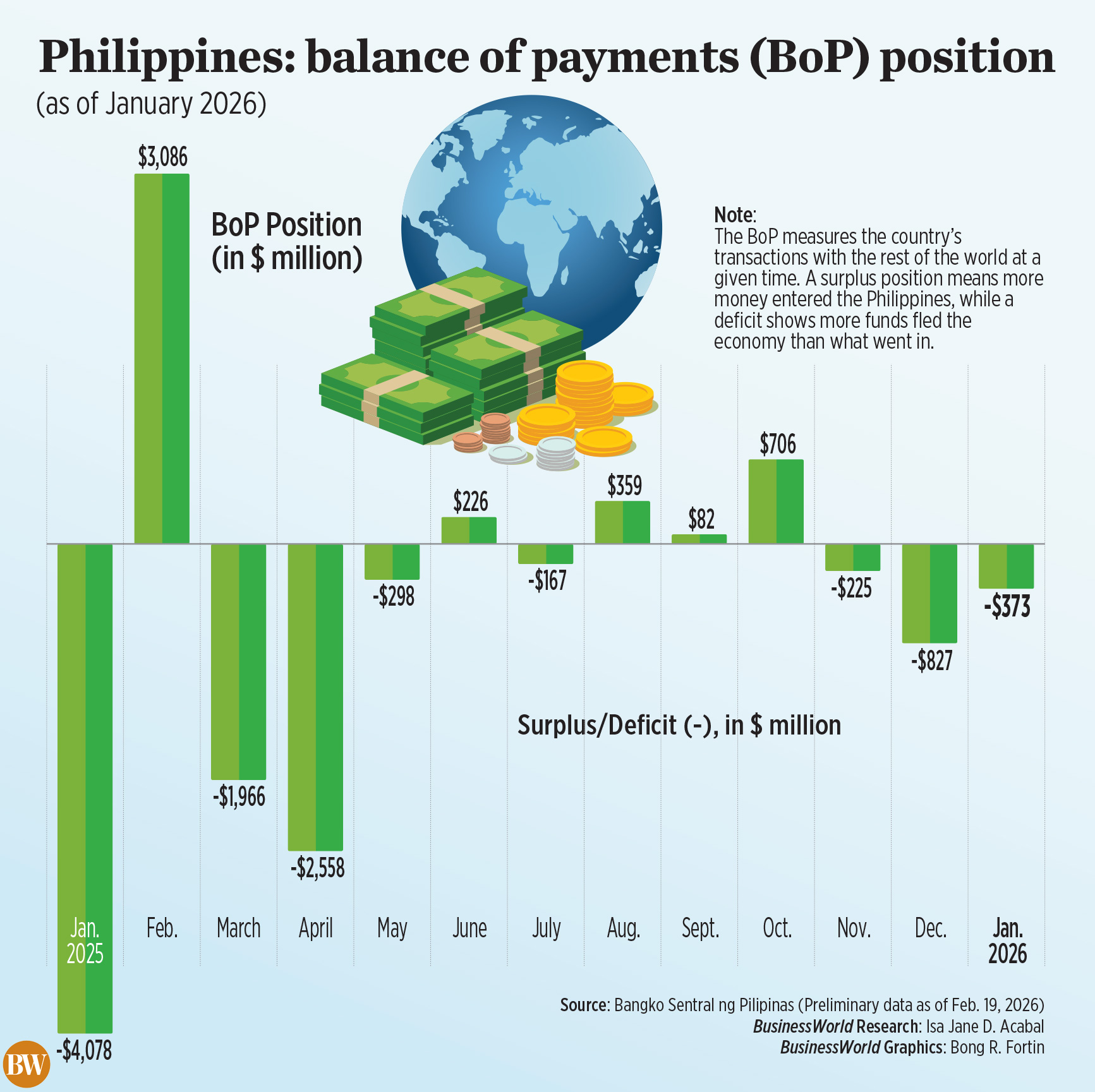
THE PHILIPPINES’ balance of payments (BoP) deficit sharply narrowed to $373 million in the first month of 2026, the Bangko Sentral ng Pilipinas (BSP) reported.

Based on central bank data released on Thursday, the country’s BoP position stood at a $373-million shortfall in January, sharply narrowing from the $4.078-billion gap recorded in the same month last year.

It was likewise smaller than the $827-million deficit posted in December 2025.

January also marked the third straight month that the country’s BoP position stood at a deficit.

BoP refers to the country’s economic transactions with other nations. A surplus indicates more funds entered into the country, while a deficit shows that the country spent more than it received.

“[The] deficit largely reflects seasonally strong import payments and profit remittances at the start of the year, alongside some portfolio repositioning amid global rate uncertainty,” SM Investments Corp. Group Economist Robert Dan J. Roces said in a Viber message.

Easing external pressures at the start of the year as well as steady inflows of remittances and services may have also driven the narrower deficit, he added.

Jonathan L. Ravelas, a senior adviser at Reyes Tacandong & Co., said the BoP deficit came on the back of the country’s persistent trade deficit.

“The BoP is still in deficit mainly because imports are outpacing exports,” he said via Viber. “That reflects strong domestic demand and infrastructure spending, while global demand for our exports — and services like BPO (business process outsourcing) and tourism — has been softer.”

Latest data showed that the country’s trade-in-goods deficit ended 2025 at its narrowest level in four years at $49.17 billion, down by 9.5% from the $54.33-billion shortfall logged in 2024.

However, Mr. Ravelas noted that the BoP deficit is “not a crisis signal,” noting that the Philippines’ external buffers are still solid.

“This isn’t a crisis signal; it’s a growth-related deficit, and our external buffers remain solid,” he said.

In the near term, the Philippines’ BoP position could remain at a deficit but may stabilize due to recovering exports, improving tourism and rising remittance inflows.

“In the coming months, the BoP should stabilize as remittance inflows rise and tourism receipts improve, though much will depend on oil prices, electronics exports, and the direction of US rates,” Mr. Roces said. “At this level, the deficit remains manageable and does not point to external vulnerability.”

Investment reforms may also provide some relief for the country’s BoP position, Mr. Ravelas added.

“The key now is to boost export competitiveness and attract more long-term investments, rather than overreacting to the headline number,” he said.

For this year, the central bank expects the BoP position to end at a deficit of $5.9 billion or -1.2% of the country’s gross domestic product.

16-MONTH HIGH RESERVES
Meanwhile, the Philippines’ foreign reserves rose to their highest level in over a year at $112.6 billion at end-January.

This was the highest in 16 months or when the gross international reserves (GIR) level stood at $112.707 billion at end-September 2024.

Month on month, it climbed by nearly 1.6% from $110.833 billion in December.

In the first month of the year, the country’s GIR level translated to 7.5 months’ worth of imports of goods and payments of services and primary income, exceeding the three-month standard.

“Specifically, the latest GIR level ensures the availability of foreign exchange to meet balance of payments financing needs, such as for payment of imports and debt service, in extreme cases when there are no export earnings or foreign loans,” the BSP said in a statement.

It is also enough to cover about 4.1 times the country’s short-term external debt based on residual maturity.

GIR comprises foreign-denominated securities, foreign exchange, and other assets such as gold. It enables a country to finance imports and foreign debts, maintain the stability of its currency, and safeguard itself against global economic disruptions.

The BSP projects the Philippines’ dollar reserves to hit $110 billion by yearend.

DoF to review OECD call to phase out VAT exemptions for senior citizens, private schools

PHILIPPINE STAR/MIGUEL DE GUZMAN

By Beatriz Marie D. Cruz, Reporter

THE DEPARTMENT of Finance (DoF) is reviewing the Organisation for Economic Co-operation and Development’s (OECD) suggestion for the Philippines to remove the value-added tax (VAT) exemptions for senior citizens, private education and healthcare providers.

“OECD has a lot of good suggestions, but we have to study them. We’ll see which ones we can do, which ones we cannot do,” Finance Secretary Frederick D. Go told reporters on Feb. 18.

The OECD in a report last week recommended that the Philippines phase out VAT exemptions for senior citizens, private healthcare and education, as part of efforts to reduce public debt and narrow its budget deficit. 

The Philippines imposes a 12% VAT on sales, leases, barter, and imports of goods and services. However, senior citizens are granted a 12% VAT exemption under Republic Act No. 9994 or the Expanded Senior Citizens Act.

Private healthcare and educational institutions also benefit from tax breaks.

At the same time, business groups said the government should focus on plugging tax leakages and addressing corruption and smuggling, instead of removing VAT exemptions and tax incentives.

“If you look at our VAT system, there’s still a lot of inefficiencies. While the VAT exemption is being seen as a leakage, I would say that there are many more leakages in terms of execution,” Makati Business Club Chairman Edgar O. Chua told BusinessWorld on the sidelines of the Philippine Business for Education (PBEd) Leadership Forum on Feb. 18.

Management Association of the Philippines President Donald Patrick L. Lim said the OECD’s proposal should be assessed for its social and inflationary impacts.

“While broadening the VAT base and modernizing corporate incentives can strengthen fiscal sustainability and transparency, reforms must not undermine our regional position in attracting investments or weaken protections for vulnerable sectors,” he said in a Viber message.

Mr. Chua said the government should focus on curbing loopholes in its tax collection system, citing rampant smuggling in the country.

LEAKAGES
The Philippines’ VAT collection efficiency is just about 35% to 40%, significantly lower than the Southeast Asian average of 57%, Asian Consulting Group Chairman and Chief Executive Officer Raymond A. Abrea told a forum on Feb. 17.

In comparison, Thailand has the highest VAT collection efficiency of 71% to 79% despite having the lowest VAT in the region of 7%.

“I guess our VAT system should be better managed to make sure there are no leakages. If it’s not managed properly, I’m sure people are finding their ways around it,” PBEd President and Co-founder Chito B. Salazar told BusinessWorld.

The Philippines’ total outstanding debt ballooned to P17.71 trillion in 2025, bringing the debt ratio to a 20-year high of 63.2% of the gross domestic product (GDP).

The OECD estimates the country’s public debt share of the GDP to hit 62.4% in 2026 before declining to 61.6% in 2027.

Federation of Philippine Industries Chairman Elizabeth H. Lee said removing tax relief for senior citizens, schools, and hospitals would dampen consumption and raise costs for vulnerable sectors.

“Any abrupt changes could ripple through households and, at the margins, labor markets, affecting employment and service access. Safeguards are essential and we must be sensitive on the effects of these changes,” she said in a Viber chat.

Jose Rene D. de Grano, president of the Private Hospitals Association of the Philippines, Inc., said the government should focus on addressing corruption to improve its tax take.

“If only we remove corruption in these agencies, there is no need to remove these exemptions and social aids,” he said via Viber.

Anthony C. Leachon, former president of the Philippine College of Physicians, said via text message that removing VAT breaks for private healthcare providers can increase operating costs, translating to higher costs for Filipino patients.

The OECD also recommended the Philippine government phase out tax holidays and focus on expenditure-based corporate tax incentives “to realign incentives with efficiency and fiscal discipline.”

Mr. Lim said a shift toward expenditure-linked incentives is “a positive direction,” but its implementation must be predictable and aligned with regional benchmarks.

“The Philippines competes directly with Vietnam, Indonesia, Thailand, and Malaysia for capital. Our tax reforms must enhance, not dilute, our attractiveness as an investment destination,” he said.

ADVERTISEMENT
ADVERTISEMENT