Home Blog Page 2563

PHL cross-border transaction market grows amid increasing digitalization

THE PHILIPPINES’ cross-border money movement market has a “market opportunity” worth $264 billion amid the rise in digital transactions, Visa Philippines said.

“The number that we normally know (for remittances) is it’s a $37-billion market. When you talk about money movement in the Philippines and from the Philippines outside, $37 billion is a very small number,” Visa Philippines Country Manager Jeffrey V. Navarro said at a briefing on Wednesday. “It’s actually $264 billion. That is the market of money movement in and out of the Philippines.”

Broken down, 43% ($113 billion) of the total is inbound remittances while 57% ($151 billion) is outbound, he said.

In 2023, personal remittances, which include inflows in kind, stood at a record $37.21 billion. Latest data from the central bank showed that personal remittances amounted to $14.89 billion in the January-May period.

Mr. Navarro noted the potential of the outbound transactions market.

“The outbound market is $151 billion. When you talk about business-to-business payments, that is around $146 billion,” he said.

“These are supplier payments, accounts payable payments, visitors coming into the Philippines and making travel and entertainment payments, and our export import payments.”

Mr. Navarro cited emerging use cases for outbound remittances, such as sending money to overseas Filipino workers (OFWs) in need, procurement of goods and items by small and midsize enterprises from abroad, and the growing number of Filipinos studying abroad.

“The Philippines is a big remittance corridor, especially for inbound (remittances),” Mr. Navarro said. “There are 12 million Filipinos who are working or living abroad. Easily, that’s close to 10% of our population.”

Three out of the top five recipients of remittances globally are found in the Asia-Pacific region, which are India, Mainland China and the Philippines. The Philippines accounts for more than 60% of all inbound remittances in the region, Visa data showed.

“The other interesting statistic that we see is the growth that we’ve seen in remittances being delivered through digital wallets,” Visa Senior Vice-President and Head of Commercial and Money Movement Solutions for Asia Pacific Chavi Jafa said.

“With the growth in digital wallets, specifically in our region, we’ve seen increasingly — especially post-COVID — a significant adoption of digital wallets,” she added.

The Bangko Sentral ng Pilipinas (BSP) on Tuesday said the share of online payments in the total volume of monthly retail transactions rose to 52.8% in 2023 from 42.1% a year earlier. This was slightly higher than the central bank’s target to digitize 50% of the volume of retail payments by end-2023.

“What we’ve seen is we’re growing year on year, that 75% are now trying to send and receive remittances through a digital app,” Mr. Navarro said.

“If you talk about the future, 58% of senders and receivers are saying that they would like to use a digital app… It’s going to be more digital, and it will accelerate because the intent and the preference of consumers is leading towards the use of digital apps.”

Visa data also showed that consumers cited challenges such as high transaction fees and inconvenient processes, among others.

“There’s no change in terms of what it is that consumers are looking for in terms of remittances and money movement. They want speed, convenience and security,” Mr. Navarro said.

For their part, Mr. Navarro said the company offers Visa Direct to help address these concerns.

Visa Direct is a digital platform that connects 8.5 billion endpoints. The platform is active in 190 countries and can facilitate movement dealing with 160 currencies.

“When I talk about endpoints, it means 8.5 (billion) Visa cards, that also includes bank accounts, and it also includes e-wallets,” he said. “Visa is capable of being able to move money from Point A to Point B, whether it be a bank account, an e-wallet or a visa card.”

“Our mission is to be able to deliver a seamless and a great consumer experience that’s secure and reliable when it comes to money movement and payment,” he said. “If you understand the nature of remittance, these are hard-earned money and as such we’re very particular in terms of ensuring that the money we send, most of it, if not 100% of it, we want our receivers to receive.” — Luisa Maria Jacinta C. Jocson

Gokongwei Brothers Foundation, URC tie up to boost manufacturing workforce

ISKOLAR NI JUAN

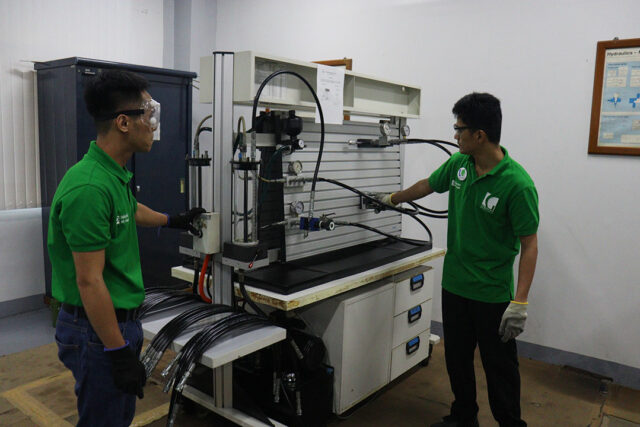
CALAMBA CITY — The Gokongwei Brothers Foundation (GBF) said it continues to offer free technology-vocational scholarships under the 10th year of its Iskolar ni Juan program, which prepares students for jobs at Universal Robina Corp. (URC) production facilities.

“Iskolar ni Juan (INJ) provides senior high school graduates and college undergraduates with a direct pathway to education and employment in the manufacturing industry,” GBF Trustee Marcia Y. Gokongwei said during the INJ anniversary event on July 23.

GBF, in partnership with URC, launched the INJ program with the vision of building a “highly skilled workforce” at the three-story Technical Training Center in Calamba City, Laguna, she said.

“Our scholars are provided with free tech-voc training in mechatronics and guaranteed employment in one of URC’s production facilities across the country,” Ms. Gokongwei said.

Among the facilities in the center are the mechanical/workbench lab, hydraulic lab, process instrumentation lab, pneumatics, and MFG process training room.

The INJ beneficiaries are offered a subsidized scholarship that covers tuition, transportation, school supplies, uniforms, accommodation, and meals.

After their stay in Laguna for the seven-month academic term, the scholars will undergo five months of on-the-job training at URC plants and other business affiliates.

To date, there are more than 500 graduates of the program.

GBF said about 60% of the graduates are still working with URC, while others have pursued college degrees or work for manufacturing companies locally and globally.

Raymund L. Ganotice, technical training center director, said the program is designed to meet the workforce requirements of URC-Branded Consumer Foods Group (BCFG).

“In the past, we also had Gokongwei affiliates, like the one in Simlong, where you have the petrochem plant. So, they’re heavy on instrumentation. Therefore, we offer two courses: mechatronics and instrumentation,” he added.

Mr. Ganotice said it depends on the requirements of the workers — and “now it’s all mechatronics for the 19 plants of BCFG,” which involves the food manufacturing process.

Despite the fully subsidized scholarship with free board and lodging, he said the INJ is also having trouble attracting scholars, which might be due to the “blue-collar mentality” and state universities offering free bachelor’s degrees.

Mc William B. Espenocilla, a scholar of the INJ, said that including batches 21 and 22, there are 35 students, while batch 23 will arrive in August.

The foundation added that it aims to double its current number of scholars in the next three years to maximize the potential of the program and the technical training center in producing tech-skilled and workforce-ready graduates.

The one-year program, which combines classroom learning and OJT, awards scholars an NCII certification from the Technical Education and Skills Development Authority. — Aubrey Rose A. Inosante

Tasmanian ‘Eco-Milk’ tests shoppers’ thirst for climate-friendly dairy

WOOLWORTHS.COM.AU

CANBERRA — A small dairy in Tasmania is stocking supermarket shelves with what it says is the world’s first branded milk produced by cows fed with a seaweed that makes them emit lower levels of environmentally damaging methane gas.

The livestock industry accounts for around 30% of global methane emissions, according to the United Nations. Seaweed and other feed additives for cattle could reduce these greenhouse gas emissions but have yet to be widely adopted due to cost.

Since February, family-owned Tasmanian dairy producer Ashgrove has been feeding around 500 cows — a fifth of its total — an oil containing a seaweed extract that reduces the methane released by a cow’s digestion, said co-owner Richard Bennett.

The cows produce around 10,000 liters of milk a day, a portion of which is bottled as “Eco-Milk” and sold across Tasmania including at Woolworths, Australia’s largest supermarket chain.

“We’re getting about 25% reduction in methane,” Mr. Bennett said.

Eco-Milk is a test of whether consumers will pay extra for dairy products that have a lower environmental impact.

A two-liter bottle sells for A$5.50 ($3.67), twenty-five cents more than normal full cream milk, Bennett said, adding that sales were going well but the company had yet to decide on whether to expand the project.

Producers of feed additives that inhibit the release of methane by microbes digesting plant matter in cows’ stomachs have invested hundreds of millions of dollars to produce enough to feed millions of animals.

French cheese maker Bel Group said last year it would feed an additive to around 10,000 dairy cows in Slovakia. Other firms including JBS, Danone and Fonterra have dabbled with additives but not rolled them out at scale.

The additive used by Ashgrove is supplied by a Tasmanian company called Sea Forest. Its Chief Executive Officer Sam Elsom said he hoped Eco-Milk would be popular.

“If these products aren’t supported, things will go back to usual,” he said. “And the pace of decarbonization will be much slower.” — Reuters

Before and after

FREEPIK

THE “before” and “after” approach in advertising seeks to dramatize the effectiveness of a product or service, including cosmetics, detergents, or gym equipment. The Unique Selling Proposition (USP) principle is applied to a process of transformation being marketed by a brand.

One example of this transformational approach is weight loss. The “before” image is a caricature, an overweight subject presented in the least flattering manner. (She couldn’t get into the seat of a plane without a shoehorn.) The subject is made to look unhappy, maybe even hopeless. The approach does not pull its punches. And the guardians of political correctness then must step in to condemn this case of “body shaming.” One cosmetologist chain had indeed exceeded the advertising brief by depicting the “before” period with video enhancements turning a lovely model into a pathetic blob clearly needing some cosmetic repair. The marketing backlash was merciless.

How does the obese “before” character cope with her needs? Is there a store set up to target the amply endowed? They can have innocuous brand names like “Wonder Woman,” “Grand Canyon,” “Moby Dick.”  But a tag line reveals their target market — We also sell tents with zippers.

What’s wrong with being a plus size anyway? In case of a strong typhoon, doesn’t the heavier person have a better chance of not getting blown away? Besides, snacking on chocolates (dark) has been discovered to prevent cancer. Boiled or deep-fried pig’s knuckles are thought to be an aphrodisiac to rival oysters. (Tell that to the pigs.) Caution: research on these assertions is not statistically vetted.

If obese subjects are shown at all in ads, it is to identify them as a target market for slimming programs. A photo (before) shows plus-sized personalities occupying one half of the studio unit of a condo. She is certain to be also badly dressed. Then the person (after) stands in front of the camera providing a testimonial on how effective her weight loss program has been. She looks like a different person from the overweight former self. She is chic, well-spoken, and is at least two tons lighter. She also has a bigger house. Is this really the same person? (Does it matter?)

Is there also a “before” and “after” in social relationships? Can former lovers drift apart and just remain friends after? (I found out something disagreeable about him.) Can the downgraded relationship from couple to “just friends” work, or even hope to be continued? What are the new rules? (I’m still here if she needs financial help.)

Drifting apart is not always a symmetrical movement, very different from synchronized swimming. Usually, one party drifts away due to an emotional detachment or just a new entrant. The “broken hearted” one clings on, maybe even become a “lurker” (that detested breed of rejects) — you’re sure you can’t attend the launch of my new dog shampoo?

What purpose can dinner together, in this case munching only food, serve except to subject the clinging vine to undue stress? He tries manfully to follow the revised rules of engagement but can’t help reminiscing, in passing and a bit playfully, over historical tidbits like scrubbing olive oil on her partner’s toes at one time, and using that for salad dressing?

Any egregious attempt at reliving past intimacy is viewed by the other as inappropriate and may merit a post-dinner text expressing disgust at the other’s inability to behave properly in a public place. The public display of affection (PDA) is banned in the redefined relationship.

Advertising, even more so now on social media with longer videos, has for so long used the traditional “before” and “after” approach in promoting the efficacy of a product, including a political position in the case of turncoats. The key is to exaggerate the ills of the status quo with horrible portrayals of the “before” to contrast this with the idyllic promise of the “after” life. The approach can unintentionally have a backlash effect on the target market who prefer the status quo of “what God gave them” to the unrealistic glamor of a promised reward.

Life is a series of transformations anyway. The ideal “after” is now the current “before.” Can there be another change? After some months, the new clothes get too tight and hard to button. Is it time to get back to the old clothes — from before?


Tony Samson is chairman and CEO of TOUCH xda

ar.samson@yahoo.com

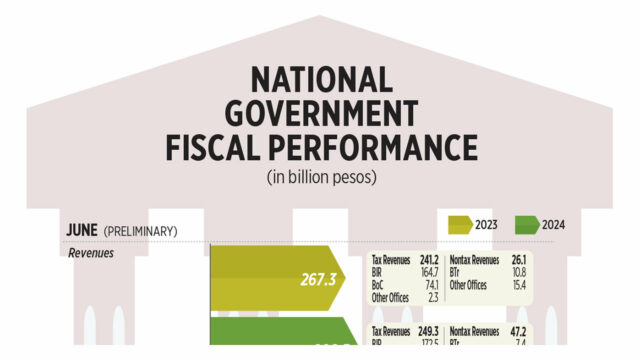
National Government fiscal performance

THE NATIONAL Government’s (NG) budget deficit narrowed by 7.24% year on year in June, as revenue collection grew at a faster clip than spending, the Bureau of the Treasury (BTr) said on Wednesday. Read the full story.

National Government fiscal performance

Super Typhoon Carina swamps PHL capital, shutters financial markets

PHILIPPINE STAR/MIGUEL DE GUZMAN

CARINA (International name: Gaemi), which intensified into a super typhoon, and a southwest monsoon continued to bring heavy rains to the Philippine capital region and northern provinces on Wednesday, halting financial markets and prompting authorities to suspend work and classes.

The presidential palace suspended government work and classes at all levels in Central Luzon, Calabarzon and Metro Manila for July 25 because of heavy rains.

Metro Manila, which is composed of 16 cities and one municipality and home to at least 13 million people, was placed under a state of calamity.

Interior and Local Government Secretary Benjamin C. Abalos, Jr. announced the decision after an emergency meeting with city mayors.

The local disaster agency said close to one million people from 180,000 families were affected by the typhoon. More than 35,000 people from 8,320 families were staying in evacuation centers.

Earlier in the day, the presidential palace suspended classes at all academic levels and work in most government offices because of the typhoon. Local governments on the main island of Luzon followed suit. 

Carina was packing maximum sustained winds of 185 kilometers per hour (kph) near the center and gustiness of up to 230 kph, the state weather bureau said in a 5 p.m. bulletin.

It was moving northwestward toward Taiwan and was expected to leave the Philippine area of responsibility by Thursday morning.

It said the water level in La Mesa dam had reached 80 meters as of 4 p.m. and was expected to rise due to heavy rains. Excess water would overflow once the dam elevation reaches 80.15 meters, affecting the areas near the Tullahan River from Quezon City, Valenzuela and Malabon.

Carina did not make landfall in the Philippines but was enhancing a southwest monsoon, resulting in heavy to intense rain in the country’s north, the agency said.

Carina and Tropical Depression Butchoy (Prapiroon), hit southern Philippines and caused floods last week, killing at least seven people.

The Philippine Coast Guard said 354 passengers and 31 vessels were stranded in ports, while airlines canceled 13 flights on Wednesday, Manila’s airport authority said.

The Philippines lies along the typhoon belt in the Pacific and experiences about 20 storms each year. It also lies in the so-called Pacific Ring of Fire, a belt of volcanoes around the Pacific Ocean where most of the world’s earthquakes strike.

Carina was expected to intensify further and hit its peak before its landfall in Taiwan, the state weather bureau said.

The combined effects of the typhoon and monsoon caused flooding in parts of Luzon. The Marikina River, which spans 16 bridges, overflowed and reached as high as 18.3 meters and forced residents to flee.

Malabon, Marikina, Valenzuela, Las Piñas, and Parañaque representatives were absent from the Metro Manila Council’s emergency meeting where the state of calamity declaration was adopted.

Quezon City Mayor Maria Josefina Tanya G. Belmonte-Alimurung, told a news briefing all the city’s evacuation centers were occupied, forcing them to use churches, covered courts and schools to house victims. Eighty of 142 villages were flooded.

More than 41,000 residents were staying in evacuation centers, the Quezon City local government said in an X post.

Kyanna Angela Bulan was in her condominium along Taft Avenue in Manila when the first floor of her parents’ two-story house in Marikina City was submerged.

“The flood reached parts of the stairs to the second floor,” she said in a Facebook Messenger chat. “Almost all of our furniture — sofa, bed, dining table, cabinets, storage racks, TV — floated.”

In Rizal province, a video showed residents helping a man swept away by flood in a town on the slopes of the Sierra Madre mountain range. Another video showed passengers leaving a bus in Quezon City, the country’s largest city, as it was submerged in floodwater.

About $500 million (P29 billion) in standby funds were available to support disaster relief, the Department of Finance said in a statement.

The President must first put the country under a state of calamity to trigger the fund release, it added.

Manila Electric Co. (Meralco) said about 430,000 customers, mostly in Metro Manila, Bulacan, Cavite and Rizal, had been affected by brownouts due to Super Typhoon Carina.

“We are closely monitoring the situation and our crews are working nonstop to restore service as soon as possible,” Meralco Vice-President and head of Corporate Communications Joe R. Zaldarriaga said in a statement.

President Ferdinand R. Marcos, Jr. said the government had provided P43.15 million in aid to more than 770,000 people affected by Butchoy in the Visayas and Mindanao.

In his third address to Congress on Monday, the Philippine leader said his government had set up 5,500 flood control projects across the country. “Many more are still under construction.”

The Philippines is among the countries most vulnerable to climate change, with annual economic damage at 13.6% of the economy, according to the World Bank. — Kyle Aristophere T. Atienza, Chloe Mari A. Hufana, Adrian H. Halili, Beatriz Marie D. Cruz and Sheldeen Joy Talavera

China urges Manila not to ‘backpedal’ on deal

FILE PHOTO of BRP Sierra Madre taken March 29, 2014. — REUTERS

By John Victor D. Ordoñez, Reporter

CHINA has urged the Philippines not to “backpedal” or do anything that would complicate the situation in the South China Sea after both countries agreed on an arrangement for Manila’s resupply missions to Second Thomas Shoal.

“We take note that the Philippine side said it’s ready to implement the arrangement it reached with China,” Mao Ning, spokesperson of the Chinese Foreign Ministry, told a news briefing on Tuesday evening, based on a transcript posted on the agency’s website. “We hope the Philippines will keep its word.”

She added that the “provisional arrangement” agreed upon during the July 2 bilateral talks in Manila was an “active effort China made to keep the situation under control.”

The Philippine Department of Foreign Affairs (DFA) did not immediately reply to WhatsApp group messages from reporters seeking comment.

China has said it would only allow Philippine resupply missions to the shoal, where Manila keeps a handful of soldiers on a grounded ship, if the Philippines informs it in advance.

The DFA said Manila had never agreed to prior notification during talks with Chinese officials.

Both parties have also agreed to set up new lines of communication to improve their handling of sea disputes.

“The Marcos administration should now accept that any dealings with Beijing must be transparent,” Michael Henry Ll. Yusingco, a fellow at the Ateneo de Manila University Policy Center, said in a Facebook Messenger chat.

“The details of any deal or arrangement must not be kept from the public, and the administration should not leave any room for Beijing to craft their own version of the agreed terms,” he added.

“Beijing believes that the accommodations made by the previous administration in Manila marked a new baseline understanding, and it does not want to retreat from that position,” Raymond M. Powell, a fellow at Stanford University’s Gordian Knot Center for National Security Innovation, said in an X message.

“It believes that Manila previously acquiesced to its demands. Even though there was never a formal signed agreement, Beijing believes the ‘gentlemen’s agreement’ is binding upon the Philippines,” he added.

President Ferdinand R. Marcos, Jr. in his third address to Congress on Monday said the Philippines would seek to deescalate tensions in the South China Sea “without compromising our position and our principles.”

“The Philippines cannot yield,” he said. “The Philippines cannot waver… The West Philippine Sea is ours,” he added, referring to areas of the sea within the country’s exclusive economic zone.

Chinese Coast Guard forces with bladed weapons on June 17 boarded Philippine rubber boats and looted several rifles stored in gun cases, actions that Manila’s military chief Romeo S. Brawner, Jr. said only “pirates” do.

A Filipino Navy sailor lost a thumb during the encounter.

US Secretary of State Antony John Blinken and Defense Secretary Lloyd J. Austin III are set to meet with Philippine Foreign Affairs Secretary Enrique A. Manalo and Defense Secretary Gilberto Eduardo C. Teodoro, Jr. in Manila on July 30 to discuss maritime and security issues.

China claims more than 80% of the South China Sea, overlapping with the exclusive economic zones of Vietnam, Malaysia, Brunei, Indonesia and the Philippines.

A United Nations-backed tribunal in 2016 voided China’s claim over the waterway for being illegal. Beijing has ignored the ruling.

About $3 trillion worth of trade passes through the South China Sea annually, and it is believed to be rich in oil and natural gas deposits, apart from fish stocks.

Meanwhile, the Philippines’ National Security Council said Manila and Beijing need consent from each other before they can publicize the details of their arrangement on resupply missions.

“The understanding should not be issued in public unless there is consent from both sides,” National Security Adviser Eduardo M. Año told a news briefing streamed live on YouTube.

“We did not agree to anything that would undermine our rights in the West Philippine Sea,” he said, adding that the national interest had not been compromised.

DepEd eyes better PISA results

Students walk inside the campus of a high school in Quezon City, April 18, 2024. — REUTERS

THE DEPARTMENT of Education (DepEd) on Wednesday said it would form a task force that will seek to improve Filipino students’ performance in tests including the Programme for International Student Assessment (PISA).

“One of our recommendations is to put up a Task Force for PISA exams specifically because we need to modify local conditions to be able to perform better in these exams,” Education Secretary Juan Edgardo “Sonny” M. Angara said in a post-state of the nation address forum.

Filipino students were among the world’s weakest in math, reading and science, according to the 2022 PISA. The Philippines ranked 77th out of 81 countries and performed worse than the global average in all categories.

Fifteen-year-old Filipino students ranked 63rd out of 64 countries in terms of creative thinking, the Organization for Economic Cooperation and Development, citing the same report.

Mr. Angara cited the need to come up with short- and long-term strategies to tweak teaching in public schools, including 30-minute reading periods in between classes.

“In the short term, to possess these skills, we are injecting some periods in the everyday curriculum for reading to strengthen the foundations of literacy and numeracy,” he said.

“We’re supplementing current initiatives like catch-up Fridays with a focus on science projects because the focus on the coming 2025 PISA exam is going to deal with science,” he added.

In his third State of the Nation Address on Monday, President Ferdinand R. Marcos, Jr. Said the national learning recovery program should proceed “without the slightest disruption, especially in basic education.”

“Our system of education must be strategically calibrated to make sure that our youth are not only taught to become literate, but it must also consciously develop them into problem-solvers and into critical thinkers — hungry for success, ready for the future.”

Mr. Angara said the Education department is working with three other agencies for the implementation of the expanded career progression system, which Mr. Marcos mentioned in his speech.

The other agencies are the Professional Regulatory Commission, Department of Budget and Management and Commission on Higher Education.

The career progression system should happen because “sometimes our teachers get pirated for better opportunities because it takes some time for them to be promoted.” “It is something that will encourage and incentivize our teachers,” he said.

“We expect to improve performance because of these innovations and developments, which the President has approved,” he added. — Kyle Aristophere T. Atienza

Senator pushes evacuation centers

QUEZON CITY residents live in modular tents inside an evacuation center in the village of Bagong Silangan after floods caused by Super Typhoon Carina and the southwest monsoon forced them to flee. — PHILIPPINE STAR/MIGUEL DE GUZMAN

A PHILIPPINE senator on Wednesday urged the government to set up evacuation centers in all cities instead of using public schools during typhoons and other calamities.

“Because we often experience calamities like typhoons and floods, it is crucial to ensure our country’s readiness to respond, including providing temporary shelter to those affected,” Senator Sherwin T. Gatchalian said in a statement in Filipino.

He earlier filed Senate Bill No. 2451, which seeks to set up evacuation centers that can withstand super typhoons Magnitude 8 earthquakes. The measure has yet to be tackled in plenary.

The National Disaster Risk Reduction and Management Council will be tasked to come up with design standards for these evacuation centers.

“Part of enhancing our ability to respond to calamities is having evacuation centers, and it is timely to begin constructing them in every city and municipality.” — John Victor D. Ordoñez

PHL HIV infections up 6x since 2010

THE PHILIPPINES posted the fastest-growing HIV (human immunodeficiency virus) epidemic in the Asia-Pacific region, according to a United Nations (UN) body, citing the rising cases among young Filipinos.

There were six times more HIV infections in the Philippines last year than there were in 2010, Eamonn Murphy, regional director of UNAIDS Asia Pacific and Eastern Europe Central Asia division, told an online news briefing on Wednesday.

“That’s primarily due to… men who have sex with men,” particularly among young people, he added.

Acquired immunodeficiency syndrome-related deaths in the country have spiked seven times since 2010, Mr. Murphy said. — Kenneth Christiane L. Basilio

Bossjob joins NVIDIA Inception

Adoption of artificial intelligence is expected to continue to increase this year. — REUTERS/DADO RUVIC/ILLUSTRATION/FILE PHOTO

BOSSJOB, an online recruitment platform, has joined NVIDIA Inception so it can use advanced artificial intelligence (AI) technologies to improve its job-matching services.

Bossjob aims to develop an in-house recommendation model using Machine Learning tools through the program.

“In the era of machine learning and large language models, Bossjob is privileged to build its own model on the shoulders of NVIDIA, constructing a new-generation talent-matching engine,” Bossjob co-founder and Chief Operating Officer Quak Kiat How said in a statement on Wednesday.

Bossjob said it is developing a custom machine learning framework that provides immediate AI-driven job recommendations, ensuring faster and more accurate job matches.

The partnership is expected to deliver more efficient job-matching services by creating Bossjob’s own recommendation model using NVIDIA’s H100 servers. — Chloe Mari A. Hufana

Gov’t told to choke drug supply

PHILIPPINE STAR/MIGUEL DE GUZMAN

THE GOVERNMENT should choke the country’s illegal drug supply apart from arresting and rehabilitating drug users, a congressman said on Wednesday.

“It is indeed difficult to stop drug addicts from buying illegal drugs if it’s freely available in the market,” Surigao del Norte Rep. Robert Ace S. Barbers said in a statement in Filipino. “While apprehending them should be the course of action, it only addresses the demand [side of the problem].”

“If there’s no supply, we no longer need to stop and apprehend them because they won’t be able to buy and use [illegal drugs],” he added.

He said President Ferdinand R. Marcos, Jr.’s “humane” approach to illegal drugs is more effective than his predecessor’s deadly war on drugs. — Kenneth Christiane L. Basilio