Home Blog Page 2561

YouTube rolls out Shorts platform enhancements

YOUTUBE will now allow users to post Shorts up to three minutes long, along with other enhancements to the platform, it said in a statement.

“YouTube empowers content creators further with new additions to Shorts, its popular short-form video platform, that will help everyone create more dynamic, compelling, and engaging videos,” it said.

“Chief among the new features is the extension of Shorts to up to three minutes long, a highly requested feature among creators. The longer format will be available starting Oct. 15, granting you greater flexibility to express yourselves and share more immersive narratives.”

Other updates to the video sharing platform’s Shorts feature include having an improved player and the introduction of templates.

“The YouTube Shorts player has been refined to prioritize content, ensuring your work takes center stage. Additionally, the introduction of templates simplifies the creation process, letting you easily jump on the latest trends and add your unique spin,” it said.

It now also provides integration with YouTube, allowing creators to remix YouTube videos directly via the Shorts camera.

Lastly, YouTube is introducing the option to “Show fewer Shorts” to allow users to personalize their feeds and prioritize long-form content.

“With these welcome updates, YouTube Shorts looks to become an even more dynamic and engaging platform for both creators and fans alike,” it said. — BVR

Meralco partners with South Korean firm to explore development of energy projects

MANILA ELECTRIC Company (Meralco) and Doosan Enerbility Co., Ltd. forge strategic partnership to drive energy innovation in the Philippines. Formalizing the memorandum of understanding are (L-R) Doosan Chief Marketing Officer Jungkwan Kim, Doosan Vice-Chairman and Chief Operating Officer Yeonin Jung, Meralco Chairman and Chief Executive Officer Manuel V. Pangilinan, and Meralco Chief Operating Officer Ronnie L. Aperocho.

MANILA Electric Co. (Meralco) has entered into a strategic partnership with South Korea’s Doosan Enerbility Co., Ltd. to explore collaborations on developing low-carbon energy projects in the Philippines, including the rehabilitation of the mothballed Bataan Nuclear Power Plant (BNPP).

Meralco and Doosan Enerbility signed a memorandum of understanding (MoU), which will focus on several key initiatives, such as the potential deployment of nuclear power facilities, the power distributor said in a statement on Wednesday.

The two companies will also study the use of small modular reactors to help meet the country’s growing power demand and achieve long-term energy security.

The companies are looking at the possible deployment of greenhouse gas reduction equipment, such as ammonia co-firing technology, for aging thermal power plants.

The MoU also covers the possible deployment and supply of gas turbines for combined cycle power projects of Meralco’s subsidiaries, with Doosan to serve as the engineering, procurement, and construction contractor for these projects.

“Partnering with reputable and dependable companies like Doosan aligns well with our pursuit to continuously explore innovative energy solutions that we can adopt as we work towards ensuring the availability of sufficient, affordable, and reliable power to meet our country’s long-term goals,” Meralco Chairman and Chief Executive Officer Manuel V. Pangilinan said.

Doosan Enerbility Vice-Chairman Yeonin Jung said that the collaboration is expected to contribute to the modernization of the Philippines’ energy infrastructure and help ensure a stable and long-term supply of power.

“We are committed to being a strong and dependable partner to the Philippine power sector, supporting its continued growth and development,” he said.

The partnership comes after the Department of Energy and Korea Hydro & Nuclear Power Co., Ltd. inked an MoU to conduct a comprehensive technical and economic feasibility study on the potential rehabilitation of the BNPP.

“Reinforcing the Philippines and Korea’s shared commitment to sustainable development and energy security, Meralco actively participates in nation-building by addressing the country’s energy challenges with meaningful partnerships and innovative projects,” the power distributor said.

Doosan Enerbility was founded in 1962 and has supplied integrated solutions in the fields of power generation, energy, and desalination plants in 40 countries around the world.

Meralco’s controlling stakeholder, Beacon Electric Asset Holdings, Inc., is partly owned by PLDT Inc.

Hastings Holdings, Inc., a unit of PLDT Beneficial Trust Fund subsidiary MediaQuest Holdings, Inc., has an interest in BusinessWorld through the Philippine Star Group, which it controls. — Sheldeen Joy Talavera

Digital banks face asset quality risks

ANASTASIA NELEN–UNSPLASH

DIGITAL BANKS in the Philippines face asset quality risks as individuals in their target market, the underserved segment, have lower incomes and lack credit history, Fitch Ratings said.

“Emerging markets in APAC (Asia-Pacific) generally have lower credit and bank penetration than developed markets, offering digital banks a larger pool of untapped customers by avoiding direct competition with incumbents for lending,” the debt watcher said in a report released on Wednesday.

“However, we believe that the potential pool of bankable customers may be constrained by their significantly lower income and/or very limited credit or payment history that make it challenging for banks to price loans adequately. This is evident from the asset quality performance of some Philippine digital lenders, when their aggregate nonperforming loan ratio shot up to 14.1% in July 2024 (December 2022: 5.9%), resulting in credit costs that almost offset their entire interest spreads,” it said.

There are six licensed digital banks in the Philippines: GoTyme Bank, Tonik Digital Bank, Inc., Maya Bank, Overseas Filipino Bank, UNObank, and UnionDigital Bank.

The Bangko Sentral ng Pilipinas (BSP) has approved the lifting of the moratorium on the grant of new digital banking licenses starting January next year, opening four new slots.

The latest BSP data showed that Philippine digital banks posted a combined net loss of P4.11 billion at end-June and had P105.37 billion in assets as of end-August.

Fitch said majority of digital banks in the APAC region also target underserved retail and small and medium enterprises (SME) as their main borrowers, which exposes them to higher credit risks than their traditional counterparts.

“Nevertheless, we expect these banks to continue to derive a significant portion of their business from the underserved segments in the near term to preserve or improve profitability, or as per their business commitments to the regulators. These structural features are likely to persist for most of the digital lenders in APAC,” it said.

The report highlighted the differences between digital banks in emerging APAC markets like the Philippines and those in developed markets in the region and how it has affected their profitability.

“The majority of digital banks in APAC are still loss-making, reflecting in part their limited operating history, though a number of lenders have turned profitable or have narrowed their losses in recent years as they rebalance their asset compositions and adjust to the change in operating environment,” Fitch said.

“Most of the profitable players are supported by large conglomerates with complementary ecosystems, particularly in areas such as internet platforms, e-commerce and communication applications,” it said, citing digital lenders in Korea, China, and Japan.

However, digital banks in developed APAC economies face challenges like high banking penetration and intense competition.

Meanwhile, online-only banks in both developed and emerging markets have higher-risk, price-sensitive business models as they mostly source their income from interest spreads, Fitch noted.

“In most APAC markets, we expect loan contribution to rise as digital banks continue to optimize their balance sheets, with unsecured retail and SME segments likely to be the key growth drivers. The declining interest rate environment is also likely to accelerate the shift as digital banks’ risk appetite returns,” it said.

“Their enlarged exposure to these higher risk segments leaves them more vulnerable to swings in economic conditions and interest rates. This was also evident from their much faster rise in impairment costs relative to the system average last year, especially in markets that experienced steep rate hikes such as Indonesia, Hong Kong and the Philippines. We believe these increases are also a function of the digital lenders’ heightened risk profiles. On the other end of the spectrum, digital lenders in Japan are among the most conservative in the region, reflected in their almost zero credit costs in the past three years.”

Fitch added that the regulatory landscape of digital banks in the region varies by country, and “their ability to adapt and optimize their business models will be crucial towards achieving and sustaining profitability in their competitive markets.”

“The digital banks’ rapidly growing presence has generally intensified funding competition within their local markets. Some digital lenders in the Philippines and Indonesia, for example, are aggressively offering time deposit rates that are almost twice the rates offered by the incumbents. These promotional rates are unlikely to be sustained in the longer run, but the keener competition has dampened the net interest margin of several smaller traditional lenders that had to compete fiercely with the digital banks for deposits. Those with lagging digital capabilities are also likely to be vulnerable to intensifying competition,” it said.

Low unemployment and more trade with more countries

There were two good pieces of data released by the Philippine Statistics Authority (PSA) recently. One was the low inflation rate of 1.9% for September, the other was the low unemployment rate of only 4% for August 2024 vs. 4.4% in August 2023.

In a press statement, Finance Secretary Ralph G. Recto celebrated these numbers, saying that “I am very glad of the back-to-back good news…. we expect more economic opportunities to be created, especially in the wholesale and retail trade sectors, as the holiday season nears and shopping peaks… The latest monetary policy easing due to the deceleration of inflation will also encourage further growth in consumption and investment that translate to more quality employment for Filipinos.”

In a separate press statement, Budget Secretary Amenah F. Pangandaman highlighted the low inflation rate, saying that, “This proves that we remain on track with our Agenda for Prosperity. Together with the rest of the Economic Team, we will continue implementing measures to reduce further inflationary pressures such as enhancing agricultural productivity, expanding logistics infrastructure, ensuring the efficient delivery of social services, and providing inflation-related subsidies.”

The labor force participation rate (LFPR) in August rose to 64.8% vs. 63.5% in the previous month. The LFPR is an indicator of optimism or pessimism of working age people about the local jobs market. If they think they can get a good and satisfying job, they go out and seek it and the LFPR goes up, usually 64% and higher. If people think the job market is bad, they pursue studies or just stay home and wait for better job opportunities and the LFPR goes down, usually 63% or lower.

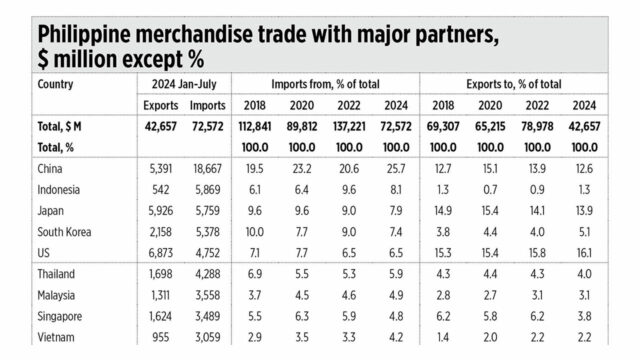
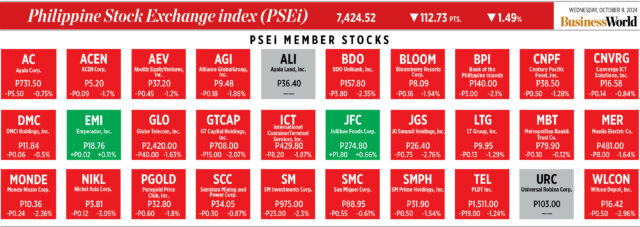
The PSA also recently released the country’s international merchandise trade statistics (IMTS) for July. I am particularly interested to know the value of our exports and imports in goods (services not included) with our major trade partners, so I checked the IMTS of previous years. The following trends can be seen.

The share of China in total Philippine imports keeps rising, from 20% in 2018 to 26% in January to July this year. The share of China in our exports remains flat at 13% from 2018 to 2024.

Indonesia has overtaken Japan, South Korea, and the US as the second biggest source of Philippine imports from 2022 to the present. But Indonesia is not buying much from the Philippines, with only a 1% share of total exports.

The share of Japan, South Korea, the US, and Thailand of total Philippine imports is declining while their share of total Philippine exports has flatlined.

Europeans are minor trade partners of the Philippines. The share of Germany, France, Italy, and Spain to total Philippine imports this year is only 4%, both among exports and imports (see the table).

The above numbers seem to contradict the frequent narrative and surveys that say Filipinos distrust China. Of every $4 of Philippines imports, $1 is from China – from toys, shoes, and electronics to trucks, buses, and bulldozers.

So our piecemeal war-mongering defense and foreign affairs policy direction against China runs contrary to the trade appetite of average Filipinos who prefer to have more trade and commerce, more investments and economic partnerships with China.

We should focus on more trade and investments, more peace and diplomacy with more countries around the world, not more war mongering. We should spend more tax money on infrastructure, on more and bigger airports and seaports, on toll roads and train systems, on power supply and energy security. Then we can create more jobs and businesses for our people, and our LFPR and employment rates will remain high while our unemployment and underemployment rates will remain low.


Bienvenido S. Oplas, Jr. is the president of Bienvenido S. Oplas, Jr. Research Consultancy Services, and Minimal Government Thinkers. He is an international fellow of the Tholos Foundation.

minimalgovernment@gmail.com

Musk’s X gets OK to resume service in Brazil after bending to top court’s demands

REUTERS

BRASILIA — Brazil’s Supreme Court cleared X to resume service in the country on Tuesday, after the social media platform reversed course and started complying with court rulings billionaire owner Elon Musk had previously vowed to resist.

Supreme Court Justice Alexandre de Moraes, who had been locked in a months-long feud with Mr. Musk, gave X the green light to resume operations in Latin America’s largest country effective immediately.

In the decision, Mr. Moraes said X had met all the necessary requirements to start operating again in the country.

The platform formerly called Twitter had been suspended in Brazil, one of its largest and most-coveted markets, since late August after not complying with court orders related to hate speech moderation and failing to name a legal representative in the country, as required by law.

Mr. Musk, who had denounced the orders as censorship and called Mr. Moraes a “dictator,” started to reverse his position in recent weeks, with his social media network blocking accounts flagged by the court, tapping a local representative and paying pending fines.

Mr. Moraes, in his Tuesday decision, ruled that Brazil’s telecommunications regulator Anatel must work to allow X to come back online within 24 hours. Users in Brazil were still unable to access the platform as of 7 p.m. local time.

Through its Global Affairs account, X said it was proud to return to Brazil, adding that it “will continue to defend freedom of speech, within the boundaries of the law” in the countries where it operates.

The Brazil dispute was one of a series of recent face-offs between Mr. Musk, who views himself as a champion of free speech, and governments including Australia and the United Kingdom seeking to prevent the spread of online misinformation.

Brazil’s communication minister said on Tuesday that X’s decision to pay the fines and comply with court orders was a “victory for the country.”

“We showed the world that here our laws should be respected, by whomever it may be,” Juscelino Filho said in a statement.

JUDICIAL BATTLE
X’s suspension initially came after an individual ruling by Mr. Moraes, who has spearheaded a local crusade against perceived attacks on democracy and the political use of disinformation.

His ruling was later unanimously backed by a five-member panel of the Supreme Court and its chief justice.

President Luiz Inacio Lula da Silva also voiced support for the move, saying that people with businesses in Brazil must follow local laws and the world was “not obliged to put up with Mr. Musk’s far-right ideology just because he is rich.”

Justices flagged at the time, however, that they would be open to reconsidering the suspension if X complied with rulings. The social media company initially said it would not abide by them because they were “illegal.”

Brazil is X’s sixth-biggest market globally and as of April had about 21.5 million users, according to data platform Statista. During the suspension, many users migrated to rival platforms such as Bluesky and Meta Platforms-owned Threads.

X had legal representation in Brazil until mid-August, when it decided to close its offices in the country due to the orders from the court, which it dubbed “censorship orders,” without naming someone to assume legal responsibilities for the firm locally.

That eventually triggered the suspension, in a judicial battle that also affected another prominent business controlled by Mr. Musk, satellite Internet provider Starlink, whose accounts Mr. Moraes temporarily froze in order to cover fines imposed on X.

A new X representative, lawyer Rachel de Oliveira Conceicao, was tapped in late September, when X also said it had started to block accounts ordered by the court.

Earlier this month, the firm paid pending fines it had previously disdained, opening the door for reinstatement in the country.

With the suspension, X remained out of service in Brazil during the final month of the country’s municipal elections, which occurred on Sunday.

In many cities, however, including Sao Paulo — Latin America’s largest city — mayoral elections will head to runoffs on Oct. 27. Reuters

In Russia, an upstart whiskey distiller looks to break the vodka mold

DYLAN DE JONGE-UNSPLASH

KEMLYA, Russia — Russia may be known for its vodka, but in a rural village a few hundred miles east of Moscow, a whiskey distillery is hoping to tempt Russians to embrace a different tipple.

Western alcohol producers slashed their exports to Russia after Moscow sent troops into Ukraine in February 2022. Though some brands are now shipped through grey import channels, the sudden supply slump helped domestic producers, whose sales have more than tripled in the last two years.

Russia’s nascent whiskey industry is one of many examples of domestic producers seeking to fill gaps left by foreign companies that stopped operations in Russia over the conflict in Ukraine.

In Kemlya, a small settlement 500 kilometers east of Moscow in Russia’s Mordovia region, the Kemlya Distillery is hoping the quality of its oak-aged whiskies will attract discerning Russian drinkers, provided they can stomach higher prices.

“The maths is simple,” Gennady Silivanov, Kemlya’s master blender told Reuters. “A Russian man would buy one bottle of a quality liquor instead of 10 bottles of cheap stuff like vodka or something like it, and drink less.”

Kemlya’s whiskies, with names such as Russian Oak and Balkan Virgin, sell from between 11,000 and 16,000 roubles ($115-$167), about 20 times higher than the average price for a bottle of vodka.

The company, which has been producing whiskey since 2015, plans to release a blended whiskey at a cheaper price for mass consumption by the end of 2026.

Sales of Russian whiskey, including from local distillates, have grown three times in the last two years, NielsenIQ Russia said in August.

Imports slumped in 2022, as the likes of Diageo, Pernod Ricard and other independent alcohol producers cut back on Russiasales, but they recovered in 2023 after Russia legalized so-called “parallel” imports that allow goods to enter the country without the brands’ permission, according to specialist publication RBC Wine.

Imports of Scotch, upon which Kemlya bases its own production, have particularly suffered.

“Exports of Scotch Whisky to Russia have fallen from £28 million ($36.6 million) in 2021 to £12.7 million in 2023,” a spokesperson for the Scotch Whisky Association told Reuters. “In addition, shipments to indirect routes to market have also decreased significantly.”

EQUIPMENT SWITCH
Kemlya has also struggled to access parts. Forsyths, the Scotland-based specialist equipment maker for Scotch whisky has cut exports to Russia, too.

“Unfortunately, we are in such a situation now that it is extremely difficult to place an order for equipment with them,” Silivanov said.

The solution, so often the case with Russian manufacturing shortages now, is to turn to China.

“Chinese engineers have replicated one of the Scottish models,” Silivanov said, showing off equipment commissioned in Shanghai. “The exact shape of pot stills that we specifically needed.”

Kemlya’s whisky went down well in Bruce Bar, a whiskey specialty bar tucked away on a side street in central Moscow, garnering interest from whiskey enthusiasts as a genuine Russian single malt.

In blind tastings, Kemlya’s whiskies have rubbed shoulders with those from Scotland and other countries, sometimes outperforming even Scottish brands, Daniil Vinner, co-owner of Bruce Bar told Reuters.

“If whiskey is produced in Taiwan or New Zealand, why can it not be produced in Russia?,” he said. — Reuters

DITO Telecommunity targets up to 16 million subscribers by yearend

DITO Telecommunity Corp. is targeting to reach between 15 million and 16 million subscribers by the end of the year, driven by its network expansion plans, its chief executive officer (CEO) said.

“Hopefully [by yearend] we will reach 15 million or 16 million,” DITO Telecommunity CEO Ernesto R. Alberto told reporters on the sidelines of the company’s gala late Tuesday night.

The telecommunications company just reached 13 million subscribers last week, Mr. Alberto said.

“We will achieve this] by continuous engagement, winning away customers, right? Getting our fair share of the customers given our investment in the network,” Mr. Alberto said.

He said the company is working on filling in the gaps by improving its connectivity services and reaching more customers in far-flung areas.

DITO Telecommunity, the country’s third major telco player, secured its certificate of public convenience and necessity from the National Telecommunications Commission (NTC) in 2019.

Last month, the telco provider passed its fifth technical audit from the NTC after achieving nationwide coverage of 86.3% and a minimum average broadband speed of 92.87 megabits per second (Mbps) and 597.7 Mbps for 4G and 5G sites, respectively.

Mr. Alberto is also optimistic that the company will break even by its sixth year or by 2025.

“We should be. That is our ambition. Next year is our sixth year, EBITDA (earnings before interest, taxes, depreciation, and amortization) breakeven, [we should have] positive cash flow,” he said.

DITO is allocating between P25 billion and P30 billion for its capital expenditure (capex) budget, mainly for its network rollout for 2024.

For 2025, Mr. Alberto did not provide an exact figure for its capex budget but said that it will be lower than this year’s capex budget.

“Obviously, it will taper down. But we will still have to spend. Because there are two things that we need to spend on. We have to cover the few gaps in our coverage and expand 5G. It should be much lower capex because the capex for the last five years is for the build-out,” Mr. Alberto said. — Ashley Erika O. Jose

Claims of connections

FREEPIK

IT USED to be a mark of social status to be “well connected.” One’s network of friends and acquaintances needs only to be mentioned to open doors and secure favors. Fraternities, alumni associations, civic organizations, political parties, even religious sects, and membership in prestigious clubs provide the right social networks.

Does name dropping still work in terms of access to power? In our highly connected culture, does “know-who” still trump “know-how”? Why is name dropping even necessary? Is it because one’s name doesn’t merit any respect? (Do you know who I am?)

Dropping names as a way of accessing power or gaining respect through reflected glory is a sort of “status by association.” The practice of claiming closeness, affinity, shared experiences, even claimed friendship since childhood (he used to swim in our pool) with someone now powerful. Maybe VIPs are beginning to resent their names being used by so many, what with so many investigations going on. Connections are not always welcome.

Social media has too quickly exposed false claims when checked by the importuned personality. The claimed relationship is too easily verified by simple online queries. (He says you used to hitch with him to get to your bus.) The quick disclaimer is noted. (We weren’t even in the same school.)

Maybe the same few names, sometimes initials, are dropped. With the acquisition of companies under fewer and fewer owners, the droppable names are getting fewer. (The executives under them though are multiplying.) Names of former owners of businesses are no longer worth dropping. In terms of probability, the name of one who controls a tenth of the GDP of this country is likely to be mentioned too many times by too many people to be even taken seriously — Oh, sure, you know the name of his dog.

The dropped name is not always checked to find out if he is even acquainted with the name-dropper. The time of the CEO is too valuable to be taken up by a mundane query from HR. (Sir, do you really know this pest?) It puts the big boss on the spot if he acknowledges that indeed he knows the person. He may then ask why the caller is asking him. Does HR think the only qualification for the job is some connection to him? Can this querying bureaucrat please give her name, rank, and direct report, please? (And don’t call him a pest.)

Name-dropping may be passé. It no longer intimidates anybody into a favorable frame of mind. If the mighty one really endorses a proposal, he would have given an indication for a favorable review. Gatekeepers can ignore anyone who resorts to this overrated approach to getting an appointment.

A subtler version of name dropping involves conversational rambling. This seemingly aimless narration of invitations received, dinners shared, gifts exchanged, vacations planned, opinions sought may involve a person in power. A touch of reluctance and even hesitation in mentioning some trivia (I didn’t even want to go to his resort, but he was insistent) makes this form of bragging more effective. No specific request is mentioned in the conversation. It is capped by a throwaway line to further dazzle the listener — these days, it’s so difficult to differentiate between mere name-droppers and real friends.

Shakespeare has commented on the traps of name-dropping. In Henry the Fourth, Glendower makes a claim: “I can call spirits from the vasty deep.” Hotspur replies: “Why, so can I or so can any man. But will they come when you call them?” This exchange can be roughly translated in modern terms as: Of course, you can message her, but will she reply? (Who’s this?)

It is socially discreet not to mention powerful people as friends or even acquaintances. If one is pressed to reveal any connection (Wasn’t he your neighbor?), one can plead a foggy recollection — It was so long ago. We do bump into each other at parties. Anyway, there’s always a long line of people that want to have their selfies with him. It’s just a circus wherever that VIP shows up.

The name dropper has been known to forget names dropped before, especially when these have fallen from grace. When confronted by those who remember, the name dropper simply shrugs — I don’t really know what he’s up to nowadays.


Tony Samson is chairman and CEO of TOUCH xda

ar.samson@yahoo.com

BSP launches financial inclusion website

BW FILE PHOTO

THE BANGKO SENTRAL ng Pilipinas (BSP) has launched a website to promote financial inclusion.

The website will serve as a “one-stop shop for financial inclusion news and resources, making relevant economic and financial information accessible to consumers, industry players, regulators, and other stakeholders supporting the effective implementation of the National Strategy for Financial Inclusion (NSFI),” the central bank said.

The project was developed by the Financial Inclusion Steering Committee. The committee was established in 2016 to implement initiatives under the NSFI.

“The website, as you have seen, will have comprehensive content on financial inclusion and financial health from partner government agencies, financial service providers, and other supporting institutions,” BSP Governor Eli M. Remolona, Jr. said during the launch on Wednesday.

The BSP also said the public can “submit blog posts or videos to share their stories related to financial inclusion” on the website.

“Our hope is that making financial inclusion information more easily accessible, this empowers and inspires our countrymen,” Mr. Remolona said.

Through the NSFI, the government aims to promote digital finance, strengthen financial education and consumer protection, enhance access to risk protection and social safety nets, and enhance the agriculture and micro, small, and medium enterprise financing ecosystem.

“We hope the information and stories on the website inspire everyone, those who need it and those who can help provide it, to work together to advance the whole country’s journey toward financial inclusion and financial health,” the BSP chief said.

“Financial health is a newer aspiration beyond financial inclusion. It means you don’t have to have a bank account, but can still meet financial obligations, save and invest for the future, and bounce back in case of shocks.”

The share of Filipinos with bank accounts reached 65% of the adult population in 2022. The BSP wants at least 70% of adult Filipinos to be part of the formal financial system. — Luisa Maria Jacinta C. Jocson

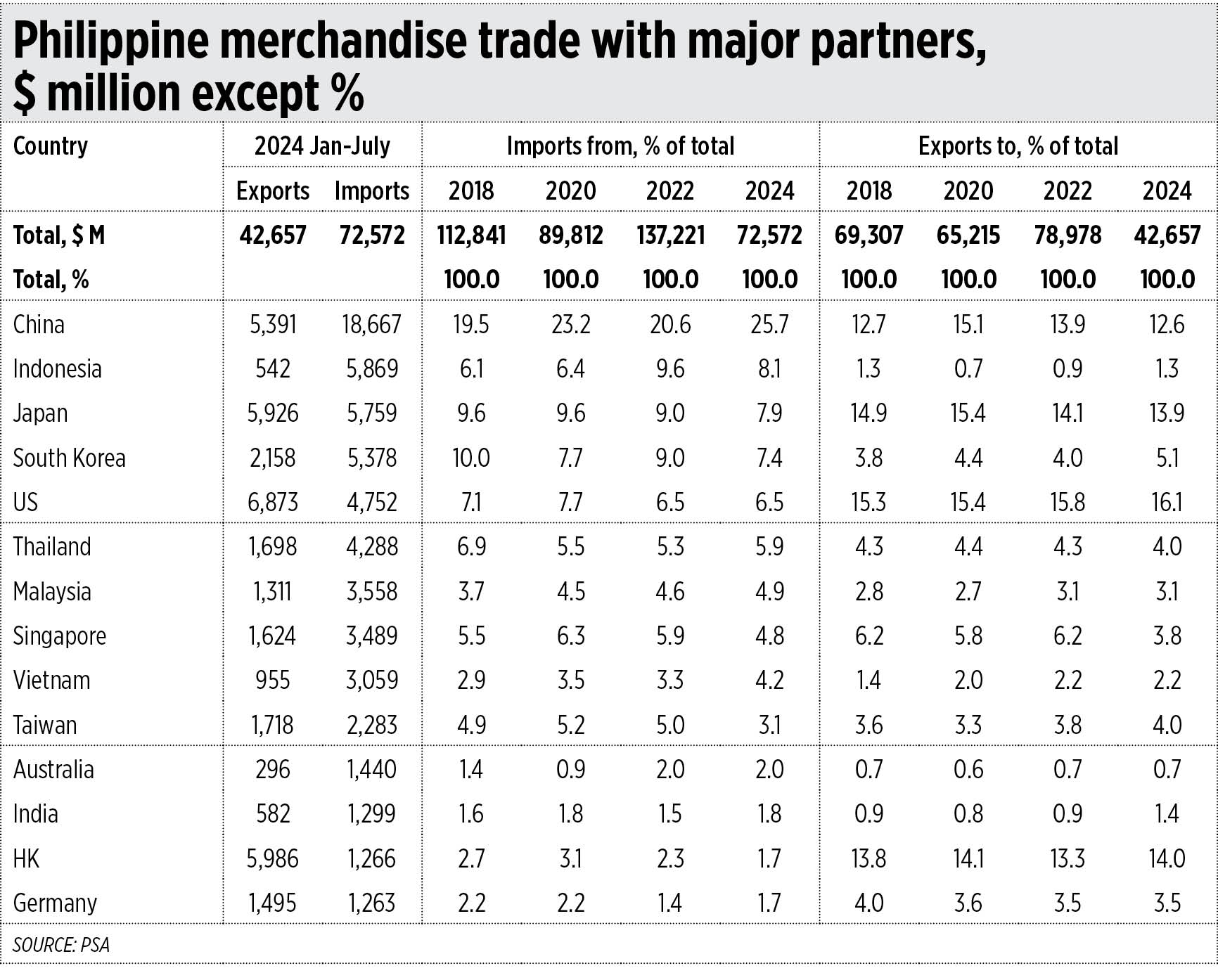
How does the Philippines’ State of Democracy compare with its neighbors? 

The Global State of Democracy 2024, released by the International Institute for Democracy and Electoral Assistance, reports annual global rankings for each main categories of democratic performance. Out of 173 countries, the Philippines ranked 90th, 96th, 104th, and 64th, respectively, in Representation, Rights, Rule of Law, and Participation categories.

How does the Philippines’ State of Democracy compare with its neighbors?

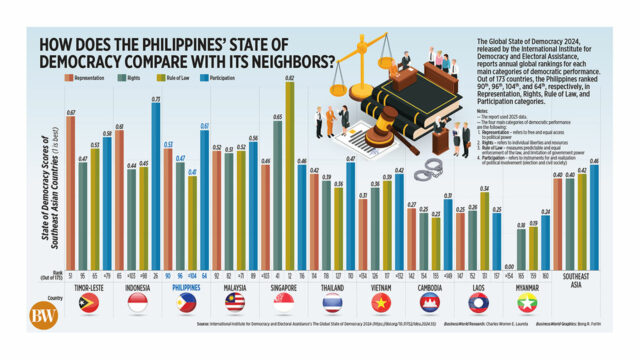
How PSEi member stocks performed — October 9, 2024

Here’s a quick glance at how PSEi stocks fared on Wednesday, October 9, 2024.


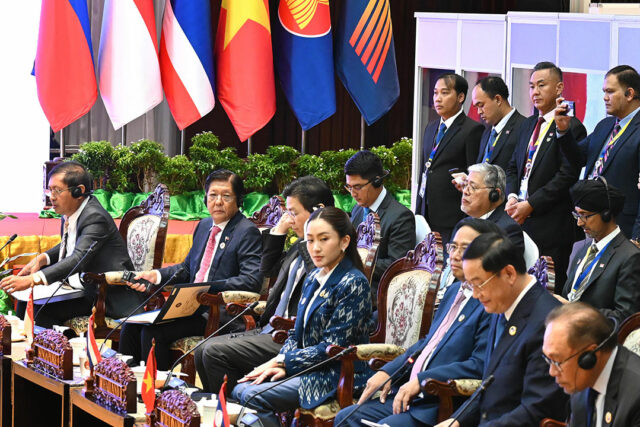
ASEAN leaders tackled South China Sea code of conduct, says Thailand

PHILIPPINE President Ferdinand R. Marcos, Jr. attends the 44th and 45th summits of the Association of Southeast Asian Nations (ASEAN) in Laos. — PPA POOL

LEADERS of the Association of Southeast Asian Nations (ASEAN) on Wednesday discussed progress toward a South China Sea code of conduct and agreed that the United Nations Convention on the Law of the Sea (UNCLOS) should be the bloc’s basis for settling sea disputes, a Thai official said.

Nikorndej Balankura, a spokesman for Thailand’s Foreign Ministry, said the issue of ASEAN unity and prioritizing its centrality was also stressed during a retreat of ASEAN leaders in Laos.

Also on Wednesday, the Philippine presidential palace said President Ferdinand R. Marcos, Jr. was set to join fellow ASEAN leaders for an “interface” with representatives of the ASEAN Business Advisory Council (ABAC) in Vientiane.

The President would reiterate the Philippines’ commitment to working with the private sector in advancing ASEAN’s goals and objectives and call on the council to take a leading role in shaping the regional economy.

Meanwhile, the Philippines and Vietnam said they are exploring more areas of cooperation to boost a strategic partnership that they sealed in 2015 that includes defense and maritime ties.

President Ferdinand R. Marcos, Jr. and Vietnam Prime Minister Pham Minh Chinh issued the statement on the sidelines of the 44th and 45th summits of the ASEAN in Laos.

“We have made a good deal of progress since our very first discussion and some of the engagements between our two countries,” he told the leader of the $409-billion economy, based on a statement from the presidential palace in Manila.

“And I am very happy that we will be able to pursue that. It also gives us the opportunity to explore new areas of cooperation and partnership,” he added.

Mr. Chinh, for his part, reaffirmed Vietnam’s commitment to its strategic partnership with the Philippines.

“I want to reaffirm that we always support the strategic partnership with the Philippines,” he said. “I’m glad to note that the discussions that we began two years ago have been implemented effectively.”

The two countries in November 2015 agreed on their strategic partnership that covers political and economic cooperation, defense and maritime ties, among other things.

Vietnam and the Philippines in January signed a deal to boost cooperation between their coast guards, amid China’s assertiveness in the South China Sea.

The two countries have also entered partnerships in rice trade and the prevention of accidents in the South China Sea, which Beijing claims almost in its entirety.

One of the South China Sea features that has been a source of tension among the three nations is Scarborough Shoal, which lies just 600 kilometers from the Philippine province of Palawan.

A 2016 arbitral ruling that voided China’s claims in the South China Sea said the shoal is a traditional fishing ground for Filipino, Chinese and Vietnamese fishermen. China has controlled the shoal since 2012.

Data from the General Department of Vietnam Customs showed Hanoi posted a $2.41-billion trade surplus with Manila in the first eight months of 2024. Their bilateral trade rose by 21% to $5.7 billion from a year earlier.

Philippines imports from Vietnam hit $4.07 billion during the eight-month period, up 17%, with rice worth $1.71 billion as the top import commodity. Rice was the only Vietnamese export to the Philippines exceeding $1 billion.

The Philippine government in June reduced the tariffs on rice imports to 15% from 35% effective August until 2028, as it seeks to cool food inflation.

Vietnam accounts for 80% of Philippine rice imports, having exported 1.44 million tons of the commodity as of May 23.

Mr. Marcos and Mr. Chinh first discussed the rice deal during their bilateral meeting on the sidelines of the 43rd ASEAN Summit in Jakarta in September last year.

At that time, Mr. Marcos said his country hoped Vietnam would be an important partner in its shift to electric vehicles.

MILITARY BUDGET
Meanwhile, Senator Joseph Victor G. Ejercito pushed funding of at least P100 billion for the Philippine military’s modernization program, citing the need for more missile systems and fighter jets to deter Chinese aggression at sea.

“The acquisition and production of defense equipment takes time, and we really need this since we don’t want to be bullied anymore by China,” he told a news briefing. Mr. Ejercito told a news briefing.

The House of Representatives has approved on final reading next year’s national budget bill, which allots P204.4 billion to the Philippine Army, Air Force and Navy. Lawmakers also allocated P50 billion for modernization efforts of the Armed Forces of the Philippines.

Philippine President Ferdinand R. Marcos, Jr. on Tuesday signed into law a bill requiring the government to pursue a defense posture that relies on local producers.

The US Navy, Marines and their Filipino counterparts on Monday kicked off their two-week joint military exercises in Subic Bay in northern Philippines aimed to boost interoperability between their military forces.

The navy and marine forces will conduct high-intensity drills focusing on anti-submarine, anti-air and anti-surface warfare, along with the use of maritime surveillance aircraft, according to the US Defense Department.

Mr. Ejercito said the government should increase military resources to deal with the precarious situation with Beijing in the South China Sea.

Chinese vessels on Tuesday fired water cannons at two ships of the Bureau of Fisheries and Aquatic Resources (BFAR) delivering supplies for Filipino fishermen at Scarborough Shoal, BFAR said.

“We really need to focus on external defense or the acquisition of multi-role fighters, war vessels and missile systems,” the Senate deputy majority floor leader said.  “This is only for deterrence to aggression.”

China claims almost the entire South China Sea, including parts claimed by the Philippines, Brunei, Malaysia, Taiwan and Vietnam.

Portions of the waterway, where $3 trillion worth of trade passes yearly, are believed to be rich in oil and natural gas deposits, as well as fish stocks.

Senators have been pushing the Philippine Foreign Affairs Department to file a resolution with the UN body condemning China’s aggression in the South China Sea.

Manila also eyes raising its dispute with China at the ASEAN once it heads the regional body in 2027.

The ASEAN and China have been in talks as far back as 2002 to craft a code of conduct in the South China Sea.

In 2016, a United Nations-backed tribunal based in the Hague voided China’s claim to more than 80% of the South China Sea for being illegal.

The Philippines has been unable to enforce the ruling and has since filed hundreds of protests over what it calls encroachment and harassment by China’s coast guard and its vast fishing fleet.

“We do not want war, but we are just protecting our territory and what is rightfully ours,” Mr. Ejercito said. — Kyle Aristophere T. Atienza and John Victor D. Ordoñez, with Reuters


ADVERTISEMENT
ADVERTISEMENT