Home Blog Page 246

BBC apologizes for airing BAFTA racial slur made by guest with Tourette’s
LONDON — The BBC apologized on Monday for failing to edit out a racial slur from its broadcast of Britain’s top movie awards, after a guest with Tourette syndrome shouted out while two Black actors from the film Sinners were presenting an award.

Michael B. Jordan and Delroy Lindo were on stage at the BAFTAs when John Davidson shouted a racial slur. The BBC broadcast the show around two hours later and the offensive language remained in the program, and on its streaming platform until Monday morning.

Later, director Akinola Davies, Jr. said “Free Palestine” in an acceptance speech. The remark was edited out of the broadcast.

The racial slur by Mr. Davidson sparked anger from several Black actors and a production designer who said there should have been a more comprehensive apology at the time. Mr. Davidson attended the BAFTA awards in London on Sunday after his life inspired the film I Swear, which picked up several awards.

Tourette syndrome is an involuntary condition that causes people to make sudden, repetitive sounds or movements known as tics, which can sometimes include swearing.

A BBC spokesperson said on Monday that some viewers may have heard “strong and offensive language” during the awards.

“This arose from involuntary verbal tics associated with Tourette syndrome, and as explained during the ceremony it was not intentional. We apologize that this was not edited out prior to broadcast and it will now be removed from the version on BBC iPlayer.”

In a separate statement issued on Monday evening, BAFTA said: “We want to acknowledge the harm this has caused, address what happened and apologize to all.”

BAFTA said it had taken steps to make the audience aware of the tics and the possibility that they could hear strong language during the ceremony.

“Michael B. Jordan and Delroy Lindo were on stage at the time, and we apologize unreservedly to them, and to all those impacted. We would like to thank Michael and Delroy for their incredible dignity and professionalism,” BAFTA added.

The host of the awards, Alan Cumming, apologized for the offensive language later in the event, saying the person with Tourette’s had no control over what he had said, and added: “We apologize if you were offended.”

Wendell Pierce, Mr. Jordan’s co-star on The Wire, said on X it was infuriating that the two actors did not receive a full and immediate apology.

“The insult to them takes priority,” he said. “It doesn’t matter the reasoning for the racist slur.”

Hannah Beachler, the Sinners production designer, said it had been an “impossible situation” but the “throw-away” apology had made it worse. “Of course we were offended,” she said.

I Swear tells the story of Mr. Davidson growing up with Tourette syndrome and the impact it had on his life, culminating in him becoming a campaigner to raise awareness of the condition.

BAFTA said Mr. Davidson chose to leave the auditorium and watch the rest of the ceremony on a screen.

“We would like to thank him for his dignity and consideration of others, on what should have been a night of celebration for him,” BAFTA said. “We take full responsibility for putting our guests in a very difficult situation and we apologize to all,” the statement added.

The Tourettes Action charity group said it deeply understood the hurt Mr. Davidson’s words had caused at the BAFTAs but said they did not reflect a person’s beliefs, intentions, or character.

“We are deeply sorry to the Black community for the harm caused but at the same time, it is vital that the public understands a fundamental truth about Tourette syndrome: tics are involuntary,” it said in a statement. — Reuters

The cognitive war in national security

ARMED FORCES OF THE PHILIPPINES

Wars are typically fought by breaching national borders and territorial boundaries. Advances in technology, however, have created new battlefields. Today, conflict can unfold without ships crossing our waters or troops landing on our shores. It can begin quietly, through unseen hands typing on keyboards.

The Philippines is confronting such a challenge.

This threat goes by a new name: foreign interference and malign influence, or FIMI. It is not an obvious, kinetic attack. Often, it appears as an ordinary post, a viral video, or a trending narrative. But beneath the surface, it is coordinated political warfare. Physical actions, cyber operations, economic leverage, and information campaigns can move in sync to achieve strategic narrative advantage.

Because FIMI operates subtly, it can be even more dangerous. It does not shock the system. It seeps into it. It gradually reshapes perceptions, reframes issues, and influences democratic choices.

Democracy depends on the collective judgment of its people. When perception is engineered, policy direction can be altered without initiating legislation.

Over the past two days, at a forum organized by the Stratbase Institute in collaboration with the Embassy of Canada in the Philippines, we confronted a reality that can no longer be ignored: We are facing a war that is largely invisible, fought in the digital domain and in the realm of perception.

We are familiar with disinformation and misinformation online. But FIMI goes further. It deliberately studies our vulnerabilities. It identifies social fault lines and amplifies them. The familiar tactics of dismissing, distorting, distracting, and denying are now joined by a fifth element: dismay. The goal is not only to confuse, but to exhaust public trust, deepen polarization, and make resistance seem useless.

Recent survey data illustrate why this approach can gain traction. Many Filipinos perceive corruption as prevalent. Inflation remains a pressing concern. These anxieties are legitimate. They deserve policy solutions. But they also create openings that foreign actors can exploit.

Public frustration shapes discourse. It influences behavior. And when amplified strategically, it can be weaponized to weaken confidence in institutions and to fan mistrust.

Foreign interference spreads instantly online, while democratic processes move slowly. In that gap, narratives can harden before the truth can catch up.

We have observed how influence networks operate across platforms. Messaging that begins in one corner of the digital ecosystem is quickly amplified through interconnected pages, online personalities, and coordinated accounts. Artificial intelligence tools make it easier to generate persuasive content at scale. Across X, Facebook, and YouTube, narratives cascade rapidly, often spilling beyond cyberspace, beyond mainstream media, and into in-person discussions.

Individually, some channels may appear benign. Business associations, cultural exchanges, academic programs, and local partnerships are often framed as routine cooperation. Many are legitimate. Yet taken together, certain networks can function as conduits for strategic messaging aligned with foreign geopolitical interests. The line between information and influence becomes blurred.

Traditional and digital media further magnify these narratives. In some narratives, the Philippines is portrayed as the aggressor in its own maritime domain, while expansive foreign claims are framed as reasonable or inevitable. When repeated often enough, such framing begins to shape public understanding.

This is why the issue must be treated as a core national security concern.

National defense can no longer be confined to military capabilities or maritime patrols. Information integrity and cyber resilience are now central pillars of sovereignty. If the integrity of our information space collapses, the strength of our physical defenses will not be enough.

Responding to this challenge requires more than isolated measures. It demands a resilient defense posture built on integration, collaboration, and capability enhancement.

Integration means breaking down silos across agencies. Legal, intelligence, economic, and communications responses must be synchronized. Collaboration means working not only within government, but with the private sector, academia, civil society, and international partners. No single institution can match the scale and speed of coordinated influence operations alone.

Capability enhancement means investing in analytical tools to detect networked campaigns early, updating legal frameworks to address modern espionage and covert funding, and strengthening civic education so that citizens can recognize manipulation when they encounter it.

We must also embrace transparency. Verified information must be released promptly. Facts must move at speed. Coordinated narrative defense should ensure that legal action, intelligence findings, and public messaging reinforce rather than contradict one another. Silence or delay only widens the space for distortion.

As we approach 2028 and beyond, the next leadership will matter profoundly. The Philippines occupies a strategic position in the Indo-Pacific region. Developments at home reverberate across the region, just as regional dynamics impact our domestic landscape. We must choose leaders capable of navigating geopolitical uncertainty and technological disruption with clarity and resolve.

Ultimately, this is about dismantling the networks that undermine our sovereignty. It is about ensuring that gray-zone tactics do not become normalized. It is about defending not only territory, but truth.

Across the Philippines and the broader Indo-Pacific region, we face a conflict that is difficult to see yet impossible to ignore. Its battlefield includes timelines, comment sections, academic forums, and economic channels. Its objective is influence.

We cannot defend sovereignty only at sea or in the air. We must defend it in the minds of our people.

In this cognitive war, our response must be strategic, sustained, and united — so that our democratic future is strengthened by informed choice, not engineered perception.


Victor Andres “Dindo” C. Manhit is the president of the Stratbase ADR Institute.

Banks’ trust assets grow to P5.7 trillion

BW FILE PHOTO

THE Philippine banking system’s trust assets ended at a record high of P5.696 trillion in 2025 amid the continued expansion of unit investment trust funds (UITFs), data from the Bangko Sentral ng Pilipinas (BSP) showed.

This was up by 27.98% from the P4.451 trillion seen at end-2024 and was the highest level recorded so far.

This also rose by 17.03% from the P4.867 trillion recorded at end-September.

Of the end-2025 total, universal and commercial banks held P5.67 trillion in trust assets, rising by 28.17% from P4.424 trillion in the prior year.

Meanwhile, thrift banks had P25.892 billion, 3.33% lower than the P26.784 billion they managed in 2024.

“The double-digit growth in trust assets may be attributed to the further expansion of investments, especially UITFs, reflecting the increased need or shift from deposits in search for higher investment returns amid lower US, global, and local interest rates since (the) latter part of 2024,” Rizal Commercial Banking Corp. Chief Economist Michael L. Ricafort said via Viber.

The US Federal Reserve has trimmed its borrowing costs by a cumulative 175 basis points (bps) since September 2024, with its target rate now at 3.5%-3.75%.

Meanwhile, the BSP delivered a total of 200 bps in cuts from August 2024 to December 2025 to bring the key rate to 4.5%. Last week, it reduced benchmark rates by another 25 bps, with the policy rate now at 4.25%.

“This also reflects the rising trend of the local stock market from the immediate low/bottom posted on Nov. 14, 2025, as well as lower bond yields towards the end of 2025, thereby leading to more investment or UITF gains that become more attractive amid lower short-term interest rates or deposit rates,” Mr. Ricafort added.

On Nov. 14, the Philippine Stock Exchange index finished at an over five-year low of 5,584.35 on concerns over the economic fallout from a corruption scandal involving flood control projects. It managed to rebound as the year wrapped up, closing the year at 6,052.92 on Dec. 29, which was the last trading day for 2025.

Bonds also rallied in late 2025 as growth concerns bolstered bets of further monetary easing by the BSP.

A trust business covers activities performed under a trustor-trustee arrangement, where a trustee manages funds or properties for the trustor’s benefit.

Banks or nonbank financial institutions may operate trust units, with industry assets made up of security investments, bank deposits and other holdings.

Based on BSP data, cash and due from banks nearly doubled year on year (92.1%) to P767 million at end-December 2025 from P398 million previously.

Net deposits stood at P1.476 trillion at yearend, 14.01% above the P1.294 trillion logged at end-2024, while net financial assets grew by an annual 11% to P2.858 trillion from P2.574 trillion.

Loans, including gross equity investments, inched down by 0.42% to P46.352 billion as of end-December from P46.548 billion in the comparable year-ago period.

Meanwhile, total accountabilities also stood at P5.696 trillion last year, with trust holdings climbing by 16.17% year on year to P1.817 trillion from P1.564 trillion.

This came as UITFs increased 25.22% year on year to P766.783 billion from P612.347 billion, while employee benefits went up by 7.93% to P382.527 billion from P354.422 billion.

BSP data also showed that agency trusts reached P2.393 trillion at end-2025, rising by 8.67% from P2.202 trillion the previous year.

On the other hand, other fiduciary services jumped by 127.94% to P1.424 trillion last year from P624.892 billion at end-December 2024.

Further easing by both the Fed and the BSP this year could attract more investments into UITFs and other trust funds, which would help drive the growth of banks’ trust assets, Mr. Ricafort said.

“Increased demand for other trust products and investments amid increased financial literacy or sophistication would lead to more demand for trust investments and other financial solutions,” he added. — Katherine K. Chan

Ayala chairman urges stronger PPP push amid infrastructure concerns

BW FILE PHOTO

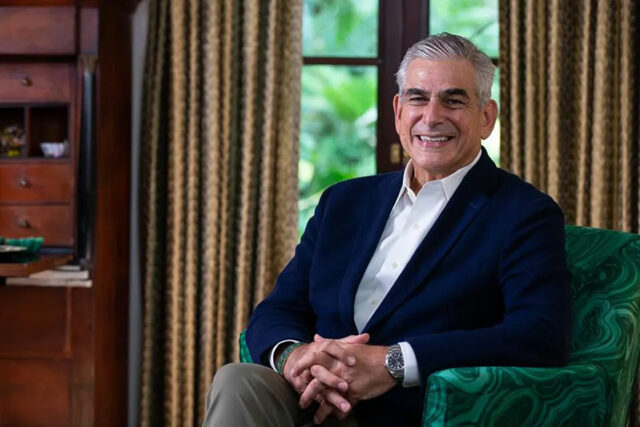
THE PHILIPPINES should expand the use of public-private partnerships (PPP), particularly in infrastructure projects, as recent developments surrounding flood control projects underscore the need for stronger accountability in government spending, according to Ayala Corp. Chairman Jaime Augusto Zobel de Ayala.

“We have had some problems in laying out infrastructure. We should just grab the bull by the horns and say infrastructure is important. Let us work on the PPP infrastructure structure that we have in the country to allow more capital from the private sector to enter,” Mr. Zobel said during the Association of Southeast Asian Nations (ASEAN) Editors and Economic Opinion Leaders Forum on Tuesday.

The government should also encourage greater private sector participation in large infrastructure projects to help strengthen accountability while improving the country’s legal framework governing public-private partnerships, he added.

“[We must] put in place firm rules and regulations, uphold the rule of law behind them, and allow private capital to enter that field. Generally, the private sector is quite accountable for its results. And if we can use the problems that we’ve had to turn that around and really give the PPP structure a much bigger push,” he said.

Mr. Zobel said infrastructure development remains a key component of gross domestic product (GDP) growth.

The country’s economic expansion slowed to a post-pandemic low in the fourth quarter of 2025, as reduced government spending weighed on investments and consumption, bringing full-year growth below target for the third consecutive year.

Data released by the Philippine Statistics Authority in January showed fourth-quarter GDP grew by 3%, slower than the 5.3% expansion recorded in the same period in 2024 and the revised 3.9% growth in the third quarter of 2025.

He said the country should build on existing momentum to accelerate infrastructure development.

“We should all raise the level of efficiency that we have in all our business dealings and in our companies to be able to compete with the best in the world,” he said.

The flood control controversy followed an investigation ordered by President Ferdinand R. Marcos, Jr., who called in his State of the Nation Address for a full review of flood control projects implemented over the past three years.

The President said about P100 billion of the P545 billion allocated for flood control projects since 2022 had been awarded to only 15 contractors.

“ I believe as us in the Philippines, we should take advantage of this year where we are the center, a little bit, of the ASEAN community to really sell our country, show what capabilities we have, make ourselves visible, and use it really to build momentum around the new Philippines story,” he said.

Ayala Corp. is the holding company of the Ayala Group, with businesses spanning real estate, banking and financial services, telecommunications, power generation, healthcare, logistics, infrastructure, industrial manufacturing, education, and technology services.

At the local bourse on Tuesday, shares in Ayala Corp. closed unchanged at P577 apiece. — Ashley Erika O. Jose

China’s Lunar New Year box office sales hit $832 million

BEIJING — China’s box office sales exceeded 5.75 billion yuan ($832.37 million) over the nine-day Lunar New Year holiday period that ended on Monday, state news agency Xinhua reported on Tuesday.

Xinhua cited data from the China Film Administration.

• The racing comedy sequel Pegasus 3 emerged as the highest-grossing film of the season, Xinhua said.

• Last year, China’s box office generated record sales during the Lunar New Year holiday, boosted by sequels to popular hit films.

• Box office sales reached 9.51 billion yuan during the festive period between Jan. 28 and Feb. 4 last year. — Reuters

Philippines’ Misery Index inches up in 2025

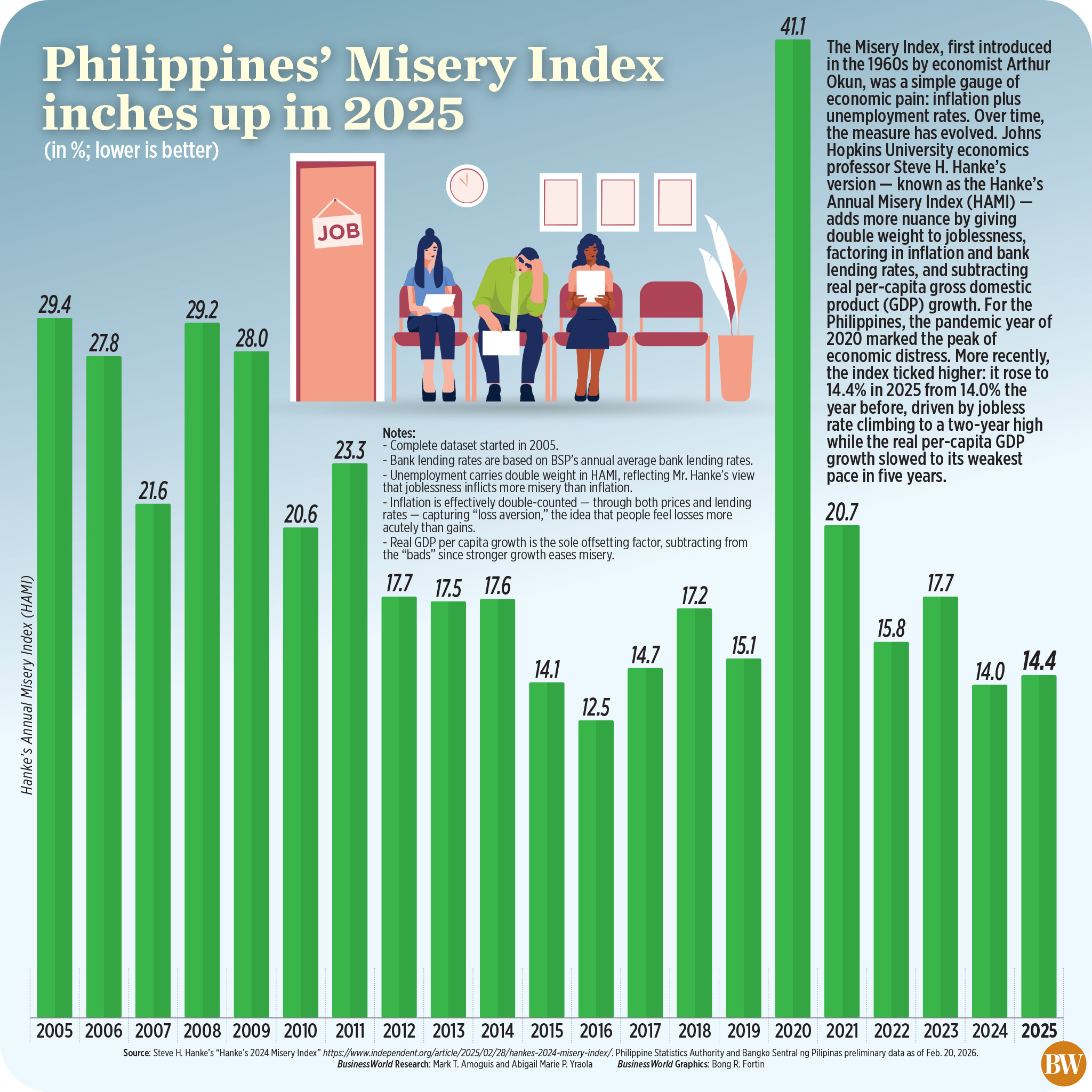
The Misery Index, first introduced in the 1960s by economist Arthur Okun, was a simple gauge of economic pain: inflation plus unemployment rates. Over time, the measure has evolved. Johns Hopkins University economics professor Steve H. Hanke’s version — known as the Hanke’s Annual Misery Index (HAMI) — adds more nuance by giving double weight to joblessness, factoring in inflation and bank lending rates, and subtracting real per-capita gross domestic product (GDP) growth. For the Philippines, the pandemic year of 2020 marked the peak of economic distress. More recently, the index ticked higher: it rose to 14.4% in 2025 from 14.0% the year before, driven by jobless rate climbing to a two-year high while the real per-capita GDP growth slowed to its weakest pace in five years.

Shaping a human-centric future for AI

STOCK PHOTO | Image by DC Studio from Freepik

By Narendra Modi

AT A DEFINING MOMENT in human history, the world gathered at the AI Impact Summit 2026 in New Delhi. For us in India, it was a moment of immense pride and joy to welcome Heads of State, Heads of Government, delegates and innovators from across the world.

India brings scale and energy to everything it does and this Summit was no exception. Representatives from over 100 nations came together. Innovators showcased cutting-edge AI products and services. Thousands of young people could be seen in the exhibition halls, asking questions and imagining possibilities. Their curiosity made this the largest and most democratized AI summit in the world. I see this as an important moment in India’s development journey, because a mass movement for AI innovation and adoption has truly taken off.

Human history has witnessed many technological shifts that changed the course of civilization. Artificial Intelligence belongs in the same league as fire, writing, electricity, and the internet. But with AI, changes that once took decades can unfold within weeks and impact the entire planet.

AI is making machines intelligent, but it is even more a force multiplier for human intent. Making AI human-centric instead of machine-centric is vital. At this Summit, we placed human well-being at the heart of the global AI conversation, with the principle of “Sarvajana Hitaya, Sarvajana Sukhaya” (Welfare for All, Happiness of All).

I have always believed that technology must serve people, not the other way around. Whether it is digital payments through UPI or COVID vaccination, we have ensured that Digital Public Infrastructure reaches everyone, leaving none behind. I could see the same spirit in the Summit, in the work of our innovators in domains like agriculture, security, assistance for Divyangjan, and tools for multilingual populations.

There are already examples of the empowering potential of AI in India. Recently, “Sarlaben,” an AI powered digital assistant launched by Indian dairy cooperative AMUL, is providing real-time guidance to 3.6 million dairy farmers, mostly women, about cattle health and productivity in their own language. Similarly, an AI-based platform called Bharat VISTAAR gives multilingual inputs to farmers, empowering them with information about everything from weather to market prices.

Humans must never become mere data points or raw material for machines. Instead, AI must become a tool for global good, opening new doors of progress for the Global South. To translate this vision into action, India presented the MANAV framework for human-centric AI governance.

M – Moral and Ethical Systems: AI should be based on ethical guidelines.

A – Accountable Governance: Transparent rules and robust oversight.

N – National Sovereignty: Respect for national rights over data.

A – Accessible and Inclusive: AI should not be a monopoly.

V – Valid and Legitimate: AI must adhere to laws and be verifiable.

MANAV, which means “human,” offers principles that anchor AI in human values in the 21st century.

Trust is the foundation upon which AI’s future rests. As generative systems flood the world with content, democratic societies face risks from deepfakes and disinformation. Just as food carries nutrition labels, digital content must carry authenticity labels. I urge the global community to come together to create shared standards for watermarking and source verification. India has already taken a step in this direction by legally requiring clear labeling of synthetically generated content.

The welfare of our children is a matter close to our hearts. AI systems must be built with safeguards that encourage responsible, family-guided engagement, reflecting the same care we bring to education systems worldwide.

Technology yields its greatest benefit when shared, rather than guarded as a strategic asset. Open platforms can help millions of youth contribute to making technology safer and more human-centric. This collective intelligence is humanity’s greatest strength. AI must evolve as a global common good.

We are entering an era where humans and intelligent systems will co-create, co-work, and co-evolve. Entirely new professions will emerge. When the internet began, no one could imagine the possibilities. It ended up creating a huge number of new opportunities and so will AI.

I am confident that our empowered youth will be the true drivers of the AI age. We are encouraging skilling, reskilling and lifelong learning by running some of the largest and most diverse skilling programs in the world.

India is home to one of the world’s largest youth populations and technology talent. With our energy capacity and policy clarity, we are uniquely positioned to harness AI’s full potential. At this Summit, I was proud to see Indian companies launch indigenous AI models and applications, reflecting the technological depth of our young innovation community.

To fuel the growth of our AI ecosystem, we are building a robust infrastructure foundation. Under the India AI Mission, we have deployed thousands of GPUs and are set to deploy more soon. By accessing world-class computing power at highly affordable rates, even the smallest startups can become global players. Further, we have established a national AI Repository, democratizing access to datasets and AI models. From semiconductors and data infrastructure to vibrant startups and applied research, we are focusing on the complete value chain.

India’s diversity, democracy, and demographic dynamism provide the right atmosphere for inclusive innovation. Solutions that succeed in India can serve humanity everywhere. That is why our invitation to the world is: Design and develop in India. Deliver to the world. Deliver to humanity.


Narendra Modi is the prime minister of India.

Pampanga startup transforms deadstock into reusable pads

FACEBOOK.COM/AMIGASDEGAIA

By Almira Louise S. Martinez, Reporter

A PAMPANGA-BASED startup is turning to excess textiles to address one of the country’s most persistent waste problems: disposable menstrual pads.

Ecopad Gaia produces reusable sanitary pads made from deadstock fabrics sourced in Taytay, Rizal, aiming to curb plastic waste and offer an alternative for women with sensitive skin.

“A woman, from the beginning of her period until the end of her period, when she’s about to menopause, uses around 11,000 to 12,000 pads,” founder Adeline P. Bondoc said in an interview. “Imagine, each woman uses 11,000 to 12,000 pads that take 500 to 800 years to decompose in landfills, in our waterways.”

Most commercial pads are composed largely of plastic, which Ms. Bondoc said could break down into microplastics that contaminate the environment.

“When it becomes microplastic, it could be in our airways, we could drink it, we could swallow it, and we could eat it,” she said. “It’s a problem that can be passed on to the next generation if we don’t do something today.”

In 2025, Greenpeace Philippines said Filipino scientists had confirmed the presence of microplastics in water, air and soil across the country, warning that contamination threatens food security.

The World Bank estimated in 2021 that the Philippines generates about 2.7 million tons of plastic waste each year, with roughly 20% ending up in the ocean.

Founded in 2021, Ecopad Gaia was born out of Ms. Bondoc’s personal experience with rashes from disposable pads. She said many women, including those with polycystic ovary syndrome, suffer irritation but do not speak up.

The company offers five types of cloth pads: a seven-inch pantyliner for daily use, a nine-inch pantyliner for spotting and menstrual cup users, a 10-inch pad for light flow, and 11-inch and 12-inch pads for heavier flow.

Pantyliners and light-flow pads are made from woven cotton lined with water-resistant fabric. Heavy-flow variants use cotton velour with Wind Pro fabric, commonly used in winter jackets overseas.

Users are advised to change pads every three to four hours. “If it’s full, it will come out on the sides, so before it’s full, change to avoid bacterial growth,” Ms. Bondoc said.

Each pad can last up to three years with proper care. After use, it can be soaked to remove stains and washed with regular laundry.

Since launch, the company has sold about 40,000 pads through partnerships with nongovernmental organizations (NGO) and e-commerce platforms.

This year, it aims to produce 36,000 pads through NGO and corporate social responsibility partnerships in Pampanga, as it shifts focus from retail to institutional buyers.

RCBC’s 2025 net profit rises 11% to P10.6 billion

RCBC/BW FILE PHOTO

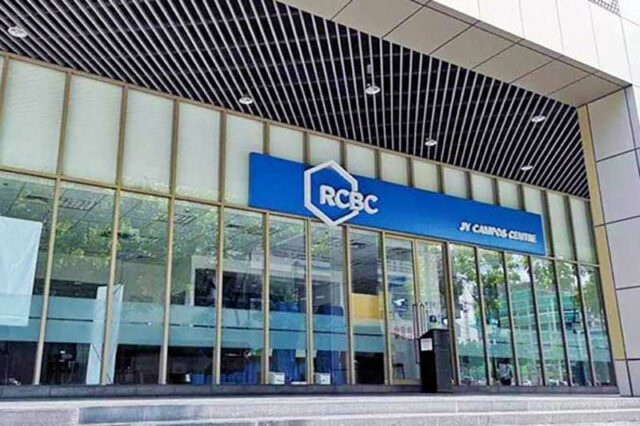
RIZAL COMMERCIAL Banking Corp. (RCBC) recorded an 11% increase in its net income last year to P10.6 billion as its core businesses continued to grow.

This translated to a 62-basis-point (bp) increase in return on equity to 6.65%, while return on assets rose by 6 bps to 0.81%, the bank said in a disclosure to the stock exchange on Tuesday.

Its financial statement was unavailable as of press time.

RCBC’s net interest income surged by 32% year on year, supported by a more diverse funding base that helped bring down costs.

It also saw better yields on earning assets as its consumer loan book grew by 29%.

Gross customer loans grew by 7% in 2025, with consumer loans now making up 49% of its portfolio as credit card receivables increased by 32% year on year.

“This growth was fueled by the successful acquisition of affluent customers, resulting in an 18% increase in issued cards. The sustained double-digit receivables growth was achieved through the strategic use of data analytics to deepen cardholder engagement and loyalty,” RCBC said.

Its net interest margin was at 4.77%, up by 89 bps from the previous year.

Meanwhile, RCBC’s service fee income rose by 25% last year, also partly driven by its focus on the consumer segment.

On the funding side, total deposits stood at P1 trillion, 52% of which were low-cost current account, savings account or CASA deposits.

Total assets were at P1.4 trillion at end-2025.

“We will continue to innovate and listen, ensuring that RCBC remains your most reliable partner in this rapidly changing world as a digital and CX (customer experience)-first bank,” RCBC President and Chief Executive Officer Reginaldo Anthony B. Cariaso said.

The bank now has 453 branches and 1,514 automated teller machines (ATM) nationwide, as well as 4,937 ATM Go or mobile ATM terminals.

RCBC’s shares closed unchanged at P25 each on Tuesday. — A.M.C. Sy

Lepanto secures majority ‘yes’ vote in Mankayan ancestral domain

Mankayan, Benguet — LEPANTOMINING.COM

LEPANTO CONSOLIDATED Mining Co. said it has received a “yes” vote from the majority of barangays within the Mankayan ancestral domain in Benguet during the consensus-building phase of the Free and Prior Informed Consent (FPIC) process.

In a disclosure on Tuesday, the listed miner said the FPIC process is a requirement for the renewal of Mineral Production Sharing Agreement (MPSA) No. 001-90-CAR granted to the company and its subsidiary, Far Southeast Gold Resources, Inc. (FSGRI).

The 948.47-hectare MPSA, one of two production sharing agreements held by Lepanto in Mankayan, covers portions of the ancestral domain of the indigenous community in the area.

The disclosure follows a 2022 ruling by the Supreme Court of the Philippines that set aside a Court of Appeals decision allowing the mining firms to continue operations in the area.

In the decision, the High Court voided an arbitral award previously issued in favor of Lepanto and FSGRI, ruling that mining operations could not proceed without compliance with the FPIC requirement of the indigenous community in Mankayan.

Under the Indigenous Peoples’ Rights Act of 1997, government agencies are barred from renewing any licenses or production-sharing agreements without prior certification from the National Commission on Indigenous Peoples.

Lepanto’s MPSA with the government, through the Department of Environment and Natural Resources, was originally entered into in 1990 for a 25-year term, with a provision for renewal for another 25 years upon mutual agreement.

Lepanto has business interests in the exploration and extraction of gold, silver, copper, lead, zinc, and various ores, metals, minerals, oil, gas, and coal, as well as their related by-products. — Vonn Andrei E. Villamiel

Paramount submits higher offer for Warner Bros. Discovery in bid to block Netflix, source says

PARAMOUNT SKYDANCE submitted a higher offer for Warner Bros. Discovery (WBD), a source familiar with the matter told Reuters on Monday, ratcheting up efforts to derail the HBO Max owner’s deal with Netflix.

The bidding war for one of Hollywood’s most coveted assets, including the Harry Potter and Game of Thrones franchises, has raised the stakes for dominance in the streaming-led market.

Paramount’s new bid — which improves its initial offer of $108.4 billion, or $30 per share, for the whole company — seeks to address Warner Bros. concerns about the certainty of its financing, the source said.

Reuters could not immediately determine how the bid was revised. Warner Bros. and Paramount declined to comment, while Netflix could not immediately be reached.

Warner Bros.’ chosen suitor Netflix, which offered to buy the studios and streaming assets for $27.75 per share in cash, or $82.7 billion, is allowed to match the latest bid from David Ellison-led Paramount.

Netflix has ample cash and could bump up its offer for HBO Max owner, while Paramount’s rival bid is backed by Oracle billionaire Larry Ellison.

The CBS parent was asked to submit its “best and final offer” after Warner Bros. rejected an enhanced bid that included paying the $2.8 billion in termination fee to Netflix and adding a 25-cent per share quarterly “ticking fee” from next year to compensate Warner Bros. shareholders for any delay in deal closure.

Warner Bros. had said Paramount’s Feb. 10 offer still falls short of what its board would consider a superior proposal and gave a seven-day deadline until Feb. 23 to submit a revised offer.

MoffettNathanson analysts had earlier said that an offer in the range of $34 per share from Paramount would end the bidding war and “avoid further debate over Discovery Global’s value.”

Warner Bros. plans to spin off its cable TV assets, such as CNN and HGTV, into Discovery Global, which could fetch between $1.33 and $6.86 a share, according to Warner Bros. estimates.

Netflix said its offer gives Warner Bros. shareholders added upside from the Discovery Global spinoff, which WBD argues will add value by giving the new company greater strategic, operational, and financial flexibility.

However, Paramount has said the cable spinoff central to the streaming giant’s offer is effectively worthless.

The David Zaslav-led Warner Bros. came under pressure from Ancora Capital after the activist investor built a roughly $200 million stake in the HBO owner and accused the company of failing to adequately engage with Paramount.

The investor warned if Warner Bros. refuses to re-enter discussions with Paramount, it will vote against the Netflix deal and hold the company’s board accountable during its annual meeting.

Shares of Paramount rose 1.3% to $10.70 in extended trading.

REGULATORY SCRUTINY
Warner Bros. shareholders were set to decide the fate of Netflix’s offer on March 20, with the vote expected to be a pivotal moment in the high-stakes bidding war to seal the future of one of Hollywood’s most iconic movie studios.

A green light from investors would move the deal forward, but it would still face intense scrutiny from US and European competition authorities, who must assess whether combining Netflix’s global streaming power with Warner Bros.’ century-old studio assets would reduce competition or limit consumer choice.

A bipartisan array of lawmakers have raised concerns about the potential harm to consumers and creatives.

Paramount said it has already secured foreign-investment clearance in Germany and is in talks with antitrust regulators in the US, the European Union, and the UK. Paramount has repeatedly argued it has a clearer path to regulatory approval than Netflix.

Paramount’s bid will create a studio bigger than market leader Disney and fuse two major TV operators, which some Democratic senators say will control “almost everything Americans watch on TV.”

It will also hand control of CNN to the conservative-leaning Ellisons, soon after they acquired CBS News and installed Bari Weiss as its editor-in-chief.

For Netflix, a combination with HBO Max would make it the biggest global streaming player, with roughly half a billion subscribers.

Netflix co-CEO Ted Sarandos has voiced confidence in winning approval, saying the company’s bid would be better for Hollywood as it would avoid job cuts in an industry already hit by fewer productions and uneven box-office returns.

The streaming pioneer said during deal talks the potential combination of its streaming service with HBO Max would benefit consumers by lowering the cost of a bundled offering.

But its argument that it needs Warner Bros. to compete with YouTube, America’s most-watched TV distributor, is likely to face pushback from the Department of Justice.

As part of its regulatory review, the US Department of Justice is examining whether Netflix engaged in anti-competitive practice.

Netflix has pointed to statistics by media analysis firm Nielsen that say Google’s YouTube accounts for more viewing time on US televisions than other streaming services. — Reuters

Philippine agency named Global PR and Communications Agency of the Year

PAGEONE has made history for the Philippines after being named Global PR and Communications Agency of the Year at the World Public Relations and Communication Awards 2025, a landmark recognition that signals the growing influence of Filipino communication professionals on the global stage.

The award, conferred by the Global Alliance for Public Relations and Communication Management, represents one of the highest distinctions in the global communication profession. The 2025 awards drew 89 entries from 19 countries, evaluated by an international panel of industry leaders, academics, and communication experts, reflecting the scale and competitiveness of the recognition. The Global Alliance for Public Relations and Communication Management is the worldwide confederation of leading PR and communication associations, representing over 360,000 practitioners and academics globally.

Adding to the significance of the win, PAGEONE is the first-ever recipient of the Global PR and Communications Agency of the Year recognition, making the milestone particularly meaningful as it is achieved by a Philippine agency.

PAGEONE’s campaign #BusogLusog100: Empowering Homemakers also earned global recognition as Winner in the Public Service Relations Campaign category and was likewise named Winner in Digital and Social Media, highlighting the agency’s ability to deliver both strong social impact and digital communication excellence.

For PAGEONE, the global recognition arrives at a defining moment as the agency celebrates its 10th anniversary.

“This recognition is deeply meaningful because it comes from the global community of professionals who understand the strategic role of communication in shaping organizations, societies, and public trust,” said Dr. Ron F. Jabal, APR, chairman and president of PAGEONE Group. “As we celebrate our tenth year, this achievement affirms that Filipino talent, when guided by strategy, discipline, and purpose, can stand shoulder to shoulder with the best in the world.”

The World Public Relations and Communication Awards recognize agencies and campaigns that demonstrate innovation, measurable outcomes, and meaningful impact. According to the Global Alliance, this year’s submissions reflected the diversity and strength of the global PR profession, showcasing work that advances communication as a strategic and trust- building discipline.

Vonj Tingson, president and chief operating officer of PAGEONE Group, said the recognition reflects the collective effort behind the agency’s growth over the past decade.

“Recognition at this level validates the professionalism, resilience, and creativity of our teams,” Mr. Tingson said. “Receiving this honor during our tenth anniversary makes it even more meaningful because it reflects a decade of disciplined execution and collaboration. The success of #BusogLusog100 demonstrates how strategic communication can deliver real social impact, and this win belongs to our teams, our clients, and the broader Philippine communication community.”

Founded in the Philippines and built on the belief that communication creates long-term reputational value, PAGEONE has grown into a strategic communications and reputation management agency known for integrating storytelling, analytics, and stakeholder engagement into high-impact programs. Over the past decade, the agency has contributed to raising the standards of communication practice in the Philippines while engaging in global conversations on trust and reputation.

The official presentation of trophies to the winners will take place during the World Public Relations Forum 2026, scheduled from Nov. 15-21 in Abuja, Nigeria, where communication leaders from around the world will gather to discuss the future of the profession.

As PAGEONE enters its second decade, the recognition stands as both a celebration of organizational achievement and a proud moment for the Philippines, demonstrating that Filipino agencies are increasingly shaping the global communications landscape.


Spotlight is BusinessWorld’s sponsored section that allows advertisers to amplify their brand and connect with BusinessWorld’s audience by publishing their stories on the BusinessWorld Web site. For more information, send an email to online@bworldonline.com.

Join us on Viber at https://bit.ly/3hv6bLA to get more updates and subscribe to BusinessWorld’s titles and get exclusive content through www.bworld-x.com.

ADVERTISEMENT
ADVERTISEMENT