Home Blog Page 247

Automated Initiation, Single-Instance and Standardized BIR audit framework

STOCK PHOTO | Image by Snowing from Freepik

The National Internal Revenue Code, as amended, empowers the Commissioner of Internal Revenue (CIR) to make assessments and prescribe additional requirements for tax administration and enforcement. The CIR, or his duly authorized representative, may authorize the examination of any taxpayer and the assessment of the correct amount of tax. Pursuant to this power, the CIR issued Revenue Memorandum Order No. 001-2026 (RMO) on Jan. 27 this year.

Automated Initiation. To ensure objectivity and integrity in the initiation of audits, the RMO provides that the issuance of Electronic Letters of Authority (eLOA) shall be governed by system-assisted taxpayer selection. While all taxpayers are generally considered potential subjects of an audit and assessment, the CIR has ordered that the initiation of audits shall be limited to taxpayers selected through the prescribed automated system-assisted process.

The selection criteria include, among others, taxpayers: with under declaration of sales/income or overstatement of expenses, or deductions by at least 30%; with intelligence information such as specific business knowledge, third party data and publicly available information; covered by Mission Orders with preliminary indicator that the taxpayer had an understatement of sales by 30% or more, those who underwent One-Time Transactions which resulted in deficiency taxes; and those enjoying tax exemptions/incentives. The RMO however provides that a more comprehensive procedure for taxpayer selection, case assignment, and eLOA issuance shall be implemented on or before April 16.

The RMO requires that the system-generated audit list should be submitted to the CIR and provides that only taxpayers included in the approved audit list may be issued new eLOAs. The RMO adds that recommendations may be made by the relevant Revenue Offices, provided that there is written justification. All endorsed recommendations shall be incorporated into the system-assisted process, subject to validation against the approved audit selection criteria and subject to approval by the CIR. Pending full automation, the Bureau of Internal Revenue (BIR) shall implement an Anonymized Selection and Assignment Process. This process ensures that taxpayer identity remains concealed during initial assignment, thereby separating taxpayer selection from Revenue Officer designation.

Single-Instance Audit Framework. Prior to the RMO, a separate Value-Added Tax (VAT) Audit could be initiated covering a taxable year that is subject to a regular audit. The Single-Instance Audit Framework introduced in the RMO is the CIR’s new policy which instructs that only one eLOA for a given taxable year, covering all applicable internal revenue tax types, including VAT, can be issued. The framework is intended to prevent overlapping or fragmented audits. The issuance of multiple or overlapping eLOAs covering the same taxpayer and taxable year is prohibited. However, the RMO provides that in fraud cases, one eLOA may cover several years.

Beginning on March 4, all pending eLOAs covering the same taxpayer and taxable year shall be automatically consolidated into one eLOA, without any action required from the taxpayer, except where a request for non-consolidation is allowed. To ensure alignment with the Single-Instance Audit Framework and to facilitate an orderly transition to the Audit Program for 2026, the VAT Audit Sections shall wind up operations by May 15.

The RMO allows a taxpayer with multiple pending eLOAs covering the same taxable year to file a written Request for Non-Consolidation allowing such audits to proceed separately. The option not to consolidate shall be upheld and respected by the BIR. Where the request for non-consolidation is received, the affected eLOAs shall be allowed to proceed independently, and the Revenue Officers shall continue their respective audit actions until April 30. After that date, however, or beginning May 4, all pending eLOAs, regardless of stage, shall be automatically consolidated. But even prior to the automatic consolidation, the RMO states that a taxpayer should not be precluded from voluntarily settling assessed or admitted tax deficiencies.

Standardized Checklist and Audit Process. Taxpayers have raised concerns on unreasonable assessments due to the violation of their right to due process. The RMO thus reminds that “[t]he conduct of audits and the issuance of assessments shall strictly observe due process, audit safeguards, and proper documentation.” All audit activities shall be undertaken in a manner that is fair, transparent, and supported by complete and verifiable records.

In order to promote this process, the CIR has imposed a mandatory standardized checklist of documents which shall serve as the uniform reference for identifying, requesting, receiving, and evaluating documents necessary for audit, verification, or other authorized compliance activities. The checklist shall be applied consistently across all offices and audit cases. The RMO, however, recognizes that the supporting documents may vary depending on the industry of the taxpayer. As such, industry-specific checklists shall also be issued by the BIR.

The RMO provides that Revenue Officers shall not issue unreasonable assessments. A Notice of Discrepancy (NOD), should clearly and specifically set out the details of the discrepancies in order to ensure that the taxpayer is sufficiently informed and is given a reasonable opportunity to explain, submit supporting documents, and contest the findings during the Discussion of Discrepancy. The NOD shall clearly state that it is not yet an assessment, but merely reflects discrepancies initially determined by the Revenue Officers. Minutes of meetings or discussions shall be prepared for the Discussion on Discrepancy. Such minutes shall be duly signed by the taxpayer or authorized representative and the Revenue Officers, with any refusal to sign clearly noted. All other meetings or discussions with the taxpayer shall be coursed through official communication channels of the Revenue Officers, such as their official e-mail address or official office contact numbers.

Examination and inspection of books of accounts and other accounting records shall be conducted in the taxpayer’s office or registered place of business, or in the appropriate BIR office. However, where the records required for audit are voluminous in nature, such that transporting, handling, or reviewing them at the BIR office would be impractical, burdensome, or disruptive to normal business operations, the taxpayer shall be given reasonable options on the manner and venue of examination, without causing undue disruption to business operations. Where records are physically submitted to the BIR, the taxpayer may submit photocopies, provided that such copies are certified by the taxpayer or its authorized representative as true and faithful reproductions of the original documents. The BIR may require the presentation of original documents for verification purposes.

Finally, the RMO reminds that due process must be observed, the factual and legal bases should be clearly stated, and the subsequent assessment notices should only reflect issues which remain unresolved. However, this requirement is nothing novel. In fact, this is consistent with the minimum audit procedures provided in existing revenue audit issuances of the BIR.

This automated, simplified, centralized, and standardized process for audits provided in the RMO provides a clear and transparent framework which will guide the BIR in tax administration and enforcement. The RMO mandates the observance of due process, and promotes responsibility and accountability in tax administration. This also provides guidance and safeguards to taxpayers to encourage and promote tax compliance.

The views and opinions expressed in this article are those of the author. This article is for general information and educational purposes, and not offered as, and does not constitute, legal advice or legal opinion.


Fatima Faye E. Cordova-De Lima is a senior associate of the Tax department of the Angara Abello Concepcion Regala Cruz Law Offices.

(02) 8830-8000

fecordova@accralaw.com

Original Biscocho Haus eyes Visayas expansion

BISCOCHOHAUS.COM

JARO, ILOILO CITY — Iloilo-based Original Biscocho Haus, a longstanding name in the region’s pasalubong (souvenir) market, is stepping up its expansion in Western Visayas, building on almost five decades of local brand recognition.

Founded in 1975 in the home of Teresa J. Guadarrama in Jaro, Iloilo, the bakery began as a family venture to support the education of the Guadarrama children.

Using day-old bread, butter, sugar and home kitchen tools, the business gradually grew from a sideline into a regional brand.

“Biscocho Haus is a product of my mother’s entrepreneurial spirit,” Jose Gerardo “Gerry” J. Guadarrama, the 67-year-old managing director and one of the owners, said in an interview at the family’s ancestral home in Jaro district last month. “She was always into something. She had sidelines all over the place.”

Today, Original Biscocho Haus operates 25 branches and kiosks across Western Visayas. The company, incorporated in 2003 as  Original Biscocho Haus Corp., is adding three more locations in Metropolitan Iloilo, including sites at terminal and central markets, and is building a branch in another district.

Expansion into Antique province is also planned, broadening its reach in the region.

Mr. Guadarrama, the sixth of eight children, said the company is deliberately keeping its focus local. Unlike other provincial brands, Original Biscocho Haus does not plan to enter Metro Manila, aiming instead to preserve its identity as a “pasalubong center.”

“If our products are available at supermarkets or stands [in Manila], would you still come here?” he asked. “We don’t want to become a commodity.”

The brand’s signature product, Bischoco — day-old bread toasted with butter and sugar — remains the top seller.

Daily production reaches about 36,000 pieces, or about 2,000 packs. Original Biscocho Haus maintains the original recipe, avoiding cheaper substitutes to preserve flavor.

The company has combined traditional methods with efficiency improvements to maintain what Mr. Guadarrama calls “upper-class quality for pedestrian pricing,” a strategy credited to his engineering and accounting background.

Original Biscocho Haus has also embraced digital trends, rolling out credit card payments and online delivery services to meet evolving consumer behavior.

The strategy appears to be paying off. In 2025, the company posted annual sales growth of as much as 10%.

With further expansion in key regional markets, Original Biscocho Haus aims to strengthen its dominance in Western Visayas while keeping the brand rooted in its homegrown identity. — Edg Adrian A. Eva

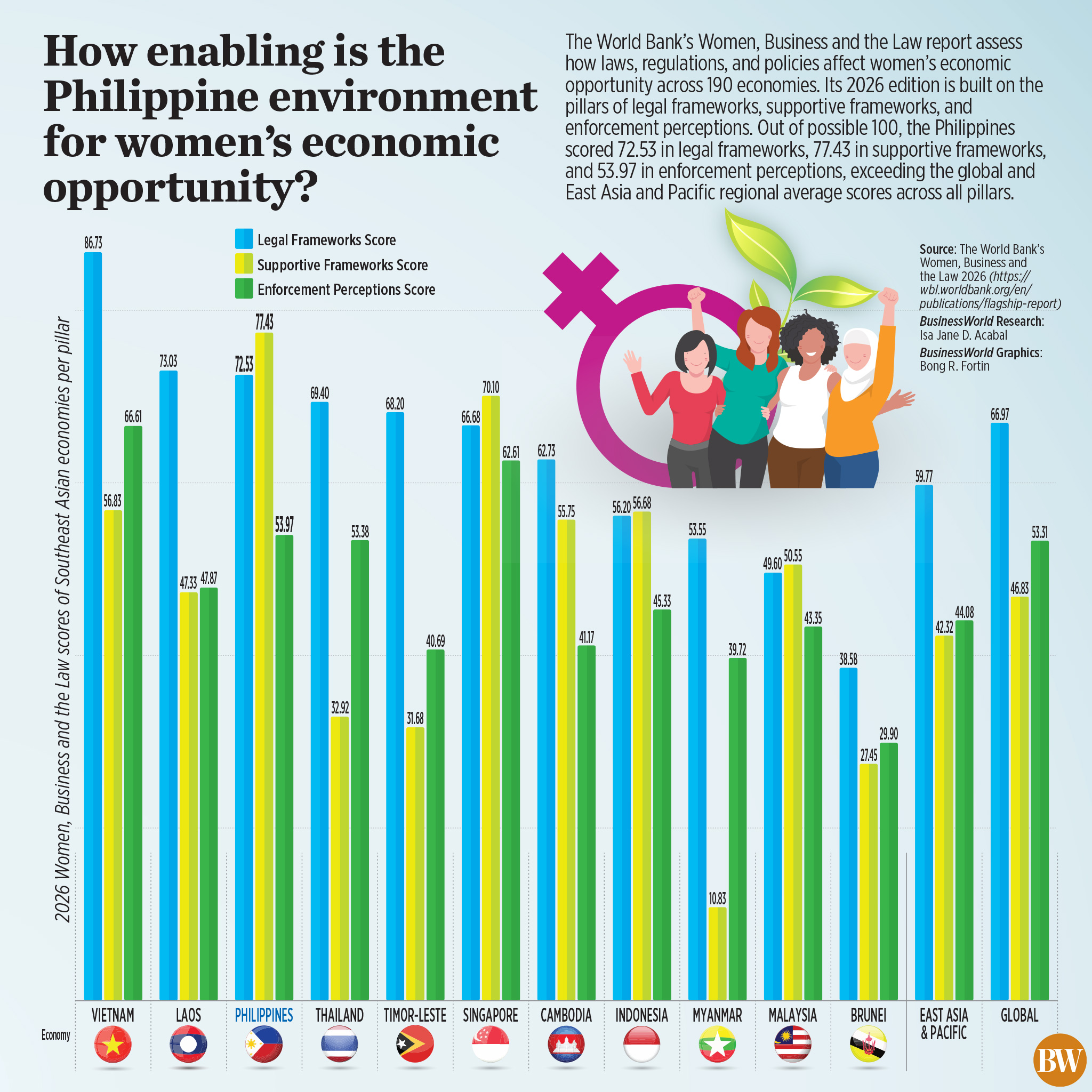
How enabling is the Philippine environment for women’s economic opportunity?

THE PHILIPPINES improved in two of the three pillars in the World Bank’s Women, Business, and the Law (WBL) 2026 report, with scores surpassing the global and East Asia and Pacific averages. Read the full story.

GSIS looks to improve its lending programs

THE GOVERNMENT Service Insurance System (GSIS) plans to make its lending programs more competitive versus those offered by private creditors as it looks to boost its investment income.

“At GSIS, 20% of our investments are in loans. What we want is to double this to 40%,” GSIS President and General Manager Jose Arnulfo “Wick” A. Veloso told reporters last Thursday.

“So, we will have enhancements. I cannot share these yet but to give you an idea, we have to be competitive. And to be competitive, we must be able to differentiate ourselves and compete with the private lending institutions.”

The state pension fund is also awaiting the finalization of the Philippine Stock Exchange’s (PSE) stock investment loan framework, Mr. Veloso said.

The PSE is pushing for the revival of stock investment loan programs (SILP) by state pension funds to inject more liquidity into the stock market.

PSE President Ramon S. Monzon earlier said that restructuring these programs to fund long-term equity investments by linking to a voluntary retirement savings program under the  Personal Equity and Retirement Account (PERA) law could be more feasible for pension funds and its members.

GSIS earlier said it is proposing a phased study and pilot approach that will validate the systems, measure members’ understanding of the program, and assess feasibility before broader rollout.

Mr. Veloso said last week that he wants a clear indicator of borrowers’ level of understanding of how the stock market works to gauge their suitability for the program, as well as their risk tolerance.

“We are always open for business. But when we are open for business, that means that we have to make sure that we have the right parameters to ensure that there’s ample customer protection,” he said.

GSIS’ net income from operations stood at P137.74 billion in 2025.

Total income rose by 6.4% year on year to P344.47 billion, driven by insurance revenues and investment returns.

“Social insurance income accounted for the bulk of revenues at P212.17 billion,” it said in a statement on Tuesday. “General insurance posted total premium income of P11.39 billion, up P1.11 billion or 10.8% from 2024, on higher new and renewal policy issuances.”

“Investment income from financial assets totaled P76.55 billion, strengthening the fund’s capacity to meet long-term pension obligations.”

GSIS’ total assets rose by 8.2% year on year to P1.96 trillion at end-2025.

“In 2025, we paid out more in benefits than the year before while growing our assets by over P148 billion,” Mr. Veloso said in the statement.

He said their financial results in 2025 showed “disciplined fund management.”

“Every peso in this fund belongs to a government worker who expects it to be there when they retire or when their family needs it.” — Aaron Michael C. Sy

SM Prime eyes June debut for Cebu’s new arena

PHILSTAR FILE PHOTO/FREEMAN

SM PRIME HOLDINGS, INC. plans to open the SM Seaside Cebu Arena in June, marking Cebu province’s first purpose-built indoor multipurpose arena and its largest to date.

Located within the company’s South Coast City development in Cebu, the arena will occupy a building footprint of more than 1.6 hectares and form part of a development with about 7.4 hectares of total gross floor area.

“By building a venue of this scale in Cebu, we are strengthening the Visayas as a destination for international events, domestic tourism and long-term investment,” SM Prime President Jeffrey C. Lim said in a statement on Tuesday.

The SM Seaside Cebu Arena is designed to accommodate more than 25,000 guests and will feature multi-level seating, professional-grade sports and entertainment facilities, corporate suites, VIP lounges, food and beverage outlets, and lifestyle amenities.

A SkyBridge will directly connect the arena to SMX Convention Center Cebu and SM Seaside City Cebu to improve accessibility and pedestrian flow.

SM Seaside Cebu Arena is currently in discussions with concert promoters, sports federations, family entertainment producers, and corporate event organizers to secure bookings ahead of its opening.

“There is a lot of excitement and anticipation for this project because Cebuanos have long supported live concerts, and having a large-capacity venue in Cebu makes these events more accessible without the added cost of traveling to Manila,” Mr. Lim said.

The SM Seaside Cebu Arena builds on SM Prime’s experience with the SM Mall of Asia (MOA) Arena in Metro Manila, which opened in 2012 with Lady Gaga’s two-night Born This Way Ball concert.

Since then, the MOA Arena has hosted major sporting events such as the NBA Global Games, the FIBA Basketball World Cup, and the FIVB Men’s Volleyball World Championships, as well as concerts by artists including Ariana Grande, BLACKPINK, BTS, Celine Dion, and Taylor Swift.

Shares in SM Prime rose 2.1% to P21.85 apiece on Tuesday. — Alexandria Grace C. Magno

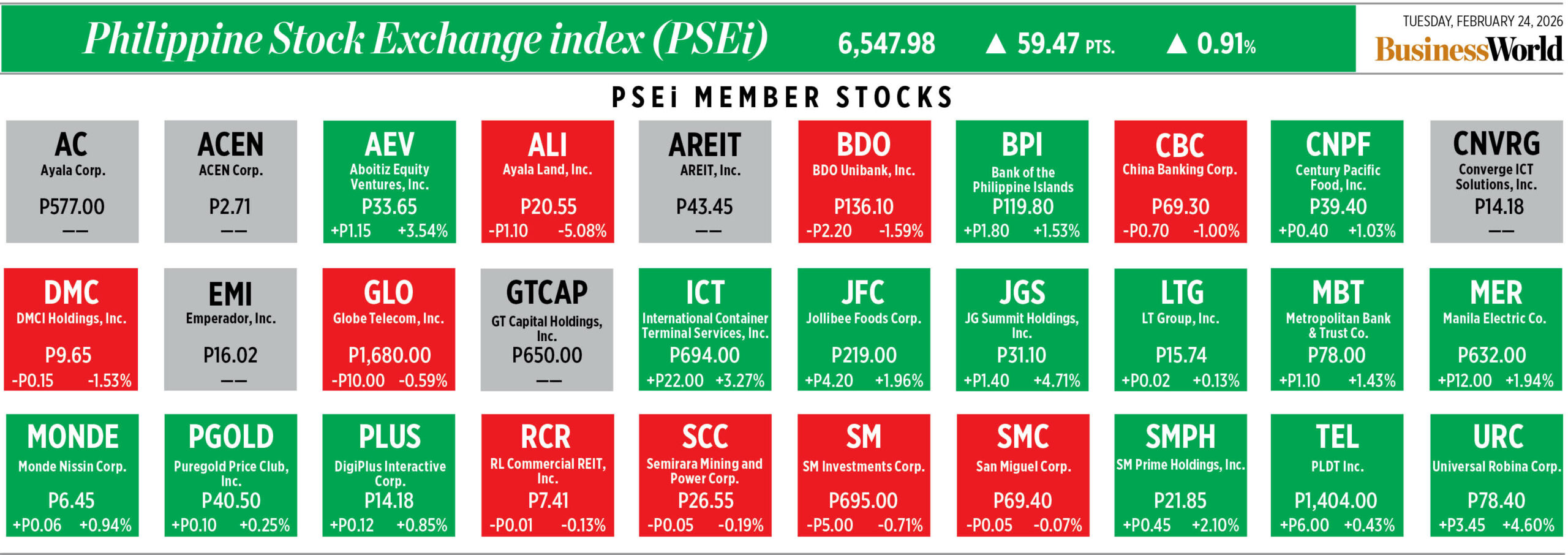
How PSEi member stocks performed — February 24, 2026

Here’s a quick glance at how PSEi stocks fared on Tuesday, February 24, 2026.


WB Women, Business, and the Law report finds PHL improvements in two of three categories

STOCK PHOTO | Image by Katemangostar from Freepik

THE PHILIPPINES improved in two of the three pillars in the World Bank’s Women, Business, and the Law (WBL) 2026 report, with scores surpassing the global and East Asia and Pacific averages.

The report, released on Tuesday, measures how laws, policies, and practices shape women’s economic opportunities. It studied 190 economies’ performance in three indices: legal frameworks, supportive frameworks, and enforcement perceptions.

In the 2025 report, the Philippines scored 72.53 in legal frameworks, 77.43 in supportive frameworks, and 53.97 in enforcement perceptions.

Compared to 2024, the Philippines scored higher in both legal frameworks and supportive frameworks, from 70 and 54.2 points, respectively. Its score fell in enforcement perceptions from 58.8 two years ago.

“In the Philippines, the legal frameworks score is 73, the supportive frameworks score is 77, and the enforcement perceptions score is 54, showing that gaps still persist between law and practice,” the World Bank said.

Nevertheless, the Philippines’ performance outperformed global and the East Asia and Pacific averages across all pillars and topics, except for mobility, marriage, and childcare.

The report covered 10 topics — safety, mobility, work, pay, marriage, parenthood, childcare, entrepreneurship, assets, and pension.

“On paper, most countries are doing reasonably well: the average country scores 67 out of 100 on the adequacy of laws to enable economic equality between women and men,” said Indermit Gill, World Bank chief economist and senior vice-president for development economics.

“But when it comes to enforcing the laws, the average score drops to 53. And when the systems needed to implement those rights are assessed, the adequacy score is just 47,” he added.

He said lower averages in law enforcement and implementation “reflect huge opportunity gaps.”

On the WBL 1.0 index, the Philippines scored 81.9 in 2026, higher than 78.8 in 2024. It measures 35 data points across 8 indicators.

This score is middle-of-the-road in Southeast Asia, exceeded by Vietnam (88.1), Timor Leste (86.3), Cambodia (84.4), Singapore (82.5), and Laos (82.5) but better than Thailand (78.1), Indonesia (70.6), Myanmar (61.9), Malaysia (60.06), and Brunei (53.1).

The report also found that the Philippines was the only economy to have enacted reform toward legal gender equality on the topic of mobility, via the Philippine Passport Act.

“The Philippine Passport Act allows married women to choose whether to adopt their husband’s surname, removing the blanket requirement for all married women to present a marriage certificate,” the World Bank said.

In total, the report tallied 68 economies that have implemented reforms toward legal gender equality from 2023 to 2025.

“Over the past two years, 68 economies enacted 113 positive legal reforms across most areas of women’s economic life, with the greatest progress in entrepreneurship and safety from violence,” the World Bank said.

“Seven countries also expanded paternity leave to help redistribute caregiving and support women’s employment,” it added.

Women, Business, and the Law assesses the global state of women’s economic participation across 10 key areas, including safety from violence, access to childcare, entrepreneurship, employment protections, asset ownership, and retirement security.

Norman Loayza, director of the World Bank Policy Indicators Group, said the report identifies safety from violence as a key shortcoming, as it makes women less able to work consistently.

“True equality begins with safety. Whether at home, at work, or in public, women deserve protection to thrive,” he said.

“Globally, we’re falling short. We have only a third of the safety laws we need, and even then, enforcement is failing 80% of the time,” he added. — Justine Irish D. Tabile

Marcos orders advance fertilizer, seed stockpiling

REUTERS

By Chloe Mari A. Hufana, Reporter

PRESIDENT Ferdinand R. Marcos, Jr. ordered the Department of Agriculture (DA) to procure fertilizer, seed and other inputs and pre-position them to minimize distribution delays.

Speaking at the 2026 National Confederation of Irrigators Associations general assembly in Quezon City on Tuesday, Mr. Marcos said he instructed Agriculture Secretary Francisco P. Tiu Laurel, Jr. to front-load procurement of farm supplies ahead of planting.

 Mr. Marcos warned that last-minute procurement — particularly of imported supplies — could result in months of shipping and inland transport delays before goods reach farms.

“I told them to buy early so that when planting season comes, everything is already there,” Mr. Marcos said.

The government is seeking to raise farm productivity and stabilize food supply amid persistent price pressures and weather disruptions.

Stockpiling and pre-positioning, he added, would allow the government to distribute assistance more efficiently and cushion farmers from price spikes or delivery lags.

The administration is seeking to modernize agriculture, including the operations of the National Irrigation Administration. Proposed measures include of a command center capable of real-time telemetry and satellite-fed weather monitoring.

Former Agriculture Secretary William D. Dar said the strategy is sound risk management.

“This is a very good strategy of DA procuring the needed inputs way ahead for better and on time distribution of the same,” he said via Viber.

Mr. Dar added that early procurement would not necessarily fuel food inflation. With timely input assistance and proper agricultural practices, productivity could rise, potentially boosting farmer incomes and stabilizing supply.

However, other analysts highlighted structural issues in the food value chain.

Jayson H. Cainglet, executive director of the Samahang Industriya ng Agrikultura, pointed to the persistent gap between farmgate and retail prices, and argued that inflationary pressures stem largely from distribution markups and intermediary costs.

“There is a disconnect between production/farmgate price and retail prices,” he said via Viber. “Farmers are always blamed for food inflation or price pressures when the real drivers are distribution markups, weak price transmission, and high intermediary margins.”

“Front loading as a concept is a positive development as farm input distribution has always been late and in other instances, substandard — thereby impacting yield and productivity.”

Mr. Cainglet supports early distribution but proposed alternative mechanisms, such as vouchers, allowing farmers to purchase supplies directly from dealers based on their specific needs.

Former Agriculture Undersecretary Fermin D. Adriano cautioned that centralized procurement assumes an efficient bureaucracy capable of competitive pricing and accurate demand forecasting.

“This is under the assumption that the bureaucracy is efficient; that it can buy stocks at a competitive price; that they know the demand for inputs by the rice farmers for each province; the time farmers need them; with the DA capable of properly stocking them,” he said via Viber.

He advocated direct cash assistance instead of centralized input procurement, arguing that cash transfers would reduce logistical risks and corruption while allowing farmers to choose inputs tailored to their operations.

Nuclear power licensing process released by DoE

PNRI.DOST.GOV.PH

THE Department of Energy (DoE) announced the proposed permit approval flowchart for nuclear power developers, which it said streamlined key stages by allowing some approvals to take place in parallel instead of sequentially.

Two of the stages — business registration and the environmental clearance certificate (ECC) — are common to most projects, while the nuclear and energy-related approvals cover the siting plan, licensing and provisional permitting by the Philippine Atomic Energy Regulatory Authority (PhilAtom); and energy industry-specific approvals and licenses like testing and commissioning approvals, the DoE said.

The Philippines is hoping to integrate nuclear power into the national power mix by 2032.

In a statement on Tuesday, the DoE said the regulatory pathway for new nuclear projects, which covers seven major phases, requiring sequential and parallel approvals.

The end-to-end licensing framework incorporated the results of a focus group discussion led by the Nuclear Energy Program Inter-Agency Committee (NEP-IAC), which took in input from the private sector and academia.

“We must ensure that every nuclear power plant project in our country meets the rigorous standards required for its safe and secure operation, in adherence to International Atomic Energy Agency (IAEA) requirements,” NEP-IAC Secretariat Head and DoE Director Patrick T. Aquino said.

The government hopes to present the NEP-IAC-validated flowchart to prospective nuclear power project proponents seeking to invest in the Philippines, alongside key policies and investment incentives.

Energy Secretary Sharon S. Garin said the government hopes to begin accepting nuclear power plant license applications by this year to stay on track for the 2032 target.

“By finalizing this harmonized licensing roadmap, we are sending a clear signal that the Philippines is preparing for nuclear energy with discipline and foresight,” Ms. Garin said.

“Our commitment is straightforward: strong safety oversight, predictable processes, and transparent public engagement, so that when proponents are ready to invest, government is ready to evaluate, regulate, and deliver our 2032 target responsibly,” she added.

The Philippine Energy Plan calls for at least 1,200 megawatts (MW) of nuclear capacity by 2032, doubling to 2,400 MW by 2045 and to 4,800 MW by 2050. — Sheldeen Joy Talavera

Farmers want DAR to retain power to sign off on agri land transfers

FACEBOOK.COM/DARGOVPH

FARMERS’ groups said they are seeking the withdrawal of a directive issued by Agrarian Reform Secretary Conrado M. Estrella III removing his department’s approval powers for the transfer or sale of certain types of private agricultural land.

In a joint statement on Tuesday, the Magsasaka Party-List (MPL) and the Federation of Free Farmers (FFF) said the administrative order (AO), dated Jan. 27,  could affect an estimated 1.2 million agrarian reform beneficiaries (ARBs) cultivating about 1.8 million hectares.

They said the order removing the requirement for Department of Agrarian Reform (DAR) sign-off could undermine decades of social justice gains and facilitate the reconcentration of land ownership.

“It eases the pathway to massive conversions of farmland by real estate and other commercial interests and, in the process, endangers farmers’ livelihoods and the nation’s food security,” MPL President Argel Joseph T. Cabatbat and FFF Chairman Leonardo Q. Montemayor said in the statement.

The AO removed the requirement for DAR approval for the transfer, sale, or conveyance of privately owned agricultural land not covered by a notice of acquisition as of the June 30, 2014 deadline set by Republic Act No. 9700 or the Comprehensive Agrarian Reform Program with Extension and Reforms Law.

The policy also applies to land awarded through Emancipation Patents or Certificates of Land Ownership Awards after completion of the 10-year holding period.

The groups said that while the order restates the rights of farm tenants and workers to security of tenure, preemption, and redemption, it does not provide enough protections.

“DAR must actively shield our agrarian reform beneficiaries from predatory market forces and forcible evictions resulting from expedited land transfers or conversions,” they said.

They also called on DAR to work with the Land Bank of the Philippines to ensure that beneficiaries have access to financing to exercise their rights.

Mr. Estrella did not immediately respond to a Viber message seeking comment. — Vonn Andrei E. Villamiel

Philippines revises lower float plan

The Philippine Stock Exchange — VILLAFRANCA/BLOOMBERG

THE PHILIPPINES is dialing back plans to ease its free float requirements, after neighboring Indonesia contended with a market meltdown following concerns over ownership of tightly-held listed firms.

The Securities and Exchange Commission has set a minimum free float of 15% for large listings, according to a newly released circular on Tuesday. It had initially aimed to bring the floor down to 12% from the current level of 20%, based on a draft it circulated to market participants in December.

The adjustment comes as index compiler MSCI Inc. in January cracked down on Indonesia over the investability of its stocks, partly due to tightly-held ownership of its listed firms. Indonesian stocks saw their worst two-day rout in nearly three decades at one point after MSCI warned it could be downgraded to frontier market status.

According to the new rules, Philippine companies that have an expected market capitalization of more than P50 billion ($865 million) at the time of listing must have a minimum initial public ownership of 15%.

Regulators could allow a lower minimum IPO requirement for “exceptionally large” listings if it determines that this wouldn’t impair market liquidity, investor protection and orderly trading. Such accommodation should not go lower than 12%, it said.

In the earlier draft, the regulator had considered allowing a minimum 12% float for companies with an expected market capitalization of over P150 billion. The SEC has now set the threshold at no less than P200 billion in the latest rules.

The SEC has scrapped its “one-size-fits-all” approach in the new rules, adjusting the required free float based on the size of the listing, subject to a minimum offer size.

The overhaul caps months of public debate as companies say stringent requirements deter them from going public, while authorities look to encourage better investor participation in the stock market.

The move could clear the way for the IPO of local fintech leader GCash, which had argued that a 20% minimum float was too high for a potential offering that would value the e-wallet provider at at least $8 billion. The company previously called for the easing of float rules as it weighs a possible IPO, potentially in the second half of 2026, Bloomberg News reported earlier, citing people with knowledge of the matter. — Bloomberg

FTI buying onions to stabilize farmgate prices

DA.GOV.PH

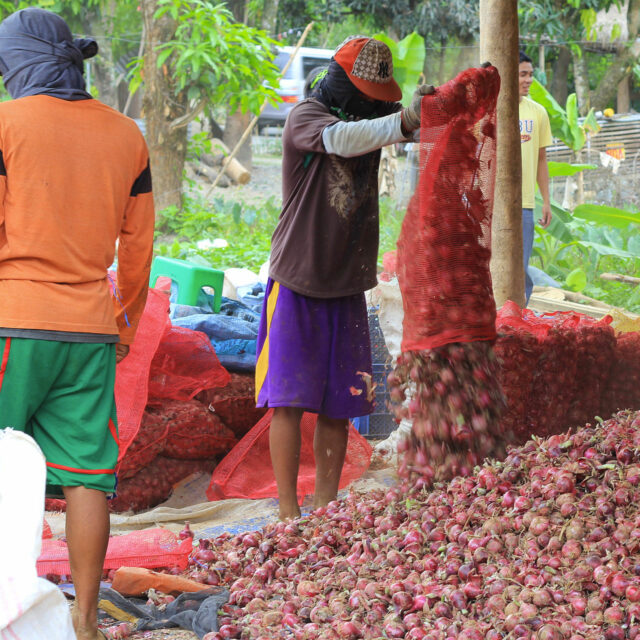
THE Department of Agriculture (DA) said state-run Food Terminal, Inc. (FTI) will begin buying onions this week to help arrest falling farmgate prices as the harvest starts to peak.

In a statement on Tuesday, Agriculture Secretary Francisco P. Tiu Laurel, Jr. said an FTI team has been dispatched to Nueva Ecija, the leading production area, to obtain cold storage space for onion purchases.

“They’ve secured space for 50,000 28-kilo bags, and we can expand that if needed,” Mr. Laurel was quoted as saying in the statement.

Nueva Ecija produces more than half of the country’s onion output, with Bongabon accounting for roughly 15% of total production, the DA said.

According to the DA, FTI President Joseph Rudolph C. Lo inspected markets in Nueva Ecija and reported farmgate prices rebounding to as high as P45 per kilo.

“Our goal is to buy at prices that are fair to farmers, at levels that are enough to make onion farming profitable and sustain their planting intentions,” Mr. Lo was quoted as saying in the statement.

The DA said FTI is also looking at purchasing onions from other major production areas such as Occidental Mindoro, Pangasinan, and provinces in the Cagayan Valley.

The DA said it is also building cold storage facilities to extend the shelf life of vegetables to keep supply and prices stable throughout the year. — Vonn Andrei E. Villamiel

ADVERTISEMENT
ADVERTISEMENT