Home Blog Page 2265

NPL ratio highest in over two years

BW FILE PHOTO

By Luisa Maria Jacinta C. Jocson, Reporter

PHILIPPINE BANKS’ asset quality continued to worsen as the industry’s gross nonperforming loan (NPL) ratio rose to an over two-year high in October.

Preliminary data from the Bangko Sentral ng Pilipinas (BSP) showed the ratio rose to 3.6% from 3.47% in September and 3.44% a year ago.

This was the highest bad loan ratio since 3.75% in May 2022. It matched the 3.6% NPL ratio in June 2022.

Data from the BSP showed that soured loans rose by 1.3% to P524.31 billion in October from P517.45 billion a month earlier.

Year on year, bad loans jumped by 16.7% from P449.45 billion.

Loans are considered nonperforming once they remain unpaid for at least 90 days after the due date. These are deemed as risk assets since borrowers are unlikely to pay.

The total loan portfolio of the banking system stood at P14.55 trillion, down by 2.4% from P14.9 trillion at end-September. However, it rose by 11.3% from P13.07 trillion a year ago. 

Past due loans went up by 1.3% to P640.88 billion in October from P632.87 billion in the month prior. It likewise climbed by 15% from P557.27 billion a year earlier.

This brought the past due ratio to 4.4%, higher than 4.25% in September and 4.26% a year ago.

On the other hand, restructured loans dropped by 0.6% month on month to P292.75 billion from P294.53 billion in September and by 5.3% from P309.16 billion in the previous year.

Restructured loans accounted for 2.01% of the industry’s total loan portfolio, higher than the 1.98% in the month prior but lower than 2.36% in October 2023.

Banks’ loan loss reserves stood at P487.52 billion, up by 1% from P482.84 billion in September and rising by 5.7% from P461.41 billion a year earlier.

This brought the loan loss reserve ratio to 3.35%, from 3.24% last month and 3.53% a year ago.

Lenders’ NPL coverage ratio, which gauges the allowance for potential losses due to bad loans, slipped to 92.28% in October from 93.31% in September and 102.66% in 2023.

Rizal Commercial Banking Corp. Chief Economist Michael L. Ricafort said the spike in NPLs could be due to the start of the BSP’s monetary easing cycle.

The central bank kicked off its policy easing cycle in August with a 25-basis-point (bp) rate cut. It delivered another 25-bp reduction in October, bringing the key rate to 6%.

BSP Governor Eli M. Remolona, Jr. earlier said they could cut or keep rates steady at the Monetary Board’s final policy review of the year on Dec. 19.

“The series of storm damage could have led to some business disruptions that could have led to some losses, both actual and opportunity losses that partly led to higher gross NPL ratio,” Mr. Ricafort said.

In October, the country was hit by Severe Tropical Storm Kristine and Super Typhoon Leon.

Mr. Ricafort also cited geopolitical risks and tensions in the Middle East which “weighed on global investments, trade, and other business activities.”

Lawmakers ratify 2025 national budget

Lawmakers decided to scrap the subsidy for Philippine Health Insurance Corp. under the 2025 national budget. — PHILIPPINE STAR/KJ ROSALES

By John Victor D. Ordoñez, Reporter

PHILIPPINE LAWMAKERS on Wednesday evening ratified the bicameral conference committee report on the P6.352-trillion national budget for 2025. 

The committee earlier on Wednesday approved the final version of the budget bill. After the measure is ratified by Congress, it will be sent to Malacañang.

Presidential Communications Office Secretary Cesar B. Chavez told reporters in a Viber message that Philippine President Ferdinand R. Marcos Jr. is “tentatively” scheduled to sign the 2025 General Appropriations Act on Dec. 20.

In the bicameral report, lawmakers scrapped the P74-billion subsidy for Philippine Health Insurance Corp. (PhilHealth) under next year’s budget, saying the agency needs to use its P600-billion reserve funds to boost its services.

“PhilHealth has P600 billion in reserve funds and they should use these to address delayed reimbursements, and we will use this (funding subsidy) to fund departments that need it more,” Senate Finance Commitee Chairperson Mary Grace Natividad S. Poe-Llamanzares said in mixed English and Filipino.

Ms. Poe said PhilHealth would still have funding for its operations, but she did not give the exact figures.

Senator Joseph Victor G. Ejercito, one of the authors of the Universal Health Care (UHC) Act, said the legality of slashing the PhilHealth subsidy could be challenged since it is mandated under the sin tax and UHC laws.

“By law, this is really earmarked for PhilHealth’s use and for indirect contributors such as persons with disabilities, senior citizens and those who cannot pay for their premiums,” he told reporters later in the afternoon.

Senator Sherwin T. Gatchalian said PhilHealth could continue to provide services without the P74-billion yearly subsidy.

“It’s a question of spending, not cash flow,” he told reporters. “If you look at the balance sheet of PhilHealth, they’re very healthy and the reserve funds are quite substantial.”

In a statement, Senate Deputy Minority Floor Leader Ana Theresia N. Hontiveros-Baraquel opposed the removal of the subsidy for PhilHealth since it is mandated by the Constitution for the government to pay for the premiums of its indirect members.

“Despite these ‘excess or reserve funds’ there are still laws that mandate this, and it is illegal, unfair and potentially unconstitutional to remove it,” she said in a statement in mixed English and Filipino.

“If the government abandons this obligation, ordinary citizens will be burdened by their monthly contributions to PhilHealth.”

In August, the Senate passed on final reading a bill that seeks to cut PhilHealth premiums to 3.25% next year from 5% this year under the Universal Health Care Act.

Ms. Poe said the 2025 budget does not include a provision allowing the National Government to sweep unused funds of government-owned or -controlled corporations (GOCC).

A provision in this year’s national budget authorized a cash sweep from GOCCs. The Supreme Court had blocked the transfer of P29.9 billion, the last tranche of PhilHealth’s P90 billion excess funds, to the Treasury.

The excess PhilHealth funds would have been used to support unprogrammed appropriations worth P203.1 billion, for state health, infrastructure and social service programs.

Filomeno S. Sta. Ana III, coordinator of Action for Economic Reforms (AER), said taking out the subsidy from the spending plan would worsen PhilHealth’s financial situation and make it harder for contributors to sustain the agency’s programs.

“What they removed are the contributions from those who do not have the ability to pay PhilHealth premiums,” he said in a Facebook Messenger chat.

“That also means direct contributors are the ones that will bear the sole burden of sustaining PhilHealth.”

Zy-za Nadine M. Suzara, a public budget analyst and former executive director of policy think tank Institute for Leadership, Empowerment and Democracy, said giving a “zero budget” for the PhilHealth subsidy is the same as slashing funding for the needs of indirect members.

“The General Appropriations Act cannot amend the Universal Health Care Law and the Sin Tax Law,” she said in a Viber message. “PhilHealth should have a reserve fund for two years or projected expenditures.”

Meanwhile, the bicameral committee also reduced the budget for the Ayuda Para sa Kapos ang Kita Program (AKAP) to P26 billion, Ms. Poe said.

The House earlier proposed a P39-billion budget for the Department of Social Welfare and Development (DSWD) financial aid program for workers with incomes lower than the poverty threshold.

The Senate earlier deleted the AKAP as a line item in DSWD’s proposed budget, opting instead to merge it with another DSWD aid program.

Leonardo A. Lanzona, who teaches economics at the Ateneo de Manila University, said the cut in AKAP’s funding next year would make it more difficult for the government to deal with rising prices and low salaries.

“This leaves the private sector with the burden to carry out the needs of society and in the process weakens the whole economy,” he said in a Facebook Messenger chat.

In a statement, House Speaker Ferdinand Martin G. Romualdez said lawmakers increased the daily subsistence allowance for soldiers to P350 from P150 or to P10,500 monthly.

Party-list Rep. and House Appropriations Committee Chairperson Elizaldy S. Co said P16 billion was allotted for soldiers’ allowances under the budget.

Before the plenary, Mr. Gatchalian told reporters the allocation for DSWD was cut by nearly P96 billion, while the Department of Health’s budget was reduced by more than P20 billion.

However, he said their budgets were still in an acceptable range.

The DSWD was given a budget of P217.34 billion next year, lower than the P313.26 proposed by the House and the P226.67 under the National Expenditure Plan (NEP), based on a copy of the amendments included in the harmonized budget measure provided by the Senate Public Relations and Information Bureau via Viber.

“We’re talking about the DSWD still having about P200 billion so it’s still within the NEP proposal and my benchmark is keeping it close to the NEP,” Mr. Gatchalian said in mixed English and Filipino.

The DoH received a P247.92 billion budget for 2025, lower than the P273.72 billion proposed by the House and higher than the P217.39 proposed by the Budget department.

Mr. Gatchalian said the final budget bill had a shortfall of P4 billion for the government’s free college education programs

The Department of Education has an approved budget of P737.08 billion, which is lower than the P748.65 billion proposed by the House, based on the reconciled version.

State universities and colleges will get P122.16 billion under the reconciled budget.

Mr. Ejercito lamented the decision to cut next year’s budget for the Armed Forces of the Philippines’ revised modernization plan by P5 billion to P35 billion amid tensions in the South China Sea.

“At least it (the modernization plan funding) was not set to zero next year,” he told reporters in mixed English and Filipino.


ADB keeps PHL growth forecasts for 2024, 2025

People in bicycles ride past the Christmas lights display along Ayala Avenue, Makati City. — PHILIPPINE STAR/RYAN BALDEMOR

THE ASIAN Development Bank (ADB) has kept its Philippine economic growth forecasts for this year and 2025, with expansion expected to be driven by easing inflation and lower interest rates.

Philippine gross domestic product (GDP) is expected to expand by 6% this year and 6.2% in 2025, the ADB said in its December 2024 Asian Development Outlook report, unchanged from its September forecasts.

Both projections are within the government’s revised GDP growth targets of 6%-6.5% for 2024 and 6%-8% for 2025.

“Household consumption and investment continue to drive the economy with both rising faster in the third quarter. Moderating inflation and monetary policy easing should continue to support growth,” the multilateral lender said in a report on Wednesday.

“On the supply side, buoyant services sector, construction, and manufacturing are contributing to overall growth,” the ADB said.

Services will remain a major growth driver for the Philippines, “with retail trade, tourism, and information technology–business process outsourcing as major contributors,” it added.

“Public infrastructure projects continue to lift growth, along with brisk private construction,” the ADB said.

It expects the Philippines to be the second-fastest growing economy in Southeast Asia this year, behind Vietnam with 6.4% and ahead of Indonesia (5%), Malaysia (5%), Singapore (3.5%), and Thailand (2.6%).

“While Vietnam sees rising foreign investment, other Southeast Asian economies like Indonesia and the Philippines are on track to meet previous growth forecasts,” the ADB said.

“However, geopolitical tensions, trade fragmentation, and severe weather events—such as Typhoon Yagi and Tropical Storm Trami — pose risks to growth, particularly in agriculture and infrastructure,” it added.

A series of storms hit the Philippines in November, resulting in about P10 billion worth of farm damage, according to the Department of Agriculture.

The World Bank on Tuesday trimmed its GDP growth projection for the Philippines to 5.9%, from 6%, reflecting the impact of typhoons.

At the same time, the ADB cut its inflation forecast for the Philippines this year to 3.6% from 3.3%. It kept its inflation projection at 3.2% for 2025.

“Inflation is expected to remain within the central bank’s 2% to 4% target, providing scope for further monetary policy easing,” it said.

Since August, the Bangko Sentral ng Pilipinas has cut rates by 50 basis points, bringing the benchmark rate to 6%.

The Monetary Board is set to hold its final policy-setting meeting of the year on Dec. 19.

US POLICY RISKS
Meanwhile, developing Asia is likely to grow more slowly than previously thought this year and next, and the outlook could worsen if President-elect Donald J. Trump makes swift changes to US trade policy, the ADB said.

Developing Asia, which includes 46 Asia-Pacific countries stretching from Georgia to Samoa — and excludes Japan, Australia and New Zealand — is projected to grow 4.9% this year and 4.8% next year, slightly lower than the ADB’s forecasts of 5% and 4.9% in September.

The downgraded growth estimates reflect lackluster economic performance in some economies in the third quarter and a weaker outlook for consumption, the bank said.

Growth forecasts for China remain unchanged at 4.8% for 2024 and 4.5% for 2025, but the ADB lowered its projections for India to 6.5% for 2024 from 7% previously, and to 7% for next year from 7.2%.

“Changes to US trade, fiscal, and immigration policies could dent growth and boost inflation in developing Asia,” the ADB said in its report, though it noted most effects were likely to manifest beyond the 2024-2025 forecast horizon.   

Mr. Trump, who takes office on Jan. 20, has threatened to impose tariffs in excess of 60% on US imports of Chinese goods, crackdown on illegal migrants, and extend tax cuts.

“Downside risks persist and include faster and larger US policy shifts than currently envisioned, a worsening of geopolitical tensions, and an even weaker PRC (People’s Republic of China) property market,” the ADB said.

It lowered its inflation forecasts for 2024 and 2025 to 2.7% and 2.6%, respectively, from 2.8% and 2.9%, due to softening global commodity prices. — Aubrey Rose A. Inosante and Reuters

OECD urges Philippine market regulators to ease listing requirements

BW FILE PHOTO

REGULATORS should consider easing requirements for listing in the Philippine stock market, as well as reducing fees, to encourage more companies to go public, the Organisation for Economic Co-operation and Development (OECD) said.

In its Capital Market Review of the Philippines released on Wednesday, the OECD said the number of newly listed firms and capital raised via initial public offerings (IPO) in the Philippines have been the lowest among the Association of Southeast Asian Nations (ASEAN) since 2000.

“The authorities could consider easing listing requirements to encourage the listing of companies with growth potential,” it said.

The OECD said the listing process is lengthy and “suffers from organizational challenges, with requirements being less flexible than in peers.”

“As stock market conditions are highly sensitive to timing, delays in the listing process may discourage companies from pursuing an IPO. Lengthy review periods can cause companies to miss optimal market windows, potentially affecting their valuation and investor interest,” it said.

In the Philippines, public equity offerings require the approval of both the PSE and Securities and Exchange Commission (SEC).

The OECD recommended that the SEC and PSE collaborate to expedite the IPO approval process to encourage more companies to list on the stock exchange.

“A single listing submission process and a three-month commitment for IPO approval could streamline the process,” the OECD said.

SEC Commissioner McJill Bryant T. Fernandez said the commission has streamlined the requirements and shortened the process for IPOs, implementing a 45-day processing period.

The OECD also said regulators should reduce fees, simplify their structure and lower the stamp duty tax. It noted that listing fees in the Philippines are also “relatively high,” and the fee structure is “more complex” than its peers.

Compared with the Philippines’ peer countries, the initial listing fee on the main market is relatively high at $150 million (P8.3 billion). It is, however, in line with most peers for a small IPO worth $10 million (P556 million) on the Small and Medium Enterprises (SME) Board.

“If you look at the listing fees of PSE, we’re talking about half of a basis point. That’s less than one-tenth of 1%. That’s our listing fees,” he said. “And I don’t think that is a deal breaker for anybody who wants to list,” PSE President Ramon S. Monzon said during a panel discussion on Wednesday.

“When you talk about listing fees, the biggest component would be the underwriting fees… I think it’s probably high because with the low liquidity of the market, there’s high risk for them,” he added.

POTENTIAL IPO CANDIDATES
According to the OECD, there are about 400 private enterprises that have the potential to go public. It cited data in 2021 when there were 411 large unlisted nonfinancial companies with assets above P5.6 billion.

“In the Philippines, public equity markets could be expanded by bringing more companies to the market,” it said.

SEC’s Mr. Fernandez said the PSE has been encouraging smaller firms to list on the SME board.

“We have been considerate and reasonable in terms of applications for incentive relief for certain entities just to be able to assist them, to handhold them, and ultimately, be able to launch their respective offerings,” he said.

“But more than that, maybe the universe is not confined to the 400, and that’s why we are going around the entire country to call on our MSMEs in our capital market roadshows [to] check on or get a feel of their interests to tap the capital markets,” he added.

The OECD noted there are many IPO candidates within the universe of large unlisted companies and among state-owned enterprises (SOE).

There are no SOEs, which are also known as government-owned and -controlled corporations (GOCC), listed on the PSE.

They make up a significant share of market capitalization in other ASEAN countries like Singapore, Indonesia, Malaysia and Vietnam, the OECD said.

It said the Philippines could expand capital markets by listing the minority stakes of financially significant SOEs.

“Among these companies two banks stand out in terms of total assets, net worth and income as potential candidates for a stock market listing — Land Bank of the Philippines with total assets of P3.1 trillion ($61.5 billion) and Development Bank of the Philippines with total assets of P1 trillion ($20 billion),” it said.

“However, some of these SOEs are chartered institutions and a legislative amendment may be required in order to incorporate and restructure them for listing.”

The OECD said SOEs should undertake reforms to enhance their performance, governance and management before listing.

This year, there were only three IPOs, falling short of the PSE’s target of six. These were mining company OceanaGold Philippines, Inc. and renewable energy companies Citicore Renewable Energy Corp. and NexGen Energy Corp. 

For 2025, the PSE is expecting to have six IPOs and is looking to raise up to P150 billion worth of capital. — Sheldeen Joy Talavera

InLife liberalizes underwriting rules for greater access to financial protection 

Insular Life (InLife) announced that it is making changes to its underwriting guidelines to ease and expedite the insurance application process and make life insurance more accessible to Filipinos.

These new guidelines aim to remove barriers, particularly for traditionally underserved groups, making financial protection available to a broader segment of the Filipino population.

InLife’s updated underwriting rules expand the scope of approval and coverage, particularly benefiting applicants with specific medical conditions, overseas Filipino workers (OFWs), military and police personnel, and residents of certain regions in Mindanao. The improvements not only address coverage limits but also allow standard or improved ratings for various conditions and professions, supporting InLife’s goal of inclusivity and adequate protection for all. 

“Our enhanced underwriting guidelines are a testament to InLife’s resolve to ensure Filipinos have better chances at securing their finances throughout their lives,” said InLife First Vice President and Insurance Operations Division Head Diana A. Tagra. “We recognize that insurance should be accessible to everyone, regardless of health conditions or profession. These changes demonstrate our commitment to delivering flexible, inclusive, and competitive solutions that meet our customers’ diverse needs.” 

Key Enhancements in Underwriting Guidelines:

  • Improved Approval for Medical Conditions: Standard premium rates will now apply to individuals with certain medical conditions that previously resulted in higher premium rates. Examples of these conditions include above normal BMI, controlled hypertension, elevated cholesterol, fatty liver, and strong family histories of certain medical conditions.
  • Diabetics for InLife’s  Critical Illness Coverage: Diabetics who are 20 to 65 yrs old, with well-controlled blood sugar, may now be covered under InLife’s critical Illness product, Resilience, subject to medical underwriting and rating. Coverage will be considered for individuals meeting certain health criteria.
  • Expanded Coverage for OFWs and Military Personnel: OFWs, just like any other insurance applicants, may now apply for coverage amounts based on their financial profile and needs. They may also apply for an Accidental Death Benefit rider. However, their eligibility will still be subject to underwriting based on their country of work and the duties they perform. Likewise, Military and police personnel are also eligible for increased coverage and additional benefits, providing security for the families of those who secure our country.
  • Coverage for Foreign Nationals and politicians: Resident foreign nationals who have appropriate resident visas may now apply for life insurance with InLife. Meanwhile, politicians may now opt for higher coverage up to 90 days prior to, and one month after, the elections.
  • Increased Coverage for Residents in Specific Regions: While certain areas in Mindanao were previously excluded, coverage is now available with limits to provide financial protection for Filipinos residing in these regions.

These updates, effective immediately, mark a significant shift in how InLife assesses risks, balancing a competitive stance with a customer-first approach. InLife’s new underwriting rules underscore its dedication to continuously evolving and adapting to the needs of a changing market.

With these liberalized guidelines, InLife proves its commitment to ensuring more Filipinos can gain the peace of mind that comes with adequate life insurance coverage, leading to A Lifetime For Good.

For more information on InLife, visit https://www.insularlife.com.ph/.


Spotlight is BusinessWorld’s sponsored section that allows advertisers to amplify their brand and connect with BusinessWorld’s audience by publishing their stories on the BusinessWorld Web site. For more information, send an email to online@bworldonline.com.

Join us on Viber at https://bit.ly/3hv6bLA to get more updates and subscribe to BusinessWorld’s titles and get exclusive content through www.bworld-x.com.

Yields on central bank’s term deposits inch down

BW FILE PHOTO

TERM DEPOSIT yields went down on Wednesday as markets priced in the latest Philippine headline inflation data and amid a stronger peso.

The BSP’s term deposit facility (TDF) attracted bids amounting to P350.69 billion on Wednesday, above the P270 billion on the auction block as well as the P342.937 billion in bids seen a week ago for a P260-billion offer.

Broken down, tenders for the seven-day papers reached P198.58 billion, higher than the P160 billion auctioned off by the central bank. However, this was below the P213.622 billion in bids seen for the P150-billion offer of seven-day deposits in the previous week.

Banks asked for yields ranging from 5.985% to 6.04%, a narrower band compared with the 5.9755% to 6.06% seen a week ago. This caused the average rate of the one-week deposits to drop by 1.77 basis points (bps) to 6.0248% from 6.0425% previously.

Meanwhile, bids for the 14-day term deposits amounted to P152.11 billion, also higher than the P110-billion offering and the P129.315 billion in tenders for the same offer volume recorded on Dec. 4.

Accepted rates for the tenor ranged from 6% to 6.08%, also slimmer than the 6% to 6.11% margin recorded a week ago. With this, the average rate for the two-week deposits went down by 2.02 bps to 6.0614% from the 6.0816% logged in the prior week’s auction of 14-day papers.

The BSP has not auctioned off 28-day term deposits for over four years to give way to its weekly offerings of securities with the same tenor.

The term deposits and the BSP bills are used by the central bank to mop up excess liquidity in the financial system and to better guide market rates.

“The BSP TDF average auction yields again mostly eased slightly for the 12th straight week after local headline inflation settled at 2.5% in November 2024, still considered relatively benign and still within the BSP inflation target of 2-4%,” Rizal Commercial Banking Corp. Chief Economist Michael L. Ricafort said in a Viber message.

Inflation quickened to 2.5% in November from 2.3% in October as food prices soared after a series of typhoons struck the country.

In the 11-month period, headline inflation averaged 3.2%, a tad higher than the BSP’s baseline forecast of 3.1% but well within its 2-4% annual target.

Within-target November inflation “could still warrant a possible local policy rate cut on Dec. 19,” Mr. Ricafort added.

The Monetary Board will hold its final policy review for the year on Dec. 19. BSP Governor Eli M. Remolona, Jr. earlier said they could either cut or keep rates steady at the meeting.

The BSP began its easing cycle in August this year and has delivered a total of 50 bps worth of cuts so far, bringing the policy rate to 6%.

Mr. Ricafort said the stronger peso recently also caused TDF yields to go down on Wednesday.

After closing at its record low of P59 per dollar on Nov. 21 and 26, the peso has since rebounded, even returning to the P57 level last week, partly boosted by seasonal remittance inflows.

On Wednesday, the local unit closed at P58.28 against the dollar, down by 27 centavos from Tuesday’s finish. — Luisa Maria Jacinta C. Jocson

Megawide’s Baguio Integrated Terminal to undergo Swiss challenge by 2025

THE BAGUIO CITY Integrated Terminal project involves leasing, operating, and maintaining an intermodal terminal to serve provincial buses arriving from outside Baguio City. — BAGUIO CITY PUBLIC INFORMATION OFFICE OFFICIAL FACEBOOK ACCOUNT

THE P1.19-billion Baguio City Integrated Terminal proposal by Saavedra-led Megawide Construction Corp. is set to undergo a Swiss challenge by early next year, according to the Public-Private Partnership (PPP) Center.

“(The project is) in the approval process. The Sanggunian of Baguio City has 90 days to approve it. Once it’s approved, there will be a comparative challenge,” PPP Center Executive Director Ma. Cynthia C. Hernandez said during the PPP Center’s year-end press chat on Wednesday.

The 90-day approval process is expected to end by early next year, PPP Center Deputy Executive Director Jeffrey I. Manalo said.

A Swiss challenge, also known as a comparative challenge, is a procurement process where a public authority invites third parties to submit competing bids against an unsolicited proposal for a public project. The original proponent is then given the opportunity to match or improve upon the best competing offer, ensuring transparency and competitiveness in public procurement.

The listed construction company submitted unsolicited proposals for the P1.19-billion Baguio City Integrated Terminal and the P1.87-billion Cavite Bus Rapid Transit System.

The Baguio City Integrated Terminal project involves leasing, operating, and maintaining an intermodal terminal to serve provincial buses arriving from outside Baguio City.

The project aims to reduce traffic congestion in the city center of Baguio while also improving facilities for commuters.

The Cavite Bus Rapid Transit System is also undergoing a comparative challenge, with the deadline set for Dec. 23.

The project is a joint venture between Megawide and property development company Maplecrest Group, Inc.

The Cavite Bus Rapid Transit System project covers the development, operation, and maintenance of a bus rapid transit and P2P (point-to-point) route with an alignment of 42 kilometers stretching through Cavite, specifically Imus, General Trias, Tanza, Kawit, Trece Martires, and its surrounding areas, while also providing a link to Metro Manila via the Parañaque Integrated Terminal Exchange. — Ashley Erika O. Jose

Philippines’ IPv6 adoption rate remains low

STOCK PHOTO | Image from Freepik

THE Department of Information and Communications Technology (DICT) urged consumers to migrate to the latest version of Internet protocol (IP) to help protect their information through its built-in security, with the Philippines’ adoption rate remaining low.

The Philippines’ adoption rate of IP version 6 (IPv6) is only at 18.5%, according to data from the Asia-Pacific Network Information Centre. India leads IPv6 adoption in the region at around 80%.

“It can help with protection because the real protection of your assets, of your information, belongs to you,” George P. Tardio, chief of Critical Information Infrastructure in the Cybersecurity Standards Division of the DICT, told BusinessWorld on the sidelines of a forum on IPv6 adoption last week.

IPv6 features end-to-end encryption and authentication through IP Security (IPSec), which was optional in previous IP versions, Mr. Tardio noted.

IPSec plays a crucial role in securing the transmission of sensitive data between IP networks, he said.

“If you have your very own IP address, which is possible in IPV6, you will be able to protect yourself,” Mr. Tardio added.

IPv6 is a system that assigns unique IP addresses to each device connected to a network and offers up to 340 undecillion addresses. Meanwhile, its predecessor IP version 4 (IPv4) only offers 4.3 billion addresses.

“Addresses are nearly unlimited and will be able to accommodate every device on Earth, ultimately producing more efficient Internet traffic,” the Department of Science and Technology and Advanced Science and Technology Institute said in a statement.

“The push to increase [the Philippines’] adoption rate, similar to what neighboring Asian countries such as India and Vietnam have done, entails all stakeholders from government, academe, industry (internet service providers, and telecommunication companies), and local Internet development groups to work together.”

Resistance among consumers has contributed to the slow migration to IPv6 in the Philippines, Mr. Tardio said during the forum.

“The ordinary consumers or subscriber do not mind if they are using IPv4 or IPv6,” he said. “What matters to them is the internet speed and availability.”

Mr. Tardio said firms must be more proactive in informing end  users about the latest technologies that can boost cybersecurity.

“Because IPv6 is more secure than IPv4, let’s try to request it to our telco or (internet) providers,” he said.

Mr. Tadio added that he is hopeful that initiatives to boost IPv6 migration in the Philippines would be part of the DICT’s priorities next year.

“It’s not too late. We would still plan our targeting for 2025 this month,” he said. “For cybersecurity, I will definitely recommend IPv6 adoption.” — Almira Louise S. Martinez

GoTyme Bank reaches 5.1 million customers, P24 billion in deposits

GOTYME.COM.PH

GOTYME BANK has reached 5.1 million customers and P24 billion in deposits to date, its top official said.

“We’re now at 5.1 million customers. We will end the year at about 5.3 million customers. We’re super thankful for the big adoption and loyalty,” GoTyme Bank President and Chief Executive Officer (CEO) Nathaniel D. Clarke told BusinessWorld in an interview on Wednesday. “Deposits are also very strong. We’re at about P24 billion now, so it’s growing much faster than planned.”

“I thought I was being ambitious when I said [we’d hit] five million [customers] in three years and 10 million in five years, but now we’re at five million in two years and we’ll be close to 10 million in three years — so it’s obviously a good problem,” Mr. Clarke said, adding that they plan to increase their savings rate to 5% from 4% early next year to celebrate these milestones.

He attributed the rapid growth in GoTyme Bank’s customers and deposits to the ease of use of their mobile app, the country’s large young and underserved market, and their customer acquisition and distribution model that is backed by their kiosks and the Gokongwei group’s retail network.

“I think the market is just underserved. The reality is if you compare it to other markets, the incumbent banks have not delivered a great digital experience. The Philippines, I think, has the second youngest population in the world in a country with above 50 million [individuals] and is demanding high-quality digital services and experience,” Mr. Clarke said.

The bank’s “phygital” or physical and digital distribution model, which utilizes kiosks and ambassadors, also addresses the needs of those who prefer to make their transactions in person, he added.

The Gokongwei group’s wide retail network has made it easier for the bank to reach areas outside the National Capital Region, especially in Cebu, Mr. Clarke said.

For 2025, GoTyme Bank expects to reach over nine million customers and over P35 billion in deposits, the official said, as the lender plans to scale up its product offerings, especially credit and investments.

“We’re also already in testing for our buy now, pay later product as a consumer credit. I think next year is about starting to scale consumer credit beyond payroll lending and getting into investments,” Mr. Clarke said.

The bank also plans to offer digital asset services soon as it was granted a Virtual Asset Service Provider (VASP) license by the Bangko Sentral ng Pilipinas (BSP) in October, he added.

“We’re hopefully days away from putting that live in a pilot, then like a limited live,” Mr. Clarke said.

VASPs are firms that offer services or engage in activities that provide facilities for the safekeeping, administration, transfer or exchange of virtual assets. Their products and services include cryptocurrencies and electronic wallets for holding and storing virtual assets.

GoTyme Bank is one of the six digital lenders licensed by the BSP. The others are Tonik Digital Bank, Inc.; Maya Bank; Overseas Filipino Bank; UNObank; and UnionDigital Bank.

It is a partnership between the Gokongwei group and Singapore-based Tyme Group, which also operates TymeX in Vietnam, India and China and digital bank TymeBank in South Africa.

TymeBank was previously reported to be gearing up for an initial public offering (IPO) in New York by 2028.

“The market will dictate the timing. We want to be IPO ready in four to five years,” Mr. Clarke said. “South Africa is already profitable, so that will start creating a lot of earnings. We need to be profitable here, and we think we need to be approaching scale and profitability in a third market, either Vietnam or Indonesia. We think that before we are listing ready, we need three markets at scale.”

The official previously said he expects GoTyme Bank to become profitable by end-2025. — Aaron Michael C. Sy

Uy’s air navigation control proposal ‘rejected’ — PPP Center

COMCLARK Chief Executive Officer Dennis Anthony H. Uy — CONVERGEICT.COM

By Ashley Erika O. Jose, Reporter

THE Department of Transportation (DoTr) has rejected ComClark Network and Technology Corp.’s P29.82-billion unsolicited proposal to manage the country’s air navigation, traffic, and control system, according to the Public-Private Partnership (PPP) Center.

“The DoTr has decided to reject and return the unsolicited proposal. The DoTr will soon be sending the proponent the rejection letter, which will contain the grounds for rejection,” PPP Center Deputy Executive Director Jeffrey I. Manalo told reporters on the sidelines of a press briefing on Wednesday.

The Dennis Anthony H. Uy-led proponent may resubmit its unsolicited proposal upon addressing the grounds for rejection, Mr. Manalo said.

In October, Civil Aviation Authority of the Philippines (CAAP) Director-General Manuel Antonio L. Tamayo said that CAAP — as the implementing agency — was evaluating the proposal of ComClark.

Information from the PPP Center’s website indicates that ComClark’s proposal encompasses the construction, modernization, and operation of air navigation service facilities, including air traffic services and communications, navigation, surveillance, and traffic management systems. The company plans to execute the project with an international partner.

The proposal aims to modernize air traffic safety while also enhancing operational efficiency and reliability.

“By addressing critical shortcomings and leveraging innovative strategies, this initiative aims to instill a robust framework that ensures the utmost safety and effectiveness in air traffic management operations nationwide,” the PPP Center said.

To recall, PPP Center Executive Director Ma. Cynthia C. Hernandez said previously that the Air Traffic Services-Air Navigation Services project was also being evaluated as a solicited project.

The project involves the financing, design, construction, operations, and maintenance of air traffic services and air navigation services of the country’s airspace and international airspace managed by the Philippines, she said.

The Transportation department has said that, while there is an unsolicited proposal for managing and controlling the air traffic control system, it has also tapped the World Bank and the International Finance Corp. to conduct a study on the management of the country’s air traffic control.

The DoTr said that allowing a private company or creating a separate entity to manage and control the country’s air traffic control system will relieve CAAP of its conflicting roles.

ComClark is the controlling shareholder of Converge ICT Solutions, Inc., a listed telecommunications company. Converge has not received any information from the DoTr or PPP Center pertaining to the project, according to its communications team on Wednesday.

BusinessWorld also reached out to CAAP’s Mr. Tamayo for comment via text message and Viber. CAAP is an attached agency of the DoTr and is responsible for regulating and overseeing civil aviation in the country.

ChatGenie launches AI-powered multi-agent framework for BPOs

PHILSTAR FILE PHOTO

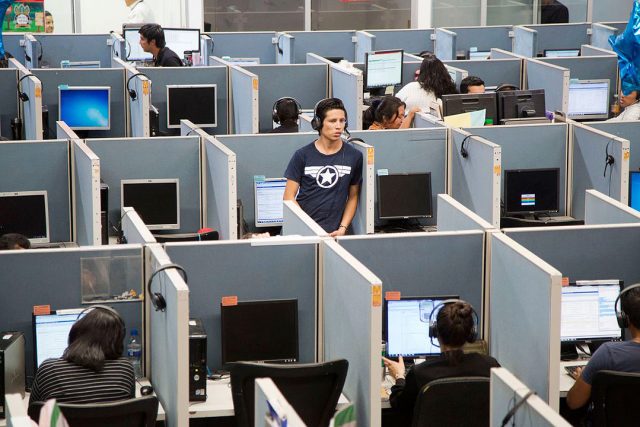
CUSTOMER engagement platform Chat-Genie has launched an artificial intelligence (AI)-powered multi-agent framework to help speed up tasks in traditional business process outsourcing (BPO) roles.

ChatGenie’s multi-agent framework deploys AI agents, which will take charge of customer interactions, enabling human workers to focus on handling more complex tasks such as resolving intricate customer issues, building client relationships, and driving customer success initiatives.

The AI agent will help automate repetitive office work such as query identification, issue classification, message filtering, and response refinement.

To run the framework, ChatGenie integrates advanced AI technologies such as Open-AI’s GPT-4o and Meta’s Llama 3.1.

Radge Falcis, cofounder and chief executive officer at ChatGenie, said the multi-agent platform shows that AI and human talent can coexist in a mutually beneficial way.

“Our technology is accelerating the redundancy of traditional customer service roles, but this isn’t about job losses,” Mr. Falcis in a statement.

“It’s about elevating agents to focus on their intellectual edge — tackling complex scenarios that require critical thinking and human empathy. In this way, we help businesses operate more efficiently while enabling employees to grow in their careers,” he added.

The framework includes agents for specific purposes, such as Guard AI, Classification AI, and Refinement AI, to ensure 90% to 95% accuracy in its responses.

The AI chatbots can also understand Filipino, English, and regional dialects.

The ChatGenie platform also integrates with popular messaging applications like Facebook Messenger, Instagram, and Meta’s Business Messaging services.

“Powered by large language models (LLMs), AI agents are systems that can perform complex tasks, make autonomous decisions, reason, adapt to unknown variables, understand language, and plan, making them highly versatile for various applications,” ChatGenie said.

The IT and Business Process Association of the Philippines (IBPAP) earlier said that 67% of firms saw enhanced productivity and operational efficiency after integrating AI into their operations. However, AI implementation resulted in job cuts among 8% of its members.

Despite this, IBPAP President and CEO Jack Madrid said AI is not expected to result in massive job losses in the industry if organizations continue to upskill their employees. — Beatriz Marie D. Cruz

Does Bitcoin at $100,000 signal a last laugh for HODLers?

PIXABAY

WHAT is there to say with Bitcoin at $100,000 for those of us who thought $10,000 looked nuts. After 15 years of cryptocurrency boom-and-bust cycles, rags-to-riches (and back to rags) stories, scams and bankruptcies, a carnival mood is back and hushing us naysayers.

Politicians are joining the party: Donald Trump is appointing pro-crypto officials, eyeing a Bitcoin reserve, and even hawking his own coin. So are punters, who are trying their hand and losing their shirts in the risky meme coin market. Like the 18th century carnival of Rome attended by the poet Goethe — where all mad and foolish behavior save knifing and brawling was allowed — it’s the mystified tourists who are in the minority.

Right now, it’s Anthony Scaramucci of all people whose analysis makes the most sense: Bitcoin’s new milestone shows it’s gained wider acceptance as a tradable asset and portfolio investment, offering both big gains and gut-wrenching drawdowns (the last peak-to-trough fall after COVID-19 was around 76%). The flipside of having no intrinsic value and a decentralized architecture with a huge energy footprint means that nobody’s using Bitcoin to buy their groceries, though: Only 7% of US consumers hold Bitcoin, according to Deutsche Bank AG research, and a survey published last month by the UK Financial Conduct Authority found only 16% of people who owned cryptocurrencies used them for payments. Skeptics focus on the lack of real-world adoption — yet it’s speculators banking on so-called digital gold who’ve come out richer.

Another point in favor of HODLers* going into 2025 is betting on the power of the incoming US president — somewhat ironically for a movement originally forged by libertarian cypher-punks. Almost $10 billion has flowed into Bitcoin exchange-traded funds since Trump’s Nov. 5 win, which makes sense given the likely gains to be had from regulatory forbearance. Gary Gensler’s departure from the Securities and Exchange Commission likely means more breathing space for tokens that have labored under the “unregistered securities” label, making US-based Coinbase Global, Inc. an obvious beneficiary of onshore trading flows and products — its shares have doubled this year. A friendlier regulatory atmosphere means we should expect more financial institutions to join in, even in risk-averse Europe.

Still, even pro-crypto folks know there are limits to this trade. We’re far from Friedrich Hayek’s vision of the “de-nationalization of money,” in which the state would ideally cede monopoly control of currency to the competitive private sector. Trump’s recent call to BRICs to accept dollar dominance shows he’s far from a crypto purist. A Bitcoin strategic reserve, with all the risk involved for US taxpayers, is probably (let’s hope) a bridge too far.

And while digital gold is a handy moniker that allows optimists to imagine another tenfold rise for Bitcoin — taking its market capitalization to $20 trillion, or on par with gold — its price has recently been correlated with tech stocks on the Nasdaq index, suggesting real-world macroeconomic conditions need to remain healthy to maintain that speculative luster. For now, they are: Monetary policy is loosening and tech stocks like Nvidia Corp. and Palantir Technologies, Inc. are rocketing (and have outperformed Bitcoin this year). But if the twin engines of the US economy and stock market sputter — perhaps due to tariffs or inflation — it may undermine Bitcoin’s attractiveness.

There are other, longer-term questions posed by this rally. The first is just how dangerous the gamblification of finance could yet be in a world of 24/7 trading apps, legalized sports betting, and instant payments — something crypto fans tend to dismiss. Like two sides of the same coin, crypto rallies expose punters to a proliferation of scams and get-rich-quick schemes. The urge to make money fast and replicate the seemingly out-of-reach gains of the early adopters can lead to horror shows like the Hawk Tuah memecoin or the baffling rise of Peanut the Squirrel’s token (market cap: $1.2 billion.) There will need to be re-regulation ahead, and maybe a total rethink of how the lines between investing and gambling are policed.

The second is whether there is already a glimpse of a future financial system beyond the speculation. Complex systems take time to emerge — something crypto doubters might also miss. Maybe new experiments, such as First Abu Dhabi Bank PJSC and Libre Capital’s announcement this week of a stablecoin lending pilot backed by tokenized money-market funds, are the budding indicators of where this Wild West of digital trading might end up.

The hope is that this carnival is close to maturity; but the history of financial manias, especially those with political encouragement, suggests a few more accidents are on the way.

BLOOMBERG OPINION

*HODL — “hold on for dear life”

ADVERTISEMENT
ADVERTISEMENT