Home Blog Page 221

Palafox pushes smart cities plan, partners with Elsal Ventures

STOCK PHOTO | Image from Freepik

ARCHITECTURE and urban planning firm Palafox Associates said it remains optimistic about advancing its smart cities initiative despite governance and economic challenges.

“We’re busier this year than before the pandemic at the Palafox Associates and Palafox Architecture, which is a very pleasant surprise, despite all this negative news about our country,” Palafox Associates Founder and Managing Partner Felino A. Palafox, Jr. said in an interview with BusinessWorld.

“To me, if we address corruption in our economy, climate change, inequality, investments, and infrastructure incompetence, we should be in the top 10 economies of the world,” he added.

In an earlier statement, Mr. Palafox stressed the need to address inefficient land use, strengthen urban planning, and establish smart cities in the countryside as part of a long-term vision for national development by 2050.

He cited a previous projection by Goldman Sachs that the Philippines could become the world’s 16th largest economy by 2050.

The outlook aligns with Palafox Associates’ “Philippines 2050: A First-World Country, A First-World Economy” campaign, which envisions the country attaining first-world status by mid-century.

“Despite all our challenges, we have three foreign investors, and then maybe without the challenges, we can probably have more,” he said, adding that foreign investors are increasingly selective in choosing Filipino partners they consider trustworthy.

Details of the agreements with the three foreign investors were not disclosed due to non-disclosure arrangements.

Mr. Palafox said one project is advancing, while the other two are in the master planning stage.

Palafox Associates and real estate and land investment facilitation firm Elsal Ventures signed a memorandum of agreement on Feb. 2 to collaborate on integrated development projects across the Philippines.

Under the partnership, Palafox Associates will contribute its expertise in master planning, sustainable design, and resilient urban development, while Elsal Ventures will provide support in land aggregation, investment facilitation, and real estate sourcing.

The companies said the collaboration aims to advance responsible and future-ready projects.

Mr. Palafox highlighted the role of strategic collaboration in city-building initiatives.

“Partnerships like this allow us to align design excellence with smart land development, ensuring projects are not only profitable, but sustainable, inclusive, and resilient,” he said.

Elsal Ventures Chairman and Chief Executive Officer Ernesto L. Salas also expressed optimism about the agreement.

“This will be the first formal partnership, because it is a perfect fit. He can provide the land, design the land, and provide investors from the Middle East or even locals. Then, we can provide the land on the scale he wants,” Mr. Salas told BusinessWorld. — Alexandria Grace C. Magno

On the Iran war, energy, and economic implications

The US-Israel joint bombings of Iran are US President Donald Trump’s second regime change project this year. Venezuela’s President Nicolas Maduro was removed in early January, and now Iran’s supreme leader, Ayatollah Ali Khamenei, has been killed.

The US has military bases, facilities, and naval support in Middle East countries with huge oil-gas reserves — Saudi Arabia, Kuwait, Qatar, the United Arab Emirates (UAE), and Bahrain.

The US has been involved in several invasions and regime change projects in Middle East countries that have plenty of oil-gas reserves. There was the Iraq invasion in 2003, the airstrikes then partial occupation of Syria in 2014, and the bombing of Iran in 2025 and 2026.

In North Africa near the Middle East, the US bombing of Libya in 2011 also led to regime change. Last December, the US bombed Islamic militants in Nigeria.

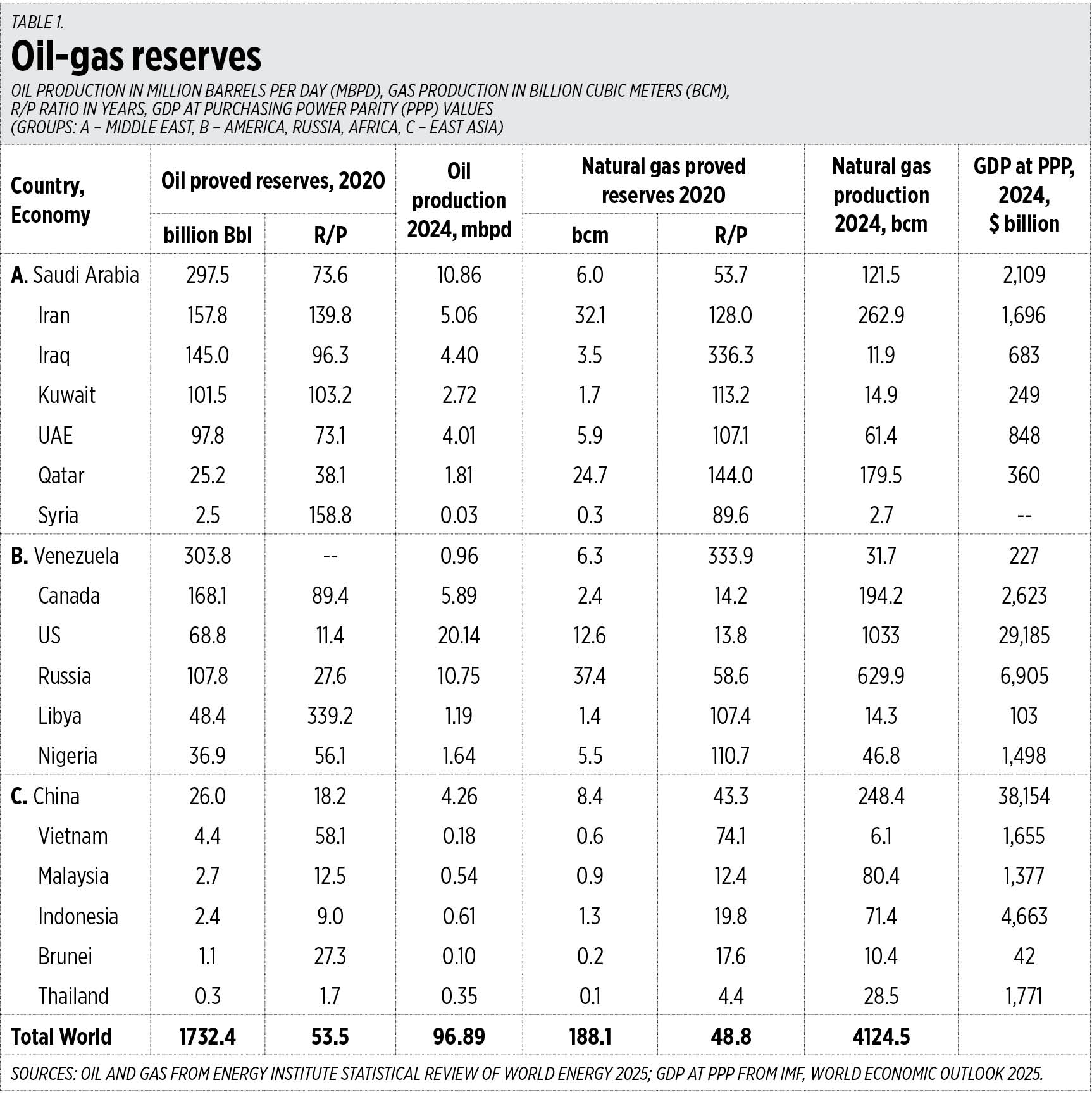
When it comes to oil reserves, Iran has second largest in the Middle East and fourth largest in the world with 158 billion barrels. When it comes to gas reserves, Iran has the largest in the Middle East and second largest in the world with 32 billion cubic meters (bcm), trailing Russia.

Looking at the oil reserves/production (R/P) ratio, or the number of years before the reserves are depleted if current rates of production both for domestic use and exports (if any) continues, Iran is fourth in the world with 140 years, behind Libya, Venezuela, and Syria — the US’ R/P ratio is only 11 years.

Then there is the gas R/P ratio, where Iran is third in the world with 128 years, behind Iraq and Venezuela with 330+ years each. The US only has 14 years.

Looking at East Asia’s R/P ratios, China has only 18 years for oil and 43 years for gas. Of our neighbors, Vietnam has 58 years in oil and 74 years in gas, Malaysia has 12 years for both oil and gas, and Indonesia has nine years for oil and 20 years for gas (see Table 1).

The US continues its military involvement in the Middle East to pursue its oil-gas security interests. Regime change in Iran is part of this long-term goal.

The Philippines gets its oil mainly from Saudi Arabia and the UAE, two countries that also host many Overseas Filipino Workers (OFWs) especially in Riyadh and Dubai. But the oil coming from both those countries passes through the Strait of Hormuz and now the Strait is technically closed as cargo ships are avoiding it for fear of Iranian missiles.

THE US, CHINA, AND PHL
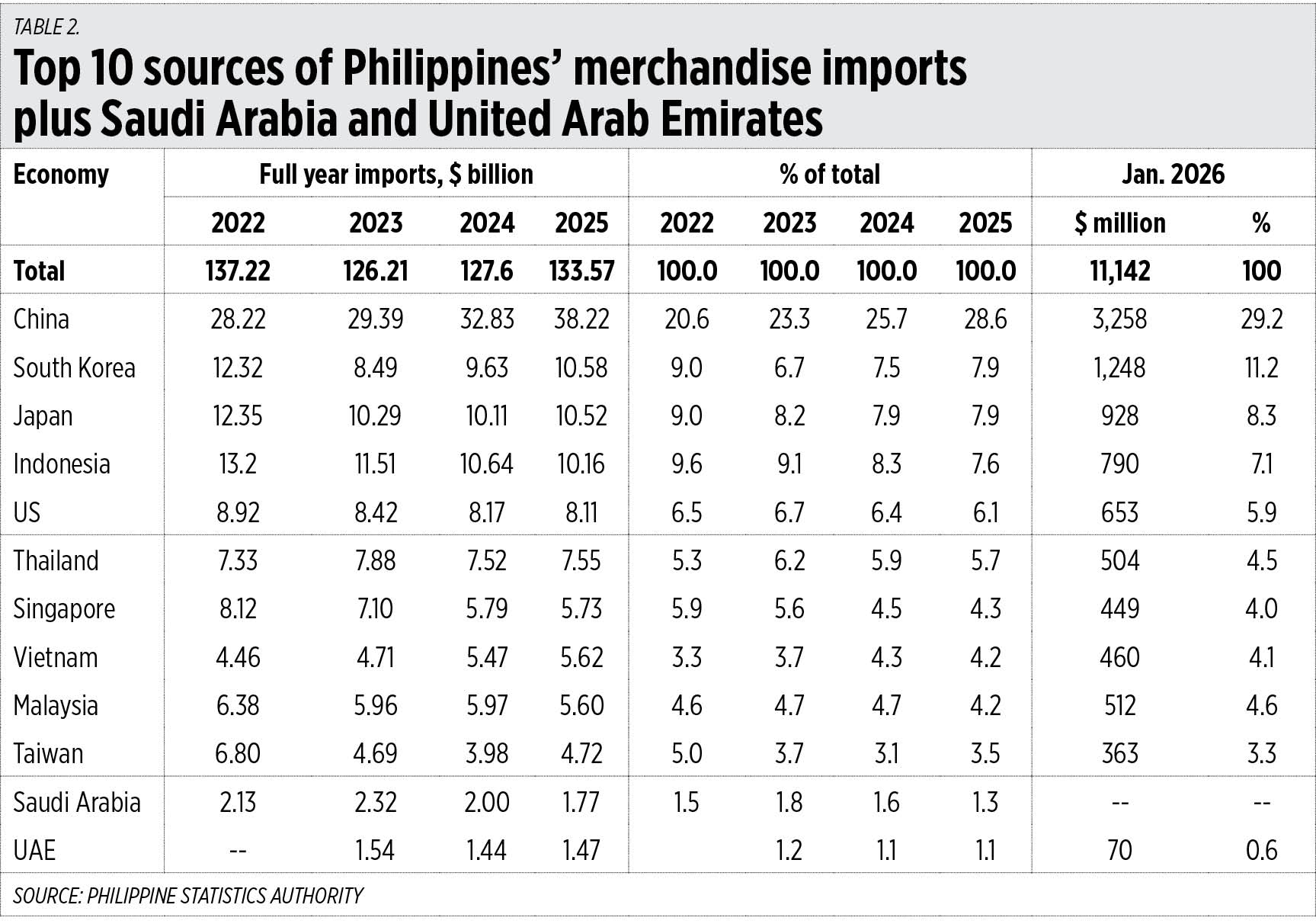
Now let’s consider the continuing economic and military rivalry between the US and China. Looking at the Philippines’ merchandise trade, especially imports, we see that China is gaining while the US is losing market share in the Philippines. The share of our total imports from China keeps rising, from 21% in 2022 to nearly 29% in 2025, and 29.2% in January 2026. In contrast, the US share decreased from 6.5% in 2022 to 6.1% in 2025, and down to 5.9% in January 2026 (see Table 2).

The overall impact of the ongoing US-Iran war will be negative economically. World prices for oil, gas, and petrochemical products (plastic, paint, fertilizer…) will increase, leading to higher overall inflation. Which will then adversely affect GDP performance as people tend to spend less when inflation is high.

I can think of two (among many) things that the Philippines can do, especially in the short-term.

One, do a partial reduction of the oil excise tax, to be compensated by a reduction of government spending like the subsidies and freebies that were created during the 2020 lockdown, and which continue until today. The budget deficit and annual borrowings should not increase when there is a partial tax cut.

Two, we should source more oil and gas from our neighbors in Asia no matter how small initially. After all, Brunei, Malaysia, Indonesia, Vietnam are fellow ASEAN members.


Bienvenido S. Oplas, Jr. is the president of Bienvenido S. Oplas, Jr. Research Consultancy Services, and Minimal Government Thinkers. He is an internationa fellow of the Tholos Foundation.

minimalgovernment@gmail.com

UnionBank nets P9.94 billion in 2025

BW FILE PHOTO

UNION BANK of the Philippines (UnionBank) saw its net income drop by 16.67% in 2025 due to one-time costs at the subsidiary level that were partly offset strong revenues from the parent.

The bank’s attributable net income went down to P9.94 billion last year from P11.93 billion in 2024, it said in a disclosure to the stock exchange on Monday.

This translated to a return on average capital funds of 5% and a return on average resources of 0.9%.

UnionBank noted that its earnings for the second half surged by 108% from the first semester.

“Performance was driven primarily by the parent bank, including the acquired Citi consumer business, which continued to gain momentum during the year. Record topline revenues at the parent bank helped offset one-time costs, largely booked at the subsidiary level, as the bank took decisive actions to clean up and strengthen its balance sheet and position it for future growth,” it said.

“In 2025, we took deliberate steps to strengthen our balance sheet and lay the foundation for profitable, sustainable growth. Building on the strength of our core franchise, we are doubling down on our key competitive advantages in 2026. We expect continued improvement in topline growth and NIM (net interest margin), supported by an expanding customer base and a growing stream of recurring revenues,” UnionBank President and Chief Executive Officer Ana Maria Aboitiz-Delgado said. “As we move into 2026, our focus remains on disciplined growth, customer‑centric innovation, and delivering long‑term value for our shareholders.”

The bank’s net revenues stood at P83.2 billion in 2025.

“This growth was supported by an expanding customer franchise, with total customers rising to 18.6 million — up 9.7% year on year.”

UnionBank net interest income increased by 10.72% to P64.25 billion in 2025 from P58.03 billion the prior year, as interest income inched up by 0.74% to P84.36 billion while interest expense dropped by 21.78% to P20.11 billion from P25.71 billion.

As a result, net interest margin was at 6.4%, up from 6% in 2024.

Meanwhile, other income dropped by 4.28% to P18.98 billion from P19.83 billion amid lower trading gains and miscellaneous income. But fee income remained strong, with its fee income-to-assets ratio at 1.3%, more than twice the industry average, UnionBank said.

“Fee growth was driven by higher digital transaction volumes, including bills payments, funds transfers, interchange, and other card-related fees across the bank’s larger and more engaged customer base.”

Total operating income was at P62.07 billion, up from P59.95 billion in the prior year.

Meanwhile, the bank’s other expenses increased by 8.15% to P47.87 billion from P44.27 billion.

“Excluding one-time items, total cost growth would have been at 5%. This reflects the bank’s disciplined efforts to drive cost efficiency and realize the benefits of the bank’s digitization initiatives,” UnionBank said.

The bank set aside credit loss provisions amounting to P21.16 billion in 2025, up by 18.14% from P17.91 billion in 2024.

UnionBank’s net loans and receivables stood at P537.68 billion last year, rising from P522.66 billion in 2024.

“The parent bank’s unsecured consumer loans grew by 18% to P150.8 billion, driven by digital acquisition and cross-selling initiatives. Consumer loans accounted for 61% of the bank’s total loan portfolio, well-diversified across credit cards, mortgage loans, personal and salary loans, and vehicle loans.”

Its nonperforming loan ratio declined by 37 basis points to 6.8%, with provision coverage increasing to 70.8% from 58.2%. It said that its unsecured loans are “more than fully covered.”

“Credit costs rose by 18% year on year to P21.2 billion; however, asset quality indicators improved over the course of the year,” UnionBank said.

“Transaction banking volumes also increased during the year, contributing to a 12% year-on-year growth in low-cost CASA (current account, savings account) deposits. This improvement in funding mix helped reduce overall funding costs and supported margin expansion.”

Total deposits increased by 15.4% to P267.019 billion at end-2025 from P231.378 billion in the prior year.

UnionBank’s resources expanded to P1.16 trillion in 2025 from P1.145 trillion in 2024.

Total capital was at P202.06 billion, up from P195.21 billion in the prior year.

“Capital ratios remain well above regulatory limits, providing sufficient buffer to support future growth, with common equity Tier 1 ratio at 15.03% and capital adequacy ratio at 15.86%.”

UnionBank’s shares gained five centavos or 0.19% to close at P26.70 each on Monday. — A.M.C. Sy

Maxicare opens 1,100-sq.m. clinic at Filinvest Three

FILINVEST.COM

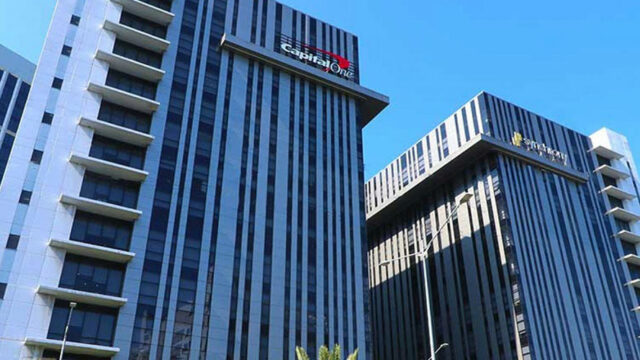
FILINVEST REIT Corp. (FILRT) has added Maxicare Health Services, Inc. as a new tenant in Filinvest Three, opening a nearly 1,100-square-meter (sq.m.) outpatient clinic on the ground floor, one of the largest in the Philippines.

“Maxicare’s choice to open one of their largest clinics in the country at Filinvest Three aligns with FILRT’s mission to not only deliver high-quality, strategically located office spaces but also to support businesses that drive innovation and growth across various sectors,” FILRT President and Chief Executive Officer Maricel Brion-Lirio said in a statement on Monday.

Josephine Lopez, Maxicare Health Services, Inc. president and chief executive officer, said the new, larger clinic at Filinvest Three marks a key expansion in providing accessible healthcare to more communities.

“By establishing our Primary Care Clinic here, we are significantly expanding our reach and reinforcing our mission to empower more Filipinos to lead healthier lives,” she added.

Filinvest Three, a Grade A office building in FILRT’s Northgate Cyberzone portfolio, is located in Filinvest City, Alabang. 

It connects to major roads such as South Luzon Expressway, Skyway, Alabang-Zapote Road, Daang Hari, and West Service Road, linking it to Metro Manila, nearby provinces, transport networks, business centers, and residential areas.

At the local bourse on Monday, FILRT shares rose 0.33% to P3.03 apiece. — Alexandria Grace C. Magno

Rock band Radiohead urges US ICE to take down video using its song

WASHINGTON — British rock band Radiohead said on Friday it wanted a promotional video for the US Immigration and Customs Enforcement (ICE) agency that used their song to be taken down.

ICE, whose immigration enforcement tactics have been widely condemned by human rights advocates during President Donald J. Trump’s hardline immigration crackdown, posted a video last week that used a version of Radiohead’s song “Let Down.”

“We demand that the amateurs in control of the ICE social media account take it down. It ain’t funny, this song means a lot to us and other people, and you don’t get to appropriate it without a fight,” Radiohead said in a statement to media outlets.

ICE did not immediately respond to a request for comment outside of business hours.

The song’s version appeared as a soundtrack to the video that showed a montage of victims of violence that ICE attributed to immigrants who are in the US illegally.

Radiohead said the song was used without the band’s permission.

The Trump administration has used ICE in an immigration crackdown and deportation drive that has been condemned by human rights advocates, especially after the January fatal shootings of two US citizens by federal agents in Minnesota. Many celebrities have also previously condemned ICE.

Rights groups say the crackdown has created a fearful environment for both citizens and immigrants, especially for minority groups.

Around the country, at least eight people have died in ICE detention centers since the start of 2026, following at least 31 deaths last year.

Rights advocates have also raised free speech and due process concerns in ICE’s detention and attempted deportations of pro-Palestinian foreign protesters who opposed US ally Israel’s assault on Gaza.

Mr. Trump has cast his crackdown as aiming to curb illegal immigration and improve domestic security. — Reuters

RLX to build Shopwise ‘big-box’ in Rizal; RRHI sets up to P7-billion capex

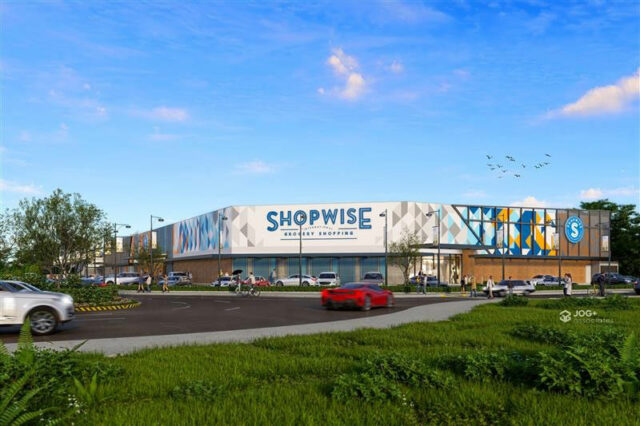
Robinsons Logistix and Industrials, Inc. has recently formed a partnership with Robinsons Retail Holdings, Inc. with the unveiling of a “big box” facility for Shopwise, Robinsons Retail’s value-driven supermarket brand. — ROBINSONS LAND CORP.

ROBINSONS LOGISTIX & Industrials, Inc. (RLX) said it has partnered with Robinsons Retail Holdings, Inc. to launch a “big box” facility for Shopwise at Sierra Valley Destination Estate in Cainta, Rizal.

“Designed to serve both the growing local community and visitors to the estate on Ortigas Avenue Extension, this project reinforces RLX’s role as a builder of scalable, high-impact retail infrastructure,” Robinsons Land Corp. (RLC) Senior Vice-President and RLX Business Unit General Manager Cora Ang Ley said in a statement on Monday.

Shopwise’s big-box facility, which will span more than 7,000 square meters (sq.m.) of land with 5,000 sq.m. of leasable space, is targeted for construction completion in the first half of 2027, with store opening scheduled in the third quarter of the same year.

RLX, known for its Grade A logistics facilities, will lead the development and construction of the new retail format as part of efforts to drive organic growth and improve integration within Robinsons Land’s operations.

The company said Shopwise Sierra Valley will adopt a big-box retail format similar to Walmart or Costco, designed for efficient, high-volume sales and bulk purchasing, making it “especially relevant” to middle-class families and small business owners.

“This development will serve real needs, strengthen communities and create more opportunities for growth for years to come,” Ms. Ang Ley said.

Sierra Valley integrates retail, residential, office, and logistics components. Key anchors include Robinsons Sierra Valley Mall and The Shops at Sierra Valley, alongside Sierra Valley Gardens residential developments and RLX’s Grade A logistics facilities.

According to the company, the project aligns with Robinsons Land’s Vision 5-25-50 plan, which aims to scale standardized developments in growth areas. The plan is anchored on five growth levers to achieve P25 billion in net income by 2030, the company’s 50th anniversary.

RLX, the industrial and logistics arm of RLC, operates 13 facilities across Calamba, Laguna; Sucat and Muntinlupa City; Pampanga; and Rizal. Its warehouses feature modern specifications and flexible layouts.

CAPEX FOR 2026
Meanwhile, in a disclosure on Monday, Robinsons Retail Holdings, Inc. (RRHI) said it has earmarked about P5 billion to P7 billion in capital expenditures (capex) for 2026, primarily for store construction and renovations.

“The company also confirms the expected store openings and renovations for its supermarket business,” the company added.

On Friday, Robinsons Supermarket reopened its third revamped branch at Robinsons Magnolia in Quezon City, with nine more renovations planned nationwide this year.

At the event, Robinsons Retail Holdings, Inc. President and Chief Executive Officer Stanley C. Co said about P200 million has been allocated for supermarket renovations.

In December, Robinsons Supermarket relaunched its branches at Robinsons Nuvali and Robinsons Galleria, the latter being its largest branch, according to Robinsons Supermarket Group General Manager Kerwin L. Legarde.

Another branch in Bacolod is scheduled for completion within two weeks.

Robinsons Supermarket currently operates 157 branches nationwide, with about 10% to 15% selected for renovation based on location, according to Mr. Co.

At the local bourse on Monday, RRHI shares fell by 2.23% to close at P37.30 apiece, while RLC shares rose by 0.76% to P18.64 each. — Alexandria Grace C. Magno

Thrift banks’ loans grow 26%

BW FILE PHOTO

THE THRIFT banking industry’s loans grew last year as they continue to extend financing to their core markets.

“Core lending expanded by 26%, reaching P977.32 billion, reflecting sustained credit support to micro, small, and medium enterprises (MSMEs) and households across the country,” Chamber of Thrift Banks (CTB) President and Citystate Savings Bank, Inc. President Jaime Valentin L. Araneta said in a speech on Monday.

Meanwhile, the sector’s nonperforming loan ratio remained manageable at 6%, which he said reflects “disciplined” risk management despite strong loan growth.

On the funding side, total deposits rose by 26% to P1.03 trillion.

The industry’s total assets also expanded by 25% to P1.38 trillion at end-2025.

“These are not incremental gains. They are structural signals of strength. They show that first banks are not only stable; we are expanding responsibly and competitively,” Mr. Araneta said.

Meanwhile, total capital increased by 21% to P209.63 billion.

Bangko Sentral ng Pilipinas (BSP) Deputy Governor Mamerto E. Tangonan said thrift banks played a significant role in the country’s digital payments ecosystem last year.

The sector facilitated nearly 70 million in InstaPay transactions as of December 2025, increasing from just 10 million in January 2025, he said in a speech at the same event.

“At the peak in September, thrift banks accounted for 31% of total InstaPay value across the entire system. But participation is uneven.”

He said thrift banks accounted for just 13% of QR Ph virtual payments last year, which is the channel most directly relevant to MSMEs.

“Given that thrift banks are among the primary financiers and deposit takers of small businesses in this country, we bank on your support to help close that gap and invite more MSME clients to enjoy the benefits of digital payments. If not on the issuing side, definitely on the accepting side. I would even say mostly on the accepting side because that’s where you get the sales transactions of the bank,” Mr. Tangonan added. — A.M.C. Sy

Leadership in a geopolitical storm

PHOTO COURTESY OF ARMED FORCES OF THE PHILIPPINES

What happens when rising tensions in the West Philippine Sea, an increasingly polarized digital public square, and a restless citizenry weary of economic strain converge at the same historical moment? The rare combination produces something close to a geopolitical storm.

We feel its winds in many ways. News alerts about maritime confrontations. Commentaries demanding either hardline condemnation or cautious accommodation. Social media feeds that amplify outrage faster than reflection. In such times, leadership is tested — not only in Malacañang, but in Congress, in boardrooms, in classrooms, and even in our homes.

But let me step back a bit.

Years ago, I wrote that the Philippines does not merely need charismatic leaders. It needs nation-builders — men and women who understand that institutions, not personalities, secure our long-term freedom. In times of geopolitical tension, this insight becomes urgent. We may be tempted to look for tough talkers who can cut through complexity with bravado. Yet history teaches us that democratic resilience is built not by spectacle, but by constitutional fidelity.

The 1987 Constitution declares that the Philippines is a democratic and republican State. Sovereignty resides in the people, and all government authority emanates from them. Lofty words. Abstract, even. But they take on concrete meaning precisely when pressures to define our nationhood mount.

If we as a nation continuously advance our constitutional core values of truth, justice, equity, peace, freedom, and equality, we enhance our credibility abroad. Diplomacy is strengthened when domestic governance is sound. International partnerships are more durable when anchored in shared democratic values.

If sovereignty resides in the people, then leadership during geopolitical tension must strengthen — not weaken — democratic practice. It must expand reasoned discourse rather than shrink it. It must call citizens to higher civic responsibility rather than manipulate emotions for short-term unity.

We have seen how easily public conversation can deteriorate into slogans and suspicion. When maritime incidents involving Chinese ships occur, narratives quickly harden. One side accuses the other of weakness. The other warns against recklessness. What we need is patient dialogue on international law, strategic constraints, economic trade-offs, and long-term national interest.

Yet truth requires patience.

Truth is not achieved by the loudest voice. It emerges from disciplined inquiry, respect for evidence, and openness to correction. A democratic nation under pressure must guard its epistemic foundations. Leaders must resist the temptation to simplify complex realities into applause lines. They must instead teach — even at the risk of being misunderstood.

Justice, too, comes into sharper relief during times of tension.

External threats often expose internal weaknesses. Economic inequality, uneven rule of law, corruption, and bureaucratic inefficiency all reduce national resilience. A divided society cannot present a united front. A citizenry that distrusts institutions will not easily rally behind them.

Thus, constitutional nation-building is not a distraction from geopolitics. It is its precondition.

When the Constitution speaks of public office as a public trust, it sets the moral tone for governance. Citizens are more likely to endure sacrifice — higher defense spending, strategic restraint, diplomatic compromise — if they believe their leaders are acting with integrity. Moral ascendancy cannot be manufactured. It is earned through consistency between word and deed.

Consider how small gestures communicate large principles. When officials explain policy transparently, they affirm the people’s right to information. When critics are allowed to speak without fear, freedom is strengthened. When decisions are justified in terms of law rather than personality, equality before the law is reinforced.

Some commentators argue that in times of geopolitical tension, we must close ranks and suspend criticism. But such advice misunderstands democracy. Unity imposed by silencing dissent is brittle. Unity forged through reasoned deliberation is durable.

Peace, moreover, must not be confused with passivity.

The Constitution commits the State to the pursuit of peace. This includes adherence to international law and peaceful settlement of disputes — hence, our government’s commitment to the Arbitral Tribunal ruling in our favor, declaring China’s “nine-dash line” claim to have no legal basis under the United Nations Convention on the Law of the Sea (UNCLOS).

But peace also requires internal social harmony. Leaders who inflame domestic divisions in the name of external firmness undermine the very stability they claim to protect.

Freedom and equality complete the constitutional compass. Under the shadow of external threat, there is always pressure to curtail civil liberties — especially freedom of speech. Prudence is necessary; security matters. Yet any temptation to limit others’ opportunities to express divergent perspectives denies equality before the law. This would make the cure more dangerous than the disease.

The ultimate test of leadership in geopolitical tension is not rhetorical defiance, but institutional strengthening. Are we investing in education and public information that cultivate critical thinking? Are we supporting channels that can adjudicate disputes fairly? Are we building economic systems that expand opportunity rather than entrench privilege?

I do not know how the present geopolitical currents with China will settle. Storms, by definition, are unpredictable. But one thing is clear: our response cannot be driven by fear nor by anger. It must be guided by constitutional conviction.

Instead of asking only what government should do in the face of the current tensions, perhaps we should also ask: How can we, as citizens, elevate our discourse? How can we insist on facts over rumor, principle over passion, dialogue over personal attacks, institutions over impulse?

In the end, leadership during times of geopolitical tension is not merely about defending territory. It is about defending the democratic soul of the nation.

And that work begins — and must continue — with us.


Dr. Benito L. Teehankee is a full professor at the Department of Management and Organization of De La Salle University. He chairs the Shared Prosperity Committee of the Management Association of the Philippines.

benito.teehankee@dlsu.edu.ph

Arthaland launches 37-story Sondris Tower in Makati

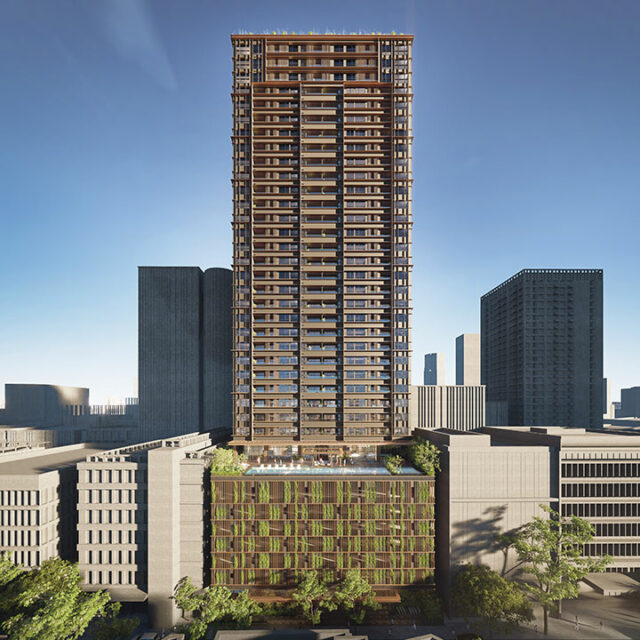
SONDRIS FACADE — ARTHALAND CORP.

LISTED Arthaland Corp., through its subsidiary Zileya Land Development Corp., has started construction of the 37-story Sondris residential tower along Arnaiz Avenue in Makati.

The project is a partnership with Mitsui Fudosan (Asia) Pte. Ltd., a subsidiary of Japan’s Mitsui Fudosan Co., Ltd.

“We are highly selective about the developments we choose to invest in, and our participation reflects our firm belief in the strengths, vision, and high standards of this project,” Mitsui Fudosan (Asia) Deputy General Manager Tan Yan Fen said in a statement on Monday.

“It also underscores our confidence in the Philippine market and our long-term commitment to contributing meaningfully and responsibly to the country’s growth.”

Mitsui Fudosan Co., Ltd., a major Japanese real estate firm with $62 billion in assets as of December 2024, develops mixed-use neighborhoods integrating offices, retail, logistics, hotels, resorts, and residences across Japan. The company also operates in key cities in North America, Europe, China, Taiwan, Southeast Asia, Australia, and India.

Under the partnership, Arthaland will oversee development and operations, drawing on Mitsui’s global expertise in design and property management.

The tower will feature 252 units, including one-bedroom units of 46-61 square meters (sq.m.), two-bedroom units of 91-114 sq.m., three-bedroom units of 135-137 sq.m., and Garden units of 180-230 sq.m. Larger units include balcony Sun Rooms with three interior packages: Timeless and Transitional; Modern and Industrial; and Formal and Serene.

The site offers views of San Lorenzo Village and the Makati skyline and is near EDSA, Skyway, business districts, museums, shops, and hospitals.

“Sondris, which is a coined name rooted in empathy, authenticity, and the presence of living fully in a space, embodies our commitment to creating a home that puts people, wellness, and sustainability at the center,” Arthaland Executive Vice-President and Chief Sustainability Officer Oliver L. Chan said.

Like other Arthaland developments, Sondris aims to meet stringent sustainability and wellness standards for multi-certification from LEED, WELL, EDGE, and BERDE.

Project turnover is scheduled for April 2030.

Arthaland Corp. shares rose 1.12% to P0.45 apiece on Monday. — Alexandria Grace C. Magno

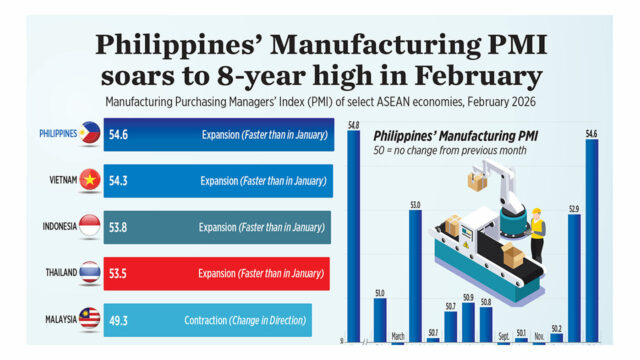
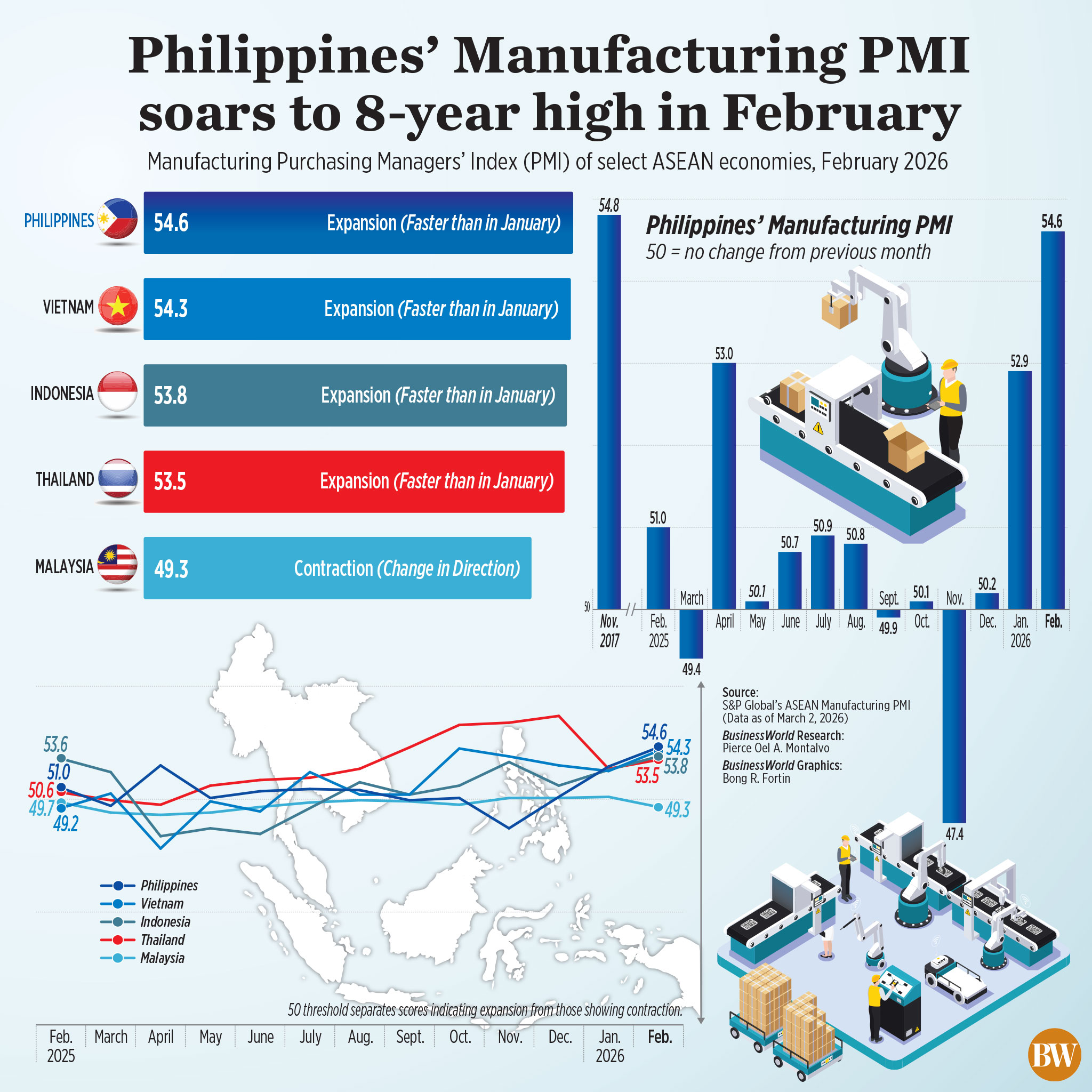
Philippines’ Manufacturing PMI soars to 8-year high in February

PHILIPPINE FACTORY activity in February expanded at its fastest pace in eight years amid an increase in production and new orders as well as a “surge in business confidence,” S&P Global said on Monday. Read the full story.

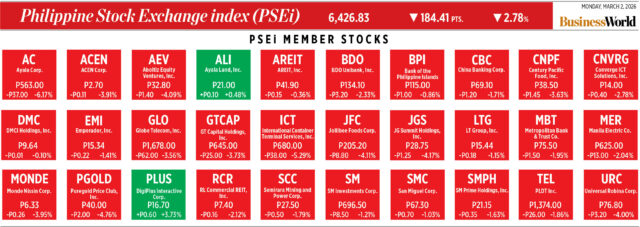
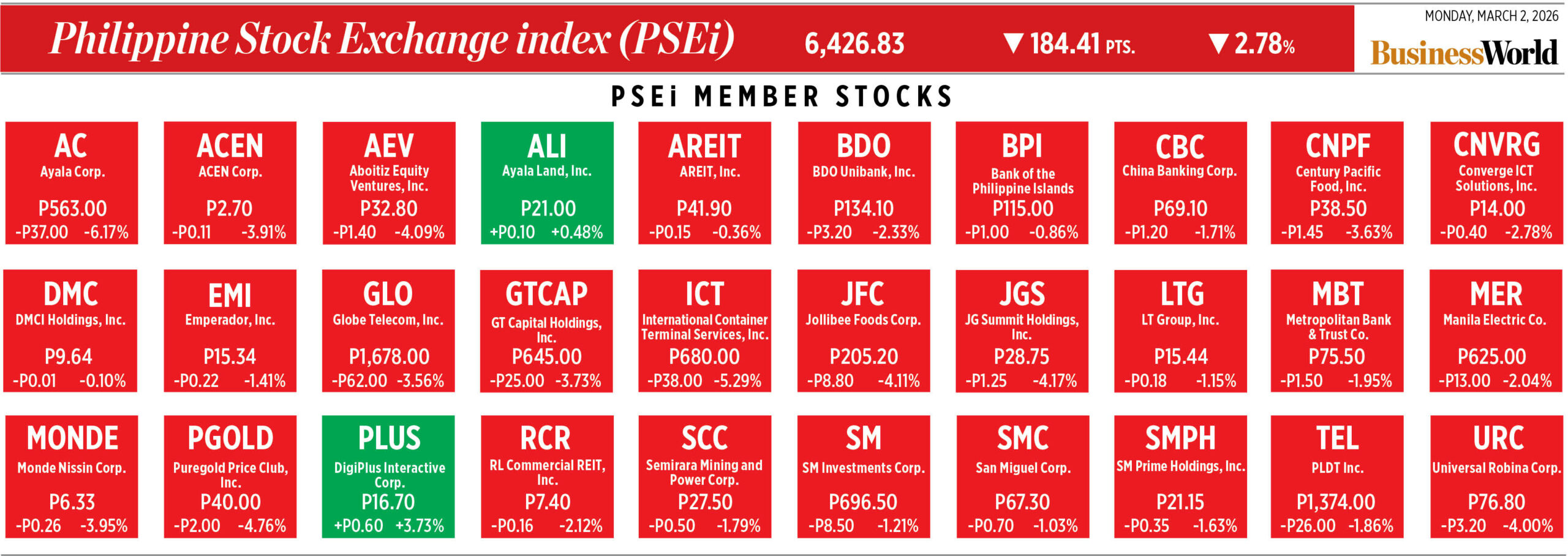
How PSEi member stocks performed — March 2, 2026

Here’s a quick glance at how PSEi stocks fared on Monday, March 2, 2026.


Philippine government prepares OFW repatriation amid war in Middle East

Smoke rises after reported Iranian missile attacks, following strikes by the United States and Israel against Iran, in Manama, Bahrain, February 28, 2026. — REUTERS/STRINGER TPX IMAGES OF THE DAY

MORE than 80 overseas Filipino workers (OFWs) in the United Arab Emirates (UAE) have requested repatriation amid escalating war in the Middle East, the Department of Migrant Workers said on Monday.

Fifty-two Filipinos in Israel have also sought voluntary return.

Migrant Workers Secretary Hans Leo J. Cacdac said mass repatriation is not yet required because Alert Level 4 has not been raised outside Syria and Yemen.

“Although the airspace in Dubai and the airports are closed, we are prepared to provide the 80 who need repatriation assistance with temporary basic needs and shelters,” he told a news briefing in Filipino. “At the appropriate time, they will be evacuated to the country.”

The Middle East is home to more than 2.4 million OFWs working in hospitals, homes, construction and other sectors. Remittances from these workers remain a key component of the Philippine economy, providing critical foreign exchange inflows.

Air transport remains a major challenge. “We are finding ways to ensure their safe return, but at this stage, air options are not yet viable, particularly in the UAE,” Mr. Cacdac said. He added that the government is coordinating with embassies, consulates and private companies to prepare land, sea and air options for repatriation if the situation worsens.

The UAE hosts the biggest concentration of Filipino labor in the region, with roughly 400,000 in Dubai alone, and about one million nationwide. Mr. Cacdac said the Philippine government is coordinating closely with the Department of National Defense and other agencies to ensure military assets, including C-130 transport aircraft, are available for evacuation if needed.

For returning OFWs, the government is preparing livelihood and reintegration support. The Department of Trade and Industry will facilitate livelihood initiatives, while recruitment agencies may help with redeployment opportunities, including transfers to other countries.

The Department of Labor and Employment will provide local employment placements via Public Employment Service Offices, and the Technical Education and Skills Development Authority will offer reskilling and retooling programs.

Meanwhile, one OFW in Israel was killed after being struck by shrapnel from falling explosives. The victim, Mary Ann Velasquez De Vera, 32, a domestic worker from Pangasinan, could not yet be repatriated due to airspace restrictions, but her family will receive government assistance, Mr. Cacdac said.

The crisis follows coordinated US and Israeli airstrikes on Tehran’s military assets over the weekend, targeting Iran’s alleged nuclear weapon program.

Iran retaliated with missile strikes against countries hosting US bases, including Iraq, the UAE, Kuwait, Bahrain, Qatar and Saudi Arabia.

Senator Rafael T. Tulfo, chairman of the Senate Migrant Workers Committee, called on the government to extend aid to undocumented OFWs in the region.

“Whether they are undocumented or not, they should be given the necessary help from the government,” he told a news briefing. He also cited the need to help stranded tourists.

The Armed Forces of the Philippines remain on standby with C-130 transport aircraft for evacuation, Mr. Tulfo said.

The senator on Monday filed a resolution urging the Senate to investigate the potential economic and security impacts of the US-Iran war.

Senator Ana Theresia Hontiveros-Baraquel urged continuous support for repatriated OFWs, highlighting assistance for reintegration into the workforce or enterprise.

She also called on the Department of Energy to strengthen measures to secure the country’s energy supply amid projected spikes in global oil prices.

“They should also prepare a comprehensive and longer-term plan for energy security because we don’t know how long this will last,” she told a separate press conference.

The situation underscores the Philippine government’s dual challenge: protecting millions of OFWs abroad while mitigating domestic economic risks tied to energy and remittances.

Officials are also closely monitoring global developments, including potential supply chain disruptions and price fluctuations, that could affect both labor mobility and domestic economic stability. — Chloe Mari A. Hufana and Adrian H. Halili

ADVERTISEMENT
ADVERTISEMENT