Home Blog Page 218

Goldman CEO says markets may take ‘couple of weeks’ to digest Iran war impacts

REUTERS

SYDNEY – Goldman Sachs CEO David Solomon said on Wednesday that he was surprised at the “benign” reaction in financial markets over the conflict in the Middle East, and it may take a “couple of weeks” for investors to more fully digest the impacts.

“I look at the market reaction, and I’m actually surprised that the market reaction has been more benign given the magnitude of this as you might think,” Mr. Solomon said in a speech at a business summit in Sydney.

Mr. Solomon said markets tend to react in a muted way to geopolitical events unless they have a direct impact on economic growth.

“There’s a cumulative effect of everything that’s happening and a much harsher reaction. Up to this point, we haven’t seen that cumulative effect,” he said. “But it’s very hard to speculate because there is so much that is unknown at this point.”

“I think it’s gonna take a couple of weeks for markets to really digest the implications of what has happened both in the short term and medium term, and I can’t speculate as to how that would play out,” he said.

Oil prices have spiked as the widening conflict stoked supply worries, exacerbating investor concerns about inflation.

Global stock indexes have slumped while the US dollar has strengthened as investors sold riskier assets and flocked to traditional safe havens.

However, Wall Street losses have been relatively mild, with the S&P 500 down less than 1% this week after paring early losses into the close on both trading days.

Mr. Solomon said a combination of factors, including an easing monetary cycle and a significant relaxation of regulatory practices, had helped keep the US economy in solid shape.

“Let us put aside what’s going on in the Middle East at the moment,” he said. “We have a confluence of strong macro tailwinds that make the economic growth trajectory of the United States, I think, quite compelling.” — Reuters

Philippines, South Korea leaders pledge closer cooperation as geopolitical uncertainty mounts

President Lee Jae Myung of the Republic of Korea and President Ferdinand R. Marcos Jr. shake hands at the President's Hall in  Malacañan Palace during their joint press statement, Mar. 3, 2026.—PPA POOL/ MARIANNE BERMUDEZ

MANILA — Philippine President Ferdinand Marcos met South Korean President Lee Jae Myung in Manila on Tuesday, where they discussed ways to deepen economic and security ties.

President Lee was in Manila on a state visit.

  • Mr. Marcos said both sides “recognize growing uncertainty in geopolitical developments,” and agreed on the need to uphold a rules‑based international order, including in the maritime domain.
  • The Philippines and South Korea agreed to expand cooperation in shipbuilding, nuclear energy and artificial intelligence.
  • Mr. Lee said the two countries will also cooperate in infrastructure and defense industries.
  • Mr. Lee added that South Korea and the Philippines plan to work together on critical minerals and supply chains.
  • The two leaders also discussed the situation in the Middle East during their talks.
  • South Korean companies will help the modernization of the Philippine military, Mr. Lee said.
  • The countries signed MOUs in various sectors, including digital technology, procurement of specific defense equipment, agriculture, intellectual property, foreign language education, culture, and police investigations.

— Reuters

Airline, travel industries scramble with fallout from Middle East conflict

Photo from www.facebook.com/DOTrPH

LONDON/CHICAGO/SYDNEY —- The airline and tourism industries scrambled to deal with the fallout from the escalating US and Israeli air war against Iran, while governments rushed to bring stranded travelers home from the Middle East following the cancellation of more than 20,000 flights in recent days.

Major Gulf hubs including Dubai, the world’s busiest international airport, remained closed or severely restricted for a fourth day, leaving tens of thousands of passengers stranded. According to Flightradar24, some 21,300 flights have been canceled at seven major airports including Dubai, Doha, and Abu Dhabi since the strikes started.

The attacks have upended travel across a growing region with several thriving business hubs that are trying to diversify away from oil-dominated economies. The turmoil also narrows an already-slim flight corridor for long-haul flights between Europe and Asia, complicating operations for global air carriers.

Stranded travelers across the Gulf rushed to secure seats on a limited number of repatriation flights as governments moved to bring passengers home even as explosions tore through Tehran and Beirut. Emirates, flydubai and Etihad have been operating a limited number of flights since Monday, mostly to repatriate stranded passengers.

“It’s pretty well the biggest shutdown we’ve seen certainly since the COVID pandemic,” said Paul Charles, CEO of luxury travel consultancy PC Agency, adding that beyond passenger disruption the cargo impact would run to “billions of dollars.”

Many passenger airlines also move cargo in their aircraft bellies, resulting in disruptions to air freight. Cargo specialist FedEx said by email it was using “contingency measures” it did not describe in the Middle East, after saying earlier in the day that it had resumed pickup and delivery services in the region where possible.

EMERGENCY EVACUATIONS
The United Arab Emirates government said 60 flights had taken off, operating in dedicated emergency air corridors. The next phase will be operating more than 80 flights.

The United States is securing military and charter flights to evacuate Americans from the Middle East, a US State Department official said on X on Tuesday, adding that it was in contact with nearly 3,000 US citizens. The department was under fire from US lawmakers who said the Trump administration should have advised people to leave before the attacks started.

Delta Air Lines said on Tuesday it paused New York-Tel Aviv flights through March 22 because of the conflict and was offering rebooking options and a travel waiver for affected customers through March 31.

Demand for alternatives to Gulf airlines has surged, with bookings and ticket prices jumping on routes like Hong Kong-London, Reuters’ checks showed on Tuesday. Should the conflict drag on, it could cost the Middle East billions in tourism dollars, analysts estimate.

“We can’t get home, we can’t go back to work, we can’t get the kids back to school,” said Tatiana Leclerc, a French tourist stuck in Thailand, whose flight had been set to go via the Middle East hubs that are a key link between Asia and Europe.

In an early sign of a thaw, Virgin Atlantic said on Tuesday it would resume services as scheduled between London’s Heathrow Airport and Dubai or Riyadh.

AIRLINE STOCKS SLIP
Shares of air carriers worldwide fell on Tuesday. The operational and financial effect varies significantly among airlines, said Karen Li, JP Morgan’s head of Asia infrastructure, industrials and transport research.

“There are important differences across carriers in terms of hedging strategy, air cargo exposure, and network rerouting capabilities that will shape the actual impact from the Middle East situation,” Li said.

Oil prices have surged amid the widening conflict. Benchmark crude is up roughly 30% so far this year, threatening to lift jet fuel costs and squeeze airline profits. Most US airlines long ago gave up on hedging fuel purchases, their second-largest operating cost behind labour.

In its latest annual filing, Delta said every one-cent increase in the price of jet fuel per gallon added about $40 million to its yearly fuel bill. A 10% increase would add $1 billion to Delta’s 2026 fuel bill, Third Bridge analyst Peter McNally said.

Shares of most US carriers ended lower, with Southwest down about 1% and Alaska Air off roughly 2%.

In Europe, shares of Wizz Air, British Airways owner IAG, Lufthansa, and Air France KLM ended down 5% to 8%.

Ryanair CEO Michael O’Leary told Reuters the airline was hedged for the next 12 months at about $67 a barrel and that the recent fluctuations would not impact the business. Its stock fell 2.2% on Tuesday.

Qantas Airways CEO Vanessa Hudson said the airline has “pretty good” fuel hedging but the spike in oil prices was significant for the industry. The Australian airline’s shares fell 1.8%.

Shares of Japan Airlines closed down 6.4%, while Korean Air Lines dropped 10.3%, its biggest fall since March 2020, as it resumed trading after a public holiday on Monday.

Shares of major Chinese carriers including Air China and China Southern Airlines lost between 2% and 4% in Hong Kong and Shanghai. — Reuters

When good intentions get misread

Why generational fluency matters

Since 2014, Acumen has led a multi-year generational study in the Philippines, mapping the shifting values, fears, and aspirations that drive behavior and decision-making. Project Alphabet is the latest in this series of studies conducted in 2025, with data and insights that can help companies better understand the evolving multi-generational Philippine consumer and workforce.

Generational Fluency is one of the key concepts laid out in Project Alphabet. Read on to get a glimpse of why it is a strategic skill for leaders, teams, and organizations in today’s workspaces.

Have you ever said something in a meeting and suddenly felt the air shift, like you had triggered tension you never intended?

I have been there.

Once, I gave what I thought was simple feedback to a group of young analysts. Nothing dramatic, just notes for revision. But the reaction was intense. Another time, I suggested improving a process an older colleague had built years ago. The response was immediate defensiveness.

As we analyzed the data and interviews from Project Alphabet, our latest study on Filipino generations, I realized my own experiences were not isolated moments. We kept hearing the same stories, only told from different sides.

The younger colleague was not resistant to feedback. What hurt was feeling their effort was unseen.

The older colleague was not against change. What they resisted was the sense that their contribution no longer mattered.

That was the turning point.

Across generations, people actually want the same things at work. Respect, trust, growth, and the chance to contribute. But each generation interprets these differently based on the context they grew up in.

When those contexts collide without understanding, miscommunication turns into misalignment, and eventually mistrust.

Here is where Generational Fluency comes in. But what is it?

It is about empathy, language, and awareness to see beyond the labels and to harness the strengths of all four generations together.

As of 2024, Generation Y (born between 1981 to 1996) and Generation Z (1997 to 2012) make up 75% of the Philippine workforce. The older Gen X (1965-1980) and Baby Boomers have become a minority but they still hold majority of senior leadership roles.

It is this new mix that is driving much of the tension seen in the workplace today.

The evolving workforce composition demands that organizations pay close attention to its implications.

Companies are feeling the strain as long-established systems built on stability and uniformity are being challenged by growing demands for flexibility, transparency, and personalization. These demands are shaped by the different values and priorities that the younger generations bring into the workplace.

Generational Fluency is the ability to understand the perspective each generation brings and intentionally bridge those differences to unlock stronger collaboration and better outcomes.

What surprised us most in Project Alphabet was this: These misreads do not only affect workplace relationships. They influence how teams make decisions, how leaders manage change, and even how organizations understand their customers.

In highly competitive environments, teams that lack Generational Fluency often struggle to align internally, resulting in slower execution, weaker strategies, and messages that fail to connect externally.

Organizations that build this fluency see something different. Clearer communication, stronger leadership alignment, and sharper understanding of evolving customer expectations.

WHAT THIS MEANS FOR COMPANIES

We must emphasize that Generational Fluency is not simply a soft skill. It has structural implications.

For leaders, it is a capability that must be intentionally developed within teams. Many organizations are embedding generational fluency into leadership and commercial capability programs to strengthen execution and collaboration.

For organizations navigating changing customer expectations, it becomes a strategic advantage. Generational insight can sharpen value propositions and inform more meaningful customer experiences, especially as expectations evolve across generations of customers.

For family enterprises transitioning leadership across generations, it can mean the difference between continuity and conflict. We often see this emerge most strongly in family corporations navigating succession and professionalization journeys.

From the research, here are a few ways organizations can begin building generational fluency:

Listen for intent, not just words. Pause before reacting and ask, “What did they really mean?” Curiosity shifts conversations away from conflict and toward collaboration.

Respect the past, invite the future. Acknowledging what has worked creates psychological safety for innovation. Legacy and progress are not opposites. They are partners.

Clarity is crucial. Make assumptions, expectations, and decision rules explicit. What feels obvious to one generation is often invisible to another.

Organizations can move beyond misreads, recognize each generation’s strengths, and build workplaces and businesses that work better because of their differences, not despite them.

If these challenges sound familiar, we invite you to explore more insights from Project Alphabet and how Generational Fluency can be applied within your organization. — Andrea Tamayo-Oliveros, Senior Strategist, Acumen (www.acumen.com.ph)


Spotlight is BusinessWorld’s sponsored section that allows advertisers to amplify their brand and connect with BusinessWorld’s audience by publishing their stories on the BusinessWorld Web site. For more information, send an email to online@bworldonline.com.

Join us on Viber at https://bit.ly/3hv6bLA to get more updates and subscribe to BusinessWorld’s titles and get exclusive content through www.bworld-x.com.

Disney Adventure arrives in Singapore

A water salute and fireworks display welcomed the Disney Adventure as it docked at the Marina Bay Cruise Centre Singapore, March 3. -- Disney Cruise Line

Disney Cruise Line’s (DCL) newest cruise ship, the Disney Adventure, arrived on Tuesday at its new home port of Singapore, as it prepares for its maiden voyage on March 10.

“The arrival of the Disney Adventure in Singapore marks a significant milestone in our global expansion, introducing Disney cruising to Asia for the very first time,” Joe Schott, president of Disney Signature Experiences, said in a statement.

“Honoring Disney Cruise Line’s legacy of unforgettable journeys, our newest ship brings together our signature storytelling and creativity in an exciting new destination,” he added.

The Disney Adventure was welcomed with a water salute and fireworks at the Marina Bay Cruise Center Singapore.

“Disney Cruise Line’s decision to homeport their newest ship in Singapore is a testament to our appeal as a premier cruise destination. Singapore’s repertoire of compelling onshore tourism experiences is a fitting complement to the Disney Adventure’s unique entertainment-led vacation at sea,” Melissa Ow, chief executive of the Singapore Tourism Board, said.

The ship offers three- and four-night sailings at sea, continuing the Disney Cruise Line’s tradition of delivering “the most magical and relaxing vacations at sea” with an immersive Disney storytelling experience. — Cathy Rose A. Garcia

Budget gap exceeds ceiling in 2025

Men are seen working on the rehabilitation of Epifanio de los Santos Avenue (EDSA) in Pasay City. — PHILIPPINE STAR/ RYAN BALDEMOR

By Justine Irish D. Tabile, Senior Reporter

THE NATIONAL Government’s (NG) budget deficit breached its 2025 ceiling after the main tax agencies missed their collection targets and state spending slowed amid a corruption scandal, the Bureau of the Treasury (BTr) said.

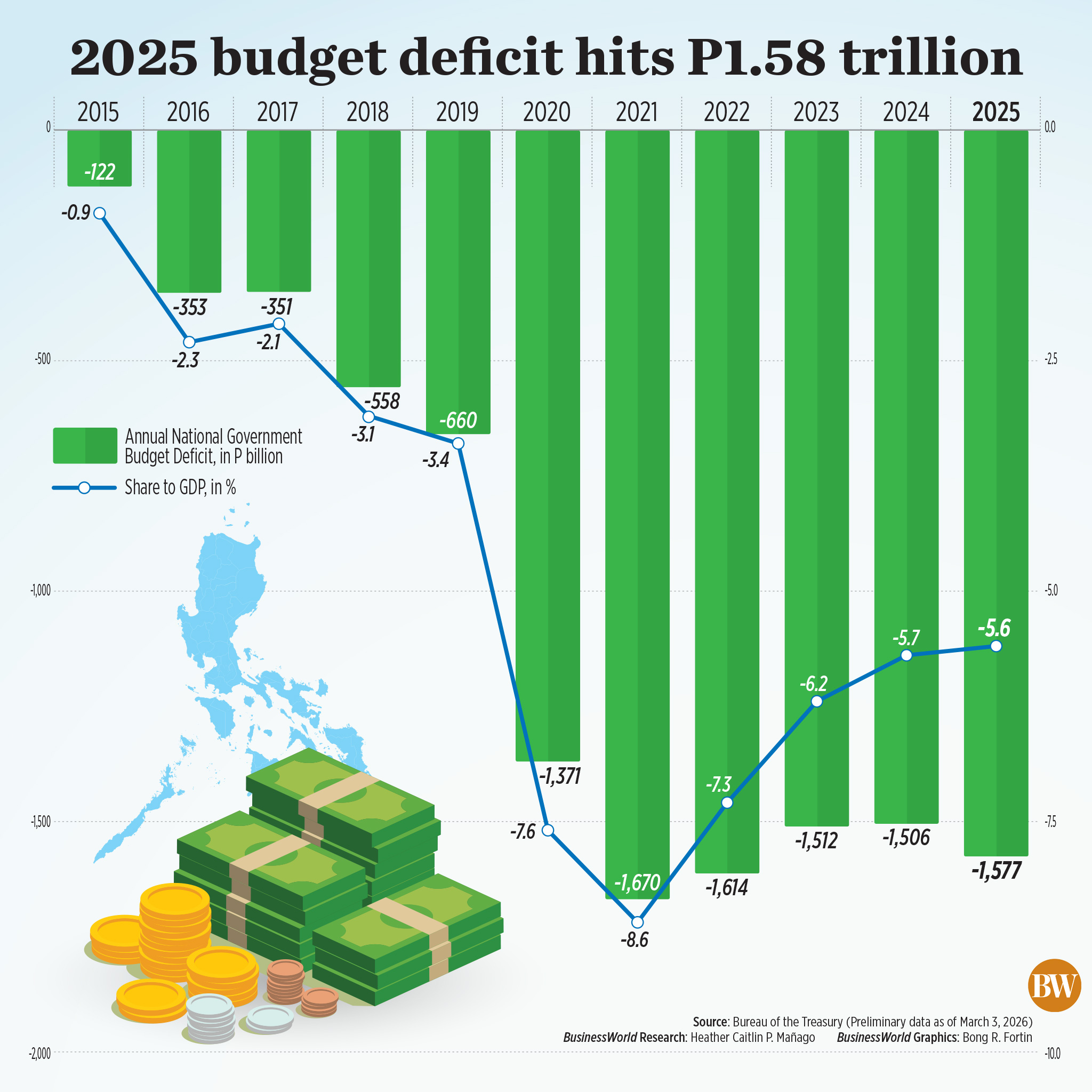
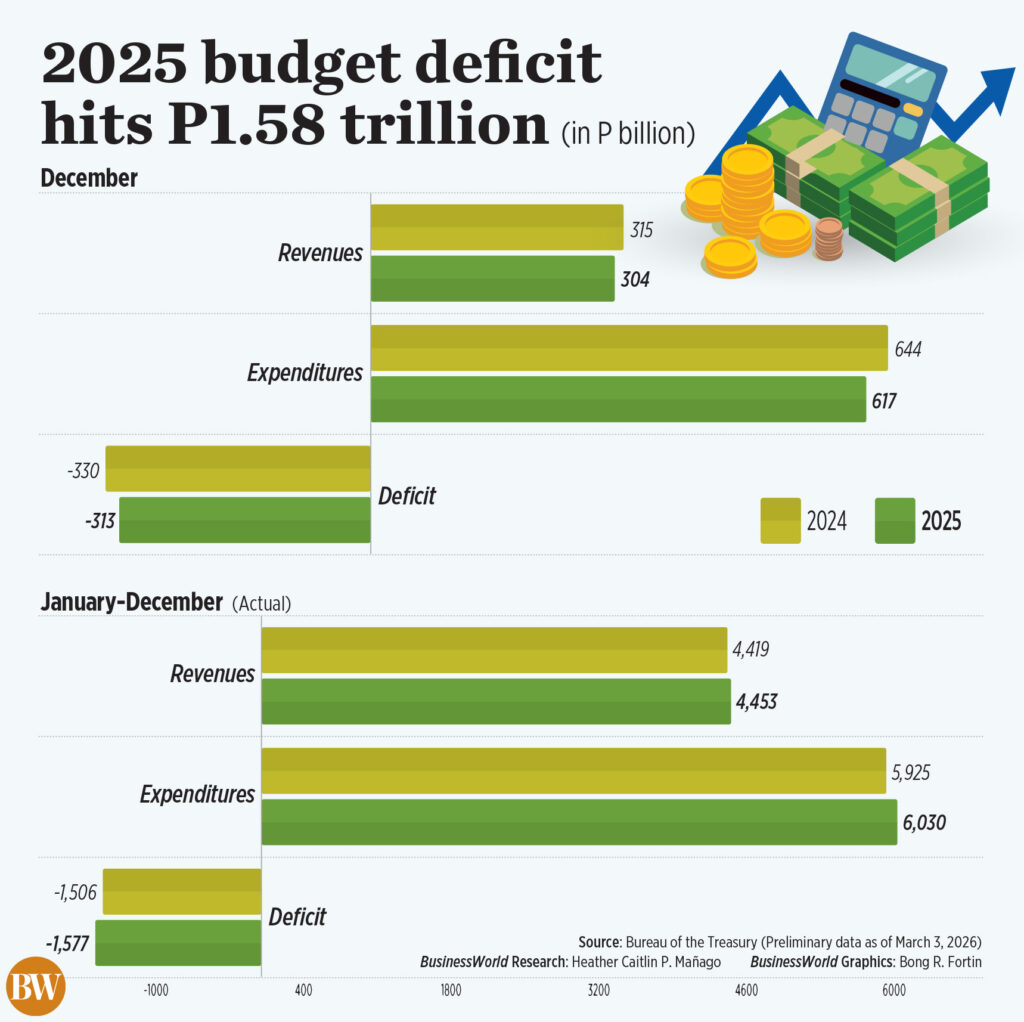
Data from the Treasury released on Tuesday showed that the budget deficit widened by 4.68% or P70.5 billion to P1.58 trillion in 2025 from P1.51 trillion in 2024.

It exceeded the P1.56-trillion deficit ceiling set by the Development Budget Coordination Committee for 2025 or by P15.1 billion.
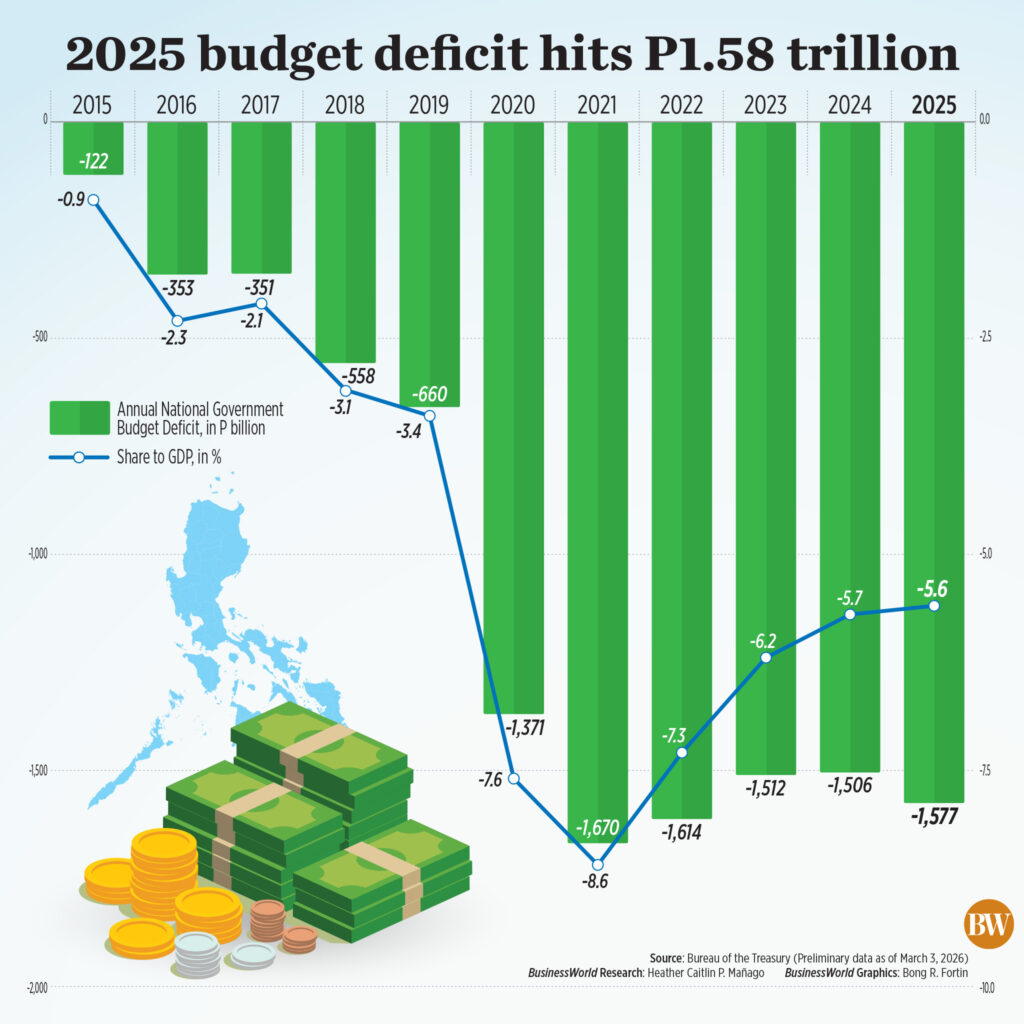
“The deficit only slightly exceeded the 2025 target by 0.97% as the 1.48% shortfall in revenue collections was partly offset by spending restraint, with actual disbursements kept below the programmed level by 0.85%,” the Treasury said.

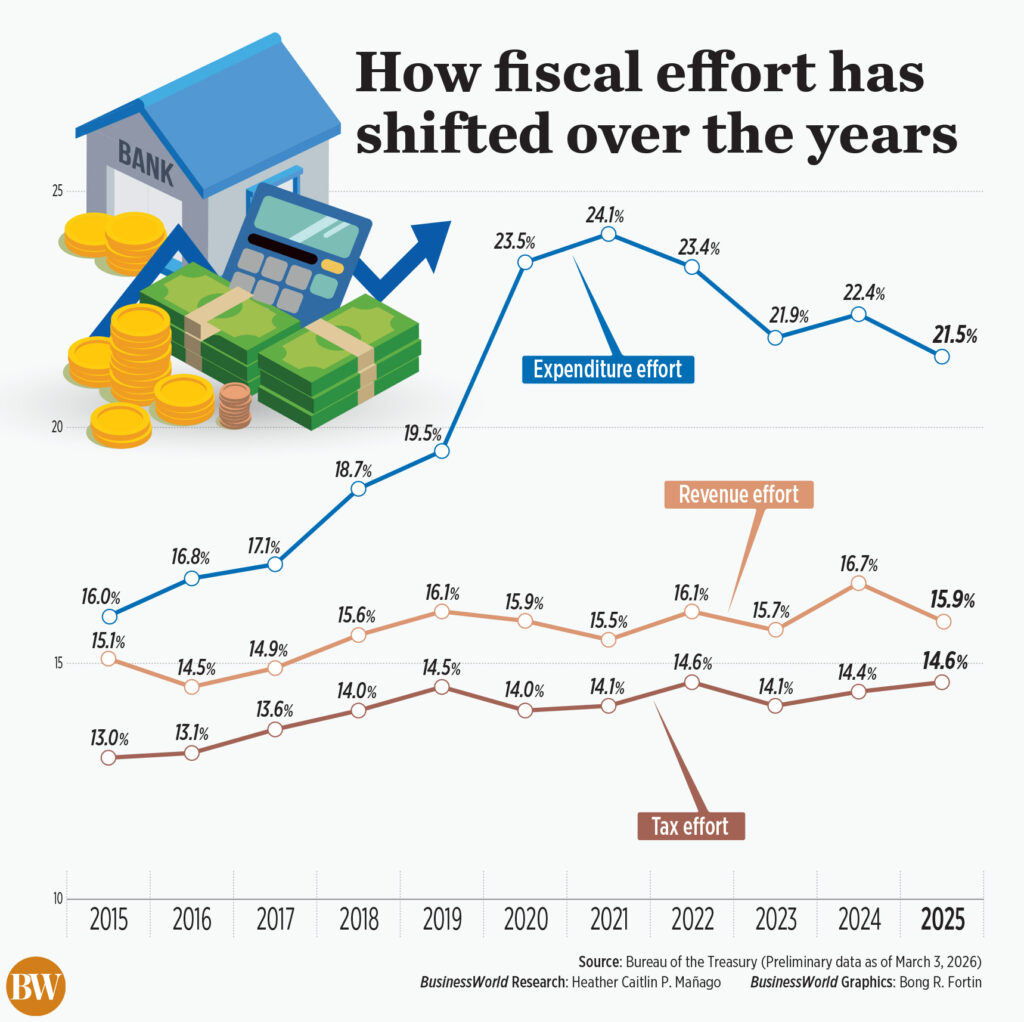
As of end-2025, the deficit as a share of gross domestic product (GDP) settled at 5.63%, reflecting an improvement from the 5.7% in 2024 but slightly higher than the 5.5% target.

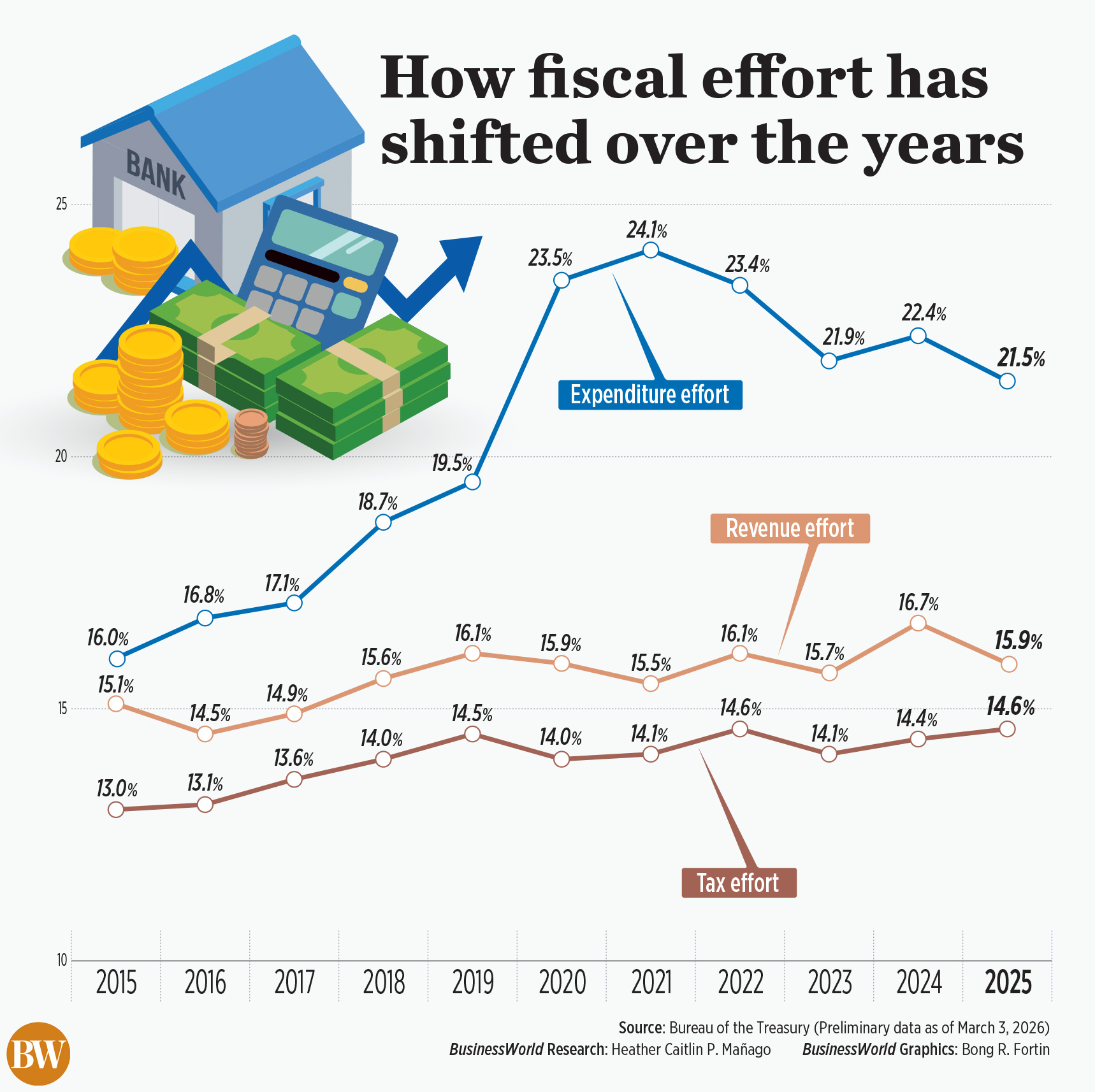
BTr data showed revenue collection inched up by 0.78% to P4.45 trillion, higher than the P4.42 trillion collected in 2024.

“The revenue uptake fell short of the revised fiscal year 2025 program of P4.52 trillion by P67 billion, as the P69.8-billion overperformance in nontax revenues was not enough to offset the P136.8-billion shortfall in tax collections,” it said.

Tax revenues, which accounted for 91.55% of the total revenues, jumped by 7.27% to P4.08 trillion in 2025, but 3.25% below the P4.52-trillion program.

Broken down, collections by the Bureau of the Internal Revenue (BIR) increased by 9.06% year on year to P3.11 trillion from P2.85 trillion collected in 2024.

“This growth was driven by stronger collections from corporate income tax, personal income tax, value-added tax (VAT), documentary stamp tax, and excise tax on tobacco,” the Treasury said.

However, BIR collections were 3.41% lower than the P3.22-trillion target for the year due to a pause in payments for infrastructure-related government contracts amid investigations into flood control projects and the temporary suspension of audit operations.

On the other hand, the Bureau of Customs’ (BoC) revenues inched up by 1.75% to P932.7 billion in 2025 from the P916.7 billion collected a year prior, amid strengthened enforcement measures and better monitoring of import declarations.

“VAT remained the principal driver of growth among the import taxes, with excise collection likewise posting year-on-year gains, effectively mitigating the significant effect of the decline in collections from import duties,” it said.

However, BoC collections were 2.72% short of its P958.7-billion target for the year due to “weaker import volumes, the suspension of rice importation, and lower global oil and commodity prices.”

Meanwhile, nontax revenues, which accounted for 8.45% of the total receipts, slumped by 39.15% to P376.3 billion in 2025 from P618.3 billion in 2024. However, it exceeded the full-year target of P306.5 billion by 22.77%.

“This drop was mainly due to the expected absence of one-time remittances received in 2024,” the BTr said. “However, full-year nontax collections surpassed the revised target… largely due to above-target performance of BTr income, particularly from its operations and dividend collections.”

The Treasury’s income declined by 17.7% to P233.2 billion last year, due to the base effect of non-recurring windfall receipts and the impact of interest rate cuts on income from investments and deposit earnings.

Despite the decline, BTr’s income still surpassed the P179.2-billion target for 2025 by 30.11% amid stronger dividend remittances, income from managed funds, higher interest income on government deposits, and guarantee fee collections.

The BTr also attributed this to the NG share from the profits of Philippine Amusement and Gaming Corp. and the Manila International Airport Authority’s terminal fees.

Revenue from other offices declined by 57.29% to P143.1 billion in 2025 but exceeded its P127.2-billion program by 12.43%.
SPENDING SLOWDOWN
Meanwhile, government expenditures edged up by 1.77% to P6.03 trillion in 2025 from P5.93 trillion a year prior. This was 0.85% below the P6.08-trillion annual program.

“The increase in spending was primarily driven by higher allocations for the National Tax Allotment to local government units, interest payments, and personnel services expenditures due to the implementation of the second tranche of salary adjustment of qualified civilian government employees,” the BTr said.

However, it said that the lower-than-program-level disbursements resulted from “proactive fiscal management, including stricter oversight on infrastructure projects linked to corruption scandals.”

Primary spending — which refers to total expenditures minus interest payments — was flat at P5.166 trillion last year from P5.162 trillion a year prior. It was also 1.3% short of the programmed P5.23 trillion.

Interest payments jumped by 13.21% to P864.1 billion in 2025 due to the “additional debt incurred to support the deficit program and the repricing of matured pandemic debt at higher prevailing rates.” This is 1.9% higher than the programmed P848 billion for 2025.

The full-year expenditure was 21.53% of GDP, slightly above the 21.45% target for 2025, but lower than the 22.41% seen in 2024.
DECEMBER DEFICIT
In December alone, the NG’s budget deficit narrowed by 4.96% to P313.2 billion from P329.5 billion in the same month in 2024.

Revenue collection declined by 3.31% to P304.3 billion in December as nontax revenues plunged by 59.31% to P25.7 billion.

This is as Treasury’s revenues fell 64.42% to P18 billion, and other offices’ revenues dropped by 38.47% to P7.6 billion.

However, tax revenues jumped by 10.73% in December to P278.6 billion as BIR collections went up by 11.08% to P204.2 billion, while Customs collections rose by 9.75% to P73.2 billion.

On the other hand, government spending slid by 4.15% to P617.4 billion in December, even as interest payments rose by 9.75% to P63.6 billion. Primary spending contracted by 5.53% to P553.8 billion.

Rizal Commercial Banking Corp. Chief Economist Michael L. Ricafort said that last year’s budget deficit could have been wider if not for government underspending on infrastructure.

“Going forward, geopolitical risks, especially in the Middle East, could lead to higher inflation that could bloat government spending,” he said in a Viber message.

He said the government’s catch-up spending plan, particularly for infrastructure, could also lead to a wider budget deficit.

Union Bank of the Philippines Chief Economist Ruben Carlo O. Asuncion said that the National Government’s slightly higher budget deficit in 2025 “was driven mainly by weaker‑than‑expected tax collections, even as spending remained below program.” 

“Despite these pressures, disbursements were kept 0.85% below the full-year program due to tighter project oversight, indicating that the deficit expansion was rooted in revenue underperformance rather than overspending,” Mr. Asuncion said in a Viber message.

“Looking ahead to 2026, the fiscal position is expected to improve modestly, supported by recovering tax operations as administrative disruptions ease and by continued fiscal consolidation efforts, although elevated interest payments — which rose 13.21% in 2025 — will remain a structural constraint,” he added.


Marcos wants ‘special powers’ to lower fuel taxes

A gas attendant is at work at a gasoline station in Manila in this file photo. — PHILIPPINE STAR/NOEL PABALATE

By Chloe Mari A. Hufana, Reporter

PRESIDENT Ferdinand R. Marcos, Jr. on Tuesday said he might seek “special powers” to temporarily lower the excise tax on petroleum products, as the Middle East war threatens to trim the Philippines’ economic growth this year.

At a news briefing, the President framed the possible tax relief as a direct measure to ease the burden on Filipino consumers, who are already feeling the impact of higher fuel costs.

“We are discussing [with lawmakers], and it could be helpful to give the President the authority to reduce the excise tax on petroleum products should Dubai crude exceed $80,” Mr. Marcos said. “We’re not yet there. But if that happens, then maybe this is one tool that we will have.”

Mr. Marcos said he will discuss the proposed lower excise tax with Congress leaders, adding that it will only be a temporary measure.

“It is not going to be a permanent measure. It will be something that we will dispose of as soon as the crisis is over,” he said.

Finance Secretary Frederick D. Go said the economic team will work with Congress to give the President the authority to temporarily cut excise taxes on fuel if Dubai crude oil breaches the $80-per-barrel level.

“To be clear, this does not mean the authority will be automatically exercised. It is a precautionary measure — a ready policy tool that the President may use, if necessary, to act swiftly in protecting Filipino consumers and safeguarding the broader economy,” Mr. Go said in a statement.

Under the Tax Reform for Acceleration and Inclusion (TRAIN) law, excise taxes on all oil and fuel products were increased in three tranches from Jan. 1, 2018 to Jan. 1, 2020.

The TRAIN law also automatically suspends the excise tax on petroleum products if the average price of oil in the global market reaches $80 per barrel in the next three months.

The Philippines imports its oil mostly from the Middle East, making it vulnerable from geopolitical tensions that would impact domestic prices upward should they persist.

GROWTH AT RISK?
At the same time, Mr. Go told reporters the conflict could shave off as much as 0.25 percentage point (ppt) from the country’s economic output this year, highlighting the broader fallout of rising oil prices and global uncertainty.

Mr. Go said they are closely monitoring movements in global oil prices and the duration of the conflict and the possibility of sustained higher oil prices.

US President Donald J. Trump earlier said the war could last four to five weeks but may extend far longer.

“In one scenario that was looked at, I think there’s an impact on GDP (gross domestic product) of between 0.1 [ppt] and 0.25 [ppt],” he said.

According to Mr. Go, there is no need to revise this year’s 5-6% GDP growth target for now, noting global oil prices are currently around $76 to $78 per barrel.

Growth targets could be revised if oil prices rise to around $85 per barrel, he added.

SUSPENSION OF EXCISE TAX
Meanwhile, legislators are backing calls to suspend the collection of excise tax on fuel products.

“Now is the time to prepare before prices surge further,” Marikina Rep. Romero “Miro” S. Quimbo, who heads the Committee on House Ways and Means, said in a statement. “Congress must immediately pass a measure authorizing the President to suspend excise tax on fuel during extraordinary circumstances.”

Mr. Quimbo filed House Bill No. 8257 which seeks to grant the President authority to suspend or reduce excise taxes on petroleum products during national or global emergencies. However, it proposed that any suspension or cut in the fuel excise tax rate should be effective for a maximum of six months, unless extended by lawmakers through a joint congressional resolution.

The bill requires the President to submit to Congress within 15 days of issuing a suspension order a “factual basis” for halting or cutting excise taxes, including estimates of foregone revenue and the impact on inflation, fuel prices and economic activity.

Navotas Rep. Tobias Reynald M. Tiangco filed a joint congressional resolution that would allow Mr. Marcos to temporarily halt the collection of value-added tax (VAT) on fuel products.

At the Senate, Senator Emmanuel Joel J. Villanueva filed Senate Bill No. 1922 that seeks to provide the President with powers to suspend or reduce excise tax on gasoline and diesel once the average price of crude oil exceeds $80 per barrel.

Under the bill, the President can suspend or reduce the excise tax on fuel through an executive order, upon the recommendation of the Energy and Finance secretaries.

The bill also provides for the automatic lifting of the suspension once global oil prices stabilize.

Senator Paolo Benigno “Bam” Aquino IV also filed Senate Bill No. 1923, which proposes to suspend the excise tax imposed in cases of national emergencies or when public interest requires it.

Senate Finance Committee Chair Sherwin T. Gatchalian expressed concern that the suspension of excise tax collection on petroleum products could hurt revenue collection, and impact economic growth.

He estimated the government may forego around P30 billion a month in revenues or around P300 billion in annual revenues due to the measure.

“If the option is to remove excise tax, there will be a lot of losses. My worry is that we’re coming from a slow growth. Maybe we won’t reach the target growth,” Mr. Gatchalian told reporters.

SECURE OIL SUPPLY
Meanwhile, Mr. Marcos said the Philippines has ample energy supply but urged the public to lessen energy use.

Mr. Go said the country’s oil supply is secure, as it has the flexibility to source from other oil-producing states.

“The Philippines maintains an adequate oil buffer equivalent to approximately 50 to 60 days of national demand, providing a cushion against short-term price volatility,” he said.

The President said he will also direct government agencies to minimize their energy use.

“We have given instruction to all government offices to find ways to save on energy. That applies — this is my call to the people as well — let’s find a way to reduce our use of all our sources of energy,” Mr. Marcos said.

Also, Mr. Marcos urged for restraint from all parties but noted the Philippines is only “tangentially” involved due to the number of Filipinos in the region.

“Let’s hope that there is a ceasefire, and we, the Philippines, ask all parties to show restraint and to bring this to a close as quickly as possible,” he said.

The Middle East is home to over 2.4 million migrant Filipino workers, who send a steady stream of remittances that is an important component of the Philippine economy. — with Kenneth Christiane L. Basilio and Adrian H. Halili

Philippines seen to be more affected by oil shock than Asia-Pacific peers

ATTENDANTS prepare to refuel vehicles at a gas station in Quezon City in this file photo. — PHILIPPINE STAR/MIGUEL DE GUZMAN

By Katherine K. Chan, Reporter

THE PHILIPPINES may bear the brunt of the global oil crisis amid the widening conflict in the Middle East compared with its peers in the Asia-Pacific region, a think tank said.

ING Think Regional Head of Research for Asia-Pacific Deepali Bhargava said the country might be worse off than its neighboring economies due to its vulnerability to oil price movements and limited subsidies.

“Several economies like Indonesia, Thailand and India are still partially shielded by fuel subsidies or regulated pricing, which dampens the direct pass through from global oil markets,” she said in a commentary released late on Monday. “On the other hand, the Philippines — also the worst impacted by higher oil prices — tends to see a stronger inflation hit because retail fuel prices are more market-driven and subsidies are limited.”

The Philippines, which imports at least 90% of its oil supply from the Middle East, could see its inflation climb up to 0.4 percentage point (ppt) for every 10% increase in oil prices, according to Ms. Bhargava.

On Tuesday, local fuel retailers imposed over P1-per-liter price increases, marking the 10th straight week of hikes for diesel and kerosene and eighth consecutive week for gasoline.

The Department of Energy  has warned that pump prices in the country will continue to spike amid escalating tensions in the Middle East, which is expected to last weeks.

Meanwhile, Pantheon Macroeconomics said the global oil shock has so far brought a “marginal” impact on inflation, though noted that they could raise their full-year Philippine inflation forecast to 2.8% from 2.6%.

“It’s certainly a concern considering that the Philippines is a net oil importer,” Miguel Chanco, chief Emerging Asia economist at Pantheon Macroeconomics, told BusinessWorld in an e-mail. “But, as things stand, which is an important caveat, the futures market suggests that the current spike in oil prices will eventually recede in the second half of this year.”

In 2025, headline inflation settled at 1.7% after a 1.8% uptick in December. The full-year print eased from 3.2% in 2024 and was the slowest rate in nine years or since the 1.3% clip in 2016.

However, inflation may pick up for a third straight month as costlier oil, electricity and rice could bring the headline print to 2.4% in February, according to the median estimate of a BusinessWorld poll of 17 analysts.

Most economic managers, if not all, have been expecting inflation to be on an uptrend starting this year, with some seeing it potentially hitting the upper end of the central bank’s 2%-4% target.

For Emilio S. Neri, Jr., lead economist at Bank of the Philippine Islands (BPI), rising energy prices amid ongoing geopolitical tensions could drive inflation toward 4% in the coming months. 

“The escalation introduces a renewed geopolitical risk premium into global markets, primarily via oil,” he said in a commentary. “For the Philippines, higher energy prices compound already elevated rice-driven inflation risks, potentially pushing headline inflation toward 4% in the coming months.”

“A renewed leg higher in global oil prices would amplify second-round effects through transport, electricity, and logistics costs, potentially broadening inflationary pressures beyond food and fuel,” Mr. Neri added.

ING’s Ms. Bhargava shared the same sentiment, noting that prolonged price shocks and foreign exchange volatility could bring Philippine inflation closer to 4%.

“Our base case had inflation across Asia rising but still staying within most central bank targets,” she said. “But a price shock of this magnitude — if it lasts — coupled with currency depreciation could push inflation, for example, in the Philippines to the upper end of Bangko Sentral ng Pilipinas’ (BSP) 2-4% inflation target, increasing the pressure on the central bank to hold rates instead of cutting further.”

Mr. Neri also noted that the BSP’s easing room may narrow if West Texas Intermediate oil price would reach $80 per barrel through June or if rice inflation keeps accelerating on a monthly basis.

The Monetary Board has been on an easing path since August 2024, having slashed the key policy rate by a total of 225 basis points to an over three-year low of 4.25%.

Following their first policy meeting this year, BSP Governor Eli M. Remolona, Jr. said they are now less certain about their policy outlook as they see tentative signs of economic recovery, even as their inflation expectations remain anchored.

FURTHER EASING
On the other hand, Capital Economics Chief Asia Economist Mark Williams and Asia Economist Gareth Leather still expect the BSP to keep cutting rates as they see a 0.5 ppt uptick in Philippine inflation, considering an $80-per-barrel Brent crude oil price, as “not a major concern.”

“Given the starting point — inflation in most countries is at or below target — this would not be a major concern,” they said in a commentary. “We would continue to expect further policy easing in several economies, most notably the Philippines and Thailand.”

However, they noted that the central bank may pause once oil prices hit $100 per barrel as it could push inflation up by over one percentage point.

Meanwhile, BPI’s Mr. Neri said they see the peso depreciating to P59.70 by yearend amid the ongoing conflict.

On Monday, the peso slid back to the P58-per-dollar level, breaking its five-day streak of closing at the P57-a-dollar mark, as uncertainty arises from the Middle East.

It weakened further to close at P58.435 against the greenback on Tuesday, down 23.5 centavos from its P58.20 finish on Monday, based on Bankers’ Association of the Philippines data.

Mr. Neri also noted that the conflict may disrupt remittance flows, especially with over 2.4 million Filipino migrants and laborers based in the Middle East.

“The conflict also poses downside risks to remittance flows,” he said. “Nearly 40% of overseas Filipino workers (OFWs) are based in the Middle East. However, cash remittances from the region accounted for approximately 18% ($6.5 billion) of total inflows ($35.6 billion) in 2025, suggesting that while risks are elevated, the overall impact may be contained than imagined unless the conflict significantly escalates.”

Last year, OFW remittances grew by 3.3% year on year to hit a record-high of $35.634 billion, with 18.19% or $6.481 billion sent home from the Middle East.

Petron profit jumps 84% to P15.6B on higher domestic sales

PETRON.COM

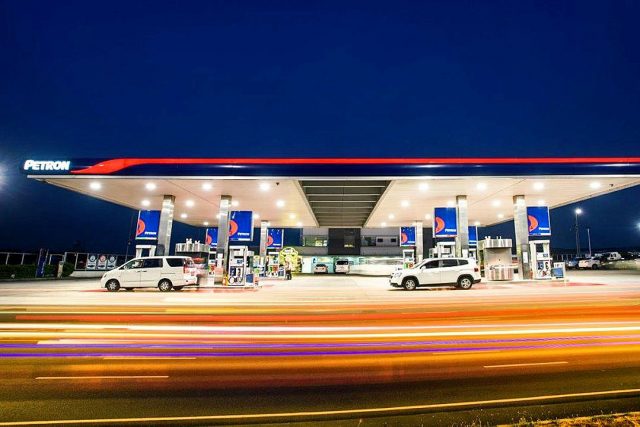
LISTED oil refiner Petron Corp. reported an 84% increase in net income to P15.6 billion in 2025, driven by sustained domestic volume growth, improved refinery productivity, and lower costs.

Revenues declined by 7% to P810 billion from P868 billion in 2024 due to weaker international prices, the company said in a statement on Tuesday. Petron has yet to release its full financial report for the period.

Petron’s operations in the Philippines and Malaysia posted a 3% year-on-year increase in total volumes to 113.4 million barrels.

The company said it maintained its leadership in the domestic market “amid tough competition.”

Volumes in Malaysia, meanwhile, remained steady “despite the demand correction following the change in the government-regulated pricing mechanism for fuels.”

Petron, which operates the country’s only remaining refinery, said it optimized plant utilization and benefited from favorable refining economics last year.

This came amid a weaker average price of Dubai crude, the regional benchmark, partly due to geopolitical developments and policy changes.

“Despite external challenges, we achieved growth across the business and emerged stronger in an unpredictable market,” Petron President and Chief Executive Officer Ramon S. Ang said.

He said the company would continue strengthening its supply chain and strategically expanding its footprint as it reinforces its position in the industry.

Petron retained its position as the Philippines’ top oil market player, with a 27.8% share as of the first half of 2025, according to the Department of Energy.

The company operates 50 terminals across the region and about 2,700 service stations and maintains a refining capacity of nearly 270,000 barrels per day.

At the local bourse on Tuesday, Petron shares rose 7.14% to close at P3.30 apiece. — Sheldeen Joy Talavera

Maynilad allocates P7.7B to reduce water losses

MAYNILADWATER.COM.PH

WEST ZONE concessionaire Maynilad Water Services, Inc. is earmarking around P7.7 billion for initiatives to reduce water losses and maximize available water supply across its service areas.

In a briefing on Tuesday, Ryan B. Zamora, Maynilad’s head for Central Non-Revenue Water (NRW), said most of the allocated investment will be used for pipe replacement.

“Recovering water through NRW reduction helps us optimize existing infrastructure and improve overall system efficiency,” Mr. Zamora said. “Much of this work happens underground through continuous monitoring and early leak detection before problems become visible at the surface.”

For 2026, NRW initiatives will support pipe replacement in high-loss areas, expanded leakage control activities, network diagnostics, and the continued evaluation of emerging technologies.

NRW refers to water that is not billed and is lost due to leaks or illegal connections.

The budget is part of Maynilad’s planned investment of up to P20.65 billion from 2025 to 2027 to reduce water losses.

The company ended 2025 with an NRW level of 30.7%, down from 38.4% in December 2024. The reduction translates to about 256 million liters per day of recovered water — enough to meet the daily needs of more than 1.6 million customers.

Maynilad aims to lower its average NRW level to 29% this year and reach 20% by 2030 through sustained infrastructure investment, system monitoring, and targeted network rehabilitation programs.

“An important aspect of NRW is water conservation, to ensure that the next generations will still inherit and will be able to use a proper water system,” Mr. Zamora said in Filipino.

Last year, Maynilad identified 35,000 underground leaks and repaired 71,000 underground and surface leaks. Mr. Zamora said aging pipelines and coastal exposure were among the main causes of pipe deterioration.

Reducing NRW involves complex operating conditions, including dense environments with limited excavation access, ongoing road and drainage construction, and extensive permitting and traffic coordination requirements.

The company currently uses electronic listening devices, ground microphones, and in-line inspection tools to pinpoint underground pipe leaks.

Maynilad serves Manila (except portions of San Andres and Sta. Ana), and also operates in Quezon City, Makati, Caloocan, Pasay, Parañaque, Las Piñas, Muntinlupa, Valenzuela, Navotas, and Malabon. It supplies the cities of Cavite, Bacoor, and Imus, and the towns of Kawit, Noveleta, and Rosario in Cavite province.

Metro Pacific Investments Corp., Maynilad’s majority shareholder, is one of three Philippine subsidiaries of First Pacific Co. Ltd., alongside Philex Mining Corp. and PLDT Inc.

Hastings Holdings, Inc., a unit of PLDT Beneficial Trust Fund subsidiary MediaQuest Holdings, Inc., holds an interest in BusinessWorld through the Philippine Star Group, which it controls. — Sheldeen Joy Talavera

Globe Business seen capturing early IoT opportunities in Philippines — BMI

RAWPIXELS.COM-FREEPIK

GLOBE BUSINESS, the corporate arm of Globe Telecom, Inc., is positioned to capture early growth in the Philippines’ nascent Internet of Things (IoT) market through its partnership with cellular IoT solutions provider Aeris, according to a report by BMI, a Fitch Solutions company.

The report, dated March 2, noted that the collaboration leverages Aeris’ IoT accelerator platform to deliver unified, secure, and scalable connectivity solutions for key sectors, including automotive, smart cities, and smart manufacturing.

“Globe is positioning to capture emerging commercial opportunities in the IoT sector as adoption accelerates across the region,” the BMI report said, adding that the Asia-Pacific accounts for roughly 82% of global cellular machine-to-machine SIMs.

Globe Business has partnered with Aeris to launch cellular IoT solutions in the Philippines through the Aeris IoT accelerator platform.

BMI said the platform functions as a single-pane-of-glass connectivity management system, allowing Globe to monitor and manage fleets of connected devices and SIMs in a unified environment.

Integrated network security is expected to help scale enterprise IoT projects, with a commercial launch targeted for the third quarter of 2026.

The report highlighted that the partnership aligns with Globe’s strategy to expand its enterprise service portfolio and deepen engagement across key sectors as enterprises transition from pilot projects to large-scale IoT deployments.

Globe plans to leverage its enterprise segment’s capabilities in network mobility to provide advanced artificial intelligence, end-to-end deployment, automation, and secure networking.

IoT refers to networks of physical and smart objects, such as appliances, sensors, wearables, and vehicles, that are embedded with software and connected technologies.

BMI noted that unified connectivity solutions can reduce operational complexity, address fragmentation, and support streamlined IoT adoption in the Philippines.

The Department of Information and Communications Technology (DICT) has previously observed that IoT adoption continues to gain momentum in the Philippines, with telecom providers using its growth to strengthen digital infrastructure.

The country’s IoT market is projected to grow at an annual rate of 20% from 2024 to 2029, the DICT said.

At the local bourse on Tuesday, shares in Globe rose P2, or 0.12%, to close at P1,680 apiece. — Ashley Erika O. Jose

Meralco projects 3% rise in energy sales volume for 2026

PHILIPPINE STAR/ MICHAEL VARCAS

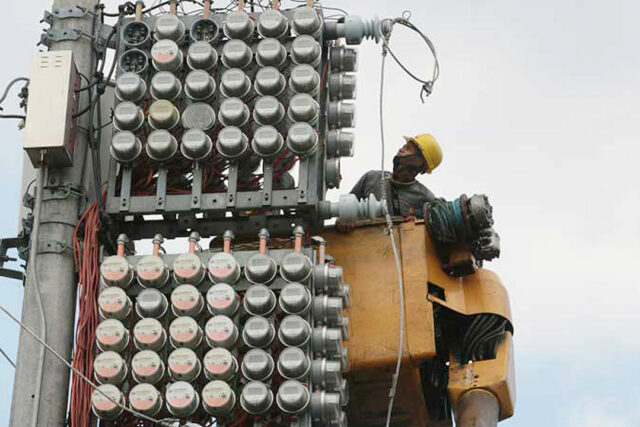
POWER DISTRIBUTOR Manila Electric Co. (Meralco) expects a 3% increase in its energy sales volume this year, supported by the expected normalization of electricity demand as temperatures stabilize.

Meralco Senior Vice-President Ferdinand O. Geluz said the company is relying on a less severe “organic contraction” compared with last year, which came off a high base due to El Niño in 2024.

“For as long as hindi mag-contract as heavy as last year ‘yung organic (demand) natin because of temperature, as service energization efforts remain consistent,” he said on the sidelines of an event last week.

For the first quarter, Mr. Geluz said Meralco expects flattish growth in energy sales, with recovery anticipated from the second quarter onward.

“We forecasted this as early as last year since first quarter (last year) was the tail end of El Niño. Now we’re at the tail end of La Niña, so we expect recovery to begin in the second quarter as warmer weather sets in,” he said.

For the full year, the power distributor recorded a nearly flat energy sales volume, with a 0.7% decline to 53,997 gigawatt-hours, affected by softer demand due to extreme weather, increased adoption of rooftop solar, and slower economic growth.

The distribution utility business accounted for the largest share of Meralco’s earnings in 2025, which rose 12% to P50.6 billion, meeting its profit target for the year.

Meralco is the country’s largest private electric distribution utility, serving more than 8.2 million customers in Metro Manila and nearby provinces, including Bulacan, Cavite, Rizal, and parts of Laguna, Batangas, Pampanga, and Quezon.

Meralco’s controlling stakeholder, Beacon Electric Asset Holdings, Inc., is partly owned by PLDT Inc. Hastings Holdings, Inc., a unit of PLDT Beneficial Trust Fund subsidiary MediaQuest Holdings, Inc., holds an interest in BusinessWorld through the Philippine Star Group, which it controls. — Sheldeen Joy Talavera

ADVERTISEMENT
ADVERTISEMENT