Home Blog Page 2019

Marianne Faithfull, voice of Britain’s Swinging ’60s, 78

MARIANNEFAITHFULL.ORG.UK

MARIANNE FAITHFULL, the wild woman of London’s Swinging ’60s who survived drug addiction, homelessness, two comas, cancer, and COVID-19, died at age 78, after a singing career that began as a teenager and lasted until her 70s.

“It is with deep sadness that we announce the death of the singer, songwriter and actress Marianne Faithfull,” her spokesperson said in a statement on Thursday.

“Marianne passed away peacefully in London today, in the company of her loving family. She will be dearly missed.”

The convent-educated daughter of a World War Two British intelligence officer, Ms. Faithfull had a front-row seat as drugs, alcohol, and sexual excess enveloped the early years of the rock music industry.

Her slow, haunting voice in her first hit, “As Tears Go By,” in 1964 seemed to portend a darker side to the British pop sound that was winning hearts around the world with the breezy early tunes of The Beatles and The Rolling Stones.

The former girlfriend of Mick Jagger, Ms. Faithfull became addicted to heroin and suffered from anorexia when the relationship ended, spending two years living on the streets of London’s Soho district in the early 1970s.

But no matter how hard she fell, Ms. Faithfull always bounced back. She released 21 solo albums, including the critically acclaimed Broken English in 1979 that won her a Grammy nomination, wrote three autobiographies and had a film acting career.

“I am so saddened to hear of the death of Marianne Faithfull. She was so much part of my life for so long.” Mr. Jagger wrote in a post on social media platform X. “She will always be remembered,” he added.

Her most recent comeback was in 2020 when she caught COVID-19 in the early days of the pandemic and went into a coma during a three-week stay at a London hospital.

Her son Nicholas later told her the medical staff were so sure she would not recover that they wrote a note on the chart at the bottom of her bed recommending, “Palliative care only.”

“They thought I was going to croak!” Ms. Faithfull told the New York Times in April 2021.

But she got better and within a year she finished the album she had been working on before falling sick: She Walks in Beauty, a collection of Romantic-era poems read by her and set to music.

She later complained of symptoms of “long COVID,” such as tiredness, breathing problems, and lack of memory and had to cut short a podcast interview in June 2021.

In March 2022, Ms. Faithfull was moved into Denville Hall, a retirement home in London that houses actors and other professional performers, according to several media reports.

Marianne Evelyn Gabriel Faithfull was born on Dec. 29, 1946, in London to a British intelligence officer who interrogated prisoners of war. Her mother was closely related to the Austrian aristocracy.

She attended a Roman Catholic convent boarding school from the age of seven but even there she nurtured a rebellious heart.

“Ever since my days at the convent my secret heroes had been decadents, aesthetes, doomed Romantics, mad Bohemians and opium-eaters,” she wrote in her 1994 book Faithfull: An Autobiography.

Ms. Faithfull’s formative years were in the swinging London of the mid-1960s when she was a budding folk singer. At 18, she married and had a son but attended a party that changed her life.

There she met Rolling Stones manager Andrew Loog Oldham who launched her popular music career and brought her into the band’s inner circle.

In 1966, she left her husband, artist John Dunbar, and started a relationship with Mr. Jagger, forming the “It Couple” of London’s psychedelic scene. Ms. Faithfull contributed backing vocals to the Beatles’ “Yellow Submarine” single and helped inspire the Stones’ “Sympathy For The Devil.”

But much of her fame came from her involvement in drug- and drink-fueled antics with the bad boys of rock.

She and Mr. Jagger were arrested in 1968 for possession of cannabis. Perhaps her most notorious caper was when police came across her, wrapped in a bearskin rug, during a drugs raid at Keith Richards’ country home in 1967.

The incident permanently earned her a place in rock ‘n’ roll legend but Ms. Faithfull later pointed out that she had not in fact been taking part in a wild orgy, as British tabloid reports suggested.

Ms. Faithfull said she had taken a bath when the police entered the house and so she grabbed the nearest thing, a rug, to cover up.

She complained that double standards for women meant that she was slandered while the arrests helped boost the image of Mr. Jagger and Richards as rock outlaws.

Ms. Faithfull also took exception to her portrayal as no more than Mr. Jagger’s artistic muse.

“It’s a terrible job. You don’t get any male muses, do you? Can you think of one? No,” she said in 2021.

As the 1960s ended, Ms. Faithfull’s life of glamor faded quickly and she spent two years living on the streets of London as an anorexic heroin addict after she and Mr. Jagger split in 1970.

Among the squalor, she found an upside.

“For me, being a junkie was an admirable life. It was total anonymity, something I hadn’t known since I was 17. As a street addict in London, I finally found it. I had no telephone, no address,” she wrote in her autobiography.

The experience was grist for the mill for her gritty album Broken English, which she described as her masterpiece.

Despite the personal cost, including an overdose of sleeping pills in Australia in 1969 that put her in a coma, Ms. Faithfull appreciated the chance to learn from great songwriters like Mr. Jagger, Paul McCartney, and John Lennon.

She had planned to attend University of Oxford to study literature, comparative religion and philosophy but instead got another kind of education.

“You know, I didn’t go to Oxford, but I went to Olympic Studios and watched the Rolling Stones record, and I watched the Beatles record as well. I watched the best people working and how they worked and, because of Mick, I guess, I watched people writing, too — a brilliant artist at the top of his game. I watched how he wrote and I learned a lot, and I will always be grateful,” she told The Guardian in 2021. — Reuters


Central bank grants regulatory relief to storm-hit lenders

AN AERIAL view of a flooded town in Batangas province after Tropical Storm Kristine hit Luzon in November 2024. — BW FILE PHOTO/PPA POOL/MARIANNE BERMUDEZ

THE BANGKO SENTRAL ng Pilipinas (BSP) is granting regulatory relief to banks in areas hit by recent typhoons.

The Monetary Board, in a resolution dated Jan. 9, approved the grant of additional regulatory relief measures for banks with head offices, branches, branch-lite units, or end-users in areas affected by the weather disturbances that hit the country late last year, namely Tropical Storm Kristine and super typhoons Leon, Ofel and Pepito, the central bank said in a memorandum posted on its website.

“These relief measures are aimed at enabling banks to carry on with their business operations after extreme weather events and extend equivalent financial relief to their affected borrowers,” the BSP said.

“The reckoning period of the regulatory relief measures shall be on the respective dates of the landfall of the typhoons in affected areas.”

Data from the National Disaster Risk Reduction and Management Council showed the combined effects of typhoons Kristine and Leon resulted in P10.57 billion in damage to infrastructure.

It also recorded P2.96 billion in infrastructure losses due to typhoons Nika, Ofel and Pepito.

The BSP also provided guidelines on how banks may deal with clients that were affected by the storms.

“Taking a critical balance of their fiduciary duty and financial intermediation role, eligible banks are not precluded from granting a temporary grace period of up to six months to their clients who were affected by the typhoons,” it said.

“The temporary grace period may cover all outstanding loans’ with payment of principal and/or interest falling due that may start on the respective dates of landfall of the typhoons.”

The temporary grace period will be based on terms agreed on by the banks and borrowers concerned, the BSP said. It may also be shorter than six months if agreed upon by both parties, it added.

“Banks are expected to discuss with their borrowers the other available options aside from the temporary grace period empowering the latter to make informed decisions considering their financial capabilities.”

The BSP added that the loans covered by the temporary grace period shall be excluded from the computation of past due and nonperforming loans ratios of the banks.

“Said loans, however, shall still be subject to prudential reporting for supervisory purposes,” it added.

Banks may also refer to Section 1151 of the Manual of Regulations for Banks (MORB), which covers regulatory relief policy, to check their eligibility for availing the relief measures.

If the financial assistance is not within the scope of BSP-approved purposes, the request for post-approval of the grant of loans, advances, or any other forms of credit accommodations to officers shall be submitted on or before March 31 to the appropriate supervising department of the BSP for regularization.

“No penalties shall be imposed on legal reserve deficiencies, if any, by thrift banks, rural banks and cooperative banks computed under Section 255 of the MORB.” — Luisa Maria Jacinta C. Jocson

Xpress to unveil new EV fleet this month

XPRESS.PH

XPRESS, a ride-hailing startup, is set to unveil a new fleet of electric vehicles (EVs) this month in partnership with Chinese EV giant BYD.

The new EVs, which will be available for booking through the Xpress mobile application, are expected to help reduce carbon emissions and enhance the passenger experience, the company said on Monday.

“At Xpress, we are focused on driving innovation that benefits both our passengers and our driver-partners. Partnering with BYD allows us to accelerate our vision of a more sustainable and inclusive transportation system for Filipinos,” said Xpress Chairman Jean Henri Lhuillier in a statement.

Xpress plans to transition 30% of its fleet to EVs within three years.

The Philippines is under pressure to transition to sustainable forms of transport to reduce its environmental impact.

“This collaboration marks a major step forward in Xpress’s commitment to eco-conscious mobility while creating new economic opportunities for local drivers through the Xpress Negosyo Program,” the ride-hailing app added.

Xpress recently opened 150 slots for ride-sharing drivers under the transport network vehicle service in Bataan as part of its regional expansion plans.

Ride-hailing app Grab also recently teamed up with BYD to expand access to up to 50,000 EVs across Southeast Asia.

The Philippine government targets a 50% EV fleet share by 2040 under a clean energy scenario, according to the Comprehensive Roadmap for the Electric Vehicle Industry published by the Department of Energy.

Under the roadmap, the country aims to have about 2 million EVs and 39,800 charging stations by 2040.

The Electric Vehicle Association of the Philippines projects the volume of EVs in the country to grow to about 6.6 million units by 2030. — Beatriz Marie D. Cruz

Sta. Lucia says sports complex to rise in Nasugbu Newtown Center

A groundbreaking ceremony was held on Dec. 11, 2024, to officially turn over the property to the local government of Nasugbu. — STA. LUCIA LAND, INC.

LISTED PROPERTY developer Sta. Lucia Land, Inc. said it recently donated a P200-million premium commercial lot to the municipality of Nasugbu, Batangas, for the development of the Nasugbu Sports Complex.

“This milestone reflects Sta. Lucia Land’s dedication to empowering local communities and fostering a new era of sports excellence in Nasugbu,” Sta. Lucia Land, Inc. President Exequiel D. Robles said in a statement last week.

The lot, intended for a mixed-use project, is located within the Nasugbu Newtown Center. The groundbreaking ceremony for the sports complex was held on Dec. 11.

The company said this initiative underscores Sta. Lucia Land’s holistic approach to property development, focusing not only on building homes but also on providing community-enhancing amenities. 

“Our developments are designed not just to provide quality homes but to create spaces where passions can be pursued and dreams can be realized. This donation reflects our unwavering commitment to building communities that foster growth, development, and well-being,” Mr. Robles said.

Once constructed, the Nasugbu Sports Complex is expected to become a vital component of the Nasugbu Newtown Center, a mixed-use development aligned with Sta. Lucia Land’s mission to create self-sustaining communities.

“Beyond housing, the company envisions vibrant spaces that promote healthy lifestyles, cultivate talent, and enrich the lives of community members,” it said. 

The project has garnered support from politicians and local sports figures alike, the property developer noted.

“As a developer that believes in the value of a holistic lifestyle where sports play a crucial role, it is truly important that we accomplish having facilities like this within our developments,” Mr. Robles added. — Beatriz Marie D. Cruz

When love must fill the void

FREEPIK-WAVEBREAKMEDIA_MICRO

Last week, as I was discussing lessons during my sustainability management class, I caught myself in a moment of irony. Here I was, teaching undergraduates about building sustainable businesses and communities, while watching support systems crumble around us. The timing couldn’t be more pointed: February, traditionally celebrated as a month of love, now asks us to examine what care and responsibility truly mean when traditional support structures fall away.

The challenges we face are immediate and severe. President Donald Trump’s January decision to suspend US foreign assistance for 90 days has already begun disrupting development programs across the Philippines. I have witnessed this firsthand. Programs designed to strengthen local businesses through education and mentorship now sit dormant, their projects frozen. These aren’t just abstract policy changes — they represent lost opportunities for Philippine entrepreneurs who need support to grow and create jobs.

Yet this external shock comes paired with an equally concerning domestic reality. The 2025 national budget strips P11.6 billion from education, eliminates crucial healthcare subsidies, and reduces social welfare programs. As detailed in Kenneth Abante’s recent “Yellow Pad” column in BusinessWorld, “Stealing our Dignity,” these cuts don’t just reduce services — they transform essential support systems into instruments of political patronage. Healthcare access now depends on guarantee letters from politicians. Education programs shrink while pork barrel projects expand.

These dual pressures weigh heavily on me, both as an educator and as someone raising a family in the Philippines. Each day in the classroom, I question what lessons we’re really teaching our youth. When we discuss business responsibility and social impact, how do we reconcile these ideals with a system that seems to be dismantling the very foundations of social support? What kind of society are we building — or unbuilding — for our children?

The answers, I believe, must come from within our communities, particularly from the business sector. Traditional corporate social responsibility programs won’t suffice anymore. We need companies willing to step forward as systemic forces for good, creating lasting partnerships that fill the widening gaps in our social fabric. Some businesses are already showing the way, establishing education partnerships with universities, launching healthcare access initiatives, and developing mentorship programs for small enterprises. These aren’t just stopgap measures — they’re investments in community resilience.

This spirit of modern-day bayanihan — of communities coming together in times of need — offers hope amid uncertainty. Industry coalitions are forming, local solutions are emerging, and businesses are discovering that social impact and commercial success can grow together. Yet even as we celebrate these positive steps, we must not forget our responsibility to hold both government and global partners accountable for their choices and their consequences.

What might it look like if businesses approached these challenges not as distant observers but as integral community partners? Perhaps it begins with understanding where the deepest needs lie as budgets shrink. Maybe it involves discovering how companies might work together, pooling resources and expertise in ways we haven’t yet imagined. The path forward might require us to reimagine funding models that build independence and resilience, moving beyond the familiar patterns of aid dependence. These aren’t simple solutions, but they’re questions worth exploring as we search for sustainable ways to strengthen our communities.

The kind of love our country needs now isn’t the February greeting-card variety. It’s the practical, determined kind that shows up when systems fail. It’s the love that drives business leaders to look beyond quarterly profits to community prosperity. It’s the love that pushes educators to find new ways to teach and inspire when resources disappear. It’s the love that builds lasting strength from temporary crisis.

As I continue to be an educator and a parent, I remind myself that this moment asks something extraordinary of all of us. The void left by retreating aid and shrinking budgets must be filled by something stronger — our collective commitment to each other. My students give me hope. They see these challenges not as insurmountable problems but as calls to action. They understand that true care means stepping forward when others step back.

This is how we build the country we want for the next generation: not through dependence on foreign aid or patronage politics, but through communities coming together, businesses stepping up, and citizens refusing to let support systems fail. This is the kind of love that must fill the void.


Patrick Adriel H. Aure, PhD is the founding director of the Phinma-DLSU Center for Business and Society and assistant dean for quality assurance of the DLSU Ramon V. del Rosario College of Business.

patrick.aure@dlsu.edu.ph

Netflix unveils Squid Game season 3 premiere date

THE popular South Korean drama Squid Game will return to Netflix on June 27 for a third and final season, the streaming platform announced during its “Next on Netflix” event on Thursday.

The event also featured a short clip from the upcoming season, which reveals yet another tension-filled scene from within the games.

The survival thriller action series turned into a global sensation in 2021, bolstering Netflix’s subscription numbers and becoming the streaming service’s most-watched original series in its first month.

Netflix reported that 142 million households had watched the dark drama about people who compete in a deadly competition to erase financial debt.

The return of Squid Game, together with high-profile live events such as the Jake Paul-Mike Tyson boxing match and two National Football League games on Christmas Day, helped Netflix add a record 19 million subscribers in its fourth quarter, to bring its total global subscriber base to nearly 302 million.

The third season will be the last installment of the series, which was developed for television by Korean writer and producer Hwang Dong-hyuk. The story will once again follow Lee Jung-jae as the protagonist Seong Gi-hun, who is determined to stop the dystopian games.

Squid Game is one of a trio of popular series returning to Netflix this year. The supernatural drama Stranger Things returns for a fifth and final installment, and the Addams Family-inspired series, Wednesday, is back for its second season.

Stranger Things creators Matt and Ross Duffer said they shot more than 650 hours of footage for the final season, but told members of the press gathered Wednesday for Netflix’s annual showcase of films, series and games that there would be more stories to tell.

“With more than 700 million people watching, we can’t just be one thing,” Netflix Chief Content Officer Bela Bajaria said. “We need to be the best version of everything.”

Other highlights of the showcase included footage of Academy Award-winning filmmaker, Guillermo del Toro’s new film, Frankenstein, which reanimates Mary Shelley’s classic tale.

“This film has been on my mind since I was a child — for 50 years,” Mr. Del Toro said in videotaped remarks. “And I’ve been trying to make it for 20 to 25 years.”

Ben Affleck touted a drama, RIP, teaming up once again with Matt Damon, this time in a crime thriller inspired by true events, set in Florida.

Stand-up comedian John Mulaney will return to Netflix on March 12 for a weekly live late-night show, Everybody’s Live with John Mulaney, which will run for 12 weeks.

“We will be live globally with no delay. We will never be relevant. We will never be your source for news. We will always be reckless,” Mr. Mulaney said.

30 Rock creator Tina Fey will adapt Alan Alda’s 1981 big-screen romantic comedy, The Four Seasons, as an eight-episode comedy series, in which she will appear alongside co-stars Steve Carell, Will Forte, Kerri Kinney-Silver, Colman Domingo and Marco Calvani. — Reuters

BSP, Royal Canadian Mint ink currency management partnership

BSP Governor Eli M. Remolona, Jr. (left) and Royal Canadian Mint President and CEO Marie Lemay sign the memorandum of understanding on currency management.

THE BANGKO SENTRAL ng Pilipinas (BSP) has partnered with the Royal Canadian Mint (RCM) to share knowledge on currency production and gold refining.

The central bank signed a memorandum of understanding (MoU) with the RCM on Jan. 22, it said in a statement on Monday.

The MoU was signed by BSP Governor Eli M. Remolona, Jr. and RCM President and Chief Executive Offiver Marie Lemay from their respective headquarters during an online ceremony.

“The five-year partnership aims to foster collaboration between BSP and RCM, focusing on sustainability practices, cost-effective currency production, gold processing operations, and commemorative coin production,” the BSP said.

“The MoU also outlines key areas of cooperation, including technology exchange, staff training and exchange, and sharing best practices, expertise, and technical and capacity-building assistance,” it added.

The RCM produces and distributes Canada’s circulation and coins.

“Its expertise in coin production and innovation has served over 80 countries worldwide,” the BSP said.

In October, the BSP also signed agreements on payments and currency management with the central bank of France and Eurosystem banknote printer Banque de France and Bundesdruckerei GmbH, the German government’s banknote printer. — Luisa Maria Jacinta C. Jocson

How PSEi member stocks performed — February 3, 2025

Here’s a quick glance at how PSEi stocks fared on Monday, February 3, 2025.


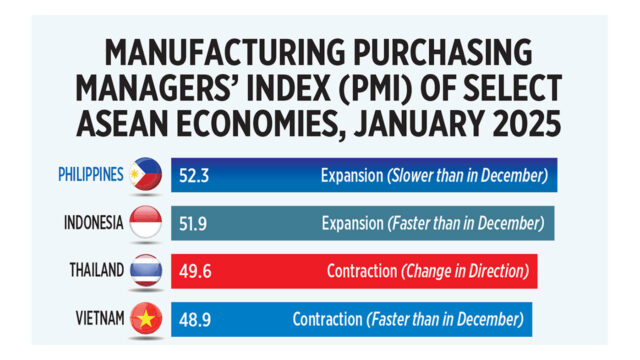
Manufacturing Purchasing Managers’ Index (PMI) of select ASEAN economies, January 2025

PHILIPPINE manufacturing activity continued to expand in January, albeit at the slowest pace in five months, S&P Global said on Monday. Read the full story.

Manufacturing Purchasing Managers’ Index (PMI) of select ASEAN economies, January 2025

Former Trump security adviser seeks united military deterrence vs China

A SCREENGRAB from Philippine Coast Guard shows a Philippine vessel being water cannoned by the China Coast Guard on April 30, 2024. — PHILIPPINE COAST GUARD PHOTO

By Kenneth Christiane L. Basilio, Reporter

THE US and its allies should limit China’s access to technology and data to curb its expansionist ambitions in the South China Sea through coordinated military deterrence, a former US security official said on Monday.

“It would be better to constrain and temper Xi Jinping’s ambitions now through robust coordinated military deterrence and through strict limits on China’s access to technology, capital and data controlled by our countries,” said Matthew Forbes Pottinger, a former deputy National Security adviser to US President Donald J. Trump.

“That is better than waiting until Xi Jinping has taken fateful and irrevocable steps, such as attacking Taiwan that would lead to a war between superpowers,” he said in a video message at a parliamentary intelligence-security forum in Manila.

The Chinese Embassy in Manila did not immediately reply to a Viber message seeking comment.

China claims almost the entire South China Sea, including parts claimed by the Philippines, Brunei, Malaysia, Taiwan and Vietnam. It asserts its sovereignty claim through an armada of coast guard ships, despite a United Nations-backed court ruling in 2016 that voided its claim for being illegal.

Mr. Pottinger said countries should speak out against Beijing’s actions that undermine the sovereignty of its neighbors. “It’s important to speak openly and loudly if we are to prevent Xi Jinping from making grave miscalculations.”

The Philippines has contested China’s sweeping claim in the waterway through diplomatic channels by filing more than 190 diplomatic protests since President Ferdinand R. Marcos, Jr. took office in 2022.

“Gratuitous efforts to flatter and reassure Beijing are likely to be taken as signs of weakness,” Mr. Pottinger said.

Countries should also consider banning Chinese-made apps such as TikTok and WeChat to prevent Beijing from conducting what he described as “information warfare” and weaken its “discourse power.”

“All we need to do is prevent Beijing’s platforms from manipulating our discourse at home, while making it easier for Chinese citizens to communicate safely with one another and with the outside world,” he added.

Washington is in a “cold war” with Beijing amid its increasing assertiveness in the contested South China Sea, said Carl Timothy Delfeld, chairman at the Hay Seward Economic Security Council.

‘SILK CURTAIN’
“Are we in a second Cold War with China?” he told the forum. “In short, we are. But it’s a very different Cold War than the one with the Soviet Union. We don’t have an ‘iron curtain’ in the Western Pacific. We have what I refer to as a ‘silk curtain.’”

The iron curtain was a political, military and ideological boundary that separated the Soviet Union from the West after World War II.

Mr. Delfeld described China’s encroachment of the waterway as a silk curtain due to the risk of conflict in contested areas. “A silk curtain is flammable, meaning there are flash points from the East China Sea to Taiwan and to the Philippines in the South China Sea.”

“It’s flexible, so it moves to and fro depending on the winds of change, events and alliances, which are constantly shifting,” he added.

He said the flow of trade in the South China Sea makes controlling it more difficult. About $3 trillion worth of ship-borne trade passes through the waterway annually.

“You have trade, you have capital, you have tourism,” he said. “So it’s much more difficult. The challenge is who’s going to control the flow through the silk curtain.”

Manila has used a so-called transparency initiative to raise public awareness and highlight its rights in the disputed waterway while also exposing “unlawful Chinese actions” including aggressive behavior and bullying, Philippine Coast Guard (PCG) Commandant Admiral Ronnie Gil L. Gavan told the same forum.

“By exposing unlawful and coercive behavior, we prevent intimidation tactics from operating in the shadows,” he said. “We made its reputational cost higher.”

The Philippine Coast Guard on Sunday said it had deployed an aircraft to check the “illegal presence” of two Chinese vessels 63 kilometers from the coast of Pangasinan province facing the South China Sea in the country’s north.

In a statement, the PCG said its Islander aircraft confirmed the presence of the China Coast Guard (CCG) vessels with bow numbers 3301 and 3104 at 9:30 am on Sunday. “Notably, the CCG vessels did not respond to the radio challenge issued by the PCG,” it added.

It said two 44-meter PCG vessels — BRP Cabra and BRP Bagacay — were dispatched to Bolinao, Pangasinan “to address the illegal presence of the China Coast Guard.”

The vessels reinforce the Philippine government’s position against the “normalization of illegal patrols” by China within the Philippines’ exclusive economic zone in the South China Sea.

The Philippines has accused China of intimidating Filipino fishermen near Scarborough Shoal and normalizing its “illegal presence” after Beijing sent the monster ship into its exclusive economic zone (EEZ) on Jan. 4.

China has repeatedly accused Philippine vessels of encroachment on its territory. Bilateral ties are at their worst in years after repeated confrontations and heated diplomatic rows.

A United Nations-backed court in the Hague voided China’s expansive claims in the South China Sea in 2016, as it ruled the shoal is a traditional fishing ground for Filipino, Chinese and Vietnamese fishermen.

House limits P200 hike to low-income workers 

PHILIPPINE STAR/RUSSELL A. PALMA

By Kenneth Christiane L. Basilio, Reporter 

The House of Representatives on Monday night approved on second reading a bill that seeks to give minimum wage workers a P200 daily increase. 

In a voice vote, congressmen passed House Bill No. 11376, which is a departure from the across-the-board hike for private sector workers endorsed by the House labor committee. 

“The regional wage board system, which for over three decades, has failed Filipino workers and their families with almost all minimum wages falling below the poverty line,” Deputy Speaker and Party-list Rep. Raymond Democrito C. Mendoza, who authored the bill, told the House floor. 

Philippine minimum wages are set by regional wage boards, which drew criticism from lawmakers due to what they perceive as its slow and meager increases amid spiraling prices. The Senate approved a counterpart bill for a P100 daily wage increase for private-sector workers in February last year. 

“The daily rate of all minimum wage workers in the private sector, regardless of employment status, including those in contractual and sub-contractual arrangements, whether agricultural or nonagricultural, shall be increased by P200,” according to a copy of the House bill. 

Microenterprises in the service sector including retail with 10 workers or fewer may apply for an exemption from the proposed wage increase. 

The House also approved on final reading a measure pegging the contribution rate of members of Philippine Health Insurance Corp. (PhilHealth) to 3.5% from 5% now, while also requiring the state-owned insurer to consider expected healthcare spending and socioeconomic factors in setting the contribution rate. 

In a 191-3-0 vote, lawmakers approved House Bill No. 11357, which requires PhilHealth to secure congressional approval before being allowed to tweak its contribution rates. It is a priority measure of President Ferdinand R. Marcos, Jr.’s government. 

“Premium contributions for direct and indirect contributors shall be derived from actuarially-adjusted rates, considering but not limited to the projected healthcare utilization, cost trends and demographic and economic factors,” according to a copy of the bill. 

“The actuarially-adjusted premium rates, as determined by the annual actuarial review, shall be subject to the approval of Congress,” it added. 

The bill keeps PhilHealth’s premium rate at 3.5% until an actuarial review of its operations is submitted to Congress. 

The 2025 monthly contribution rate for members with an income floor and ceiling of P10,000 and P100,000 stands at 5%. 

“An independent body shall review the annual actuarial report prior to its submission to Congress to ensure transparency and accuracy in the findings,” according to the bill. 

Meanwhile, the House also passed on final reading a measure that seeks to strengthen cigarette tax administration by implementing a track-and-trace system for all tobacco products. 

With 177 congressmen in favor, four against and zero abstention, the House passed House Bill No. 11286, which is supposed to curb cigarette smuggling. 

“A tracking and tracing system shall be established for the manufacturing, importation, storage, removal, distribution and sale of tobacco products, cigars, cigarettes, heated tobacco products, vapor products and novel tobacco products,” according to a copy of the bill. 

Lawmakers also approved on final reading House Bill No. 11360, which seeks to curb tobacco smuggling by reducing excise taxes. 

In a 190-4-0 vote, the House passed the bill setting a P41 tax per package of heated tobacco products, while harmonizing the tax of vapes and cigarettes at P66.15. 

The Philippines imposes a tax of P57 per milliliter (ml) on salt nicotine products, P6.30/ml on freebase nicotine products and P65/10 ml on classic nicotine products, according to the excise tax rates prescribed by the Bureau of Customs for 2024. 

It amends the Philippine Internal Revenue Code by imposing a 2% tax on tobacco products every even-numbered year starting in 2026; and 4% every odd-numbered year starting in 2027. 

The increase will be enforced until Dec. 31, 2035. 

House OKs bills banning POGOs, online cockfighting

PHILIPPINE STAR/IRISH LISING

By Kenneth Christiane L. Basilio, Reporter

THE HOUSE of Representatives on Monday approved on second reading separate bills that seek to ban Philippine offshore gaming operators (POGO) and online cockfighting amid their perceived negative effects on society.

In a voice vote, lawmakers approved House Bill (HB) No. 10987, which outlaws the operations of any offshore gaming operations in the country, putting teeth into President Ferdinand R. Marcos, Jr.’s order last year to ban them.

“It is still necessary to enact legislation to address illegal POGOs as they have been tied to numerous different unlawful activities,” Cavite Rep. Antonio A. Ferrer, who heads the House committee on games, told the House plenary in his sponsorship speech.

“While an executive order has been issued by the President, no penalties have been provided other than just prohibiting the same,” he added.

Mr. Marcos in his State of the Nation Address last year ordered a total ban on POGOs, citing their ties to illicit activities such as money laundering, prostitution and human trafficking.

All offshore gaming operators, support staff and local gaming agents must settle all taxes before winding down.

People caught operating POGOs face a jail term of up to eight years and may be fined as much as P5 million under the bill.

The House also approved on second reading a measure that seeks to ban online cockfighting or e-sabong operations and penalize illegal operators.

“All permits and licenses of e-sabong operators issued by the Philippine Amusement and Gaming Corporation (PAGCOR) are declared invalid and the PAGCOR shall make an accounting of any financial obligation due to and from e-sabong operators,” according to House Bill No. 11254. “No permits or licenses for the operation of e-sabong may be issued by PAGCOR upon the effectivity of this act.”

Mr. Marcos issued an order in 2022 that kept the ban on online cockfighting operations imposed by his predecessor.

Violators face a jail term of up to 20 years and a maximum fine of P500,000.

Also on Monday, lawmakers approved on second reading a bill that seeks to strengthen the Energy Regulatory Commission’s (ERC) charter.

House Bill No. 11373 seeks to make the agency an “independent, accountable, quasi-judicial and rule-making regulatory body,” allowing it to better police the power sector.

“The ERC shall determine the benchmark for the range of prices and rates that are deemed reasonable for both the end-user and the operations of generation, transmission and distribution entities,” it added.