Home Blog Page 1974

French push to become ‘startup nation’ gets shot in the arm

EMMANUEL MACRON — PICRYL

EMMANUEL MACRON’s ambition of turning France into a “startup nation” got a much-needed shot in the arm this week as investors pledged to plow about €109 billion ($114 billion) into artificial intelligence (AI) projects in the country. For the French President, the investments are critical to safeguarding his legacy — one that’s made entrepreneurship cool in France.

For years, among the highest aspirations of the country’s young graduates was to be a civil servant — a “fonctionnaire,” as the French call them — or climb the corporate ladder at big conglomerates. Not anymore. Changes in the attitude to work among young people, Mr. Macron’s push and the emergence of the gig economy have made being an entrepreneur the preferred option for many, and that needs funding.

France’s startup scene saw the most dramatic growth of any European country over the last decade, with investments jumping nearly 1000% to $60 billion, according to London-based venture capital firm Atomico. But money started to peter out in the last two years amid political turmoil and shrinking valuations. Mr. Macron has been keen to rekindle investor interest to preserve one of the bright spots of his reign and make the country’s entrepreneurial culture stick.

The Artificial Intelligence Action summit in Paris this week was part of that effort. It drew investment pledges from the United Arab Emirates, Amazon.com, Inc., Brookfield Asset Management, Apollo Global Management, Inc. and others, suggesting the country’s work-shift trends will continue to be bankrolled.

Investors have taken note of the change in the country’s entrepreneurial mindset, says Nina Rawal, partner and co-head of ventures at Trill Impact, a Stockholm-based fund that invested in French startup May Health last year alongside state-owned Bpifrance and Paris-based Sofinnova Partners.

“You can feel the difference. I don’t know about efficiency, or value for money, but in terms of feeling a different energy in Paris, it’s very clear,” said Ms. Rawal, who, with a background in neuroscience, spent some time as a student in France. Silicon Valley’s powerful narrative has infiltrated French culture, she said.

Although the emergence of China’s DeepSeek has shaken France’s AI scene, rising stars like Mistral, H and Poolside have drawn investors, funds and credibility. Other startups like online insurer Alan, now valued at €4 billion, Doctolib, an app for medical appointments valued at €5.8 billion, and second-hand smartphone seller Backmarket worth €5.1 billion have shown what’s possible.

“This has come with quite a big change in mindset and culture,” Clara Chappaz, a 35-year-old Harvard Business School graduate and France’s first minister for Artificial Intelligence and Digitalization, said in an interview. “There’s been a big piece of work done on changing the culture of work — giving the idea and the belief to everyone that they can start their own companies, they can create new things, they can innovate.”

As old taboos around creating wealth, making money, running a company and even failing have faded away, more young people in France are choosing to start businesses. Some 58% of French citizens under 30 are involved in entrepreneurship, according to a 2023 study by French state investment bank Bpifrance. That’s up from 36% in 2016.

Responses in a survey from about 2,099 graduates of France’s most notable and prestigious universities and colleges showed more of them were motivated by having an “entrepreneurial profile” than on developing a route to reach the upper echelons of management — something their parents had strived for.

The French perception of chief executive officers is no longer one of someone “just exploiting poor workers,” said Axel Cateland, founder of fintech startup Kulipa. Now, “everybody knows someone who works for a startup, especially if you live in Paris,” he said. “It’s changed the perception.”

Pressure has also mounted on young graduates to chart their own course as other avenues of employment have narrowed. With a huge debt load and mounting budget deficits, France is slimming the ranks of its civil servants. Also, with higher life expectancy, employees at the country’s biggest companies are hanging on to their jobs for longer, shrinking the number of new openings.

From her office at Station F, one of the world’s largest startup incubators, Roxanne Varza has a front-row seat to the unfolding economic transformation in France. Founded by French billionaire Xavier Niel and opened in 2017 by Mr. Macron soon after he took office, Station F is a startup accelerator that’s housed in an old reconverted railway station in eastern Paris and is headed by Ms. Varza, who grew up in Silicon Valley. 

When Ms. Varza arrived in France 15 years ago, entrepreneurship was “not cool at all,” she said. If someone told their family they wanted to start a company, their parents would say, “but you’ve done all this studying — why don’t you get a ‘real’ job?” Ms. Varza said. “Then all of a sudden it became really trendy for everyone to have their own company and to start a startup.”

Ms. Varza credits Mr. Macron’s pro-business policies for helping fuel the shift. During the president’s first term, moves like the flat 30% tax on capital gains and exemption of investments in companies from wealth tax helped bring in funds. Accelerators like Station F also made the choice more credible and reduced some of the risk, she said.

“Today risk is almost celebrated, whereas in the past it was really kind of like, ‘Why would you make that kind of decision?’” she said.

People are also viewing failure differently. “Failure was really considered a dead end,” Kulipa’s Mr. Cateland said. But entrepreneurs have presented it as a chance to do better the second time around, and that “changed perceptions,” he said.

Other countries in Europe are similarly seeking to transition from older economic models — there are tech hubs in London, Berlin, Dublin and Amsterdam. That said, the region is struggling to boost venture capital funding for AI startups, which is dwarfed by money pouring into similar US companies — about $15 billion in Europe and Israel put together last year compared with almost $100 billion in the US.

But France has a leg up on its neighbors, particularly with its lower electricity prices — thanks to nuclear energy — and its technical prowess. The country has the second-highest number of Fields Medals, the most prestigious award for mathematics, behind the US. After decades of trying and failing to leverage its engineering and technology skills, a new generation of business founders in France has finally found a Silicon Valley-style momentum building.

“Companies like Mistral can now be in an article alongside global leaders like OpenAI, and nobody questions it,” Ms. Varza said.

American TV shows and movies like Silicon Valley, The Social Network and The Internship have made a deep impression, Mr. Cateland said. Employees find the more casual dress and atmosphere at startups appealing, although “we don’t all look like Mark,” he said, alluding to Meta Platforms, Inc.’s founder.

While the last decade saw tremendous growth, France’s startup ecosystem may encounter more headwinds in the next decade as the struggle to balance the budget constrains the government’s  ability to back fledgling companies. But Ms. Chappaz, who previously served as the chief executive officer of the French Tech Mission, a government agency tasked with beefing up the country’s startup roster, said she remains committed.

“It’s very important for this government to continue supporting the ecosystem,” she said. “There’s still so much potential.” — Bloomberg News


Robinsons Land Corp. to open Uniqlo roadside store on Sierra Valley Estate, Rizal

ROBINSONS LAND Corp. (RLC) said it plans to open a Uniqlo Logo Roadside store in Sierra Valley Estate, Rizal, in March.

“Opening in March 2025, this exciting addition to Sierra Valley is designed to offer Rizal residents a more convenient and enjoyable shopping experience,” RLC said in a statement on Tuesday.

The store will be located within Sierra Valley, an 18.3-hectare (ha) destination estate in Cainta and Taytay, Rizal.

The estate will also feature a two-hectare logistics facility, RLX Sierra Valley, with Grade A warehouses and modern infrastructure located near major transport routes.

RLC is also set to develop the Robinsons Sierra Valley Mall, a six-hectare property expected to be the largest shopping mall in Cainta.

The estate already boasts popular food spots such as Starbucks, Conti’s, Yellow Cab, Pancake House, Gerry’s Grill, and Wendy’s, with more crowd favorites expected to follow.

“In addition to the upcoming mall, the Shops at Sierra Valley will further enhance the retail experience by offering a diverse selection of services and specialty stores, ensuring that every visit is both enjoyable and fulfilling,” RLC said.

Also within the estate is Sierra Valley Gardens, a mid-rise residential property offering modern homes in a greener environment. Situated near the elevated portions of Taytay and Antipolo, it offers fresh air, tree-lined pathways, and expansive open spaces.

Sierra Valley is located along Ortigas Avenue Extension, boasting connectivity to key urban areas like Metro Manila. The upcoming Metro Rail Transit Line 4 is expected to further increase the accessibility and appeal of the area. — Beatriz Marie D. Cruz

An art journey in Makati

INTERIORS of The Words You Speak Become the Home You Live By, a mini home by Kim Borja at the Glorietta Activity Center.

THE 10 Days of Art initiative, the lead-up to this year’s Art Fair Philippines, is well underway, making various forms of art accessible all around the Makati Central Business District (CBD).

One of the most eye-catching installations that will surely serve as a landmark for those traversing the fair at Ayala Triangle Gardens is Barrier Tape 2 by SpY Studio.

Located in the garden area, the piece features common red and white barrier tape draping from tree branches to the ground. It invites parkgoers to interact and take pictures with the large tree it adorns, as the tapes move with the wind.

Nearby, the Rewilding exhibition, curated by Jun Sabayton, is projected onto the Ayala Triangle Garden Amphitheater and Greenwall. It is made up of animation works by Bjorn Calleja, Ivan Despi, Pauline Despi, Jo Gregorio, Jeff Hazel Ombrete, Peter Daniel Palanas, and Cherylee Sng.

“Our works are about nature reclaiming abandoned urban spaces and allowing it to grow in that form,” said Pauline Despi, whose work Gardenias in a Glass Vase began as a sketch in her notebook. Now it is a projection on water, played against the Amphitheater’s little fountain against the wall, giving the flowers an almost hologram-like, ephemeral quality.

Her work, along with the other projections, inspires a sense of awe and wonder, especially at night amidst the towering glass, steel, and concrete structures surrounding the area.

INSTALLATIONS AT MALLS
Over at Glorietta, the Activity Center houses an installation of its own, giving mallgoers a chance to explore art without cost.

The Words You Speak Become the Home You Live By, by visual artist Kim Borja, is a mini house right in the center of the shops and restaurants. The cute structure seems quaint and simple, but those who heed their curiosity and enter (mainly children, unsurprisingly) will find a colorful home full of meaning.

It serves as “an invocation, invitation, and a quiet warning,” the installation built on images and language that have “the power to shelter or destroy,” the artist said in a statement. The work brings to light the silent struggles of mental health.

Meanwhile, Ayala Malls Circuit, while situated away from the Makati CBD, is bustling with a community of its own. One of its installations which passersby can admire is made of recycled plastic — Olivia D’Aboville’s Wonderland of Lights.

Consisting of giant dandelions that surround the outdoor walkway, the work depicts organic textures with synthetic materials. “The dandelion heads are made of recycled water bottles. We used more than 11,000 for this project,” Ms. D’Aboville told BusinessWorld in a message.

Despite being made of plastic waste, the finished product is a calming, luminous spectacle, a statement on the potential of urban art in relation to the environment. It was installed at Circuit Makati in collaboration with Art House.

PHOTOGRAPHY IN THE CITY
Fotomoto PH holds a regular spot both at the 10 Days of Art and at Art Fair Philippines itself. This year, its exhibit is again set up at the Legazpi Underpass, making the daily commute more interesting for employees of the Makati CBD as part of its goal to make contemporary photography visible all over the Philippines.

One of its projects, the I/Land Open Call, is currently on display at the Ayala Museum, with the photos also being shown at the digital exhibit in the underpass. Its 72 entries were selected out of a thousand that were submitted by photographers from the various regions.

Pia Mercado, co-director of the Qube Gallery in Cebu, is one of the exhibiting photographers. Having only taken up photography seriously a year ago, she told BusinessWorld how enjoyable fine art photography has been as a newcomer.

“It was like therapy because it’s become a routine already. Every month we (IMAGES Camera Club) have shows; every quarter we join art fairs. Being part of shows as a photographer, I realized, also takes a lot of time, but I think I want to keep doing it,” Ms. Mercado said.

Her photos are visual meditations, set in a water-filled aquarium with a cloth backdrop, where she puts in flowers and paint to capture their palettes and movements.

“The process is what makes it special for me, because I know what I want it to look like, but when you add the paint into the water, you can never control it,” she explained.

“The whole setup takes maybe an hour. When I add the paint, I only have a few seconds to get like one or two good shots before the whole aquarium is covered with the color, and I have to do it all over again.”

Ms. Mercado’s 2024 photography series, Impetus, centers on a specific subject — the Protea flower from South Africa — which finds its continuation at Fotomoto’s upcoming exhibit at Art Fair Philippines.

Titled KUHA, curated by Cocoy Lumbao, the exhibit features works by Tom Epperson, Neal Oshima, Jason Quibilan, Veejay Villafranca, Aeson Baldevia, Artu Nepomuceno, Benjo Campomanes, Bimpoman, Geloy Concepcion, Johann Guasch, Colin Dancel, Denise Weldon, and Ms. Mercado herself, as the rising newbie of the group.

For her, fine art photography allows her (and later, the viewers) to “concentrate on the beauty and drama” that ensues from the painstaking yet mesmerizing aquarium setup.

ART FAIR PROJECTS
Two women who have upcoming shows as part of the Art Fair PH Projects section also showcase unconventional forms of art.

Glass sculptor Goldie Poblador’s exhibit titled The Rise of Medusa makes use of glass, scent, and sound to depict how marine life adapts to the changing seascape brought about by manmade damage.

“The sculptures will have ‘pockets’ in them where the scent will be installed,” she told BusinessWorld at the Art Fair launch in January. “I’ve actually worked with glass and scent for 15 years. But for this, I’m adding in elements of sound and performance.”

Those helping her orchestrate the multi-sensory experience are curator Erwin Romulo, sound composer Ben Richter, and perfumer M. Dougherty. “The sounds will be based on the molecular weight of the scents, like a scent-to-sound translation,” Ms. Poblador explained.

As for why she works with scent in the first place, she added: “It is the sense that’s most linked to our memories. It triggers memories.”

Another woman who hopes to allow people to reflect on the world through sound is Jezzel Wee, whose Art Fair PH Projects exhibit Pagbulong (Whisper) is composed of ceramic art.

Inspired by Japanese daruma dolls, which are used as a wishing charm, Ms. Wee’s ceramic dolls are meant to be held with both hands and shaken while one whispers their wishes to it. As it is being shaken, a gentle chime bounces within the ceramic body of the figure.

“I wanted to share that experience of wishing for yourself. There’s a difference when you’re holding something tangible that makes a sound. You get to focus on your thoughts, which is a luxury for us because of how busy and noisy the world can be,” she said.

Her works are made entirely of clay, which has textures and sounds that vary depending on the thickness of the form, the firing intensity, the temperature.

Ms. Wee said: “My goal is for visitors to have a minute or two with the doll, to get to have a moment to commune with something and think.”

The installations for the 10 Days of Art are now open to the public until Feb. 23, while the exhibits at Art Fair Philippines will be on display at the Ayala Triangle Gardens (regular day pass at P750) from Feb. 21 to 23. — Brontë H. Lacsamana

Game-changer for e-commerce: How R.A. No. 12023’s VAT rules will reshape digital transactions in the Philippines

FREEPIK

The Bureau of Internal Revenue (BIR) has released the implementing rules and regulations (IRR) for Republic Act (R.A.) No. 12023 or the Digital Service Act, imposing 12% Value-Added Tax (VAT) on digital services provided by both resident and non-resident Digital Service Providers (DSPs). This legislation introduces a significant shift for non-resident DSPs, ensuring that they are subject to the same tax obligations as local businesses.

Under this new law, 12% VAT is imposed on digital services consumed in the Philippines. For non-resident DSPs, digital services are considered consumed in the Philippines if the buyer is located in the Philippines. This ensures that digital services are treated similarly to their physical counterparts concerning taxation. By implementing these rules, the government addresses the disparity between traditional and digital businesses. And by closing regulatory gaps, the law seeks to create a fairer competitive environment while reshaping compliance, operations, and enforcement in the country’s rapidly expanding e-commerce and digital services sector.

Contrary to common misconceptions, the VAT on digital services is not an entirely new tax. Instead, it is a long-overdue measure to ensure fair taxation of digital transactions. Traditional businesses have long been subject to VAT, while many foreign DSPs have historically operated outside the scope of Philippine tax authorities due to the complex nature of digital commerce. R.A. No. 12023 rectifies this imbalance by reinforcing tax regulations that should have been applied earlier, adapting them to the evolving digital landscape.

For resident DSPs, complying with the VAT requirements under R.A. No. 12023 is relatively uncomplicated. Since local businesses are already registered taxpayers accustomed to remitting VAT under existing tax structures, the law and its IRR primarily reinforces that digital services fall within the scope of VATable transactions.

However, an important distinction applies to resident DSPs classified as e-marketplaces with nonresident participating merchants or sellers. According to the IRR, these e-marketplaces have the additional obligation to withhold the 12% VAT on the gross sales earned by their nonresident merchants or sellers from digital services consumed in the Philippines. They are also required to file tax returns online and remit the withheld VAT to the BIR on behalf of these nonresident merchants or sellers.

The real challenge in implementing VAT on digital services lies in taxing non-resident DSPs such as global streaming platforms, online marketplaces, and software providers that operate without a physical presence in the Philippines. Unlike local companies, these entities operate across borders, making enforcement difficult. The BIR is now tasked with ensuring compliance through the VAT on Digital Services (VDS) Portal, where non-resident DSPs are required to register, file, and remit VAT.

Recognizing the complexities of VAT compliance for nonresident DSPs, the IRR offers an alternative solution: allowing them to appoint resident third-party service providers to handle tax compliance on their behalf. These providers — which may include law firms, accounting firms, or consultancy firms — ensure proper receipt of notices, maintenance of records, tax return filing, and fulfillment of all reporting obligations. By partnering with local tax experts, nonresident DSPs can ensure smooth registration, timely remittance, and full compliance with the law and its IRR — effectively reducing the risk of penalties and operational disruptions.

To strengthen enforcement, the IRR grants the Commissioner of Internal Revenue (CIR) or his duly authorized representative the authority to issue a Closure or Take Down Order against DSPs that fail to register with the BIR or comply with the IRR’s provisions. This Order includes blocking access to digital services performed or rendered in the Philippines by the erring DSPs, which shall be implemented by the Department of Information and Communications Technology (DICT) through the National Telecommunications Commission (NTC).

ADVANCING FAIRNESS IN DIGITAL TAXATION
The implementation of R.A. No. 12023 and its VAT regulations represents a significant step toward modernizing the Philippine tax system and ensuring a level playing field in digital commerce. While compliance may be straightforward for local businesses, enforcing VAT on non-resident DSPs remains a challenge that will require robust international cooperation and technological enforcement mechanisms.

These regulatory reforms set the stage for a more structured and equitable digital economy in the country, ensuring that all businesses — both local and foreign — contribute their fair share to national development. As the digital landscape continues to evolve, ensuring compliance will not only safeguard government revenues but also foster a more sustainable and competitive marketplace. The success of this framework will depend on effective enforcement, cooperation, and the willingness of all stakeholders to embrace a fair and transparent tax system.

The views and opinions expressed in this article are those of the author. This article is for general information and educational purposes, and is not offered as, and does not constitute, legal advice or legal opinion.


Marielle Mae P. Paler is an associate of the Cebu Branch of the Angara Abello Concepcion Regala Cruz Law Offices (ACCRALAW).

mppaler@accralaw.com

(02) 8830-80000

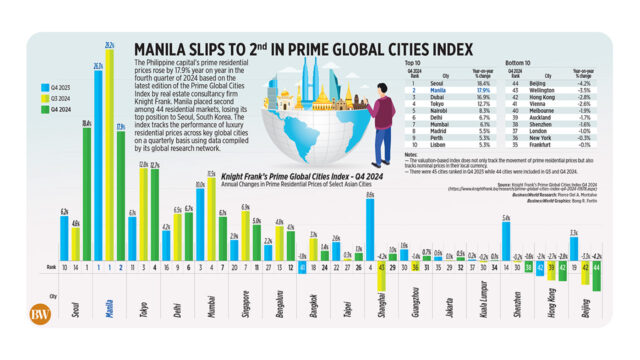
Manila slips to 2nd in Prime Global Cities Index

The Philippine capital’s prime residential prices rose by 17.9% year on year in the fourth quarter of 2024 based on the latest edition of the Prime Global Cities Index by real estate consultancy firm Knight Frank. Manila placed second among 44 residential markets, losing its top position to Seoul, South Korea. The index tracks the performance of luxury residential prices across key global cities on a quarterly basis using data compiled by its global research network.

Manila slips down to 2<sup>nd</sup> in Prime Global Cities Index

How PSEi member stocks performed — February 18, 2025

Here’s a quick glance at how PSEi stocks fared on Tuesday, February 18, 2025.


Peso weakens with Fed seen extending pause

BW FILE PHOTO

THE PESO declined against the dollar on Tuesday as some US Federal Reserve policy makers said they may need to keep rates steady for now due to elevated inflation.

The local unit closed at P58.15 versus the greenback on Tuesday, weakening by 12 centavos from its P58.03 finish on Monday, Bankers Association of the Philippines data showed.

The peso opened Tuesday’s trading session weaker at P58.08 against the dollar, which was already its intraday best. Meanwhile, it dropped to as low as P58.285 versus the greenback.

Dollars exchanged rose to $1.67 billion on Tuesday from $1.16 billion on Monday.

The peso depreciated on broad dollar strength following hawkish comments from Fed officials, a trader said in a phone interview.

For Wednesday, the trader expects the peso to move between P58 and P58.40 per dollar, while Rizal Commercial Banking Corp. Chief Economist Michael L. Ricafort sees it ranging from P58.05 to P58.25.

The dollar firmed on Tuesday as traders weighed tariff worries and the path to US rate cuts, Reuters reported.

Investor focus this week will be on Wednesday’s release of minutes of the Federal Reserve’s meeting in January to gauge how policy makers have sought to weigh the risk of a broader tariff war in the wake of President Donald J. Trump’s trade policies.

Data last week showed US consumer prices increased at the fastest pace in nearly 18 months in January, reinforcing the Fed’s message that it was in no rush to resume cutting rates amid growing economic worries.

The dollar index, which measures the greenback against six other major currencies, was 0.27% higher at 107.01, still not far from the two-month low of 106.56 it touched on Friday.

Federal Reserve Governor Michelle Bowman said on Monday she wanted increased conviction that inflation will decline further this year before lowering interest rates again, particularly given uncertainty around the impact of the Trump administration’s new trade and other policies, Reuters reported.

Meanwhile, Federal Reserve Bank of Philadelphia President Patrick Harker sounded an upbeat note on the state of the US economy on Monday, and said he saw no reason to change interest rate policy right now as the central bank continued to work to lower inflation levels.

For his part, Federal Reserve Governor Christopher Waller said his “baseline” view is that the Trump administration’s new tariffs will have only a modest impact on prices that the central bank should try to look through in setting monetary policy.

As it stands “the data are not supporting a reduction in the policy rate,” Mr. Waller said. “But if 2025 plays out like 2024, rate cuts would be appropriate at some point this year.”

The Fed at its March meeting is expected to hold its benchmark interest rate steady at the current range of 4.25% to 4.5%. — A.M.C. Sy with Reuters

PSEi advances as strong earnings boost sentiment

BW FILE PHOTO

PHILIPPINE STOCKS recovered on Tuesday as strong corporate earnings lifted sentiment and as players picked up bargains following the market’s two-day decline.

The benchmark Philippine Stock Exchange index (PSEi) rose by 1.69% or 101.48 points to close at 6,094.96, while the broader all shares index climbed by 1.87% or 67.78 points to end at 3,678.94.

The PSEi opened Tuesday’s session at 5,994.64, a tad higher than Monday’s finish and already its intraday low. It climbed to as high as 6,107.62 during the day but settled just below the 6,100 mark at the closing bell.

“The local market bounced back this Tuesday as investors hunted for bargains after two consecutive days of decline. Optimism towards fourth quarter and full-year 2024 corporate results also helped in driving the market higher following sound earnings reports from Bank of the Philippine Islands, Asia United Bank Corp., and the most recent one SM Prime Holdings, Inc.,” Philstocks Financial, Inc. Senior Research Analyst Japhet Louis O. Tantiangco said in a Viber message.

“Also helping in Tuesday’s trading was the overseas Filipinos’ cash remittance data for 2024, which posted a 3% increase,” he added.

Cash remittances from overseas Filipino workers hit an all-time high of $34.49 billion in 2024, up by 3% year on year and in line with the central bank’s full-year forecast.

“Philippine shares closed higher as investors welcomed the signing of the IRR (implementing rules and regulations) for corporate tax cuts,” Regina Capital Development Corp. Head of Sales Luis A. Limlingan said in a Viber message.

On Monday, Finance Secretary Ralph G. Recto and Trade Secretary Ma. Cristina Aldeguer-Roque signed the IRR of the Corporate Recovery and Tax Incentives for Enterprises to Maximize Opportunities for Reinvigorating the Economy or CREATE MORE Act.

Almost all sectoral indices closed higher on Tuesday. Property surged by 3.32% or 71.23 points to 2,216.68; financials climbed by 1.52% or 34.38 points to 2,283.92; holding firms increased by 1.36% or 68.35 points to 5,076.79; industrials jumped by 1.34% or 116 points to 8,753.40; and services rose by 0.36% or 7.23 points to 1,992.82.

Meanwhile, mining and oil dropped by 0.17% or 13.89 points to 7,939.94.

“ACEN Corp. was the day’s index leader, jumping 5.26% to P3.20. Emperador, Inc. was the main index laggard, falling 2.99% to P12.32,” Mr. Tantiangco said.

Value turnover increased to P6.30 billion on Tuesday with 1.06 billion shares traded from the P5.32 billion with 1.23 billion issues that changed hands on Monday.

Advancers bested advancers, 101 versus 72, while 64 names were unchanged.

Net foreign selling declined to P199.76 million on Tuesday from P991.98 million on Monday. — R.M.D. Ochave

Philippines accuses Chinese Navy of reckless flight maneuvers near shoal

PHILIPPINE STAR/MICHAEL VARCAS

By John Victor D. Ordoñez and Adrian H. Halili, Reporters

THE Philippine Coast Guard accused the Chinese Navy of performing dangerous flight maneuvers on Tuesday when it flew close to a government aircraft patrolling a disputed shoal in the South China Sea.

“This reckless action posed a serious risk to the safety of the pilots and passengers,” it said in a statement.

The Philippine Coast Guard said the government fishery aircraft was conducting what it called a maritime domain awareness flight over Scarborough Shoal, a rocky atoll and prime fishing patch inside the Philippines’ exclusive economic zone.

The People’s Liberation Army Navy helicopter flew as close as three meters to the aircraft, which the Philippine Coast Guard said was a “clear violation and blatant disregard” of aviation regulations.

The Philippine plane “intruded” into China’s airspace over the disputed shoal, the Southern Theater Command of China’s military said in a statement.

The move by the Philippines severely “violated” China’s sovereignty, it said, adding that the Chinese military had organized naval and air forces to track, monitor and drive away the plane.

The Chinese Embassy in Manila, quoting Colonel Tian Junli, a spokesman for the Southern Theater Command, said the Philippine government had “reversed right and wrong and spread false narratives.”

“The Philippine actions seriously violated China’s sovereignty and seriously violated relevant provisions of international law and Chinese laws. Huangyan Island (Scarborough Shoal) is China’s inherent territory,” it added.

“The Theater troops remain on high alert and will resolutely defend national sovereignty and security and peace and stability in the South China Sea.”

Named after a British ship that was grounded on the atoll nearly three centuries ago, Scarborough Shoal is one of the most contested maritime feature in the South China Sea, where Beijing and Manila have clashed repeatedly.

“The People’s Liberation Army Navy offensive action seen in their reckless helicopter flight maneuvers over the West Philippine Sea is an unfair fortification of their air power in our air space,” Chester B. Cabalza, founding president of Manila-based think tank International Development and Security Cooperation, said in a Facebook Messenger chat.

“Our rules should be recognized and respected in our own air space. China’s low-flying light combat aircraft has no right to risk the safety of our Filipino coast guardians by sheer intimidation,” he added.

“There seems to be no foreseeable off-ramp, so it is important to have a working hotline and crisis management mechanism to avoid serious accidents or miscalculation,” Lucio B. Pitlo III, a research fellow at the Asia-Pacific Pathways to Progress Foundation, said via Messenger chat.

“Worryingly, dangerously close run-ins are becoming a new norm in the maritime spat between the Philippines and China,” he added.

China claims sovereignty over almost the entire South China Sea, a vital waterway for more than $3 trillion of annual ship-borne commerce, putting it at odds with Brunei, Indonesia, Malaysia, the Philippines and Vietnam.

A United Nations-backed tribunal in 2016 voided China’s claim for being illegal, but Beijing does not recognize the ruling.

“Unless the two parties come to terms to settle their differences on the use of waters and air space in the South China Sea, such incident can occur again,” Rommel C. Banlaoi, president of the Philippine Society for International Security Studies and former deputy national security adviser, said in a Viber message.

“Both parties need to learn how to coordinate their actions in the South China Sea if they want to prevent unintended violent encounters at sea,” he added. — with Reuters

SC asked to stop Senate from trying VP Duterte

LAWYERS Luna Acosta-Manlitoc, Israelito P. Torreon and Martin B. Delgra III hold copies of their petition, filed in Manila on Tuesday, asking the Supreme Court to stop the Senate impeachment trial of Vice-President Sara Duterte-Carpio. — PHILIPPINE STAR/EDD GUMBAN

By Chloe Mari A. Hufana and Adrian H. Halili, Reporters

SUPPORTERS OF Vice-President (VP) Sara Duterte-Carpio on Tuesday asked the Supreme Court (SC) to stop the Senate from holding her impeachment trial, as they accused the House of Representatives of violating her right to due process during impeachment proceedings.

Twenty-nine plaintiffs led by Davao-based lawyer Israelito P. Torreon and former Land Transportation Franchising and Regulatory Board Chairman Martin B. Delgra III filed the lawsuit. More are expected to join as intervenors in the case.

Named respondents were the Senate and House.

In 114-page pleading, the plaintiffs also asked the High Court to void the articles of impeachment against Ms. Duterte for failing to meet constitutional requirements on verification and proper filing.

“This is a legitimate attempt on the part of the people to stop a constantly void, as well as defective, procedurally defective, and jurisdictionally deficient impeachment complaint that was filed against Vice-President Sara Duterte,” Mr. Torreon separately told reporters after filing the suit.

He said they had not been influenced by the Vice-President to file the case.

Civil society groups, activists and clergymen separately filed three impeachment complaints against the Vice-president in December. More than 215 congressmen filed and endorsed a fourth complaint that was directly sent to the Senate before Congress went on a four-month break early this month.

Mr. Torreon said congressmen violated Ms. Duterte’s right to due process by railroading the impeachment proceedings.

“The VP was not even summoned to answer the allegations that she committed as found in the complaint,” he said. “There was no due process at all.”

He also said the impeachment complaint sent to the Senate bore only the signature of House Secretary General Reginald S. Velasco.

Meanwhile, Supreme Court spokesperson Camille Sue Mae L. Ting said the High Court gave the Senate 10 days to comment on a separate lawsuit asking the court to compel senators to start Ms. Duterte’s impeachment trial.

The tribunal might soon ask the Senate to comment on the Torreon lawsuit, she told a news briefing, noting that it would treat the case with urgency.

“In general, the Supreme Court is tasked to determine if the impeachment proceedings or the impeachment rules are in accordance with the Constitution and if there’s any grave abuse of discretion on the part of the Senate,” Ms. Ting said.

The High Court has the power to determine any abuse of discretion by any government branch, she added.

The House impeached Ms. Duterte on Feb. 5, accusing her of misusing confidential funds.

Senate President Francis G. Escudero earlier said they would not be able to convene as an impeachment court until July since Congress is on a recess.

Also on Tuesday, Senate Minority Leader Aquilino L. Pimentel III urged the Senate president to start the impeachment proceedings.

In a letter, he said the 1987 Constitution mandates the Senate to promptly start any impeachment trial.

“Given the gravity of impeachment proceedings, it is imperative that the Senate uphold its duty with urgency, diligence and a steadfast commitment to the Constitution,” according to a copy of the letter dated Feb. 14.

He said the term “forthwith” used by the Charter means the Senate should not delay the impeachment proceedings. “I repeat that this is the Senate’s duty.”

Senator Ana Theresia N. Hontiveros-Baraquel said that Constitution clearly states that the impeachment trial of the Vice-President should start immediately. “I agree with the letter issued by (Mr. Pimentel),” she told reporters in a Viber group message.

At a news briefing, Senator Maria Imelda R. Marcos said the term “forthwith” still depends on the Senate’s next available session.

“In fact, we’ve been hearing about impeachment in Congress for two years now,” the lawmaker, an ally of Ms. Duterte, said. “Also, the final impeachment complaint was not immediately brought to the Senate. We can’t say it is urgent and requires the calling of a special session.”

Congress went on a four-month break starting Feb. 5 for the 2025 midterm elections. It will reconvene for a two-week session on June 2.

The House impeached Ms. Duterte on charges of violating the Constitution, betrayal of public trust, graft and corruption and other high crimes.

The ouster charges consisted of seven articles of impeachment, including allegations of plotting the assassination of the President, misusing secret funds, amassing unexplained wealth and committing acts of destabilization.

Marcos orders DSWD to fast-track aid in calamity areas

PHILIPPINE STAR/EDD GUMBAN

PRESIDENT Ferdinand R. Marcos, Jr. on Tuesday ordered the Department of Social Welfare and Development (DSWD) to boost efforts to digitalize its services to speed up and expand its aid programs especially in areas prone to natural calamities.

“We must also prepare for the future,” he said in a speech at the DSWD’s seventh anniversary program in Manila, based on a transcript from the Presidential Communications Office. “That future demands modernization, efficiency and accessibility.”

“Even as we strengthen these core programs, we remain vigilant against modern challenges such as climate change.”

On Tuesday, the DSWD launched an online portal where people can send cash donations electronically.

It also launched a so-called harmonized electronic license and permit system that seeks to fast-track applications for licenses and permits and make it easier for stakeholders to access assistance programs.

“This online system will allow our clients to access our regulatory services anytime, anywhere as long as they have their gadgets and internet access with them, even in the comfort of their homes,” Social Welfare spokesperson Irene B. Dumlao said in a statement.

The agency is tasked to regulate the certification and accreditation of social welfare and development agencies and other civil society groups engaged in social work.

Ms. Dumlao said the new system will cut the processing of permits to seven days from 43.

The Social Welfare department also launched the minors traveling abroad system, a more streamlined travel clearance process for children.

Mr. Marcos cited the need for the DSWD to continue aid programs for Filipinos during climate disasters, such as the quick-response fund that helped almost 7.4 million Filipino families affected by calamities last year.

The President also backed the implementation of the agency’s conditional cash transfer program, which benefitted about 4 million Filipinos last year.

The fund includes rice and health subsidies worth P600 and P750 a month. It also covers monthly school subsidies worth P300-P700 for more than 7 million students.

“Through conditional cash grants, we help families stay on track with their children’s education and their healthcare, laying a sturdier foundation for a better life,” Mr. Marcos said.

“Every single centavo spent, every program that is implemented, every decision that has been made must serve a very clear purpose: to create opportunities that endure, uplift and reach far beyond just today,” he added. — John Victor D. Ordoñez

Franchise requirement for social media mulled amid disinformation crackdown

A person using a smartphone is seen in front of displayed social media logos in this illustration taken on May 25, 2021. — REUTERS

By Kenneth Christiane L. Basilio, Reporter

A HOUSE of Representatives committee is considering a proposal that will require social media companies to secure a franchise to operate as part of efforts to combat the spread of disinformation, a congressman said on Tuesday. 

An operational franchise could also allow the government to capture the industry’s profits amid tax jurisdiction issues faced by the Bureau of Internal Revenue (BIR) in collecting taxes from online personalities, Surigao del Norte Rep. Robert Ace S. Barbers said during a House probe into online disinformation. 

“We are contemplating on… asking all social media platforms to secure a franchise in Congress,” he said. 

“We want to make sure that it’s not just the platforms who make money, but also the Philippine government. If you are under the franchise of this government, then you will be subject to the regulations and rules that will be imposed,” he added. 

BIR lawyer Tobias Gavin C. Arcilla told the panel that the revenue commission relies on the “voluntary declaration” of online personalities for their income taxes.  

“There is great difficulty in monitoring it considering that their income primarily comes from foreign income payor,” he said. 

“What we do is we audit and investigate the influencers, and we request data from foreign tax jurisdictions where we have existing treaties of exchange of information with, and we cross-check or we compare the information that we receive… and their (online personalities’) declared income tax returns.” 

At present, the Philippine government requires public utilities, such as power distributors and water concessionaires, as well as broadcasting companies to secure a legislative franchise from Congress before operating. 

“There needs to be regulation. There should be a policy for our social media platforms and actors because they shouldn’t be allowed to use it to spread fake news or baseless statements,” said Mr. Barbers in Filipino. 

He said the House joint committee on public safety, public information and communications technology would likely determine key factors for franchise approval after its investigation. 

“This is not intended to suppress their freedom of expression or their free speech. This is to ensure discipline, a code of conduct, and ethics [in platforms],” he added. 

The proposal giving Congress the power to grant social media platforms a franchise to operate could stifle free speech and be weaponized, according to analysts. 

“A legislative franchise requirement for social media platforms raises serious concerns. While it aims to curb mis- and disinformation, it risks state overreach, censorship, and politicization of digital spaces,” Karl Patrick R. Mendoza, an associate professor at the Polytechnic ya University of the Philippines’ Department of Communication Research, said in a Facebook Messenger chat. 

“This will not effectively reduce disinformation. Misinformation thrives due to algorithmic incentives, political networks, and low media literacy, not just weak regulation,” he added. 

The government should instead push greater accountability for social media platforms through fact-checking collaborations and digital literacy programs, said Mr. Mendoza. 

The proposal to police social media platforms through a legislative franchise requirement is “unacceptable,” Danilo A. Arao, an associate professor of journalism at the University of the Philippines, said in a Facebook Messenger chat. 

“Legislative franchises can be weaponized, as in the case of what happened to ABS-CBN in 2020. There are no benefits when media operations are put at the legislators’ mercy,” he said. 

“If Congress wants to fight ‘fake news,’ it should allocate a bigger education budget so that schools can do a better job in implementing media literacy and media education,” he added.

AMONG BIGGEST CHALLENGES
Most Filipinos source news from these platforms, with six out of 10 Filipinos saying they get their news from social media, particularly on Facebook, a 2024 survey by political consultancy firm Publicus Asia reported. In a separate report, the University of the Philippines found that the widespread use of social media inundates Filipinos with content spreading mis- and disinformation.

Also on Tuesday, Philippine Coast Guard spokesman Jay Tristan Tarriela said that “fake news” is among the biggest challenges of the Philippine government in Manila’s campaign to stake its South China Sea claim.

The Chinese Embassy in the Philippines did not immediately respond to a Viber message seeking comment.

The Philippine government launched its “transparency” campaign in the South China Sea to “raise awareness among the Filipino people about the realities in the West Philippine Sea,” said Mr. Tarriela, referring to areas of the waterway that falls within Manila’s exclusive economic zone.

ADVERTISEMENT
ADVERTISEMENT