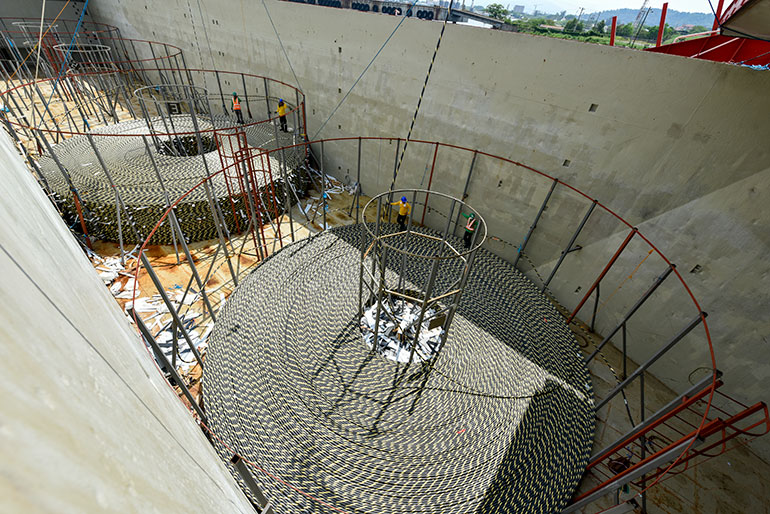
THE DEPARTMENT of Information and Communications Technology (DICT) is expecting to deploy the second and third phases of the National Fiber Backbone by July.
“We are actually ahead of schedule for the second and third phase because these are expected to be deployed sometime later in 2025. I think before SONA (State of the Nation Address) we can complete these phases,” DICT Secretary Ivan John E. Uy told reporters on the sidelines of the Economic Journalists Association of the Philippines (EJAP) event last week.
The National Fiber Backbone project targets to provide faster and reliable internet connectivity in the country. The DICT estimates around 70 million Filipinos will benefit from this project.
The second and third phases of the National Fiber Backbone cover southern Luzon and parts of the Visayas and Mindanao.
The first phase, which involves high-speed connections between Laoag, Ilocos Norte and Quezon City, was completed in April last year. It covers 1,245 kilometers with 28 nodes. It has an initial 600 gigabits per second optical spectrum capacity that will serve the government and at least 14 provinces, and two National Government data centers, the DICT said on its website.
“For phase 4 and phase 5, we have already secured a loan from the World Bank which we will use to accelerate the remaining phase,” Mr. Uy said.
In 2024, the DICT secured a $287.24-million loan from the World Bank which will fund the remaining phases of the National Fiber Backbone project.
The remaining phases of the National Fiber Backbone project will cover the Visayas and Mindanao, Mr. Uy said, adding that the loan proceeds would accelerate the project’s overall completion.
The completion of the project is also expected to spur growth in rural areas, especially in Visayas and Mindanao.
“So now, the project construction can go parallel now. I think we can complete this before our term ends,” Mr. Uy said.
The project is initially projected for completion by 2028, the DICT said. — AEOJ
From left to right: Eastern Communications’ (EC) AVP and Head of Marketing & Customer Experience Jed Estanislao, EC Product Manager Edwin De Jesus, EC CAN Planning & Engineering Head Rachelle Roque, EC Brand Communications Head Hannah Lazatin, and Contributing Editor of Asian Business Review, Simon Hyatt.
According to the latest e-Conomy SEA report by Google, Temasek, and Bain & Company, the Philippines recorded the fastest-growing internet economy among six Southeast Asian nations in 2024. Driven largely by the rising e-commerce sector, the country’s digital economy surged by 20%, with its gross merchandise value (GMV) rising from $26 billion in 2023 to $31 billion in 2024.
As the demand for digitalization grows, premier telecommunications and managed ICT services provider Eastern Communications highlights its strong performance over the past year and stands ready to empower businesses with cutting-edge ICT solutions and its robust, innovative network infrastructure.
A Year of Growth and Recognition
Eastern Communications has experienced remarkable business growth and resilience over the past decade. In 2024, Eastern increased its revenue by 8.4%, marking its competitive presence in the telco industry. The company has fueled its success by continuously striving for innovation, operational sustainability, and customer-centric solutions.
With a growing B2B market share, Eastern Communications has been able to make its innovative ICT solutions more widely accessible. This expansion has significantly impacted offerings like Eastern Cloud, a customizable public cloud platform powered by CloudSigma. Designed for flexibility, Eastern Cloud allows businesses to purchase only the computing resources they need, without being locked into fixed server sizes, offering greater control, cost efficiency, and scalability.
From left to right: Eastern Communications’ (EC) Brand Communications Head Hannah Lazatin, EC Product Manager Edwin De Jesus, EC AVP and Head of Marketing & Customer Experience Jed Estanislao, and EC CAN Planning & Engineering Head Rachelle Roque
It was recently named the Cloud Initiative of the Year — Philippines at the Asian Telecom Awards 2025, highlighting Eastern’s effort in redefining cloud computing in the Philippines. More than just a business success story, Eastern Cloud has also helped drive digital transformation across industries in the Philippines by enabling businesses to reduce IT infrastructure costs by up to 30%.
The Asia Telecom Awards recognizes exceptional accomplishments within the telecom industry in the Asia-Pacific region. The organization also awarded Eastern Communications as the Infrastructure Initiative of the Year — Philippines, giving praise to the Philippine Domestic Submarine Cable Network (PDSCN), a joint venture between Eastern Communications, Globe Group, and InfiniVAN, designed to fortify the country’s communication infrastructure.
Addressing the vulnerabilities of traditional networks, the PDSCN Express Route strategically ensures that at least 80% of cables are laid underwater, with less than 20% inland, significantly reducing the risks of network disruptions caused by cable cuts. Through this innovative approach, Eastern Communications delivers enhanced bandwidth and network resilience, empowering Filipinos — especially those in disaster-prone areas — with stronger, more reliable connectivity.
For Atty. Aileen Regio, Co-Coordinator of Eastern Communications, this recognition marks an exciting start to the year. “We are truly grateful for these global recognitions. They highlight our continuous mission to drive digital transformation across the Philippines. They fuel our passion to push boundaries, to empower businesses with resilient connectivity and future-ready solutions, and to champion ICT education and accessibility for all Filipinos,” she said.
Expanding Reach and Elevating its Heart of Service
Eastern Communications is committed to expanding its network to more business hubs across the country. In 2025, the company will extend its services to key cities including: Cotabato City in BARMM, General Santos City in South Cotabato, and Dipolog City in Zamboanga del Norte.
Eastern Communications’ management committee leads the pack through strategic growth in 2025.
“Our continuous expansion across the country is more than just growing our footprint, but pushing for a digital-ready Philippines and driving economic progress. With the rising demand for digital solutions, we aim to bring our world-class connectivity to rising business centers across the country, strategically improving our network to provide world-class connectivity to Filipinos,” said Jaeson Evangelista, Co-Coordinator of Eastern Communications.
Strengthening Security and Connectivity with DDoS-Protected Eastern IDS
As cyberthreats become more sophisticated, Eastern Communications continues to invest in next-level security solutions. One of its latest offerings, DDoS-Protected Eastern IDS (Internet Direct Service), provides a premium, dedicated, high-speed internet solution designed to meet the demands of modern businesses.
Eastern Communications enhances nationwide infrastructure through its submarine cable laying project.
DDoS-Protected Eastern IDS uses fiber-powered leased line technology, coupled with robust DDoS (Distributed denial of service) protection, ensuring reliable 24/7 connectivity with speeds of up to 10 GBPS, symmetrical upload and download speeds, and resilient access to global internet backbones. This cutting-edge solution enhances workforce productivity while safeguarding businesses against cyber disruptions.
As Eastern Communications looks ahead, it remains dedicated to being more than just a telco and ICT provider — it aims to be a trusted managed services partner of choice for businesses. Eastern continues to highlight its Heart of Service, delivering personalized solutions that drive business success. In 2024, the company’s Customer Satisfaction Score rose to an above-industry standard of 96.1%, demonstrating its dedication to customer experience excellence.
The company’s Heart of Serviceinspired its 2025 campaign, “Exceeding Expectations,” which aims to help businesses go beyond their goals and elevate their own customer experience through Eastern’s high-tech and high-touch solutions.
ABOUT EASTERN COMMUNICATIONS
Eastern Communications, the Philippine premier telecommunications company, and ICT solutions provider, has provided reliable connectivity and advanced business tools to enterprises and emerging businesses for over 145 years. The company offers custom solutions from an extensive portfolio of services that include Connectivity Solutions, Network Solutions, Security Solutions, Cloud and Data Center Solutions, and Business Applications. It continues to be the solutions partner of choice for the biggest industry players in the country through its unique brand of “High Tech” and its “High Touch” service. To learn more about Eastern Communications’ dedicated internet, cloud, cybersecurity, and other ICT solutions, talk to us at 5300-7000.
Spotlight is BusinessWorld’s sponsored section that allows advertisers to amplify their brand and connect with BusinessWorld’s audience by publishing their stories on the BusinessWorld Web site. For more information, send an email to online@bworldonline.com.
Join us on Viber at https://bit.ly/3hv6bLA to get more updates and subscribe to BusinessWorld’s titles and get exclusive content through www.bworld-x.com.
METRO PACIFIC Tollways Corp. (MPTC) has deferred merger discussions with San Miguel Corp. (SMC) to focus on raising funds to pay down debt, its chairman said.
“We deferred the discussion with them because MPTC is raising money. We have significant debts. So, once we have achieved that, then we can resume the discussion,” MPTC Chairman Manuel V. Pangilinan told reporters last week.
MPTC expects to raise funds within the next two to three months via bank loans or private placements, Mr. Pangilinan said.
In 2023, MPTC reported its debt at approximately P145 billion to P150 billion, the highest among Metro Pacific Investments Corp. (MPIC) units.
On Friday, MPTC announced the appointment of Jose Ma. K. Lim as its new president and chief executive officer (CEO), effective March 1, replacing Arrey A. Perez, who was appointed as MPTC’s president and chief operating officer in November last year.
Mr. Lim has been a member of MPTC’s board of directors since 2008. He served as president and CEO of MPIC from 2006 to 2022.
“[Mr. Lim] possesses extensive experience in infrastructure and utilities, as well as in financing, risk management, and regulatory matters. He will be able to lead MPTC to address the challenges of the business while maintaining excellence in the service that we provide our stakeholders,” MPTC said in a statement.
For now, the planned tollway merger with SMC has no definite completion date, although Mr. Pangilinan said he hopes it can be completed within the year.
MPTC’s Mr. Perez previously said that the company aimed for a 50-50 split in the planned merger with SMC, describing it as the ideal structure for the joint venture.
The company plans to leverage its international assets, with reports suggesting a 90-10 division favoring SMC in the expected tollway merger.
“Whatever it takes to make that happen — the 50-50 — if we’re going to include the international assets, we will include. For now, our mandate is to have a 50-50 arrangement,” Mr. Perez said in an earlier interview.
Last year, MPTC and its units, together with Singapore’s GIC Pte. Ltd., a global institutional investor, finalized an investment cooperation valued at $1 billion for the acquisition of a 35% stake in PT Jasamarga Transjawa Tol, a major toll road operator in Indonesia.
Jasamarga manages the 676-kilometer section of the Trans-Java toll road, serving between 700,000 and 800,000 vehicles daily.
This toll road is expected to add P30 billion in yearly revenue to MPTC, the company said, noting that this will help balance its toll assets with SMC.
MPTC is the tollway arm of Metro Pacific Investments Corp., one of three key Philippine units of Hong Kong-based First Pacific Co. Ltd., alongside Philex Mining Corp. and PLDT Inc.
Hastings Holdings, Inc., a unit of PLDT Beneficial Trust Fund subsidiary MediaQuest Holdings, Inc., holds a majority stake in BusinessWorld through the Philippine Star Group, which it controls.
AYALA CORP. Chief Sustainability and Risk Officer Jaime Z. Urquijo (second from left) and AC Mobility President and CEO Jaime Alfonso Zobel de Ayala (third from left) speak with Boom Gonzalez (left) during the Real Score segment at Ayala Media Night 2025.
THE Ayala group’s next-generation leaders are focusing on synergy and sustainability to drive the conglomerate’s growth as it approaches its 200th year while navigating economic uncertainties and shifting market dynamics.
“We’re nine years away from the year 200. We really feel that our core portfolio will carry us to a leadership position by the year 200. But to differentiate and separate ourselves further, synergy needs to be a big part of our strategy,” Jaime Alfonso Zobel de Ayala, chief executive officer of AC Mobility Holdings, Inc. (AMHI), said at a media event last week.
The young Ayala, son of Ayala Chairman Jaime Augusto Zobel de Ayala, said that the company has developed its portfolio in a way that is close to the consumer.
“One of the advantages that we have is we can use strategic assets already in place that are close to the consumer,” he said. “We’re doing it in retail right now. We’re leveraging telecommunications and our real estate footprint to generate better returns from retail.”
Founded in 1834, Ayala Corp. has become a prominent player across different sectors, with its core businesses in real estate, banking, telecommunications, and power. It then expanded its portfolio by venturing into healthcare, logistics, manufacturing, education, infrastructure, and the automotive industry.
“The Ayala portfolio has been developed to address major national pain points. And so, we’ve built a portfolio that’s mainly in the B-to-B (business-to-business) segment — power generation, real estate development, banking. And we’re primarily operating in a consumer-driven economy. That’s the main driver of growth,” Mr. Zobel said.
Moving forward, Mr. Zobel expects an “exciting period” ahead as the company prepares for its 200th year.
“It’s about a decade of execution on the planning that we’ve done. We’re excited to fulfill the potential of the Ayala brand and what the institution means to a variety of stakeholders. We frankly have the tools to deliver on that proposition,” he said.
“How exciting it is to do this at a time when there are so many services and different kinds of products needed in this evolving landscape. So, I think it’s just a really exciting decade ahead,” he added.
Jaime Z. Urquijo, chief sustainability and risk officer of Ayala Corp., stressed the importance of making sustainability the core purpose of businesses.
“Sustainability, at its core… starts with the purpose of Ayala Corporation — building businesses that enable people to thrive…Ultimately, what really enables individuals to thrive, and what kind of businesses can support that?” he said.
Mr. Urquijo also highlighted the transformation occurring within the group.
Part of this includes the company’s property business through Ayala Land, Inc., led by Mariana Zobel de Ayala, another next-generation leader of the conglomerate.
“I think of Ayala Land and the incredible transformation that’s now occurring in the malls and hotels business, obviously being run by Mariana. It’s incredible — the new level of detail now being demanded in that space,” he said.
Looking ahead, Mr. Zobel acknowledged uncertainties and volatility due to changes in geopolitical relationships and supply chains.
“The choices we’re making right now for the portfolio are being made in a way that provides us with the right options,” he said.
“Consumer behaviors are changing, and organizations need to evolve accordingly. But I think when you look at where we’re deploying capital, even geographically, we’re doing it with an awareness that we’re operating in an uncertain environment. We need flexibility, and that’s how our portfolio is evolving,” he added.
Despite potential risks that the company may face in the near term, Mr. Urquijo remains optimistic about the Philippines’ growth potential in the coming decades.
“I think it’s very easy to get bogged down by the very real risks we’re facing over the next six to 12 months. But when we step back and look at the 190-year history of this company and use that as a lens to view the next 10 to 20 years, we see that we’re in a unique country with huge potential,” he said.
“If we look at how the country is growing, there is a very strong chance that the whole economy will double in size over the next 10 years. I mean, that’s mind-blowing to consider — the opportunities that will unlock. We’re excited to play our part in helping the country on this journey, and overall, we remain very bullish,” he added. — Sheldeen Joy Talavera
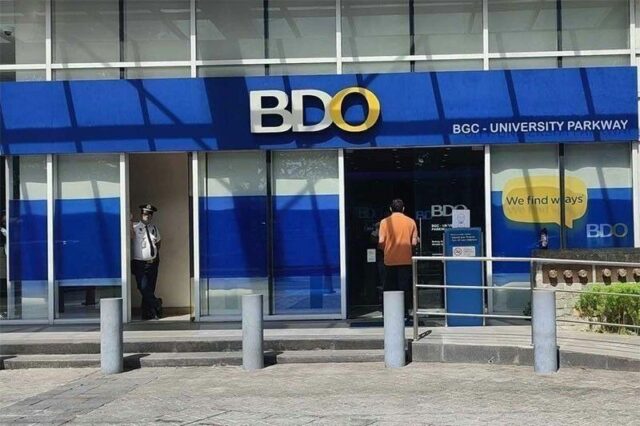
BDO UNIBANK, Inc. was one of the most actively traded stocks in the local market last week after disclosing its 2024 earnings and partnership with a Japanese bank.
Data from the Philippine Stock Exchange showed that P2.94 billion worth of 19.83 million BDO shares were traded from Feb. 24 to 28.
The Sy-led bank’s shares inched up by 5.6% to P150 apiece week on week last Friday from P142 on Feb. 21. Since the start of the year, the stock has increased by 4.2%.
BDO became the fifth most actively traded stock last week following the release of its 2024 earnings, which showed a strong return on equity (RoE).
“BDO’s full-year 2024 earnings fell within Unicapital Securities’ and the consensus estimates and delivered a 15.1% RoE, which is superior compared to its peers,” Wendy B. Estacio-Cruz, head of research at Unicapital Securities, said in an e-mail.
Ms. Estacio-Cruz also noted that the expansion of its partnership with Shizuoka Bank Ltd. “boosted” investor optimism.
“This boosted investor optimism as the partnership should increase the bank’s client base by supporting Japanese companies investing in the Philippines. This should also help grow its corporate banking, remittance, and trade finance sectors while reinforcing its role in cross-border economic activities,” Ms. Estacio-Cruz added.
In a press release disclosed to the local bourse last week, BDO reported an 11.73% year-on-year rise in attributable net income to P82.02 billion in 2024 from P73.41 billion in 2023.
Robust growth across its core businesses increased the bank’s consolidated net income by 33.4% to P57.05 billion from P42.79 billion the year prior.
Meanwhile, BDO’s net interest income also picked up by 8.24% to P186.60 billion in 2024 from P172.39 billion a year earlier. The bank’s net interest margin stood at 4.4%.
Customer loans and total deposits rose year on year by 9% and 14%, respectively.
Ms. Estacio-Cruz gave a full-year forecast for 2025 of P290.4 billion in revenue and P91.4 billion in net income.
In a separate report, BDO expanded its partnership with Shizuoka Bank Ltd. to boost trade and investment with Japanese companies in the country.
The expanded partnership with Shizuoka Bank enables companies to connect with the right partners, streamline financial transactions, and navigate regulatory landscapes, the bank said in a statement.
In a statement, the parties announced that they had signed a memorandum of understanding to enhance their business alliance and support Japanese firms in the Philippines.
Under the expanded partnership, Shizuoka Bank expects a larger client base in the Philippines through additional investments and business-matching initiatives.
Shizuoka Bank is one of the group companies of Shizuoka Bank Group. It is a leading regional bank based in Shizuoka Prefecture, operating 177 branches and 26 sub-branches. Its network extends beyond Shizuoka Prefecture, with branches in Japan’s three major economic centers—Tokyo, Osaka, and Nagoya.
Ms. Estacio-Cruz set a support level at P145 apiece and a resistance level at P156 apiece. — Lourdes O. Pilar
YELLOW terno worn by Imelda Cojuangco — JOSEPH L. GARCIA
NATIONAL COSTUME gown worn by the 1994 Miss Universe pageant candidate Charlene Gonzales.
A Barbie doll in Rita Moreno’s likeness, wearing a copy of a dress by Pitoy Moreno.
Pitoy Moreno exhibit at The M shows that he was not limited to the 1970s
AS LONG AS disco and Manila Sound live, Jose “Pitoy” Moreno, who died in 2018, will not be forgotten. His name and the quality of his clothes will live on through Hotdog’s song “Bongga Ka ’Day” (roughly translated: “You’re fabulous, sister”), which has the line, “suot mo’y gawa ni Pitoy” (what you are wearing was made by Pitoy).
The song was recorded in 1979, at the height of Martial Law in the Philippines, and arguably, the height of Mr. Moreno’s designing power. His name has become attached to the informal court of then-First Lady Imelda Marcos, but a new exhibit at the Metropolitan Museum of Manila (The M Museum) in BGC argues that his influence reaches before and beyond those years. The exhibit, fittingly, is called Timeless: J. Moreno. The exhibit was opened on Feb. 27 and will run until June 29.
Born in 1925 and an adolescent by the end of World War II in 1945, Mr. Moreno, known to his clients and the rest of society as “Pitoy,” had the unique opportunity to be cohorts with future history-shapers. Educated at the University of the Philippines (UP), he became friends with artist Araceli Dans and theater luminary Celia Diaz-Laurel, among others; while the future National Artist Fernando Amorsolo headed the UP Fine Arts Department. His extracurricular activities with the Upsilon Sigma Phi fraternity, and its sorority counterpart, Sigma Delta Phi, brought him in close proximity to the future senator Benigno “Ninoy” Aquino, Jr., and future president and dictator Ferdinand E. Marcos, Sr.
New York-based art historian Florina H. Capistrano-Baker, who curated the exhibit with Ditas R. Samson and Clarissa M. Esguerra, argued during a Feb. 28 talk that Mr. Moreno had been famous prior to the Marcos association, thanks to this network.
He had designed costumes for the Bayanihan Philippine National Folk Dance Company, which performed abroad, and during the Macapagal administration (just prior to the long Marcos years), he had already been designing for Diosdado Macapagal and his family. Gowns made for his wife Eva and daughter Gloria (who herself later became president) are displayed in the exhibit, including the wedding dress made for Mrs. Macapagal-Arroyo.
Mr. Moreno even designed a dress for his (sort of) namesake, American actress Rita Moreno, in 1962. Ms. Moreno had heard of her nomination to the Academy Awards for her role in West Side Story while she was shooting a film in the Philippines. She made her way to his Taft Avenue atelier, and came out with a creation made with Japanese fabric used for obi (a kimono sash). Ms. Moreno won the Oscar for Best Supporting Actress, and was photographed in the dress. Decades later, Mattel designed a Barbie doll in Ms. Moreno’s likeness, wearing a copy of Mr. Moreno’s dress. The doll is displayed in the exhibit.
Ms. Capistrano-Brown noted that Mr. Moreno’s fame, as well as that of the Bayanihan Dance Company, precedes that of Imelda. “People who came later, the younger generation, assumed that she created them. But like Bayanihan, like the Madrigal (Singers) — Pitoy was already well-known before Imelda,” she said.
Even Mrs. Marcos couldn’t be credited for his first international outings: that was the work of Tourism Commissioner under the Macapagal administration Conchita Sunico, who formed Karilagan International, which brought Filipino designs for overseas fashion shows.
What Mrs. Marcos did do was make his fame international: through Mrs. Marcos, he formed the connections necessary to dress her friends, which included Princess Margaret (sister of the late Queen Elizabeth II). The dress he made for her is in the Victoria and Albert Museum in London.
Ms. Capistrano-Brown emphasized that Mr. Moreno designed across the political spectrum, and kept his fame beyond the Marcos years: while he designed for Mrs. Marcos and her friends (there’s a yellow terno in the exhibit worn by socialite and Marcos friend Imelda Cojuangco), there are also gowns for Mrs. Macapagal, and gowns made well into the 1990s, including the National Costume gown worn by the Philippine candidate to the 1994 Miss Universe pageant, Charlene Gonzales.
In 2009, Mr. Moreno was named as a National Artist for fashion design — a designation which later met with opposition as having been made in a manner that did not follow the rules and traditions of choosing National Artists. The Supreme Court responded with a temporary restraining order on the conferment of the award to Mr. Moreno and six others. The honor was revoked in 2013.
“I’m hearing, I’m not sure if this is accurate — but I was recently told that he has again been nominated for the current search (for National Artist),” said Ms. Capistrano-Brown. “There are again, questions… what I’m being told is that he is nominated, but there are these rumblings.”
She argues that Mr. Moreno’s real political statement was this: “We are beautiful people. Our dress enhances our beauty.”
“When he brought the designs overseas, the purpose is to show the overseas colleagues, or Europe, or wherever country he’s in that we are a beautiful people. We have beautiful designs, we can make beautiful things… we have fine craftsmanship, and we can compete with the rest of the world,” she said.
After all the strife faced by the Philippines, Pitoy’s clothes, according to her, said, “We remain beautiful and worthy of respect. That’s what he says to me.” — Joseph L. Garcia
D&L INDUSTRIES, Inc., a listed producer of specialty food ingredients and oleochemicals, is reducing its capital expenditure (capex) budget for 2025 as it focuses on minor expansions at its Batangas plant, its president said.
“We are still making minor expansions, not as big as what we’ve done in the past couple of years, but on a much smaller scale. So there will still be some capex, but the expectation is for it to be lower than what we did last year,” D&L President and Chief Executive Officer Alvin D. Lao said during a briefing on Friday.
“So roughly around the P1-billion mark, or maybe even less,” he added.
The latest capex budget is lower than the P1.16 billion allocated in 2024.
D&L expects a higher contribution from the Batangas plant to its bottom line as utilization increases and operational efficiencies are realized.
The company commenced commercial operations at the plant in 2023, allowing it to push for high-value-added, coconut oil-derived ingredients and finished products for the food, personal hygiene, and home care segments in the export market.
“We believe that we have only just begun to tap into the plant’s potential given the vast opportunities we see in both local and international markets,” Mr. Lao said.
In 2024, the company’s net income rose by 2% to P2.3 billion, despite higher operating and interest expenses incurred with the Batangas plant.
The continued ramp-up in operations helped offset the incremental expenses, allowing the plant to record its first full-year profit of P244 million.
Meanwhile, D&L expects export revenues to continue growing after both sales and gross profits increased during the period. Exports accounted for 30% of the company’s revenues in 2024.
Amid renewed tariff announcements from former US President Donald J. Trump, Mr. Lao said the company is not concerned, as “the US is a very small part of our export business. There’s a lot of demand for our products, not just from the US.”
Instead, the company sees arbitrage opportunities arising from potential tariffs, as changes in trade policies create short-term price differences across markets.
“In our view, the apparent trade tensions between the US and China present opportunities for companies like us to supply businesses that cannot source from either the US or China,” Mr. Lao said.
“Our new plant in Batangas gives us the capacity and capability to cater to bigger export customers. This puts us in a prime position to capture opportunities arising from the evolving international trade environment,” he added.
Established in 1963, D&L specializes in product customization and manufacturing for the food, chemicals, plastics, and consumer products original design manufacturer industries. Its core business activities include producing customized food ingredients, specialty raw materials for plastics, and oleochemicals for personal and home care applications. — Sheldeen Joy Talavera
JAPANESE luxury skincare brand Shiseido is introducing a new formula to a tried-and-true classic, the Ultimune Power-Infusing Serum, as part of its refreshing of the company’s Ultimune line.
The reformulated serum is now infused with the brand’s Power Ferment Camellia+ technology which uses camellia seed extract fermented using the ki-koji fermentation process which claims to boost “skin regeneration by four times and reduces aging factors by over 50%.”
“It is way more effective right now, aside from the power of fermented camellia, which targets memory T cells… it targets even more skin aging concerns,” Yricka Caluya, retail and training head of Shiseido Philipines told BusinessWorld during the launch on Feb. 21 in Mandaluyong City.
Memory T cells are immune cells that provide long-term protection by recognizing and responding more quickly to previously encountered pathogens. The new Ultimune serum is supposed to target and interact with these T cells on the skin, which is said to slow down “the aging process by 50%.”
Additionally, the serum is also said to target 11 key skin concerns — from uneven skin tone to fine lines — and is suitable for all skin types, positioning it as a universal product.
According to Kaila Nicdao, general manager of Shiseido Philippines, fans of the Ultimune line will continue to enjoy the new formula alongside its added benefits, while those who want to try the serum for the first time will have an opportunity to experience its enhanced formula, which offers improved skin defense, hydration, and radiance.
“This product is tailored to fit customers who are combating and preventing signs of aging. So [the Ultimune serum] can be used as early as your early to late 20s. We really want to ensure that they can protect their skin,” Ms. Nicdao said.
Coming in three sizes — 30 ml, 50 ml, and 100 ml — the Shiseido Ultimune Power-Infusing Serum starts at P4,450 (for the 30 ml).
QUICK REVIEW This writer was provided with the 50 ml serum and a 50 ml refill to try after the event and while it’s still too early to tell what its long-term effects are, I do have some thoughts about the product.
First of all, the red glass pump bottle looks very premium and is perfect to display on one’s vanity table. The serum itself has a pretty thin consistency and smells similar to Elizabeth Arden’s Green Tea fragrance — which I do like as it’s not too strong and the fragrance doesn’t really last long enough to bother me, but it does have a fragrance, so people who are sensitive to fragrances should watch out.
Because it is formulated to be a generalist serum, it’s meant to do everything and fit anyone — as such it absorbs into the skin very quickly: this is perfect for those with oily or combination skin as it doesn’t make your skin oily, but for those with dry to normal skin like mine, I figured two pumps work best to ensure that I have enough coverage while balancing its quick absorbency.
I have used it for an entire week, twice a day, and what I noticed is that while it is absorbed fast, it doesn’t dry the skin and it hydrates the skin, allowing my day and night creams to penetrate my skin better in a way that leaves it feeling smoother, plumper, and more “glowy” without any greasy residue.
Am I able to vet their anti-aging claims as early as now? No. But as any generalist serum, it’s not really a one-size-fits-all solution for every skin concern. It will help with your fine lines, uneven skin tone, elasticity, texture, etc., but if your skin needs more targeted treatments for specific concerns, you may need to layer it with more potent actives or specialized products, because at the end of the day, skincare is personal.
Is it a good serum? Yes, definitely, as I am enjoying how my skin feels after using it for a week and if you do have the budget for it, it is worth a try.
Zsarlene Chua is a former BusinessWorld reporter who is now a fledgling PR girl. She’s all about skincare, makeup, and video games — and occasionally food. None of the products she reviews are the writer’s clients. Contact the author at zsarlene.chua@gmail.com.
RATES of the Treasury bills (T-bills) and Treasury bonds (T-bonds) to be auctioned off this week may inch down to track the broad decline in US Treasury yields amid worries over the world’s largest economy.
The Bureau of the Treasury (BTr) will auction off P22 billion in T-bills on Monday, or P7 billion each in 91- and 182-day papers and P8 billion in 364-day papers.
On Tuesday, the government will offer P30 billion in reissued seven-year T-bonds with a remaining life of five years and four months.
T-bill and T-bond yields could track the slight decline in secondary market rates on Friday following the easing in US Treasuries, Rizal Commercial Banking Corp. Chief Economist Michael L. Ricafort said in a Viber message.
The reissued seven-year bonds on offer this week could fetch yields ranging from 5.975% to 6.05%, a trader said in an e-mail, close to secondary market levels.
At the secondary market, yields on the 91-, and 364-day T-bills inched down by 1.39 basis points (bps) and 0.47 bp week on week to end at 5.3794% and 5.7842%, respectively, based on PHP Bloomberg Valuation Service Reference Rates data as of Feb. 28 published on the Philippine Dealing System’s website. Meanwhile, the 182-day paper’s yield inched up by 1.96 bps to 5.6116%.
Meanwhile, the seven-year bond’s rate slipped by 0.52 bp week on week to close at 6.0036% while the five-year paper, the tenor closest to the remaining life of the T-bonds, went down by 0.13 bp to end at 5.9212%.
On Friday, the yield on benchmark US 10-year notes fell 6 basis points to 4.227% from 4.287% late on Thursday, Reuters reported.
The 2-year note yield, which typically moves in step with interest rate expectations for the Federal Reserve, fell 8.9 bps to 3.991% from 4.08% late on Thursday.
The prospect of higher US tariffs sent jitters through markets and revived concerns about an escalating global trade war.
US President Donald J. Trump said on Thursday that 25% duties on imports from Canada and Mexico will come into effect on March 4 — not April 2 as he had suggested a day earlier — and said goods from China will be subject to an additional 10% duty. Last week, he also floated 25% tariffs on shipments from the European Union.
Mr. Ricafort added that T-bill and T-bond yields may slip on expectations of slower Philippine headline inflation last month.
A BusinessWorld poll of 18 analysts yielded a median estimate of 2.6% for the February consumer price index (CPI).
If realized, this would be slower than the 2.9% in January and the 3.4% clip in the same month a year ago.
This would also be the lowest print in four months or since the 2.3% recorded in October and settle within the central bank’s 2.3% to 3% estimate for the month.
The Philippine Statistics Authority will release February CPI data on March 5 (Wednesday).
Last week, the BTr raised P22 billion as planned from the T-bills it auctioned off as total bids reached P83.711 billion or almost four times as much as the amount on offer.
Broken down, the Treasury borrowed P7 billion as planned via the 91-day T-bills as tenders for the tenor reached P24.475 billion. The three-month paper was quoted at an average rate of 5.329%, inching up by 1.1 bps from the previous auction, with accepted rates ranging from 5.28% to 5.358%.
The government also made a full P7-billion award of the 182-day securities as bids stood at P25.936 billion. The average rate of the six-month T-bill stood at 5.672%, 1 bp higher than the previous week. Tenders accepted by the BTr carried yields of 5.64% to 5.693%.
Lastly, the Treasury raised the programmed P8 billion via the 364-day debt papers as demand for the tenor totaled P33.3 billion. The average rate of the one-year debt decreased by 2.6 bps to 5.754%, with bids accepted having rates of 5.74% to 5.77%.
Meanwhile, the reissued seven-year bonds to be offered on Tuesday were last auctioned off on Feb. 4, where the BTr raised a total of P40 billion via the papers, above the planned P30 billion, as it opened its tap facility to accommodate strong demand. The bonds fetched an average rate of 5.968%, lower than the 6.375% coupon rate.
The Treasury is looking to raise P147 billion from the domestic market this month, or P22 billion from T-bills and P125 billion from T-bonds.
The government borrows from local and foreign sources to help fund its budget deficit, which is capped at P1.54 trillion or 5.3% of gross domestic product this year. — A.M.C. Sy with Reuters
The Audi Q6 e-tron can travel 640 kilometers on a full charge. — PHOTO BY KAP MACEDA AGUILA
1 of 5
The Audi Q6 e-tron can travel 640 kilometers on a full charge. — PHOTO BY KAP MACEDA AGUILA
Audi Philippines Managing Director Paolo Brambilla — PHOTO BY KAP MACEDA AGUILA
PHOTO BY KAP MACEDA AGUILA
PHOTO BY KAP MACEDA AGUILA
PHOTO BY KAP MACEDA AGUILA
Premium BEV seen to raise the bar in safety and convenience
AUDI PHILIPPINES has just added to its pure-electric options available in the country with the recent introduction of the Audi Q6 e-tron. The SUV now takes its place as the most affordable BEV (battery electric vehicle) of the Ingolstadt-headquartered premium marque here.
“The introduction of the 100% electric e-tron SUV and e-tron GT models in early 2022 ushered in a new chapter in Audi’s success story in the Philippines. It spurred the adoption of premium electromobility in the country through seamless ownership processes, standardization of charging solutions, and partnerships with various stakeholders. The launch of the all-new Audi Q6 e-tron accelerates the progress of the local market’s transition to fully electric vehicles,” declared Audi Philippines Head and PGA Cars President Benedicto Coyiuto in a release.
Audi Philippines also celebrates its 20th year and looks forward to a busy period for the four-ring brand. Said Audi Philippines Managing Director Paolo Brambilla, “We’re very excited about this year, as we just launched two vehicles in January, the Q7 and the Q8, and we’re expecting to launch an additional three or four models,” he told members of the media in an interview. This is the first time for the German marque to unveil this many cars in a year.
Built on the so-called Premium Platform Electric, the Q6 e-tron is said to “(take) full electric-powered mobility to a new level with a comprehensive array of digital features and Audi’s self-driving technology,” said the company.
Audi Philippines wants to highlight this functionality in the Q6 e-tron. “Numerous sensors” are employed to constantly monitor the new Q6 e-tron’s surroundings — enabling the vehicle to automatically maintain the pre-selected speed of the vehicle, as well as adjust for changes should the vehicle in front slow down. The system instantaneously reacts, determining and maintaining an ideal distance.
This also works in usually arduous stop-and-go traffic, where “the self-driving system can slow the new Q6 e-tron to a standstill and can also set it off again without driver intervention,” continued the release. “Combined with the active lane keep assist, which automatically ensures the vehicle stays between lane markings on the road (even around bends), the new Q6 e-tron is able to provide self-driving functions under certain conditions.” Completing a suite of driver assistance features are lane departure warning, swerve assist and front turn assist, cross traffic assist, emergency brake assist, and others. Meanwhile, Drive and Park allows the vehicle to autonomously slot into a parking slot.
Powered by a 100-kWh battery, the Audi Q6 e-tron (initially available in a lone Performance variant) boasts 326hp and 485Nm maximum output. Expressed in driving distance, the SUV can muster a WLTP-rated 640 kilometers on a full charge. Utilizing the battery is an advanced 800-volt battery system designed for high efficiency and fast charging. Audi Philippines says this allows a maximum charge rate of up 270kW (DC), translating to a 10%-80% charge level in just 21 minutes “under ideal conditions.” A single Permanent magnet Synchronous Motor (PSM) mounted at the rear is put to work.
The Q6 e-tron Performance sports a rear-biased powertrain layout, leading to heightened steering precision and balance. It is fitted with an optimized S-sport suspension system to guarantee a comfortable and controlled ride.
Inside the cabin, the model gets the Audi Digital Stage which consists of three main screens: the 11.9-inch Audi virtual cockpit, 14.5-inch Audi MMI panoramic touch display, and the 10.9-inch MMI passenger touch display. The so-called Virtual Cockpit displays relevant information, and the MMI panoramic display are placed on the slim, free-standing curved panel with OLED technology — curved and oriented toward the driver.
Additionally, the MMI passenger display lets the front-seat occupant manage navigation and entertainment options without disturbing or distracting the driver. The augmented reality head-up display (AR HuD) additionally provides information such as speed, traffic signs, assistance, and navigation symbols.
Visual communication cues for the Audi Digital Stage are realized in the Dynamic Interaction Light (IAL) — a light strip spanning the width of the cockpit that functions as a “welcome greeting” when the car is locked and unlocked, an additional visual safety reminder by duplicating the dynamic indicator light on the exterior, and a charging status indicator.
“Audi Philippines has been at the forefront of electric vehicles in the Philippines. Since we launched the Audi e-tron, we’ve sold over 350 units. With the new Q6 at the lower price segment, we’re expecting to double that figure in the next two years,” concluded Mr. Brambilla.
A customer buys fresh produce at the public market in Marikina. — PHILIPPINE STAR/ WALTER BOLLOZOS
THE National Price Coordinating Council and Agriculture department should act to stabilize vegetable market prices, Speaker Ferdinand Martin G. Romualdez said on Sunday.
The government should also collaborate with the private sector to formulate a “sustainable food pricing system” that will make vegetables cheaper, he said.
“We cannot leave this to the market without a clear plan. From planting to selling in the market, there must be proper regulation,” he said in a statement.
Mr. Romualdez said vegetable prices remain elevated, putting a strain on the finances of low-income families.
In February, the Philippine Statistics Authority reported that the average retail price for a kilo of tomato was P109.94, red onion P162.69, and calamansi P86.63.
Mr. Romualdez said he would back measures that would “institutionalize long-term solutions” to elevated rice prices, such as improved land-use policies for farming, incentives for agricultural cooperatives and strengthening oversight over food supply chain disruptions.
He also said the lack of an efficient farm-to-market transportation system and post-harvest facilities are also putting upward pressure on vegetable prices.
“The cost of production and transporting vegetables from the provinces to the market is higher. Too many middlemen are profiting, while farmers suffer losses and consumers struggle with high prices,” he said.
The Department of Agriculture is working with the Department of Public Works and Highways to upgrade farm roads, to reduce transportation costs and expedite produce delivery, Agriculture Secretary Francisco P. Tiu Laurel, Jr. said in February.
The government should improve farm-to-market roads and storage facilities, helping reduce post-harvest losses and stabilize supply, which Mr. Romualdez sees as key to cheaper produce, he added.
Congress has earmarked P23.2 billion for farm-to-market road repairs and constructions for this year, according to the Agriculture department’s budget document.
Improving access to vegetables could lead to reduced dependence on imports, Mr. Romualdez said.
“We need to strengthen our own harvest… The solution is not just imports but strengthening our own production.” — Kenneth Christiane L. Basilio
HONDA CARS PHILIPPINES, Inc. (HCPI) is set to launch its new HR-V model, further expanding the car manufacturer’s full-hybrid lineup in the Philippines.
“This solidifies the company’s commitment to improving people’s way of life by reducing their carbon footprint,” HCPI said in a statement over the weekend.
The new HR-V, HCPI’s third hybrid model in the Philippines, will have its official consumer launch at SM North EDSA The Block Atrium on March 9, HCPI said.
It will be priced at P1.45 million for the 1.5 S CVT, P1.52 million for the 1.5 V CVT, and P1.8 million for the 1.5 RS e:HEV E-CVT, available across HCPI’s 38 dealerships nationwide.
Depending on the variant, the model comes in six colors: Ignite Red Metallic, Platinum White Pearl, Premium Opal White Silver Pearl, Meteoroid Gray Metallic, Crystal Black Pearl, and Sand Khaki Pearl.
However, Platinum White Pearl and Premium Opal White Silver Pearl will cost an additional P20,000.
According to HCPI, deliveries of the new HR-V will begin this month.
The model will also be showcased in mall tours at SM Megamall from Feb. 27 to March 5, SM North EDSA from March 7 to 9, and Festival Mall from March 14 to 16.
For 2025, HCPI is targeting a 3–5% sales growth from the 15,518 units sold in 2024. Last year, its sales accounted for 3.32% of total industry sales.
According to HCPI President Rie Miyake, growth will be driven by new model launches and dealership expansions in 2025.
“For the succeeding years, our direction is to expand the hybrid (models). Today, I cannot mention any specific models or timing, but our direction is always to shift to hybrid,” she told reporters in January.
“Considering the current market situation, we believe the hybrid model is the best solution for Filipino customers to contribute to carbon neutrality. So our direction is to bring in more hybrid (models),” she added. — Justine Irish D. Tabile