Home Blog Page 1809

How malls celebrate women

INTERNATIONAL Women’s Day may be over, but there are still plenty of Women’s Month events being held throughout Metro Manila. Malls, being the place many Filipinos frequent, are among the largest organizers of these events.

Whether you are in transit, whiling away the time, or finding somewhere to bond with family or friends, there are quite a few women’s events to choose from in malls around the metro.

Here they are, from north to south:

SM NORTH EDSA’S BEAUTYVERSE FAIR
Ongoing until March 31, the Beautyverse Fair at the upper ground level of SM North EDSA in Quezon City welcomes women to check out beauty finds offered by merchants throughout the area. Participants include Sunnies, Happy Skin, and BLK Cosmetics, among many others. There is also a photo spot where women can take pictures.

ROBINSONS GALLERIA’S ‘TREATS FOR HER’ OFFERING
To celebrate Women’s Month, Robinsons Galleria in the Ortigas Center, Quezon City, is offering “Treats for Her,” where shoppers get a chance to win a special treat. From March 22 to 23, they can present a single receipt of P2,500 from any food and beverage outlet to the Guest Services booth on the mall’s Level 3 and claim a prize.

SM MEGAMALL’S MEGA HUE DINER
For a space where women can sip, dine, and relax, SM Megamall in Ortigas Center, Mandaluyong City has put up a mega diner at the Mega Fashion Hall in Level 3. Running until March 31, the area offers treats from shops like Araro Gelato, Weekday Coffee, Chotto Matcha, and We Knead Pastry Shop.

Meanwhile, the Cutie Claw Machine gives visitors the chance to win beauty, fashion, and wellness gifts.

SHANGRI-LA PLAZA’S RFLXN PHOTO EXHIBIT
With RFLXN: The Many Faces of a Woman, Shangri-La Plaza in the Ortigas Center, Mandaluyong City, captures a visual narrative that celebrates the complexity, strength, and evolution of women. The photo exhibit will showcase the many faces of women’s beauty and will run from March 20 to 30 at the East Wing of the mall’s mid-level.

SM MALL OF ASIA’S WEDNESDAY SALE
For Women’s Month, the SM Mall of Asia in Pasay City is offering deals for women on Wednesdays. On March 19 and 26, mallgoers can check out buy-one, get-one and 50% off deals, applicable to various stores throughout the mall, from anti-aging skincare and fragrances to shoes, underwear, and workout clothing.

AYALA MALLS MANILA BAY’S WOMENPRENEUR FAIR
Right in the middle of the expansive Ayala Malls Manila Bay in Parañaque City is the Activity Center, where a market filled with women entrepreneurs is selling various goods and services until March 22. Titled the “Womenpreneur Fair,” it is organized by the Academy for Women Entrepreneurs and is open daily from 10 a.m. to 9 p.m.

The female health tech company Kindred also has a pop-up until March 23, where it offers 40% off on all its products and services, to promote women’s health to mallgoers.

Finally, on March 22, from 1 to 3 p.m., GoNegosyo will hold a talk on women empowerment and business insights for the women entrepreneurs in attendance.

ALABANG TOWN CENTER’S ‘BRIGHT & BEAUTIFUL’ POP-UPS
Billed as an “ode to female friendship and creativity,” the pop-up event “Bright & Beautiful” at the Alabang Town Center in Muntinlupa City will run from March 27 to 30. Held at the Activity Center, it will have stalls offering beauty finds and free makeovers from select merchants as well as a market of clothes and accessories by local creators.

Starting March 28, the sports, hobbies, and fitness area in front of Toby’s will host a series of workouts every day at 10 a.m.

Finally, on March 29 and 30, Bumi & Ashe will have pottery, rug tufting, and silver clay jewelry making workshops which will be open to all. — BHL

Breaking free

FREEPIK

Our nation’s greatest tragedy is not poverty, corruption, or external threats — it’s our paralysis in the face of these challenges. The current socioeconomic-political system, dominated by oligarchs and political dynasties, has proven immune to reform, absorbing and neutralizing every attempt at change. Elections, legislation, and advocacy have become ritualistic exercises in futility. The rules of engagement are skewed in their favor, leaving ordinary Filipinos demoralized and disillusioned.

We’re shackled by a small elite that wields disproportionate influence over our lives.

Despite decades of reforms and promises of change, the entrenched elites remain in place. From land reform programs under President Corazon Aquino, to across-the-board reform initiatives of President Fidel Ramos, to anti-corruption campaigns in subsequent administrations, every initiative has been diluted or derailed by oligarchic resistance. Even the Marcos experiment in authoritarian rule failed to dismantle the oligarchic structure.

Working within this system has repeatedly failed. The persistence of patronage politics and crony capitalism underscores the futility of conventional approaches. The question before us now is not whether change is needed, but how it can be achieved in a way that bypasses or disrupts oligarchic control. To break free, the Philippines must embrace innovative strategies that mobilize all sectors of society while circumventing traditional power structures.

Any good son and daughter of the Republic realizes from repeated bad experience that there’s no point in sticking to conventional approaches. It’s time to consider embracing creative disruption — tactical, unconventional, and relentless strategies that bypass or dismantle the system’s safeguards against real transformation. Most of us who’ve been there and done that, including enlightened oligarchs whose businesses actually uplift the poor, will reasonably agree that our “extraordinary situation requires extraordinary whole-of-nation actions.”

Here’s an assembly of ideas, distilled from regurgitating discussions, for discussion and consensus building on what Filipinos should be prepared to do to break free and take concerted action, come what may. But before doing so, it’s crucial to level off by agreeing first on what the common vision is to serve as the basis for strategies, goals, and relevant plans of action.

1. ECONOMIC PARALLEL SYSTEMS
The Philippine economy is held hostage by powerful interests that control life’s essentials — power, water, food, telecoms, banking, information. Attempts at reform have led to monopolistic shell games that merely reallocate control within the same circles. A true economic revolution requires direct, decentralized action.

Boycott and Replacement. A systematic, grassroots effort to establish cooperative and community-driven alternatives. Decentralized finance (DeFi), blockchain-powered microbanks, and peer-to-peer trade networks offer unprecedented opportunities to bypass traditional oligarchic control.

Energy Independence Cells. The failure to modernize the power sector should be countered by localized, self-sustaining microgrids and alternative energy collectives, such as small-scale solar, hydro, and geothermal barangay-based cooperatives.

Urban Farming and Food Sovereignty. Communities should adopt a war footing for food self-sufficiency — rooftop farms, aquaponic stations in urban slums, and large-scale cooperative farming on idle lands backed by digital supply chain coordination.

2. TACTICAL POLITICAL WARFARE
The oligarchic machine has perfected the art of neutralizing electoral, legislative, and investigation threats. Disrupting it in a way that accelerates its collapse might be a better approach.

The Trojan Horse Strategy. Embed operatives to create chaos within corrupt institutions — sowing dysfunction, sabotaging deals, ensuring bureaucratic gridlocks.

Digital Guerrilla Warfare. A dedicated Filipino information insurgency to systematically expose corruption, support whistleblower networks, and undertake crowdsourced investigations at an industrial scale.

Hyperlocal Revolts. Thousands of small, simultaneous, uncoordinated acts of defiance — public office sit-ins, public space occupations, bureaucratic work slowdowns, lightning street protests can overload and short-circuit the system.

3. GOVERNANCE WITHOUT PERMISSION
Build a new system alongside the old one to render it obsolete.

People’s Courts and Arbitration Networks. Communities should form arbitration councils that resolve disputes fairly and efficiently. If these gain credibility, even businesses will prefer them over official courts.

Underground Education Networks. Public education has failed to produce critical, patriotic, and capable citizens. A parallel system of underground schools — teaching true history, good manners, right conduct, a culture of service and patriotism, critical thinking, modern skills, entrepreneurship — to raise a new generation of Filipinos.

Autonomous Zones. Create self-sustaining enclaves of functional governance, communities that have their own financial, security, and infrastructure system.

4. REPROGRAMMING THE FILIPINO MIND
The deepest wound inflicted by colonialism and oligarchic rule is psychological. Filipinos have been conditioned to feel powerless, accept suffering, and see themselves as perpetual victims. This must be undone through a systematic campaign of radical reawakening.

Mythmaking and Identity Engineering. We must cultivate a new heroic narrative of defiance, resilience, and triumph aggressively propagated through films, music, art, and social media.

The Culture of Martial Readiness. We need to train in self-defense, community security, and emergency response through voluntary civic networks, and to also serve as psychological deterrents to foreign invasion and internal oppression.

Shame as a Political Weapon. A cultural shift must be engineered where betrayal by political parties, unworthy candidates, publicity agencies, and electoral bodies, is met with public humiliation so severe that it will be feared more than legal consequences.

5. STRATEGIC CHAOS
Change won’t come easily nor peacefully. The ruling order won’t yield without force. While outright violent revolution is impractical, controlled disruption is necessary. Consider:

Targeted Economic Collapses. Boycotts, worker strikes, and investigative journalism.

Overload. Civil disobedience and tax resistance on a massive scale.

Triggering Elite Infighting. The ruling class is factionalized too. Those in power can be made to turn on each other.

None of those ideas are pipe dreams. They require deep reflection, sustained effort, and selfless sacrifice from all sectors. Our struggle is a moral imperative requiring courageous collective action and performance excellence. The question is whether Filipinos are willing to take the leap to think, act like revolutionaries, and rally behind worthy leaders.

History shows that even the most entrenched systems can be dismantled when ordinary people unite behind a shared vision for good governance, justice, and freedom. The system will not fix itself. It must be bypassed, undermined, and ultimately, transformed. Only then can the Philippines be truly free.


Rafael “Raffy” M. Alunan III is a former secretary of Tourism and secretary of the Interior and Local Government; a member of the Management Association of the Philippines or MAP, the Harvard Kennedy School Alumni Association of the Philippines, the Philippine Council for Foreign Relations, and Rotary Club of Manila.

map@map.org.ph

malunan@gmail.com

Ionics to close manufacturing operations of subsidiary Iomni Precision

IOMNI.COM.PH

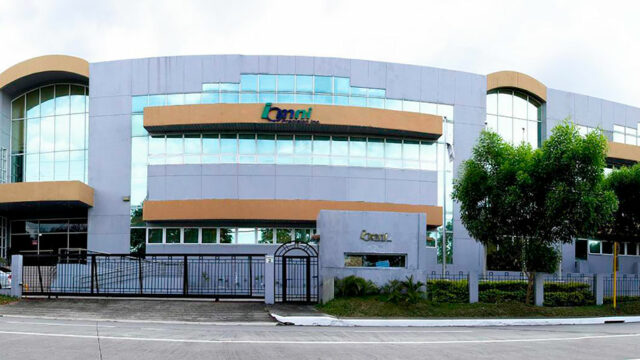
LISTED electronics manufacturer Ionics, Inc. said its subsidiary Iomni Precision, Inc. will cease production on May 15 to improve the company’s financial performance.

The decision was confirmed during a board meeting last week, Ionics said in a regulatory filing on Monday.

“After a lengthy review of the conditions affecting the plastic molding business, the management of Iomni recommended and its board of directors approved the cessation of its manufacturing operations, effective May 15, 2025,” Ionics said.

“The cessation of manufacturing operations is not expected to have any significant impact on the financials of the group and, moving forward, will improve its overall financial performance,” it added.

Iomni is engaged in the production and assembly of precision injection-molded plastic products. The company is located in the Light Industry & Science Park II in Calamba City, Laguna.

For the first nine months of 2024, Iomni posted a $0.4-million net loss, a reversal of the $0.01-million net income recorded in the prior year. Revenue fell by 46% to $1.51 million due to lower customer orders.

Iomni’s weaker performance dragged Ionics’ overall financials.

For January to September last year, Ionics’ attributable net income dropped by 30.5% to $2.85 million. Revenue rose by 7% to $78.35 million on higher sales from turnkey customers.

Gross profit declined by 17% to $8.17 million due to weak market demand for products under the consignment business model.

Ionics provides solutions for the telecommunications, automotive, computer, consumer, industrial, plastics, and medical sectors.

On Monday, Ionics shares rose by 20.25% or 16 centavos to 95 centavos each. — Revin Mikhael D. Ochave

Ted Lasso coming back for new season with Jason Sudeikis

LOS ANGELES — The Emmy-winning comedy series Ted Lasso is returning to the pitch for a fourth season, streaming service Apple TV+ announced on Friday.

Co-creator Jason Sudeikis will reprise his role as Lasso, the American coach of upstart British football team AFC Richmond in the feel-good, fish-out of water story.

“We all continue to live in a world where so many factors have conditioned us to ‘look before we leap,’” Mr. Sudeikis said in a statement. “In season four, the folks at AFC Richmond learn to leap before they look, discovering that wherever they land, it’s exactly where they’re meant to be.”

Ted Lasso won 13 Emmys including two for best comedy series during its three seasons from 2020 to 2023. Its future had been in doubt as the creators had said they originally planned for only three installments. — Reuters

Infrastructure delays may disrupt developers’ plans beyond Metro Manila, say analysts

PHILIPPINE STAR/MICHAEL VARCAS

By Beatriz Marie D. Cruz, Reporter

FURTHER delays in mass transport projects may complicate property developers’ expansion plans outside the National Capital Region (NCR), as improved connectivity is a key factor in unlocking new growth areas, analysts said.

“One way to temper the lackluster demand in Metro Manila is to be more aggressive in expanding outside the capital region; developers are also hinging their expansion on these infrastructure projects,” Joey Roi H. Bondoc, director and head of research at Colliers Philippines, said by telephone.

“These delays will likely stall the development strategies of developers outside Metro Manila,” he added.

Among the causes of delays in major mass transport projects are right-of-way (RoW) issues, budget constraints, and procurement and technical challenges.

“Infrastructure project delays may affect the credibility of the National Government in delivering economy-enhancing projects, which, in turn, could indirectly negate investor appetite for the Philippines,” Havitas Properties President and Chief Executive Officer Jonathan F. Caro said in an e-mail.

For instance, delays in the North–South Commuter Railway (NSCR) could affect key developments outside Metro Manila.

The Department of Transportation recently established a Flagship Project Management Office to accelerate the implementation of key mass transportation projects, including addressing RoW challenges.

Big-ticket projects under its monitoring include the NSCR, the Metro Manila Subway Project, the EDSA Busway Project, the EDSA Greenways Project, the Cebu Bus Rapid Transit, and the Davao Public Transport Modernization Project.

Both investor and buyer confidence rely on the timely delivery of public infrastructure projects, said Spike Alphonsus Ching, project director at PH1 World Developers.

“Delays or unmet expectations could erode confidence, particularly for developments meant to benefit from these projects. However, once these projects are completed, we expect a positive impact on the market, as enhanced connectivity unlocks new growth opportunities for both investors and property owners,” he said in an e-mail.

Delays in mass transport projects could also affect the development of luxury properties, which are primarily located outside the capital region.

“You can’t live there if you can’t get there,” Bill Barnett, executive director of Thailand-based hospitality consulting group C9 Hotelworks, said in an e-mail.

Mr. Barnett added that mass transportation infrastructure is necessary to further develop metropolitan areas in the countryside.

“For luxury real estate like branded residences, there is strong opportunity outside traditional areas like Makati, BGC (Bonifacio Global City), and the Bay Area, but the catalyst for change has to be a large-scale commitment to mass transport,” he also said.

Tech giants, stop trying to build godlike AI

FREEPIK

WE have ChatGPT because Sam Altman wanted to build a god.

For all the buzz, the chatbot is only a prototype along the way to a loftier goal of AGI, or “artificial general intelligence” that surpasses the cognitive abilities of humans. When Altman co-founded OpenAI in 2015, he made it the non-profit’s goal. Five years earlier, Demis Hassabis co-founded DeepMind Technologies Ltd., now Google’s core AI division, with the same AGI objective. Their reasons were utopian: AGI would create financial abundance and be “broadly beneficial” to humanity, according to Altman. It would cure cancer and solve climate change, according to Hassabis.

There are problems with these noble goals. First, the financial incentives of large tech firms are likely to skew AGI efforts towards benefiting their coffers first and foremost. Those early altruistic objectives of Altman and Hassabis have fallen by the wayside in the last few years as the generative AI boom has sparked a race to “win,” whatever that means. In the last few years, DeepMind’s website has removed content on health research or discovering new forms of energy creation to become more product-focused, spotlighting Google’s flagship AI platform Gemini. Altman still talks about benefiting humanity, but he’s no longer a non-profit “free from financial obligations” per his 2015 founding statement, and more of a product arm of Microsoft Corp., which has since sunk roughly $13 billion into his company. 

The other issue is that even the people who are building AGI are fumbling in the dark, despite how sure they are of their timeline predictions. Anthropic CEO Dario Amodei has said we’ll have AGI by 2027. Altman has said it’s “a few thousand days” away and we’ll have the first AI agents joining the workforce this year. Billionaire Masayoshi Son thinks we’ll have it in two or three years. Ezra Klein, a New York Times podcaster who regularly has AI leaders on his show, recently wrote, “It’s really about to happen. We’re about to get to artificial general intelligence.”

But ask the tech leaders what AGI actually means and you’ll get a smorgasbord of answers. Hassabis describes it as software that can perform “at human level.” Altman says it will “outperform humans.” Both, alongside Amodei, often take greater pains to talk about the complexity and challenges of defining AGI. Altman has also called it a “weakly defined term.” And Microsoft Chief Executive Officer Satya Nadella has even derided the AGI effort as “nonsensical benchmark hacking.”

I get little comfort from seeing AI’s top leaders trash talking or dancing around the definition of their North Star, while simultaneously racing toward it. Not just because computer-science experts, along with Elon Musk, worry that the advent of AGI will also come with rather high stakes, existential risks to human civilization. But because tilting at a vaguely defined goal opens the door to unintended consequences.

A more worthwhile aspiration would be narrower and more concrete, such as building AI systems that reduce medical diagnostic errors by 30%. Or in education, improving math proficiency in students by 15%. Or systems that could enhance energy grids to reduce carbon emissions by 20%. Such goals not only have clear metrics for success but serve concrete human needs, just as AI builders like Altman and Hassabis originally envisioned.

There is no evidence that when a company like Google or Microsoft (or China’s DeepSeek) claim to have finally built AGI, they will have the key to curing cancer, solving climate change, or increasing the wealth of everyone on earth by “trillions” of dollars, per Altman. So intense has the arms race become that it seems more likely they will instead position themselves as having a competitive advantage in the market, raise prices, and lock down information sharing. There will be questions about geopolitical ramifications. When he founded OpenAI, Altman said that if his team ever noticed another research lab was getting closer to AGI, they would down tools and collaborate. That looks like a pipe dream today.

Last month a large group of academic and corporate AI researchers published a paper that called on tech firms to stop making AGI the be-all and end-all of AI research. They argued that not only was the term too vague to measure properly, creating a recipe for bad science, it left key people out of the conversation — namely, all those whose lives would be changed. Technologists in 2025 have far more societal power than they did at the turn of the millennium, able to reshape culture and individual habits with the social media products they’ve deployed, and now large swathes of jobs too with AI, with few checks and balances.

The researchers, including Google’s former AI ethics lead Margaret Mitchell, suggest not only that tech firms include more voices from different communities and fields of expertise in their AI work, but that they drop the vague shtick about AGI, which one scientist memorably defined for me as “the rapture for nerds.”

The obsession with “bigger is better” has gone on long enough in Silicon Valley, as has the jostling between people like Musk and Altman to have the biggest AI model or the biggest cluster of Nvidia Corp.’s AI chips. J. Robert Oppenheimer had much regret for his role as the father of the atomic bomb, and now epitomizes the notion that “just because you can, doesn’t mean you should.”

Rather than look back in hindsight with remorse, tech leaders would do well to avoid the same trap of gunning for glory and trying to build gods, especially when the benefits are far from certain.

BLOOMBERG OPINION

ALI, PNB partner to simplify real estate financing for overseas buyers

(L-R) Shiela Marie B. San Buenaventura, RBG Chief Finance Officer, Ayala Land, Inc. (ALI); Rufino Hermann S. Gutierrez, Senior Marketing Director, AyalaLand International Sales, Inc. (ALISI); Augusto D. Bengzon, Chief Finance Officer & Treasurer, ALI; Mariana Flores, Caculitan, First Senior Vice President, Philippine National Bank (PNB); Celeste V. Lim, First Senior Vice President, PNB; Allan L. Ang, First Senior Vice President, PNB

REAL ESTATE developer Ayala Land, Inc. (ALI) has partnered with the Philippine National Bank (PNB) to streamline property purchases in the Philippines for foreign clients.

“We highly value our partnership with Philippine National Bank (PNB) as it strengthens our commitment to providing a seamless and efficient buying experience for our clients abroad,” Rufino Gutierrez, senior managing director of Ayala Land International Sales, Inc., said in a statement on Monday.

“Through this collaboration, we are making it easier for Filipinos and foreign investors to acquire properties in the Philippines by offering accessible financing and secure remittance solutions.”

The enhanced PNB Own a Philippine Home Loan program allows buyers in the United States to apply for a real estate loan evaluated based on their FICO Score, with no age limit on loan applications.

This offers greater flexibility and accessibility in securing home financing, ALI said.

Buyers can use the Autopay Remittance Solution via ACH by enrolling their US-based bank account, ensuring timely and hassle-free payments.

Ayala Land buyers in Singapore can avail of a US dollar-denominated loan, while those in Japan can secure financing in Japanese yen.

“This provides a practical option for international clients seeking a stable and convenient financing solution.”

Filipino buyers are also not required to appoint an attorney-in-fact when applying for a loan through PNB branches in Los Angeles, New York, Guam, Singapore, and Japan.

“We understand the challenges that come with buying property from abroad and, through this partnership, we are making the process easier, more accessible, and worry-free,” PNB President Florido Casuela said.

“With PNB’s specialized home loan solutions and global presence, we are committed to supporting Filipinos and investors every step of the way in securing their future in the Philippines.” — Beatriz Marie D. Cruz

T-bill rates decline on bets of April BSP cut

WIKIPEDIA/JUDGE FLORO

THE GOVERNMENT upsized the volume of Treasury bills (T-bills) it awarded on Monday as yields dropped across the board on expectations that the Bangko Sentral ng Pilipinas (BSP) will resume its rate-cut cycle as early as next month.

The Bureau of the Treasury (BTr) raised P30.8 billion from the T-bills it auctioned off on Monday, higher than the initial P22-billion plan, as total bids reached P118.944 billion, more than five times as much as the amount on offer and higher than the P90.598 billion in tenders recorded on March 10.

The strong demand prompted the government to double the accepted noncompetitive bids for the 91- and 182-day securities to P5.6 billion and to P6.4 billion for the 364-day T-bill, the Treasury said in a statement after the auction.

Broken down, the Treasury borrowed P9.8 billion via the 91-day T-bills, higher than the P7-billion plan, as tenders for the tenor reached P35.384 billion. The three-month paper was quoted at an average rate of 5.118%, declining by six basis points (bps) from the 5.178% seen at the previous auction. Tenders accepted by the BTr carried yields of 5.1% to 5.123%.

The government also made a P9.8-billion award of the 182-day securities, above the programmed P7 billion, as bids stood at P31.05 billion. The average rate of the six-month T-bill was at 5.496%, 5.2 bps lower than the 5.548% fetched last week, with accepted rates ranging from 5.45% to 5.513%.

Lastly, the Treasury raised P11.2 billion via the 364-day debt papers, more than the P8 billion placed on the auction block, as demand for the tenor totaled P52.06 billion. The average rate of the one-year debt decreased by 7.6 bps to 5.697% from 5.773% previously, with bids accepted having yields of 5.693% to 5.713%.

At the secondary market before the auction, the 91-, 182-, and 364-day T-bills were quoted at 5.2499%, 5.5675%, and 5.7920%, respectively, based on PHP Bloomberg Valuation Service (BVAL) Reference Rates data provided by the Treasury.

The government hiked its T-bill award as average rates were all lower than yields seen at the previous auction and at the secondary market, the Treasury said.

T-bill rates went down as investors flocked the offer to lock in relatively high yields before the BSP resumes its easing cycle, Rizal Commercial Banking Corp. Chief Economist Michael L. Ricafort said in a Viber message.

Market players are buying government securities in anticipation of an April rate cut from the central bank and with lower reserve requirement ratios (RRR) by month-end, which could flood the financial system with fresh liquidity that could cause debt yields to decline further, a trader said in a text message.

BSP Governor Eli M. Remolona, Jr. last week said a rate cut is “on the table” at the Monetary Board’s policy meeting on April 10.

He said the BSP is still on easing mode and expects to slash benchmark borrowing costs by “a few more times” this year.

The Monetary Board in February unexpectedly paused its rate-cut cycle, which Mr. Remolona said was a “prudent” move amid uncertainty over the trade policies of US President Donald J. Trump and their potential impact on the Philippines.

The BSP chief earlier said that the central bank will likely continue reducing interest rates by 25 bps at a time, with 50 bps in cuts still on the table this year.

Last year, the BSP cut benchmark interest rates by a total of 75 bps via three consecutive 25-bp reductions since it began its easing cycle in August, bringing the policy rate to 5.75%.

Meanwhile, the RRR of universal and commercial banks and nonbank financial institutions with quasi-banking functions will be reduced by 200 bps to 5% from 7% effective March 28.

The ratio for digital banks will also be trimmed by 150 bps to 2.5%, while that for thrift banks will be cut by 100 bps to 0%.

Rural and cooperative banks’ RRR has been at zero since October last year.

The RRR is the portion of reserves that banks must hold onto to ensure they can meet liabilities in case of sudden withdrawals. A lower ratio means banks have more liquidity, which they can use to fund their loans.

On Tuesday, the BTr will offer P30 billion in reissued 10-year Treasury bonds (T-bonds) with a remaining life of eight years and 10 months.

The Treasury is looking to raise P147 billion from the domestic market this month, or P22 billion via T-bills and P125 billion through T-bonds.

The government borrows from local and foreign sources to help fund its budget deficit, which is capped at P1.54 trillion or 5.3% of gross domestic product this year. — Aaron Michael C. Sy

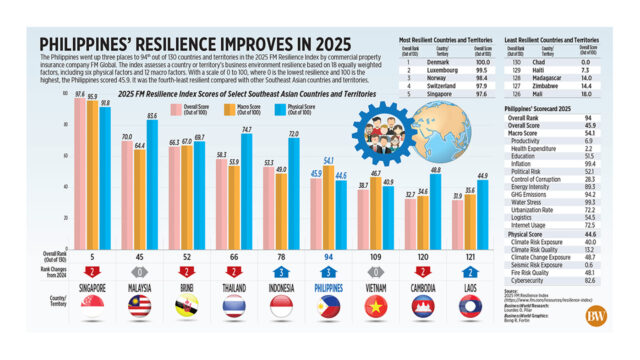
Philippines’ resilience improves in 2025

The Philippines went up three places to 94th out of 130 countries and territories in the 2025 FM Resilience Index by commercial property insurance company FM Global. The index assesses a country or territory’s business environment resilience based on 18 equally weighted factors, including six physical factors and 12 macro factors. With a scale of 0 to 100, where 0 is the lowest resilience and 100 is the highest, the Philippines scored 45.9. It was the fourth-least resilient compared with other Southeast Asian countries and territories.

Philippines’ resilience improves in 2025

New songs by late singer Marianne Faithfull to be released

INSTAGRAM.COM/MARIANNEFAITHFULLOFFICIAL

LONDON — Four new songs by Marianne Faithfull, the English singer best known for the 1960s hit “As Tears Go By” and who died earlier this year, will be released this summer, her son said on Friday.

Ms. Faithfull, one of the most colorful personalities of London’s Swinging ’60s, endured homelessness, drug addiction, and cancer before she passed away aged 78 in January.

As the former girlfriend of the Rolling Stones’ Mick Jagger, Ms. Faithfull gained notoriety for her escapades in the era of sex, drugs, and rock and roll, but she also released 21 solo albums, won a Grammy nomination, and had a film acting career.

Ms. Faithfull had worked on the new recordings over the past year. They were inspired by her first two albums from 1965 and due to be revealed last month but plans were put on hold following her death, Decca Records said.

“Marianne lived to create and perform music — it was her driving force and she never stopped,” her son Nicholas Dunbar said in a statement. “Right up until the end she was looking forward to this release which now completes and celebrates her remarkable artistic career.”

“Burning Moonlight,” one of the new songs, which also gives its title to the EP, was inspired by the opening line of “As Tears Go By.” It will be released on Friday, while the full digital EP will be released on June 6.

“It’s a good time to look back,” Ms. Faithfull had said after completing the project, according to Decca Records.

“It helps me to remember all the things I’ve done. I can’t say I’m a particularly nostalgic person, but I am enjoying this period of reflection.” — Reuters

On GDP size, exports, FDI, and electricity generation

In comparing the GDP size of countries, I use the purchasing power parity (PPP) values, not current values for two reasons. One is that PPP adjusts prices of a comparable basket of commodities that reflect varying standards of living in various nations, each of which has its own currency. And two, PPP values are consistent with electricity generation numbers, and these are in terawatt-hours (TWh), not in currency values.

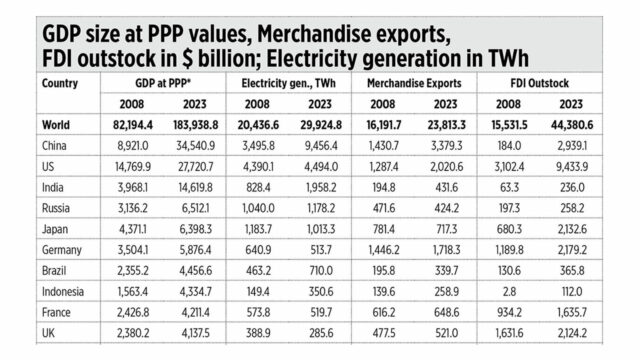
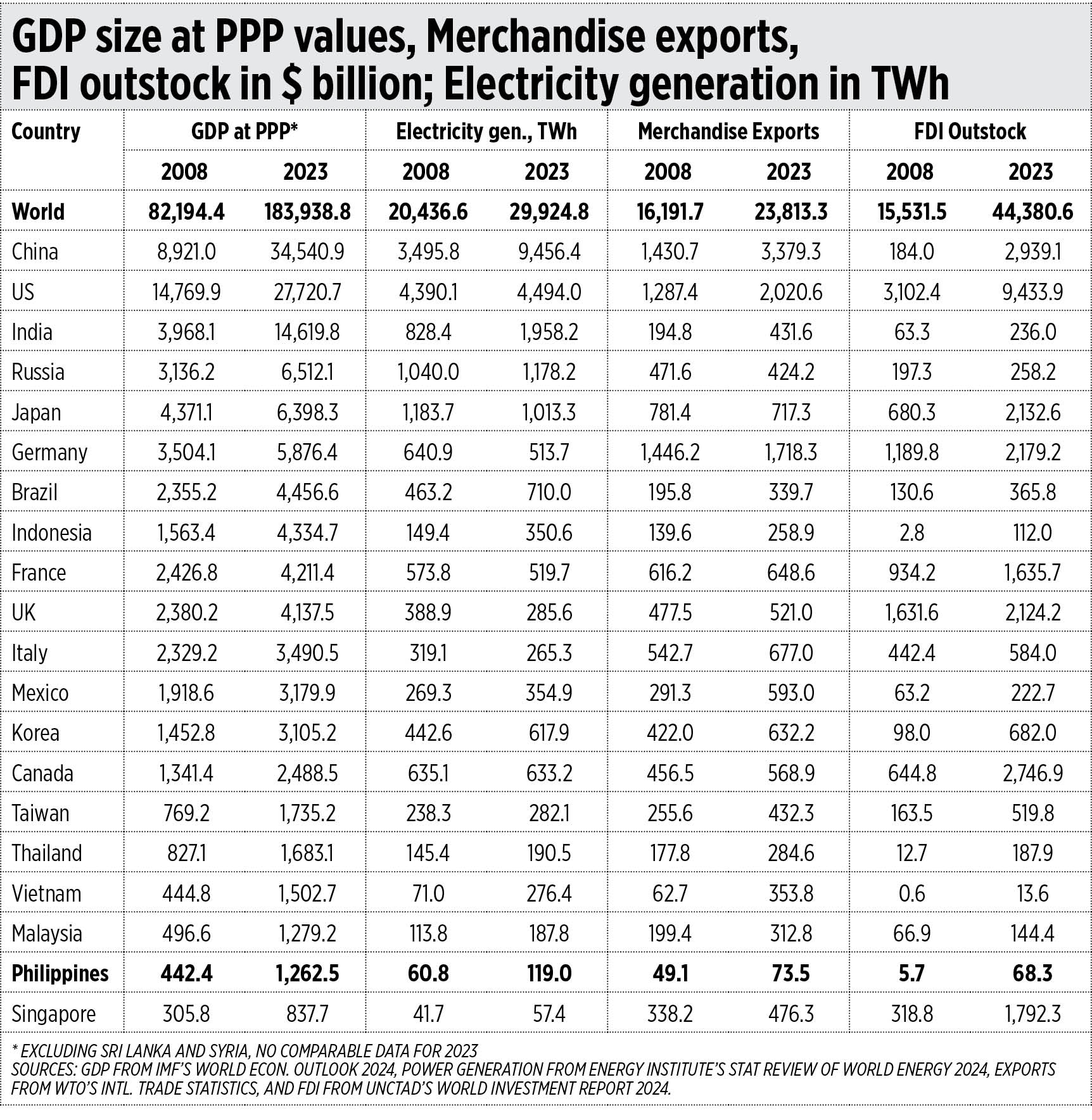
For this column I have compared the data of major economies in the world plus ASEAN-5 in 2008 and 2023, 15 years apart. I took GDP size — the values of the flow of goods and services in one year — at PPP values, and compared it with levels of power generation, merchandise (or goods) exports, and foreign direct investment (FDI) outward stock or net of inflows minus outflows accumulated through the years.

Comparing China and the US, one sees that in GDP size at PPP values, China overtook the US in 2016 — $18.85 trillion vs $18.80 trillion, respectively. When it comes to power generation, China overtook the US in 2011, with 4,713 TWh vs 4,363 TWh, respectively. In merchandise exports, China overtook the US in 2007 — $1.22 trillion vs $1.15 trillion. But in FDI outward stock, China is still way behind the US — but China’s expansion has been big, going from $184 billion in 2008 to $2.94 trillion in 2023, expanding by 16 times over the last 15 years.

I used FDI outward stock in the table, not inward stock because I want to know by how much countries have evolved from being net recipients of capital to being exporters of capital.

Let us compare the ASEAN-5 in FDIs. In 2023, the Philippines’ FDI inward stock was only $119 billion, Malaysia’s was $207 billion, Vietnam’s $229 billion, Thailand’s $291 billion, and Singapore’s was $2.63 trillion — an outlier in the ASEAN. In FDI outward stock in 2023, the Philippines’s was $68 billion, larger than Vietnam’s $14 billion (see the table). Philippine multinational companies like Jollibee, SM, San Miguel Corp., Unilab, and Ayala banner the country in foreign investments abroad.

THE POWER OF POWER
How China overtook the US in GDP size, in merchandise exports, and other major indicators, I think is due to China’s huge expansion in power generation. In 2023, it had twice the capacity of the US, nine times that of Japan, 18 times that of Germany, and 33 times that of the UK. So, China can do all sorts of energy-intensive manufacturing, run big hotels and resorts, malls and theme parks, hospitals and universities, and not worry about blackouts or expensive electricity because the supply is so big.

And of China’s 9,456 TWh in total generation, 61% comes from coal, 13% from hydro, and 5% from nuclear. China has expanded its solar-wind power generation recently, but such is only addition, not a substitution for or transition away from coal power.

For context, the Philippines’ total generation of 119 TWh in 2023 was equivalent to only five days of China’s generation. That is how small our economy and power generation are, or how large China’s are. Aside from having a huge population and hence a huge demand for power, since China is a socialist country it has huge state-led power generation and transmission infrastructure through the State Grid Corp. of China (SGCC) — which also happens to be the owner of 40% our own National Grid Corp. of the Philippines (NGCP).

China has electricity price control too, like our secondary price cap at the Wholesale Electricity Spot Market or WESM. Their National Energy Administration under the National Development and Reform Commission is like our Energy Regulatory Commission. But their price regulation function is secondary to their heavy power generation function, so that “cheap but not available” electricity and blackouts are not a problem there but a regular threat here.

Recently the Maharlika Investment Corp. (MIC) invested in the NGCP and I think it was a good move. I want to mention my former classmate and batchmate (1984) from the UP School of Economics (UPSE), Gladys Cruz-Sta. Rita. Gladys joined the MIC last week as Vice-President for Investment Management Group (Power). She is a good addition there because she was the Provincial Administrator of Bulacan province under three different governors, and was a president of the National Power Corp. Her extensive experience in running a government bureaucracy and in the power sector should help the MIC make prudent investments, especially in the energy sector.

Another batchmate from UPSE 1984 is Lynette Ortiz, President of the Land Bank of the Philippines (LANDBANK). Last week, LANDBANK received an upgraded Viability Rating from Fitch Ratings, rising from ‘BB’ to ‘BB+’. When LANDBANK contributed to the MIC’s capital fund, many analysts predicted there would be a deterioration of LANDBANK’s financial condition. They were wrong, with the ratings upgrade serving as a testament of improved standalone financial strength. Congratulations batchmates Lynette and Gladys.


Bienvenido S. Oplas, Jr. is the president of Bienvenido S. Oplas, Jr. Research Consultancy Services, and Minimal Government Thinkers. He is an international fellow of the Tholos Foundation.

minimalgovernment@gmail.com

Raslag eyes P2-B preferred share issuance by July

PHILSTAR FILE PHOTO

RASLAG Corp., the renewable energy unit of the Nepomuceno group, plans to raise up to P2 billion through a private placement of preferred shares by July.

In a regulatory filing on Monday, the company said its board of directors approved the issuance of up to 15 million preferred shares, with a base size of up to P1.5 billion and an oversubscription option of up to P500 million.

The company has engaged BPI Capital Corp. as the sole issue manager, lead underwriter, and bookrunner. Picazo Buyco Tan Rider & Santos serves as legal counsel.

Raslag said the offering will proceed once it secures approval from the Securities and Exchange Commission for the conversion of its 100 million unissued common shares into preferred shares.

Asked for further details, Raslag Chief Finance Officer Karl Geo D. Origeneza said most of the proceeds will fund the development of the Raslag 7 solar power project in Nueva Ecija.

“We’re targeting to complete the project by 2027. Estimated project cost as of now is P4.8 billion,” Mr. Origeneza said in a Viber message.

At the same meeting, the board approved the purchase of a lot for Raslag 7’s switching station, with an estimated total area of 1,000 square meters, amounting to P10 million, excluding taxes and miscellaneous expenses.

Meanwhile, the board authorized Raslag President Robert Gerard Nepomuceno to enter into a 15-megawatt (MW) power supply agreement with Pampanga I Electric Cooperative, Inc.

Raslag develops, owns, and operates solar power plants to provide utility-scale renewable energy to on-grid customers.

The company has a total installed capacity of 77.844 MW from four facilities in Pampanga. It aims to expand its renewable energy portfolio to at least 1,000 MW by 2035.

At the local bourse on Monday, Raslag shares closed unchanged at P0.98 apiece. — Sheldeen Joy Talavera