Home Blog Page 18

A woman’s strength

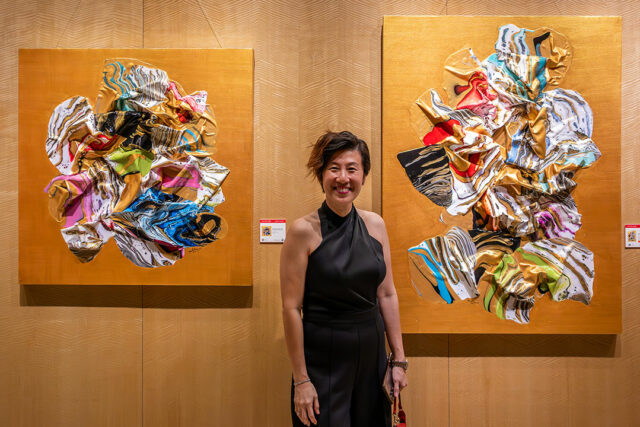
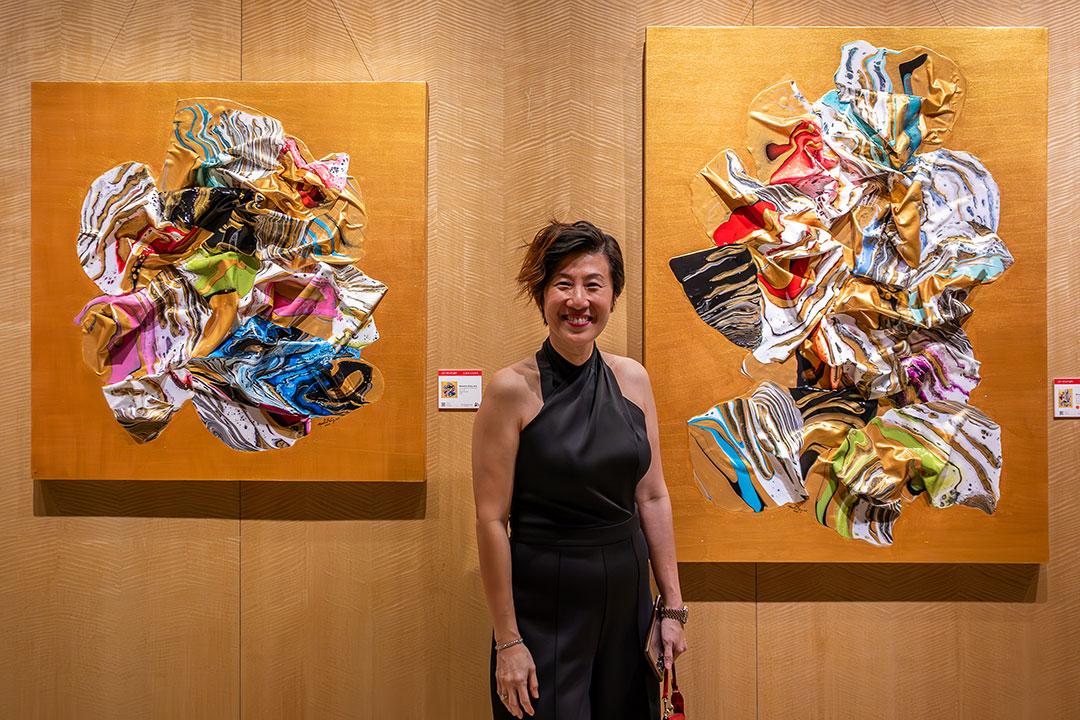
Meneline Wong presents new mixed-media works

WOMEN never quite fit into narrow definitions for Meneline Wong, MD, a multidisciplinary artist and obstetrician-gynecologist.

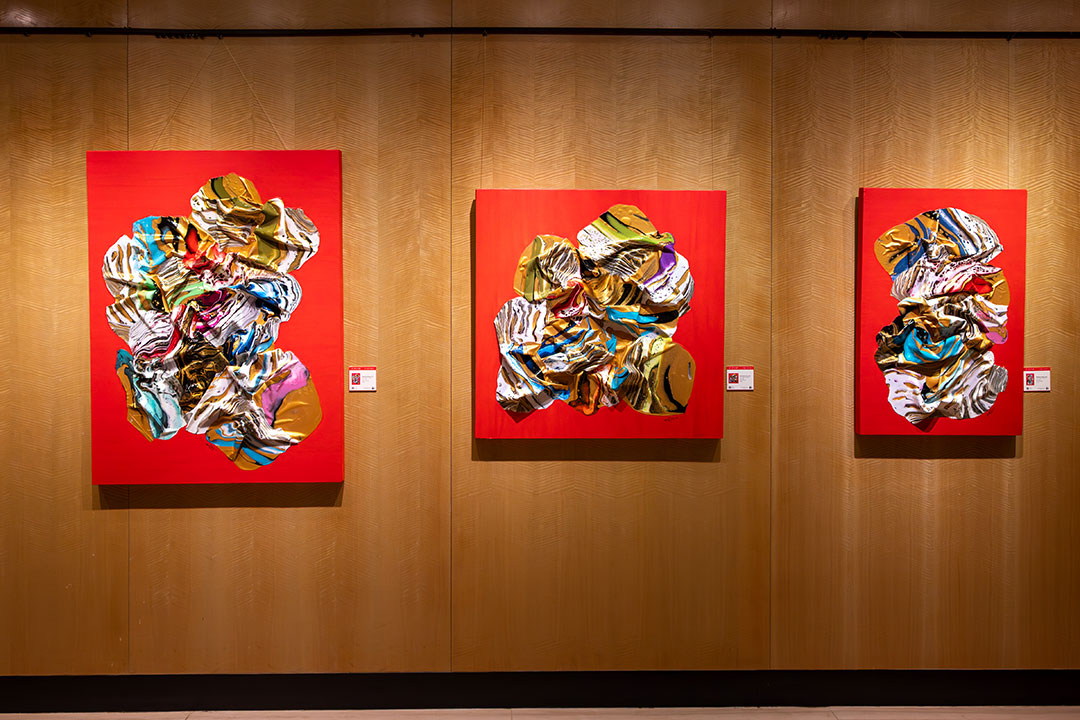
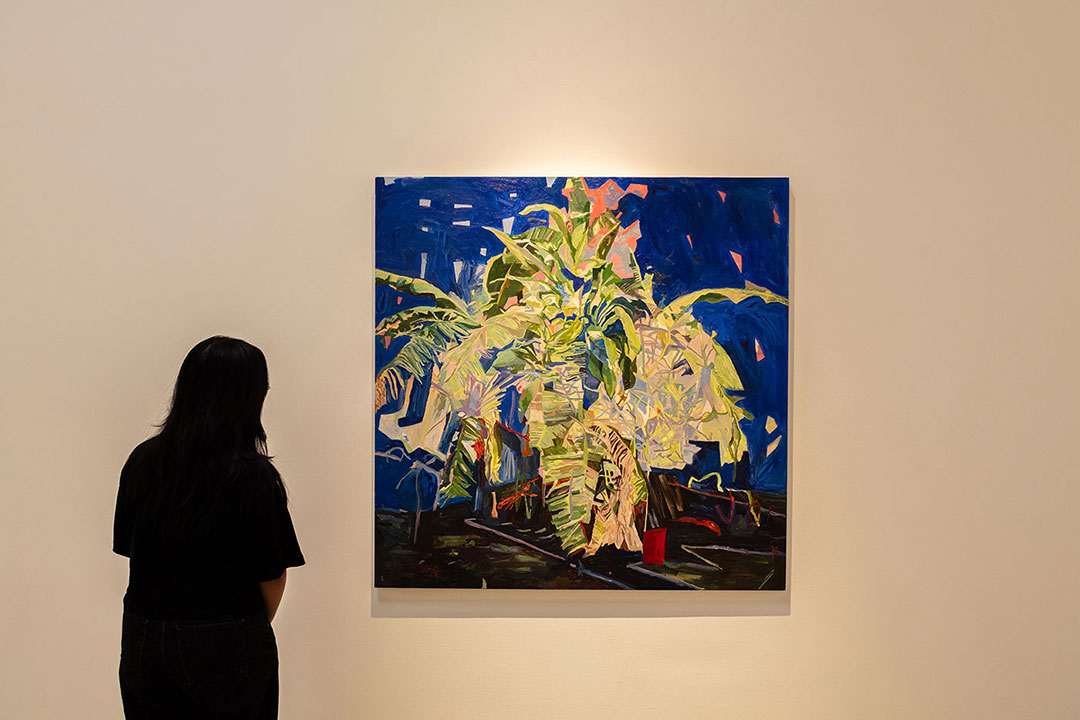
For her, the resilience and beauty of women are best expressed in the mixed-media format, which allows for textures, flourishes, and imperfections. At the Conrad Manila hotel, 20 of Ms. Wong’s latest works provide a splash of color on the walls, for guests and visitors to peruse and admire.

Titled Creases, the 40th exhibit in the “Of Art and Wine” series at the hotel’s Gallery C reflects the strength that can be found in the imperfect, bridging contemporary art and a doctor’s experience with the women she encounters in her day-to-day life.

Ever since she won 2nd place in the GSIS National Art Competition in 2018 for non-representational art, Ms. Wong has continued to experiment and infuse her paintings with an intimate understanding of movement, flow, and organic transformation.

“I’m spontaneous. I don’t plan out my works, maybe except for an upcoming one that will be more of a 3D sculpture,” Ms. Wong told BusinessWorld on the sidelines of the exhibit launch on March 24.

“In front of the canvas, I’m really spontaneous,” she said.

The exhibit’s title brings attention to the creases and folds in her artworks, inviting viewers to look closer and appreciate that these are not flaws in the design. The layered textures and expressive forms, backed by bright colors, symbolize the struggles, sacrifices, and silent battles that women carry with grace.

Some notable details are the lightness of the pastels, representing finesse, and the boldness of the metallic colors, which convey inner strength.

“For so long, women have been confined within narrow definitions,” said Ms. Wong. For her, labels such as “the weaker sex,” “too emotional,” and “lacking courage” do not reflect who women are.

“These are limitations imposed by a world that has not taken the time to truly see them,” she explained.

Rupert Hallam, Conrad Manila’s general manager, said at the launch that these creations are a way to recognize “the remarkable contributions and impact of every woman across our business and in every sector, including the arts.

“Through this latest installation, we invite our guests and patrons to experience a thoughtful tribute to the vulnerabilities and imperfections that ultimately give women their depth, character, and enduring beauty,” he said.

As for Susane Tiausus, managing director of Art Lounge Manila which represents Ms. Wong, the highlight of the creased works are the emotions they manage to evoke.

“Meneline does not hesitate to really express what she has inside,” Ms. Tiausus said. “Try to look into her artworks and see what she’s really trying to tell you — the story, the emotions.”

Curated by Nestor Jardin, Creases is a continuation of mixed-media paintings that Ms. Wong produced for a Women’s Month group show two years ago.

She told BusinessWorld that the natural progression of her works will eventually be the removal of the canvas, resulting in a more sculptural form. As she cycles through her usual schedule — clinic three times a week, painting two times a week, and playing sports in her free time — the drive to push the envelope continues.

“My goal is to have more international shows, maybe even a solo show,” she said.

Of Art and Wine: Creases is on view at Conrad Manila’s Gallery C. — Brontë H. Lacsamana

MPower to supply power to 60 Starbucks stores in Metro Manila

STARBUCKS The Vantage at Kapitolyo, Pasig City — STARBUCKS.PH

MPOWER, the retail electricity supplier of Manila Electric Co. (Meralco), said it will provide electricity supply to 60 Starbucks stores in Metro Manila under the retail aggregation program (RAP).

Rustan Coffee Corp. (RCOC), the authorized licensee of Starbucks in the Philippines, pooled the demand of 60 stores with a combined load of over 3 megawatts (MW) to enroll in RAP, MPower said in a statement on Tuesday.

“In today’s evolving business environment, it is important for companies like ours to continue exploring ways to operate more efficiently,” RCOC President Noey Tantoco Lopez said. “Since transitioning, we have begun to see initial savings in our electricity costs.”

The initiative complements RCOC’s in-store practices, including water-saving fixtures, 100% LED lighting, energy-efficient air-conditioning systems, and improved waste management.

Under RAP, qualified end-users may combine their power demand to access more competitive electricity rates directly from suppliers such as MPower.

“By pioneering RAP within the food and beverage sector, it demonstrates how businesses with multiple facilities can access the benefits of the Retail Competition and Open Access (RCOA) framework,” Meralco Senior Vice-President and Head of MPower Redel M. Domingo said.

MPower said the enrollment of Starbucks stores under RAP, which began in November last year, will enable cost optimization while supporting sustainable growth.

Starbucks started operations in the Philippines in 1997 and has since expanded to more than 500 stores.

MPower holds more than a 35% share of the competitive retail electricity market within Meralco’s franchise area. It serves contestable customers, including large corporations.

Meralco’s controlling stakeholder, Beacon Electric Asset Holdings, Inc., is partly owned by PLDT Inc.

Hastings Holdings, Inc., a unit of PLDT Beneficial Trust Fund subsidiary MediaQuest Holdings, Inc., has an interest in BusinessWorld through the Philippine Star Group, which it controls. — Sheldeen Joy Talavera

Benilde Open Design and Art merges the natural and the technological

DATIRATI by Niño Tayao — BRONTË H. LACSAMANA

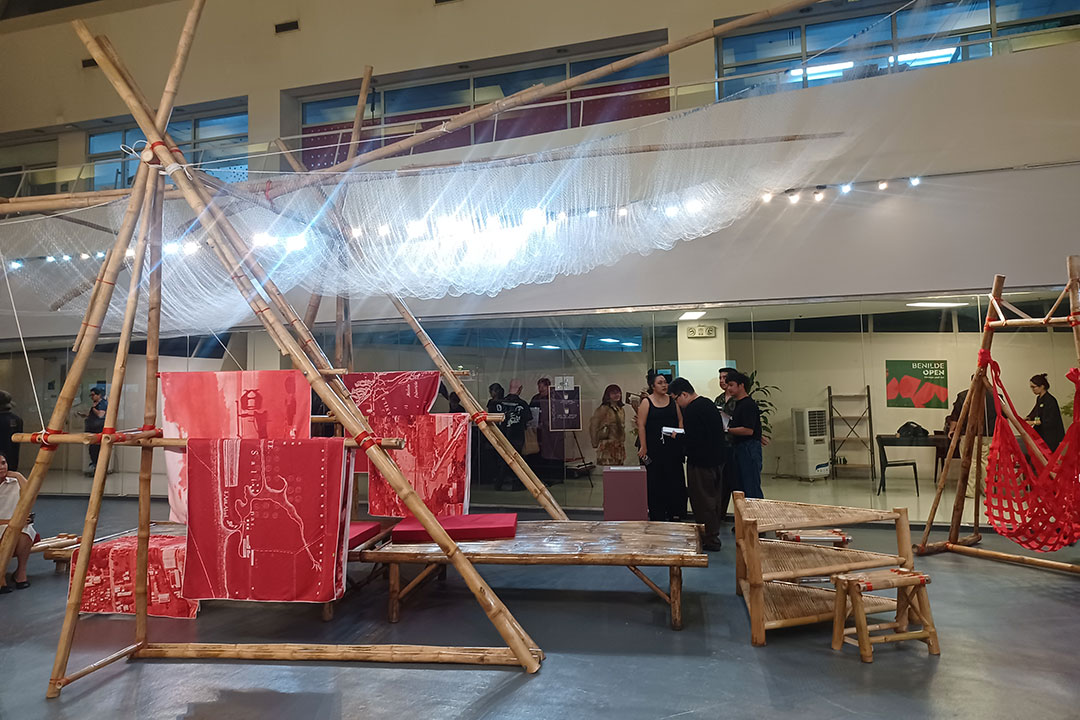
FILLING the gallery space with an inviting area of soft seats and hammocks with a netted canopy overhead, Karl Castro’s Maytubig emerged as part of the second set of Benilde Open Design and Art grants. The pop-up cultural space is another in his series titled Locus Pocus: Kinetic Social Infrastructures for Rest and Collective Care, derived from the aesthetics and labor of fishing culture.

The installation at Benilde was one of the most popular on opening night, offering a public space for rest shaped by human and ecological memory. Built in collaboration with fishermen from Talim Island, its canopy draws from the salambao, a traditional lift net once common in Manila Bay and its river networks, and the sakag, a manual push net still commonly used for shrimp fishing.

“I want people to think about our literal relationship with water in the area where Benilde is,” Mr. Castro told the media prior to the launch of Benilde Open on April 11. Malate, Manila, where the campus sits, used to have waterways leading up to Manila Bay.

“I’m grateful to the fisherfolk communities whose knowledge and craft are at the heart of this structure, which makes rest a form of remembering and a temporary act of reclamation,” he said.

He is one of the 10 grantees chosen to receive P300,000 to realize design and art projects encompassing various fields, under the theme “Extension of Nature” for this edition.

Meanwhile, media artist Mac Andre Arboleda turned to the digital sphere to examine colonial crimes against nature, with a project titled Nutrition Month (Presented by Mayor Alice Guo). In a sonic archive format, it cleverly uses the figure of Alice Guo as a lens to investigate the various trends and systems that define the Filipino today.

“It’s presented as a satirical billboard and evolving archive, mimicking the language of government campaigns and online scams,” Mr. Arboleda told BusinessWorld. He posited that a research-driven yet grassroots approach to the complex social media landscape is critical to make real progress.

For him, be it the seafaring network of Filipinos abroad, the e-sabong networks locally, or the complications behind acceptance of gender identities in the Philippines, there is much yet to be studied online.

SELECTION PROCESS
The Benilde Open Design and Art is a grant-giving body organized by De La Salle College of Saint Benilde (CSB). For its second edition, the showcase is installed across the 6th and 12th floors of the CSB campus, where students and visitors can browse through the works.

It invited creatives from all fields of design and art — like traditional crafts, textiles, industrial design, video, and architecture, to name a few — to participate. The 130 proposals received were narrowed down to 10 professional grantees, each of whom received a P300,000 grant to fulfill their projects.

This year, the international selection committee was composed of Freddie Anzures, Creative Partner at HPIQ; Jiho Lee, curator at the National Museum of Modern and Contemporary Art in Korea; architect Mireia Luzárraga of TAKK; Natalie Huni, managing director and head of design at Wells Fargo; and Timothy Moore, curator of contemporary design and architecture at the National Gallery of Victoria and director of Melbourne Design Week.

“It was very difficult to select because there’s hundreds of creatives and we were really confronted with the variety of disciplines. What was helpful was the theme, which looks at nature,” Mr. Moore told BusinessWorld. “As a jury, we were really interested in projects that challenge the binary relationship between nature and human, projects that look at how nature is complex and entangled in our lives.”

He added that Benilde Open is unique in that it commissions “prototypical work that tests out ideas in a gallery setting,” unlike other similar grants of this scale. “It’s brave to have this kind of incubator for people at different stages of their career. It’s quite unique globally, an opportunity that we don’t see a lot,” he said.

FAMILIAR MADE NEW
Some projects reinterpreted day-to-day rituals and materials to develop new forms.

Technospoonism: Wearable Cutlery for a Reimagined Kamayan by designer Bianca Carague presents a speculative jewelry collection that reimagines the Filipino tradition of eating using one’s hands. Her experimentation in form resulted in rings that double as forks, cuffs that also function as plates, and pendants that may carry food.

Datirati by Niño Tayao revisits childhood play through a stacking toy made from agricultural waste. Using organic materials like rice husks, corn husks, various seeds, and starch, his series of toys invites people to contemplate the life cycle of objects.

“Coming from an industrial design background, I found that the agri-waste materials carried nostalgia. I feel that I’m working with a living thing that’s very fragile,” he said. “The uncertainty is kind of a metaphor for the climate we have right now.”

CIVIC LIFE, PUBLIC SPACE
For artist Krishner Appay from Sulu, whose project A Cultural Revival of the Tausug Luhul Giyuting Tree of Life presents appliqué textiles developed with local artisans, the Benilde Open is an opportunity to keep traditional textile knowledge alive.

“Sulu traditional art has to be passed on to the next generation, even in the reality of modernization. This traditional knowledge deserves wider recognition, appreciation, and preservation,” she told BusinessWorld. “This exhibit also challenges the notion that local artisans can only create for local audiences. It can go beyond the community.”

More representations of civic life appear across the showcase. Andi Osmeña’s Waste of Space is an answer to the scarcity of accessible public spaces in Metro Manila. She uses upcycled materials like sachets to put up temporary gathering spaces that communities can build on their own.

“Public space is becoming more topical in light of car-centric infrastructure and rising prices of oil and gas. Metro Manila gets the brunt of it. This is something that we can take hold with our own hands, which is why the materials I chose are simple, inexpensive, and made from post-industrial waste,” said Ms. Osmeña.

“We can do things guerrilla,” she added. “From it, I want people to find hope and small pockets of joy.”

Meanwhile, an exploration of life on Negros Island was captured on film by artists and filmmakers Kiri Dalena and Ben Brix. Common Ground, a multi-channel video installation, examines ecological volatility and colonial agricultural histories on the island.

Both explained that, aside from filming the experiences of locals, they were able to pick up on the contradictions and tensions in the region.

SPECULATIVE DESIGNS
Another video installation among the grantees was helmed by filmmaker Mikael Joaquin. His work, The Memory of Flood, speculates a future Manila reshaped by rising waters.

“It presents an imagined landscape where flooding water has shaped the city. I hope audiences feel the fragility of the image,” he told BusinessWorld.

He said that the video contemplates how Manila’s coastline is drastically ever-changing. It is centered on a lone figure facing the sea while a color image of Dolomite Beach is projected on a thin, makeshift-screen made of gauze.

Nicolei Racal’s What If Snow Falls in the Philippines? is another speculative work, which imagines a fictional climate catastrophe through a textile-based installation.

Atlas of Water Futures by architectural studio Uno Sinotra, led by Mona and Buddy Ong, tackles flooding with an inflatable bubble-dome installation, developed from workshops with children in Cebu.

For selection committee member Freddie Anzures, the 10 final projects stood out because they contained “narratives that relate to cultures globally, just executed in a Filipino lens.”

“They all have a collective aspect, a community aspect, and that is what I would love to see represent the Philippines on a global level,” he explained. “I think a lot of the projects capture a Filipino-ness, though the Philippines is made up of a lot of different cultures. The geographical nature of the country hinders its ability to have a solid identity, so the variety is part of its identity. It’s a collage.”

The Benilde Open Design and Art 2026 exhibition is on view until April 27 on the 6th and 12th floors of the CSB’s School of Design and Arts campus in Pablo Ocampo St., Malate, Manila. — Brontë H. Lacsamana


Tanduay eyes wider global reach, product innovation

PHILSTAR FILE PHOTO/TANDUAY

TANDUAY DISTILLERS, Inc. said it will continue to expand its presence in international markets as it builds on recent earnings growth.

“As we build on the momentum of the previous year, we will keep strengthening Tanduay’s presence locally and globally,” LT Group President and Chief Operating Officer and Tanduay President and Chief Executive Officer Lucio C. Tan III said in a statement late Monday.

Tanduay products are currently distributed in markets including Australia, Austria, Belgium, Canada, Costa Rica, the Czech Republic, Denmark, Estonia, Germany, Hungary, India, Italy, Japan, Latvia, Lithuania, Luxembourg, Malta, China, Peru, Poland, Singapore, Slovakia, South Korea, Taiwan, Thailand, the Netherlands, the United Arab Emirates, the United States, and the United Kingdom.

“We will remain focused on product quality and innovation, while also looking for more ways for people around the world to experience the heritage and tradition behind Tanduay,” Mr. Tan added.

Lucio Tan Group, Inc. (LTG) posted P30.98 billion in consolidated attributable income in 2025, up 7% from 2024, with Tanduay Distillers as one of its key units.

Tanduay posted a net income of P3.12 billion, up 45% from P2.15 billion a year earlier, marking its sixth consecutive year of record profits.

The company reported net revenues of P34 billion in 2025, slightly higher than P33.85 billion in 2024, driven by improved pricing and operational efficiency.

Cost of sales declined to P28.12 billion from P28.92 billion, supporting a higher gross profit margin of 17% from 15% a year earlier. Operating expenses also decreased to P2.02 billion from P2.12 billion due to lower spending on advertising and promotions.

Tanduay increased its national market share to 39.5% from 34.2% in 2024, while maintaining its share in the Visayas and Mindanao at 70.4% and 82.9%, respectively.

At the local bourse, LT Group shares rose by 2.17% to P15.06 each on Tuesday. — Alexandria Grace C. Magno

BTr fully awards reissued bonds

STOCK PHOTO | Image by RJ Joquico from Unsplash

THE GOVERNMENT made a full award of the Treasury bonds (T-bonds) it offered on Tuesday as uncertainty over the Middle East conflict boosted demand for safer assets.

The Bureau of the Treasury (BTr) borrowed P30 billion as planned via the reissued 20-year bonds as total bids for the tenor reached P70.365 billion or more than double the amount on offer.

The Auction Committee fully awarded the offering as the average yield was lower than prevailing secondary market levels, the Treasury said in a statement after the auction.

This brought the outstanding volume of the series to P443.3 billion.

The reissued bonds, which have a remaining life of five years and three months, were awarded at an average rate of 6.328%. Accepted yields ranged from 6.293% to 6.349%.

To accommodate the strong demand for the bonds, the BTr on Tuesday opened its tap facility window to raise P10 billion more through the papers.

The average rate of the reissued papers rose by 20 basis points (bps) from the 6.128% fetched for the series’ last award on Aug. 13, 2024 but was still 167.2 bps below the 8% coupon for the issue.

Meanwhile, this was 16.8 bps lower than the 6.496% fetched for the same bond series and 8.6 bps below the 6.414% quoted for the five-year paper — the benchmark tenor closest to the remaining life of the issue — at the secondary market before Tuesday’s auction, based on the PHP Bloomberg Valuation Service (BVAL) Reference Rates data provided by the BTr.

The BTr fully awarded its bond offer as the average rate settled at the lower end of market expectations amid strong appetite, a trader said in a text message.

“The higher demand and lower yields are likely due to market reaction to overnight US Treasury yield movements, as tensions continue to escalate with the declaration of a US Naval blockade amid the Middle East Conflict,” the trader said.

Government-issued debt are generally considered to be safe assets as they are backed by the state.

The reissue’s average yield was lower than secondary market rates as sentiment improved after the declaration of a two-week ceasefire between the United States and Iran, causing a broad correction in asset prices despite peace talks collapsing over the weekend, Rizal Commercial Banking Corp. Chief Economist Michael L. Ricafort said in a Viber message.

However, he noted that the average rate was above the 5.717% fetched for the BTr’s latest five-year bond auction early in March as the war-driven oil shock continues to stoke inflation concerns, which could cause the Bangko Sentral ng Pilipinas to consider tightening its policy stance.

The US military began a blockade of Iran’s ports, angering Tehran and adding uncertainty around the crucial waterway, although hopes for dialogue to end the war provided some relief to oil markets where benchmark prices fell below $100 on Tuesday, Reuters reported.

After a breakdown of weekend talks in Islamabad between the two adversaries, a US official said there was continued engagement and forward motion on trying to get to an agreement. Pakistani Prime Minister Shehbaz Sharif also said efforts were still under way to resolve the conflict.

US President Donald J. Trump said Iran had been in touch on Monday and wanted to make a deal but that he would not sanction any agreement allowing Tehran to have a nuclear weapon.

Since the United States and Israel began the war on Feb. 28, Iran effectively shut the Strait of Hormuz to all vessels except its own, saying passage would be permitted only under Iranian control and subject to a fee. The fallout has been widespread, since nearly a fifth of the world’s oil and gas supplies flowed through the narrow waterway before the start of the conflict.

The US’ blockade has further clouded the outlook for global energy security and the supply of a vast array of goods that relies on petroleum, and has little, if any, international backing.

The BTr wants to borrow up to P248 billion from the domestic market this month, or P140 billion via Treasury bills and P108 billion through T-bonds.

The government borrows from local and foreign sources to help fund its budget deficit, which is capped at P1.61 trillion or 5.3% of gross domestic product this year. — Aaron Michael C. Sy with Reuters

Assessing the first half of the Marcos Jr. administration: Comparisons

PRESIDENTIAL COMMUNICATIONS OFFICE

(Part 4)

To assess the quality of governance in the Philippines, it would be enlightening to study the Worldwide Governance Indicators (WGI) which provides cross country comparisons.

The WGI summarizes complex governance realities into six composite dimensions: Voice and Accountability; Political Stability and Absence of Violence/Terrorism; Government Effectiveness; Regulatory Quality; Rule of Law; and Control of Corruption. These indicators are constructed from approximately 35 international data sources, including surveys of citizens and business enterprises as well as expert assessments. These then are strategically combined using unobserved components models to account for measurement error.

In terms of Voice and Accountability, as compared to other similar economies like Vietnam and Malaysia, the Philippines has experienced a steady erosion since 2014. In 2024, the third year of the Marcos Jr. administration, the Philippines’ Governance index deteriorated as compared to Malaysia. It is no consolation that the Philippines still ranks higher than Vietnam on this count since Vietnamese socialist leaders never pretend that they are building a democratic society.

As regards Political Stability, the Philippines experienced a decline in 2019 during the Duterte administration. To the credit of the Marcos Jr. administration, there was a marked improvement on this score in 2024. However, from 2014 to 2024, compared to both Malaysia and Vietnam, the Philippines had been ranked as the least politically stable. I can only surmise that this poor record is no longer due to insurgency, which has markedly declined through these years, but to the antics and poor behavior of Filipino politicians who are the greatest sources of instability and corruption.

As regards Government Effectiveness, the Philippines continues to suffer a decline which started in 2014 and remains below earlier-decade levels. Unlike Political Stability, which recovered in 2024, Administrative Effectiveness shows no comparable rebound, pointing to enduring challenges to public service and policy execution, despite legislation and pronouncements against red tape and bureaucracy. In 2024, the Philippines continues to compare poorly in Government Effectiveness with Malaysia but ranks better than Vietnam.

Regulatory Quality in the Philippines has remained broadly stable over the past decade, reflecting policy continuity across administrations. This stability, however, has not translated into Government Effectiveness, indicating persistent challenges to regulatory implementation rather than rule design. As regards cross-country comparison, the Philippines lags Malaysia in regulatory quality in 2024 but compares well with Vietnam.

Rule of Law indicators for the Philippines deteriorated markedly during the Duterte administration, reflecting the brutal campaign against drug offenders. There was a marked improvement during the Marcos Jr. administration but in 2024, the Philippines still lags behind both Malaysia and Vietnam under this category. Malaysia has sustained strong legal institutions, while Vietnam has gradually improved legal predictability under centralized governance.

As regards the Control of Corruption, the Philippines has remained persistently low over the three administrations, with no statistically meaningful improvement, despite changes in political leadership. In contrast, Malaysia and Vietnam exhibit gradual but discernible gains, reflecting stronger enforcement credibility and institutional coherence. Considering what happened in 2025 concerning the flood control scandal, the Philippines must have seen a significant decline under Control of Corruption, comparing even worse with its two ASEAN neighbors despite the fact that Malaysia and Vietnam have had similar well publicized corruption cases.

INFLATION
Of the many politico-economic pressures facing the Marcos Jr. administration today, consumers can find some relief in newfound price stability. By the end of 2025, thanks to effective monetary and fiscal management, coupled with a very pro-active program for food security, the economy was able to recover from the inflationary pressures generated by the pandemic. From a high of an annual rate of 6% in 2023, headline inflation averaged 1.7% at the end of 2025, below the 2% to 4 % target set by the Bangko Sentral ng Pilipinas (BSP). This figure is near a decade-low, second only to the 1.3% seen in 2016 at the end of the administration of Benigno Aquino III.

The inflation story is worth telling to highlight the role of effective responses of the government to the abnormal conditions that brought about high consumer prices. Just at the end of the Duterte government, the-BSP Governor Benjamin Diokno cited rising food and energy prices as the immediate causes of price hikes. On the former, the African Swine Fever (ASF) outbreak was the most salient cause of the sudden food cost rise, exposing regulatory and technological bottlenecks. As regards energy, the global reopening from a year of lockdowns served as a boon to the oil producing nations. With industries resuming activities and consumers looking for recovery from lost time, the world resumed spending with a vengeance. As a result of the very high demand, the West Texas Intermediate (WTI) crude benchmark lunged 55.4% to $75.2/barrel, pushing energy-related inflation higher.

A year later, inflation truly emerged with a vengeance, with the Russian invasion of Ukraine severely disrupting global supply chains. The first year of the Marcos Jr. administration was literally a trial by fire, as inflation accelerated to 5.8%. The same oil benchmark reached an astonishing high of $130.5/barrel in 2022, with the consequent abnormal price increases of energy, food, and transport prices (important components of the consumer price index). Making matters worse, export bans among major rice producers, the continuing spread of ASF, and successive deadly typhoons led to food inflation of 5.9%. It was a real challenge for the Marcos Jr. administration to tame this inflation caused by outside forces.

First, due credit must be given to the excellent men and women of the BSP, who have kept the central bank’s integrity and responsibly carried out its primary mandate of containing inflation. Pivoting from pandemic easing to post-pandemic tightening was not a politically popular decision, but one that had to be made, nonetheless. It was also providential that the current BSP Governor, Eli Remolona, had been dubbed as one of the world’s top central bankers for two straight years by Global Finance magazine (a reputation also enjoyed by former Governor Diokno and other Governors in the past). In fact, in general our central banking system is considered one of the best in the ASEAN region.

Second, the Marcos Jr. administration must also be commended for an effective food security program, which from the beginning was assigned the highest priority by the President himself, who assumed the role of Secretary of Agriculture for the first 14 months of his term and subsequently appointed a very competent successor in the person of Francis Tiu Laurel. Also a wise move of the Department of Agriculture was the tariff-slashing program, which brought down tariffs on our staple cereal from 35% to 15%. This move was favorably complemented by the rice producing nations like Vietnam and India increasing output to benefit from the higher prices. As expected, rice prices all but tumbled, providing downward pressure on inflation.

Another boon to lower prices was the decision of the OPEC to increase oil output to punish its errant members. This caused oil prices to tumble below $70/barrel in recent years, giving much needed breathing room to the consuming public.

We can say that a combination of effective government management of the economy and favorable geo-political conditions give Filipino consumers some breathing space in the battle against inflation. The Marcos Jr. administration now has room to focus on the other Key Result Areas (KRAs) of improving the long-term productivity of the agricultural sector, attracting higher levels of FDIs, resuming the Build, Build, Build program started during the Duterte administration, and reducing poverty incidence to a single-digit level.


Bernardo M. Villegas has a Ph.D. in Economics from Harvard, is professor emeritus at the University of Asia and the Pacific, and a visiting professor at the IESE Business School in Barcelona, Spain. He was a member of the 1986 Constitutional Commission.

bernardo.villegas@uap.asia

The Samurai Detectives: Volume 2 explores money and kinship in the Edo underworld

AT HIGH NOON on a scorching summer day, retired samurai Kohei finds the fearsome Kumagoro writhing around a field in agony. The stricken man’s name translates as “demon bear,” and he’s the proprietor of a bar of the same name. Kohei finds him next to a temple famous for a tragic legend of familial loss and despair.

This setting frames the second installment of The Samurai Detectives, written by Shōtarō Ikenami between 1972 and 1989 and newly translated by Yui Kajita. The novel is steeped in mystery, legend, and the ties and tensions of blood kin, fierce loyalty, and pride.

Returning to 18th century Edo Japan, we leave behind the complex machinations of political assassination plots of the first book. This volume explores the seedier underbelly of the city that became modern-day Tokyo, with a new cast of characters.

In addition to the “demon bear” bar owner, these include an upwardly mobile but corrupt samurai willing to hew down innocent passersby, an aged father-warrior seeking his missing son, a street-vendor looking to “muscle-up,” a beloved merchant’s daughter who keeps disappearing, and a kosamebo (“demon drizzle monk”) who visits in the rain.

In the center of all this is Kohei, the protagonist samurai-detective, and his son, the upright warrior Daijiro. They’re joined by some familiar faces from their previous adventures.

Life is looking up for the two, with a bit more money and food for Daijiro. But at heart, Kohei is still the wily old samurai whose age belies his mental and physical abilities.

There are also the familiar temptations of cosmopolitan Edo: the easy sex, the allure of money, and, underpinning it, the ever-present violence — all of which threaten to topple any one of the characters that succumb to it. Sex and love make for powerful motivators but it’s money that provides the lubricant for the inevitable violence.

FAMILY BETRAYALS AND FATHERLY CARE
Ultimately, the second Samurai Detective volume is a meditation on the ties of parent-child relationships — and what happens when they go wrong. Satelliting Kohei and Daijiro’s admirable father-son, master-pupil, warrior-comrade dynamic of respect and care are other examples that range from love to despair.

As with the last book, the tension of law verses morality forms the basis of these stories. In a city of complex fealty and interconnected relationships, it asks: what does doing the right thing mean?

Social, moral, and natural justice all play their part in this complex society — though in a pinch, the rough justice of the warrior code will do. This is clear through the number of arms, legs and noses that go flying during the many sword fights.

In this volume, Kohei and Daijiro unravel mysteries shaped by complicated family relationships. At the heart of these stories are contrasts between care, respect, love, and loyalty — and on the other side, neglect, abandonment, betrayal, and abuse.

The ensuing resolutions use revenge as their motivator. But there are underlying concerns of power, hierarchy and money that structure the intricate society of Edo.

Towards the end of the book, another tragic, unresolved character from the previous volume returns: a figure of doomed, forbidden love. While portrayed as monstrous, we come to understand that worse still was the cruelty of parental abandonment that sets the chain of events in motion. Ultimately, these are also about the abandonment of the samurai code, something that underpins all the stories in this book.

Balancing all this is the fatherly care of Kohei — not only for Daijiro, who he continues to train, but for all the characters who come his way.

From the continuing concern for Mifuyu, the warrior-daughter of the most powerful lord in Edo, to the disappeared son of his own son’s former teacher, Kohei feels the pull of a collective responsibility to the younger ones. Even the lower-status merchant daughters and unagi eel sellers on the street are not below his level of concern.

They fuel an inquisitiveness that leads Kohei to undignified actions, such as hiding in toilets to overhear plots of intrigue — and ultimately investigate.

As a sequel, The Samurai Detectives: The Killer on the Streets does more than paint an ongoing series of mysteries in Edo Japan. It highlights the necessity of respect, love, and care in the creation of a stable society.


Hui-Ying Kerr is a Senior Lecturer in Fashion Communication and Promotion at Nottingham Trent University. She previously received funding from the AHRC for her PhD in History of Design (2010-2013), on the 1980s Japanese Bubble Economy.

Alliance Select posts $1.8-M loss as costs offset revenue growth

ALLIANCESELECTFOODS.COM

ALLIANCE Select Foods International, Inc. (ASFII) reported a net loss for 2025 as higher costs and weaker margins offset revenue growth.

In a regulatory filing on Tuesday, the listed seafood company posted a net loss after tax of $1.8 million for 2025, compared with a $3 million loss in 2024.

Gross profit declined to $5.9 million from $8.04 million a year earlier, as higher raw material, labor, and overhead costs, a weaker product mix, and increased interest expenses weighed on margins.

ASFII said interest costs peaked in the fourth quarter, contributing to margin pressure.

Consolidated net revenues rose 7.9% to $78.1 million from $72.5 million in 2024, marking a third straight year of growth.

Export sales increased as the company expanded into new markets and introduced new products, although gains were partly offset by a decline in co-packing and lower frozen loin volumes amid stronger competition from China and Ecuador.

“ASFII was significantly affected by a less favorable portfolio mix and operational headwinds. We are actively addressing these issues to improve performance and restore profitability. The outlook for 2026 is challenged by increased cost of fish and transport, paired with uneven demand,” ASFII President and Chief Executive Officer Jeoffrey P. Yulo said.

The company said other segments posted stronger results, driven mainly by canned and pouch products, while its local business also recorded growth.

Alliance Select Foods is a listed seafood company engaged in tuna processing and supplies more than 20 countries.

ASFII shares fell by 1.22% to P0.405 apiece on Tuesday. — Alexandria Grace C. Magno

Metrobank raises P35 billion from ASEAN Sustainability Bond offering

METROBANK.COM.PH

METROPOLITAN Bank & Trust Co. (Metrobank) has raised P35 billion from the sale of sustainability debt, marking its largest peso issuance to date as it saw strong demand.

It listed the 1.5-year Series F ASEAN Sustainability Bonds on the Philippine Dealing and Exchange Corp. on Tuesday, it said in a disclosure to the stock exchange.

Metrobank said the bonds drew strong demand from both institutional and retail investors, with orders reaching seven times its initial P5-billion target.

This prompted the bank to close the public offer period early on March 23 versus the original March 30 schedule.

“We are encouraged by the strong response to this issuance, which reflects the trust our clients and partners continue to place in Metrobank. It also highlights the growing demand for investments that deliver not only financial returns, but also meaningful and lasting impact,” Metrobank Treasury Group Head John Christopher C. Lu said.

“Proceeds from the issuance will be used to diversify Metrobank’s funding sources and support its lending activities. In line with the bank’s Sustainable Finance Framework, the funds will be allocated to finance or refinance eligible green and social assets, supporting projects that contribute to environmental sustainability and inclusive growth,” the bank said.

The bonds are priced at 5.4727% per annum. Metrobank sold the securities at a minimum investment of P500,000 and additional increments of P100,000 thereafter. They were issued out of the bank’s P200-billion bond and commercial paper program approved in December 2021.

Metrobank tapped First Metro Investment Corp., ING Bank N.V. Manila Branch, and Standard Chartered Bank as joint lead managers and bookrunners for the issuance.

These three institutions and Metrobank also served as selling agents, while ING Bank was also the sustainability coordinator. 

“As market conditions continue to evolve, Metrobank underscores the importance of taking a disciplined and forward-looking approach to financial decisions. By enabling investments that support both stability and long-term growth, the bank continues to guide its clients in navigating uncertainty through actions that promote resilience and readiness for opportunities,” it said.

The bank last tapped the domestic bond market in October 2022, raising P23.7 billion from 1.5-year notes at a 5% coupon. The final issue size was more than double the initial P10-billion plan amid strong demand, likewise prompting an early close of the offer period.

Proceeds from that issuance were used mainly for general capital requirements, including refinancing maturing obligations.

Metrobank reported a record net income of P49.7 billion in 2025, supported by steady loan growth and strong trading gains.

Its shares gained 20 centavos or 0.3% to close at P67.50 each on Tuesday. — Aaron Michael C. Sy

Natural Gas Law: untapped relief

STOCK PHOTO | Image from Freepik

On Jan. 8, 2025, President Ferdinand Marcos, Jr. signed into law Republic Act (RA) 12120 establishing the Philippine Downstream National Gas Industry and creating a legal and regulatory framework to govern it.

The law encourages the exploration and use of indigenous natural gas to help achieve energy security for the Philippines. It promotes the entry of investors into an environment of competition, transparency, and fair trade.

It promotes the industry as a “safe, efficient, and cost-effective source of energy and an indispensable contributor to energy security.”

The law mandates that all industry facilities undergo an evaluation process for possible entitlement to incentives. These are incentives provided by the National Internal Revenue Code of 1997, as amended by the Corporate Recovery and Tax Incentives for Enterprises (CREATE) Act.

Specifically, under the law, the sale and purchase of indigenous natural gas, aggregated gas, and power generated by facilities using indigenous natural gas and aggregated gas are exempt from value-added tax.

Last year, upon its passage, RA 12120 was already a crucial piece of legislation. At that time, it was deemed a priority measure because of our country’s drive to address climate change by reducing carbon emissions and promoting renewable energy (RE). Under the Philippine Energy Plan, the Philippines aims to have RE comprise 35% of the power generation mix by 2030, 50% by 2040, and more than 50% by 2050.

Today, the law takes on an even greater significance.

The war in the Middle East, the initial shock in oil prices, the failed peace talks, and the anticipated prolonged resolution have exerted pressure on Filipino households. The effects of the war are not only being felt by motorists who line up at gas stations. Rather, they are felt by everyone. Indeed, with the rise in transport costs come the corresponding effects on food prices and other basic goods.

At the same time, electricity rates are also moving upward. Distribution utilities have announced power rate adjustments this April, adding to the financial strain on households and businesses already managing higher day-to-day expenses.

It is imperative for the government to explore all opportunities that would soften the impact of these global events on the ordinary Filipino. To be fair, the Marcos Jr. administration has responded with urgency. For example, an Executive Order declaring a state of National Energy Emergency has been released, with the consequent mandate to the Energy department and related agencies to strengthen fuel resilience. We have also obtained fuel from other countries.

But undeniably, more has to be done.

Measures do not have to be new. We would also benefit much from using existing policies intended to cushion the impact of the crisis.

And RA 12120 — promoting the development of indigenous natural gas resources while ensuring that consumers benefit from more stable and potentially lower energy costs — is an example of an existing policy.

A key provision of the law is the exemption from value-added tax (VAT) on the purchase and sale of indigenous natural gas, as well as on electricity generated from such resources. By design, this measure is intended to translate into lower generation costs, which can help moderate electricity rates for consumers.

The law also makes clear that the exemption applies across various modes of transactions, including bilateral supply agreements and organized markets such as the wholesale electricity spot market (WESM).

In this context, the VAT exemption on indigenous natural gas serves as a practical and targeted measure to help cushion consumers from external shocks. Ensuring its consistent and timely application can contribute to easing the incremental burden on electricity users. The timely and effective implementation of its VAT exemption provision can help ensure that the intended benefits of the law are felt more directly by consumers.

The Implementing Rules and Regulations (IRR), issued through Department of Energy Circular No. DC2025-04-0005, have been in effect since April 2025. With the policy framework already established, there is now an opportunity to further advance its implementation so that its benefits can be more fully realized at the consumer level.

We should not remain in the realm of policy. What must be done now is for the Department of Energy, in coordination with other relevant institutions and industry stakeholders, to provide further clarity on implementation timelines and processes. Strengthening alignment across the sector will be key to ensuring that the policy is applied in a consistent and predictable manner.

Filipino consumers have already absorbed a series of cost increases driven by global developments. As such, the timely execution of existing consumer-oriented policies remains essential. Measures that are already grounded in law, such as those provided under Republic Act No. 12120, can play an important role in helping manage these pressures.

During a crisis, equally important as the ability to come up with innovative solutions is the facility to tap existing mechanisms and use them to address the issue at hand. In this case, the legal and policy foundations for natural gas are in place. We need only to ensure its effective implementation so that the intended benefits of these reforms are felt where they matter most.

In the end, we have to make sure we do not lose sight of who and what are truly important: Filipino households and businesses navigating an increasingly challenging economic and energy environment.


Victor Andres “Dindo” C. Manhit is the president of the Stratbase ADR Institute.

Arts & Culture (04/15/26)


PPO concludes 41st season

THE Philippine Philharmonic Orchestra (PPO) is staging a grand finale for its 41st season, titled Concert VIII: Coda, on April 17, 7:20 p.m., at the Metropolitan Theater in Manila. Under the baton of music director and principal conductor Grzegorz Nowak, the concert season finale will feature Czech composer Antonín Dvořák’s Carnival Overture, Op. 92; French musical prodigy Camille Saint-Saëns’ Introduction and Rondo Capriccioso, Romantic era Russian composer Peter Ilich Tchaikovsky’s Romeo & Juliet, and Russian composer Igor Stravinsky’s Firebird: Suite (1919). It will also have the world premiere of PPO composer Jeffrey Ching’s Paganini and the Time Machine as well as his Fiesta Contrapuntística. Acclaimed Filipino violinist Diomedes Saraza, Jr. will be the guest soloist. PPO concert tickets are priced from P1,500 to P3,000, available at TicketWorld, with discounts for senior citizens, PWD, government and military personnel, and athletes. PPO season subscribers get an exclusive 20% discount.


NCCA Gallery opens April exhibition

AT THE National Commission for Culture and the Arts (NCCA) Gallery, abstract ideas take tangible form in In-Sight, an exhibition by the SeekArt Collective running from April 13 to 30 in Intramuros, Manila. It showcases how artists transform observation and reflection into compelling “visual field notes” that invite viewers to see, think, and rethink the world. The participating artists are John Merick Eupalao, Flaviano Lucas, Jr., John Michael P. Oarga, Eleanore Fern B. Pagaduan, Susanne Therese D. Tolentino, and Jared Yokte.


Two exhibits at Silverlens this April

AT Silverlens Manila, a group exhibition and a solo exhibition are ongoing. The former, Play, features the works of Jennifer K Wofford, Jake Verzosa, and Aze Ong, which investigates the transformation of space into place, centrally evoked in the ubiquitous site and spatiality of the basketball court. Meanwhile, Is Jumalon’s Topography of Seeing presents a new series of works where the artist paints an interface and an inheritance. Both exhibits run until May 16.


MSO to mount Mozart, Mahler concert

LED by Venezuelan conductor Joshua Dos Santos, the Manila Symphony Orchestra (MSO) will continue its Centennial Season with a program centered on the works of Mozart and Mahler. The evening opens with Wolfgang Amadeus Mozart’s Sinfonia concertante in E-flat, K. 364 for violin and viola, a work celebrated for its technical precision. The piece features rising Filipino artists Emanuel John Villarin (violin) and Christian Wrona (viola). The program culminates in Gustav Mahler’s Symphony No. 1, a work that demands expressive depth, where the MSO will be joined by selected members of the UST Symphony Orchestra in a side-by-side performance. Tickets, priced from P1,500 to P5,000, are available at TicketWorld, with a 20% off special early bird offer valid until May 1 with the code MOZARTMAHLEREB20.


Karylle to star in Charlie and the Chocolate Factory

THE international tour of Broadway musical Charlie and the Chocolate Factory is coming to Manila this July. For its Manila stop, Filipino multi-awarded performer Karylle will star as the loving and resilient Mrs. Bucket. Following a sold-out run at Shanghai Culture Square in November, the musical will go to The Theater at Solaire. It is based on Roald Dahl’s globally beloved novel and runs from July 8 to 26.


Morissette to star in The Notebook

THEATRE GROUP ASIA (TGA) has announced the casting of singer Morissette as Middle Allie in its upcoming production of The Notebook: The Musical, opening in September at the Samsung Performing Arts Theater. The production will serve as the musical’s international premiere, opening TGA’s 2026-27 season. The Notebook: The Musical is a stage adaptation of Nicholas Sparks’ novel, featuring music and lyrics by Ingrid Michaelson and a Tony-nominated book by Bekah Brunstetter.

Victorias Milling income up 2.3% on lower costs

FACEBOOK.COM/VICTORIASMILLINGCOMPANY

VICTORIAS MILLING CO., INC. (VMC) reported a 2.33% increase in attributable net income to P511.46 million for the three months ended February, as lower costs of sales and services offset a decline in revenue.

In a regulatory filing on Tuesday, the listed sugar miller said net income rose from P499.82 million a year earlier.

Total revenue declined 20.13% to P3.38 billion from P4.23 billion in the same period last year.

Revenue from sales fell 9.61% to P3.15 billion from P3.48 billion, while revenue from services dropped 69.08% to P231.28 million from P748.07 million.

Other income, which includes storage and handling fees, interest income, and investments, declined 29.45% to P49.76 million from P70.53 million.

VMC’s cost of sales and services decreased 25.4% to P2.71 billion from P3.63 billion in the same period last year.

Operating expenses declined 8.28% to P165.44 million from P180.38 million a year earlier.

Finance costs also fell 11.78% to P8.08 million from P9.16 million.

For the six months ended February, attributable net income reached P673.75 million, down 22.61% from P870.57 million in the same period last year, driven by a dip in revenue due to “continuing industry challenges and evolving market conditions.”

At the local bourse, VMC shares last traded at P1.94 each on April 13. — Vonn Andrei E. Villamiel

ADVERTISEMENT
ADVERTISEMENT