Home Blog Page 1577

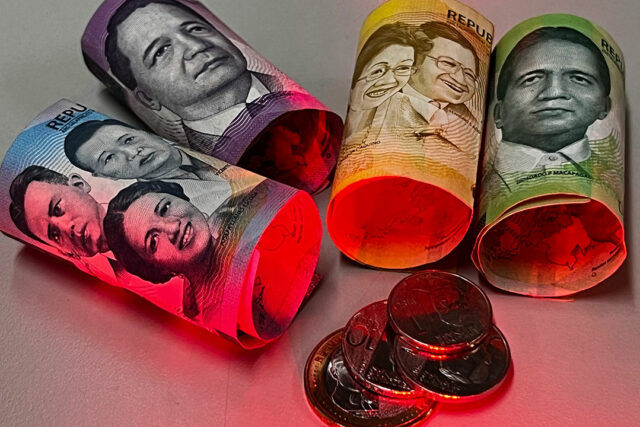
Peso strengthens amid market caution over Trump’s higher tariffs

BW FILE PHOTO

By Aaron Michael C. Sy, Reporter

THE PESO appreciated against the dollar on Wednesday amid market caution due to uncertainty stemming from US President Donald J. Trump’s planned tariffs.

It closed at P57.88 a dollar, five centavos stronger than its P57.93 finish on Tuesday, according to Bankers Association of the Philippines data posted on its website.

The peso opened at P57.87 against the dollar. It weakened to as much as P57.92 and strengthened to as much as P57.855 against the greenback. Dollars exchanged fell to $1.09 billion from $1.38 billion on Tuesday.

“The dollar-peso traded cautiously amid uncertainties on Trump’s trade policies and ahead of US GDP data tomorrow,” a trader said by telephone.

Mr. Trump on Monday said tariffs against Canada and Mexico would proceed as scheduled, ostensibly from March 4.

The dollar pulled off an 11-week low versus major peers, helped by a rebound in short-term Treasury yields even as a run of weak economic data weighed on investor sentiment.

The Canadian dollar slipped to a two-week low and the Mexican peso was weaker with a new round of tariffs from Mr. Trump’s administration due to hit those neighbors next week.

“Currency markets remain fickle,” DBS analysts wrote in a client note, citing swings in the dollar over the course of this week.

In terms of the US economy, “sentiment has been shaky for a while and any miss in data would place downward pressure on yields,” they said. “We suspect that this risk-off move may have further to go and expect US yields to maintain a downward bias in the short term.”

The dollar index, which measures the currency against six major rivals, added 0.3% to 106.51 in the Asian afternoon, rising from this week’s low of 106.13, the weakest level since Dec. 10.

The dollar index weakened 0.5% on Tuesday after the US Conference Board said its consumer confidence index dropped 7 points, its largest fall since August 2021, to 98.3, well short of the 102.5 estimate of economists polled by Reuters.

The result added to other weak data, pushing expectations toward two quarter-point interest rate cuts by the Federal Reserve over the remainder of this year, with the next likely coming in July, according to market pricing.

The two-year US Treasury yield declined as low as 4.074% on Tuesday for the first time since Nov. 1, but was up at 4.1271% on Wednesday.

“US data flow on net is now disappointing expectations, calling into question the US exceptionalism narrative that had been USD supportive,” said Tapas Strickland, head of market economics at National Australia Bank.

Lower global crude oil prices also supported the peso on Wednesday, Michael L. Ricafort, chief economist at Rizal Commercial Banking Corp., said in a Viber message.

Brent crude rose 0.3% or 24 cents to $73.26 a barrel by 7:35 a.m. GMT. US West Texas Intermediate (WTI) crude oil futures rose 0.3% or 23 cents to $69.16, according to Reuters.

These were up from Tuesday, when oil prices fell about 2% to a two-month low, with Brent futures falling 2.4% or $1.76 to settle at $73.02 a barrel, while US WTI crude fell 2.5% or $1.77 to $68.93.

The trader expects the peso to trade at P57.70 to P58 a dollar on Thursday, while Mr. Ricafort sees it moving from P57.75 to P57.95. — with Reuters

PSEi rebounds after strong corporate earnings

REUTERS

By Sheldeen Joy Talavera, Reporter

PHILIPPINE shares rebounded on Wednesday after two straight days of decline as strong corporate earnings lifted investor sentiment.

The bellwether Philippine Stock Exchange index (PSEi) advanced 1.33% or 80.8 points to close at 6,144.96. The broader all-share index gained 0.77% or 27.96 points to 3,668.41.

“The local bourse rebounded… as investors seized buying opportunities after two consecutive days of decline,” Claire T. Alviar, research analyst at Philstocks Financial, Inc., said in a Viber message. “Optimism was further fueled by corporate earnings results, which contributed to the market’s positive sentiment.”

Juan Paolo E. Colet, managing director at China Bank Capital Corp., said the index rose “on the back of generally positive corporate earnings results and fresh bargain hunting.”

“While today’s gains reflect some renewed optimism, the PSEi’s momentum will likely hinge on how these upcoming releases and earnings reports shape expectations for domestic growth and policy direction in the near term,” Jayniel Carl S. Manuel, an equity trader at Seedbox Securities, Inc, said in a Viber message.

Almost all sectoral indexes increased except mining and oil, which fell 1.51% or 124.25 points to 8,076.36.

Financials gained 1.56% or 35.79 points to 2,323.27; while the property index rose 1.45% or 32.17 points to 2,251.08. The industrial index increased 1.29% or 112.93 points to 8,831.74, while holding firms went up by 1.22% or 61.37 points to 5,110.33. Services added 0.32% or 6.39 points to 1,963.02.

Value turnover rose to P5.31 billion involving 467.32 million stocks, from P5.17 billion involving 634.67 million shares a day earlier.

Advancers outnumbered decliners 93 to 85, while 60 were unchanged. Net foreign buying stood at P166.13 million, a turnaround from the P563.8 million in net foreign selling on Tuesday.

Market players would be closely watching the budget balance, money supply and bank lending data for January, Mr. Manuel said.

“These releases will shed light on the government’s fiscal position, liquidity conditions and overall credit growth factors that could influence both the corporate earnings outlook and the peso’s stability against the US dollar,” he added.

China tells PHL to withdraw Typhon missile system to keep regional peace

PHILSTAR FILE PHOTO

By John Victor D. Ordoñez and Adrian H. Halili, Reporters

CHINESE state media on Wednesday urged Manila to withdraw Washington’s mid-range Typhon missile system to keep the peace  in the region amid rising tensions in the waterway.

“The region needs peace and prosperity, not intermediate range missiles and confrontation,” People’s Daily, the newspaper of the governing Communist Party, said in a commentary. “The Philippines has repeatedly gone back on its word and acted in bad faith … initially promising that it was only a temporary deployment, and that the system would be withdrawn.”

The Typhon missile system was deployed by US forces to the Philippines in April last year as part of their Balikatan or “shoulder-to-shoulder” military exercises. The Philippines had said the deployment was temporary, but they have since remained in the country, drawing the ire of the Chinese government.

This followed the Chinese Foreign Ministry’s Feb. 12 statement, calling for the Philippines to “change the course” by reconsidering its plan to keep the US Typhon missile launchers.

Philippine President Ferdinand R. Marcos, Jr. earlier said he was willing to pull out the US Typhon missile once China stops its aggression in the South China Sea.

Philippine Defense Secretary Gilberto Gerardo C. Teodoro, Jr. earlier said Manila will not be a “doorstep” and that acquiring the missile system was within the country’s “prerogative” to enhance its defense capabilities.

China claims sovereignty over almost the entire South China Sea, a vital waterway for more than $3 trillion of annual ship-borne commerce, putting it at odds with Brunei, Indonesia, Malaysia, the Philippines and Vietnam.

A United Nations-backed tribunal in 2016 voided China’s claim for being illegal, but Beijing does not recognize the ruling.

Senator Ana Theresia N. Hontiveros-Baraquel said that China continually shifted the narrative when it comes to aggressive activities in the South China Sea, especially on social media.

“We feel it very strongly here in the Philippines that whenever they bully us in the West Philippine Sea or there is an issue that they are doing something wrong to us, they will really come out with their propaganda that denies it,” Ms. Hontiveros said in a separate news briefing.

She added that certain individuals, sectors, or even candidates in the mid-term elections have been supporting China it is effort to spread false narratives, especially on activities in the South China Sea.

“We are being gaslighted by China… I would expect that from Chinese state-owned media but not from our (countrymen),” she said.

US Embassy in the Philippines has no comment on the Chinese state media’s statement, its Spokesperson Kanishka Gangopadhyay said via Viber message.

Foreign Affairs spokesperson Ma. Teresita C. Daza did not immediately reply to a WhatsApp message seeking comment.

NOT A VALID STANCE
The Philippines should not consider China’s proposition as a “valid stance,” Josue Raphael J. Cortez, a lecturer at the School of Diplomacy and Governance of De La Salle-College of St. Benilde said in a Messenger chat.

Keeping the missiles could be a way for the country to project the power and capabilities in response to aggressive activities carried out by China towards the Philippine Coast Guard (PCG) and fisherfolks, he said.

“These actions are crystal clear violations of our territorial integrity, and the Philippines will of course have to do something about it,” he said.

“We can speculate that this pronouncement of China is in response to the new regime of Washington as this is a manifestation of the United States’ ‘ironclad commitment’ to us… Beijing now needs to think twice before undertaking something that would further impede on our rights over the disputed territories,” he said.

A security analyst separately said it would be in the best interest of the Philippines to have peaceful settlements with China.

“The presence of US Typhon missiles in the Philippines serves American security interests in Asia to counter China,” Rommel C. Banlaoi, president of the Philippine Society for International Security Studies and former deputy national security adviser, said in a Viber message.

“But it is in the best interest of the Philippines to have peaceful settlements with China through friendly negotiations and diplomatic engagements and not through military deterrence and strategic containment.”

Last week, the PCG accused the Chinese Navy of performing dangerous flight maneuvers close to a Philippine government aircraft.

The People’s Liberation Army Navy helicopter flew as close as three meters to the aircraft, which the PCG said was a “clear violation and blatant disregard” of aviation regulations.

Armed Forces of the Philippines Chief of Staff General Romeo S. Brawner, Jr. has said that the country is looking to buy more military hardware to modernize its arsenal, including additional BrahMos missiles from India and at least two submarines.

The Philippines has contested China’s sweeping claims in the waterway through diplomatic channels by filing more than 190 diplomatic protests since Mr. Marcos took office in 2022.

Philippine Foreign Affairs Secretary Enrique A. Manalo has said Manila plans to raise its dispute with China before the Association of Southeast Asian Nations (ASEAN) when it takes the chairmanship in 2026.

“The Philippines should uphold the Association of Southeast Asian Nations  principles of peace, freedom, and neutrality amidst great power rivalry,” Mr. Banlaoi said.

Philippines retains ‘partly free’ status as democracy struggles

PHILIPPINE STAR/WALTER BOLLOZOS

By Chloe Mari A. Hufana, Reporter

THE PHILIPPINES maintained its “partly free” status for the second consecutive year in the 2025 Freedom in the World report by US-based Freedom House, as inequalities in its justice system remain.

The Philippines registered a score of 58 out of 100, unchanged from the previous year, according to the annual report, which assesses individual’s political rights and civil liberties. The country particularly scored 25 out of 40 for political rights and 33 out of 60 for civil liberties.

“Although the Philippines transitioned from authoritarian rule in 1986, the rule of law and application of justice are haphazard and heavily favor political and economic elites,” the report, published on Wednesday, read.

Philippines still ‘partly free’ in Global Freedom Report“Long-term violent insurgencies have continued for decades, though their threat to the state has diminished in recent years.”

National Union of People’s Lawyers (NUPL) President Ephraim B. Cortez said that “partly free” is not “accurate” in depicting the state of democracy in the country.

“Differently stated, the rule of law and of justice is still tilted against the majority and in favor of the few, especially the wealthy and the powerful,” he told BusinessWorld in a Viber chat. “58% is too low a score that it reflects the dismal situation of justice and human rights in the country.”

He noted the uneven rule of law is among the reasons why the country still has an insurgency problem.

The report noted that global freedom declined for the 19th consecutive year in 2024, with 60 countries experiencing deterioration in political rights and civil liberties, while only 34 improved.

It cited violence during elections, ongoing armed conflicts, and the spread of authoritarian practices as key factors driving this degradation.

In terms of election violence, the report noted that violence marred over 40% of national elections last year, with candidates targeted by assassination attempts or assaults, polling places attacked, and post-election protests suppressed.

Of the 66 countries and territories that held national votes in 2024, violence affected 27.  Twenty countries saw attacks on candidates, while 14 experienced attacks on voting places.

Freedom House also noted ongoing conflicts as the second major theme in 2024 as it undermined safety and rights, with 20% of the countries and territories scoring 0 out of 4 in the physical security and freedom from illegitimate use of force indicator.

Moreover, countries led by authoritarians saw manipulated elections through arrests, imprisonment, or disqualification political opponents, the report noted.

POLICY RECOMMENDATIONS
The report emphasized the need for democracies to work together to halt the deterioration of freedom.

Key recommendations included strengthening the rule of law, reducing violence, reforming security services, and bolstering checks and balances.

A coordinated and sustained campaign is needed to support human rights defenders, secure the release of political prisoners, and strengthen democracy worldwide by upholding free and fair elections and responding to coups, it said.

It is essential to prioritize strengthening the rule of law and delivering economic benefits following political transitions by ensuring accountability under the law and creating a fair economic and political environment, it added.

“The events of this period have demonstrated, again and again, that the harmful effects of authoritarian repression and misrule regularly spill across national borders,” the 30-page report read.

“Just as tyranny fuels the spread of instability, armed conflict, terrorism, mass displacement, and corruption around the world, it is the protection of democratic rights and the rule of law that ultimately ensure freedom, security, and prosperity,” it added.

The report noted this year’s findings underscore the need for reform and rebuild democratic institutions to prevent democratic erosion and violence.

“Democratic governments, civil society organizations, business leaders, and others hoping to protect democracy and expand freedom all have a critical role to play in such efforts.”

Marcos satisfaction rating declines as political feud escalates

PRESIDENT FERDINAND R. MARCOS, JR. — PHILIPPINE STAR/NOEL PABALATE

By Kenneth Christiane L. Basilio and Chloe Mari A. Hufana, Reporters

MORE than four in 10 Filipinos are not satisfied with the performance and leadership of President Ferdinand R. Marcos, Jr., a recent WR Numero Research poll found, which could be linked to his escalating feud with Vice-President (VP) Sara Duterte-Carpio and his administration’s response to national issues.

In its February survey, WR Numero found 43% of Filipinos said they are dissatisfied with Mr. Marcos, with 30% finding the Philippine leader’s performance satisfactory. About 27% of Filipinos remain on the fence about his performance.

Mr. Marcos’ score dipped by 15% from his 45% performance rating in WR Numero Research’s September 2024 poll, showing a declining trend in his satisfaction rating based on the pollster’s previous surveys. His satisfaction rating in December 2023 was 65%.

The President’s declining performance ratings were caused by his escalating political feud with the Dutertes and discontent with his government’s handling of the country’s pressing issues, such as persisting inflation, said Cleve V. Arguelles, chief executive officer and president of Philippine think-tank WR Numero Research.

“We think that this really has something to do with the Marcos-Duterte divide, and in relation to that, the divide between the two leaders is really unpopular,” he said in a media briefing.

“There’s still a lot of disapproval in terms of how the Marcos administration is responding to some of the key issues in the country,” he added.

The Marcoses and Dutertes had a political falling out owing to policy differences, with Mr. Marcos veering away from the key policies of ex-President Rodrigo R. Duterte, including standing up to China and pursuing closer security ties with western nations such as the US and investigating his predecessor’s bloody drug war.

The feud between two of the country’s most influential clans reached a new peak in early 2025 after Ms. Duterte was impeached by the House of Representatives, who is headed by Speaker Ferdinand Martin G. Romualdez, the President’s cousin.

The dissatisfaction rating of Ms. Duterte was 28.6% in the same survey, while 41% found her performance satisfactory. Three of 10 Filipinos are unsure about her performance.

“The decline in President Marcos’ ratings is faster, and a lot of that has to do with regional political loyalties,” said Mr. Arguelles in Filipino. “Mindanao remains a Duterte stronghold, and the Vice-President can still maintain at least 40% satisfaction ratings despite losing support elsewhere.”

“On the other hand, the President relies on areas like Metro Manila, which is traditionally a very fickle-minded constituency without much traditional political loyalty. They can be swayed by political narratives, which is why Mr. Marcos is more affected,” he added.

The President received a 31.2% approval score in Metro Manila and 17% in Mindanao, while Ms. Duterte garnered a 29.2% satisfaction rating in Metro Manila and 68% in Mindanao.

VP IMPEACHMENT
Meanwhile, Filipinos are largely divided regarding Ms. Duterte’s impeachment at the House, with 47% opposing it and 33% in support. One-fifth or 20% remain undecided on her indictment.

“This indicates that public opinion may shift towards either side, whether supportive or opposing the House impeachment of the Vice-President,” said Mr. Arguelles.

The same survey showed that four of 10 Filipinos remain undecided on how the Senate should rule in Ms. Duterte’s impeachment trial. Over 30% of Filipinos believe the Senate should acquit her, while 23.3% say she should be convicted.

The majority of Filipinos — 56.1% — also said that Mr. Marcos should remain neutral on the Vice-President’s looming ouster trial. Results showed that one in five Filipinos believe the President should dissuade his senate allies from convicting Ms. Duterte, with only 19.7% saying he should rally for her conviction.

The House on Feb. 5 impeached Ms. Duterte for alleged abuse of power and constitutional violations stemming from her use of confidential funds, paving the way for her trial by the Senate.

The ouster charges against the embattled Vice-President were filed and signed by 215 congressmen, more than the one-third legal requirement before it can be sent to the Senate, which will try her in an impeachment court. Several congressmen will be serving as impeachment prosecutors.

The complaint consisted of seven articles of impeachment, including allegations of plotting the assassination of the President, misusing secret funds, amassing unexplained wealth and committing acts of destabilization.

Congressmen sent the impeachment bill to the Senate on the last day of the congressional session, before lawmakers took a four-month break for the midterm elections in May. Filipinos will pick a new set of congressmen, 12 of the 24-member Senate and other local government officials on May 12.

The May polls will serve as a referendum on Mr. Marcos’s popularity and offer him an opportunity to consolidate power and groom a successor for 2028.

SENATE RACE
In the same survey, WR Numero found at least eight senatorial bets of the Marcos-backed Alyansa Para sa Bagong Pilipinas are within the winning margin of the 12-seat Senate race.

Party-list Rep. Erwin T. Tulfo remains the Senate frontrunner, as 46.5% of Filipinos said they will vote for him. He is followed by Senator and re-electionist Manuel M. Lapid (37.1%), sharing the second-fourth place with ex-Senator Ramon “Bong” B. Revilla, Jr. (36.1%) and Senator Pilar Juliana “Pia” S. Cayetano (35.8%).

Ex-Senator Vicente C. Sotto III (32.4%), Makati City Mayor Mar-Len Abigail S. Binay (32.3%), broadcaster Bienvenido T. Tulfo (32.1%), and ex-Senator Panfilo M. Lacson (30.8%) shared the fifth-seventh position.

Senators Christopher Lawrence T. Go (30%) and Ronald M. Dela Rosa (29.5%) and ex-Senator Emmanuel D. Pacquiao, Sr. (26.9%) are tied for the eight-10th position.

Television personality Wilfredo B. Revillame (26.5%) and ex-Senators Paolo Benigno A. Aquino (25.2%) and Francis Pancratus N. Pangilinan (24.9%) topped the 11th-14th position.

“Is this a referendum on the administration? In my view, partly yes… But again, it’s hard to give Mr. Marcos all the credit for this because most of the administration candidates aren’t strictly his. These are old names in Philippine politics,” Mr. Arguelles told BusinessWorld after the media briefing.

“Those names, if you look at them, aren’t strictly Marcos partisans. These are big names, re-electionists and incumbents,” he added.

The pollster interviewed 1,814 Filipinos across the country from February 10 to 18 with an error margin of ±2%.

Eight admin-backed senatorial candidates likewise dominated the Social Weather Station’s (SWS) latest pre-election survey.

The nationwide poll, conducted from Feb. 15 to 19, in collaboration with the Stratbase Group, surveyed 1,800 registered voters and has a ±2.31% margin of error.

It comes just days after the official campaign period kicked off on Feb. 11.

ACT-CIS Rep. Tulfo retained his lead in the race, securing 45% voter preference. Behind him, the battle for Senate seats remains fluid.

Mr. Go climbed to second place with 38%, edging out Mr. Lapid, who holds steady in third with 36%.

Mr. Sotto slipped from second to a shared fourth-fifth place as support for him declined from 38% to 34%. He is now tied with broadcaster Mr. Tulfo, who saw a modest rise to fourth place from sixth with the same 34% backing.

The biggest gainer in SWS’s February poll is Mr. Revilla, Jr., who jumped from the lower tier (11th-13th place) to a more secure 6th-7th ranking, enjoying a four-percentage-point increase to 33%.

He shared the spot with Ms. Cayetano, who maintained her position.

Meanwhile, Mr. Lacson saw his ranking slide to the 8th-9th place from 5th as his support dipped to 32%, now tied with Mr. Dela Rosa, who climbed one notch higher.

Mr. Pacquiao and Ms. Binay both saw their rankings drop, landing in the 10th-12th bracket.

Mr. Revillame remains on the edge of the Senate’s “magic 12” with 30% support.

Former Senator Francis Pancratus N. Pangilinan took a significant hit, sliding from 11th to 13th to 15th place as support fell from 29% to 22%. His political ally, former Senator Paolo Benigno A. Aquino IV, lost four percentage points but retained his position at 17th.

Meanwhile, candidates backed by former President Rodrigo R. Duterte’s PDP-Laban remain far from securing Senate seats as their polling numbers continue to lag.

While administration-backed bets continue to dominate, opposition candidates remain outside the winning circle, reinforcing a trend seen in previous elections.

Political science lecturer at the Ateneo de Manila University Hansley A. Juliano attributed this to the opposition’s continued reliance on an “institution-based and institution-identified reform-oriented campaign” that struggles to compete with entrenched patronage networks.

“Opposition candidates continue to be seen as “losing propositions” for 9 years now, which only solidifies the longer it persists,” he told BusinessWorld in a Facebook Messenger chat.

At the same time, the weakening of civil society networks — historically key to mobilizing opposition support — has further eroded their electoral base, he noted.

Once-powerful institutions such as universities, mainstream media, and the Catholic Church are struggling to assert influence while evangelical networks and alternative media spaces shape new voter blocs, he added.

If the current lineup holds, Philippine politics is likely to remain defined by the Marcos Jr. vs. Duterte rivalry, leaving little space for opposition resurgence, according to the academic.

The opposition’s failure to adapt to new political realities — where name recall, media influence, and local machinery outweigh policy-driven campaigns — continues to hurt their chances, he added.


BI deports 98 Chinese with POGO links

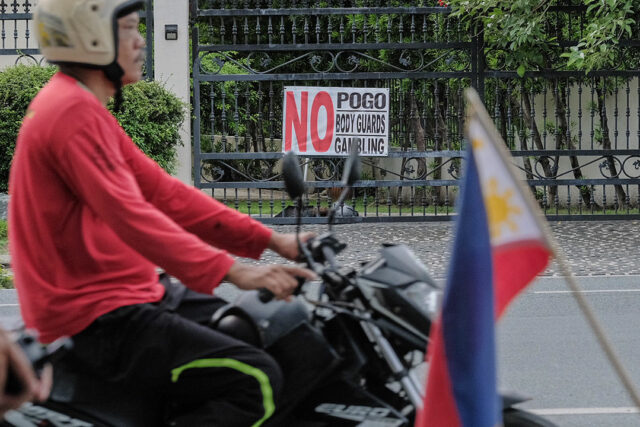
Some residents have displayed signs protesting the presence of Philippine Offshore Gaming Operators (POGO) in Ayala Alabang Village in Muntinlupa, July 13, 2024. — PHILIPPINE STAR/RYAN BALDEMOR

THE Bureau of Immigration (BI) deported 98 Chinese nationals working in illegal Philippine Offshore Gaming Operators (POGO) last Feb. 25, it reported on Wednesday.

“As part of our intensified campaign, we have successfully deported a total of 98 Chinese nationals who were caught working for an illegal POGO company,” Commissioner Joel Anthony M. Viado said in a virtual briefing on Wednesday. “Last night, these individuals boarded a Philippine Airlines chartered flight to Xi’an, China.”

“This is part of a broader coordinated effort with the Chinese embassy to expedite the removal of foreign nationals engaged in illegal offshore gaming operations,” he added.

Out of the 98 Chinese, 91 were among the 450 apprehended during an operation in Parañaque City last January.

The immigration chief said they have arrested over 500 foreign nationals since January who were linked to illegal POGO activities in various operations across Parañaque, Pasay, and Cavite.

This latest deportation brings a total of 226 individuals sent back to their home countries.

“The Philippines will not be a safe haven for illegal activities. We are committed to enforcing our immigration laws and upholding national security,” he said.

Spokesperson Dana Krizia M. Sandoval, in the same virtual briefing, said the agency aims to arrest the remaining 11,000 illegal foreign POGO workers by mid-year.

“What we want — and for the majority of these cases — is to have them apprehended by mid-year,” she said in mixed English and Filipino. “We’re really targeting all of this within the year.”

In a statement, Beijing affirmed that this move marked further cooperation between the Philippines and China in combating illegal gambling activities.

“The Chinese government is committed to cracking down on gambling and relevant crimes and always asks overseas Chinese nationals strictly abide by local laws and regulations and do not engage in any illegal and criminal activities,” it added. 

“We urge the Philippines to completely eradicate the scourge inflicted by offshore gambling as soon as possible. China will continue to work with the Philippines to jointly combat crimes,” it said.

About 3,024 foreign POGO workers have been deported out of 30,144, data from the Philippine Amusement and Gaming Corp. (PAGCOR) showed.

Meanwhile, a Senator said on Wednesday that the majority of foreign POGOs have remained in the country to supervise the changing of their operations to a smaller scale.

“Those POGO bosses, probably a lot of them, are still here. They haven’t come out yet. Because they are still overseeing the morphing of their POGO operations into smaller, guerrilla-like operations,” Senator Ana Theresia N. Hontiveros-Baraquel said in a news briefing on Wednesday.

Ms. Hontiveros added that POGO bosses have reportedly been using travel advertisements to entice individuals to their scam operations.

“Of course, it’s difficult to be completely POGO-free right away because they’ve been here for at least nine years or eight years since the Duterte era,” she added.

There used to be about 300 POGOs throughout the country during its peak in 2019, according to PAGCOR.

According to a Senate Committee report, illegal financial activities and scam hubs have persisted despite moves to outlaw POGOs in the country.

Last year, President Ferdinand R. Marcos, Jr. signed an executive order, banning POGOs due to their links to organized crime, such as human trafficking. This is in line with his policy directives during his third State of the Nation Address to shut down POGOs by the end of 2024.

Ms. Hontiveros suggested that the BI should coordinate with counterpart immigration agencies to monitor the deportation of foreign POGO workers.

She added that these agencies should ensure that these foreign POGO workers “actually arrive at their destination and do not detour somewhere.”

Several lawmakers have already urged the BI and other concerned agencies to hasten the deportation of foreign nationals previously engaged with POGOs. — Chloe Mari A. Hufana and Adrian H. Halili

DoF clarifies PhilHealth fund use

PHILSTAR FILE PHOTO

THE LARGEST chunk of the Philippine Health Insurance Corp.’s (PhilHealth) P60-billion excess funds remitted to the Bureau of the Treasury (BTr) went to health and social service programs, the Department of Finance (DoF) said.

This comes after the second round of oral arguments, questioning the legality of the controversial transfer of P89.9 billion in excess reserve funds from PhilHealth to the BTr.

“As a matter of fact, as of December of 2024, the total amount of P46 billion, thereabouts, more or less, had been devoted under the unprogrammed appropriations for social — more particularly, health projects,” Solicitor-General Menardo I. Guevarra said in a statement on Wednesday.

The DoF said the largest chunk P27.45 billion was used to settle the Public Health Emergency Benefits and Allowances for Health Care and Non-Healthcare Workers.

In addition, P10 billion was used for medical assistance to indigent and financially incapacitated patients, while P4.10 billion funded the procurement of medical equipment for the hospitals of the Department of Health (DoH), local government units, and primary care facilities.

The DoF added that P3.37 billion went to finance the construction of three DoH health facilities, while P1.69 billion was allocated to the Health Facilities Enhancement Program.

“The rest, or about P13 billion, was used to fund government counterpart financing for foreign-assisted infrastructure and ‘social determinants for health’ project,” it said.

Among the projects under the unprogrammed appropriations for government counterpart financing are the Metro Manila Subway Project, the Philippine Multi-Sectoral Nutrition Project, the Mindanao Inclusive Agriculture Development Project and the Fisheries and Coastal Resiliency Project.

As of last year, the DoF said PhilHealth’s P498 billion is more than enough to continue increasing its inpatient, outpatient, and special benefit packages. — Aubrey Rose A. Inosante

Case disqualifying Rep. Tulfo filed

ERWIN T. TULFO — PHILIPPINE STAR/KRIZ JOHN ROSALES

ACT-CIS Rep. Erwin T. Tulfo is facing another disqualification complaint over his libel case, his citizenship, and for the violation of the political dynasty provision of the 1987 Constitution.

In a pleading filed before the Commission on Elections (Comelec) on Tuesday, petitioners Berteni C. Causing and Graft-Free Philippines Foundation, Inc., alleged Mr. Tulfo is still suffering from the 20-year disqualification caused by the moral turpitude in four counts of libel.

“He is disqualified from running for Senator in the May 12, 2025, elections because he was convicted of four (4) counts of libel that became final after these were affirmed by the Supreme Court,” the 28-paged complaint read, noting the lawmaker’s libel lawsuit in 2008.

It also alleged Mr. Tulfo should be disqualified as he is not a Filipino citizen but an American one.

“Erwin claimed he did not renounce his US citizenship because he claimed he was not considered a US citizen by the US Embassy officials when he surrendered his US passport that he had been using under the name Erich Sylvester Tulfo,” it read.

“In other words, he admitted he was holding a US citizenship under the name Erich Sylvester Tulfo since 1991,” it noted.

They also accused the lawmaker of violating the political dynasty prohibition of the 1987 Constitution as his other brother is an incumbent senator, while one is also running for a senatorial post.

Mr. Tulfo said they have not yet received a copy of the complaint.

“But as part of the justice process in our country, I am ready to answer the complaint filed by Causing, who is a lawyer at the Supreme Court disbarred and Comelec declared as a nuisance candidate in the 2025 senatorial election,” he said in mixed English and Filipino in a statement.

“I will respect his right to file a complaint and leave the Comelec to judge,” he added.

The lawmaker and his brothers faced his first disqualification complaint last week, citing violations of anti-dynasty provisions. 

Mr. Tulfo and his brother, Bienvenido, are the leading contenders in the 2025 Senatorial race, according to surveys by the Social Weather Station. They are ranked first and fourth, respectively.

Up for grabs in the May 12 elections are 317 congressional seats and thousands of local posts. The biggest battle will be for 12 spots in the 24-seat Senate, a chamber packed with political heavyweights and wielding outsized influence. — Chloe Mari A. Hufana

4Ps, Duterte Youth lead SWS polls

PHILIPPINE STAR/EDD GUMBAN

A FEBRUARY commissioned survey for the party-list congressional race by the Social Weather Stations (SWS) showed that party-list groups Pagtibayin at Palaguin and Pangkabuhayang Pilipino (4Ps), Duterte Youth, FPJ Panday Bayanihan, and ACT-CIS emerged as the most preferred groups of Filipino voters.

Party-list 4Ps continued to lead the SWS survey but showed that support for the group declined to 9.61% from 11.8% in January. Duterte Youth retained its second-place ranking as support increased to 8.28% from 6.05%.

“These results show that 4Ps and Duterte Youth are the only two party-list groups projected to win three guaranteed seats in the House of Representatives, as of February 2025,” the pollster said in a statement.

Group FPJ Panday Bayanihan climbed to third place in February from seventh last month, with preference growing to 4.76% from 2.45%. ACT-CIS inched down to fourth after support declined to 4.46% from 5.41% in January.

“Both FPJ Panday Bayanihan and ACT-CIS are on track to secure two seats, having met the 4% threshold for additional representation,” SWS said.

SWS interviewed 1,800 registered voters nationwide from February 15 to 19 with a ±2.31% margin of error. — Kenneth Christiane L. Basilio

Ilocos Norte gets P3.5-M grant

Ilocos Norte gets P3.5-M grant — EMBASSY OF JAPAN IN THE PHILIPPINES FACEBOOK PAGE

THE EMBASSY of Japan in Manila on Wednesday said that it has issued a grant worth P3.5 million ($60,711) to Ilocos Norte province for its disaster relief efforts.

In a statement, Tokyo said the grant would allow the local government of Ilocos Norte to purchase rescue boats for their disaster response activities and be funded by the Japanese government’s Grant Assistance for Grass-roots Human Security Projects (GGP).

The embassy said that the project would “enhance the safety and security of the residents of Laoag City and its surrounding municipalities.”

It said that the fund would allow the provincial government to procure two rescue boats and strengthen the province’s disaster preparedness and rescue system in the event of flooding.

“As the top official development assistance (ODA) donor for the Philippines, the Government of Japan launched the GGP scheme in the Philippines in 1989 to reduce poverty and help various communities engage in grassroots activities,” it added.

The Philippines obtained $5.67 billion worth of ODA funding in 2024, according to the Department of Finance.

The Japanese Embassy said that they have funded and implemented a total of 567 grassroots projects under the GGP scheme.

“Japan believes that these projects will strengthen the friendship between Japan and the Philippines and contribute to sustaining strategic partnerships between the two countries,” it said. — Adrian H. Halili

DBM releases rules on gov’t office creation in Negros Island

BW FILE PHOTO

THE Department of Budget and Management (DBM) has issued guidelines on setting up offices in planned sectors, workforce, and allocating funds for the operation of the Negros Island Region (NIR).

According to circular letter 2025-3, the daily operations and infrastructure costs of the NIR offices will be sourced from existing budgets of the concerned departments in Western Visayas and Central Visayas.

This circular was issued after the Implementing Rules and Regulations of Republic Act 12000 or NIR Act.

Under Section 4 of the Act, Negros Occidental will install government offices related to agriculture, land, peace and order, security, and governance.

Meanwhile, Negros Oriental will host offices focused on human development, infrastructure, and industry and labor.

“With the NIR Act designed to speed up public service delivery in the local community, the DBM ensures its success by providing clear guidelines on how offices should be organized and operated effectively,” Budget Secretary Amenah F. Pangandaman said. — Aubrey Rose A. Inosante

Bill wants full coverage of doctor’s fees

PNA/JOAN BONDOC

A BILL mandating the Department of Health’s (DoH) indigent medical aid program to cover the doctor’s fees within its healthcare package was filed at the House of Representatives on Feb. 4.

House Bill No. 11415, filed by Party-list Representative Jose J. Teves, Jr., aims to cover the full professional fees of doctors from both private and public hospitals and clinics for medical services.

“This measure seeks to mandate the inclusion of professional or doctor’s fees, without any limitation to the approved amount… to help attain the ‘zero billing’ goal of President Ferdinand R. Marcos, Jr.,” the bill’s introductory note stated.

The DoH’s so-called Medical Assistance to Indigent and Financially Incapacitated Patients (MAIFIP) program provides indigent patients with financial aid to pay off their medical bills.

It currently covers medicines, bloodwork, laboratory procedures, and all hospital bills of indigent Filipinos, but caps the coverage for professional fees at 50% of the “approved amount of medical assistance,” according to a DoH administrative order.

“Many indigents and financially incapacitated Filipinos still carry the burden of paying excessive hospital bills notwithstanding the payment of professional or doctor’s fees,” the bill stated.

All doctors are required to accept guarantee letters from DoH’s MAIFIP. Refusal could lead to a P100,000 fine for the first offense and could result in the revocation of a medical license for repeat offenses. — Kenneth Christiane L. Basilio