Home Blog Page 1563

EU-Philippines partnership targets green growth for Filipino food MSMEs

Working with the European Union (EU), the Department of Trade and Industry’s Center for International Trade Expositions and Missions (DTI-CITEM) will launch an initiative aiming to push for a more resilient Philippine food industry.

The Sustainability Solutions Exchange (SSX) Exhibition and Conference 2025, CITEM’s flagship initiative promoting sustainable practices and resources, will debut as a physical event on May 22-24 at the World Trade Center in Pasay City.

It will be located at the Sustainability Hall within the International Food Exhibition (IFEX) Philippines 2025, the country’s premier international food trade show. This move is set to underscore the country’s commitment to sustainability and circularity in the food industry.

The SSX exhibition will connect entrepreneurs with industry leaders and sustainable solutions providers, showcasing innovations in sustainable food production, packaging, and distribution. It will also feature business matching and pitching sessions to prompt collaborations among industry stakeholders.

The conference will run in parallel at the neighboring Pasay City headquarters of the Philippine Trade Training Center (PTTC). The PTTC Global SME Academy (PTTC-GMEA) is CITEM’s Training and Event Partner for SSX 2025.

Sessions will explore topics aligned with this year’s theme, “Green Innovations: Navigating Sustainability Solutions to Future-Proof the Food Industry.” Discussions will focus on building a circular food system, and tackle challenges and opportunities such as food security, social responsibility, packaging, and sustainable waste management.

The two-day conference will feature local and international experts, including EU Delegation Head of Cooperation Marco Gemmer.

The EU is supporting SSX as part of the EU-Philippine Green Economy Partnership under the Global Gateway — the European strategy for engaging with partners globally to promote investments around shared priorities. The partnership focuses on achieving sustainable and inclusive growth through policy dialogue, championing of local initiatives, investments and the creation of green and decent jobs.

Organized by CITEM, SSX launches with the objective of helping micro, small, and medium enterprises (MSMEs) transition to a circular economy. The event aims to boost entrepreneurs’ global competitiveness and promote adherence to the United Nations Sustainable Development Goals (SDGs).

Interested innovators, policy makers, and advocates are encouraged to visit sustainability.ph now to access the program and register as a delegate to SSX 2025.


SparkUp is BusinessWorld’s multimedia brand created to inform, inspire, and empower the Philippine startups; micro, small and medium enterprises (MSMEs); and future business leaders. This section will be published every other Monday. For pitches and releases about startups, e-mail to bmbeltran@bworldonline.com (cc: abconoza@bworldonline.com). Materials sent become BW property.


Xinyx Design launches flexible learning platform for future microchip designers

Xinyx Design, one of Southeast Asia’s largest companies in microchip development, has launched what it calls the Philippines’ “first flexible learning platform,” focused entirely on integrated circuit (IC) design, a field at the core of modern electronics.

The platform, LABS by Xinyx, was officially unveiled on May 9 at Colegio de Muntinlupa (CDM). Designed for engineering students and professionals, the program aims to build local talent in IC design and microelectronics — critical components found in everything from smartphones and laptops to medical devices and electric vehicles.

The launch was attended by Muntinlupa City Mayor Ruffy Biazon, CDM President Dr. Teresita Fortuna, DTI-BoI Director Corieh Dichosa, TESDA Deputy Director-General Nelly Dillera, and representatives from the Private Sector Advisory Council, Asian Development Bank, and several academic institutions offering or planning to offer IC design programs.

LABS by Xinyx supplements the traditional BS Electronics Engineering curriculum and offers a new pathway for senior high school students, university students, STEM graduates, educators, and industry professionals to gain hands-on training, expert mentorship, and globally-aligned coursework in IC Design. Courses are delivered through flexible formats such as online, in-person, or hybrid to allow learners from various backgrounds to build real-world engineering skills tailored to current industry demands.

“LABS by Xinyx is the Philippines’ first premium, flexible platform focused on IC Design and Microelectronics. It’s designed to close the skills gap that limits the growth of our semiconductor industry,” Charade Avondo, president of Xinyx Design, said.

The platform aligns with President Ferdinand Marcos, Jr.’s 2024 directive prioritizing the development of the semiconductor and electronics sector. Despite growing global demand, a shortage of IC Design talent persists locally, partly due to outdated curricula and limited access to specialized training in higher education.

Ms. Avondo noted that this will build on the reputation of Filipino workers abroad. Multinationals in Europe and the US, she pointed out, already hold Filipino workers, including engineers, in esteem for their creativity, resilience, and innovation. “Filipino engineers are already trusted leaders in R&D teams abroad. It’s time we bring that level of innovation home,” she said.

IC Design is a vital yet often overlooked component of the global semiconductor value chain, creating and enabling innovations in AI, aerospace, healthcare, renewable energy, automotive tech, defense, and more. LABS by Xinyx sets to position the Philippines as a competitive player not just in electronics manufacturing but in design-led innovation by nurturing Filipino talent and steering young engineers towards this lucrative field.


SparkUp is BusinessWorld’s multimedia brand created to inform, inspire, and empower the Philippine startups; micro, small and medium enterprises (MSMEs); and future business leaders. This section will be published every other Monday. For pitches and releases about startups, e-mail to bmbeltran@bworldonline.com (cc: abconoza@bworldonline.com). Materials sent become BW property.

Mapúa University pushes for creative thinking in Business Education

In partnership with Arizona State University (ASU), Mapúa is offering students a more interdisciplinary learning experience through courses that blend creativity, critical thinking, and technical skill.

Led by Prof. Corinne Romabiles, the initiative aims to equip future professionals with both analytical rigor and creative fluency, preparing them for a fast-changing world where storytelling, empathy, and culture are increasingly valued alongside strategy and execution.

The programs at Mapúa University E.T. Yuchengco School of Business, in collaboration with ASU, train students to develop agile, creative, and critical thinking skills to succeed in the rapidly changing tech-enabled business industry.

Prof. Romabiles noted this approach to business education is critical for students to develop a foundation that understands the importance of the arts and humanities. “I developed the art-science course to allow students who have probably not gotten so familiar with the humanities to know more about what the liberal arts is about,” she said.

As a business professor at Mapúa University E.T. Yuchengco School of Business, she teaches art-science thinking, or the meeting of art and science, to instill in her students the practice of combining both disciplines in crafting new ideas and innovations in their business strategies. 

Through art-science, Prof. Romabiles aims to expose business students to art history, art theory, and art criticism in ways that they could apply to business practice. The ability to think outside the box, read between the lines of literature, comprehend trends in the past, and examine art forms critically hones their innovative thinking and decision-making.

“Art-science reintroduces creative thinking and artistic thinking to students. In courses that are not so familiar with humanities, sometimes, there is so much emphasis on math, science, or history that they forget that there is an intellectual side to the art,” she said. “Art-science is art studies at the service of the hard sciences.”

The university will also apply similar principles with its Global Classroom, which provides students with access to globalized and internationalized learning sessions at ASU. This enables them to immerse themselves in a different culture and hone their soft skills, encouraging them to go beyond conventional thinking and widen their perspectives on business knowledge and strategies.

“The course uses arts to develop critical thinking, so business students have better decision-making skills, and they can sharpen their higher order thinking skills,” Prof. Romabiles explained. She shared that it is also equally important to teach art-science in other programs, like Science, Technology, Engineering, and Math (STEM) courses.

In developing future business professionals, the Mapúa University’s E.T. Yuchengco School of Business collaboration with ASU trains students to find the balance between technical competence, and cultural and creative literacy. While financial models and statistical analysis will always be fundamental to business, the collaboration ensures that the value of the arts is never lost.


SparkUp is BusinessWorld’s multimedia brand created to inform, inspire, and empower the Philippine startups; micro, small and medium enterprises (MSMEs); and future business leaders. This section will be published every other Monday. For pitches and releases about startups, e-mail to bmbeltran@bworldonline.com (cc: abconoza@bworldonline.com). Materials sent become BW property.
Maynilad trims IPO size, eyes July 17 listing

MAYNILADWATER.COM.PH

By Revin Mikhael D. Ochave, Reporter

PANGILINAN-LED water concessionaire Maynilad Water Services, Inc. has reduced the size of its planned initial public offering (IPO), with the listing now scheduled for July 17.

Based on its latest prospectus draft dated May 14, Maynilad’s IPO is now expected to raise up to P45.8 billion, slightly lower than the up to P49 billion indicated in its initial prospectus.

The revised IPO comprises up to 2.29 billion common shares, lower than the earlier maximum of 2.46 billion shares. The indicative maximum price remains at P20 per share.

This offering is also smaller than the country’s largest IPO to date — the P48.6-billion market debut of food and beverage producer Monde Nissin Corp. in June 2021.

The updated structure includes a primary offer of up to 1.66 billion common shares, an overallotment option of up to 249.05 million primary common shares, an upsize option of up to 354.7 million secondary common shares, and 24.9 million primary common shares to be offered to Hong Kong-based investment holding firm First Pacific Co. Ltd., which is also led by Manuel V. Pangilinan.

This compares with the previous allocation of up to 1.78 billion primary common shares, an overallotment option of up to 266.31 million primary common shares, an upsize option of up to 379.29 million primary common shares, and 36.31 million primary common shares for First Pacific.

The latest timetable shows that the listing date has been moved to July 17 from the earlier target of July 10.

The notice of final offer price to regulators is scheduled for July 1, while the offer period will run from July 3 to July 9.

Maynilad is required to offer at least 30% of its outstanding capital stock to the public by January 2027 under the terms of its legislative franchise.

Net proceeds from the IPO will be used to fund Maynilad’s capital expenditure requirements for its water, wastewater, and customer service and information system projects through 2026. A portion of the proceeds will also be allocated for general corporate purposes.

Maynilad’s market debut is one of six IPOs anticipated this year. However, the Philippine Stock Exchange has so far recorded only one: the April offering of Cebu-based fuel retailer Top Line Business Development Corp.

Mr. Pangilinan, chairman of Maynilad, previously said the company would proceed with its IPO despite external uncertainties, including tariff risks under the Trump administration.

“We have to go public by the early part of 2027. We just want to probably finish and comply with the franchise law of Maynilad. I’d like to encourage them to proceed,” he said.

Maynilad appointed BPI Capital Corp., HSBC, Morgan Stanley, and UBS as joint global coordinators and joint bookrunners for the offering. BPI Capital Corp. will also serve as the domestic lead underwriter.

Metro Pacific Investments Corp., which holds a majority stake in Maynilad, is one of three Philippine subsidiaries of First Pacific Co. Ltd., alongside Philex Mining Corp. and PLDT Inc.

Hastings Holdings, Inc., a unit of PLDT Beneficial Trust Fund subsidiary MediaQuest Holdings, Inc., has an interest in BusinessWorld through the Philippine Star Group, which it controls.

CREC eyes June close for P6.7-B deal with Indonesian firm

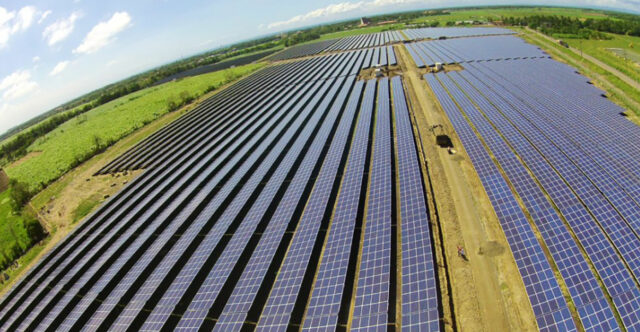
Citicore Solar Negros Occidental — CREIT.COM.PH

LISTED renewable energy company Citicore Renewable Energy Corp. (CREC) expects to achieve financial close by June on its share subscription agreement with Indonesian state-owned PT Pertamina Power Indonesia (Pertamina New & Renewable Energy or NRE), under which the latter will acquire a 20% stake in CREC.

“We are hoping to close by next month. We’re only waiting for one final closing condition to be achieved by Pertamina,” CREC President and Chief Executive Officer Oliver Tan said during the PSE Star: Investor Day on Friday last week.

In January, CREC and Pertamina NRE entered into a landmark share subscription agreement involving the latter’s acquisition of 2.23 billion common shares in CREC at P3 per share.

The transaction will result in a 20% equity interest in CREC, with an estimated value of P6.7 billion.

“The partnership with Pertamina NRE presents limitless opportunities for Indonesia and the Philippines to collaborate on innovative technologies and practices in renewable energy,” Mr. Tan previously said.

“It gives a wider stage to CREC’s unique end-to-end capabilities by opening doors in Indonesia even as we drive our developments in the Philippines at full speed,” he added.

Proceeds from the agreement will support CREC’s pipeline of renewable energy projects, in line with its target of expanding its portfolio to 5 gigawatts over five years.

While CREC is planning to expand into new areas, Mr. Tan said the company will continue focusing on the expansion of existing and soon-to-be-energized plants through next year.

“The primary factors that influence our decisions for new areas obviously would be the grid capacity and the solar irradiance and obviously the geotechnical analysis that comes with the site selection,” Mr. Tan said.

CREC, directly and through its subsidiaries and joint ventures, manages a diversified portfolio of renewable energy generation projects, power project development operations, and retail electricity supply services.

At present, the company holds a combined gross installed capacity of 285 megawatts from its solar facilities across the Philippines. — Sheldeen Joy Talavera

How Filipino SMEs can grow with the digital economy with Odoo’s Shopee API

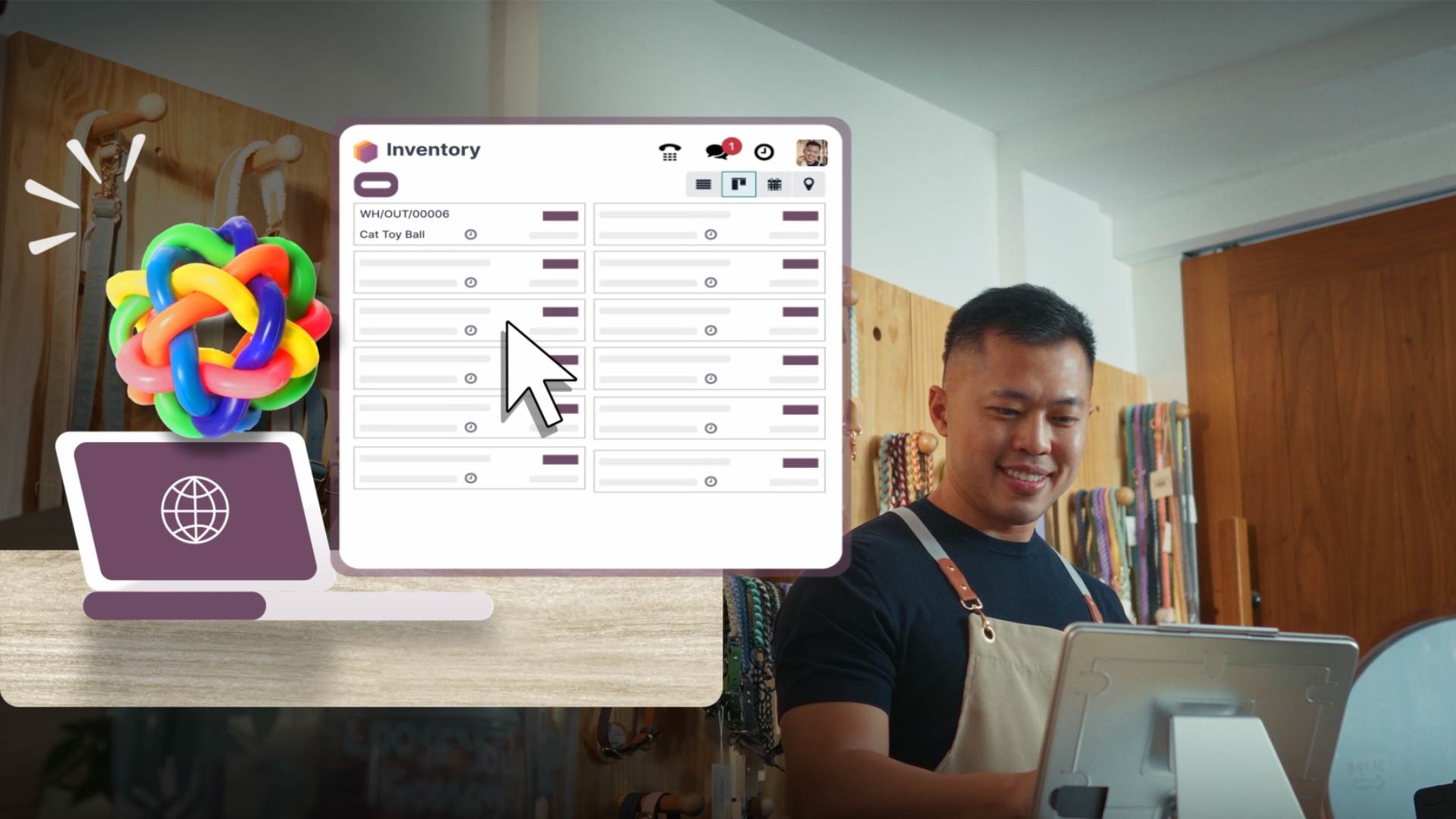
The benefits of digitalization centralized product management, real-time inventory syncing, and omnichannel selling — can now be simplified with Odoo’s Shopee Connector.

E-commerce in the Philippines continues to expand rapidly, with sales reaching as much as $17 billion in 2021 and estimated to reach $24 billion in 2025 as found by the International Trade Administration. Notably, this growth is primarily driven by mobile-first consumers and platforms like Shopee, Lazada, and brands like Zalora, and BeautyMNL.

According to Statista, these online shopping platforms were the most-visited e-commerce websites across the region, with Shopee seeing the highest gross merchandise value among the e-commerce platforms.

Yet, even with their presence, many small and medium enterprises (SMEs) today still struggle with opening up to e-commerce, limiting their growth and reach. To fully take advantage of these digital platforms, SMEs need to adopt omnichannel systems that unify sales, inventory, fulfillment, and customer data. But many digital solutions are either too complex or too costly to implement.

Shopee x Odoo

Going omni-channel with Odoo’s Shopee Connector

This is where tools like Odoo, all-in-one business management software come in. With the release of version 18.0, Odoo introduces a built-in API integration that allows businesses to manage their Shopee stores directly within the Odoo platform. This means that product listings, inventory levels, and order fulfillment can be monitored and updated in real time, even alongside other sales channels like a separate e-commerce website or physical store.

For SMEs, the benefit is twofold: first, it removes the need to manually reconcile sales and stock across platforms, reducing the risk of human error and lost revenue. Because inventory is synced in real-time, businesses can avoid common issues like overselling or stockouts, especially during peak sales periods.


This also means that making updates to inventory is made much simpler, as online purchases, in-store transactions, or restocks are reflected instantly, reducing the need for any manual checks and improving overall efficiency.

The second benefit is Odoo’s all-in-one business management platform, one that consolidates operations into a single, centralized system, giving business owners greater visibility and control over their day-to-day processes.

Instead of switching between different systems to manage Shopee transactions, all incoming orders are automatically recorded in Odoo. This allows businesses to process, track, and fulfill orders from one centralized dashboard, making it so much easier to manage and minimize risks like delays, missed, or mishandled transactions. There is also the ability to fetch official Shopee shipping labels with one click, which ensures that packages are labeled and dispatched according to Shopee’s requirements.

Most importantly, the Shopee Connector is available to all users of Odoo’s standard version, meaning there are no additional costs to access these features. For small businesses with limited budgets, this makes it easier to adopt a scalable system without investing in separate, specialized software or third-party integration tools.

Beyond Shopee, Odoo’s modular structure means that businesses can gradually expand their use of digital tools as their needs grow. A company may start by managing inventory, then add accounting, customer relationship management, or marketing automation — all within the same ecosystem. This flexibility supports long-term digital growth without forcing businesses to overhaul their systems all at once.

Platforms like Shopee are no longer optional in the digital age. Businesses grow and thrive by how well they adapt to the digital world, and as platforms Shopee continues to lead in markets like the Philippines, businesses must evolve with them or risk being left behind.

In 2021, a government survey found that the majority of Filipino SMEs — or around 73% — faced difficulties digitizing their business, particularly with regard to e-commerce fundamentals such as marketing, content management, and simply getting an online business off the ground.

Despite this, after the pandemic had accelerated digitalization across all sectors nationwide, more SMEs have begun conducting their businesses online, highlighting the crucial role the internet serves in developing an inclusive and sustainable economy. 

Seizing the opportunities of the digital economy can be simple and seamless with tools like Odoo’s full suite of SME-focused offerings. With no added cost and minimal setup, it’s an easy yet impactful step forward for businesses ready to embrace that new frontier. Experience the power of omnichannel selling and learn more about the Shopee Connector on Odoo’s website. Or, book a demo with an Odoo expert today.


Spotlight is BusinessWorld’s sponsored section that allows advertisers to amplify their brand and connect with BusinessWorld’s audience by publishing their stories on the BusinessWorld Web site. For more information, send an email to online@bworldonline.com.

Join us on Viber at https://bit.ly/3hv6bLA to get more updates and subscribe to BusinessWorld’s titles and get exclusive content through www.bworld-x.com.

BPI shares dip on profit taking, NPL concerns

BPI FACEBOOK PAGE

SHARES of Bank of the Philippine Islands (BPI) edged lower last week after the release of its first-quarter (Q1) financial results, as investors engaged in profit taking following the stock’s recent rally, while concerns over an uptick in nonperforming loans (NPLs) dampened investor sentiment.

Data from the Philippine Stock Exchange (PSE) showed that BPI was the fourth most traded stock last week, with 9.49 million shares worth P1.32 billion changing hands.

The Ayala-led bank’s share price declined by 0.7% week on week to P135.90 apiece on Friday from P136.80 on May 9. The drop was smaller than the 2.8% contraction in the financial sector index but contrasted with the 0.1% gain in the benchmark PSE index during the same period.

Year to date, BPI shares have risen by 11.4%.

The market was closed on Monday for the Philippine general election.

“BPI rallied ahead of its first-quarter earnings on strong expectations but pulled back after the results due to profit taking and concerns over higher NPLs, softer margins, and moderate loan growth despite profit rise,” Regina Capital Development Corp. Head of Sales Luis A. Limlingan said in a Viber message.

BPI reported a 9% year-on-year increase in attributable net income to P16.64 billion in the first quarter from P15.26 billion in the same period last year.

Ralph Jonathan B. Fausto, research associate at China Bank Securities Corp., said the stock’s price action during the week was driven by “broad-market profit taking as most big banks saw particular strength in recent weeks — making them vulnerable to profit taking.”

The stock saw a sharp drop on Thursday, closing at its weekly low of P135 from a week-high close of P141 on Monday.

“We may have also seen some reactive moves to prospects of more rate cuts through the year, which would provide downward pressure on lending margins,” Mr. Fausto said in an e-mail message.

The Monetary Board resumed its easing cycle with a 25-basis-point cut in April, bringing cumulative cuts to 100 basis points since August last year.

“For now, we think we will have completed the easing cycle in 2025,” Bangko Sentral ng Pilipinas (BSP) Governor Eli M. Remolona, Jr. said.

“A possible risk is that we begin to see a hard landing, and then we’ll have to cut by more than 2025. But 2027 is still too far away.”

Juan Alfonso G. Teodoro, an equity research analyst at Timson Securities, Inc., said the broader market was affected by “weaker-than-expected gross domestic product (GDP) numbers, so investor sentiment turned a bit cautious.”

Data from the Philippine Statistics Authority showed that GDP expanded by 5.4% in the first quarter, below the government’s 6-8% target for the year.

“BPI’s strategic focus on the high-yielding non-institutional loan segment is anticipated to support its loan growth targets and provide cushion against margin compression amid an easing interest rate environment,” Mr. Fausto added.

BPI’s nonperforming loan ratio stood at 2.26% in the first quarter.

“It’s technically not a huge red flag yet since they’ve got good coverage, but it’s something investors are watching,” Mr. Teodoro said. “If they can keep the strong income growth while managing those risks, the stock could perform well in Q2.”

Mr. Limlingan added that the shift to non-institutional loans “should boost margins but raises credit risk.”

For the second quarter, Mr. Teodoro forecasts BPI’s earnings at approximately P16.18 billion, contributing to their full-year projection of P72.46 billion.

“I wouldn’t be surprised to see some consolidation or sideways movement,” Mr. Teodoro said. “But if you zoom out, BPI’s fundamentals are still solid and technically it still looks strong, so any pullbacks could actually be good entry points for longer-term investors.”

Mr. Fausto identified key external factors to monitor, including “the trajectory and outlook for US inflation and Fed’s policy stance amid tariff uncertainties, as they may influence businesses’ appetite for credit.”

US President Donald J. Trump temporarily deferred the implementation of higher tariffs for a 90-day period beginning April 9, instituting instead a uniform 10% blanket tariff rate until July.

Mr. Fausto places support at P132.30 and resistance around P142.50-P143.90.

Mr. Limlingan sees support levels at P134 and P130, while resistance sits at P140 and P143.

Mr. Teodoro set short-term support at P132.50-P134 and resistance at P143-P145, adding a long-term resistance level at P150.

“BPI’s fundamentals are still solid and technically it still looks strong, so any pullbacks could actually be good entry points for longer-term investors,” Mr. Teodoro said. — Pierce Oel A. Montalvo

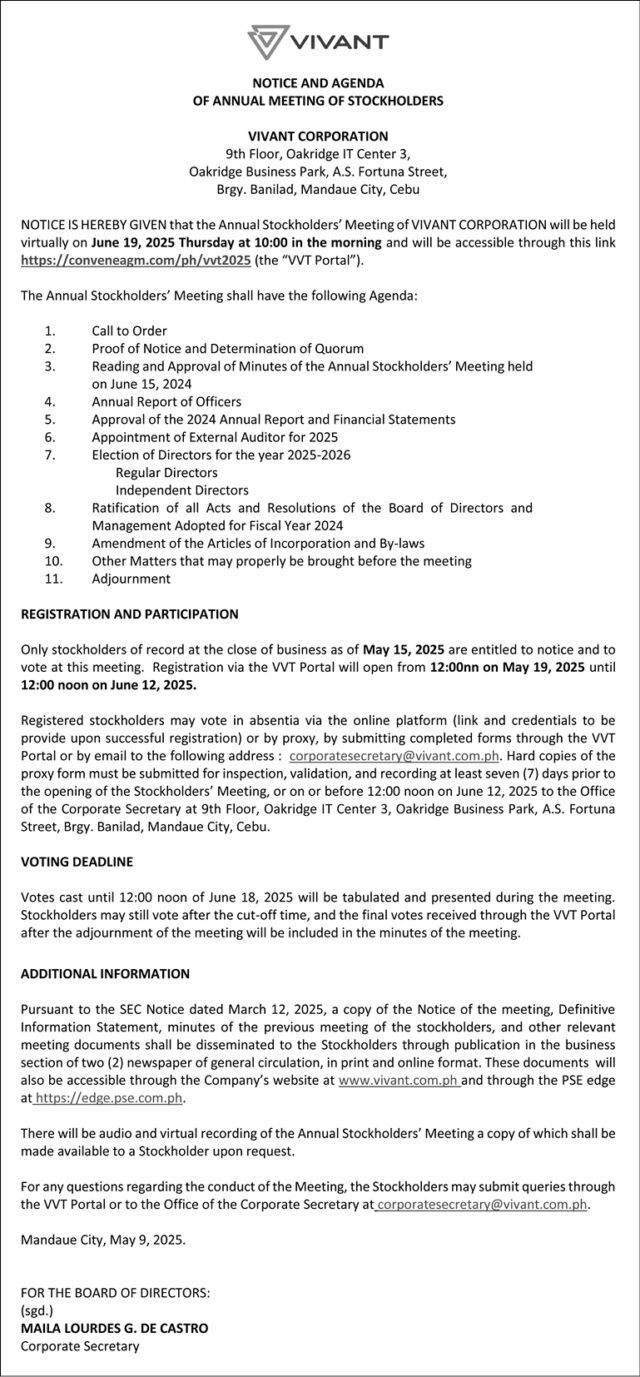
VIVANT Corp. to hold virtual Annual Stockholders’ Meeting on June 19


Spotlight is BusinessWorld’s sponsored section that allows advertisers to amplify their brand and connect with BusinessWorld’s audience by publishing their stories on the BusinessWorld Web site. For more information, send an email to online@bworldonline.com.

Join us on Viber at https://bit.ly/3hv6bLA to get more updates and subscribe to BusinessWorld’s titles and get exclusive content through www.bworld-x.com.

Fertilizer regulator bats for expanded powers

DA.GOV.PH

THE Fertilizer and Pesticide Authority (FPA) said it will seek a bill expanding its powers, citing the need to more broadly participate in agriculture modernization efforts.

The FPA said the bill it is seeking will amend of Presidential Decree 1144 to “expand FPA’s authority to include research, development, and extension services that will enable the agency to adapt to modern agricultural needs.”

The decree established the FPA in 1977, replacing the Fertilizer and Industry Authority, which was created in 1973 in response to declining rice production.

The FPA, which will mark its 48th anniversary on May 30, said it will seek to leverage its mandate — which includes licensing, quality assurance, import control, stewardship, and public information — “not merely as regulatory duties but as platforms for encouraging innovation.”

It cited the need to adapt to developments like precision farming practices such as drone-assisted spraying of fertilizer and pesticide.

The FPA said it is currently supporting local government units in their waste-to-compost initiatives by providing composting facilities. It is also promoting the use of drones in agriculture, developing protocols, standards, and monitoring systems.

The FPA’s key projects and activities this year include firming up drone application policy, further digitalization of licensing and accreditation processes, and intensified first-border inspections. — Kyle Aristophere T. Atienza

Treasury bill, bond rates may be range-bound on BSP easing bets

STOCK PHOTO | Image by RJ Joquico from Unsplash

RATES of the Treasury bills (T-bills) and Treasury bonds (T-bonds) on offer this week could end mixed to track secondary market yield movements and as the market expects the Bangko Sentral ng Pilipinas (BSP) to further ease its policy stance as early as next month.

The Bureau of the Treasury (BTr) will auction off P25 billion in T-bills on Monday, or P8 billion each in 91- and 182-day papers and P9 billion in 364-day papers.

On Tuesday, the government will offer P30 billion in reissued 10-year T-bonds with a remaining life of nine years and 11 months.

T-bill auction rates could mirror the week-on-week decline seen for comparable benchmarks at the secondary market following dovish signals from the BSP, Rizal Commercial Banking Corp. Chief Economist Michael L. Ricafort said in a Viber message.

At the secondary market on Friday, the 91-, 182-, and 364-day T-bills went down by 1.01 basis points (bps), 4.51 bps, and 1.56 bps week on week to end at 5.5126%, 5.6257%, and 5.6996%, respectively, based on PHP Bloomberg Valuation Service (BVAL) Reference Rates data as of May 16 published on the Philippine Dealing System’s website.

BSP Governor Eli M. Remolona, Jr. said earlier this month that they are open to cutting rates by a further 75 bps this year amid cooling inflation. The central bank resumed its easing cycle in April with a 25-bp rate cut, bringing the policy rate to 5.5%.

The Monetary Board’s next meeting is scheduled for June 19.

April inflation slowed to an over five-year low of 1.4% from 1.8% in March and 3.8% a year earlier. For the first four months, it averaged 2%, at the low end of the BSP’s 2-4% annual target.

Meanwhile, the reissued 10-year bond to be auctioned off on Tuesday could see its average rate rise to track the movements of comparable secondary market and US Treasury yields as the trade truce between the US and China could give the US Federal Reserve room to keep rates steady for now, Mr. Ricafort added.

A trader said the T-bond offer could be “well received” and fetch rates ranging from 6.185% to 6.225%.

At the secondary market on Friday, the 10-year bond rose by 2.94 bps week on week to yield 6.1732%, PHP BVAL Reference Rates data showed.

The US-China deal to lower the most aggressive import tariffs between the world’s two largest economies could lessen the impact of their trade war, though the levies left in place are still steep and will leave a mark on the economy, Federal Reserve officials said on Monday last week, Reuters reported.

Federal Reserve Governor Adriana Kugler said the 90-day pause on import levies at levels that threatened to shut down bilateral trade reduces chances that the US central bank will need to lower interest rates in response to an economic slowdown.

In separate comments to the New York Times, Chicago Fed President Austan Goolsbee agreed the weekend deal would lower the impact tariffs have on the economy — for now.

The Fed’s policy-setting Federal Open Market Committee this month kept its benchmark interest rate in the 4.25%-4.5% range where it had been since December. Policymakers said they were unlikely to make a change until it was clear whether tariffs would lead to a new inflation problem, or undercut growth and pose risks to the job market that warranted a reduction in borrowing costs.

Last week, the BTr raised P25 billion as planned from the T-bills it auctioned off as total bids reached P70.345 billion, almost thrice the amount on offer.

Broken down, the Treasury borrowed the programmed P8 billion via the 91-day T-bills on tenders for the tenor reached P23.375 billion. The three-month paper was quoted at an average rate of 5.546%, 2.7 bps lower from the previous auction. Tenders accepted by the BTr carried yields of 5.5% to 5.572%.

The government likewise made a full P8-billion award of the 182-day securities as bids amounted to P29.335 billion. The average rate of the six-month T-bill was at 5.65%, down by 1.7 bps, with accepted rates ranging from 5.623% to 5.668%.

Lastly, the Treasury raised P9 billion as planned via the 364-day debt papers as demand for the tenor totaled P17.635 billion. The average rate of the one-year T-bill decreased by 4.2 bp to 5.655%, with bids accepted having yields of 5.54% to 5.72%.

Meanwhile, the 10-year T-bonds to be auctioned off this week are part of the P300 billion in new benchmark fixed-rate Treasury notes priced on April 15 and issued on April 28. The papers fetched a coupon rate of 6.375% and an average rate of 6.286%.

The Treasury is looking to raise P260 billion from the domestic market this month, or P100 billion via T-bills and P160 billion through T-bonds. — Aaron Michael C. Sy

Eco-friendly shoe brand opens first store in Manila

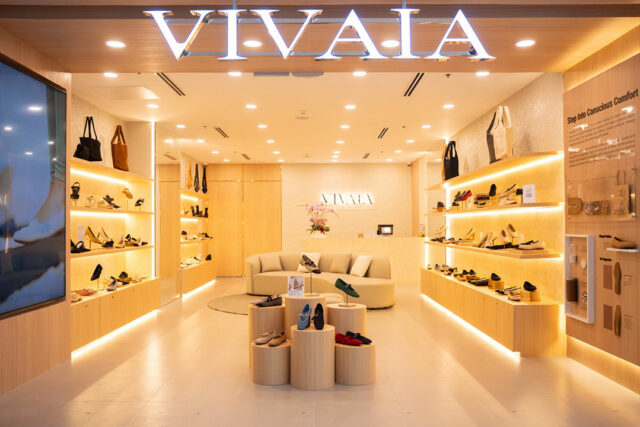
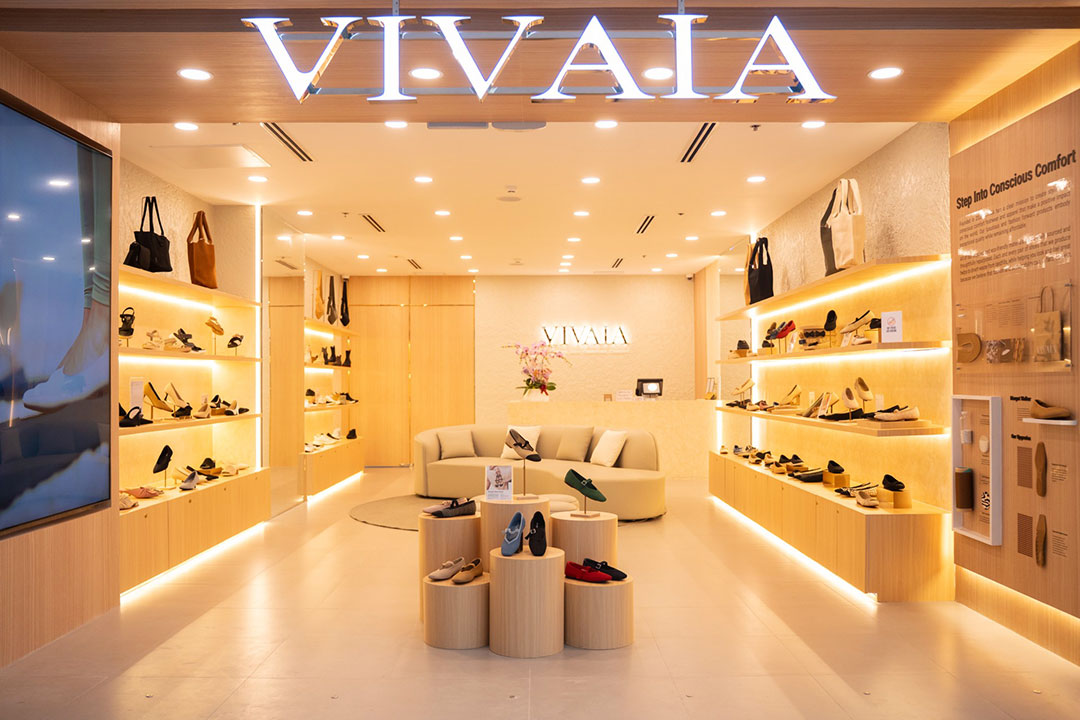
VIVAIA STORE in SM Megamall

Vivaia brings style, comfort, celebrity street cred

STARS like Bella Hadid, Scarlett Johansson, Aubrey Plaza, and Jenna Ortega are said to be fans of the shoe brand Vivaia, with K-pop star Jennie of the girl group BLACKPINK spotted wearing them as well. While it has already made its presence felt in the Philippines since January through pop-up stores (in Power Plant Mall and Shangri-La Plaza), it officially opened its first permanent store in SM Megamall on May 8.

Vivaia’s store occupies 92 square meters on the mall’s 3rd floor. There are wall-to-wall wooden shelves filled with the brand’s signature styles for flats, heels, loafers, sneakers, bags, and many more, all bathed in warm lighting. Comfortable seats invite shoppers to try on the shoes, which cost between P6,000 and P13,000.

At the entrance, the “Conscious Comfort Wall” highlights key details about Vivaia’s footwear production, from how six PET plastic bottles are recycled per pair (acquired through suppliers in the US) to the padded insole technology that makes sure the feet are well-supported.

Eira Peña, co-owner of Vivaia’s Philippine stores, talked about discovering the brand in Hong Kong in 2023.

“I used to work in corporate and I was looking for comfortable shoes I could wear to the office. I had my eye on the brand for a while, but they didn’t have it in the Philippines,” she said. “I did some research and I saw that the technology of it is really good.”

Vivaia was founded in the US in 2020 and is now present in over 60 countries. About the shoes’ comfort, Ms. Peña said, “The shoe technicians embed sneaker-like comfort into everyday wear. I feel like it’s an underserved market in the Philippines. There’s a lot of potential to serve Filipinos’ everyday conscious comfort.”

Vivaia Philippines co-owner Jeremy Go added that it’s the only brand that “brings together the two worlds of fashion and technical comfort,” making it unique.

“We do have competitors on both sides, style-focused heels and fast-fashion shoes on one hand, and walking shoes in the comfort space on the other. Uniquely, there’s no one kind of in the middle where we are, that’s melding both worlds of comfort and fashion,” he explained.

This sentiment was echoed by Ms. Peña, who maintained that Vivaia has “no direct competitors.”

WALKING THE WALK
With this, BusinessWorld tried on a few of the shoes and gave them a spin around the store, to see if Vivaia indeed blended style and comfort. Notable new designs are the trendy Cristina Ballet Sneaker Flats and round-toe Nelly Mary-Jane Flats. Those looking for boots can check out the Ryan Slip-On Chelsea Boots.

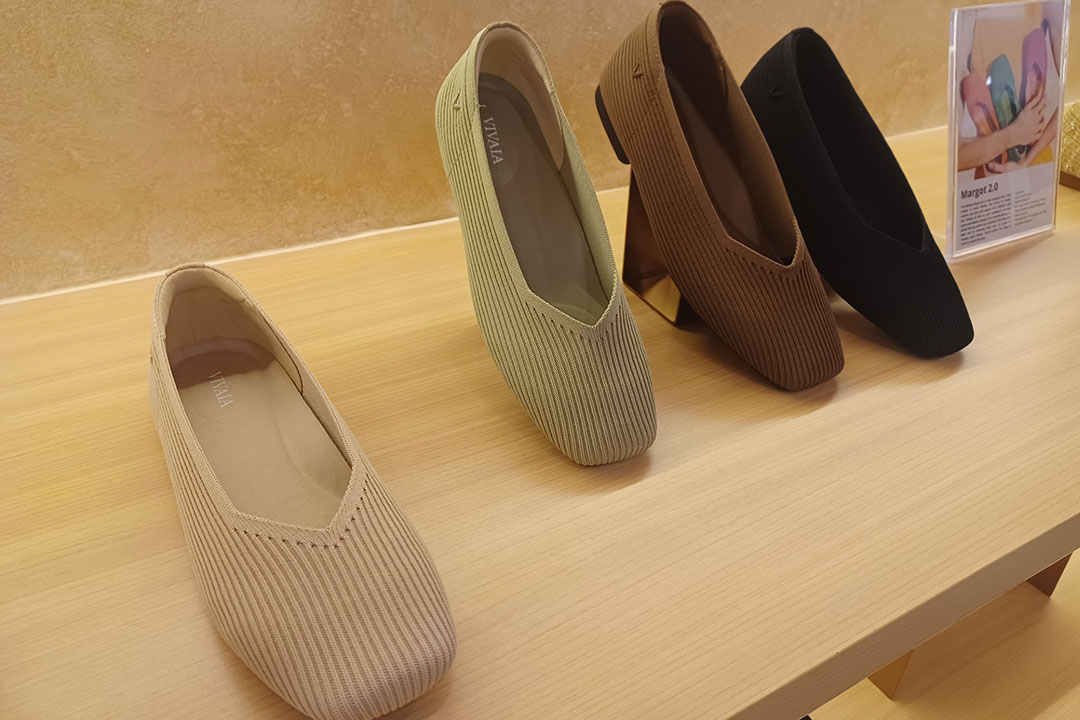
We opted for the bestseller Margot Mary Janes, available in blue, red, beige, and black — they were requested by about three-quarters of the visitors at the launch, so we had to ask for them, too. The Margot 2.0, which is a variation of the Margot Mary Janes without the buckle, but available in more colors, was also very popular.

Slipping one’s feet into a pair, one immediately feels the high-quality comfort. The simple style lends a timeless look to any outfit. Walking in them was like walking on clouds. While the shoes are machine-washable, we found it was easy to gently wipe off a dirt stain from the side of our beige pair (a plus for those who actually will use them to walk on the streets in this tropical, urban setting).

“A lot of other brands try to do this, but you can actually wear this one every day and just wash it,” said Ms. Peña. “It’s why celebrities have been loving it, because of the chic look combined with that luxury walking experience.”

Mr. Go emphasized that the shoes are sustainable, made entirely of recycled plastic material. “We work with REPREVE, a company in the US that makes sure that each bottle used in making the fabric is actually diverted from landfills. No virgin materials are used,” he said.

They added that more Philippine stores are in the pipeline, with Glorietta and SM Mall of Asia branches set to open in the next few months.

“After that, hopefully in Power Plant Mall, and maybe in Opus Mall,” Mr. Go said.

Vivaia’s first store in the Philippines so far is located in Level 3 of SM Megamall Building B, Mandaluyong City. — Brontë H. Lacsamana

First Gen eyes three more LNG cargoes this year

BW FILE PHOTO

LOPEZ-LED First Gen Corp. is looking to secure at least three additional liquefied natural gas (LNG) cargoes this year to support the supply requirements of its gas-fired power plants in Batangas, its president said.

“For the summer, the turnaround is somewhat quick. We’re still assessing it. Maybe before the year ends, maybe another three cargoes. It depends on consumption, right?” First Gen President and Chief Operating Officer Francis Giles B. Puno told reporters last week in mixed English and Filipino.

Mr. Puno said the company expects its eighth LNG cargo delivery this month to meet the supply requirements of its Batangas gas-fired power plants.

The cargo, with a volume of 130,000 cubic meters, is expected to dock at the Batangas terminal on May 20, “coming from Middle East and Asia.”

First Gen received its seventh LNG cargo last month.

Last year, the company completed the tender and receipt of six LNG cargoes following the completion of its terminal in 2023.

These cargoes enabled the company to supply its four existing gas-fired power plants with a combined capacity of 2,017 megawatts (MW) located at the First Gen Clean Energy Complex in Batangas.

Mr. Puno said the company schedules tender timing to ensure it can accommodate the entire cargo.

“It’s all collaborative within the power users, so we have to coordinate with Meralco (Manila Electric Co.) and then we have to coordinate with the supplier. We have to know when the ship is coming [to ensure that] by the time the ship arrives, we can accommodate the entire cargo,” he said.

In 2023, its subsidiary FGEN LNG Corp. completed the interim offshore LNG terminal and entered into a five-year time charter party for its floating storage and regasification vessel, BW Batangas.

In January, FGEN LNG secured a permit from the Department of Energy to operate and maintain its interim offshore LNG terminal for 25 years.

First Gen has a total of 3,668 MW combined capacity from its portfolio of plants running on geothermal, wind, hydro, solar energy, and natural gas. — Sheldeen Joy Talavera

ADVERTISEMENT
ADVERTISEMENT