Home Blog Page 1466

Banks’ assets rise to P26.89 trillion at end-April

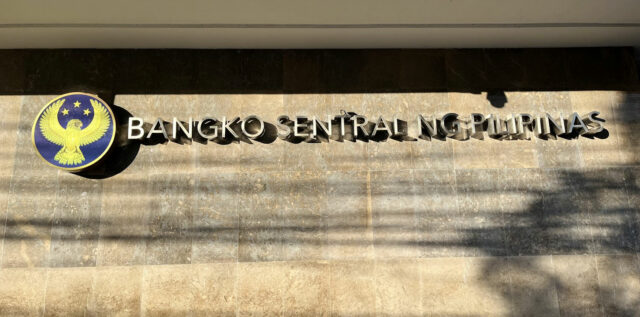
The main office of the Bangko Sentral ng Pilipinas in Manila. — BW FILE PHOTO

THE Philippine banking industry’s total assets rose by 5.5% year on year as of end-April, preliminary data from the Bangko Sentral ng Pilipinas (BSP) showed.

Banks’ combined assets rose to P26.89 trillion as of end-April from P25.48 trillion in the same period a year ago.

However, month on month, total assets inched down by 2.7% from P27.64 trillion as of end-March.

Banks’ assets are mainly supported by deposits, loans, and investments. These include cash and due from banks as well as interbank loans receivable (IBL) and reverse repurchase (RRP), net of allowances for credit losses.

The banking sector’s total loan portfolio inclusive of IBL and RRP jumped by 10.2% to P14.85 trillion from P13.47 trillion in the comparable year-ago period.

Net investments, or financial assets and equity investments in subsidiaries, increased by 8.8% to P8.03 trillion as of end-April from P7.38 trillion in the same period in 2024.

Net real and other properties acquired climbed by 12.7% year on year to P119.88 billion from P106.41 billion.

On the other hand, cash and due from banks fell by 24.7% to P1.91 trillion as of end-April from P2.54 trillion in the previous year.

Banks’ other assets slipped by 0.1% to P1.984 trillion from P1.986 trillion.

Meanwhile, the total liabilities of the banking system amounted to P4.63 trillion as of end-April, up by 3.1% from P4.49 trillion in the year prior.

Bulk of banks’ liabilities were deposits, which increased to P19.77 trillion at end-April from P19.004 trillion a year prior. Peso-denominated deposits stood at P16.35 trillion, while foreign currency deposits were at P3.42 trillion.

Rizal Commercial Banking Corp. Chief Economist Michael L. Ricafort said banks’ total assets continued to be driven by double-digit growth in lending.

“Loan growth slowed down for the largest banks based on the latest data as of April, but still more than twice gross domestic product growth, as consumer loans even grew faster year on year,” he said.

Outstanding loans of universal and commercial banks grew by 11.12% year on year to P13.25 trillion in April, the slowest growth in five months. Consumer loans jumped by 24% to P1.67 trillion in April, a tad faster than the 23.9% increase recorded a month prior.

Mr. Ricafort said further monetary easing here and abroad could spur demand for loans, which would in turn boost bank assets.

“Further BSP and Federal Reserve rate cuts for the coming months could further reduce financing costs that could help increase the demand for loans, as well as support banks’ trading gains on fixed income investments,” he added.

BSP Governor Eli M. Remolona, Jr. has said a rate cut is on the table at the Monetary Board’s June 19 policy review. The central bank has so far slashed interest rates by 100 basis points since it began its easing cycle in August last year. — Luisa Maria Jacinta C. Jocson

Nighttime skincare that works

HUMANHEARTNATURE.COM

By Zsarlene B. Chua

Product Review
Human Nature Overnight Elixir
and Radiant Grace Night Cream

NIGHTTIME is when skin does its most intensive repair work, and not enough is said about the importance of a good sleep routine and using the right products to ensure that your skin has the components it needs to repair itself. But if you’re like me, whose sleep routine is often out of whack, the right products are pulling double duty — helping make up for lost rest while supporting the skin’s natural renewal cycle.

When Human Nature reached out to ask if I’d try their newest night line, I was genuinely interested. I’ve used their products consistently over the years for their balance of affordability and effectiveness. Their Sunflower Beauty Oil, as well as the Hydrating and Nourishing facial washes and toners, have long been staples in my routine.

Now, Human Nature is leveling up — evolving to meet a wider range of skincare needs. Over the years, the brand has been introducing more active ingredients into its formulations, including ceramides, hyaluronic acid, Vitamin C, and even bakuchiol, a plant-based alternative to retinol.

Their newest line is no different, as the Radiant Grace Night Cream (P995/45 ml) and Overnight Elixir (P995/30 ml) feature bakuchiol, known for improving skin texture and appearance of fine lines, with the added benefit of being gentler than traditional retinoids.

To note, this isn’t the first time the brand has dabbled in bakuchiol in their products as they introduced their Sunflower Beauty Oil with Bakuchiol (P299.75/30 ml) two years ago — a product I’ve enjoyed and continued to buy sporadically.

Unlike that earlier, more targeted product, the Overnight Elixir is a facial oil that takes a broader, more holistic approach. Rather than centering on a single active ingredient, it functions as a multi-tasking cocktail — combining a range of skin-nourishing oils and active ingredients designed to support hydration, repair, and barrier resilience. While bakuchiol is present, it is listed in the last third of the ingredients list, suggesting it is used at a lower concentration.

The formula leans more heavily on a blend of botanical oils, including their signature sunflower oil, along with rosehip, avocado, passion fruit, soybean, rose, lavender, elemi, and rosemary oils. These oils are rich in antioxidants, fatty acids, and vitamins, contributing to overall skin conditioning and glow. Rather than targeting a single issue, the elixir is built to support a more well-rounded nighttime routine, especially for those dealing with dryness, dullness, or early signs of aging. As it is, the elixir may not be potent enough for those who want products specifically targeting deeper fine lines or more advanced concerns.

Bakuchiol is more prominently featured in the Radiant Grace Night Cream, appearing in the first half of the ingredients list. The cream also contains ceramides, which help strengthen the skin barrier, and Vitamin C, known for brightening age spots.

When used together, the elixir and the night cream pack quite a punch by combining targeted active ingredients with rich nourishing oils to support skin repair, hydration, and overall radiance. But routines are personal, and effectiveness depends on individual skin needs and concerns, so I’m not saying that you need to use these two products in tandem, as I believe that any good product can and should stand on its own against and in combination with other brands.

What I did like about the two products is that the elixir reminded me of Kiehl’s Midnight Recovery Concentrate (P3,500/30 ml), a facial oil focused on nighttime skin recovery and a personal favorite despite its higher price point. Both the Human Nature Overnight Elixir and Midnight Recovery Concentrate lean on that lavender scent to make it relaxing, and the blend of botanical oils helps keep the skin hydrated overnight. This makes them perfect for dry-to-normal skin like mine, but may feel too oily for those with combination-to-oily skin.

The Radiant Grace Night Cream, meanwhile, is like an upgraded version of their Ceramide Skin Renewing Night Cream (P299.75/50 ml), not only in price point but also in the effects it promises as Radiant cream is touted to not only strengthen the skin barrier (like the ceramide cream) but also help in the skin’s recovery efforts overnight due to Vitamin C and bakuchiol.

According to the brand’s product page, the Radiant Grace Night Cream and Overnight Elixir are recommended for those with more mature skin or (in my opinion) for individuals who already have an established anti-aging skincare routine — like me — who know what works for their skin. This also reflects Human Nature’s move to expand their line, incorporating more advanced active ingredients to address a wider range of skincare needs for more mature skin.

If you’re still working out how to introduce retinoids into your routine or are looking to start an anti-aging regimen, I’d suggest trying the Ceramide Night Cream and the Sunflower Beauty Oil with bakuchiol first. They offer a gentler introduction at a lower price point, allowing you to see how your skin reacts before moving on to more advanced products.

Overall, I did and do like the two new products as they offer a balanced combination of effective ingredients and nourishing oils, supporting skin hydration, repair, and a more radiant complexion without harsh effects. They also feel luxurious on the skin, and I have been waking up with a noticeably softer, more refreshed complexion in the past few weeks that I’ve been using them. However, visible results require consistent, long-term use, and it remains to be seen whether I will make them a regular part of my routine.

Human Nature products are available online at humanheartnature.com, e-commerce sites, and in select stores nationwide.


Zsarlene Chua is a former BusinessWorld reporter who is now a fledgling PR girl. She’s all about skincare, makeup, and video games — and occasionally food. None of the products she reviews are the writer’s clients. Contact the author at zsarlene.chua@gmail.com.

Digital peso in the Philippines: Ready or not?

CRECENCIO I. CRUZ

By Lourdes O. Pilar, Researcher

CHEAPER cross-border remittances, greater financial inclusion, enhanced liquidity management, reduced settlement risks, and financial stability support are the many promises of central bank digital currency (CBDC) to the country’s financial landscape. But would a digital peso work in the Philippine financial system?

A CBDC is a form of digital currency issued by a country’s central bank. It was like cryptocurrencies, except that its value is fixed by the central bank and is equivalent to the country’s fiat currency.

Last year, the country’s central bank completed its testing phase for Project Agila, its prototype wholesale CBDC.

Rizal Commercial Banking Corp. (RCBC) views the potential adoption of a CBDC as a strategic move toward modernizing the Philippine financial ecosystem.

“CBDCs provide a secure, efficient, and transparent alternative to physical cash, enabling real-time, government-backed digital settlements that enhance the integrity of payments nationwide,” said Angelito M. Villanueva, RCBC executive vice-president and chief innovation and inclusion officer.

China Banking Corp. (Chinabank) recognizes that the adoption of wholesale CBDC technology can bring significant benefits to the banking system.

“Through Project Agila, we have observed that wholesale CBDC (wCBDC) can facilitate 24/7 domestic fund transfers, leading to enhanced efficiency in interbank settlements and faster turnaround times for financial transactions,” said Delfin Jay M. Sabido IX, Chinabank chief innovation and transformation officer.

There are two types of CBDC, wholesale and retail. Financial institutions are the primary users of wholesale CBDCs in which the BSP is introducing in the country, while retail CBDC are for consumers’ and businesses’ use.

Financial institutions included in the pilot study see CBDCs as a powerful enabler and have the potential to promote broader financial inclusion.

“Designed with offline capabilities, CBDCs can reach unbanked populations in geographically isolated and disadvantaged areas. Even without internet access, individuals can transact digitally using feature phones or offline wallets via SIM toolkit, Bluetooth, or QR-based solutions,” Mr. Villanueva of RCBC said.

Mr. Villanueva also added that CBDCs also enable direct government-to-person disbursements, bypassing the need for a bank account and ensuring aid reaches the intended recipients fast and securely.

“Underbanked and underserved Filipinos can indirectly benefit from wholesale CBDCs through micro, small, and medium enterprises, cooperatives, lending institutions, and the government sector. These entities can leverage the efficiencies and capabilities of wholesale CBDCs to provide better financial services and support to their communities,” said Mr. Sabido of Chinabank.

HOW IT WORKS
According to Mr. Villanueva, the BSP selected Hyperledger Fabric, a distributed ledger technology, as the foundation for pilot testing due to its ability to record, synchronize, and share data across a network of participants. This makes it ideal for off-hours inter-institutional fund transfers — such as during evenings, weekends, holidays, or when the PhilPaSSplus system is offline.

The selection was based on its strengths in security, system access, 24/7 availability, interoperability, and programmability — all critical to building a resilient CBDC infrastructure.

RCBC said that digital access alone isn’t enough. In areas with limited or no internet connectivity, hybrid solutions will be essential. This includes offline-capable CBDC transactions and mobile-based technologies like SIM toolkit integration.

Equally important is the human element. As the country undergoes digital transformation, trusted community intermediaries are critical to bridge the gap.

The project aims to assess the technology’s viability and its potential to improve financial operations, but some advantages and disadvantages were experienced by banks in the implementation of CBDC during pilot testing.

RCBC’s participation in the Project Agila pilot presents a unique opportunity to explore the real-world functionality and potential of a wCBDC. The pilot demonstrated key benefits, including faster settlement speeds, reduced reliance on clearing intermediaries, and greater transaction transparency.

“However, the pilot also surfaced important challenges, such as the need to integrate CBDC systems with legacy banking infrastructure, which often lacks built-in interoperability,” said Mr. Villanueva.

Broad adoption will require extensive user education and strategic change management to avoid fragmentation and ensure alignment across financial institutions, Mr. Villanueva added.

Chinabank experienced several positive outcomes, including the ability to conduct programmable transactions tailored to specific systems using smart contracts, faster interbank settlements, and expanded flexibility in fund management.

“These developments have the potential to significantly improve transaction efficiency and operational risk management,” said Mr. Sabido

He added that areas for further study may include the need for robust cybersecurity measures to protect against potential threats, the requirement for comprehensive staff training to ensure smooth adoption, and the necessity to update existing regulatory frameworks to accommodate new technological advancements.

READY OR NOT?
As one of the Philippines’ most digitally progressive banks, RCBC is strongly positioned to lead in the CBDC and digital finance space.

“RCBC has built a proven track record in delivering innovative, inclusive, and impactful financial technologies. We’ve shown that innovation and inclusion can — and must — go hand in hand. We have launched groundbreaking platforms designed to bring banking closer to every Filipino,” Mr. Villanueva said.

Chinabank’s participation in Project Agila has enabled it to thoroughly assess their technical, operational, and strategic capabilities in adopting wCBDC technology.

“Chinabank continues to monitor developments closely and will carefully evaluate future requirements, opportunities, and challenges as the project progresses. We remain committed to adapting and evolving our systems to ensure readiness for innovative financial technologies,” Mr. Sabido said.

The BSP said that the project will likely be launched by 2029, still within the six-year term of BSP Governor Eli M. Remolona, Jr.

Mega Prime sets over P1-B capex for projects

MEGAPRIMEFOODS.COM.PH

MEGA PRIME FOODS, INC. has allocated over P1 billion for capital expenditure (capex) this year to support new projects.

“For capex this year, we are building a lot of new developments, so it will be more than P1 billion, 20-30% higher than last year,” Mega Prime President and Chief Executive Officer Michelle Tiu Lim-Chan said on the sidelines of the company’s 50th Anniversary event on Friday.

“We are investing in the Philippines because we want to generate more jobs and improve the economy of the Philippines,” she added.

She said the company is focusing on developing its information technology and automation systems to improve operational efficiency and maintain the quality of its sardines.

A portion of the capex will also be used to build new boats, refurbish old boats, and for dry docking.

Meanwhile, Mega Prime is targeting double-digit growth in revenues and market share.

“Target growth for revenues is 28%. And we are tracking well so far,” said Mega Prime Chief Growth and Development Officer Marvin P. Tiu Lim.

In a previous statement, he said the company aims to increase Mega Sardines’ market share to at least 30% by year-end, up from 26% in 2023.

Ms. Tiu Lim-Chan said a 28% topline growth would be higher than usual for the company.

“It will be primarily driven by our 50th year promotion and the Jimm’s Coffee acquisition,” she added.

For its promotion, the company is giving away P50 million to consumers who purchase Mega Sardine cans with special codes on the lids.

“They can win instant GCash, or they can also win a raffle every month for either a car or P1 million. So, we are very excited and hopeful that this will help boost sales and also help penetrate a lot of people throughout the nation,” Mr. Tiu Lim said.

On acquisitions, he said the company is in ongoing talks with several firms, particularly in the health and wellness segment.

“What we really want is to transform the business into a health and wellness business because it is a waste if we do not take care of our nutrition,” he said.

Asked about the timeline for the planned acquisition, he said, “The timeline is as soon as possible because we really want to grow. It is going to be hard to just grow organically, so we need to grow through acquisitions.”

He clarified that the funding for the acquisition will not come from this year’s capex.

The company is also targeting to increase exports to 10% of its business.

“Exports are not big. They are only around 5% now. But we really want to grow it to 10%. Because the base is growing, the domestic market is growing, so the export market needs to catch up with that,” Ms. Tiu Lim-Chan said.

Mega Prime currently exports to 30 countries, mostly those with large overseas Filipino worker populations. — Justine Irish D. Tabile

European Union open to lowering tariffs on US fertilizer in trade talks

REUTERS

BRUSSELS — The European Union (EU) is open to lowering tariffs on US fertilizer imports as an offer in trade talks with the Trump administration, but will not weaken its food safety standards in pursuit of a deal, EU agriculture commissioner Christophe Hansen told Reuters.

“That is definitely an option,” Mr. Hansen said, of reducing US fertilizer tariffs.

“That will be on the table. And I think that would be a huge way forward, and an offer as well to the US,” he said in an interview with Reuters, adding that whether that would mean zero tariffs, or a reduction of current rates, would need to be negotiated.

US exports face the EU’s standard tariffs of 5.5% on imports of ammonia, and 6.5% on nitrogen fertilizer, as well as an extra 29.48 euro-per-ton anti-dumping duty on US urea ammonium nitrate (UAN).

UAN comprised around three quarters of EU imports of US fertilizer last year, EU trade data show.

Reducing tariffs could boost Europe’s purchases of US fertilizer, to fill a gap as the EU cuts supplies from Russia.

Around 24% of the EU’s nitrogen fertilizer imports came from Russia in 2023, while the US accounted for 8%, EU data show.

“I believe most of the Europeans would prefer buying fertilizer from the US than from Russia,” Mr. Hansen said.

The EU will hit nitrogen-based fertilizer from Russia with tariffs rising to 100% over three years, a level that would effectively halt annual trade flows currently worth 1.3 billion euros.

Mr. Hansen said the EU was also open to discussing increasing its purchases of hormone-free beef from the US, and a deal to have zero-for-zero tariffs on EU and US wines.

But he said the bloc would not compromise on its stringent food safety standards as it seeks a deal.

“I don’t see room for maneuver to roll back our high quality standards. But of course, on other points, on other products, we are very open to negotiations,” Mr. Hansen said. — Reuters

The EDSA problem

PHILIPPINE STAR/MIGUEL DE GUZMAN

Time was when Highway 54 was a two-lane road lined with acacia trees craning to see who was the rare interloper driving up or down the stretch from the Bonifacio Monument in Caloocan to Taft Avenue in Pasay City, exiting some places in between. That was in the 1950s, when greater Manila was rising from the destruction and setbacks of World War II and the Japanese occupation.

Construction of what was then called the North and South Circumferential Road began in 1939 under Commonwealth President Manuel L. Quezon, who had planned a new capital city, which became Quezon City. Highway 54 was C-4, meant to interconnect Quezon City, Manila, and Pasay. After World War II and the independence of the Philippines from the United States in 1946, it became known as Avenida 19 de Junio (June 19 Avenue), after the birth date of national hero José Rizal (bworldonline.com, May 25, 2018). In 1959, the formal name was changed to Epifanio de los Santos Ave., after the Rizal scholar, historian, and jurist.

Landscape architect, environmental planner, and urban designer Paulo Alcazaren related his own experience of the history of Epifanio de los Santos Avenue, still stubbornly called Highway 54 through the 1960s, and later to be called by its acronym “EDSA” by the 1970s in his column in The Philippine Star (Feb. 24, 2024):

“Highway 54 started as a two-lane asphalt road with large swathes of cogon field on either side of it. It widened to four lanes by the mid-1950s, but had no lighting and very little development along it except for the government’s housing ‘Projects,’ the private Philamlife Homes, as well as some commercial development at the highway’s two main “crossings” at Cubao in Quezon City and at Shaw Boulevard. The Shaw intersection was (and is still known) as “crossing”;

“…We crossed Highway 54 to get to school or to old Manila, where we would visit my grandfather or watch movies downtown. In the early 1960s, I remember the lonely stretch of the highway when I accompanied my father, a doctor, to a clinic for employees at the old ABS-CBN compound. It was a shack with one lone television tower;

“…In the 1970s and into the Martial Law years, traffic built up as suburban residential enclaves sprouted along EDSA and daily commutes to Makati and central Manila built up traffic rush hours. In 1978, when I started working in Makati, I was still able to get home to Barrio Kapitolyo in Pasig in 15 minutes, but every year the traffic got heavier and the government started building interchanges, flyovers, and underpasses along all the major intersections.

“…Post-People Power, Makati was joined by the Ortigas district and Cubao as CBDs (Central Business Districts) that serviced the larger metropolis. The old downtown of Binondo had relinquished its role to these satellites. These were threaded by EDSA like a string of pearls lit at dusk by headlamps of thousands of vehicles that plied its length.

“…The 1990s and the first two decades of the 21st century have both seen EDSA evolve to become the key corridor for motorized transport for the metropolis. A light rail system was built to improve mobility for a population that now surpassed 10 million (with another few million commuting from beyond the boundaries of Metro Manila). This should have come first as rails systems are more efficient in moving people and the infrastructure could have been much less complicated than today’s reality of multi-layered interchanges that blight the cityscape and take up so much space.”

Yes, that’s the EDSA problem. It has grown into an unavoidable angry monster, already constipated with traffic way beyond its capacity that multiplied and compounded as the growing population has been funneled and force-fed into its dilated bowels. An average of 437,873 vehicles pass through EDSA each day, exceeding its carrying capacity of 250,000, government records show. During the Christmas season, the “MMDA expected travel along EDSA to become slower, with speeds dropping from the (then-current) average of 21 kilometers per hour to as low as 15 kph in the next two weeks,” said the Philippine Daily Inquirer (May 27).

EDSA is indeed the longest and the most congested highway in the metropolis, stretching some 23.8 kilometers. And it can hardly be avoided as it passes through six of Metro Manila’s 17 cities and municipality, namely, from north to south, Caloocan, Quezon City, San Juan, Mandaluyong, Makati, and Pasay. Sufferers of the chronic heavy traffic on EDSA have empirically tested that it would take 1.5 to two hours going to or from the Cubao crossing to the Buendia crossing in the peak hours between 6 a.m. and 9 p.m., or up to three hours on a bad day, like when it is raining (and not so strongly at that). Good luck and pray each time you decide to turn into EDSA from wherever — you are “caught” once you enter. Turning back will only bring you into deeper traffic on those small feeder roads where masochistic drivers wait some more, still insisting on proceeding via EDSA.

THE BANE OF FLYOVERS
Sitting in standstill traffic on EDSA, one must be alert, because the lanes narrow into three, or even two, from four at certain lengths of the avenue. Undisciplined drivers lined up beside or behind may suddenly go for that little gap between waiting vehicles, and enter your lane, squeezing in front of you, to go first when the traffic inches up slowly at 5 kph. Why did the MMDA — the Metro Manila Development Authority —  construct flyovers (the Kalayaan Flyover, the EDSA-Kamuning Flyover, the Ortigas Interchange, and the Magallanes-EDSA Flyover) and the Metro Rail Transit (MRT) over EDSA? Their support structures — huge concrete foundation posts and four-lane ascent/descent ramps — ate up precious lanes of EDSA under them. That’s why EDSA traffic moves so slowly!

The Civil Engineering Magazine (civilengineermag.com, May 12) says that of course, flyovers help with traffic control and safety for pedestrians. However, “they are not usually suitable for built-up areas because they require a large area. (These are) extremely expensive to construct …and a lack of proper management during the flyover construction process can lead to several issues (like cracks and weak foundations).”

Even as far back as 2011, Cebu City’s concerned residents called to “Stop the Cebu Flyovers!” The reason, according to the Cebu Daily News (Sept. 25, 2011), “why opposition to the planned flyovers is more intense than ever today, is precisely because these are now intruding into the urban core — a very private space which residents consider sacred. A public image of the City is being maintained by large numbers of the City’s inhabitants which they treasure and protect. With these new flyovers, the traditional sentiments and feelings of Cebuanos are being violated.

“Furthermore, the flyovers pose potential risks to safety and security. These huge infrastructures create dark and dingy spaces at night which are difficult to police. Reduced visibility violates the concepts of defensible space and discourages natural surveillance in urban areas which need it most. Such conditions contribute much to the degradation of the urban setting usually commencing a series of reactions from the public.”

It is too late for Metro-Manilans to cry out against the flyovers on EDSA that have blighted the landscape and even worsened traffic. Yet the MMDA seems still enamored with flyovers as the quick-fix glamor solution to the hoary EDSA problem. “Talks are underway for the construction of new flyovers that would serve as ramps for the EDSA busway and U-turn slots underneath for private vehicles to solve traffic congestion, the Metropolitan Manila Development Authority said just before the COVID pandemic constrained movements,” said The Philippine Star (Nov. 27, 2020).

But now that COVID-19 is no longer the arbiter for movements and traffic, here the MMDA comes as gallant knight with brandished sword to tame the dragon EDSA. Until President Ferdinand “Bongbong” Marcos, Jr. called a sudden temporary halt to the project for further study, ground works maintenance and repair was to be done, section by section, on the length of EDSA, estimated to be completed in two years. An odd-even scheme was to be in effect starting June 16. About 50% of vehicles plying EDSA would have been grounded, to allow construction and repair on EDSA to be done more expeditiously. Protests from road users forced the MMDA to indefinitely postpone the odd-even traffic reduction scheme said the Manila Standard (June 5).

The propensity of every administration since Quezon to today’s Marcos Jr. to build, build, build in the short-term (for PR points) with little planning for the long-term (the I-will-not-be-there-anymore mentality) has been pathetically told by the history of EDSA’s problems which were foisted on the people. Yes, EDSA has to be repaired and refurbished at the ground level, but please no more flyovers, exit ramps, and fancy cloverleafs over the existing road network. There is no need to rush to spruce up EDSA before the presidential elections in 2028. Go slowly but surely.

There is still time to develop detailed long-term strategic planning, not only for EDSA, but for the other road systems of the country. The Build Better More infrastructure programs of President Marcos Jr. (costing P9 trillion) will be funded by the people’s taxes and government’s long-term borrowing which will be paid by coming generations.

To our leaders in government: be honest and true to your sworn duties to God, country, and the Filipino people.


Amelia H. C. Ylagan is a doctor of Business Administration from the University of the Philippines.

ahcylagan@yahoo.com

Hongqi launches two EVs at new showroom

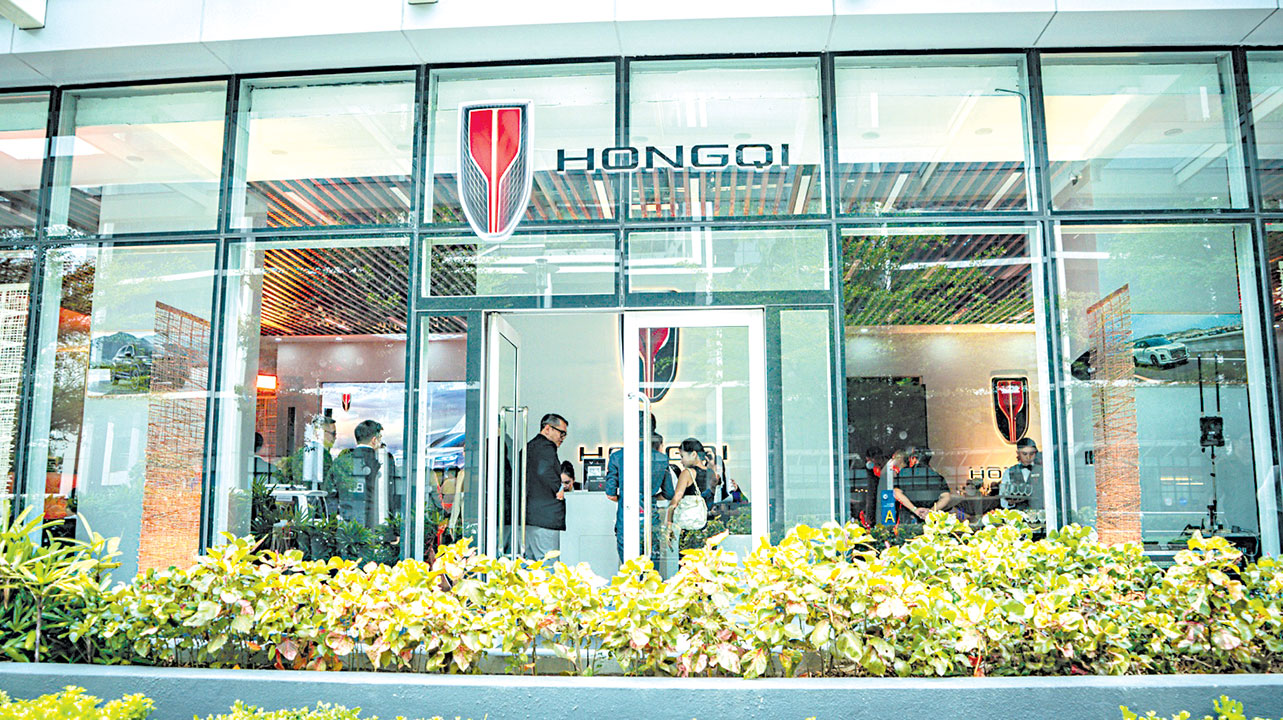
The third Hongqi Philippines showroom is located at Four E-Com Center, Mall of Asia Complex in Pasay City. — PHOTO BY KAP MACEDA AGUILA

BEVs said to mark ‘bold new chapter’ for brand here

By Joyce Reyes-Aguila

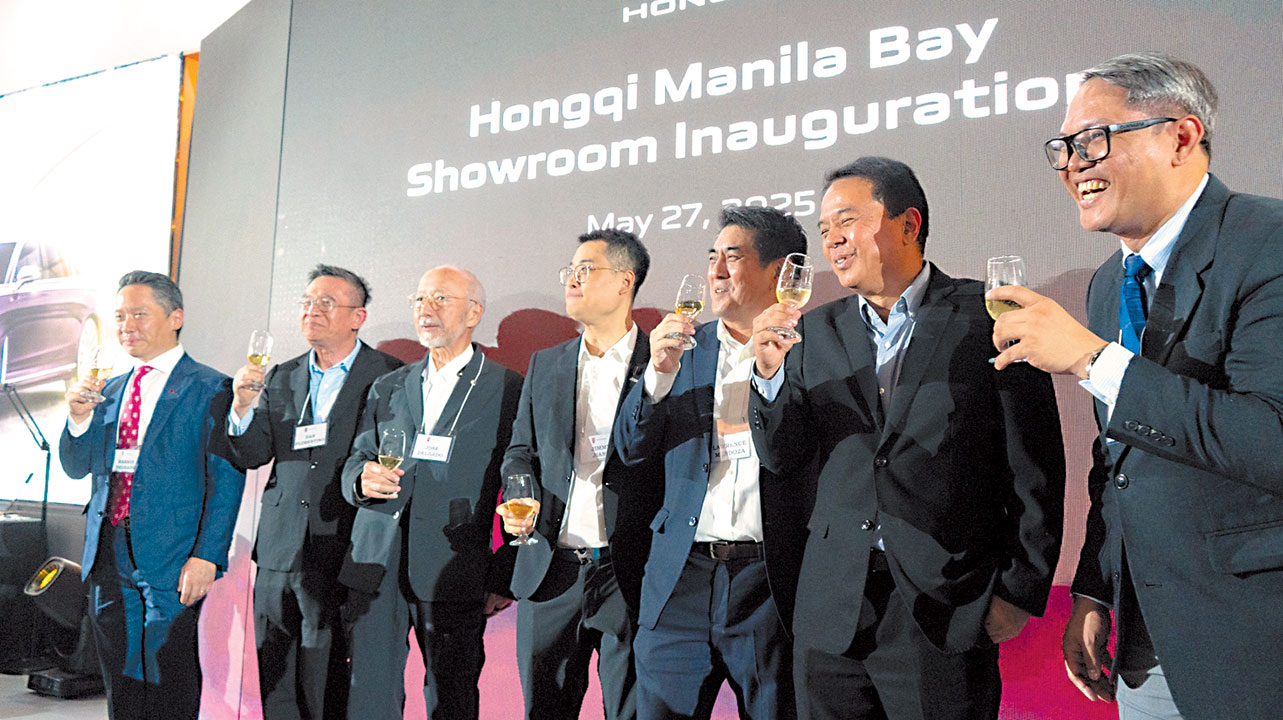
IN WHAT it describes as an expansion of its local footprint, Hongqi Philippines opened its fourth location in the country — this one in Pasay City. EVOxTerra, Inc. President Rashid Delgado said at the inauguration of Hongqi Manila Bay, “In 2023… our journey began with a flagship showroom in BGC (Bonifacio Global City) as a statement that Hongqi is set to make a bold mark in the industry. In less than two years, (we) have expanded (our) footprint with a presence in Alabang, Quezon City, and this newly opened (location).”

The opening of the dealership at Four E-Com Center, Mall of Asia Complex coincided with the formal launch of two Hongqi battery electric vehicles (BEVs): the EH7 and EHS7. The BEVs “mark the beginning of a bold new chapter” for the brand, according to Mr. Delgado, as these demonstrate the brand’s “strong commitment to innovation and design and engineering. They continue to redefine luxury through comfort, sustainability, and forward-thinking technology.”

The EH7 sedan and EHS7 sport utility vehicle (SUV) feature the same dual-motor AWD setup, delivering an output of 455kW (610hp) and 756Nm. A 111-kWh next-generation battery pack charges from 10% to 80% in 20 minutes, yielding a driving range of 650km for the EH7 and 540km for the EHS7. Both models have a glass roof offering 99% UV protection, and “reimagined” exteriors.

“Hongqi is synonymous with uncompromising elegance, crafting vehicles that deliver the ultimate fusion of performance and sophistication,” the executive continued. “With a growing lineup of nine models, ranging from the HS3 that we launched last year at the Manila International Auto Show to the top-of-the-line EH9 and the H9, we at Hongqi firmly believe that modern luxury is defined by exceptional comfort.

“We are committed to crafting refined experiences. Hongqi’s statement ‘I decide what drives me’ is a challenge to all of us to be authentic, to be original, and to decide what truly drives us forward. (This) marks the beginning of a bold new chapter for Hongqi as we unveil two fully reimagined all-electric models.”

Hongqi Philippines is offering the first 30 customers who will pre-order the EH7 or EHS7 with an early-bird promo. Aside from a complimentary 3-kW portable charger and a 7-kW wall charger, customers will get six months of free charging equivalent to P50,000 worth of charging credits for EVOxCharge stations nationwide. EVOxCharge is EVOxTerra, Inc.’s charging platform that offers brand-agnostic charging infrastructure. In an interview with “Velocity” last April, Mr. Delgado shared the brand’s plan to build its own charging network in commercial establishments, condominiums, office buildings, and residences of Hongqi customers. Electric vehicle owners of any brand can visit the EVOxTerra EV Lifestyle and Service Center in Western Bicutan, Taguig to access its 10-slot EV charging service.

In his speech at the event, Manila Bay showroom owner Jimmy Jiang of Max888 Auto echoed Honqi’s commitment to its mission of offering luxury innovation. “More than just a space, (this location is) a statement. Hongqi is committed to delivering not only vehicles, but also unmatched service, luxury, and (a) deep understanding of the needs of the market.”

The EH7 and EHS7 come in Executive and Flagship variants. The EH7 is priced at P2.28 million (Executive) and P2.88 million (Flagship); the EHS7 Executive costs P2.58 million while the EHS7 Flagship is at P3.08 million. Flagship versions, said Hongqi Philippines, “add premium enhancements such as upgraded interior ambient lighting, a more advanced audio system, and exclusive design touches with added power and range.”

More information about Hongqi’s offerings can be found on its website, https://www.hongqi.ph, its Facebook page (hongqi.philippines), Instagram (@hongqi.ph), and LinkedIn at https://www.linkedin.com./company/hongqiphilippines/.

GCash now pilot testing GBonds 

ELECTRONIC WALLET giant GCash is now in the process of pilot testing its GBonds feature, which will allow users to buy and sell government securities via the platform.

“GBonds is currently in its pilot test phase,” it said in a social media post.

GCash last week hosted a learning session in preparation for the launch of GBonds in partnership with the Bureau of the Treasury and the Philippine Digital Asset Exchange, Inc.

“This marks a significant step in making investments simpler, safer, and more accessible for all Filipinos. Soon, secure, low-risk government bonds are directly accessible on your phone, empowering you to confidently build a better financial future,” it said.

National Treasurer Sharon P. Almanza last month said they plan to launch GBonds early in the second semester.

The GBonds feature will be available to more than 94 million registered users of GCash.

The minimum investment will be about P500 for Treasury bills, while retail Treasury bonds (RTB) can be bought for as low as P5,000 for GCash, Ms. Almanza said.

RTBs are peso-denominated, low-risk, fixed-income retail investment instruments that earn interest every quarter.

Ms. Almanza said GCash would waive the transaction fee during the primary issuance or in the first two weeks of the offer period.

G-Xchange, Inc. is the operator of GCash. The parent firm of GCash, Globe Fintech Innovations, Inc. or Mynt, is an affiliate of listed telecommunications company Globe Telecom, Inc.

The BTr has been finding ways to offer securities and other debt instruments to retail investors and overseas Filipino workers to help boost the country’s capital markets.

The government plans to borrow P2.545 trillion this year, with about 80% sourced from local lenders and the rest from overseas. — Luisa Maria Jacinta C. Jocson

First Lady promotes local crafts, indigenous art

INSTAGRAM.COM/LIZAMARCOS

FROM June 5 to 8, the Foro de Intramuros — a new community space built in the ruins of one of the buildings in the historical district — became host to Likha 4, a project of the Office of the First Lady, Marie Louise “Liza” Araneta Marcos.

Last year’s Likha had the presence of Gawad sa Manlilikha ng Bayan artisans. This year’s edition hosted around 70 enterprises from around the Philippines.

During the opening ceremonies on June 5, Mrs. Marcos pointed out one of her favored stalls, one selling goods from Sarangani in Mindanao, whose artisans walked eight hours down from the mountains and then continued their journey to Manila. New sellers, numbering about 30, were marked by sails made of local indigenous cloth.

Dina Arroyo Tantoco, the palace’s Deputy Social Secretary, said that more established brands (like Heartefino, which had a stall at the event), were there to help build the new businesses. “They’re not even brands yet,” she said in an interview. Heartefino, Artefino’s social enterprise arm, exhibited the winner of their grant for this year, Project Nova, which makes bags from decommissioned tourist kayaks in Bohol.

Ms. Arroyo Tantoco pointed out some stalls of interest: No. 13, for example, CaDiWa Nito Hats, sells woven hats and baskets made by ex-armed rebels from Negros.

BusinessWorld noted flower garlands made of shells from Iloilo Capiz Shell Flowers and Antiques, and Banwa Pens, which makes fountain pens inlaid with abalone shells, also from Iloilo. Carvers and papier-mâché crafts from Paete, Laguna, were also represented, while hand-smocked items from Good Luck, Humans, had a hint of luxury.

According to Ms. Arroyo Tantoco, some concessions were made, especially for the newer businesses from far-flung areas, such as not charging them for the booths and paying their expenses. “One hundred percent goes to (them),” she said. “We don’t make money [from the event]. The government doesn’t make money from this.

“There’s a heritage team that puts this together,” she added. “They have been working with artisans for decades.”

As established by these lifestyle fairs, Filipino aesthetics have suddenly become cool. Ms. Arroyo Tantoco tried to give an answer as to how native crafts have suddenly become all the rage. “After COVID, we were like ‘let’s build together’ and develop, and be proud of what we have,” she said.

Of course, cool does come at a price: almost everything we saw had a price tag of above P1,000. She said: “When you go and talk to the craftsmen, it’s generations of art being passed down. Hundreds of years of an art form. Don’t you pay high for that?

“We have to be proud of that.” — JLG

Big banks’ share prices rose in Q1 despite uncertainties

STOCK PHOTO | Image by Dragana_Gordic from Freepik

LISTED BANKS weathered the first quarter despite trade uncertainties and easing interest rates.

But these same sentiments will still linger in the succeeding quarters, analysts said.

The bellwether Philippine Stock Exchange index dropped by 10.5% year on year to 6,180.72 at the end of the first quarter.

However, the financial subindex, which the banks fall under, climbed by 16.7% annually to 2,374.49 during the period.

In the first three months of the year, 11 of the country’s 14 listed universal and commercial banks’ share prices posted growth year on year.

China Banking Corp. (ticker symbol: CBC) led the pack with a 154.8% annual surge in its share price at the end of the first quarter. It was followed by Philippine National Bank (PNB, 148.2%), Asia United Bank Corp. (AUB, 75%), Rizal Commercial Banking Corp. (RCB, 15.4%), and Philippine Trust Co. (PTC, 15.3%).

Meanwhile, Union Bank of the Philippines’ (UBP) stock declined by 26.7% annually as of end-March, while Philippine Bank of Communications (PBC) dropped by 2.7% drop and BDO Unibank, Inc. (BDO) slipped by 0.8%.

“The performance of listed banks in the first quarter was supported by favorable macroeconomic tailwinds — namely sustained GDP (gross domestic product) growth and a marked decline in inflation — alongside a stable regulatory environment. The BSP’s cautious stance on monetary easing preserved credit stability while allowing room for potential policy support,” said Arielle Anne D. Santos, an equity analyst at Regina Capital Development Corp.

“The weaker-than-expected first-quarter GDP growth (largely due to reduced exports and slower investments amid global trade uncertainties), and still high interest rates have likely contributed to the moderation in industry loan growth for the quarter,” said Abigail Kathryn L. Chiw, BDO Securities Corp. first vice-president and head of research.

She added that the lag effect of the central bank’s policy rate cuts has tempered lending margins for some banks, with the benefit of the reserve requirement ratio (RRR) cuts yet to reflect in the coming quarters.

Jarrod Leighton M. Tin, an equity research analyst at DragonFi Securities, Inc., said that the RRR cuts led to a decline a banks’ deposits with the BSP, effectively freeing up more liquidity used for lending.

“This easing measure has, to some extent, supported loan growth across the banking sector. With the BSP targeting a gradual reduction of the RRR to 0% by 2028, we expect this to contribute to more sustainable credit expansion and help keep NIMs (net interest margins) more manageable, especially as policy rates continue to ease,” he said.

The Philippine economy grew by 5.4% in the first three months of the year, missing the government’s 6-8% growth target.

Inflation eased further to almost five-year low of 1.8% in March, bringing the first quarter average to 2.2%, within the 2-4% target of the Bangko Sentral ng Pilipinas (BSP).

The central bank’s key rate was left untouched in the first three months of the year. But in April, BSP resumed its easing cycle by cutting 25 basis points (bps).

The central bank has so far slashed 100 bps to its key rate since it started its easing cycle in August last year.

Also in February, the central bank announced it will slash the RRR of big banks and nonbank financial institutions with quasi-banking functions by 200 bps to 5% from 7%, effective March 28.

It also trimmed the digital banks’ RRR by 150 bps to 2.5%, while the thrift lenders’ will be lowered by 100 bps to 0%.

Since October last year, rural and cooperative banks’ RRR has been zero.

RRR represents the share of deposits that banks are mandated to retain instead of deploying as loans. A reduction in the RRR effectively frees up liquidity within the banking system, enabling lenders to extend more credit to borrowers and stimulate economic activity.

The country’s largest banks posted an aggregate net income of P94.49 billion as of end-March, growing by 8.6% year on year from P87 billion, data from the BSP showed.

Similarly, the universal and commercial banks’ total assets rose by 7.6% to P25.91 trillion as of end-March, according to central bank data. The big banks’ gross total loan portfolio, which forms the bulk of the total assets, expanded by 13.8% to P14.47 trillion during the period.

The gross nonperforming loans ratio of these big banks improved to 3.02% as of end-March from 3.07% in the same period last year.

Their NIM — a ratio that measures banks’ efficiency in investing their funds by dividing annualized net interest income to average earning asset — likewise inched up to 4.11% as of end-March from 3.96% a year ago.

Big banks’ provision for credit losses, however, climbed by 41.2% to P29.46 billion as of end-March from P20.87 billion last year.

STANDOUTS
BPI and CBC stood out in the first quarter amid strong earnings and loan expansion during the period, analysts said.

“BPI delivered robust results, underpinned by broad-based loan expansion and improved net interest income, reflecting solid execution in a benign credit environment,” Regina Capital’s Ms. Santos said.

“Among the index banks, BPI and CBC stood out, on sustained double-digit earnings growth and RoE (return on equity) of over 15% for the quarter, on the back of: 1) robust loan growth (13% and 19%); 2) better NIMs (+30 bps and +7 bps y-y); and 3) solid asset quality (with NPLs still low at 2.26% and 1.5%),” BDO Securities’ Ms. Chiw said.

Meanwhile, UBP and Security Bank Corp. (SECB) were singled out as underperformers during the period.

“UnionBank’s net income for the first quarter of 2025 was P1.43 billion, a 28.5% decline from the same time the year before. The primary reasons for this decline were front-loaded nonrecurring expenses and one-time, tax-related write-offs from a subsidiary,” said Juan Alfonso G. Teodoro, an equity research analyst at Timson Securities, Inc.

“Security Bank surprisingly stood out negatively as Moody’s downgraded the bank’s outlook from stable to negative,” DragonFi’s Mr. Tin said.

“SECB earnings results came in behind consensus estimate likely due to higher-than-expected provisions in 1Q25. Investor sentiment was further dampened by Moody’s recent outlook revision from stable to negative, which outlined concerns over its capital ratios given the impact of its loan growth to risk-weighted assets, and the stake acquisition in Home Credit Philippines,” said Ralph Jonathan B. Fausto, research associate in Chinabank Securities Corp.

Last May, SECB completed its acquisition of 25% in HC Consumer Finance Philippines, Inc. (aka Home Credit) from MUFG Bank Ltd. for P10.365 billion.

THINGS TO WATCH OUT FOR
Moving forward, investors should continue to monitor the central bank’s policy stance and its current trajectory of rate cuts as well as RRR cuts and GDP growth, DragonFi’s Mr. Tin said.

“Banks may continue to target consumer loans to avoid steeper NIM compression amid lower rates. However, this can also lead to higher provisions for loans, weighing on earnings. Although, this is unlikely to have a serious impact as the banks remain very healthy due to their high NPL coverage,” he added.

“Investors should closely monitor asset quality as banks continue to expand their exposure to the high-yield segments in an effort to sustain lending margins amid expectations of further policy easing,” Chinabank Securities’ Mr. Fausto said.

“We believe market participants should closely monitor lingering global trade uncertainties, particularly the outcome of US President Trump’s tariff measures once the 90-day moratorium expires,” said Jash Matthew M. Baylon, an equity analyst at First Resources Management and Securities Corp.

He added that a renewed flare-up in trade tensions could pressure the Philippine peso and strain foreign exchange liquidity in the banking sector.

In addition, BDO Securities’ Ms. Chiw said: “Risks of reaccelerating inflation and interest rates remaining high and restrictive, could also have knock-on effects to the ability of borrowers to repay their debts. And such risks may require banks to incur more loan loss provisions to buffer against the potential rise in loan delinquencies.” — JPGV


Court affirms conviction of Calata officers in market manipulation case

THE Securities and Exchange Commission (SEC) said a Makati City trial court upheld the conviction of officers of delisted Calata Corp. for making statements the court found misleading, which allegedly caused a surge in the company’s share trading in 2016.

In a consolidated order dated May 19, Branch 148 of the Regional Trial Court of Makati City denied the motion for reconsideration filed by Calata Corp. officers seeking acquittal on two counts of violating Section 24(d) of Republic Act No. 8799, or the Securities Regulation Code (SRC), the SEC said in an e-mail statement over the weekend.

In May 2024, the court sentenced Calata Corp. Chairman, President, and Chief Executive Officer Joseph H. Calata, as well as Corporate Secretary, Compliance Officer, and Corporate Information Officer Jose Marie Fabella, to pay a P4-million fine each or serve prison time for market manipulation.

Section 24 prohibits false or misleading statements on any material fact that a person knew or had reasonable ground to believe was false or misleading to encourage investors to buy a security listed or traded on an exchange.

The court rejected the claim that the officers violated only Section 17 of the SRC, which relates to reportorial requirements and is administrative in nature without penal sanctions.

“The fact that [Calata and Fabella] may have also committed an administrative violation of Section 17 of the SRC is not a bar to prosecution under Section 24,” the order said.

The order also denied the claim that there was insufficient evidence to prove the officers’ guilt beyond reasonable doubt, despite the lack of actual injuries and witnesses testifying to losses from the alleged misleading disclosures.

“Actual loss or harm, much less actual public harm, is not an element of the offense. Thus, the Court reiterates that the evidence presented by the prosecution proves beyond a reasonable doubt the criminal liability of the accused,” the order said.

The trading volume of Calata Corp. shares surged following the company’s disclosure in August 2016 of its partnership with Sino-America Gaming and Macau Resources Group Ltd. for the development of the $1.4-billion Mactan Leisure City integrated resort and casino project.

The court previously found the disclosures contained “unfounded promises and exaggerations” and were made despite the absence of a license application with the Philippine Amusement and Gaming Corp. for the project.

Eight shareholders of Calata Corp. were also previously indicted for market manipulation for allegedly employing manipulative devices that induced the public to buy its shares. — Revin Mikhael D. Ochave

Brazil’s Lula bets on agriculture to drive higher growth in 2025

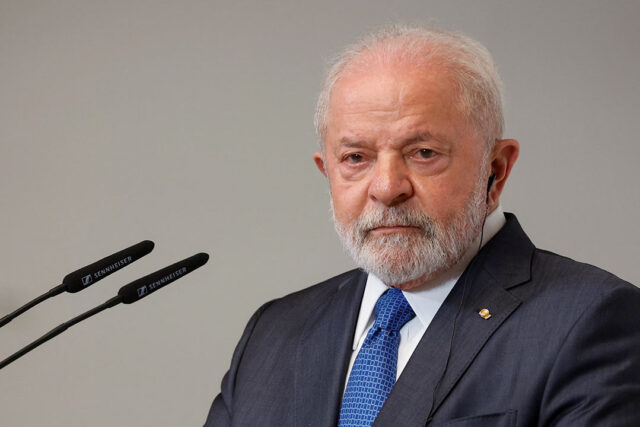
BRAZILIAN President Luiz Inacio Lula da Silva — REUTERS

BRAZILIAN President Luiz Inacio Lula da Silva said growth in the agriculture sector may allow Latin America’s largest economy to defy current projections and expand this year more than in 2024, when it notched growth of 3.4%.

Mr. Lula’s optimistic remarks diverge from his own government’s forecast. The Finance Ministry sees Brazil’s gross domestic product (GDP) growth slowing to 2.4% in 2025 amid tight monetary conditions.

The comments followed the publication of Brazil’s first-quarter GDP figures last week, which showed year-on-year growth of 2.9% fueled by a jump in agricultural activity thanks to a bumper harvest of soybeans, the country’s top farm export.

Brazil is the world’s largest exporter of soy, coffee, cotton, sugar, beef and chicken, as well as a top supplier of corn and pork.

“Our first-quarter growth demonstrates that we can once again surprise the world and grow above the global average,” Mr. Lula told an event in Paris, where the country was recognized as free of foot-and-mouth disease without vaccination.

“If last year we grew 3.4% with agriculture not expanding as much as we expected, I think agriculture growth this year can allow us to think about growing a bit more,” he added.

Private economists polled on a weekly basis by the central bank expect Brazil’s GDP to grow 2.13% this year. — Reuters

ADVERTISEMENT
ADVERTISEMENT