Home Blog Page 1445

Discovering ways of celebrating Independence Day

By Mhicole A. Moral, Special Features and Content Writer

Every June 12, Araw ng Kalayaan passes quietly, save for flag-raising ceremonies, parades in communities, or social media posts with filtered selfies in red, blue and yellow. For many, it is just another holiday with banks closed, classes suspended, and little else changes.

But for many others, they are asking what it truly means to be Filipino, and this Independence Day, they are not just waving flags. They are singing, creating, and connecting to a deeper sense of identity.

The National Historical Commission of the Philippines (NHCP), in partnership with the Civil Relations Service of the Armed Forces of the Philippines (AFP), is presenting “Musikalayaan 2025” at the open-air auditorium in Manila.

The production brings together soldiers, artists, and students in a musical and dance performance designed to remind Filipinos of the nation’s hard-won freedom and the rising calls to protect its maritime territory.

“This musical theater play will serve as an avenue for defense agencies to enjoin the public to be proud of a nation blessed with a history of valor and gallantry. Through music, we hope Filipinos will be inspired to value national sovereignty and maritime heritage,” said Col. Francel Margareth Padilla, spokesperson of the AFP and head of the Media and Civil Affairs Group (MCAG).

The musical features uniformed personnel from the Philippine Army, Navy, Air Force, National Police, Bureau of Fire Protection, Bureau of Jail Management and Penology, and the Philippine Coast Guard. Also performing are the Philippine Army Marching Band, the Indayaw Dance Company from Signal Village National High School in Taguig City, and artist reservists of the AFP.

The NHCP also launched the “Tapat sa Watawat” outreach program to connect young Filipinos with national symbols and values. The initiative includes educational sessions on Republic Act 8491, also known as the Flag and Heraldic Code of the Philippines, along with interactive activities that promote awareness of local heritage.

The program is open to schools, youth groups, and local governments, aiming to bring history lessons out of the classroom and into communities.

In several provinces, youth groups are leading heritage walks and hosting trivia nights focused on local history. Some are reenacting key moments in Philippine history through short skits and social media reels.

The National Historical Commission of the Philippines (NHCP), the City Government of Imus with the Provincial Government of Cavite, the Office of Representative Adrian Jay Advincula, and the Armed Forces of the Philippines commemorate the Battle of Alapan, one of the most important victories that led to the Proclamation of Philippine Independence. — Photo from National Historical Commission of the Philippines

Meanwhile, the “Likha” fair has returned to Intramuros, featuring more than 30 new artisans alongside seasoned creators. The exhibit, launched on June 6 at the Foro de Intramuros along Anda Street, is free and open to the public daily from 9 a.m. to 6 p.m. through June 8. Visitors can browse and purchase products, and also witness live demonstrations of how the items are made.

On display are baskets woven from coconut midrib by artisans in Negros, woodworks from Banaue carvers, and embroidered fabrics from Aklan, Bicol, and Laguna. Also featured are guitars from Lapu-Lapu City, banig and nigo from Davao Oriental, and Habul Tyahian satin fabrics from Sulu. 

The lineup continues with Lingling-o brass pendants crafted by makers in Banaue, Banwa pens from Iloilo, and traditional woven mats and hats from Tawi-Tawi and Samar. Visitors can also explore hand-forged knives from Ilocos Norte, Yakan weaves, Binaludan malongs, Damili clay pots, Binakul textiles, and Meranaw brassware.

Each product is rooted in family traditions passed down through generations. Many items come from remote communities, where artisans work with simple tools.

Likha is more than just a showcase. It’s a movement to empower local artisans and preserve Filipino heritage. This initiative hopes to inspire appreciation for the ingenuity and resilience of Filipino creativity,” the Presidential Communications Office said.

Independence Day 2025

Thousands are expected to fill Rizal Park on Wednesday morning as the country marks the 127th anniversary of Philippine Independence and Nationhood, with a lineup of ceremonies, performances, and public services spread across several days and locations.

The National Historical Commission of the Philippines (NHCP), the City Government of Imus with the Provincial Government of Cavite, the Office of Representative Adrian Jay Advincula, and the Armed Forces of the Philippines commemorate the Battle of Alapan, one of the most important victories that led to the Proclamation of Philippine Independence. — Photo from National Historical Commission of the Philippines

The National Historical Commission of the Philippines is leading this year’s celebration under the theme “Kalayaan. Kinabukasan. Kasaysayan.” President Ferdinand Marcos, Jr. will raise the flag at 7 a.m. at the Independence Flagpole near the Rizal Monument, kicking off the main program in Luneta.

The AFP will provide full military honors during the event, followed by a wreath-laying ceremony with President Marcos, NHCP Chairperson Regalado Trota Jose, Jr., and AFP Chief-of-Staff Gen. Romeo Brawner, Jr.

The Parada ng Kalayaan 2025 will take over the park with historical reenactments and festival performances from various regions. The NHCP said the parade highlights the country’s long struggle for freedom while also featuring select local celebrations that reflect the diverse cultures across the islands.

The celebration will continue into the evening with a special cultural show titled Musikal III: Ang Tanghalan at Ang Kalayaan at the Metropolitan Theater. The production brings together some of the country’s leading artists to perform songs and scenes that trace the nation’s path to independence.

Meanwhile, the government has opened nearly 150 booths at Rizal Park under the banner Mga Pampamahalaang Programa at Serbisyo from June 10 to 11. More than 50 agencies are present to provide public information, accept applications, and assist citizens with services.

The Kadiwa ng Pangulo, led by the Department of Agriculture and Department of Trade and Industry, is offering affordable fresh produce and local goods to parkgoers, while Klinikalayaan 2025 provides free medical, dental, and optical checkups.

The AFP and other uniformed agencies have also set up a static display of vehicles and equipment at the event grounds. Visitors may view the gear used by soldiers and emergency responders up close.

Simultaneous flag-raising and wreath-laying ceremonies will take place at several key historical sites. These include the Dambanang Emilio Aguinaldo in Kawit, Cavite; Barasoain Church in Malolos, Bulacan; Pinaglabanan Memorial Shrine in San Juan City; Mausoleo de los Veteranos de la Revolucion at Manila North Cemetery; Andres Bonifacio National Monument in Caloocan City; and the Museo ng Kasaysayang Panlipunan ng Pilipinas in Angeles City, Pampanga.

The NHCP also confirmed that all 28 of its museums will host flag rites, along with local governments and Philippine embassies around the world.


Modern expressions of patriotism are rooted in cultural pride

Olympic gold medalist Carlos Yulo — Photo from Facebook.com/CARLOSEDRIELYULO

Patriotism, as a concept, has always been defined as the strong emotional attachment to one’s local community or nation-state. Stories of heroic, patriotic, and to some extent, violent feats by Andres Bonifacio and Jose Rizal during the Spanish occupation have been told for generations as leading examples of Filipino nationalism. However, along with the rise of new ideologies heralds a brand new meaning for the concept that the two heroes died for.

Globalization and the internet have impacted multiple facets of human lives and have reshaped society as a result. The constant exchange of ideas and goods driven by the former has been, in a way, boosted by the latter’s ability to connect people all over the world. This powerful combination allows for unprecedented cultural exchange and has blurred territorial boundaries in a more interconnected global community.

Yet, in the midst of this digital migration emerges a growing awareness of the importance of preserving local identity and taking pride in one’s own culture. In a sense, expressions of patriotism have also taken new forms. While Filipinos still deeply value traditional symbols such as waving the flag, singing the national anthem, or participating in state ceremonies, modern expressions of Filipino patriotism are intertwined with cultural pride on the internet and in daily life.

Perhaps, the most meaningful expression of modern patriotism can be found in the lives of overseas Filipino workers (OFWs), who are often hailed as the country’s modern-day heroes. Despite being away from Philippine soil, OFWs remain strongly rooted in their identity, proudly celebrating Filipino festivals abroad, cooking native dishes, teaching their children the language, and sending remittances that have long been the saving grace of the Philippine economy.

Every Filipino caregiver in Europe, seafarer in the Middle East, or nurse in North America is a quiet act of patriotism, showing love for where they came from regardless of where they are.

Freepik

Another form of modern patriotism can be seen in malls across the archipelago. It is apparent that there is a renewed appreciation for indigenous textiles, regional crafts, and traditional artistry. Supportive local campaigns, like the Philstar Media Group’s “Nakakalocal,” have sprung up and resulted in the current renaissance in Filipino arts, crafts, and local industries that can be seen in shopping centers today.

Central to this is the increasing desire of Filipinos to help other Filipinos. As in the context of the Bayanihan culture, support for local artisans and entrepreneurs is seen as both an economic and patriotic gesture, helping preserve Filipino traditions while promoting national identity in a modern context.

This renewed sense of cultural pride has even escaped the nation’s borders and now thrives on global stages and the internet. #PinoyPride has become a common tag throughout social media, where Filipinos rally behind fellow countrymen achieving excellence abroad regardless of political affiliation, gender identity, or ethnic or religious background.

Food bloggers highlight hidden culinary gems in the metro and in the provinces, fashion influencers proudly wear garments by Filipino designers, and young creators make short videos teaching Filipino history, regional dialects, or traditional crafts. Filipino social media is often peppered with wholesome content that support fellow Filipinos and reinforces national pride.

On the global stage, this phenomenon has become most apparent in sports. Crime rates have famously dropped when boxing legend Manny Pacquiao fought in the 2000s. Olympic gold medalists Carlos Yulo and Hidilyn Diaz were cheered on by Filipinos and were even given various incentives for their wins. Even basketball players who play in leagues abroad, such as Jordan Clarkson in the National Basketball Association and Kai Sotto in the Japanese Basketball League, are venerated for representing the country internationally. 

Similarly, Filipinos who earn acclaim in the arts and academics have been praised, emphasizing this new expression of patriotism. Dolly De Leon’s nomination as Best Supporting Actress during the 2023 Golden Globe Awards and subsequent invitation to become a member of the Academy has been a great source of national pride in the arts. Meanwhile, Eion Nikolai Chua, who graduated magna cum laude from Harvard University with a remarkable double degree in Economics and Chemistry, has lately been the talk of town.

Of course, embracing cultural pride as a form of modern patriotism is not without challenges. There is a risk of cultural appropriation, where traditional symbols are used without respect for their origins; and commercialization, where goods are branded as local despite being made abroad. It is crucial that efforts to promote Filipino culture are grounded in authenticity, inclusivity, and respect for the communities that made and keep these traditions alive.

Furthermore, cultural pride must be inclusive and forward-looking. It should embrace the country’s rich diversity, not only the popular tenets of Filipino culture but also the voices of the indigenous and contributions of marginalized groups. After all, Filipinos of any age, color, origin, doctrine, or affiliation will remain Filipino and have their own sense of nationalism, too.

In the end, modern expressions of patriotism are about carrying forward the spirit of heroes like Bonifacio and Rizal in ways that resonate in today’s world. Through cultural pride, Filipinos honor the past, shape the present, and build a future where love of country is lived every day. — Jomarc Angelo M. Corpuz

Celebrating independence with that most celebratory dish: Lechon

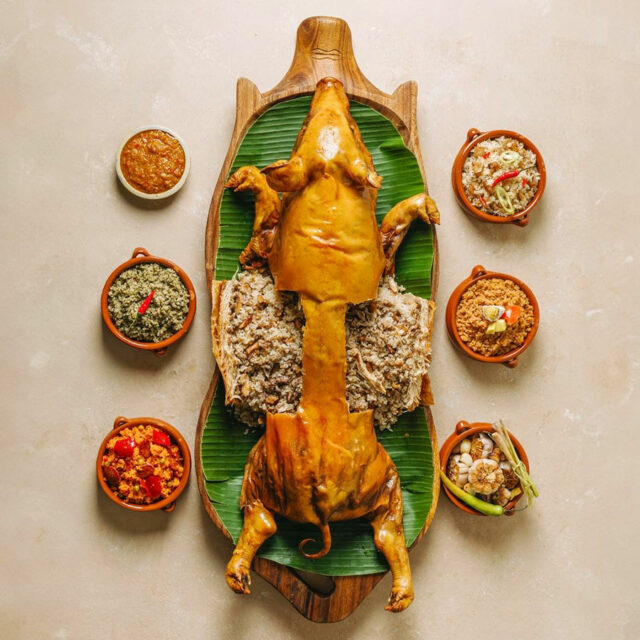
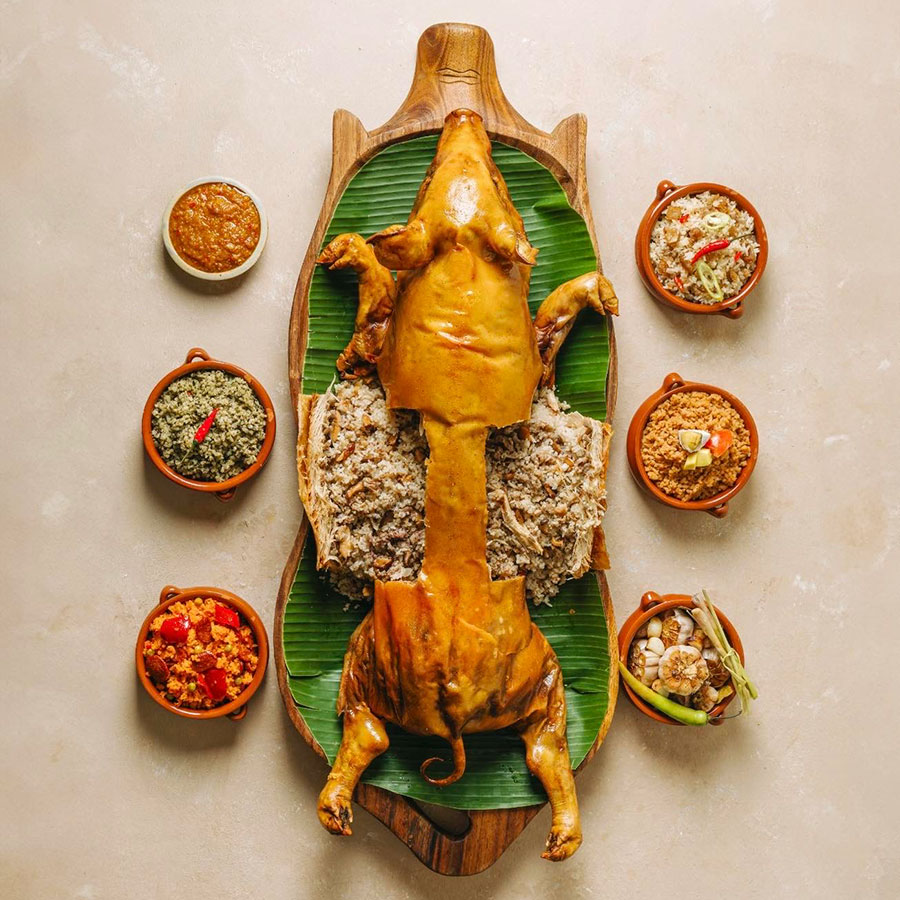
BINAGOONGAN rice-stuffed lechon and truffle rice-stuffed lechon de leche will be the highlights at The Grand Kitchen for its Independence Day celebration. — GRAND HYATT MANILA

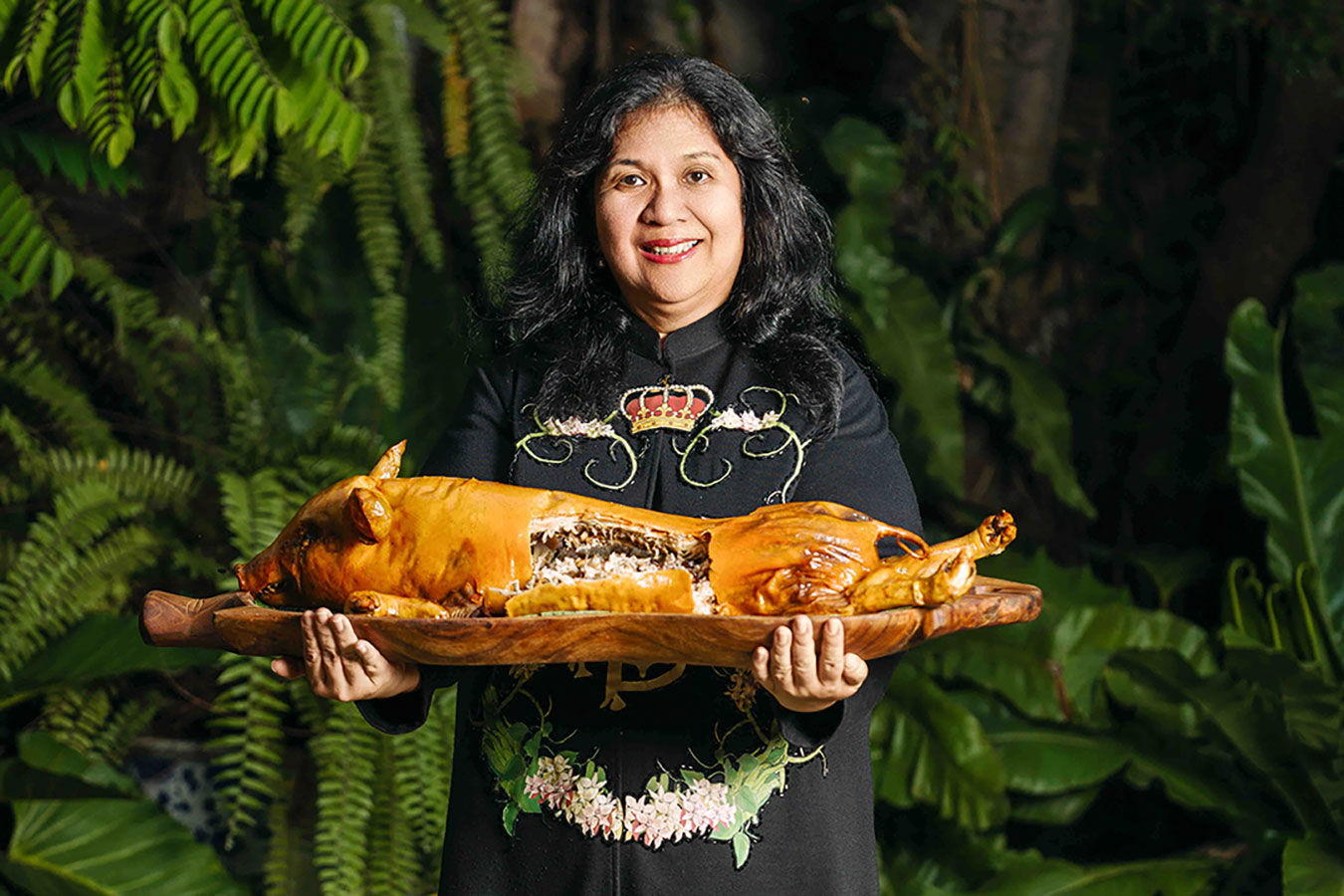
AS THE COUNTRY celebrates Independence Day today, a spread at The Grand Hyatt’s The Grand Kitchen with the “Lechon Diva” Dedet dela Fuente can be a way to celebrate the occasion yourself. The hotel’s collaboration with Ms. Dela Fuente will run from June 12 to 15.

Earlier this year, BusinessWorld sampled the Lecheng Sarap degustation on Ms. Dela Fuente’s own table at home (https://tinyurl.com/4rfatffk). For the Grand Hyatt shindig, she’s serving up some of the dishes from that dinner (which we rated as, so far, the best we’ve had this year), with a few extras. And, of course, lechon (whole spit-roast pig).

During a preview lunch on June 9 at the hotel, we again had the Crab Gulong-Gulong, her version of Mindanao’s Crab Alavar, with its sweetish-spicy flavor. In a nice place like the Grand Hyatt, it’s a bit of a hassle to eat, shells and all; but if you’re not as conscious about your clothes, dive right in. We also enjoyed the Hiplog, shrimps in a creamy and gritty salted egg sauce, and we found the cashew kare-kare (a stew of oxtails usually made with peanuts) milder, creamier, and more well-rounded than what we have been used to. We especially enjoyed the Balut Salpicao — usually, the fertilized and slightly aged duck egg would be enjoyed on its own, but she cooked it in a garlic and olive oil sauce. The result was very intense and deceptively simple; the texture, divine.

Who’s the Lechon Diva without the lechon? The binagoongang lechon was as lovely as we remember it, the roast pork flavoring the rice and the bagoong (fish paste) doing the same to the pork in a delightful synergy. This lechon was the first that she made, back when she trained under local chef Reggie Aspiras. We missed her breakfast lechon, to be served for breakfast at the hotel, which is stuffed with tocino paella with garlic and salted egg. However, the truffle rice-stuffed lechon, which put her on the path to fame (this was served to both the late Anthony Bourdain and Martha Stewart) was also served for lunch that day. It was cut with some ceremony, with her announcing that it would be served in exactly seven minutes, because it was her lucky number.

The truffle flavor was used elegantly: just a hint, but the hint was all that was needed. It was very fragrant, and the scent steamed out after she cut open the skin. It was perfectly moist, the earthy truffle blending seamlessly with the pork. Her Divalicious Sauce (when asked about the ingredients, she answered, “A whole lot of love”) cuts through the richness of the roast pig. We personally have a “no soda” rule, but the sense of indulgence was at its peak, so we, and other people who would have skipped the soda, cheated with glasses of Coca-Cola. That was just the first bite: we savored our second, leaned back in our seats, wondering which god we had to thank for bringing us here. It was THAT good.

We must also add that the dishes had a uniformly rich flavor, and we kept telling ourselves that we’d only eat sparingly, getting small helpings and thinking they were enough: however, we ate about six plates of the same things, over and over.

Ms. Dela Fuente said in an interview that this collaboration was for a comeback: she said she had been on a six-year break before the Lecheng Sarap dinner. While her lechon business continued, her private dinners and to-go menus were on a freeze during the pandemic, He had also moved to Canada temporarily while her daughter finished college there.

“I wasn’t sure if people still remembered me,” she said.

She doesn’t call herself a chef because she maintains that she was not classically trained (she learned how to cook from her mother and two local chefs, Ms. Aspiras being one). She was, oddly enough, eating a salad, while dressed in a sequined jacket emblazoned with pigs and a coronet, and the words “Lechon Diva” on the back. With some cheer after saying she wasn’t a chef, she did say, “Diva. There’s no one else in the world.”

This Independence Day spread celebrates not just the country’s independence but Ms. Dela Fuente’s own independence. Asked how she balances tradition and novelty in her dishes, she said, “Because I was not taught in formal cooking schools, I have no rules. That’s the reason why I can come up with all these things.

“Being a mother, and not a chef, I want them to know that you don’t have to be a chef to be able to do something like this,” she said. Countered by someone else that the culinary world is a whole lot more forgiving now, what with the celebration of the home cook and other unconventional figures online, she added, “You just have to have a passion for cooking, eating, and believing.”

Lechon Diva’s creations will be available for buffet lunch at The Grand Kitchen of The Grand Hyatt in BGC, Taguig, from June 12 to 14 for P2,188 net per person, and for dinner at P2,988 net per person. On June 15, Father’s Day, both lunch and dinner are priced at P4,288 net per person with free-flowing house wine and house lager as well as a special spread of oysters, Singaporean chili crab, Hainanese chicken, crispy pork belly, pork char siu, roasted Chinese duck, porchetta beef Wellington and more. Trolleys will be roaming the venue serving Australian beef pie as well as pan-seared Norwegian salmon. The signature tiramisu of The Grand Kitchen will also be available during this period. For inquiries and reservations, call 8838-1234, or e-mail manila.grand@hyatt.com. — Joseph L. Garcia

Semirara cleared to proceed with P291-B coal project in Antique

SEMIRARAMINING.COM

SEMIRARA MINING and Power Corp. (SMPC) has secured an amended clearance from the Department of Environment and Natural Resources (DENR), allowing it to proceed with its P291-billion coal mine expansion in Antique, the Consunji-led mining company said on Wednesday.

In a regulatory filing, SMPC said it had been granted an amended environmental compliance certificate (ECC) by the DENR for the expansion of the Semirara Coal Mine Complex.

An ECC is issued by the DENR to certify that a proposed project has undergone environmental review and is not expected to cause significant adverse environmental impact.

The amendment allows SMPC to expand the project area from 4,369.25 hectares to 5,221.75 hectares within the 13,000-hectare Coal Operating Contract No. 5, which was awarded to the company by the Department of Energy (DoE).

“The ECC amendment allows SMPC to sustain operations by including the Acacia mine alongside the currently operating Narra mine,” the company said.

“It also raises the annual production limit from 16 to 20 million metric tons (MMT) of coal, using the open-pit mining method, from 2025 to 2027.”

SMPC said the amendment supports its ongoing operations and is aligned with the mine plan approved by the DoE.

The company has earmarked P6.9 billion in capital expenditures for 2025, a significant portion of which will be allocated to its coal operations.

SMPC posted a 33% drop in first-quarter net income to P4.4 billion, as coal selling prices continued to normalize, partially offset by stronger performance in the power segment.

SMPC is the country’s largest coal producer. It supplies fuel to power plants, cement factories, and other industrial facilities across the Philippines, and exports to markets including China, South Korea, and Brunei.

Shares in the company rose by 0.31% to close at P32.70 apiece on Wednesday. — Sheldeen Joy Talavera

More Filipino students now using AI for learning

PHILIPPINE STAR/ MIGUEL DE GUZMAN

EDUCATION TECHNOLOGY firm Instructure Holdings, Inc., the developer of the learning management system Canvas, said more than half of Filipino students use artificial intelligence (AI) for academic tasks.

“Filipino students are already actively engaging with AI tools to support their learning,” Ryan Lufkin, vice-president of Global Academic Strategy at Instructure, told BusinessWorld in an interview.

Citing the firm’s 2025 State of Higher Education report, Mr. Lufkin said 63% of Filipino students use generative AI chatbots like ChatGPT to generate texts, while 58% use it for translation tasks.

Some 55% of students also seek assistance from AI-powered platforms to explain difficult concepts, while 52% rely on these to summarize academic articles.

With this, teachers must also work to understand AI and how to effectively and ethically use these tools, according to Mr. Lufkin.

“One of the most important aspects is ensuring that educators become AI literate,” he said. “They can pass that knowledge on to students, upskilling them for future careers.”

The same study from the firm showed that 71% of educators in the country create learning materials and 65% generate quiz questions and assignments with the help of AI.

It added that 56% of teachers use AI to create personalized or adaptive learning materials for students, 37% use it for seminar or tutorial plans, and 31% use it for marking transcripts.

“Looking ahead to next year, I expect AI adoption in the Philippines’ classrooms to increase significantly, following the global trend and expanding use cases,” Mr. Lufkin said.

“However, that growth will only be meaningful if it’s accompanied by investments in AI literacy and faculty training, clear governance frameworks, and strategic technology integration,” he added.

The 2025 State of Higher Education report survey was conducted in 2024 with approximately 400 student and educator respondents nationwide. — Almira Louise S. Martinez

Clark airport prepares for long-term expansion amid rising traffic, LIPAD says

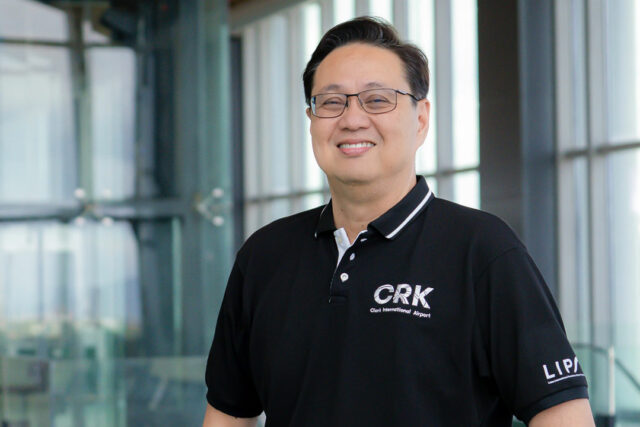
NOEL F. MANANKIL — LIPAD

By Ashley Erika O. Jose, Reporter

CLARK INTERNATIONAL Airport is aiming to surpass three million passengers this year, banking on the transfer of turboprop operations and ongoing talks with new airline partners, as operator Luzon International Premiere Airport Development Corp. (LIPAD) prepares for long-term expansion to accommodate up to 25 million passengers annually.

“We now have an entire ecosystem and hubs for operations and further expansion. It really adds to the future of Clark as a preferred airport,” LIPAD Chief Executive Officer Noel F. Manankil said in an interview with BusinessWorld.

Mr. Manankil previously served as president and chief executive officer of Clark Development Corp. (CDC), the implementing arm of the Bases Conversion and Development Authority for Clark.

“I call it my love story with Clark. I think everybody knew that I started with CDC, and even at that time we really knew that the main asset of Clark is really the airport. At that time, even in our master plan, we always had the airport at the back of our minds,” Mr. Manankil said.

“I really got involved when I joined LIPAD in 2022. So, I had my feet and hands wet in airport operations,” he said.

Mr. Manankil said LIPAD is aiming to return to and exceed its pre-pandemic level of four million passengers, with long-term plans to expand the airport’s current capacity.

The airport terminal’s shell has a design capacity of eight million passengers annually, but its current fit-out can only serve up to four million.

“Then in the medium term, we want to fully utilize the eight million capacity of the shell, and our long-term view is to actually expand the capacity of the existing terminal,” Mr. Manankil said.

He said the airport operator has access to sufficient land for expansion to accommodate up to 25 million passengers annually, all within the concession area.

“We actually have no problems in terms of land; there is also no issue in terms of right-of-way. You need to put in infrastructure. You just pour the concrete,” he said.

Mr. Manankil said LIPAD’s strategy to attract more domestic and international routes is also supported by ongoing infrastructure developments aimed at improving access to the airport.

For instance, the Department of Transportation expects the full line of the North–South Commuter Railway to be operational by 2027 to 2028.

“That will give Clark the very seamless connectivity from Manila. In the meantime, while you are waiting for that, there are a lot of transportation modes we have,” he said.

Clark International Airport handled 2.4 million passengers in 2024, up 20% from 2023.

LIPAD earlier said it expects weekly flight movements at Clark to rise to 269 from the current 237.

At present, LIPAD is in talks with several local and foreign airlines to expand operations in Clark.

“We have been actively engaging some of the foreign airlines aside from our local to introduce Clark as a good alternative, if they intend to look at the Philippines in terms of adding additional flights and additional frequency,” Mr. Manankil said, adding that the company is in discussion with three to four carriers, including one from the Middle East.

LIPAD is also planning to implement technology upgrades at the terminal, including chat-based support and biometric screening to enhance the passenger experience.

Aside from passenger terminal expansion, Mr. Manankil said the company is eyeing further airside development and is in talks with maintenance, repair, and overhaul (MRO) firms and express freight operators.

“We are attracting two of the biggest express freight providers in the world. Hopefully the others will follow suit. We are also in talks with one MRO provider to have their facility in Clark,” he said.

LIPAD is composed of Filinvest Development Corp., JG Summit Holdings, Inc., Philippine Airport Ground Support Services, Inc., and Changi Airports Philippines (I) Pte. Ltd., a wholly owned subsidiary of Changi Airports International.

The consortium took over operations and maintenance of Clark International Airport in 2019.

Ginebra San Miguel is now in 12 countries

FACEBOOK.COM/BARANGAYGINEBRA

GINEBRA SAN MIGUEL, the gin in the dimpled bottle that you can find in virtually any store in the Philippines, can now be found in 12 countries.

This was announced on June 10 by Ginebra San Miguel, Inc. (GSMI), a subsidiary of San Miguel Corp., on June 10 at the Diamond Hotel, during a preview of the World Gin Day celebrations on June 14.

Ronald Rudolf Molina, GSMI marketing manager said in a speech, “You might be surprised that in some of these places, Ginebra San Miguel goes for as high as 20 dirhams. That’s about P310.” In a similar case, he saw that the gin, which would go for less than P150 for the big 700 ml size here at home, sells for about P1,000 in either New Zealand or Australia. Ginebra San Miguel is now present in the US, Taiwan, the United Arab Emirates, Canada, Australia, Saipan, Hong Kong, Macau, India, the Cayman Islands, Japan, and New Zealand.

Mr. Molina also highlighted recent recognitions of their products by award-giving bodies: a gold from Monde Selection Quality Institute this year, and Double Gold Medals from the Spirits International Prestige (SIP) Awards for the GSM Blue Gin Pomelo flavor and their Ginebra San Miguel Premium last year. A bottle was also brought on a recent Mt. Everest expedition, making it to the very top.

“If you’re a Filipino and love the Philippines, it’s a source of great pride that our local spirits — the Filipino spirits — are actually making it on the world stage,” said Mr. Molina in a speech that evening, which had performances by rapper Boss Toyo and actress/singer Julie Ann San Jose.

On the price of the classic gin (about P150), and Ginebra San Miguel Premium (about P260; of more than comparable quality to several imported gins), Mr. Molina said, “That’s basically a decision. If we were to base it on the kind of quality that we’re making our gins, we could actually price it higher. But we want the average Filipino to have access to good quality gin. For us, it’s a service.”

They do have premium lines for export and domestic sale: there’s 1834, flavored with sampaguita and calamansi, retailing for about P1,700. The gin’s name is an homage to the distillery’s founding year. This was released in 2020, according to Mr. Molina. Late last year, they released Archangel Reserve Premium Dry Gin (P3,000), in an emerald-green bottle, which is flavored with various citrus fruits. “It’s a statement of capability,” he said about these premium releases.

“Ginebra’s been part of Philippine culture. It’s a liquor that the country… has actually patronized. It’s older than the Philippine Republic. Being truly Filipino is something that gives Ginebra San Miguel a position to celebrate the pride of the Filipino spirit,” said Mr. Molina.

For details on Ginebra San Miguel’s International Gin Day celebration, visit its Facebook page https://web.facebook.com/BarangayGinebra. — JL Garcia

Medical technology firm BD looks to bring products to more PHL hospitals

By Beatriz Marie D. Cruz, Reporter

BECTON, Dickinson and Co. (BD), a multinational medical technology company, is looking to bring its testing and treatment products to more Philippine hospitals and provide training to local healthcare workers.

“One of the things that we’re definitely going to invest in is improving our coverage,” Liang Lu, country general manager and managing director for BD Southeast Asia and Pakistan, told BusinessWorld on the sidelines of a briefing last month.

“I think in NCR (National Capital Region) and even outside of the capital region, we should have more coverage, either through our own team or through a distributor partner.”

BD produces over 34 billion medical devices annually, with a focus on developing technology, services and solutions that can help both patients and healthcare providers.

The company has been distributing medical care products in the Philippine market for 43 years. It has one office in Bonifacio Global City in Taguig and has over 50 associates nationwide.

“Breast and cervical cancer screening, as well as peripheral venous and artery disease — these are the areas where we feel that we have a lot of value to create,” Mr. Liang said.

For breast cancer diagnostics, the company specializes in biopsy needles, while for chemotherapy, BD provides vascular access devices, markers, and guide wires. It also offers screening products and services for cervical cancer and devices for peripheral arterial and venous disease treatment.

Mr. Liang said the Philippines has a “good” healthcare system, citing the Universal Healthcare Act, which seeks to provide all Filipinos access to affordable and quality healthcare.

He also noted that the country’s healthcare spending accounted for 5.9% of its gross domestic product in 2023.

Despite these, the Philippines still has a relatively low life expectancy of 70 years, compared to Indonesia (71.3), Vietnam (74.7), and Singapore (83.9), according to data from the 2024 World Population Review.

“I’m also quite surprised to see how severe the doctor shortage is here… For every population of 1,000, there are only 0.04 doctors,” Mr. Liang said.

Healthcare workers leaving the country to work overseas also remains a key issue in the Philippines, he added. Common reasons for migrating include precarious work, low pay, and burnout.

The Philippines has a shortage of 190,000 healthcare workers, Health Secretary Teodoro J. Herbosa said last year.

“It’s actually a systematic issue to attend to, and one of the solutions is to not only train them but also adopt better practices, tools, and solutions that ease their pain and improve efficiency,” Mr. Liang said, adding that there is a need to improve healthcare workers’ incomes.

To help address these gaps, BD is looking to invest in clinical education and partner with relevant stakeholders to help medical professionals in the Philippines, he said.

“We aim to not only leverage our own specialists to provide the training — we also want to work with the leading hospitals and doctors to provide the training as well.”

MUFG N0W re-imagines PHL’s energy landscape, sustainable supply chains

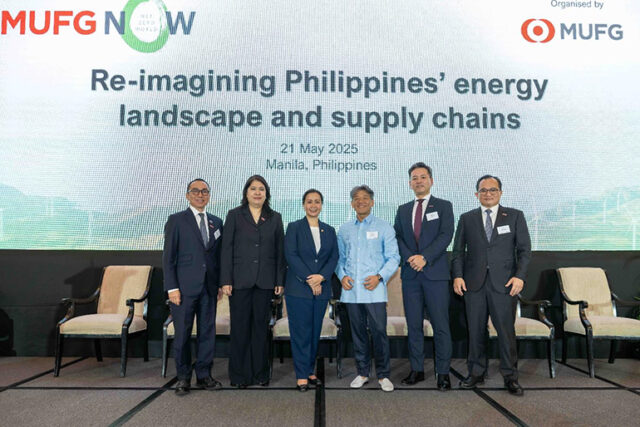
MUFG Bank executives: (from left) Head of Sustainable Finance for APAC Colin Chen, Manila Deputy Country Head Diane Singson, Chief Executive for APAC Nobuya Kawasaki, Manila Country Head Masami Yoshitake, and Head of Global Corporate Banking for Malaysia, Vietnam and Philippines Goh Kiat Seng Goh, with Undersecretary Ma. Angela Ignacio, Office of the Special Assistant to the President for Investment and Economic Affairs (third from left)

MUFG Bank, Ltd. (MUFG), Japan’s largest bank and one of the world’s largest, recently hosted over 160 business leaders, policymakers, and industry experts at its MUFG N0W conference in Manila.

MUFG N0W is the bank’s flagship regional networking and thought leadership platform launched in September 2023 to support the bank’s sustainability engagements across the Asia-Pacific. This year’s event in the Philippines follows the success of the inaugural MUFG N0W in Manila last June.

Hosted by the bank’s sustainable finance team for Asia-Pacific and its Manila branch, the event was attended by distinguished guests, including Undersecretary Ma. Angela Ignacio, Office of the Special Assistant to the President for Investment and Economic Affairs; and Pia Roman Tayag, Assistant Governor for Strategy Innovation and Sustainability, Bangko Sentral ng Pilipinas (BSP).

Senior executives from the Philippines’ leading conglomerates and industry leaders in green energy, finance and manufacturing also participated in lively discussions on advancing renewable energy and sustainable supply chain management strategies.

In her keynote address, Ms. Ignacio said that the government is committed to achieving energy security by 2028 in support of a vision of a country powered by clean energy, where communities thrive and benefit from systems that are reliable, accessible and affordable for all.

“For the Philippines, opportunities lie in our growing economy game-changing reforms, liberalizing policies and rich green energy sources but above all, it is in the partnerships with organizations and business leaders, who share and invest in the mission of a better and more sustainable future. The rise in renewable energy investments and projects backed by defined policy targets and key initiatives shows that we are not merely waiting for the world to change. MUFG N0W serves as a reminder that the road to net zero is not one that we take alone, it is a shared journey,” she added.

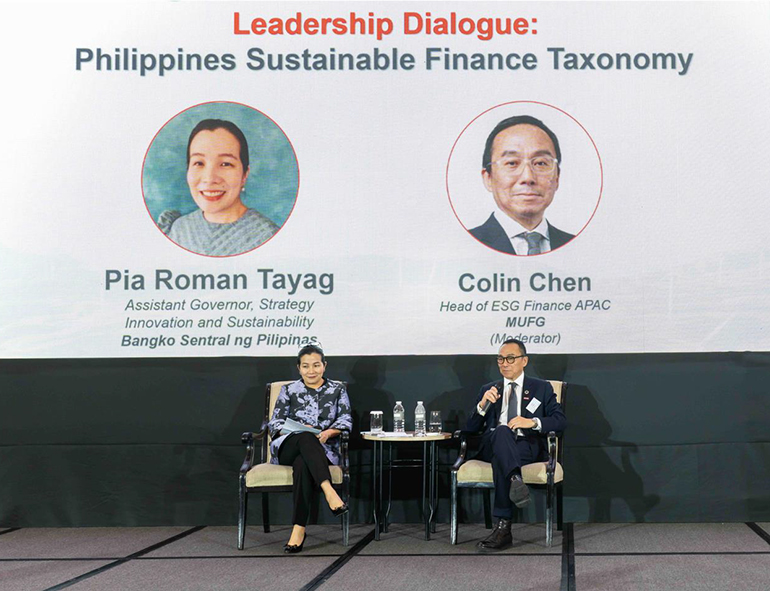
During the leadership dialogue, BSP Assistant Governor Tayag affirmed the BSP’s commitment to advancing its green agenda, which is anchored in supporting adaptation and resilience. “The country is extremely vulnerable to the impacts of climate change, regardless of geopolitical shifts. As (BSP) Governor Remolona has pointed out, a climate-resilient economy and financial stability are mutually reinforcing goals. Our green agenda, therefore, is mandate-driven,” she emphasized.

BSP Assistant Governor Pia Roman Tayag at the MUFG N0W leadership dialogue alongside Colin Chen, Head of Sustainable Finance for MUFG, APAC

Ms. Tayag also highlighted the significance of the Philippine Sustainable Finance Taxonomy Guidelines (SFTG), launched in February by the country’s financial sector regulators, as a key enabler in mobilizing capital toward the country’s climate mitigation and adaptation priorities. She noted that the SFTG is a living document that will be progressively enhanced to include other environmental objectives relevant to the Philippine context, such as circular economy and biodiversity. She also shared the plans to develop a taxonomy supplement that will offer more granular guidance on adaptation and resilience financing.

MUFG has played significant roles in landmark transactions, including Ayala Corp.’s first sustainability-linked loan signed in November 2023. With the support of its strategic partner Security Bank Corp. (SBC), one of the lead arrangers for Ayala Land’s inaugural sustainability-linked bond (SLB) in July 2024, MUFG was able to support the launch of the Philippines’ first SLB as well.

MUFG’s Head of Sustainable Finance for Asia Pacific Colin Chen reiterated the importance of engagement in raising awareness of the opportunities inherent in the Philippines’ pivot towards sustainable energy sources and business practices.

“As a net energy importer, the Philippines is all too familiar with the need to accelerate energy transition while meeting its growing energy requirements as a fast-developing nation,” Mr. Chen said.

“While MUFG continues to innovate and pioneer tailored solutions for our clients, our true strength lies in our ability to leverage our global and regional franchises to connect the public and private sectors, which we continue to do with the MUFG N0W series,” he added.

Nobuya Kawasaki, MUFG’s Chief Executive for Asia Pacific said: “As a bank with a longstanding history in the Philippines, MUFG is proud and honored to be a trusted financial partner in the country’s long-term development. Beyond corporate and infrastructure financing, we are extending our sustainability financing capability and expertise to help corporations catalyze and sustain decarbonization initiatives in the Philippines.

“It is my sincere hope that MUFG’s contributions will continue to be a win-win-win proposition for this wonderful country, its people and the precious environment,” he added.

MUFG’s 72-year presence in the Philippines has been bolstered by strategic investments in SBC, consumer finance company Home Credit Philippines and digital finance firm, Mynt (parent of GCash). Beyond supporting the broader economic development of the country through its relationships with the Philippines’ leading companies, MUFG has in recent years also actively engaged with corporate clients in support of their sustainability aspirations.


Spotlight is BusinessWorld’s sponsored section that allows advertisers to amplify their brand and connect with BusinessWorld’s audience by publishing their stories on the BusinessWorld Web site. For more information, send an email to online@bworldonline.com.

Join us on Viber at https://bit.ly/3hv6bLA to get more updates and subscribe to BusinessWorld’s titles and get exclusive content through www.bworld-x.com.

Jetstar Asia to cease operations by July due to high operating costs

JETSTAR.COM

SINGAPORE-BASED budget airline Jetstar Asia will permanently stop operations by July 31, citing rising airport fees and other aviation charges that have made it too costly to continue flying.

Jetstar Asia, a subsidiary of the Qantas Group, made the announcement on Wednesday.

The carrier currently operates 18 weekly flights between Singapore and Manila, and about four weekly roundtrip services to Clark.

“Despite our best efforts to offset these rising costs, they are expected to continue into the foreseeable future, putting unsustainable pressure on Jetstar Asia’s ability to offer low fares,” it said in a statement.

The airline currently serves 16 intra-Asia routes and will continue operations through the end of July, albeit with reduced frequency.

According to its website, the decision to wind down operations does not affect Jetstar Airways services between Australia and Southeast Asia, or Jetstar Japan flights.

“For customers with bookings prior to 31 July 2025, there will be some changes to Jetstar Asia’s usual schedule, and we will reach out directly if there are any changes to your upcoming flight,” it said.

Passengers with bookings from July 31 onwards will be entitled to a full refund to their original form of payment.

“Unfortunately, this goes beyond us, as Qantas, its owner, has decided to close its entire Jetstar Asia flying out of Australia to Singapore and our region, and identified skyrocketing supplier costs and higher airport fees in the region,” Mr. Nigel Paul C. Villarete, senior adviser on public-private partnerships (PPP) at technical advisory group Libra Konsult, Inc., said via Viber.

This development will affect the Philippines’ tourism sector as well as connectivity across Southeast Asia, Mr. Villarete also said, adding that services should be replaced by flights operated by other budget carriers. — Ashley Erika O. Jose

Does a michelada without beer still taste as sweet?

GUINNESS.COM

Alcohol-free beverages are getting better. Except maybe for wine

By Howard Chua-Eoan

I FIND MYSELF unhappily on trend. Young people everywhere are increasingly “on the wagon” — to use the American idiom for sobriety from the 1920s, when the 18th Amendment to the US Constitution banned the production and sale of alcohol. The wagon in the expression was a public-service vehicle loaded with water to tamp down dust and grime on city streets; by extension, it described the clean and sober law-abiding citizens of America. According to some estimates, 39% of Gen Z say they have foresworn alcoholic drinks; about half of them imbibe such beverages only occasionally. Many have taken to non-alcoholic alternatives.

I didn’t set out to join that youthful bandwagon. Nevertheless, I have been alcohol-free since Jan. 20, 2025. Those of you who recognize that date as US Inauguration Day must get the coincidence out of your head. It just happened to be when I felt I’d had too much wine over the previous three months. Alas, my doctors agreed with me — because of decades of loving wine and champagne, not just those recent three months. And so, I’ve spent nearly 140 days looking at how to enjoy the brave new world of NA (non-alcoholic) — a market that’s gotten a huge boost in sales and creativity precisely because of health-focused Gen Z, a cohort that probably makes up 25% of the world’s population. I am a late Boomer, but now I’m medically required to be young at heart.

The NA market can be too sprawlingly defined, including everything from bottled water and high-fructose sodas to electrolyte-infused liquids to NA wines and beer. I’m going to look at beverages that someone who likes to sip good vintages would gravitate to, intriguing in their own right or complementary, even transformative, with food. I was in Copenhagen recently where I attended Noma Chef René Redzepi’s revived MAD symposium on the future of restaurants1. These kinds of events are usually chock-full of discriminating chefs and sommeliers intent on sampling novel or rare wines and spirits. Would I find alcohol-free stuff to quaff to help me avoid all those temptations?

I will admit to staring longingly at the wonderful vintages poured out in Copenhagen. I love wine, perhaps even more so now that I can’t have it. But there was no shortage of NA wine. Indeed, Denmark is home to Muri, a pioneer in the blending of different fermented juices to create an alternative to wine. Other NA wine purveyors use physical means (often with low heat) to remove alcohol. That usually results in a thin impersonation of wine, with much of the mouthfeel and vibrancy extracted along with the ethanol (which is the predominant form of alcohol produced by the yeast in winemaking). Muri’s process stops short of producing alcohol and utilizes several fruits fermented separately and then blended to create distinct potables.

But as tasty as Muri can be (and its beverages are delicious), let me declare now that all the non-alcoholic wines I have sampled don’t come close to the vivacity of even middling good wine. There are excellent NA sparklings — L’Antidote and L’Antilope by Domaine de Grottes in France’s Beaujolais region — but even these are soda pop compared to champagne or even the new generation of English bubblies. Good wine is a liquid time capsule — a memento of earth, grape, water, the seasons and human touch. It moves beyond taste. I may no longer drink a good Savagnin from the Jura, but I can still appreciate its aroma.

Nevertheless, the thrill of having something that looks and — at first blush — feels like wine is enough to fool the brain into producing dopamine. A guilty elation takes over, and you think, “They’ve made a mistake. They’ve poured me real wine.” Soon enough, you realize it’s an impostor in your glass. You aren’t going to be fooled by the second — if you decide to have it.

The NA beers I tasted in Copenhagen were more “hoppy” or overly flavored with things like elderflower to disguise the absence of malted barley. That said, many non-alcoholic brews I’ve tried here in London are more successful in impersonating their originals. Guinness 0.0% is 99.9% identical in taste to its model (it has a flatter effect as it approaches room temperature). And Estrella Damm has tweaked the vacuum distillation method — the same one many NA winemakers use to remove alcohol — to reintroduce lost flavors. Its FreeDamm is remarkably good lager. Yet, the second-glass — or in this case, second pint — syndrome persists for both the lager and the stout. The buzz you thought you had turns out to be fantasy.

Of course, the quest for buzz — that convivial lightheadedness — is the existential issue in the first place for many drinkers. The road to intoxication is broad. So how do you get the consumer to focus on flavor instead of inebriation? It may be cocktails or “mocktails” — a terribly awkward word. But restaurants can customize drinks for their characteristic cuisine. I had a miraculous NA michelada at Sanchez, chef Rosio Sanchez’s wonderful Mexican restaurant in the Vesterbro district of Copenhagen. The super piquant concoction is usually made with beer, but that’s been substituted by a NA pilsner from Rothaus, a German brewer. It went perfectly with the food, flowing and metamorphosing with the ingredients and heat.

Micheladas — hellishly spicy — aren’t for everyone and don’t go with everything. But there are other choices. I had a range of kombuchas in Copenhagen (teas fermented with a variety of ingredients, including roses, magnolias, and fig leaves) that were startlingly seductive. Those in the know will say that kombuchas contain some alcohol. That is an important concern for those with substance abuse issues. But the alcohol content is often less than a very ripe banana’s (0.2% to 0.5% alcohol-by-volume in the fruit, compared with the 12% to 15% with wine)2. The probiotics of kombucha may be beneficial too.

NA alternatives are as costly as regular offerings — or more. Muri has about six different blends available on its websites, each around £25 ($33.75) a bottle. Guinness 0.0% is more expensive than regular Guinness. That’s because — while the market is potentially enormous — the new technologies and processes for making the beverages can’t scale up yet. The customer base has to grow to make everything more affordable. As for mocktails, restaurants have to find and pay bartenders skilled in fermentation to come up with those kombuchas, which take time to cultivate.

If such things concern you, my friend Jenny Sharaf, an artist based in Los Angeles and Copenhagen, has an alternative to consider: the Wa-tini. You can style it like a Martini — dirty with olive juice, or with a twist or an indulgent kiss of NA vermouth — all poured into the classic glass. But one ingredient is key: bitingly cold, clean water. Shaken or stirred? It’s all in your head. — Bloomberg Opinion

1The previous MAD symposium was held in 2018. Funding and, eventually, the pandemic put a halt to what had been an annual get-together of the restaurant and food world. The name derives from a play in Danish and English. Mad means “food” in Danish (pronounced like “mal” and a close cognate of the word “meal”). The insanity stems from the free-flowing proceedings at the symposium, which are conducted under a distinctive, four-peaked magenta circus tent.

2A graver concern with NA beverages is sugar content and how it might affect diabetics or pre-diabetics who usually face much less risk with wine.

Yields on term deposits slip on BSP easing bets

BW FILE PHOTO

YIELDS on the Bangko Sentral ng Pilipinas’ (BSP) term deposits continued to inch lower this week as both tenors were oversubscribed and as slower May inflation boosted expectations of further cuts in benchmark borrowing costs.

Bids for the term deposit facility (TDF) reached P151.725 billion on Wednesday, higher than the P120 billion placed on the auction block but lower than the P169.771 billion in tenders seen last week for the P140-billion offer. The central bank made a full P120-billion award of the papers.

Broken down, tenders for the seven-day term deposits stood at P89.438 billion, above the P70 billion auctioned off but a tad lower than the P90.668 billion in bids seen last week for the same offer volume. The BSP awarded P70 billion worth of the one-week tenor as planned.

Banks asked for yields ranging from 5.45% to 5.5125%, slightly below the 5.05% to 5.5185% margin seen last week. This caused the average rate of the one-week term deposits to inch down by 0.35 basis point (bp) to 5.5048% from 5.5083% a week ago.

Meanwhile, the 14-day papers attracted bids worth P62.287 billion, more than the P50 billion placed on the auction block but down from the P79.103 billion in tenders fetched for the P70 billion on offer last week. The central bank likewise made a full P50-billion award of the two-week deposits.

Accepted rates were from 5.47% to 5.53%, narrower than the 5.4% to 5.545% range seen a week ago. As a result, the average yield of the 14-day deposits likewise slipped by 0.35 bp to 5.5138% from 5.5173% the previous week.

The BSP has not auctioned off 28-day term deposits for more than four years to give way to its weekly offerings of securities with the same tenor.

Both the TDF and BSP bills are used by the central bank to mop up excess liquidity in the financial system and to better guide market yields closer to the policy rate.

“The BSP TDF average auction yields again slightly eased for the seventh week in eight weeks after the latest benign inflation [print] in May,” Rizal Commercial Banking Corp., Chief Economist Michael L. Ricafort said in a Viber message.

This could support a possible 25-bp cut at the Monetary Board’s policy meeting next week and further reductions within this year, consistent with recent signals from the BSP chief, Mr. Ricafort said.

He added that strong demand also caused TDF yields to go down, noting that the rates for both tenors are already close to the BSP’s target reverse repurchase rate.

Philippine headline inflation eased to an over five-year low of 1.3% in May from 1.4% in April and 3.9% in the same month a year ago.

This brought the five-month average to 1.9%, a tad below the BSP’s 2-4% annual target band. The central bank expects inflation to average 2.3% this year.

Last month, BSP Governor Eli M. Remolona, Jr. said the Monetary Board could deliver two more rate cuts this year in “baby steps” or increments of 25 bps, with the next reduction on the table as early as the June 19 policy meeting.

The BSP chief said cooling inflation gives them “plenty of room” to ease their policy stance further, although they don’t want to cut “too much” as this could stoke prices anew.

In April, the Monetary Board resumed its rate-cutting cycle with a 25-bp reduction after a surprise pause in its February review, bringing the policy rate to 5.5%.

The central bank has now reduced benchmark borrowing costs by a total of 100 bps since it began its easing cycle in August last year.

Mr. Ricafort added that expectations of further monetary easing by the US Federal Reserve also caused term deposit yields to decline “as the BSP could match future Fed rate cuts to maintain healthy interest rate differentials.”

The Fed is expected to hold rates steady next week and a Reuters poll showed that analysts expect the central bank to hold that stance till September. — BVR

ADVERTISEMENT
ADVERTISEMENT