Home Blog Page 1333

TotalEnergies shifts PHL business to franchise model

BATAAN SOLAR PROJECT — REUTERS

FRENCH multinational integrated energy company TotalEnergies is transitioning its Philippine operations from a joint venture to a franchise model, according to listed Basic Energy Corp. (BEC). 

In a stock exchange disclosure on Wednesday, BEC said Filoil Energy Co., Inc. (FEC) will take over the Total brand and business operations under Total Philippines Corp. (TPC).

FEC is TotalEnergies’ joint venture partner in local companies engaged in the supply, distribution, and marketing of petroleum products. 

BEC holds a 60% stake in FEC, giving it an indirect interest in FEC’s joint ventures with Total Marketing Services, the Philippine subsidiary of TotalEnergies. These joint ventures include TPC, Filoil Logistics Corp., and La Defense Filipinas Holdings, Inc.

TotalEnergies will continue overseeing operations as the franchisor of the brand and business. 

The integrated energy company operates across multiple sectors, including oil and gas, natural gas and green gases, renewables, and electricity.

Under Republic Act No. 8479, or the Downstream Oil Industry Deregulation Act of 1998, no permit or clearance from the Department of Energy (DoE) is required for the transition, according to Rino E. Abad, director of the DoE’s Oil Industry Management Bureau.

The DoE is being updated on company developments through annual company profile reports. 

While BEC clarified that it is not involved in the transaction between TotalEnergies and FEC, it said the shift to a franchise model “has no material effect or impact on its business and operations.”

BATAAN SOLAR PROJECT
In a separate disclosure, BEC said it has secured approval from the DoE to proceed with the pre-development phase of its proposed solar power project in Mariveles, Bataan.

The DoE has granted a solar energy operating contract allowing BEC to begin procurement activities ahead of the 25-year contract term. 

The solar facility will cover approximately 72 hectares and is expected to generate a peak output of at least 62 megawatts (MW), based on a preliminary assessment by an independent third-party firm.

Following the permit approval, BEC said it will now proceed with securing approvals from relevant national agencies and local government units. It will also conduct a system impact study with the National Grid Corp. of the Philippines.

“We are excited to advance the development of the Mariveles Solar Power Project and remain committed to providing updates as the project progresses,” the company said.

Oscar L. de Venecia, Jr., vice-chairman and chief executive officer of BEC, earlier told BusinessWorld that the company is applying for two solar power projects in Negros and Bataan with a combined capacity of 90 MW.

BEC aims to develop 500 MW of solar and 500 MW of wind energy projects by 2030.

“Once realized and operational, these initiatives are expected to contribute meaningfully to [BEC’s] growth and reinforce its position as a key player in the energy sector,” it said. — Sheldeen Joy Talavera

FNI posts 51.82% profit decline, plans P711.8-m capex

GLOBAL Ferronickel Holdings, Inc. (FNI) saw a 51.82% drop in its 2024 attributable net income to P743.9 million from P1.54 billion a year earlier, mainly due to lower revenues and higher costs.

Revenue from contracts with customers fell 13.37% to P7.61 billion from P8.79 billion in 2023, the company said in a statement to the stock exchange on Wednesday.

The company said it saw “lower nickel ore prices, partially offset by strong volumes.”

“By mine site, Surigao revenues decreased 3.1% to P4.667 billion (61% of total revenues), and Palawan revenues decreased 25.9% to P2.925 billion (39% of total revenues),” it noted.

“By geography, shipments to China made up 93% of revenues followed by Indonesia at 7%,” the company added.

The decline in revenue was accompanied by a 13.29% rise in the cost of sales to P4.07 billion from P3.59 billion.

As a result, gross profit dropped 31.81% to P3.54 billion from P5.19 billion a year ago. 

Operating expenses rose 8.04% to P2.59 billion, driven by higher general and administrative costs, which surged 23.1% to P1.41 billion from P1.15 billion.

Excise taxes and royalties declined 6.96% to P791.93 million from P851.17 million, while shipping and distribution costs slipped 3.28% to P384.4 million from P397.43 million. 

FNI’s total comprehensive income for the year stood at P786.76 million, reflecting a 56.78% decrease from P1.82 billion in 2023.

“While market conditions are beyond our control, we are laying a strong foundation for the future by funding growth and unlocking efficiencies,” said FNI President Dante R. Bravo.

“In 2024, we sustained double-digit volume growth, reduced our average cash operating cost per volume sold, and reinvested back in the business. Looking ahead, we will build on these achievements as we continue to advance on our strategy to capture new revenue streams and deliver profit growth,” he added.

The company said the average realized nickel ore price fell to $24.26 per wet metric ton (WMT) last year, down 27.1% from $33.28 a year earlier.

Low-grade ores sold for an average of $19.58 per WMT, down 23.9%, while medium-grade ores were priced at $33.06 per WMT, down 29.1%.

“Various factors affected market prices, including but not limited to: demand fluctuations in China and Indonesia, stainless steel and low-grade nickel pig iron production, supply chain disruptions from maintenance shutdowns of some steel mills, and the supply growth in Indonesia which outweighed production cuts and mine closures in the rest of the world,” the company said.

“Total volume shipped rose to 5.448 million WMT, up 15.5%, with growth in both Surigao and Palawan mine sites. This increase was fueled by investments to expand production and improve productivity,” it added.

It noted that sales of low-grade ores grew 18.1%, making up 65% of total volume, up from 64% in 2023, while sales of medium-grade ores increased 11%, accounting for 35% of total volume, down from 36% a year ago.

At the same time, the company said its capital expenditures (capex) spending reached P1 billion, up 15.6% from P869 million in 2023, representing 13.2% of revenue.

For 2025, the company has allocated P711.8 million for capital expenditures.

“Strategic priorities include the development of existing mines and expansion of resources, with ongoing exploration permit applications in North Luzon, Eastern Samar, Camarines, and additional areas in Surigao. It also covers further investments in warehouse and container terminal in Bataan as well as pursuing value-added nickel processing, primarily ferronickel and battery-grade nickel facilities,” the company said.

The company also said it expects to increase its revenues with a double-digit growth rate this year.

“The significantly higher production capacity in Palawan (from 1.5 million WMT to 3 million WMT) combined with the increase in productivity in Surigao and improved contribution from port operations in Bataan will be the main drivers of the expected top-line growth,” it said.

“In response to input cost inflation, the company is intensifying its efficiency program through increased production volumes, process and cost optimization, and innovation to firm up profitability,” it added. — K.A.T. Atienza

CLI secures SEC approval for new unit

CEBULANDMASTERS.COM

LISTED property developer Cebu Landmasters, Inc. (CLI) has secured regulatory approval to register a new subsidiary as it prepares to expand into Luzon.

The company received the certificate of incorporation for CLI Luzon Ventures, Inc. from the Securities and Exchange Commission on March 18, CLI said in a regulatory filing on Wednesday.

CLI Luzon Ventures will primarily engage in acquiring and managing real estate assets, including buildings, tenements, factories, edifices, and other structures.

In January, CLI said it is allocating P12 billion for the initial phases of its two maiden Luzon projects, which include a horizontal development and a condominium.

The first Luzon project is set to launch by 2026.

Earlier this month, CLI said it was included in the P300-million ATR Asset Management Philippine Sustainable Development Growth Fund, which comprises the top 20 listed companies demonstrating strong environmental, social, and governance (ESG) performance while maintaining financial growth.

The fund, which recognizes companies for sustainability efforts, is the third best-performing equity fund in the Philippines, delivering an 18% year-to-date return as of December 2024.

Since its establishment in 2003, CLI has launched nearly 130 projects across 17 cities.

Its portfolio includes residential developments, offices, hotels and resorts, co-living and co-working spaces, mixed-use projects, and large-scale townships.

CLI shares were unchanged at P2.69 apiece on Wednesday. — Revin Mikhael D. Ochave 

Gaming tycoon Willy Ocier resigns from AbaCore board

WILLY N. OCIER
WILLY N. OCIER

LISTED holding company AbaCore Capital Holdings, Inc. announced on Wednesday that businessman and gaming tycoon Willy N. Ocier resigned as a director for personal reasons.

Mr. Ocier, who had served on the board since 2007, will be replaced by his daughter, Mischel Gabrielle O. Mendoza, AbaCore said in a regulatory filing. Ms. Mendoza will serve the remainder of Mr. Ocier’s term.

“In light of this, I would like to endorse my daughter, Mischel, as my successor. I am confident that her expertise, innovative spirit, and commitment to excellence will be valuable assets to the team and will help propel the company to even greater heights,” Mr. Ocier said. 

Mr. Ocier holds multiple leadership roles across various companies. He is chairman and president of listed lottery company Pacific Online Systems Corp. and co-vice chairman of integrated resort developer and operator Belle Corp. 

Ms. Mendoza is an executive director of Pacific Online and a director of Total Gaming Technologies, Inc.

She holds a bachelor’s degree in management engineering from Ateneo de Manila University and has completed certificate courses at Tsinghua University in China and Josai International University in Japan.

AbaCore is a holding company with interests in energy, real estate, and financial services.

On Wednesday, AbaCore shares declined by 1.35% or P0.005 to P0.365 per share. — Revin Mikhael D. Ochave

PLDT, Nokia partner for data center solutions

EPLDT.COM

PLDT INC., through its unit VITRO Inc., has partnered with global telecommunications and network infrastructure provider Nokia to enhance data center solutions and make them artificial intelligence (AI)-ready.

VITRO and Nokia signed a memorandum of understanding to collaborate on AI-driven data center solutions aimed at improving network security, scalability, and efficiency.

“The partnership will leverage VITRO’s world-class data center infrastructure and Nokia’s advanced network technologies to develop data center solutions tailored for AI workloads, including Generative AI (GenAI) training and inference,” PLDT said.

ePLDT plans to build its next data center in South Luzon to position VITRO Sta. Rosa as a data center hub and strengthen its market presence.

This follows the launch of VITRO Sta. Rosa, the company’s 11th data center, which is now operational.

In July, the company completed the structure of its 50-megawatt hyperscale VITRO Sta. Rosa, its largest data center to date.

At the stock exchange on Wednesday, PLDT shares rose by P7 to close at P1,345 apiece.

Hastings Holdings, Inc., a unit of PLDT Beneficial Trust Fund subsidiary MediaQuest Holdings, Inc., holds a majority stake in BusinessWorld through the Philippine Star Group, which it controls. — Ashley Erika O. Jose 

Rocket Software bets on PHL firms’ demand for modern data management

REUTERS FILE PHOTO

ROCKET SOFTWARE, Inc. is optimistic about its growth in the Philippine market as more businesses now prioritize safe and modern data management.

“Over the past five years, we’ve grown at almost 25% year on year, I think we will continue that growth, with the investments that are happening in Philippines,” Praveen Kumar, vice-president for Asia-Pacific at Rocket Software said in an interview with BusinessWorld.

“We are, in fact, seeing more investments happening in the security space, in the data space, content space, also in the modernization space.”

Rocket Software provides IT modernization and automation services across legacy platforms and distributor platforms.

“We work on the philosophy of modernization without disruption,” Mr. Kumar said. “People used to think that if I have to move content off the mainframe or legacy, then I have to rewrite… [Some] people believe that I have to get off the mainframe to modernize.”

Mr. Kumar said many Philippine companies do not have the tools needed to put data in the cloud from their mainframe computers.

“Many of the customers who are running the mainframe today in the Philippines do not have a complete data replication kind of solution from the mainframe,” he said. “They are discussing it with us, and we are providing solutions.”

The company in January launched Rocket DataEdge, which seeks to provide hybrid cloud data integration solutions to businesses.

Hybrid cloud solutions help integrate mainframe, distributed, and cloud data to boost companies’ efficiency and productivity.

Mr. Kumar also noted the importance of decreased reliance on cloud services, especially during unexpected outages.

“If I bet everything on the cloud, and if one cloud provider goes down for whatever reason, even for 10 minutes, then the impact to the business is just enormous,” he said.

The hybrid cloud market is expected to have an estimated value of $262 billion by 2027 from $85 billion by 2021, according to German online data platform Statista. — Beatriz Marie D. Cruz

Hit the reset button

FREEPIK

One curious piece of news slipped under the radar on the same day that the drama of former president Rodrigo R. Duterte’s arrest unfolded, gripped the country and caught the attention of foreign media exactly a week ago.

Only two news outlets — one which buried this piece of news at the bottom of page 6, while the other was a purely online outfit — reported that Chinese police had arrested three visiting Filipinos for alleged espionage. The first two had been recipients of a scholarship under a sisterhood agreement between Hainan and Palawan, and had returned to the Chinese province to take up a job offer. They were arrested in early November, just as the Senate was wrapping up its probe on former Bamban, Tarlac mayor Alice Guo (a.k.a. Guo Huaping), who has been branded as an “agent of influence” of China. Then, just last month — after Philippine authorities announced that they had arrested a handful of Chinese nationals and their Filipino accomplices in two operations for alleged espionage — the Philippine Consulate General in Guangzhou confirmed that Chinese authorities had arrested a third former scholar under the same program.

These developments have gone largely ignored, for now, but signal a marked escalation in our tensions with China.

SPY VS SPY
While there may be some truth to suspicions about the Chinese nationals who our law enforcers had nabbed, given the sophisticated gadgets found in their possession that are not readily available to ordinary folks, it is to be expected that all major foreign powers have their spies in this country which straddles the strategic South China Sea.

Some local quarters have argued that the Chinese now detained by the National Bureau of Investigation can’t be spies, saying that “human intelligence” (HUMINT) is obsolete in an age of satellites. However, traditional information gathering methods like HUMINT still come in handy (e.g., for low-level signals intelligence like the one we saw recently), since satellites are much more costly to operate and, therefore, are more selectively employed.

At the same time, it is doubtful that those Palawan residents now in Chinese detention are spies — well, at least not ours anyway. Remember that 2016 incident wherein one of our main intelligence agencies was criticized for using “information” from a satirical website in a “confidential” report to the Senate? If anything, that proved that our spies are neither skilled nor equipped enough to operate abroad.

But here we are — arresting well-equipped Chinese suspects, and so Beijing seems to have decided to engage us in hostage diplomacy. “Some of us were actually expecting this to happen, because it is becoming their trademark,” one Filipino diplomat said in a recent chat, noting that China’s image and reputation had taken a hit from Philippine action against suspected Chinese spies.

Unless those Palaweños were employed by a foreign power (highly doubtful, because who would be dumb enough to spy in that technologically advanced police state up north), expect them to be part of a discreet prisoner swap in the next year or two (kind of like the exchange which Canada and China carried out in September 2021.)

So, from simply blocking our subsistence fishermen from accessing their traditional fishing grounds, Beijing has upped the ante with thousands of our nationals now in China possibly serving as bargaining chips. Make no mistake: if that’s not escalation, then I don’t know what is.

Now, I do not know if the arrest of those Palaweños warrants a general travel advisory on this matter (I am sure our Foreign Affairs and Tourism authorities will balk at that approach), but I think those promoting or handling such people-to-people exchanges between the two countries should still be responsible enough to include this alert in briefings of outbound Pinoys.

HOW FAR DO WE TAKE THIS?
And that’s just it.

Now, I applaud our legal victory at The Hague, our transparency initiative and moves to draw in other states with interest in keeping South China Sea navigation free as way of enforcing the July 2016 arbitral ruling. These steps have been a fitting — though inadequate — response to our 2012 Scarborough Shoal debacle, which demonstrated to all and sundry (including Beijing first and foremost) the limits of Washington’s “ironclad” commitment when faced with the world’s only other superpower.

Those methods constitute our warfare by other means (in much the same way that China — described by some analysts as “a risk-averse bully” — wields its own methods), and each time Beijing cries “ouch” shows that we are on point.

But then, just how far can we take this tack, especially in the face of a currently incoherent, unpredictable US foreign policy?

Analysis by experts since 2012 have noted our missteps, as well as inherent flaws, like a foreign policy that could change with every new administration after six years vs. China’s long-term mindset and planning. Such missteps stem partly from missing opportunities as well as from misreading signals from both Beijing and Washington.

Some observers argue that the US defense strategy has prioritized building capability to prevail in a long-term competition with China, but US President Donald Trump’s transactional approach to foreign policy has made Washington’s next moves in specific issues like the South China Sea increasingly uncertain. Taking a cue from Ukraine’s experience, US allies in the region understandably fear that US support — which for the Philippines has never been clear nor proven beyond annual joint war games, occasional joint patrols and ship visits — could go up in smoke overnight.

And I am sure that ever-the-strategic folks in Beijing are keeping their eyes peeled for any chance to prod Washington in that direction in the Indo-Pacific region (I’ll give them that).

MISSING PIECE OF THE PUZZLE
Hence, something tells me that we need to read Beijing much better, even as we await actions beyond assurances last month from US State Secretary Marco Rubio and National Security Adviser Michael Waltz in order to see which way the wind blows from Washington.

That means we need to tap China experts to help us out of this rut, and I am glad that we employed old China hands like the late Jose Santiago L. Sta. Romana and former CNN Beijing bureau chief Jaime A. FlorCruz — both of whom spent quite some time in exile in China during our Martial Law years — as our ambassador there.

I did say in an earlier piece that a lot of knowledge about China has yet to be tapped among our businessmen who deal regularly with counterparts and officials there. So maybe an advisory group can be set up with these businessmen plus knowledgeable academics to help us read Beijing’s moves better, i.e., whether what it does constitutes mere propaganda (largely for its domestic audience), a clever ruse, or a genuine overture.

All of my analyst pals were educated/are connected with western institutions, so it was quite a treat for me to engage a couple of younger China hands in chats on this matter:

• Dr. Brian Wong, assistant professor at the University of Hong Kong, a fellow at the Centre on Contemporary China & the World, as well as chief strategy officer of the HK-ASEAN Foundation; and,

• Lucio B. Pitlo III, president of the Philippine Association for Chinese Studies and fellow at the Asia Pacific Pathways to Progress Foundation, Inc.

Messrs. Wong and Pitlo agree that, unlike the rest of the Association of Southeast Asian Nations (ASEAN), the Philippines is viewed by China as a US proxy. Thus, Beijing has singled us out for special treatment (note how Vietnam, which has built the most structures in the South China Sea, has not borne as much Chinese aggression as we have). The establishment of five Enhanced Defense Cooperation Agreement sites in 2016 and the addition of four more sites in 2023 “ticked off” Beijing and cemented this perception of the Philippines, Mr. Wong said. Those sites may have some deterrence value, but Mr. Trump’s erratic foreign policy has suddenly cast a cloud over their fate. Any Philippine overture to Beijing will simply have to take this perception into account.

Mr. Pitlo also advised our policy makers to be alert for signs of Beijing’s accommodation of Mr. Trump’s priorities anywhere in the globe, since that of course will come at a price, e.g., acquiescence to the sale by Hong Kong-based CK Hutchison Holdings of shares of its units that operate two key ports in Panama to BlackRock (China has criticized and is now reviewing the sale).

WINDOW NARROWING
Mr. Wong said that the current instability of US foreign policy has just made some form of Philippine-China rapprochement urgent, since Manila may soon find itself “slipping towards the edge of the cliff” without US backing.

Key steps:

First, there has to be “a big diplomatic reset” with Beijing, preferably before the Philippines assumes the ASEAN chair next year (else, China boycotting or sending a minor official to those meetings would be an embarrassment for us). Perhaps reciprocal visits by President Ferdinand R. Marcos, Jr., and Chinese President Xi Jinping (who has been known to brusquely rebuff counterparts he does not agree with) would be out of the question for now. But the process could start with a visit by senior Foreign Affairs, Defense and Trade officials (note that Chinese officials had complained that we stopped bilateral defense exchanges, something which even Vietnam does).

Second, private sector leaders could conduct backchannel talks to backstop official overtures.

Depending on results of initial official and backchannel exchanges, Manila could send signals that would persuade Beijing to de-escalate tensions. What those signals will consist of, how, and when they will be sent is something that China experts can prescribe.

Messrs. Wong and Pitlo noted that while Manila seems aware that “saving face” is still important to Beijing, which has been clearly hurting from the blow to its international image from our transparency initiative (as it burnishes its reputation as a global peacemaker, replacing the United States, and champion of “small and weak countries”1 ) we should start wielding that knowledge to encourage a more conciliatory stance from Beijing, i.e., where’s the candy?

At this point, let me just note that while we keep saying that our West Philippine Sea spat does not constitute the entirety of our bilateral relations with China, it does occupy the bulk of messaging to the public (compared to, say, news that China’s growing appetite for pineapples fueled growth of these Philippine exports in 2024). Perhaps the government can package information on these other aspects of Philippine-China relations better (not just to meet some quota for press releases) in order to give the public a holistic perspective of bilateral ties.

Finally, as ASEAN chair next year, Manila could set up “a purely advisory, non-binding dialogue platform” with China and all other ASEAN states with a stake in the South China Sea that “would be conducive towards fostering a modicum of minimal understanding and keeping communication lines open,” Mr. Wong said. This is separate from the troubled talks on a prospective code of conduct in those waters which have dragged for more than a decade.

Don’t get me wrong: the Philippines should accelerate efforts to achieve minimum deterrence capability with more diversified and less US armament. This tack includes tapping private funding — a proposal that was aired as early as 20162 and revived last year — though Congress will have to repeal a restriction on loans to the military establishment3.

Strategy-wise, small states bearing aggression from giants like China will be well-advised to draw lessons from Ukraine’s credible defense4, and Taiwan has been at the forefront in studying these applications5. Our Defense establishment may want to discreetly engage with counterparts in Ukraine and Taiwan (our one-China policy notwithstanding) as we hone our strategy on this matter.

And, of course, encouraging all countries that rely on a free South China Sea to be actively engaged remains a sound strategic anchor for now.

So, depending on how Beijing responds to our overtures (backed by standing down of its forces in our waters) — fingers crossed — our transparency initiative could give way to more conciliatory messaging for starters. n

1 Ryan Woo and Laurie Chen, “Major powers should not bully the weak, China foreign minister says,” Reuters, March 8, https://tinyurl.com/24ah7dmj

2 Nestor Corrales, “Teodoro asks business leaders: Help finance AFP upgrade,” Inquirer.net, July 12, 2024 https://tinyurl.com/243luh89

3 Manny Mogato, “Funding the military modernization,” News5, Nov. 12, 2024, https://tinyurl.com/29ch6cv5

4 Olena Guseinova, “Did we learn anything from the war in Ukraine?,” The Interpreter (published by the Lowy Institute), Feb. 25, https://tinyurl.com/227rt6yk

5 Mick Ryan, “Taiwan and Ukraine: Learning the right lessons,” The Interpreter, Dec. 16, 2024, https://tinyurl.com/2ddvg9hp


Wilfredo G. Reyes was editor-in-chief of BusinessWorld from 2020 through 2023.

Printwell expands into Aboitiz group’s LIMA Estate

ABOITIZECONOMICESTATES.COM

ABOITIZ INFRACAPITAL (AIC), the infrastructure arm of the Aboitiz group, announced that Printwell International Corp. will expand into LIMA Estate by yearend.

The 1.6-hectare (ha) facility will be located within LIMA Estate, the Aboitiz group’s 940-ha mixed-use development in Batangas, which hosts over 240 locators and employs 75,000 workers.

“Operational by Q4 (fourth quarter) of 2025, its 1.6-ha facility will also provide packaging solutions for other locators within the Economic Estate, driving regional growth and creating hundreds of new jobs,” AIC said in a statement.

Founded in 1976, Printwell supplies printing and packaging solutions across industries such as food, beverage, publishing, pharmaceuticals, personal care, and electronics.

“Our expansion at LIMA Estate signifies Printwell’s commitment to long-term growth within this dynamic environment. We anticipate a strong, collaborative future, building our business and creating mutually beneficial opportunities with fellow LIMA Estate locators,” said Benjamin Yam, president of Printwell International Corp.

Last year, AIC said it is investing P4 billion in a 40-ha expansion of its business district. The project is slated for completion by 2027, with the first phase set to be finished by July.

“Aboitiz InfraCapital Economic Estates provides a holistic approach to business establishments in the Philippines through our ecosystem of solutions designed to cultivate business growth and drive economic advancement for local communities and the nation,” said LIMA Estate Industrial Business Operations Head Aldwin Chester Y. Dumago. — Beatriz Marie D. Cruz

Shakey’s celebrates 50 years with 20 new stores

And P50 pizza

SHAKEY’S PIZZA first arrived in Manila in 1975 when San Miguel Corp. opened a restaurant in Makati. Fifty years later, now in the hands of another conglomerate, it is a nationwide staple with around 300 stores, and 20 more coming along.

We’re opening a lot of Vis-Min (Visayas and Mindanao) stores because we’re under-penetrated [in those areas],” said Shakey’s President and Chief Executive Officer Vicente Gregorio. “We’ve been very busy the last three, four years, even after the pandemic. Expect that to continue, because as the middle class and the economy improves, there are going to be more opportunities from Shakey’s,” he told BusinessWorld during the Shakey’s anniversary celebration on March 10 in its Katipunan, Quezon City branch.

The pizza parlor (its American parent was co-founded in Sacramento by war veteran Sherwood “Shakey” Johnson, his nickname coming from nerve damage from a disease) shifted hands from San Miguel to the Prieto family, and is now Shakey’s Pizza Asia Ventures Inc. (SPAVI), a publicly listed company with a majority of its shares owned by the Century Pacific Group, Inc. (CPG), controlled by the Po family, a relationship that has been in place since 2016. This was after an acquisition done in cooperation with Singapore’s sovereign wealth fund GIC through affiliate Arran Investment Pte Ltd, according to a 2023 press release. Through a 2021 investment that bought out GIC’s shares, the Gokongwei family is also part of the pie through JE Holdings, Inc.

“Under the new owners and a bigger group, we’re able to really maximize the growth. We’re happy to be part of a group that’s really growth-oriented,” said Mr. Gregorio.

In recent years, they have also acquired the brands Potato Corner, Peri-Peri Charcoal Chicken, and the franchise for R&B milk tea. Late last year, Shakey’s “completed the incorporation of its United States subsidiary in support of the company’s expansion plans,” according to a previous story from BusinessWorld.

During the anniversary, Mr. Gregorio explained that “The subsidiary we put up in the US is actually for one of our brands, Potato Corner, in the US. Not for Shakey’s. We own the global brand rights for Shakey’s in Asia, the Middle East, and Oceania.”

“We’re preparing and creating the foundations for a bigger portfolio of brands,” he said. However, he also said, “We’re focused with the brands that we currently have… the current brand portfolio we have, there’s a lot of room for growth. We’re just focused on that for now, but we will always be open for opportunities that may come.”

ENOUGH BUSINESS, MORE PIZZA
During the event, the brand announced its promos for its anniversary celebrations, as well as unveiled a commercial with entertainers Marian Rivera, Gary Valenciano, and Ashley Atayde.

One of these promos will be held on March 24 between 2 and 5 p.m., when guests can purchase one Regular Thin Crust Manager’s Choice for only P50. This will be available for dine-in and carryout transactions in all Shakey’s stores except those at Ninoy Aquino International Airport (NAIA), Mactan–Cebu International Airport (MCIA), Boracay, Palawan, and KCC Zamboanga.

Shakey’s also launched a raffle for Supercard holders, during which time it will be awarding P50,000 in cash to one lucky winner every single day for 50 days. From March 25 to May 13, active Supercard holders can earn one raffle entry for every P300 spent on dine-in, carryout, or delivery orders at all Shakey’s stores (except NAIA 3 and MCIA), Peri-Peri Charcoal Chicken & Sauce Bar, and R&B Tea.

Finally, there is Shakey’s 1975 Anniversary Blowout promo which brings together customers’ favorite items in one bundle at P1,975. The bundle features one Large Thin Crust Pizza, seven Chicken ‘N’ Mojos, six Mozzarella Cheese Sticks, and one pitcher of soft drinks. The bundle also comes with the new anniversary-edition Supercard Classic, which includes a Welcome Treat — a choice of Skilleti or Carbonara Platter or any All-Time Favorite or Classic Pizza flavor.

Each bundle comes with Super Fun Treats coupons worth P1,883, which can be used on future orders at Shakey’s, Peri-Peri Charcoal Chicken, R&B Tea, and Potato Corner. Shakey’s 1975 Anniversary Blowout is available for dine-in, carryout, and delivery at all Shakey’s stores nationwide, except at NAIA, MCIA, Boracay, Palawan, Enchanted Kingdom, and KCC Zamboanga.

SECRET TO SUCCESS
Mr. Gregorio credits their 50 years to “Wowing the guests every single chance we get. That has been our secret.”

His own career is intertwined with Shakey’s: starting as a crew member, he became a manager of the Shakey’s branch in Katipunan where the anniversary party was held, back in the late 1980s, and eventually climbing up to his executive post (basically the manager).

“It’s a personal thing. I came from the ranks. I want to help this company and this group grow as big as it can, so that it will also create opportunities for our employees and the younger people,” he told BusinessWorld.

“It’s like an honor and a privilege. It’s a blessing which I need to pay forward.” — Joseph L. Garcia

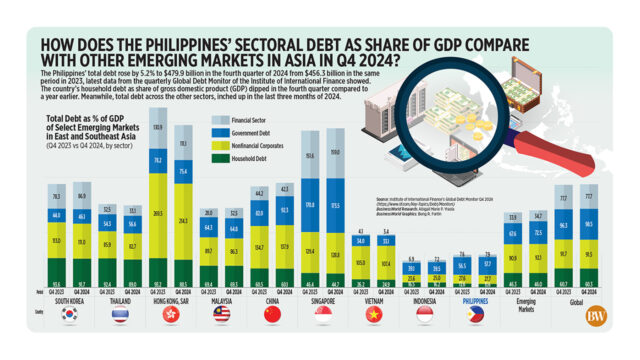
How does the Philippines’ sectoral debt as share of GDP compare with other emerging markets in Asia in Q4 2024?

The Philippines’ total debt rose by 5.2% to $479.9 billion in the fourth quarter of 2024 from $456.3 billion in the same period in 2023, latest data from the quarterly Global Debt Monitor of the Institute of International Finance showed. The country’s household debt as share of gross domestic product (GDP) dipped in the fourth quarter compared to a year earlier. Meanwhile, total debt across the other sectors, inched up in the last three months of 2024.

How does the Philippines’ sectoral debt as share of GDP compare with other emerging markets in Asia in Q4 2024?

Yields on term deposits rise amid weak demand

BW FILE PHOTO

YIELDS on the Bangko Sentral ng Pilipinas’ (BSP) term deposits inched higher on Wednesday as the offer went undersubscribed due to uncertainty here and abroad.

Total demand for the term deposit facility (TDF) of the central bank amounted to P122.771 billion on Wednesday, well below the P200-billion offering and the P202.697 billion in bids for a P220-billion offer a week ago. The BSP awarded just P115.771 billion in papers to cap the rise in yields.

Broken down, tenders for the seven-day papers reached P61.127 billion, lower than the P90 billion placed on the auction block as well as the P87.456 billion in bids for a P110-billion offering seen in the previous week. The central bank accepted only P59.127 billion in tenders.

Accepted yields ranged from 5.74% to 5.79%, a slightly wider band compared with the 5.74% to 5.78% seen a week ago. With this, the average rate of the one-week term deposits edged up by 0.89 basis point (bp) to 5.7668% from 5.7579% previously.

Meanwhile, the 14-day papers fetched bids amounting to P61.644 billion, below the P110-billion offer and the P115.241 billion in tenders for the same offer volume a week ago. The BSP made a P56.644-billion award of the two-week papers.

Tenders accepted carried rates from 5.748% to 5.79%, also narrower than the 5.7% to 5.79% range seen last week. This caused the average rate of the two-week papers to go up by 0.28 bp to 5.7723% from 5.7695% in the prior auction.

The BSP has not auctioned off 28-day term deposits for more than four years to give way to its weekly offerings of securities with the same tenor.

Both the TDF and BSP bills are used by the central bank to mop up excess liquidity in the financial system and to better guide market rates.

TDF yields were higher amid uncertainties here and abroad, Rizal Commercial Banking Corp. Chief Economist Michael L. Ricafort said in a Viber message.

At home, political noise related to former President Rodrigo R. Duterte’s arrest are keeping investors on wait-and-see mode “as a matter of prudence if there would be risk of massive protest rallies or any form of destabilization from the important priorities of the government,” Mr. Ricafort said.

Mr. Duterte, who led the Philippines from 2016 to 2022, was arrested on charges of crimes against humanity. He faced the International Criminal Court (ICC) in a pre-trial session last week.

He could become the first former Asian head of state to stand trial at the ICC.

Meanwhile, markets are also awaiting developments in the Trump administration’s tariff policies, with concerns of a trade war causing global yields to rise recently.

US President Donald J. Trump still intends for new reciprocal tariff rates to take effect on April 2, the White House said on Tuesday, despite earlier comments from Treasury Secretary Scott Bessent that indicated a possible delay in their activation, Reuters reported.

“The intent is to enact tariffs on April 2,” the official said when asked to clarify Mr. Bessent’s comments that countries would get an opportunity to avoid higher tariffs by reducing their own trade barriers.

“Unless the tariff and non-tariff barriers are equalized, or the US has higher tariffs, the tariffs will go into effect,” the White House official said.

Mr. Bessent told Fox Business Network’s Mornings with Maria program that Mr. Trump on April 2 would give trading partner countries a reciprocal tariff number that reflects their own rates, nontariff trade barriers, currency practice and other factors, but could negotiate to avoid a “tariff wall.”

His remarks were taken to mean that while the proposed duties would be announced on April 2, their implementation could be delayed to allow time for negotiations. But the White House official said any such deals would need to be negotiated in advance to avoid the new tariffs.

The dueling comments illustrate the developing nature of Mr. Trump’s new reciprocal tariffs just two weeks out from the April 2 activation deadline.

Financial markets have become increasingly nervous about the impact of Mr. Trump’s tariffs and retaliation from trading partners will have on inflation and economic growth.

“The TDF average auction yields were slightly higher since they were already almost the same as the key BSP overnight (one-day) rate of 5.75%, as there must be some slight premium for seven-day and 14-day tenors to become more attractive in siphoning off some peso liquidity in the financial system,” Mr. Ricafort added.

Recent dovish signals from the BSP chief helped cap the increase in term deposit rates, he said.

BSP Governor Eli M. Remolona, Jr. last week said a rate cut is still “on the table” at the Monetary Board’s meeting on April 10, signaling “a few more” rate cuts for the rest of the year.

The BSP last month unexpectedly paused its easing cycle amid global uncertainties, keeping the policy rate at 5.75%. — Luisa Maria Jacinta C. Jocson with Reuters

AI governance framework dev’t is a must for enterprises, Boomi says

BW FILE PHOTO

By Cathy Rose A. Garcia, Editor-in-Chief

GOVERNANCE is key for enterprises looking to incorporate artificial intelligence (AI) in their operations, according to US-based integration and automation company Boomi.

David Irecki, Boomi chief technology officer for Asia-Pacific and Japan, said more businesses are adopting AI and AI agents, which brings challenges for security and compliance.

“AI governance will be forming a much bigger part of the AI conversation with businesses,” he said in an interview with BusinessWorld last week.

Mr. Irecki noted that last year, many organizations have been laying the groundwork and putting in frameworks around how AI should be useful for their businesses, implementing data management strategies to understand the data quality across their organizations.

“Research analysts tend to say between 60% and 70% of an organization’s data is dark. It’s siloed. So, if you’re thinking for AI, it needs access to data, but it also needs data liquidity. Because of these silos, how can you use a technology like Boomi to connect all these systems together and to get AI the right data at the time?” Mr. Irecki said.

“I see 2025 as companies being able to now really use AI and challenge it, and see what outcomes they get, and hopefully if they do really well with it, the next challenge will be AI governance, which we’re getting ready for,” he added.

Mr. Irecki said a governance framework allows enterprises to essentially register their AI agents and observe them.

“(First, you) register all the agents within your organization and understand what do you have, what is operating,” Mr. Irecki said.

“(It will) provide observability… What data are they (AI agents) accessing? What are the results because as a business the last thing you want is for one of your employees to upload data that they shouldn’t or for the AI to provide data that it shouldn’t.”

Boomi has already deployed over 25,000 AI agents for its customers. It recently launched AI Studio that provides organizations with a secure and vendor-agnostic way to design, govern, and orchestrate AI agents.

It also provides full AI agent lifecycle management in order to ensure integration, governance and control.

Meanwhile, Boomi is seeing increasing interest from enterprises in the retail, insurance and hospitality sectors in the Philippines.

“For us, the year’s been very fruitful in the Philippines, especially if I pick out three sectors. Retail, insurance and hospitality have been areas we’ve been getting customers in,” Mr. Irecki said.

He said enterprises want to get a better understanding of their customers to eventually drive more revenue.

For instance, retail enterprises that use Boomi can have a chatbot that can be augmented with AI.

“The AI is able to provide better recommendations and better support. And the reason being because if an organization has used a technology like Boomi to provide that foundation, the AI is now able to be connected to your systems, so it understands the customer,” Mr. Irecki said.

Asked what the main challenges to greater AI adoption for enterprises in the Philippines are, Mr. Irecki said it all comes back to data.

“For here in the Philippines specifically, it’s those legacy systems, the data silos, it’s the skills, and it’s just general infrastructure and internet connectivity,” he said.

For enterprises embarking on an AI-driven digital transformation, Mr. Irecki said putting in an ethical framework first is key.

“Understanding your data, proving its quality and its liquidity, is key because those two things set the foundation for AI. But equally, you don’t necessarily have to do a ‘big bang’ approach,” he said.

Enterprises should also consider if the cost of running AI solutions is worth the efficiency gains.