Home Blog Page 1238

Value of InstaPay, PESONet transactions rises to P3.45 trillion at end-February

STOCK PHOTO | Image by David Dvořáček from Unsplash

THE COMBINED VALUE of transactions done via InstaPay and PESONet jumped by 36% as of end-February, data from the Bangko Sentral ng Pilipinas (BSP) showed.

Transactions coursed through the two automated clearing houses climbed to P3.45 trillion as of end-February from P2.54 trillion in the same period in 2024.

The volume of transactions done via InstaPay and PESONet surged by 61% to 325.45 million in the same period from 202.1 million a year ago.

The value of transactions done through PESONet rose by 29.6% to P1.99 trillion at end-February from P1.53 trillion a year prior.

The volume of transactions likewise increased by 18.2% year on year to 18.7 million from 15.8 million.

Meanwhile, the value of InstaPay transactions stood at P1.46 trillion at end-February, higher by 45.8% from P1 trillion in the previous year.

The total volume of transactions that went through the payment gateway also jumped by 64.7% to 306.8 million from 186.3 million.

PESONet and InstaPay are automated clearing houses that were launched in December 2015 under the central bank’s National Retail Payment System framework.

PESONet caters to high-value transactions and may be considered as an electronic alternative to paper-based checks.

Meanwhile, InstaPay is a real-time, low-value electronic fund transfer facility for transactions up to P50,000 and is mostly used for remittances and e-commerce.

“The continued strong growth in InstaPay and PESONet transactions could reflect the continued strong growth in the country’s online business transactions,” Rizal Commercial Banking Corp. Chief Economist Michael L. Ricafort said.

“This may also reflect the increased use of e-wallets by Filipinos that are also interconnected with the banking system, electronically though InstaPay and PESONet.”

Latest central bank data showed digital payments made up 52.8% of the volume of retail transactions in 2023, higher than the 42.1% share in 2022.

In terms of value, 55.3% of retail transactions in 2023 were done online, higher than the 40.1% the year prior.

The BSP said the increase in digital payments was driven by wider use of online transaction channels among people and businesses, with the coronavirus pandemic accelerating the shift.

“More people may have found more value and convenience in using InstaPay and PESONet as alternatives to using checks and other over-the-counter banking transactions,” Mr. Ricafort said.

The faster growth in these online transactions could also reflect “increased financial literacy of Filipinos that also facilitated more investments and capital market transactions locally and also with the rest of the world.”

The central bank wants online payments to make up 60-70% of the country’s total retail transaction volume by 2028. — Luisa Maria Jacinta C. Jocson

Cebu Air income down 68% in 2024 on higher expenses

CEBUPACIFICAIR.COM

CEBU AIR, Inc., the operator of budget carrier Cebu Pacific, reported a net income of P2.64 billion for 2024, down 68.3% from P8.34 billion in 2023, as rising costs outpaced revenue growth. 

In its regulatory filing on Thursday, Cebu Air said total revenues grew 15.4% to P98.19 billion from P85.09 billion in 2023. 

Passenger revenue increased 13.5% to P65.15 billion from P57.4 billion, while cargo revenue rose to P5.54 billion. Ancillary revenue expanded to P27.51 billion from P23.69 billion. 

However, total expenses surged to P89.84 billion from P77.72 billion, weighing on profitability. 

“We have always been optimistic about the potential of Philippine aviation, driven by the country’s strong economic, geographic, and demographic advantages. Strategic investments in our fleet and hubs have been key to Cebu Pacific’s growth,” said Cebu Pacific Chief Financial Officer Mark Julius V. Cezar. 

In October 2024, Cebu Pacific finalized a P1.4-trillion ($24 billion) aircraft order with Airbus SE for up to 152 aircraft.

“By capitalizing on these opportunities early, we’ve positioned ourselves as leaders in both the domestic and international markets. This solid foundation gives us great confidence as we look ahead to 2025, where we anticipate continuing our rapid growth and improving both operational and financial performance,” Mr. Cezar said.

In 2024, Cebu Pacific carried 24.5 million passengers, an 18% increase from 2023, with a seat load factor of 84.4%.

The airline expanded its route network, securing a 54.1% share of the domestic market and 20.6% of the international market in 2024.

At the local bourse, shares in Cebu Air closed 45 centavos or 1.34% higher at P33.95 apiece. — Ashley Erika O. Jose

The rice farmers and their rice farms

PHILIPPINE STAR/KJ ROSALES

(Part 2)

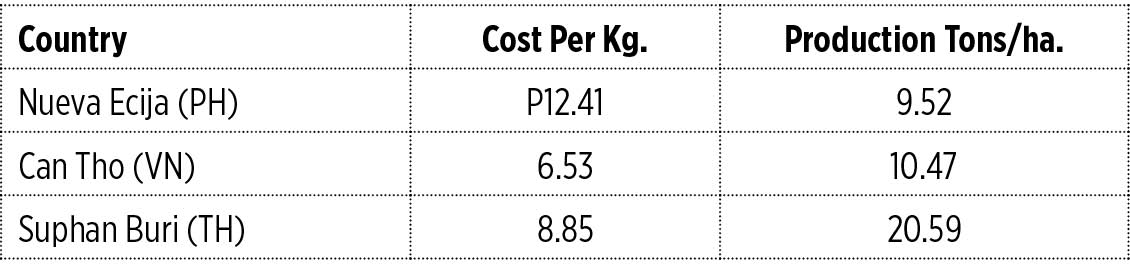
“The Philippine Rice Industry Road Map – 2030,” published by the Department of Agriculture in 2018, includes a comparative analysis of rice farming productivity in the Philippines, Vietnam, and Thailand. The comparison was made on the basis of the relevant data from the more productive provinces in each country, as shown in the accompanying table.

The comparison clearly shows that the Philippine production cost per kilo of rice is higher. But at the same time, the rice produced expressed in tons per hectare is lower, particularly compared with Thailand where the rice production per hectare is double that of the Philippines. It is a double whammy for the Philippines: incurring higher cost but producing lower output.

The roadmap does not provide more details from which we can determine the factors of production causing the large comparison differences. These details are necessary when formulating Philippine public policy choices to improve the current dismal situation. However, it is safe to assume that one of the factors, if not the single one that makes the greatest impact, is the comparative average rice farm size.

THE SIZE OF FARMS
The average Philippine rice farm size at 1.4 hectares in 2018 — and which is probably even smaller today — is so small that it is more likely that the average farm size in the two other countries mentioned is larger than that of the Philippines. Size is a major factor in production. When scaled up, size or capacity produces higher productivity per unit of measure. Therefore, smaller farm size is a major factor in the much lower productivity that the Philippines derive from its rice farms.

There are two things that stand out from the information and analyses made in Parts 1 and 2 of this essay. One is the very small average size of our rice farms which, in my view, is a major factor that causes the very low productivity of our rice farms. And the other is the current miserable economic condition of most of our rice farmers, both the landowning farmers and non-landowning farmers, but especially the latter.

No matter what we do in trying to increase rice farming productivity, it will not result in a significant improvement if we do not endeavor to substantially increase the size of our farms. Try to picture it yourself — there is nothing much one can do to raise productivity in a piece of farmland measuring 1.4 hectares or less, whether farming is mechanized or not. In fact, by just increasing the farm size itself, and using the same method of production as before, it will already produce higher productivity. Such is a natural result of scaling up.

We can only increase the average rice farm size by removing the present legal limit in the ownership of farmland, which is presently five hectares per person. By removing this limit — or increasing it substantially — the marketplace will do the rest in increasing farm size. There will be buyers who see good profits in large-scale agriculture production because of economies of scale and its suitability to full mechanization, two factors which will certainly lead to much higher productivity. And there will be sellers when they see an attractive price, which increased demand usually produces. To make these buying and selling activities more vigorous, it is necessary that we also remove any present restrictions in the disposal of farmland acquired by the beneficiaries of the past land reform program.

There is nothing that prevents us from removing the present farm size limit or increasing it to a much larger size. Having gone through a land reform program, however imperfectly it was executed, we have duly performed our social obligation to our landless countrymen. I believe then that there is no longer any impediment in removing or increasing the farm size limit. We must absolutely do so if we want to improve our rice farming productivity to a high degree.

A BASIC INCOME
Let me now turn to the rice farmers, both landowners and non-landowners. As mentioned before, most of them have an annual income that is below the poverty threshold. They need help to escape from this pitiful condition.

This observation recalls my earlier commentary suggesting that the government adopt a program of providing poor Filipinos with a basic income. This program will cover all poor families whose annual income is within the poverty threshold. To be clear, the program coverage will include, in addition to the rice farmers, all other farmers, owning the farmland or not, and the urban poor. This program will replace the present 4Ps, the amount of which given per family is miniscule.

I realize that such a program is very controversial because some believe that the beneficiaries would tend to become lazy and would just spend part of the money in consuming alcohol and engaging in other vices. However, I recall from my readings that the reviews of similar programs adopted by some countries did not indicate a significant occurrence of such results. Moreover, the adoption of public policy must be dictated by the benefits it brings to the great majority and must not be deterred by the consideration of the anticipated bad behavior of the few.

The current poverty threshold for a family of five people has increased to P166,000 per year (rounded off this comes to P13,873 per month) as determined by the Philippine Statistics Authority (PSA) in 2023. For purposes of illustration, let’s get a fraction of that amount to be given as basic income to poor families. Say, P4,000 per month or P48,000 per year for each poor family. That translates to P144 billion per year based on the reported 3 million poor families in 2023 as similarly determined by the PSA. I believe that this total amount per year of P144 billion is affordable and therefore doable. Moreover, this total amount should decline as we move towards the future.

Nowadays, it should not be difficult to manage such a program as cash transfers can be done electronically and therefore quickly with minimum human intervention, reducing substantially the probable occurrence of corruption.

An important matter to consider is that such a total amount will be spent by the beneficiaries for basic consumption, such as food and clothing, which are locally produced using substantially local materials and employing local labor. Such consumption, taken alone by itself, will certainly add to economic growth.

In sum, removing or increasing substantially the present legal limit in the ownership of farmland will significantly increase productivity in the production of rice and other agricultural crops and produce.

Giving the Filipino poor a meaningful basic income does not result in a wasteful use of money. On the contrary, doing so helps the poor, especially the farmers, in improving their living conditions which, in turn, provides a contribution, in no small measure, to economic growth.

(See Part 1 here: https://tinyurl.com/2c7zn9dd)


Benjamin R. Punongbayan is the founder of Punongbayan & Araullo. Contact him at (ben.punongbayan@ph.gt.com).

Survey says: Most Pinoys are looking to get wet this summer

PHILIPPINE STAR/NOEL PABALATE

IT IS TIME to go swimming — which is something most people are looking forward to doing this summer, according to a survey. And summer is officially here, according to the Philippine Atmospheric, Geophysical and Astronomical Services Administration (PAGASA) on March 26.

“The shift of wind direction from northeasterly to easterly due to the establishment of the high pressure area (HPA) over the Northwestern Pacific signifies the termination of the Northeast Monsoon over most parts of the country and the start of the dry season,” said the weather bureau. “With this development, the day-to-day weather across the country will gradually become warmer, though isolated thunderstorms are also likely to occur,” said the statement.

And just as summer officially arrived, a national survey by public opinion firm WR Numero was released detailing what Filipinos are most excited to do this summer.

More than two in five Filipinos (44%) are eager to go swimming this summer, according to the survey, while one in three Filipinos reported that they prefer to stay at home amid the summer heat, opting instead to watch movies, listen to music, or read books.

Other preferred activities include learning a new life skill (13%), engaging in outdoor activities like hiking (12%), going to public places for leisure, entertainment, or learning (10%), traveling or going on vacation locally (8%), and playing sports (6%).

Foreign travel was attractive to 3% of respondents — 4.8% in Classes A, B, and C favored foreign travel as a summer escape, while 5% of Class D approved of this activity.

Learning new artistic hobbies like painting or playing a musical instrument placed the lowest on the list, as only 1.7% of respondents were interested across Classes A, B, C, and D.

Younger Filipinos prefer swimming this summer, with 48% of those 30 and below and 44% of those 31 to 59 looking forward to getting wet.

In contrast, 45% of Filipinos 60 and above prefer to stay home. Among other activities, 18% of seniors and 15% of those 31 to 59 are interested in learning new skills, while 15% of the youngest group prefer hiking.

Swimming is also the top summer activity across income groups, with 59% of Class A, B, C, and D, and 39% of Class E choosing the activity. The survey also shows Class E has the highest preference for staying home at 36%.

Summer activity preferences vary by region. In Luzon (outside the capital), 68% of Filipinos look forward to swimming, while 38% in the Visayas and 34% in Metro Manila prefer staying home. In Mindanao, preferences are split evenly, with 33% favoring both staying home and swimming.

The nationwide, non-commissioned survey, conducted from Feb. 10 to 18 this year, was done through face-to-face interviews with a nationally representative sample of 1,814 Filipinos aged 18 and older. The survey has a margin of error of ±2% at a 95% confidence level. At the subnational level, the margin of error is ±6% for the National Capital Region, ±5% for North and Central Luzon, ±5% for South Luzon, ±5% for the Visayas, and ±5% for Mindanao, all at the same 95% confidence level.

The complete Volume 2025 Issue 1 report is set to be released this March. The issue will feature the complete survey findings on the current state of public opinion on the upcoming 2025 general elections, the impeachment of Vice-President Sara Z. Duterte, and other issues concerning the nation and the world. — JLG

Bank of Makati eyes steady profit growth

BANKOFMAKATI.COM.PH

BANK OF MAKATI (A Savings Bank), Inc. looks to sustain its profit growth this year as it aims to channel funds to be freed up by the upcoming cut in reserve requirement ratios (RRR) to ramp up its lending, its top official said.

Bank of Makati President Luis M. Chua said their net income grew by about 20% year on year in 2024, meeting their target, even as they fell behind some of their loan segment goals.

“We would not disclose right now our exact target, but definitely it should be more than what we are getting in the previous years,” Mr. Chua told BusinessWorld on the sidelines of an event this month when asked about their profit outlook for this year.

Based on its balance sheet posted on its website, the bank’s return on equity was at 19.8% at end-2024, down from 19.14% at end-September 2024.

Return on assets rose to 8.11% from 7.82% in the same periods, while net interest margin declined to 19.73% from 22.1%.

The official said the bank aims to use the liquidity to be released via the Bangko Sentral ng Pilipinas’ (BSP) RRR cut to fund its loans.

“Thrift banks would always go for consumer loans… because they’re the most profitable,” Mr. Chua said.

The BSP will bring down the RRR of thrift lenders by 100 basis points (bps) to 0% effective March 28. The reserve ratio for universal and commercial banks and nonbank financial institutions with quasi-banking functions will also be cut by 200 bps to 5%, while that for digital banks will be slashed by 150 bps to 2.5%.

Rural and cooperative banks’ RRR has been at 0% since October, the last time the BSP cut reserve requirements.

The RRR is the portion of reserves that banks must hold onto to ensure they can meet liabilities in case of sudden withdrawals. Lower ratios mean they have more funds to lend to borrowers.

“We are optimistic about housing loans. Although I think some of the banks have already slowed down, but we are still optimistic about housing loans. Also, simply because our portfolio is still small,” Mr. Chua said.

“But for other consumer loans, particularly, we will be still strong with motorcycle loans as we have been leading in that particular area. All the rest will be typical loans,” he added.

About 70-80% of Bank of Makati’s loan portfolio is made up of motorcycle loans.

The thrift bank is also targeting to launch a digital banking app by mid-year to expand its reach, Mr. Chua said.

Bank of Makati’s gross loan portfolio grew to P39.81 billion at end-2024 from P36.57 billion at end-September, according to its balance sheet.

Its gross nonperforming loan (NPL) ratio improved to 13.77% at end-2024 from 14.89% at end-September. Its gross NPL coverage ratio, meanwhile, went down to 46.34% from 51.37%.

Bank of Makati had assets worth P53.38 billion at end-2024. — A.M.C. Sy

CloudStaff sets up operations in Davao’s Damosa IT Park

DAMOSALAND.COM

DAVAO-BASED property developer Damosa Land, Inc. (DLI) said Australian outsourcing firm CloudStaff will open an office at Damosa IT Park.

“CloudStaff’s entry into Damosa IT Park reinforces our vision of making Davao one of the top outsourcing hubs in the country,” DLI President Ricardo F. Lagdameo said in a statement on Thursday.

“More than just providing office spaces, we are enabling companies to operate in an environment that supports business growth, promotes employee well-being, and contributes to the city’s economic expansion,” he added.

Damosa IT Park, located along J. P. Laurel Avenue in Davao City, is the first Philippine Economic Zone Authority (PEZA)-accredited IT park in Southern Mindanao.

Designed to meet the needs of global IT-BPO firms, the park offers PEZA incentives, energy-efficient office spaces, and seamless connectivity, DLI said.

“The integration of modern workspaces, green areas, and accessibility to key commercial and residential hubs ensures that businesses operating in the park benefit from both operational efficiency and employee well-being,” it added.

CloudStaff said it chose Davao for its latest expansion due to its highly skilled workforce, cost-efficient operations, and business-friendly environment.

“We chose Davao as our 14th site in the Philippines because of its rich pool of highly skilled talent, its growing infrastructure, and the strong support from the local community,” said Miki Carbonel, global chief recruitment officer for CloudStaff.

Founded in 2005, CloudStaff initially focused on software development for Western firms.

It now employs 6,000 staff members and contractors across 17 offices worldwide, with operations in the Philippines, India, and Colombia.

DLI said it will continue developing world-class spaces that attract industry leaders and create opportunities for local talent, according to Mr. Lagdameo.

“With Damosa Land at the forefront of Mindanao’s real estate and business transformation, the company remains focused on attracting more global enterprises, creating high-value employment, and positioning Davao as a premier investment hub,” the developer said. — Beatriz Marie D. Cruz

Elevating sustainability in corporate boards

ORIGINAL PHOTO FROM FREEPIK

Sustainability has gone from a voluntary corporate exercise to a core determinant of long-term success, resilience, and competitive edge. It is imperative that corporate boards take the top role in foregrounding the environmental, social, and governance (ESG) priorities of business in the board’s strategic agenda. Sustainability programs, initiatives, policies, and committees must be adopted. Just as important is ensuring that those on the board bring sustainability expertise to the table. Embedding sustainability into the governance framework can reshape business models and deliver sustainable stakeholder value.

Sustainability programs offer a holistic framework for business strategy that addresses environmental and social issues in a comprehensive, long-term manner. This includes programs such as reducing carbon footprints, having resource efficiency, increasing inclusive growth, and ethical business practices. Sustainability programs that are governed by the corporate board create accountability and alignment with the business strategy; they further embed ESG priorities into risk management and business development when directed by corporate boards.

Active board champions of sustainability indicate a commitment to responsible growth, attracting investors, customers, and employees whose loyalty is grounded in ESG performance. Sustainability initiatives reduce risks such as regulatory fines and supply chain disruptions and create financial opportunities such as green finance and brand loyalty.

Given the importance of sustainability in corporate boards, and how deeply they can drive everything from clean supply chains to board composition, corporate boards must establish do-able initiatives and policies to drive the ESG goals into action. These might include investments in renewable energy, waste reduction strategies, and policies promoting diversity and inclusion.

Sustainability in architecture and infrastructure projects might require in-depth environmental impact assessments and green construction. Embedding ESG practices into the work of organizations can include a focus on responsible resource management, investment in renewable energy, or sustainability-driven lending approaches. When better decision-making prevents risks and the focus on long-term value improves overall stakeholder value, everyone wins.

DEDICATED SUSTAINABILITY COMMITTEES
Creating sustainability committees in corporate boards provides consistent oversight of ESG priorities. These committees establish sustainability targets, monitor progress and link business operations with environmental and social commitments.

For example, sustainability committees can concentrate on reducing energy consumption and carbon emissions for energy intensive industries. Organizations seeking to embed sustainability into their governance may create dedicated committees to oversee energy usage, e-waste, and digital inclusion. Institutionalized efforts like this help maintain sustainability as a key part of corporate strategy and risk-rooted approaches.

For sustainability programs to be effectively adopted and implemented, corporate boards need to include board members with expertise in ESG disciplines. For one, sustainability experts can provide insights into emerging trends, regulatory changes, and technological advancements that may impact long-term business strategy. Boards with ESG specialists are better equipped to identify and mitigate environmental and social risks. Ultimately, the presence of sustainability experts in corporate boards is a powerful signal to investors, employees, and consumers who are increasingly demanding that companies demonstrate their commitments to sustainability.

Evidently, companies that are proactive in augmenting sustainability expertise at the board level ensure ESG factors are embedded in corporate governance. This transition methodically enhances corporate reputation and business risk management infrastructure.

Unfortunately, despite these clear advantages, many corporate boards remain reluctant to give sustainability the importance it deserves at the corporate board level.

One reason for this is corporate boards’ short-term focus on profit. An over-emphasis on quarterly earnings can impact long-term sustainability investments, which can hurt resilience and competitiveness.

Another reason is the limited ESG expertise among board members; thus, corporate boards without sustainability expertise may fail to see the strategic value of ESG integration.

Truthfully, there is a felt resistance to change. We often hear how established corporate cultures are resistant to sustainability initiatives, fearing disruptions to operations or, worse, increased costs. Moreover, sustainability seems to be perceived as “complex” with some board members arguing that integrating ESG may require navigating complex trade-offs, regulatory landscapes, and shifting stakeholder expectations.

To promote meaningful ESG transformation in corporate boards, sustainability needs to become an integral part of governance and therefore a structured roadmap needs to be adopted.

Key components include:

• A well-defined sustainability policy – Measurable goals of reducing environmental impact, social responsibility, and ethical governance.

• Sustainability Committees – Dedicated board level committees to review ESG initiatives and ensure continuous improvement.

• Incorporation into Enterprise Risk Management – Integrating sustainability risks into risk assessment frameworks to counter ESG-related vulnerabilities.

• Enhanced Board Representation — Adding sustainability experts to the board to provide strategic guidance on ESG matters.

• Executive Compensation Tied to Sustainability Goals — Linking compensation structures with performance metrics to sustainability targets fosters long-term corporate commitment.

• Active Stakeholder Engagement — Regular discussions with investors, employees, and communities to make sure corporate strategy aligns with ESG pressures.

Indeed, sustainability is no longer just a backup option, it is a defining factor for corporate resilience, investor confidence, and competitive edge. Yet corporate boards need to move beyond such rhetoric and commit to making sustainability an integrated part of their businesses, with structured programs, initiatives, policies, and representation on boards.

Sustainability-focused organizations will be better equipped to navigate shifting community issues and expectations of consumers and shareholders.

Moving forward, the future of corporate governance requires a shift in the paradigm — making sustainability the fulcrum upon which decisions, risk management, and profitability pivot. Boards must demonstrate that they are making sustainability a pillar of the strategic framework going forward, so that no stakeholder is left behind and the organization has a future that is resilient, equitable, and prosperous.


Dr. Ron F. Jabal, APR, is the CEO of PAGEONE Group (www.pageonegroup.ph) and founder of Advocacy Partners Asia (www.advocacy.ph).

ron.jabal@pageone.ph

rfjabal@gmail.com

TUCP party-list files bill seeking to codify rules vs workplace violence

THE Trade Union Congress of the Philippines (TUCP) filed a bill on Thursday to fully implement International Labour Organization (ILO) Convention No. 190 (C190), which deals with eliminating violence and harassment in the workplace.

The measure, filed by TUCP Party-list Rep. and Deputy Speaker Raymond Democrito C. Mendoza, aims to protect workers from physical, psychological, and economic harm, with a strong emphasis on addressing economic violence.

The TUCP, the country’s largest labor federation, said that as the first Asian country to ratify ILO Convention No. 190, the Philippines must follow through by enforcing its provisions.

It also noted that the proliferation of short-term contractual work, commonly known as endo, leads to economic violence.

Poverty wages and job insecurity, the TUCP warned, trap workers in cycles of poverty and desperation.

“This landmark legislation highlights the overlooked economic violence, which TUCP claimed is happening in workplaces as endo proliferates and union organizing is effectively muzzled through various schemes from outright killings to threats, intimidation, harassment, and termination of employment,” Mr. Mendoza added in a statement.

The bill expands the definition of violence and harassment to include “a range of unacceptable behaviors and practices, or threats thereof, whether a single occurrence or repeated, that result in or are likely to result in physical, psychological, sexual, or economic harm.”

ILO C190, adopted in June 2019 and ratified in 2022, is the first international treaty to recognize the right of everyone to work free from violence and harassment.

The convention defined violence and harassment in the world of work broadly, encompassing physical, psychological, sexual, and economic harm, and applies to all workers, regardless of employment status.

It requires governments to adopt laws and policies to prevent and address violence and harassment while ensuring protection and remedies for affected workers.

Mr. Mendoza also underscored the urgency of addressing the economic struggles of women workers during Women’s Month, saying they bear the heaviest burden due to persistent gender pay gaps and the disproportionate share of unpaid care work at home.

“We cannot claim to be protecting workers from violence and harassment just by ratifying ILO Convention No. 190 while keeping them trapped in poverty and starvation — a form of economic harm that ILO Convention No. 190 seeks to prohibit — without a wage hike for workers’ prosperity and dignity.”

The TUCP is pushing for a P200 legislated wage hike, which cleared the House of Representatives on second reading in January. — Chloe Mari A. Hufana

Stuff to Do (03/28/25)


Check out Robinsons’ payday sale

SHOPPERS can enjoy 80% off on select items and cashbacks from March 28 to 30 at Robinsons Department Store. The three-day sale celebrates payday and offers a P300 gift certificate to those who present a single receipt purchase of P5,000 from 10 a.m. to 2 p.m. Go Rewards cardholders also get a chance to earn up to P5,000 worth of Go points for a minimum single-receipt purchase of P3,000. Shoppers can earn extra points by using their Go Rewards credit and debit cards or their Cebu Pacific credit card.


Catch Kim Chiu and Paulo Avelino’s new romcom

THE movie My Love Will Make You Disappear is premiering this weekend. With a PG rating, the Star Cinema film invites audience members of all ages to see Kim Chiu and Paulo Avelino in their first outing as a love team. The romantic-comedy film revolves around a woman with a history of disappearing boyfriends finding love with her landlord, who is fighting to save his community from being displaced.


See Philippine birds at Gateway 2’s exhibit

A PHOTO exhibit titled The Flight of the Philippine Birds is ongoing at the Quantum Skyview of Gateway Mall 2 in Cubao, Quezon City until March 30. It showcases photos of vibrant and diverse Philippine bird species, taken by members of Haring Ibon – Birds in Focus, Inc. Alongside the majestic Philippine Eagle, there are photos of the underrepresented birds including kingfishers, mocking jays, cockatoos, and many more endemic birds. The exhibit also details where they are found, their conservation status, and their international standing.


Listen to Iloilo musician Rock Opong’s first single

FILIPINO singer-songwriter Rock Opong, a newcomer to the music scene, is officially debuting as a recording artist. The 19-year-old Iloilo-based musician was discovered by Rico Blanco’s Balcony Entertainment and has released his single under Sony Music. Titled “Marahuyo,” the soulful track aims to capture the emotions of longing for someone and passionately pursuing love against all odds. Produced by Mr. Blanco, the R&B ballad is the first of many more slated for release soon.

White Lotus craze bolsters Thai island’s April hotel bookings

THAILAND saw a surge in hotel bookings by international visitors for the Songkran holiday in April, with the island of Koh Samui — filming location of the hit series The White Lotus — recording a 65% increase from a year ago, according to the government.

Koh Samui, located in the southern province of Surat Thani, tops the hotel booking list for foreign tourists planning to check in between April 10 and 17, Deputy Spokesman Anukool Pruksanusak said in a statement, citing data from technology solutions firm SiteMinder.

The resort island is the primary destination for long-staying foreign tourists for the April holiday, Anukool said. The average stay has risen to 3.8 nights from 3.74 nights previously, he said.

The latest season of the television series The White Lotus has stirred international tourism interest for Koh Samui since it premiered in mid-February. Direct online bookings for the three Anantara resorts, owned by Minor International, rose 41% in mid-February from a year ago, while web traffic more than doubled during the same period, according to founder Bill Heinecke.

Foreign bookings for hotels in northern Chiang Mai province and Bangkok registered a 41% and 20% increase respectively, according to Anukool. The government expects Songkran, the Thai new year holiday famous for public water fights, to generate about 20 billion baht ($590 million) in tourism spending, he said.

Thailand welcomed 8.9 million visitors since the start of 2025, generating revenue of 434.7 billion baht, according to the Ministry of Tourism and Sports. The tourism industry accounts for about 12% of the Southeast Asian nation’s economy and employs nearly 20% of its workers. — Bloomberg

The science and art of investment business cases

Writing an investment business case for a major technology project should be straightforward, yet many business leaders struggle with it. They know the stakes — approving the wrong project could waste millions, while rejecting the right one could leave the company behind. However, they frequently run into difficulties when putting the case together.

The fact that digital transformation initiatives don’t always yield clear, immediate benefits is a major contributing factor. Technology expenditures frequently involve efficiency benefits, cost avoidance, or long-term competitive advantages that are more difficult to measure than new product launches, where revenues can be estimated. And when senior executives ask, “What’s the payback?”, the answers are often murky.

Another challenge is that writing a business case isn’t just about numbers. It’s also about persuasion. A perfectly calculated return on investment won’t get far if the case doesn’t tell a compelling story. Senior executives must see the whole picture and have faith in the vision before they can accept projects based solely on spreadsheets.

But let’s start with the science before we move on to the storytelling.

Clear financial reasoning is the foundation of a strong business case. You must first identify the sources of revenue. You can anticipate extra revenue based on historical performance and market trends if the project directly boosts sales, like an e-commerce improvement that raises conversion rates. Although the figures will be less evident, they can still be modelled if the revenue impact is indirect, such as when enhancing customer experience lowers attrition.

Next, look at the savings or efficiency drivers. Will the project cut processing time, reduce manual work, or minimize system downtime? If a new cloud-based system reduces IT maintenance costs by 20%, that’s a real, measurable benefit.

Cost avoidance is another factor. While many initiatives don’t save money right away, they do save money down the road. Consider investing in cybersecurity. Although a business may invest millions in advanced threat detection, how can the value of preventing a data breach be calculated? Here, you make an estimate of the possible financial consequences of a breach — legal fees, lost revenue, and regulatory fines — and use it as support.

Cost drivers are on the opposite side of the equation. This covers implementation, training, change management, and continuing support in addition to the cost of the technology itself. Businesses frequently undervalue these. The development of a new artificial intelligence-powered chatbot for customer support may cost $1 million, but the real cost may be far greater if the rollout calls for substantial employee training and integration with older systems.

Compute the net present value (NPV) after you have enumerated all of the revenue and cost components. This guarantees that the time value of money is taken into consideration when weighing the costs of the now against the rewards of the future. You must reduce those future returns to reflect the project’s current value if it costs $5 million now but yields $10 million in benefits over five years. The project makes financial sense if the net present value is positive.

However, the argument won’t sell itself, even with impressive data. The art enters the picture here.

Just because the math works doesn’t mean that executives approve investments. They believe in them, which is why they approve of them. That belief comes from storytelling.

Take Amazon’s cloud computing business AWS. In the early 2000s, Amazon’s leadership had to justify investing billions into infrastructure when the company was still focused on retail. The financial case was strong — third-party developers needed scalable cloud services — but the breakthrough came from how it was framed. Amazon positioned AWS as the foundation of the internet’s future, enabling companies of all sizes to develop more quickly, rather than only showcasing data. Strong financials and that vision made the argument unstoppable.

The Starbucks smartphone app serves as another illustration. The business case for the company’s initial investments in digital incentives and payments went beyond merely facilitating quicker transactions. Enhancing client relationships, fostering loyalty, and establishing a smooth digital-physical experience were the main goals. Although the numbers were significant, Starbucks’ vision as a tech-driven coffee brand rather than merely a network of coffee shops was what strengthened the argument.

It’s simple to concentrate on spreadsheets and projections when composing an investment case. However, the most successful examples combine a compelling vision with evidence. Show the potential consequences of the company’s inaction in addition to the return on investment. Will rivals get an advantage? Will consumers switch to more favorable digital experiences? Will the accumulation of inefficiencies hinder future growth?

A compelling investment thesis strikes a balance between reason and feeling. While the art makes it convincing enough to receive approval, the science makes sure the numbers hold up. Leaders in business who are adept at both not only get initiatives authorized, but also influence the direction of their organizations.

The views expressed herein are his own and do not necessarily reflect the opinion of his office as well as FINEX.


Reynaldo C. Lugtu, Jr. is the founder and CEO of Hungry Workhorse, a digital, culture, and customer experience transformation consulting firm. He is a fellow at the US-based Institute for Digital Transformation. He is the chair of the Digital Transformation IT Governance Committee of FINEX Academy. He teaches strategic management and digital transformation in the MBA Program of De La Salle University. The author may be e-mailed at rey.lugtu@hungryworkhorse.com

Security Bank Corp. to hold 2025 regular meeting of stockholders via remote communication on April 29


Spotlight is BusinessWorld’s sponsored section that allows advertisers to amplify their brand and connect with BusinessWorld’s audience by publishing their stories on the BusinessWorld Web site. For more information, send an email to online@bworldonline.com.

Join us on Viber at https://bit.ly/3hv6bLA to get more updates and subscribe to BusinessWorld’s titles and get exclusive content through www.bworld-x.com.