Home Blog Page 1239

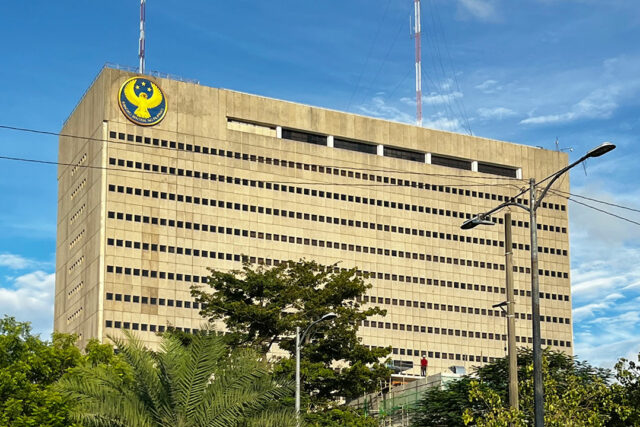
PT&T may return to stock market this year

PTT.COM.PH

PT&T CORP. is about to complete the requirements for its return to trading at the Philippine Stock Exchange (PSE) this year, according to its top official.

“We are on track,” PT&T President and Chief Executive Officer James G. Velasquez told reporters on the sidelines of an event last week. “The plan is to be able to do that within the year. So, hopefully within the first half is our objective.”

Toby Allan C. Arce, head of sales trading at Globalinks Securities and Stocks, Inc., said the company’s plan to resume trading at the PSE aligns with market trends.

“If the broader economic and stock market conditions in 2025 improve, it could create a conducive environment for PT&T’s reentry,” he said in a Viber message on Sunday. “However, uncertainty due to global economic headwinds remains a risk.”

Mr. Velasquez said the company is in the process of meeting the requirements and regulatory approvals for the plan.

“There are still a few things that we need to complete,” he said. “But I would say 90% of what we need to do has been completed. So we’re at the tail end of that.”

Mr. Arce said PT&T’s reentry this year is strategic given the digital transformation and expansion of telecommunications and broadband services.

“This is assuming the industry’s robust growth continues,” he said. “Meeting all Philippine Stock Exchange requirements will likely boost investor confidence in the company’s governance and compliance standards.”

Increasing demand for high-speed internet and digital connectivity especially in underserved areas might position PT&T as a key player, Mr. Arce said.

“Supportive government initiatives for digital infrastructure could catalyze growth for PT&T,” he said. “The company’s ability to communicate its turnaround story effectively will be critical in influencing market reception.”

Incorporated in 1962, PT&T is a diversified company that caters to corporate, small and medium businesses and residential segments.

The company was listed in 1990 but requested a voluntary trading suspension in December 2004 after failing to meet the local bourse’s reportorial requirements and as the company faced financial challenges.

Last year, PT&T said it was actively pursuing its return to the market after recording strong performance in 2023.

The Securities and Exchange Commission in November 2023 approved an increase in PT&T’s authorized capital stock to P12.6 billion from P3.8 billion, allowing it to facilitate a debt-to-equity conversion of P8.9 billion, according to its website.

Last week, SecureLink Networks, Inc., the joint venture between PT&T and Australia’s Netlinkz Ltd., announced its plan to establish a multimillion-dollar tech facility in the Philippines to enhance the country’s connectivity and cybersecurity. — Ashley Erika O. Jose

India offers US tariff cuts on farm imports

REUTERS

NEW DELHI — India has offered tariff cuts on imports of US farm products like almonds and cranberries as a further concession to the US, two government sources said, hoping to avert President Donald Trump’s reciprocal tariffs set for next week.

Unlike China, Canada and the European Union, India is actively seeking to appease the Trump administration and is open to cutting tariffs on over half of US imports worth $23 billion, Reuters reported earlier this week.

In a series of meeting in New Delhi with Brendan Lynch, the assistant US trade representative for South and Central Asia, India agreed to cut tariffs on bourbon whiskey and agricultural products such as almonds, walnuts, cranberries, pistachios and lentils, one of the sources familiar with discussions said.

Trade talks are “progressing well” and the bilateral trade pact, still in progress, will benefit both nations, Indian Trade Minister Piyush Goyal said on Thursday.

“Securing a favorable deal is a priority for Indian negotiators,” a second government source said, adding that India has aligned its offers with US priorities, particularly in the agriculture industry and some other sectors.

Both sources spoke on condition of anonymity due to the sensitivity of the talks.

India’s trade ministry didn’t respond to e-mail request for comment, while the US embassy spokesperson in New Delhi said: “We don’t have anything to share on private diplomatic discussions.”

India lowered duties for bourbon whiskey to 100% from 150% last month. Import duties range from 30% to 100% on agricultural products like cranberries, almonds, walnuts, and around 10% on lentils.

However, there is still resistance in government circles to lowering tariffs for dairy products, rice, wheat and maize, the source said, adding India is seeking greater market access for shipments of fruits like pomegranates and grapes to the US market.

The negotiators are expected to agree on the framework for the broad contours of the first phase of the bilateral deal, expected to be signed by fall 2025, the sources said.

In 2024, exports of US agriculture and allied products to India totaled nearly $2 billion, including $452 million in alcoholic beverages and $1.3 billion in fruits and vegetables while India’s exports to the US stood at about $5.5 billion. — Reuters

T-bill, bond rates may end mixed before inflation data

BW FILE PHOTO

RATES of the Treasury bills (T-bills) and Treasury bonds (T-bonds) to be auctioned off this week could track secondary market yields before the release of March inflation data, which could affect the Bangko Sentral ng Pilipinas’ (BSP) policy decision next month.

The Bureau of the Treasury (BTr) will auction off P25 billion in T-bills on Monday, or P8 billion each in 91- and 182-day papers and P9 billion in 364-day papers.

On Wednesday, the government will offer P30 billion in reissued seven-year T-bonds with a remaining life of five years and three months. This week’s T-bond auction was moved from the usual Tuesday schedule due to the Eid’l Fitr holiday.

Rates of the government securities on offer this week could mirror the mixed yield movements at the secondary market last week, Rizal Commercial Banking Corp. Chief Economist Michael L. Ricafort said in a Viber message.

At the secondary market on Friday, the 91-, 182-, and 364-day T-bills rose by 12.09 basis points (bps), 9.05 bps, and 8.86 bps week on week to end at 5.2978%, 5.6163% and 5.7763%, respectively, based on PHP Bloomberg Valuation Service Reference Rates data as of March 28 published on the Philippine Dealing System’s website.

Meanwhile, the seven-year bond’s rate went down by 6.3 bps week on week to close at 6.0353%. The five-year debt, the benchmark tenor closest to the remaining life of the papers on offer on Wednesday, also declined by 6.3 bps week on week to yield 5.9001%.

Yields at the secondary market ended mixed amid expectations of a BSP rate cut as early as next month, Mr. Ricafort said.

The market is awaiting the release of the March inflation report as this could dictate the central bank’s next move, he added.

BSP Governor Eli M. Remolona, Jr. last week said that there is a “good chance” that the Monetary Board will cut rates by 25 bps at their April 10 meeting, Bloomberg reported.

Mr. Remolona said the BSP remains on an easing cycle and could reduce borrowing costs by as much as 75 bps this year depending on data.

The central bank has brought down benchmark interest rates by a total of 75 bps since it began its rate-cut cycle in August last year, with its policy rate currently at 5.75%.

The Monetary Board in February unexpectedly kept rates unchanged amid uncertainties stemming from the Trump administration’s policies.

The Philippine Statistics Authority will release March consumer price index (CPI) data on April 4 (Friday).

Headline inflation may have eased slightly in March amid lower prices, analysts said. A BusinessWorld poll of 18 analysts yielded a median estimate of 2% for the March CPI.

If realized, this would be a tad slower than the 2.1% in February and the 3.7% clip in the same month a year ago. This would also be the lowest monthly inflation in six months or since the 1.9% print in September.

Mr. Ricafort added that secondary market yields last week were also affected by the latest cut in banks’ reserve requirement ratios, which took effect on Friday and infused about P330 billion into the financial system. Traders said the excess liquidity was mostly placed in debt instruments at the front end of the curve.

Last week, the BTr raised P28 billion from the T-bills it auctioned off, higher than the original P22-billion plan, as total bids reached P67.88 billion, more than twice as much as the amount on offer.

Broken down, the Treasury borrowed P7 billion as planned via the 91-day T-bills as tenders for the tenor reached P18.825 billion. The three-month paper was quoted at an average rate of 5.157%, rising by 3.9 bps from the previous auction. Tenders accepted by the BTr carried yields of 5.14% to 5.179%.

Meanwhile, the government made a P9.8-billion award of the 182-day securities, above the P7-billion program, as bids for the paper amounted to P19.925 billion. The average rate of the six-month T-bill was at 5.554%, 5.8 bps higher than the previous week, with accepted rates ranging from 5.488% to 5.599%.

Lastly, the Treasury raised P11.2 billion via the 364-day debt papers, more than the P8 billion placed on the auction block, as demand for the tenor totaled P29.13 billion. The average rate of the one-year debt inched down by 1.6 bps to 5.681%, with bids accepted having yields of 5.673% to 5.697%.

Meanwhile, the T-bonds on offer on Wednesday were last auctioned off on March 4, where the government raised P30 billion as planned at an average rate of 6.019%, lower than the 6.375% coupon.

The Treasury is looking to raise P245 billion from the domestic market this month, or P125 billion via T-bills and P120 billion through T-bonds.

The government borrows from local and foreign sources to help fund its budget deficit, which is capped at P1.54 trillion or 5.3% of gross domestic product this year. — A.M.C. Sy

Honoring Enrico P. Villanueva

CEM.UPLB.EDU.PH

It was Feb. 25, the second day of the Supreme Court (SC) oral arguments for the petitions against the PhilHealth fund transfer, when Rico Villanueva left this earth for good.

It is almost poetic — tragic, even — that on a day meant for defending the Filipino people’s right to health, we lost someone who stood for what is right and championed the cause of protecting PhilHealth (Philippine Health Insurance Corp.) funds from predation.

Rico, a Senior Lecturer at the Department of Economics of the University of the Philippines Los Baños (DE-UPLB), was among the voices of dissent against the PhilHealth fund transfer. He became an important figure in igniting the discourse on the fiscal and actuarial aspects of the issue. He shared his well-founded criticisms and financial analysis of the issue on social media (X and Facebook) where he had amassed influence as a respected monetary and fiscal expert.

The first time that civil society advocates consulted him about the PhilHealth issue, we were at his office in UPLB, and he was clearly exhausted from a long day of lectures. Despite this, Rico was accommodating and generous in sharing his insights into PhilHealth’s financial position. He even shared his frustration that no one seemed to point out the true financial situation of PhilHealth — one that stands in stark contrast to the claims of the state health insurer having “excess” funds.

On Oct. 29, 2024, we formally visited the Department of Economics in UPLB. It was a few days after Tropical Storm Kristine ravaged Luzon, and the campus was still bearing signs of the aftermath. Trees had been uprooted and branches piled along the roadside. Despite the chaos, the DE–UPLB warmly welcomed us as we sought help to understand the financial situation of PhilHealth.

During this visit, Rico explained the true financial situation of PhilHealth, noting that the claims of the Department of Finance Secretary Ralph Recto overestimated (or exaggerated) the state health insurer’s funds, and ignored its outstanding obligations to all its members of P1.163 trillion in insurance contract liabilities (ICL). Given this obligation, PhilHealth faces a deficit of P644 billion — a dire fiscal situation that was further exacerbated by the government’s order of transferring P89.9 billion of PhilHealth funds to the National Treasury.

Of this amount, P60 billion was already transferred before a temporary restraining order was released by the Supreme Court on that very same day, Oct. 29, about two hours after our meeting with Rico.

In a small open space beside the DE function room where we held our meeting, stacks of bond paper were spread out on the thin grass, left to dry under the sun. It was sort of a reminder that something the storm tried to drench and damage can still be reclaimed; we just have to expose it to the light.

And so we did.

After that meeting, efforts to enlighten the public about the true financial situation of PhilHealth began. Rico wrote a pivotal piece for AER’s Yellow Pad entitled “State of the PhilHealth fund: Claimed excess ignores reserve deficit and service gaps.” (See BusinessWorld, Nov. 4, 2024.). The article was widely shared. It debunked claims of “excess funds,” helping the public better understand the real financial state of PhilHealth and fueling wider opposition to the transfer of PhilHealth funds.

Rico also created a short video to explain the issue in a simpler, less technical way.

Now, the public is very aware of the issue. The public rejects the actions of the National Government of taking away PhilHealth funds, which is contrary to law. This issue is highlighted in the oral arguments at the Supreme Court. Associate Justice Amy Lazaro-Javier emphasized that the state health insurer is essentially on the brink of bankruptcy, given that for the past three years, its reserve funds have been significantly lower than actuarial estimates. The PhilHealth reserve fund, which Secretary Recto claims to be more than sufficient to provide benefit packages to members and their dependents, was found to be critically short of covering the insurer’s total obligations.

Rico taught us, and his students, to make use of and critically analyze government reports. “Actually, I’m just using PhilHealth data,” Rico told us about his findings. He keenly analyzed data and made technical and complex economic and financial topics easy to understand for the public.

Even with the gap in the provision of ICL out of the picture, the figures cited by Secretary Recto and President Ferdinand “Bongbong” Marcos, Jr. in their statements on the funds available at PhilHealth’s disposal will not be sufficient to sustain the complete rollout of crucial PhilHealth benefit packages for all Filipinos. For one, based on our calculation, the outpatient Konsulta package alone will cost at least P194 billion per year to cover the entire population, not to mention the infrastructure that needs to be in place to effectively implement this package, including health information technology. In addition, the 2023 benefit payments of PhilHealth revealed its failure to sufficiently fund the full-service coverage of benefits that contribute to the attainment of the Sustainable Development Goals (SDGs). For instance, PhilHealth covered only half of the benefits for pregnant women and a small proportion of TB patients.

Rico also lambasted the role of the DoF in the fund transfer. The DoF created a circular to implement the special provision of the 2024 General Appropriations Act calling for collection of government-owned and -controlled corporation (GOCC) funds in excess of reserves. Wrote Rico in his Yellow Pad article, “the DoF appointed itself via circular as the calculator of reserve funds, which is a case of conflict of interest. The DoF cannot be both the arbiter of excess reserves and beneficiary of collected funds. The calculation of reserves is the job of the Actuary who ideally should be independent.”

Rico was an influencer, a leader, and a mentor. His memorial service was attended by diverse sectors — bankers, professors, students, triathletes, and others — sharing stories of how Rico had touched their lives. Sorrow quietly turned into a celebration as those who loved him found comfort in knowing that, despite his abrupt passing, Rico lived a full life.

Among his many roles, we at AER remember Rico as an intellectual with unwavering commitment to serving the people. His legacy is using his expertise in finance and economics to champion controversial causes that truly matter to Philippine society — an embodiment of honor, excellence, and service to the people.

We look back at a post he shared on his X account regarding the PhilHealth case: “I hope accountants, actuaries, and health economists will speak up. Please amplify the truth.”

We at AER sincerely hope and pray that Rico’s pursuit of the truth will prevail. While he may not witness the SC’s decision on the case, the impact of his contributions to the discourse and the young minds he has influenced is a victory in itself.


Rosheic Sims and Dhelyn Dela Cruz are researchers for Action for Economic Reforms’ health and fiscal policy team.

PHL told to strike balance in US, China ties or risk economic retaliation

PHILIPPINE STAR/NOEL PABALATE

By John Victor D. Ordoñez, Reporter

THE PHILIPPINES needs to strike a balance in preserving its diplomatic and trade ties with China amid Manila’s pursuit of stronger military ties with the United States or risk economic arm-twisting from its neighbor, according to a security analyst.

This comes after US Defense Secretary Peter Brian Hegseth reaffirmed Washington’s ironclad commitment to boosting deterrence efforts with Manila “considering threats from the communist Chinese.”

The US Defense chief met with his Philippine counterpart Gilberto Eduardo Gerardo C. Teodoro, Jr. and Philippine President Ferdinand R. Marcos, Jr. on March 28 to discuss continued cooperation on keeping the peace in the Indo-Pacific region and the South China Sea.

“We cannot afford to see China as an enemy just to boost our ties with the United States,” Edwin S. Estrada, who teaches international relations and specializes in national security studies at the De La Salle College of Saint Benilde School of Diplomacy and Governance, told BusinessWorld in an interview.

“China could retaliate if it wanted to. Not just militarily, but maybe using its economic power, economic clout.”

The Chinese Foreign Ministry last week urged the Philippines to stop “serving as other countries’ mouthpiece and more stunts for personal political agenda” ahead of Mr. Hegseth’s visit.

Beijing bankrolled about 233 projects in the Philippines between 2000 and 2022 worth $9.1 billion, according to a 2024 study by Virginia-based research group AidData.

The Marcos government has withdrawn loan negotiations with China for the P142-billion South Long-Haul project in the Bicol Region, the P50-billion Subic-Clark Railway project, and the first phase of the Mindanao Railway project worth P36 billion.

“Despite the second Trump administration’s sort of ‘inwardness’ in terms of current national and foreign policy priorities, it still does not forget to pursue and protect its interests overseas, especially when it concerns their trading with partners in the Indo-Pacific,”  Josue Raphael J. Cortez, who teaches diplomacy at De La Salle College of St. Benilde, said in a Facebook Messenger chat.

At a joint press conference on March 28 with Mr. Teodoro, Mr. Hegseth said Washington was rebuilding its military under US President Donald J. Trump and that it will stand with its allies amid threats to regional peace.

The Chinese Foreign Ministry accused the US of “indulging its allies in provocations in the South China Sea” and having “repeatedly fabricated false propositions about China’s threat to freedom,” ministry spokesperson Guo Jiakun told a news briefing in Bejing that same day.

The US Defense chief’s trip to the Philippines comes on the heels of his tour to Hawaii and Guam, where he met military leaders overseeing the Pacific region. He traveled to Japan after his Philippine visit and will fly to another Asian ally of the US that has been at odds with China over Senkaku Islands.

Manila has been at the forefront of efforts to contest Beijing’s expansive sea claim, deepening security ties with Western countries and regional allies like Japan and Australia.

More than $3 trillion worth of trade passes yearly through the sea, which China claims almost in its entirety. A United Nations-backed tribunal in 2016 voided its claim for being illegal.

Philippine and US army soldiers on March 24 started three weeks of joint military exercises that focus on territorial defense and commanding large-scale deployment of forces.

“It’s an option for any state who still is in the process of modernizing its military to strengthen its defense partnerships with allies,” Mr. Estrada said.

“It is but natural for the Philippines to strengthen its defense partnership with the US while modernizing its military in order to, let’s say, be prepared in the event of any untoward incidents that would impinge on its sovereignty and territorial integrity.”

The People’s Daily, the newspaper of the governing Communist Party, has urged the Philippines to give up the Typhon missile system, which was deployed by US forces to the Philippines in April last year as part of joint military exercises to keep the peace in the region.

Mr. Marcos earlier said he was willing to pull out the US Typhon missile system once China stops its aggression in the South China Sea.

“One can easily speculate that these (Typhon missile) deployments are yes, part and parcel of American positioning within the region come what may,

“But is also a game that majority of the developing world opts to play with the fear that noncompliance or cooperation may affect their political and economic ties with Washington.”

Washington’s military has moved its Typhon launchers, which can fire multipurpose missiles up to thousands of kilometers, from Laoag airfield to another location on the island of Luzon, Reuters earlier reported.

The Philippines also secured an exemption from the 90-day funding freeze that Mr. Trump ordered in January so it could receive $336 million for the modernization of its security forces.

“It’s always an issue of security when missiles were placed very near your territory,” Mr. Estrada said.

“So China will closely monitor the developments between our defense partnership with the US and China definitely will release more pronouncements condemning it, giving a warning.”

Philippine Rallycross and National Rally series fete ’24 champs, kick off new season

Philippine Rallycross Series (PHRX) and Philippine National Rally Championship (PNRC) winners pose with their plaques. — PHOTO FROM PHRX

THE PHILIPPINE Rallycross Series (PHRX) and the Philippine National Rally Championship (PNRC) celebrated the top rally drivers of the 2024 season in an awarding ceremony held recently at Oriental Palace, Quezon City. The event honored the top finishers in each category, recognizing their “skill, endurance, and dedication to one of the most challenging motorsport disciplines in the country.”

The PHRX and PNRC are the only rally events sanctioned by the Automobile Association Philippines (AAP), and aim not only to recognize top drivers but also to expand the sport by attracting new participants to the world of rally racing.

Here are the winners per category: Group 1 champion: Caloy Calica, second: Ricxie Dela Cruz, third: Rolando Tecson; Group 2 champion: Louie Camacho, second: Paul Santos, third: Peewee Mendiola; Group 3 champion: Louie Camacho, second: Paul Santos, third: Ricardo Dy-Liacco; Group 4 champion: Paul Santos, second: Ricardo Dy-Liacco, third: Peewee Mendiola; Open Class champion: Mike Reyes, second: Paolo Santos, third: Ricardo Dy-Liacco; AWD Class champion: Mike Reyes, second: Paolo Santos, third: Ralph Ramento; UV Class champion: Louie Camacho, second: DJ De Guzman, third: Aven Tongo; RWD Class champion: EZ Ligaya, second: Devor Andres, third: Jun Magno; Pickup Class champion: Louie Camacho, second: Aven Tongo, third: Boboy Rabe; Novice Class champion: Ricardo Dy-Liacco, second: Aven Tongo, third: Ricxie Dela Cruz; Ladies Class champion: Gabie Desales, second: Pauline Bautista, third: Hazel Ramirez.

The 2024 PHRX season took place over seven rounds, featuring races at Parklinks in Pasig City, the CCP Complex in Pasay City, and the Arden Botanical Garden in Trece Martires, Cavite. The CCP and Arden rounds were full-dirt rallycross events, while Pasig featured a combination of tarmac and dirt, creating a diverse and unpredictable competition format. Each two-kilometer rally course tested the drivers’ adaptability and skill, with both day and night races adding to the challenge.

Meanwhile, the PNRC consisted of three rounds, each pushing competitors to their limits in grueling rally conditions. The “Kagitingan Rally” in Capas, Tarlac, featured 12 Special Stages over 49 kilometers of gravel and dirt tracks. The “Unang Sigaw Rally” followed with 55 kilometers of intense terrain, split into eight Special Stages. The season concluded with the “Rally Nueva Ecija 2 — Tribute to Jun Espino,” where drivers tackled 10 special stages covering 50 kilometers of challenging dirt and gravel roads.

The 2025 season will feature seven rounds of the rallycross series and four rounds of the national rally. For the national rally championship, two rounds will be held in Nueva Ecija, one in Cavite, and a first inter-island rally in Lubang, Occidental Mindoro, marking a significant expansion in the Philippine rally scene. Meanwhile, the rallycross series will build upon last year’s success by holding seven rounds, ensuring more thrilling competition and testing drivers across longer and more complex rally stages.

According to race organizers Olson Camacho and Ronnie Trinidad, these expansions are aimed at bringing rally racing to more regions in the country, growing its fanbase, and providing new and seasoned drivers more opportunities to compete.

Media partners have played a crucial role in bringing rally racing back into the spotlight, said the organizers, who listed the supporting publications: Manila Times, Manila Bulletin, Philippine Daily Inquirer, Philippine Star, Business Mirror, BusinessWorld, Auto Review, Motoring Today, Auto Focus, Turbo Zone, Ignition PHL, Visor, Top Gear PH, and Carguide.

Analysts’ March inflation rate estimates

HEADLINE INFLATION likely eased slightly in March as prices of rice and fuel further dropped, analysts said. Read the full story.

Analysts’ March inflation rate estimates

Philippine modernist painter Juvenal Sansó, 95

PHOTO FROM FUNDACION SANSÓ

ARTIST Juvenal Sansó, born in Spain and based in the Philippines where he became a luminary of modern art, died on March 28 at the age of 95. He is survived by his niece, Carmen Montes.

“It is with great sorrow that we announce the passing of multi-awarded artist Mr. Juvenal Sansó,” said an official announcement by the non-profit organization Fundacion Sansó, which he founded.

The wake will be held from April 1 to 2 at Heritage Memorial Park Chapels 7 and 8 in Taguig City. Mass will be held at 7 p.m. on both days.

“His legacy lives on in Fundacion Sansó; which has been running his museum, authenticating his works, and awarding scholarships to deserving art students, scholars, artists, and cultural workers all over the country, as well as creating programs that promote art and culture, as Sansó wished,” the foundation said.

Born in Reus, Spain, on Nov. 23, 1929, Mr. Sansó and his family emigrated to the Philippines in 1934 to escape civil unrest and settled in Manila where they set up the wrought-iron works Arte Español. After narrowly surviving the horrors of World War II in Manila, he studied painting under Alejandro Celis at the age of 17, and took up Fine Arts at the University of the Philippines where he was taught by National Artists Fernando Amorsolo and Guillermo Tolentino, and by Irineo Miranda.

He discovered modernism by sitting in on the classes of Cesar Legaspi, Galo Ocampo, and Antonio Garcia-Llamas at the University of Santo Tomas. Soon after, he garnered awards at the Art Association of the Philippines and at the Shell National Student Art Competition. It was after this period that Mr. Sansó left for Europe to pursue further studies in Italy and France.

Mr. Sansó exhibited in prestigious museums here and abroad and was bestowed many state recognitions: the Presidential Medal of Merit from the Republic of the Philippines in 2006, the Distinguished King’s Cross of Isabela by King Juan Carlos I of Spain in 2007, and the Chevalier de l’Ordre des Arts et des Lettres by France in 2008.

Galerie Joaquin, the gallery which served as a platform for showcasing his work for the past two decades, described his paintings as “the expert fusion of beauty and melancholy, turning his scenes into powerful reflections of his life and inner world.

“The profound impact of his artistry and the exceptional quality of his work have firmly established him as one of the most esteemed and sought-after artists in the art scene,” the gallery said.

Fundacion Sansó, in its announcement, quoted the late art historian Rod. Paras-Perez to sum up the artist’s legacy: “Sansó believes that the act of painting is an intimate, private confession. The audience is always, for him, an intrusive eavesdropper… It is the point in Sansó’s solitary voyage to the self.” — Brontë H. Lacsamana

GT Capital eyes $200-M investment

GTCAPITAL.COM.PH

GT Capital Holdings, Inc. is looking to invest as much as $200 million (P11.5 billion) this year as it expands its portfolio in underpenetrated segments, a high-ranking official said.

“We are in investment mode,” GT Capital Senior Vice-President and Chief Financial Officer George S. Uy-Tioco, Jr. told reporters on the sidelines of a recent investor conference in Taguig City. “We are in the process of looking for sectors and businesses that we can invest in to expand our portfolio.”

He said the company might invest $100 million to $200 million to fund projects and other expansion plans.

“Our priority would be to take a look at managing our capex (capital expenditure) requirements as well as any capital required by our affiliates,” he added.

Mr. Uy-Tioco said the company has not zeroed in on a specific investment, but it is looking at potential opportunities particularly in underpenetrated areas.

“There are active discussions in terms of potential opportunities and we just have to sift through all of them and decide which ones make sense,” he said.

The company said it is most likely to invest in affiliated or associated businesses to give the company leverage in these industries.

GT Capital is a listed holding company with interests in banking, property development, infrastructure and utilities, automotive assembly, importation, wholesaling, dealership and financing, and life and nonlife insurance.

“Probably brownfield or acquisition is more appropriate, but I would not rule out anything at this point,” Mr. Uy-Tioco said. “We may even consider greenfield.”

The company is also looking at partnerships for its investments, he added.

While GT Capital is interested in emerging industries, Mr. Uy-Tioco said the company would stay away from gambling businesses.

The company had a plan to diversify its business and go into healthcare, renewable energy, education and data centers.

The company is still considering these sectors, Mr. Uy-Tioco said, adding that GT Capital considers these segments as fragmented with good margin and growing demand.

GT Capital has a stake in Pangilinan-led Metro Pacific Investments Corp. (MPIC). MPIC is one of the three key Philippine units of Hong Kong-based First Pacific Co. Ltd., the others being Philex Mining Corp. and PLDT Inc.

Hastings Holdings, Inc., a unit of PLDT Beneficial Trust Fund subsidiary MediaQuest Holdings, Inc., has a majority share in BusinessWorld through the Philippine Star Group, which it controls. — A.E.O. Jose

Italy concerned but not ‘terrified’ by potential Trump wine tariffs

REUTERS

ROME — Italy is concerned but not “terrified” of any new tariffs the US could impose on wine, the agriculture minister said, adding he hoped diplomatic efforts could avert damage to a key industry.

US President Donald Trump has threatened to impose a 200% tariff on wine, cognac and other alcohol imports from Europe, as part of a global trade war that has roiled financial markets and raised recession fears. The White House is expected to make a major tariff announcement on April 2.

Italian trade group Federvini warned on Wednesday that wine and spirits exports to the US are stalling due to the uncertainty over possible new duties.

“We fear any further burden that will create more difficult conditions (for wine exports), but we aren’t terrified,” Agriculture Minister Francesco Lollobrigida said at a conference in Rome.

He added that he hoped “diplomacy will prevail in negotiations with such a strategic ally like the US, over a fundamental market for Italy, indispensable and not replaceable.”

Mr. Trump’s threat to target European wines and other alcohol imports is a response to a European Union plan to impose tariffs on American whiskey and other products next month — which in turn is a reaction to Mr. Trump’s 25% tariffs on steel and aluminum imports that took effect earlier this month.

Italy’s wine exports in 2024 grew 5% year on year to over 8 billion euros, of which just under a quarter were directed to the United States, according to national statistics agency ISTAT.

The industry, including the wider supply chain, accounts for just over 1% of Italy’s gross domestic product, Italy’s wine producers association Uiv said.

“Nobody can still say anything clear about the impact tariffs will have on the national wine industry as nothing is still defined or final,” said Matteo Zoppas, head of the country’s trade agency ICE.

Mr. Lollobrigida and Mr. Zoppas were speaking at a conference presenting this year’s Vinitaly. Some 4,000 wine companies and 3,000 buyers from 140 different countries are expected to attend the event, one of the world’s largest wine fairs. It is taking place in the northern city of Verona on April 6-9.

“The US delegation has confirmed its presence,” said Federico Bricolo, the president of Veronafiere, the exhibition center hosting the fair. — Reuters

Yields on BSP bills drop

BW FILE PHOTO

YIELDS on the central bank’s short-term securities declined on Friday even as the two-month tenor was undersubscribed.

The Bangko Sentral ng Pilipinas (BSP) securities fetched bids amounting to P195.495 billion on Friday, higher than the P190-billion offer and the P181.216 billion in tenders for the P150 billion auctioned off in the previous week. However, the central bank only awarded P182.336 billion in bills as the two-month tenor went undersubscribed.

Broken down, tenders for the 27-day BSP bills reached P81.659 billion, above the P70-billion offering and the P41.55 billion in bids for the P50 billion placed on the auction block a week ago. The BSP made a full P70-billion award of the tenor.

Banks asked for yields ranging from 5.79% to 5.8575%, lower than the 5.82% to 5.8895% band seen a week earlier. This caused the average rate of the one-month securities to drop by 4.06 basis points (bps) to 5.8222% from 5.8628% previously.

Meanwhile, bids for the 55-day bills amounted to P113.836 billion, below the P120-billion offering as well as the P139.666 billion in tenders for a P100-billion offer the week prior. The central bank made a partial P112.336-billion award of the two-month securities.

Accepted rates for the two-month tenor were from 5.74% to 5.85%, wider than the 5.82% to 5.849% margin seen a week ago. With this, the average rate of the securities declined by 2.1 bps to 5.8134% from 5.8344% logged in the prior auction.

The tenors of the BSP bills offered on Friday were adjusted from the usual 28-day and 56-day maturities due to holidays.

The central bank uses the BSP securities and its term deposit facility to mop up excess liquidity in the financial system and to better guide market rates.

The BSP bills were calibrated to not overlap with the Treasury bill and term deposit tenors also being offered weekly.

Data from the central bank showed that around 50% of its market operations are done through the BSP bills.

Short-term instruments offer more stability and predictability, the BSP has said. These are also considered high-quality liquid assets, giving banks more flexibility. — Luisa Maria Jacinta C. Jocson

Thousands are feared dead in Myanmar’s quake. Trump’s USAID cuts will cause even more unnecessary deaths

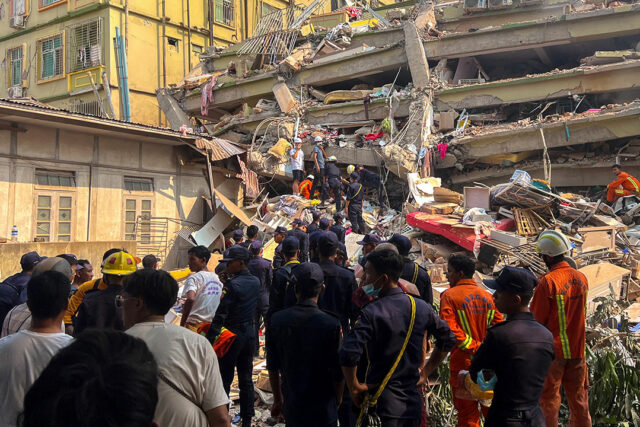
RESCUE PERSONNEL work at the site of a building that collapsed, following a strong earthquake, in Mandalay, Myanmar, March 29, 2025. — REUTERS

In early 2021, after a decade of political and economic reforms, Myanmar looked like it was finally beginning to shake off the hangover of decades of military rule. Foreign investment was growing, and standards of living were gradually improving.

In February that year, however, the military again grabbed power after ousting Aung San Suu Kyi’s democratically elected government in a coup. This sent the country spiraling towards civil war and social and economic collapse.

In the latest addition to the daily misery of Myanmar’s long-suffering people, a huge 7.7-magnitude earthquake hit the center of the country on Friday. Its epicenter was just outside Mandalay, the county’s second-largest city.

The Thai capital of Bangkok, more than 1,000 kilometers from the epicenter, experienced extensive damage too. Video images showed a collapsing building under construction and sloshing rooftop infinity pools causing waterfalls down high-rise condominiums.

Information on the extent of the damage in Myanmar was slower to emerge, given the junta has largely banned social media and communications apps, such as Facebook, Instagram, WhatsApp, Signal, and X.

The death toll has now passed 1,000 at the time of writing. US Geological Survey modelling, however, suggests there could be more than 10,000 deaths and economic losses potentially exceeding the country’s gross domestic product (GDP).

Unusually for the isolationist military juntas of Myanmar, its leader, Min Aung Hlaing, immediately issued a call for international assistance.

The junta, however, has full control of as little as 21% of the country in the ongoing civil war, with the rest contested or controlled by ethnic armed groups and resistance fighters. This indicates some hard-hit areas of the country may be inaccessible to international aid.

Compounding these difficulties, the Trump administration has decimated the US Agency for International Development (USAID) activities in the country. This will make it far more challenging to determine the areas most in need and distribute any aid on the ground.

NATURAL DISASTERS IN MYANMAR
Along with its history of brutal and authoritarian military rule since gaining independence in 1948, Myanmar is also regularly afflicted by natural disasters.

At least 430 people are believed to have died in floods last September due to the remnants of Typhoon Yagi. In 2023, Cyclone Mocha reportedly killed about 460 of the Rohingya ethnic minority, who are largely confined to government camps in Rakhine state in inhuman conditions.

The worst natural disaster in living memory, however, was Cyclone Nargis in 2008, which left at least 140,000 dead. On that occasion, the military junta resisted international assistance, likely resulting in many unnecessary deaths.

At that time, there was no independent media in Myanmar and it was almost impossible to find out what was actually happening on the ground.

Fortunately, the proliferation of mobile phones in the last decade has allowed information to spread much more widely, even with the junta’s internet blocks and other methods of censorship currently in place.

When Cyclone Nargis occurred — the year after the iPhone was launched — only around 1% of the Myanmar’s population had mobile phones. By the time of the coup in 2021, Myanmar had a smartphone penetration rate of 114%. (This means the country has more smartphones than people.)

FOREIGN ASSISTANCE HAS BEEN COMPROMISED
While Min Aung Hlaing has gone farther than his predecessor in 2008 in asking for international help, US President Donald Trump’s actions have ensured that any aid will be far less effective than it would have been two months ago.

On Friday, the same day the earthquake hit, the Trump administration told Congress it would cut nearly all remaining jobs at USAID and shut the agency, closing all USAID missions worldwide.

Jeremy Konyndyk, the president of Refugees International and a former USAID official, called the move “a total abdication of decades of US leadership in the world.” He argued the firings would cut “the last remnants of the team that would have mobilized a USAID disaster response” to the earthquake.

In 2024, USAID spent $240 million in Myanmar, around one-third of all multilateral humanitarian assistance to the country.

However, since Trump’s inauguration in January, the number of USAID programs in Myanmar has shrunk from 18 to just three. Several NGOs and at least seven US-funded hospitals operating along Myanmar’s border with Thailand have been shut down.

Myanmar’s exiled independent media outlets, which shine a light on the military’s atrocities, have also seen their funding slashed by the Trump administration’s USAID cuts.

WHAT HAPPENS NOW?
The day before the earthquake, Min Aung Hlaing addressed troops at the 80th anniversary of Armed Forces Day Parade. He announced national elections would go ahead in December — a vote that human rights groups are already calling a “sham.”

There is no conceivable way elections of any integrity can be held in the country under military rule or while the civil war continues to rage.

Military-backed parties have been overwhelmingly rejected by Myanmar’s electorate in every remotely free or fair election over the last four decades. This includes the most recent elections held in 2020, won by the National League of Democracy (NLD), led by Aung San Suu Kyi.

While the world should welcome — and urgently respond to — Min Aung Hlaing’s invitation for international assistance, this doesn’t mean the past is forgotten. Thousands of innocent lives have been lost as a result of the military’s unnecessary and destructive 2021 coup.

If the NLD had remained in government, the country would be infinitely more prepared to deal with consequences of this earthquake. Once again, the military’s brutal rule — and Trump’s draconian aid cuts — will no doubt cause more unnecessary suffering and deaths.


Adam Simpson is a senior lecturer in International Studies at the University of South Australia.