Home Blog Page 1204

GoTyme disburses over P5B in loans

GOTYME BANK has disbursed over P5 billion in loans as of end-July, driven by continued customer growth.

“We hit seven million customers today, about P32 billion in deposits and over P5 billion in loans,” GoTyme Bank President and Chief Executive Officer Nathaniel D. Clarke told reporters on Thursday.

This puts the digital bank on track to reach its target to have nine million customers by the end of this year, Mr. Clarke added.

GoTyme Bank on Thursday announced its partnership with social media platform TikTok, which aims to help bridge the funding gap for micro, small, and medium enterprises (MSMEs). It launched customizable loans for businesses operating on TikTok Shop, the app’s e-commerce platform.

Meanwhile, the digital bank is also looking to roll out a local stock investing feature within this quarter.

It will also introduce other services such as cryptocurrency trading via its app, cash deposit and withdrawal machines with self-service and off-us functionality, as well as a new reward points earning scheme through Go Rewards.

Under the new scheme, users can get one point per P100 spent at partner stores and a point per P500 spent elsewhere, which they can use to book flights or pay for their purchases.

GoTyme Bank recently launched a buy now, pay later product.

Based on its latest balance sheet, GoTyme Bank had assets worth P35.3 billion as of March. Its gross loan portfolio stood at P5.46 billion, while deposit liabilities were at P28.91 billion in the same period.

The bank booked a net loss of P2.47 billion in 2023, widening from the P909.67-million loss in 2022, due to higher expenses, its latest available annual report showed.

GoTyme Bank began commercial operations in October 2022 and is one of the six digital banks licensed by the Bangko Sentral ng Pilipinas. It is a partnership between the Gokongwei group and Singapore-based Tyme Group. — Aaron Michael C. Sy

Have empathy for Marvic

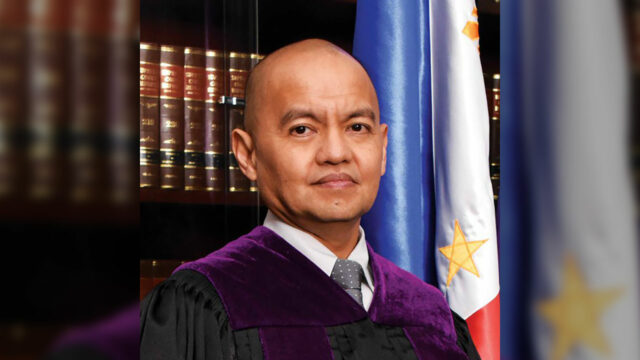
JUSTICE MARVIC M.V.F. LEONEN

This essay is a response to a Manila Standard column written by dear friend and colleague Tony La Viña, titled “Inconvenient truth about impeachment” (Aug. 1).

Tony’s essay is actually a series where he argues that the Supreme Court (SC) decision penned by Justice Marvic Leonen is a significant expansion of judicial power into territory long reserved for politics.

In the same breath, Tony writes: “For the record, I have deep respect for the Justices — many of whom, including the ponente, I know personally. I do not doubt their integrity or independence.”

My piece however does not focus on the correctness or incorrectness of the SC decision. Tony and other great legal minds have discussed the issue thoroughly. My message is about understanding Marvic. I will call the senior associate justice by his first name because like Tony, I know him personally.

Like Tony, I understand where Marvic and the SC are coming from.

To be sure, we can disagree with Marvic. But this must be a healthy debate or disagreement, unlike what’s happening in the public sphere where strident voices are impugning Marvic’s character.

In a healthy debate, we must understand the perspective of Marvic and SC. We must have “empathy” even towards our adversaries. An example is the story of Robert McNamara on how John Kennedy averted a war with the Soviet Union and Cuba by defusing the Cuban missile crisis through empathy. Kennedy’s adviser, Tommy Thompson who knew well the Soviet Union’s head, Nikita Khrushchev, prevailed upon Kennedy to avoid using military force and thus avert a nuclear war in resolving the missile crisis. Reading Khrushchev’s mind, Thompson argued that Khrushchev’s threat was meant to display his toughness to his Soviet constituency but internally, he wanted a graceful exit in resolving the missile crisis.

Here, McNamara defines empathy as understanding the perspective of the enemy. McNamara defines empathy thus:

“We must try to put ourselves inside their skin and look at us through their eyes, just to understand the thoughts that lie behind their decisions and their actions.”

Let’s try to put ourselves inside Marvic’s skin. Let’s walk in Marvic’s shoes.

Marvic is not even an enemy. All the more he deserves empathy.

Empathy does not mean being in agreement with the other party. In the context of strategy, it is about understanding the opposite view towards making better calculations, better decisions.

Furthermore, we will be mistaken to treat Marvic, the Justice, as our ally. He is no longer a civil society advocate; he is a jurist (Tony reminds me). As jurist, he pens decisions not based on what we, the advocates, want or on what is politically correct, but based on impartiality and objectivity. This is the tradition that is embedded in the saying that “justice is blind.”

But at the same time, Marvic, a product of the University of the Philippines (UP) College of Law, is influenced by the legal realism of Oliver Wendell Holmes, Jr., the former US Supreme Court Justice. Upon entering the College of Law building, one is greeted by a quotation from Holmes inscribed on the college’s central wall: The business of a law school…is to teach law in the grand manner, and to make great lawyers.” For Marvic, law in the grand manner is about being critical, being provocative, being controversial. Indeed, he has always been provocative and controversial.

Another famous saying from Holmes is: “The life of the law has not been logic; it has been experience.”

Here, Marvic’s experience is not just about his experience of being victimized by an arbitrary impeachment attempt (which failed). Regardless of this experience, Marvic has seen how impeachment has been used to eliminate political enemies or to grab or perpetuate power by hook or by crook.

Regardless, too, of Marvic’s political leanings (which he ought to keep to himself), Marvic as the jurist wants to apply law in a grand manner for society’s betterment. He cares about good institutions. And he thinks the impeachment process has been bastardized. While impeachment is a political process, Marvic eschews impeachment characterized by arbitrariness, short-cuts, and intense partisanship. That’s the sad reality in the Philippines. And Marvic and the SC want to correct this. But as Tony pointed out, the correction might turn out to be “overboard.” Another term to describe the decision is “overcorrection.”

Nonetheless, finding the delicate balance between the legal and the political is a challenge. Specific contexts dictated by prevailing political, social and economic conditions influence the tilting of the balance to either the political or the legal. I remember what the late Chito Sta. Romana said about an independent or neutral foreign policy: It has an equilibrium shaped by geopolitical realities. But that equilibrium is not static, and the equilibrium is not exactly located at the dead center.

Some decisions Marvic has made, including the one on the impeachment of Vice-President Sara Duterte, are controversial. But let it be said that such decisions are anchored on his deep knowledge and interpretation of legal philosophy, ethics, doctrine, rules and norms.

Another perspective to understand Marvic is his grasp and use of law and economics. He, too, is a product of the UP School of Economics.

The way that impeachment is being done serves partisan politics or trapo politics. Marvic wants to change the behavior (and the incentives) of an essentially trapo Executive and Congress. He wants institutional efficiency. He sees the current practice of impeachment, which if not reformed, will result in tremendous long-term costs to Philippine institutions.

Of course, Marvic and the SC, are all fallible. So are we. No one has the monopoly of what is correct.

My appeal thus is: Have empathy. Understand where Marvic or the SC is coming from.

Marvic is definitely not going to be the caricature of being an “umbrella boy.” Neither can he be accused of making a subjective decision solely based on his own personal traumatic experience with impeachment.

And this is where Tony’s knowing Marvic well becomes constructive and invaluable.

Tony is well familiar with Marvic’s view and attitude towards law and the legal system.

I likewise have known Marvic for close to four decades. And we worked closely as board members of Legal Rights and Resource Center, wherein Marvic was our guiding light.

We are aware of Marvic’s complex persona — his genius, his scholarly mien, his being a terror teacher, his audacity, confidence and strong will, his quirks and idiosyncrasies. An appropriate tagline for Marvic is: Marvic the Maverick.

But to repeat what Tony said, Marvic is now a jurist, and he is constrained by the parameters that he has set as a jurist. We may agree or disagree with him. I, for one, support the criticism raised by others like Tony and Justice Azcuna — that the change in the rules is better applied prospectively.

And so, let’s not cancel Marvic.


Filomeno S. Sta. Ana III coordinates the Action for Economic Reforms.

www.aer.ph

Bringing nature-based skincare to the spa

WITH THE GOAL of introducing a new chapter in wellness through its spa offerings, Conrad Manila is incorporating ISUN Skincare into its new signature therapies.

This marks the Colorado-based product line’s debut in the Philippines. It is found exclusively in Conrad Spa Manila’s refreshed spa menu. Offerings include massage and facial rituals, created “to nurture the mind, body, and spirit” using the organic products.

ISUN Skincare was founded by Bunnie Gulick in 2006, after decades of product formulation, development, and manufacturing experience in the wellness and beauty industries. She decided to start her own brand that focused on healing and rejuvenating.

“ISUN is rooted in nature, rooted in integrity, rooted in intention and healing. As a company, we are committed to sustainability and holistic wellness,” said Tracey Annette Drabløs, director of ISUN Skincare, at the brand’s launch at the Conrad Manila in Pasay City, on July 23.

Their ethos is “an alchemical approach to beauty,” grounded in ISUN’s roots in the San Juan Mountains of Colorado, USA, where they handcraft plant-based formulations spanning cleansers, masks, serums, moisturizers, mists, herbal body oils, and lip care products.

“Like us, Conrad believes in offering holistic wellness experiences, and so together, we have co-created elevated spa rituals that will deeply nourish body, mind, and spirit,” Ms. Drabløs explained.

Created in small batches using organic botanical ingredients, the new products “complement Conrad Spa’s vision of blending luxury with conscious care.”

Treatments incorporate ISUN’s gemstone-infused aromatic oils. Some utilize Chinese medicine techniques like gua sha, where an object is used to scrape the skin for therapeutic benefits, and energy-balancing massages aimed at restoring both physical and emotional health.

Highlights of the Conrad Spa Manila’s refreshed treatment menu include:

• Transcend (90 minutes) — A deeply relaxing massage that “harmonizes energy and restores balance,” using calming aromatherapy blends, energy-balancing gemstones, and herb-infused oils. These products are meant to aid in enhancing energy flow throughout the body.

• Elevate Facial (90 minutes) — A therapeutic and restorative facial designed to target devitalized skin. Here, gua sha is used “to stimulate energy flow and circulation, contour facial angles, and aid in detoxification.”

• Ormus Bath (30 minutes) — A luxurious soak featuring mineral-rich bath salts infused with delicate aromatics. This ritual “offers a grounding and replenishing experience for both body and spirit.”

Guests can book individual treatments or combine them into a wellness experience tailored to their needs. For the full list of spa treatments and rituals, visit Conrad Spa. — Brontë H. Lacsamana

Green lane system rolled out for strategic agri investments

PPA POOL/NOEL B. PABALATE

THE DEPARTMENT of Agriculture (DA) said it issued a joint memorandum circular (JMC) to streamline the approval process for strategic investments in agriculture and fisheries.

“This JMC is a significant step forward in our commitment to making it easier for investors to do business in the Philippines’ agri-fishery sector,” Agriculture Secretary Francisco P. Tiu Laurel, Jr. said in a statement over the weekend.

“With improved coordination and more efficient systems in place, we are creating an environment that attracts investment and drives inclusive rural development,” he added.

Under the JMC, the DA is expected to play a central role in facilitating investments related to agribusiness, agricultural mechanization, food security, and rural infrastructure.

“By removing unnecessary red tape, the JMC is expected to create a more transparent and investor-friendly climate — particularly in underserved rural areas,” it said.

“The DA hopes this initiative will catalyze new investments, modernize farming and fisheries practices, and ultimately lead to increased productivity and profitability for producers,” it added.

A dedicated INFA-Net Focal Unit led by the DA’s Agribusiness and Marketing Assistance Service will be established to ensure “timely coordination and compliance with the circular’s provisions.”

The JMC seeks to enhance the operational mechanism of the Investment Facilitation Network (INFA-Net) while integrating the provisions of Executive Order (EO) No. 18, Series of 2023.

Signed in February 2023, EO 18 institutionalized green lanes for strategic investments, which authorizes the fast-tracking of permits, licenses, and registrations for major investment projects.

The JMC was co-signed by 38 national government offices. — Justine Irish D. Tabile

SEC warns public against Sana Credit

SEC.GOV.PH

THE Securities and Exchange Commission (SEC) has issued a cease-and-desist (CDO) order against Sana Credit over its operation of an online lending platform (OLP).

The commission’s Financing and Lending Companies Department issued the order on July 28, directing Sana Credit to halt its lending activities due to the absence of required registration and approval.

Sana Credit was reported to have a virtual presence on the App Store, Play Store, LoanPHI, and Similarweb.

According to the SEC, Sana Credit has violated SEC Memorandum Circular (MC) No. 19 issued in 2019 that requires financing and lending companies to fully disclose and report the OLPs they operate, as well as MC No. 10 issued in 2021 that imposed a moratorium on new OLPs.

“By operating an unregistered and undisclosed online lending platform, [Sana Credit] effectively circumvents the commission’s regulatory and supervisory authority. Consequently, the general public, particularly borrowers, are exposed to potential risks, including abusive and unfair debt collection practices, unjust interest rates, [and] violation of data privacy rights,” the order read.

“In light of [Sana Credit’s] continued unauthorized operation of its OLP, the commission finds it necessary to issue this [CDO] in order to prevent further harm or prejudice to the public, and to safeguard the integrity of the regulatory framework governing lending companies,” it added.

The SEC has the power to conduct enforcement actions against financial service providers as provided under Republic Act No. 11765 or the Financial Products and Services Consumer Protection Act. — Revin Mikhael D. Ochave

BSP’s short-term securities fetch lower yields

Bangko Sentral ng Pilipinas main office in Manila. — BW FILE PHOTO

YIELDS on the Bangko Sentral ng Pilipinas’ (BSP) short-term securities fell further on Friday as it capped its accepted rates for the two-month tenor despite the oversubscription.

The BSP bills fetched bids amounting to P136.183 billion on Friday, higher than the P130-billion offer but below the P162.008 billion in tenders for the P90-billion auctioned off a week prior. However, the central bank only awarded P120.066 billion in securities as it made a partial award of the two-month papers.

Broken down, tenders for the 28-day BSP bills reached P64.217 billion, above the P60 billion placed on the auction block but lower than the P76.398 billion in bids seen for the P40-billion offer seen the prior week. The BSP fully awarded the one-month papers.

Banks asked for rates ranging from 5.3% to 5.432%, higher but narrower than the 5.2625% to 5.408% band seen a week earlier. This caused the weighted average accepted rate of the one-month securities to decline by 1.34 basis points (bps) to 5.3842% from 5.3976% previously.

Meanwhile, bids for the 56-day bills amounted to P71.966 billion on Friday, a tad higher than the P70-billion offering but less than the P85.61 billion in tenders for the P50-billion auctioned off in the previous week. The central bank made a partial P60.066-billion award of the two-month securities as it only accepted bids that had lower yields versus those seen in the prior week.

Accepted rates were from 5.365% to 5.41%, a wider and lower margin compared to the 5.395% to 5.42% range seen the week prior. With this, the average rate of the 56-day securities dropped by 1.43 bps to 5.391% from the 5.4053% logged in the previous auction.

The central bank said the BSP bill (BSPB) yields continued their downtrend on Friday.

“Both tenors were oversubscribed, with bid-to-cover ratios of 1.07 times for the 28-day BSPB and 1.03 times for the 56-day BSPB,” it said in a statement.

The central bank uses the BSP securities and its term deposit facility to mop up excess liquidity in the financial system and to better guide short-term market rates towards its policy rate.

The BSP bills also contribute to improved price discovery for debt instruments while supporting monetary policy transmission, the central bank said.

The central bank securities were calibrated to not overlap with the Treasury bill and term deposit tenors also being offered weekly.

Data from the central bank showed that around 50% of its market operations are done through its short-term securities.

The BSP bills are considered high-quality liquid assets for the computation of banks’ liquidity coverage ratio, net stable funding ratio, and minimum liquidity ratio.

They can also be traded on the secondary market. — Luisa Maria Jacinta C. Jocson

Toyota girds for TGR PHL Cup season finale

PHOTO BY KAP MACEDA AGUILA

THE TOYOTA GAZOO RACING (TGR) Philippine Cup, Toyota Motor Philippines’ (TMP) premier one-make racing series, is set to return to the Clark International Speedway in Mabalacat, Pampanga on Aug. 9 for its third and final race weekend of the 2025 season.

Leading the standings in the Super Sporting Class is Russel Cabrera of Toyota Team Cebu-Standard Insurance, followed by Alain Gabriel Alzona of Toyota General Santos-Smart Communications Racing, and Michael Bryan Co of R Garage/Toyota Dagupan Group. In the Sporting Class, Jesse Garcia of Obengers Racing-Toyota Balintawak leads the standings, then Russel Reyes of Toyota Gazoo Racing Philippines and Raymond Cudala of R Racing-MADkart. The Novice Class is led by Luis Moreno of Toyota Gazoo Racing Philippines-Novice Team, with teammates Pablo Salapantan (of Yuga Auto and “Velocity”) and TMP President Masando Hashimoto in second and third places, respectively.

Two sprint races will be held over the weekend, with a 1.5-hour endurance race also making a comeback to put both racers and cars to the test. Making its debut at Race Weekend 3 is the Tamaraw Sprint Race Exhibition, a showdown of the Tamaraw one-make-race (OMR) model previously introduced as the Tamaraw Racing Concept during Race Weekend 2 at Villar City. Driving the Tamaraws will be former Vios Cup Super Sporting Class champions Allan Uy (2016), Daniel Miranda (2017), Estefano Rivera (2021) and John Dizon (2023), and previous Vios OMR Test Driver Tyson Sy. The next-generation Tamaraw will also be showcased in an exhibition drag race to further test its capabilities as a racing vehicle. Meanwhile, owners of the GR Yaris, GR Supra, and GR 86 will have a five-lap circuit race, and a drifting exhibition will also be staged.

At the activity area, freebies and prizes will be up for grabs at the sponsors’ booths and game booths. Sim racing rigs will be set up for attendees seeking to test their skills on virtual tracks.

As a teaser to its upcoming e-motorsports competition in August, the Toyota Gazoo Racing Philippines eSports GT Championship 2025, TMP will also be holding free qualifiers for interested sim racers. Fans can also enjoy car displays of Toyota’s GR and GR-S lineups, and various Toyota Car Club vehicles. Original GR merchandise including shirts, caps, and umbrellas will also be available for sale.

Local pop and alternative rock band Over October will be performing, followed by the awarding ceremonies for Race Weekend 3. “It’s the final race weekend of the year, so we want to end on a high with new activities such as the Tamaraw Sprint Race, and the return of the endurance race. We invite everyone who got a taste of the thrill of motorsports last Race Weekend 2 to join us for Race Weekend 3, where we’ve packed even more exciting activities,” shared TMP Assistant Vice-President for Marketing Services Andy Ty.

The TGR Philippine Cup is sanctioned by the Automobile Association Philippines and is presented by official fuel and lubricant partner Petron and official tire partner GT Radial. The event is also supported by official timekeeper Seiko, Toyota Financial Services Philippines, Tuason Racing, AVT, 3M, Denso, OMP, ROTA, Autoplus, PIAA, Vinyl Frog Premier Vehicle Wraps, AutoQuix, Bebang Halo-Halo, myToyota Wallet, and Kinto One.

The event will be broadcast live on the Toyota Gazoo Racing Philippines Facebook page and YouTube channel starting 8:30 a.m. For more information on the TGR Philippine Cup and other TGR events, visit https://toyota.com.ph/tgrphilippines and follow Toyota Gazoo Racing Philippines on Facebook, Instagram, X, YouTube and TikTok; along with TMP’s official (ToyotaMotorPH) accounts on Facebook, Instagram, and X. TMP is also on Viber (Toyota).

One Eye of all storms

PHILIPPINE STAR/MIGUEL DE GUZMAN

Après le deluge.

There is, of course, Biblical flooding. Last week’s floods in Luzon — which managed to still surprise a Philippines so familiar with annual delubyo — seemed less the result of three typhoons embroiled in the southwest monsoon, than with immense narratives of wrongdoing and retribution.

In Judaic culture, the earth-altering floods survived by the patriarch Noah, his family, and paired animals has had a humongous place in the imagination through at least 5,000 years. Originally for an ethnic group, the Hebrew-speaking Semites, the story belongs to the primeval, the beginning of the known world.

That is to say, the beginning of the monotheistic world. Indeed, that big a change.

The flood story is in Genesis, the first book of what eventually became the Christian Bible, but originally part of the Jewish Torah or the Pentateuch. Noah, who is Nuh in Arabic, and his ark, are also fundamental to the philosophical arc of the Islamic Quran.

The deluge wiped out believers of pagan gods and cleared the earth for One God in the Abrahamic religions.

Flash forward to right now: New York City and New Jersey have been declared under a state of emergency because of runaway flooding. The subways are flooded, and transport infrastructure is overwhelmed by the continuing torrential rains and a slow-moving cold front.

Considering that New York City is the global epitome of modern ascendance over nature, its current situation seems to suggest natural and cultural change of, well, Biblical proportion.

Après le deluge, New Yorkers, Filipinos, and many other folks from everywhere visited by floods of unprecedented scale will return to “regular programming.” But they will nonetheless carry a kernel of deep worry about what is massively ending and what is beginning.

FLOODING THE IMAGINATION
Floods overwhelmed people and places used to these events, but also those that do not know or remember how bad it can be. It literally dawned on the survivors of this year’s 4th of July floods in Hill Country, Texas that the sheer scale of the flooding — the Guadalupe River rose 26 feet in 45 minutes — can only be comprehended as the hard reality of climate change.

And also: that disaster is very much bigger indeed when alertness to the details of change slackens because of bureaucratic blunders, an anti-science culture on the ascendance, a collective denialism of the climate sciences, and so forth. The death of more than a hundred in Texas cannot be shunted outside collective memory in the United States.

What floods flood the imagination with are memories of quick humanitarian response to great odds. Floods challenge human endurance because hope is plausible, as much as human infrastructure collapse and death all around are likely. Floods hold both potentials: annihilation or salvation, or some combination of both.

Floods also erode human arrogance, particularly that which used to muscularly support modern ideas. “Cities like New York,” writes a commentator from The Logical Indian, a South Asian news platform, continuing, “…with large impervious surfaces such as concrete and asphalt, face heightened flood risks because rainwater fails to absorb easily into the ground.” The concrete and asphalt can now be seen as counterproductive to modern ambition.

Little wonder that floods are inevitably enormous in the imagination, no matter what eon in human history. It holds up extreme hope that human capacity to act quickly and rethink things can save the day — but always under the extreme duress of losing all that was previously held dear, including life itself.

REAL EYE OF THE STORM
In June of 2024, a report from Germany from “Floodlist” of the European Center for Medium Range Weather Forecasts: “Multiple rivers broke their banks in… Bavaria, the Schmutter, Cham, Paar, Ilm, Danube and Isar all reached above the level 4 (highest) warning levels in several locations. Several dam breaks and dike failures were also reported, including in Augsburg District and in the district of Pfaffenhofen an der Ilm, where around 800 people have been evacuated from the town of Baar-Ebenhausen.”

The same platform writes about Afghanistan a month earlier. “The catastrophic floods struck on 10 to 11 May 2024… the World Health Organization reported over 300 fatalities in the provinces of Baghlan, Takhar, and Badakhshan. This figure was provisional and given the scale of the disaster was expected to rise further. Floods also damaged or destroyed thousands of homes. Livestock losses have added to the toll of destruction.”

According to Save the Children, 300,000 Afghan children needed support, especially for the estimated 310,000 children residing in the worst-affected districts. Everywhere in the world where floods ran through habitations, whether in the US state of Texas or Afghanistan’s Baghlan Province, cries for humanitarian help are focused on saving children more than any other demographic. People rest their deepest hope in preserving the lives of the next generation. Apparently this is an enduring definition of what it means to be human.

Chaos descended upon Buenos Aires in March 2024 as a mean total rainfall of 140.1 mm fell on it. The airport, 11 major roadways, and all public transport ground to a halt. Many could not be evacuated, as it was in eight significant flood events in 2024 in Corrientes, Buenos Aires, Jujuy, and Córdoba Provinces of Argentina. In the same month of the same 2024, 80,000 people were forced to evacuate in Sumatera Utara, Indonesia, as landslides and floodwaters rushed through both rural and urban areas. In Padang, the capital of this province, 10,000 homes were impacted.

The eyes of all these storms in Oman, France, Brazil, Uruguay, and all of the places mentioned, and this year, only halfway into whatever nasty surprises are in store, when Pakistan, Nepal, India, and the Republic of Korea have already been hit badly, are as though One Eye. It is that peaceful, terrible center of weather turmoil where/when there is a momentary break from alertness, and some clarity is possible.

Through that eye, that should allow people to see as far back as perhaps 5,000 plus years ago to a Fertile Crescent that at that time was tropical and not desert, to just yesterday’s struggles with only the latest of recurrent deluges, it is possible to see that the warming oceans are producing more and more violent storms; that the ways humans build cities and farms and transport systems are not going to help mitigate the scale of disaster; that the human capacity for hope must be vested in grasping natural and cultural systems collapse.

And grasping all that is as gigantic a change as the shift to monotheism eons ago.


Marian Pastor Roces is an independent curator and critic of institutions. Her body of work addresses the intersection of culture and politics.

India carves out industries to protect vs US imports

MUMBAI — US President Donald J. Trump imposed a 25% tariff on Indian goods after prolonged talks that got bogged down over access to India’s labor-intensive agricultural sector, which New Delhi has pledged to protect.

The United States is pressing India to open its markets to a wide range of American products, including dairy, poultry, corn, soybeans, rice, wheat, ethanol, fruits and nuts.

While India is willing to provide greater access for US dry fruits and apples, it is holding back on corn, soybeans, wheat, and dairy products.

A key reason for this resistance is that most US corn and soybeans are genetically modified (GM), and India does not permit the import of GM food crops.

GM crops are widely perceived in India as harmful to human health and the environment, and several groups affiliated with Prime Minister Narendra Modi’s ruling Bharatiya Janata Party (BJP) are opposing their introduction. The commercial cultivation of a high-yielding GM mustard variety that India developed itself is currently not allowed due to an ongoing legal battle.

Like GM crops, dairy is also a highly sensitive issue, as it provides a livelihood for millions of farmers, including many who are landless or smallholders. The dairy industry helps sustain farmers even during erratic monsoon seasons, which can cause significant fluctuations in crop production.

In India, where a large proportion of the population is vegetarian, food choices are strongly influenced by cultural and dietary preferences. Indian consumers are particularly concerned that cattle in the US are often fed animal by-products — a practice that conflicts with Indian food habits.

India is self-sufficient in most farm goods, with the exception of vegetable oils. After liberalizing cooking oil imports over three decades ago, the country now has to import nearly two-thirds of its supply to meet demand. India does not want to repeat this mistake with other basic foods, which account for nearly half of its consumer price index.

Though agriculture makes up just 16% of India’s nearly $3.9-trillion economy, it is the lifeblood for nearly half the country’s 1.4 billion people. Four years ago, this powerful voting bloc forced Mr. Modi’s government into a rare retreat on a set of controversial farm laws.

Some in power fear a flood of cheaper US imports would bring down local prices and hand opposition parties an opportunity to sharpen its attack on the government. New Delhi is also worried that a trade deal with the US could also force it to open its agricultural sector to other countries.

The vast disparity in the scale of farming makes it difficult for Indian farmers to compete with their US counterparts.

The average Indian farm is a 1.08 hectares (2.67 acres), compared to 187 hectares in the US. For dairy farmers, the difference is even more dramatic — a small herd of two or three animals versus hundreds or more in the US.

Many Indian farmers also rely on traditional, unmechanized techniques, while American agriculture has developed into a highly efficient, tech-driven industry.

One of India’s key goals with its Ethanol Blended Petrol (EBP) program is to reduce energy imports and support domestic farmers by using sugarcane and corn for biofuel production.

Indian companies have invested heavily in new distilleries, and farmers have expanded corn cultivation to meet the rising demand. India recently achieved its ambitious target of a 20% ethanol blend in petrol.

With state assembly elections approaching in Bihar — a major corn-producing state in the east — allowing US ethanol imports would lower corn prices. This would probably anger farmers and turn them against the BJP ahead of the election and also undermine the growing distillery sector. — Reuters

Japanese shoe store opening in Manila

ARTIST’S rendition of the first ABC-MART Grand Stage store.

ABC-MART, the landmark Japanese footwear retailer, will be opening stores in the Philippines starting September.

This was announced at a press conference in Bonifacio Global City (BGC) on July 28 by Koji Higashimae, chief executive officer (CEO) of ABC-Mart Sonak Philippines. “This expansion marks a significant milestone for ABC-Mart,” he said.

“Our Grand Stage store, opening this September in BGC, will be a flagship destination, showcasing our extensive collections in a dynamic and engaging space,” he added. “But that’s just the beginning. In the near future, we will also be rolling out our Standard stores.”

ABC’s entry in the Philippines is a part of its strategic expansion plan in Southeast Asia. “It’s a large and dynamic market for ABC-Mart, and we believe that our collaboration with Sonak Retail Group will deliver outstanding outcomes,” said Kiichiro Hattori, vice-president of ABC-Mart, in a statement. “We’re eager to bring the distinct retail experience and curated brand assortment to the style-conscious Filipino shopper.”

ABC-Mart Sonak Philippines comes here through a joint venture between the Japanese retailer and Sonak Retail Group, headed by CEO Anil Buxani. Currently, Sonak distributes brands like ASICS, Onitsuka Tiger, Molten, and Mikasa in the Philippines.

The first store to open, the ABC-Mart Grand Stage flagship format, will be located in Bonifacio High Street, said incoming Chief Executive Officer and Director of Sonak Retail Group Kabir Buxani.

Measuring 750 square meters over two floors, it will offer exclusives from Nike, Adidas, ASICS, Puma, New Balance, Skechers, Timberland, Vans, Crocs, Salomon, and more. This will also be the first ABC-Mart in the world with a dedicated wellness corner.

The second location, in the Standard Concept format, will open at nearby Mitsukoshi.

In an interview, Kabil Buxani told BusinessWorld, “ABC-Mart is a big step forward for us in terms of our lines of sneakers and fashion. With this, it takes it to a whole new level because of how many brands we have available to offer.”

The Philippines seems to be a ripe market for sports fashion, considering recent openings of stores for brands like Alo Yoga and JD Sports by another retailer, Stores Specialists, Inc. “If you take a look at the share pricing of these new sport-style fashion brands, you see there’s almost a triple-digit growth since COVID times,” said Anil Buxani. “It’s very apparent that the shift of fashion is definitely moving into something more comfortable, something more practical to wear.”

For more information, visit ABC-Mart Philippines on Instagram @abcmartph.grandstage and @abcmartphilippines. — Joseph L. Garcia

Robinsons Retail eyes more Premiumbikes stores

PREMIUMBIKES.PH

GOKONGWEI-LED Robinsons Retail Holdings, Inc. (RRHI) said it is looking to further expand its motorcycle dealership business nationwide following its acquisition of Premiumbikes Corp.

“We’re still very small compared to the number one player, and you see the number of motorcycles on the road. So, there’s definitely opportunity for us to really expand and open more stores, capture more areas,” RRHI President and Chief Executive Officer (CEO) Stanley C. Co told reporters on the sidelines of an event last week.

“For example, you don’t even see Premiumbikes in our malls.”

Robinsons Supermarket Corp., a wholly owned subsidiary of RRHI, recently signed a definitive share purchase agreement to acquire 100% of Premiumbikes from Lance Y. Gokongwei, the president and CEO of JG Summit Holdings, Inc.

In a regulatory filing last week, the P146.4-million deal involves the acquisition of 20.15 million shares at P7.27 per share, with its transaction value equivalent to 1.0x the audited book value of Premiumbikes for 2024.

RRHI is also open to further expanding Premiumbikes in the Visayas and Mindanao, Mr. Co said, noting that most of its stores remain concentrated in Luzon.

“We’re really covering the whole country,” Mr. Co said.

Premiumbikes, which carries motorcycle brands like Honda, Yamaha, Suzuki, Kawasaki, Kymco, and TVS, has about 214 stores nationwide.

In 2024, Premiumbikes’ net income grew by 15.2% to P4.17 billion. Its earnings before interest, taxes, depreciation, and amortization (EBITDA) jumped by 36.7% to P324.2 million.

RRHI, the retail arm of JG Summit, has a portfolio of 2,448 stores as of end-March. This consists of 760 food stores, 1,131 drugstores, 50 department stores, 225 DIY stores, 282 specialty stores, and 2,116 franchised stores under The Generics Pharmacy brand.

At the local bourse on Thursday, RRHI shares rose by 0.13% or 5 centavos to close at P38.05 per share. — Beatriz Marie D. Cruz

Gov’t debt yields end mixed on BSP, Fed bets

YIELDS on government debt traded on the secondary market ended mixed last week amid expectations of further monetary easing by the Bangko Sentral ng Pilipinas (BSP) and with the US Federal Reserve staying cautious.

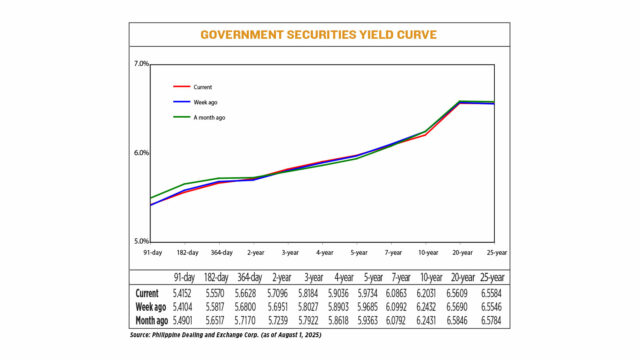
Yields on government securities (GS), which move opposite to prices, inched down by an average of 0.42 basis point (bp) week on week, according to data from the PHP Bloomberg Valuation System Reference Rates as of Aug. 1 published on the Philippine Dealing System’s website.

At the short end of the curve, the 91-day Treasury bill (T-bill) inched up by 0.48 bp to fetch 5.4152%. Meanwhile, yields on the 182- and 364-day T-bills dropped by 2.47 bps and 1.72 bps to 5.557% and 5.6628%, respectively.

At the belly, GS rates mostly went up. Yields on the two- three-, four-, and five-year Treasury bonds (T-bonds) climbed by 1.45 bps (5.7096%), 1.57 bps (5.8184%), 1.33 bps (5.9036%), and 0.49 bp (5.9734%), respectively. On the other hand, the seven-year bond declined by 1.29 bps to fetch 6.0863%.

Lastly, at the long end of the curve, the rates of the 10- and 20-year notes dropped by 4.01 bps and 0.81 bp to 6.2031% and 6.5609%, respectively. Meanwhile, 25-year T-bond inched up by 0.38 bp to yield 6.5584%.

GS volume traded slid to P26.1 billion on Friday from the P64.31 billion the week prior.

Jonathan L. Ravelas, senior adviser at Reyes Tacandong & Co., said GS yields were mostly lower earlier in the week on prospects of further policy easing from the BSP, but tempered Fed cut bets affected the market.

“The Fed’s decision to maintain its policy rate at the 4.25%–4.5% range signaled a continued ‘wait-and-see’ approach amid still-resilient US economic data. This cautious stance, coupled with a stronger US dollar and firmer Treasury yields, prompted local fixed income investors to turn defensive. As a result, Philippine government bond yields saw a slight upward bias, particularly in the belly and long end of the curve, as participants reassessed risk premiums amid the global rate uncertainty,” ATRAM Trust Corp. Vice-President and Head of Fixed Income Strategies Lodevico M. Ulpo, Jr. said in a Viber message.

BSP Governor Eli M. Remolona, Jr. said on Wednesday that a rate cut is “on the table” at the Monetary Board’s Aug. 28 review. If realized, this would mark the BSP’s third straight easing move since April.

The BSP has so far reduced borrowing costs by a total of 125 basis points since it began its easing cycle in August last year. Mr. Remolona added that he is keeping his outlook for two more rate cuts this year. After this month’s review, the Monetary Board has two remaining meetings scheduled in October and December.

Meanwhile, the Fed on Wednesday left its benchmark interest rate in the 4.25%-4.5% range as policymakers stayed on the sidelines to see how US President Donald J. Trump’s aggressive regime of large import tax increases will affect the economy and inflation pressures, Reuters reported.

Fed Chair Jerome H. Powell’s comments after the decision undercut confidence the central bank would resume its policy easing in September as had been widely anticipated by financial markets and some economists.

Two Fed officials opposed that stance and wanted a rate cut, worried that risks to the job market are rising and that the inflation threat posed by tariffs is transient.

The Fed’s dissenters found some support for their concerns in the Friday release of weaker-than-expected jobs data that was particularly notable for downward revisions to prior month’s job gains. Some Fed officials who spoke on Friday noted the report with concern but said they need to see more evidence the job market is running into trouble before changing their views on monetary policy.

Mr. Trump reacted to the jobs data with a double-barreled attack, hitting the Fed for not cutting rates while directing his staff to fire the commissioner of the Labor department’s Bureau of Labor Statistics, claiming without evidence the hiring numbers had been rigged. Mr. Trump’s move rattled markets and raised questions about the future integrity of one of the most important statistical reports financial markets rely upon.

Late on Friday, traders were betting on an 87.5% probability for a September rate cut compared with 37.7% on Thursday, according to CME Group’s FedWatch tool.

Mr. Ulpo added that the upcoming retail Treasury bond (RTB) offering this week also led to a “cautious tone” in the bond market.

“Yields reflected this defensive positioning, especially on the medium to long tenor rates. Investors anticipated this issuance would help the government refinance near-term maturities while also addressing budgetary needs,” he said.

The Bureau of the Treasury is holding the rate-setting auction for its offer of five-year RTBs on Tuesday and wants to raise at least P30 billion from the issuance. The public offer period will run from Aug. 5 to Aug. 15, unless ended earlier by the Treasury.

“Globally, the uptick in US Treasury yields, driven by stronger-than-expected economic prints, added upward pressure on local rates,” Mr. Ulpo added.

For this week, Mr. Ravelas said yields may move sideways as the market awaits the release of July inflation data on Tuesday (Aug. 5).

A BusinessWorld poll of 17 analysts yielded a median estimate of 1.2% for the July consumer price index, within the central bank’s 0.5%-to-1.3% forecast for the month.

If realized, the July print would be slower than the 1.4% in June and 4.4% clip in the same month a year ago.

“The pricing and demand for the upcoming RTB issuance will set the tone for local bond trading [this] week. Investors are expected to position around expected term premiums, with secondary market yields adjusting depending on the pricing level and bid strength of the RTB auction,” Mr. Ulpo said.

“A strong showing could anchor rates, while a tepid response may push yields higher across the curve. Investors should monitor bid award volume, allocation trends, and overall participation dynamics during the RTB offer period.” — Matthew Miguel L. Castillo with Reuters

ADVERTISEMENT
ADVERTISEMENT