Home Blog Page 1096

Vehicles procured via e-portal valued at nearly P290 million

DBM

VARIOUS agencies have taken possession of nearly P290 million worth of motor vehicles (MVs) procured via the e-Marketplace platform, the Department of Budget and Management (DBM) said on Tuesday.

The DBM’s Procurement Service (PS) reported that 153 vehicles have been delivered to 50 government agencies as of Aug. 26.  The vehicles were acquired for a combined P289.936 million.

The DBM also reported that 30 more agencies are awaiting the delivery of 56 vehicles, valued at P115.72 million.

“When compared to the Authority to Purchase Motor Vehicle — a documentary requirement for procuring entities to procure MVs which indicates the budget ceiling for purchase — the savings shoot up to P27.43 million,” the DBM said via Viber.

The e-Marketplace is an official electronic commerce platform where agencies can directly procure supplies and equipment from vetted suppliers.

The PS said only motor vehicles are currently available on the e-Marketplace but expects to add airline tickets, cloud computing services, and software and licenses soon.

The e-Marketplace currently lists 83 vehicle models available for procurement, including multi-purpose vehicles, passenger vans, utility vans, sport utility vehicles, sedans, buses, mini buses, and pick-up trucks. 

The e-Marketplace had been projected to process at least P320 million in transactions this year.

The e-Marketplace is a feature of the New Government Procurement Act, which was signed into law by President Ferdinand R. Marcos, Jr. in July 2024. — Aubrey Rose A. Inosante

Aramco acquisition of 25% stake in Unioil cleared by competition regulator

UNIOIL.COM

THE Philippine Competition Commission (PCC) said it cleared the proposed acquisition by Aramco Asia Singapore Pte. Ltd. of a 25% stake in Unioil Petroleum Philippines, Inc. and Unioil Energy Pte. Ltd.

In a statement, the regulator said it does not see the transaction resulting in a substantial reduction of competition in the relevant markets.

The PCC noted that “the parties have limited shares, there is substantial competition from other established players, and the entry of new players is likely, timely, and sufficient due to low barriers to entry.”

Aramco Asia is an affiliate of Saudi Arabian Oil Co. (Saudi Aramco) and renders sales, marketing, procurement, and logistics services out of Singapore.

Unioil Petroleum is a fuel retailer while Unioil Energy is a trading company that ships in gasoline and diesel to the Philippines.

In February, Aramco Asia and Unioil Petroleum announced a definitive agreement for a stake sale, marking Saudi Aramco’s return to the Philippine market.

Saudi Aramco used to own 40% of Petron Corp. but divested in 1994.

Under the Philippine Competition Act, the PCC is tasked with reviewing mergers and acquisitions (M&As), including foreign transactions, that meet notification thresholds, to ensure that the deals do not harm competition.

Earlier this year, the PCC raised the thresholds for notifiable M&A deals to a size of party of P8.5 billion and a size of transaction of P3.5 billion. — Justine Irish D. Tabile

PHL digitalization deepens, but rules for AI in education lacking

STOCK PHOTO | Image from Freepik

By Aaron Michael C. Sy, Reporter

THE DIGITALIZATION of Philippine industries is deepening, with adopters starting to harness its full potential in response to regulation supporting more access to services, industry representatives said.

“In the past 12 months, we see that the questions are now more of: how do I use all this potential? And particularly for those that are in the learning and development in organizations, it’s more around how do you keep up with the best versions and upskill your employees?” Michelle Alarcon, AI Association of the Philippines president, told a panel at the Manila Tech Summit on Tuesday.

However, companies and regulators are working to counteract risks stemming from emerging technologies such artificial intelligence (AI) as adoption accelerates, such as scams, summit participants were told.

Ms. Alarcon said the Analytics and AI Association of the Philippines (AAP) has grown to more than 1,000 members from only 20 last year.

Benito Teehankee, De La Salle University professor of Management and Organization and chairman of the AAP’s Responsible AI Council, noted that the education industry AI push has been hampered by lack of development in rules governing student use.

“Students cannot string sentences together anymore because of their abuse of AI. Let’s put it as plain as that. But teachers are trying to better guide them on how to use it properly,” he said.

Over the last year, organizations have been working to upskill their employees on AI and other digital tools to ensure that humans remain in the loop.

“I think what has happened is people have realized over the last 12 months that… organizations need to be digital-ready and AI ready,” according to Eugene S. Acevedo, an Asian Institute of Management vice chairman and former Rizal Commercial Banking Corp. president and chief executive officer.

He noted that digitalization has been led by regulators upskilling their own workers.

“The good thing is that our Monetary Board was actually first in terms of trying to upskill themselves when it comes to AI and AI strategy. I mean, we’re not expecting them to be technical in terms of AI, but understanding the technology so that when they do discuss policy, they understand the effect and impact of this technology. I think it starts with enabling them with the knowledge.”

Eugene C. Teves, chief information officer of the Bangko Sentral ng Pilipinas Technology and Digital Innovation Office, said consumer trust should be the main focus of organizations as digital attacks such as fraud and scams have only become more frequent as digitalization deepens.

“How do we still maintain trust in the financial sector? I think one thing we are encouraging financial institutions to look for is use cases where AI can really secure our financial network. But on top of that, there’s good that AI creates, but there’s also bad. You’ll see a lot more scams, more issues, because of this new AI.”

PPP being considered for LRT-2 West extension line 

LRT-2 / TWITTER

THE Department of Transportation (DoTr) said it is planning to tap the private sector for the Light Rail Transit Line 2 (LRT-2) West expansion project.

Transportation Secretary Vivencio B. Dizon said in a statement that the DoTr is considering implementing the project through a public-private partnership (PPP) due to limited funds.

“The LRT-2 project is currently in the development stage for PPP structuring, covering its operations and maintenance; rehabilitation and expansion,” the PPP Center said when queried by Viber. It said this includes an option to tap the private sector for the West Extension project.

The feasibility study for this project is expected to be completed by the end of this month, the PPP Center said.

In January, the Light Rail Transit Authority (LRTA) said the construction of LRT-2’s West Extension project had suffered further delay due to funding unavailability.

The operator of the LRT-2 line has said that no definite construction date has been set for the project as a result, with the rail line also lacking a multi-year obligational authority, a prerequisite for budgeting projects that take multiple fiscal years to complete.

The DoTr said last year that it is hoping to begin construction of the West Extension project in 2025.

The proposed LRT West Extension covers three kilometers from the current Recto Avenue station terminus to Pier 4. This line will have three stations: Tutuban, Divisoria and Pier 4.

The project also includes the procurement of additional light rail vehicles to meet growing passenger demand.

The LRTA has obtained P2 billion for the project to support preliminary activities such as acquiring right of way.

Also on Tuesday, Mr. Dizon said the DoTr is set to order e-commerce platforms to block listings for reselling beep cards.

Beep cards, created by AF Payments, Inc., are stored-value cards used on trains and buses in Metro Manila.

Mr. Dizon said charges are pending against e-commerce platforms for allowing the unauthorized sale of beep cards online.

The DoTr added that there is no shortage of beep cards following the delivery of around 300,000 units for Metro Rail Transit Line 3 (MRT-3); LRT-1 and LRT-2. — Ashley Erika O. Jose

Hong Kong IPA touts low taxes, market access to PHL investors

REUTERS

By Beatriz Marie D. Cruz, Reporter

HONG KONG is touting its favorable tax regime and market access to attract investment from Philippine conglomerates, technology companies, and high net worth individuals.

Invest Hong Kong (InvestHK), the city’s investment promotion agency (IPA), added that the Philippines “also has a lot of wealthy family businesses, large conglomerates. So, when they want to plan for their wealth management, traditionally, a lot of them have done in Singapore, but they know about Hong Kong now,” Alpha Lau, director-general of investment promotion at InvestHK, said at a media roundtable on Tuesday.

“We want to see more opportunities, particularly for tech companies and entrepreneurs, to expand overseas and Hong Kong is the best place to do it,” she said.

Last year, Hong Kong was the Philippines’ fifth-largest trading partner with bilateral trade in goods worth $13.9 billion.

Ms. Lau noted key investment opportunities in Hong Kong’s emerging technology sector, particularly in artificial intelligence, life and health science, advanced manufacturing, sustainability and green technology, and financial technology.

She also cited potential investments in traditional sectors like financial services, wealth management, and family offices.

Hong Kong enjoys easy access to Asia’s key markets like China, Singapore, and Japan, all reachable in under four hours, Ms. Lau said.

It is also one of the world’s busiest container ports, with about 320 container vessel sailings weekly to 470 destinations.

Investing in Hong Kong also ensures access to the Guangdong-Hong Kong-Macau Greater Bay Area, which accounts for 11% of China’s gross domestic product (GDP), Ms. Lau said.

She also cited Hong Kong’s tax rate of 8.25% on the first 2 million Hong Kong dollars  (HK$) in profit and 16.5% on profits above HK$2 million.

She added that Hong Kong charges no tax on capital gains and does not have value-added tax and withholding tax on investments, among others.

Hong Kong is home to over 2,700 family offices and 2,633 listed companies.

“We also allow for multiple listings, as we have an agreement with the stock exchanges around the world,” Ms. Lau said. “So, if a Philippine company wants to get listed, you can do it in Hong Kong, but if you want to also support your home IPO (initial public offering) market, then you can do a dual listing.”

Ms. Lau said the global tariff situation is currently “difficult to understand.”

“If you have multinational businesses or are trading with many countries, you need to have a quick reaction center to manage your supply chain and financials,” Ms. Lau said.

The Philippines and Hong Kong are set to conduct a second round of negotiations on a double taxation agreement in October, according to Libera Cheng, director-general of the Hong Kong Economic and Trade Office in Jakarta.

PHL milk production up 11.4% in first half

REUTERS

MILK production in the six months to June rose 11.4% to 18.16 million liters, according to the National Dairy Authority (NDA).

Milk from cattle accounted for 60.4% or 10.98 million liters, the NDA said in a report.

Carabao milk made up 14.5% or 2.64 million liters of the total, it added.

Goats, meanwhile, accounted for 11.8% or 2.14 million liters.

In NDA-assisted areas, cow’s milk and goat’s milk production rose  11.7% and 47.5%, respectively.

The NDA said the national dairy herd grew to 166,411 head, equivalent to a 16.4% increase, largely due to the Department of Agriculture’s herd build-up programs for cattle and goats.

It said the Philippine Carabao Center (PCC) is also building up the carabao herd via breeding programs.

The national dairy carabao herd consisted of 89,907 animals, of which 44.6% were grown in PCC-assisted farms.

The NDA said while cattle accounted for the smallest part of the dairy herd, “they consistently deliver the largest share of national milk production, reaffirming their strategic importance in the country’s dairy development agenda.” — Kyle Aristophere T. Atienza

Philippines warns China of ‘red line’ if BRP Sierra Madre is towed from shoal

AN AERIAL VIEW of the BRP Sierra Madre at the contested Second Thomas Shoal on March 9, 2023. — REUTERS

By Kenneth Christiane L. Basilio, Reporter

CHINA would be crossing a “red line” if it tries to tow a grounded Philippine warship from a disputed shoal in the South China Sea, a Philippine Navy spokesman said on Tuesday, stressing that contingency plans are in place after a Chinese navy tugboat was spotted in the contested waters.

Philippine Navy spokesman Rear Admiral Roy Vincent T. Trinidad confirmed increased Chinese activities at Second Thomas Shoal, locally known as Ayungin Shoal.

He said the People’s Liberation Army-Navy had deployed a tugboat that might just be for its own use, but warned that Manila would view any attempt to remove the grounded vessel BRP Sierra Madre as hostile.

“There are already rules of engagement and contingency plans in place for any eventuality, including actions like those the other side might take,” Mr. Trinidad told reporters in Filipino.

The Chinese Embassy in Manila did not immediately reply to a Viber message seeking comment.

The BRP Sierra Madre, a World War II-era landing ship, was deliberately run aground by the Philippines in 1999 to serve as a permanent outpost at the shoal, which lies within Manila’s exclusive economic zone. A handful of Philippine marines has since been stationed aboard the rusting vessel.

Beijing has repeatedly demanded its removal, asserting sovereignty over the reef. Manila, however, maintains that the grounding was a lawful assertion of its maritime rights, strengthened by a 2016 United Nations-backed arbitral ruling that voided China’s sweeping “nine-dash line” claim.

“It will take more than a tugboat to pull out BRP Sierra Madre,” Mr. Trinidad said, adding that the Armed Fores of the Philippines has noted growing Chinese “posturing” in the area.

“Our assessment is that this is more for their own use, in the event that they would need a tugboat to pull out any of their ships that would run aground in the shallow portion of Ayungin Shoal,” he said, using the Philippine name for Second Thomas Shoal.

“The towing of BRP Sierra Madre is construed as a direct assault against the 2016 arbitral ruling and the United Nations Convention on the Law of the Sea since it is deemed a commissioned warship,” Chester B. Cabalza, founding president of Manila-based think tank International Development and Security Cooperation, said in a Facebook Messenger chat. “Destroying it by towing or boarding it with arms is an act of war.”

RISING CHINESE PRESENCE
The Philippine military has observed a sharp rise in Chinese activity at Second Thomas Shoal. From an average of seven maritime militia vessels and two China Coast Guard ships, the number swelled to about 20 last week. On Monday, 13 militia vessels, two coast guard ships and the Chinese Navy tugboat were detected nearby.

This presence follows repeated confrontations during Philippine resupply missions, when Chinese vessels used blocking maneuvers, ramming and water cannons. Last week, the military reported Chinese Coast Guard drills near the shoal involving inflatable boats and water cannon exercises.

Despite such actions, Mr. Trinidad stressed that resupply operations would continue.

“The rotation and reprovisioning of our forces is a moral obligation of the leadership of the Armed Forces of the Philippines,” he said. “Regardless of any threat or coercion, it will be conducted.”

Mr. Trinidad said any Filipino deaths caused by Chinese actions in the South China Sea would constitute a “red line” for Manila. Such an incident could trigger the 1951 Mutual Defense Treaty (MDT) with the US.

The MDT obliges both countries to come to each other’s aid in case of an armed attack in the Pacific, including the South China Sea. Washington has repeatedly affirmed that the treaty covers Philippine public vessels, troops and aircraft in the contested waters.

Security cooperation between Manila and Washington has intensified under President Ferdinand R. Marcos, Jr., who has adopted a firmer position against Beijing than his predecessor Rodrigo R. Duterte.

The Marcos government has allowed expanded American access to Philippine military bases under their Enhanced Defense Cooperation Agreement (EDCA). Some of the EDCA sites are in northern Luzon, near Taiwan, and in Palawan, close to the South China Sea.

For the US, the Philippines has become a key ally in its Indo-Pacific strategy, not only because of treaty obligations but also as part of a coalition upholding international law and freedom of navigation.

Analysts warn that Second Thomas Shoal remains a flashpoint. While Manila insists its actions are defensive and lawful, China continues to deploy naval and paramilitary forces, heightening risks of miscalculation.


House vows impartial probe into flood control fund misuse

PHILIPPINE STAR/EDD GUMBAN

By Kenneth Christiane L. Basilio, Reporter

CONGRESSMEN on Tuesday said the House of Representatives would spare no one in its investigation of alleged irregularities in government flood control projects, vowing there would be “no sacred cows.”

The chamber will conduct a “full, transparent and impartial” inquiry into substandard and questionable projects, Deputy Speaker and La Union Rep. Francisco Paolo P. Ortega V said in a statement.

“Every peso we lose to corruption is a life left at risk when floods hit,” he said. “This investigation is not about politics; it’s about justice.”

The probe comes amid President Ferdinand R. Marcos, Jr.’s campaign against corruption in flood control works, which critics say has allowed collusion between contractors and officials to thrive.

Public Works Secretary Manuel M. Bonoan said he does not tolerate corruption. “That’s why I’m filing all the charges against anybody who is involved [with] ghost projects that had been discovered by the President,” he told reporters.

Last week, lawmakers adopted House Resolution No. 145, authorizing the committees on public accounts, public works and good government to jointly examine infrastructure projects allegedly tainted with corruption.

The government has allotted about P1.47 trillion for flood control projects from 2009 to 2024, according to Senator Paolo Benigno “Bam” A. Aquino IV.

The House will begin hearings next week, Party-list Rep. Terry L. Ridon, who heads the public accounts committee, told BusinessWorld in a Viber message. The committees are expected to scrutinize projects awarded to undercapitalized contractors, as well as unfinished, substandard or nonexistent structures.

“This is not a witch hunt,” Deputy Speaker and Zambales Rep. Jefferson F. Khonghun said in the same statement. “It’s not a show either. Those who were entrusted with the people’s money — whether in government or the private sector — must explain.”

Mr. Ortega said the investigation aims to produce reforms such as stronger procurement safeguards, digital tracking systems and real-time transparency tools to prevent fund misuse.

In a separate statement, Senator Mark A. Villar raised concerns that some contractors might have bypassed oversight by submitting falsified geotagged photographs to claim government payments for supposed progress.

“No contractor should have been able to collect from the government on the basis of deception,” he said.

Mr. Villar, who served as Public Works secretary before being elector senator, said he required contractors to provide geotagged pictures of ongoing projects as a safeguard.

“The whole purpose of mandatory geotagging was to make sure the government and the public could verify that work was actually being done where and when it was supposed to be,” he said.

“If contractors have found ways to cheat the system, that is an abuse of public trust, and it must be investigated thoroughly,” he added.

Marcos vows tighter restrictions on online gambling

PRESIDENT Ferdinand R. Marcos, Jr. poses with attendees of the Manila Tech Summit 2025 in Bonifacio Global City in Taguig. — PHILIPPINE STAR/NOEL B. PABALATE

PHILIPPINE President Ferdinand R. Marcos, Jr. on Tuesday vowed to tighten online gambling rules, saying the fast-growing industry exploits consumer vulnerabilities and threatens the stability of the country’s financial system.

Speaking at the Manila Tech Summit 2025 in Taguig City, the President said his administration has begun suspending gambling features embedded in e-wallets and websites as part of efforts to shield Filipinos from scams, addiction and unsafe digital transactions.

“There is the growing problem of online gambling, which preys on our people’s vulnerabilities,” he said. “We are addressing this through initial measures… This way, we can help protect our citizens and preserve the integrity of our financial system.”

Civil society groups and lawmakers have been pressing for tighter oversight of online gambling platforms, citing their social costs. Mr. Marcos earlier expressed support for stronger regulation but ruled out a total shutdown.

The Bangko Sentral ng Pilipinas (BSP) on Aug. 14 ordered e-wallet providers, banks and other financial institutions to remove in-app gambling features and links to gaming websites.

GCash and Maya have since complied. The BSP is also preparing measures such as bans on credit card use for betting, biometric verification, transaction limits and self-exclusion tools.

The Philippine Amusement and Gaming Corp. (Pagcor) expects revenue to reach P116.65 billion this year, with online gaming projected to contribute about P62 billion to P65 billion, or 60% of total collections, Pagcor Chairman Alejandro H. Tengco earlier told congressmen.

Alongside the crackdown, Mr. Marcos pledged to accelerate the Philippines’ shift to a digital economy. He noted the sector was valued at P2.25 trillion in 2024, or 8.5% of gross domestic product, and created 11.3 million jobs. More than half of all payment transactions last year were made digitally, he said.

“Technology allows more opportunities to reach every Filipino,” he said, citing how e-wallets and online platforms helped sustain the economy during the pandemic.

The administration is banking on flagship projects such as the National Fiber Backbone, which will expand high-speed internet to 17 million Filipinos by 2028. It is also pushing the rollout of the Philippine Identification System and improving digital access in schools through free Wi-Fi and SIM card distribution. 

Mr. Marcos urged investors to view the Philippines as a regional hub for digital innovation while vowing to strengthen consumer safeguards through laws such as the Internet Transactions Act and Anti-Financial Account Scamming Act. — Chloe Mari A. Hufana

Marcos relieves Torre, appoints Nartatez as PNP chief

IN THIS Aug. 12 photo, President Ferdinand R. Marcos, Jr. stands next to then-Philippine National Police (PNP) Chief BGen. Nicolas Torre III during the 124th Police Service Anniversary Celebration at the PNP Grandstand in Camp Crame, Quezon City. — PHILIPPINE STAR/NOEL B. PABALATE

PRESIDENT Ferdinand R. Marcos, Jr. relieved General Nicolas D. Torre III of his post as Philippine National Police (PNP) chief, just nearly three months since he was appointed, the Palace confirmed on Tuesday.

In a letter, dated Aug. 25, Executive Secretary Lucas P. Bersamin informed Mr. Torre of his removal, effective immediately.

Interior and Local Government Secretary Juanito Victor C. Remulla said Mr. Marcos made the “difficult but necessary decision” to ensure the National Police Commission’s role remains aligned with the law.

“With the recent developments, the President was presented with the facts and he determined that the best course of action is to uphold the role of Napolcom as it was intended by law. As part of this resolution, the President decided to relieve PGEN Torre,” he said in a statement on Tuesday.

“This was not an easy choice, but it was made in the national interest.”

Mr. Remulla said the decision was not based on any legal violation or pending case against Mr. Torre.

He added Mr. Torre, who reaches mandatory retirement age in March 2027, may either retire early or remain in service in another role.

“The President is considering him for another post in government. We will know soon if General Torre will accept,” Mr. Remulla said in a briefing, streamed live on Facebook.

“The President still believes in his capacity, in his organizational strength, and his vast experience in the service. He believes Torre can still be of use in positions critical to the nation’s development.”

Mr. Torre, who assumed office only on June 2, will go down as having served the shortest term as PNP chief. Prior to his PNP stint, Mr. Torre was behind headline-making operations, among them the arrest of detained preacher Apollo C. Quiboloy, and the arrest of former President Rodrigo R. Duterte, who is currently being held at the International Criminal Court in the Netherlands.

He was the first graduate of the PNP Academy to head the 230,000-strong force.

He will be replaced by Police Lt. Gen. Jose Melencio C. Nartatez, Jr., who will be the 32nd chief of the national police force.

As part of the transition, Mr. Marcos directed Mr. Nartatez and the Department of Interior and Local Government to present within a month a comprehensive citizen security strategy aimed at boosting police presence nationwide and assuring communities of greater safety.

Mr. Nartatez will oversee the police organization’s operations, with his initial mandate centered on public safety and community security. — Erika Mae P. Sinaking

LPA, monsoon hit 34,000

PHILIPPINE STAR/EDD GUMBAN

TORRENTIAL rains fueled by the southwest monsoon and a lingering low-pressure area (LPA) inundated towns in Maguindanao, displacing more than 34,000 people over the weekend, according to the national disaster agency.

At least 6,917 families across 15 villages were affected as floodwaters swamped Pandag, Buluan, and Paglat towns, according to the National Disaster Risk Reduction and Management Council’s (NDRRMC) Situational Report No. 2, published on Tuesday morning.

Most of those displaced, nearly 33,960 people, sought shelter with relatives or neighbors, while only 625 individuals entered evacuation centers.

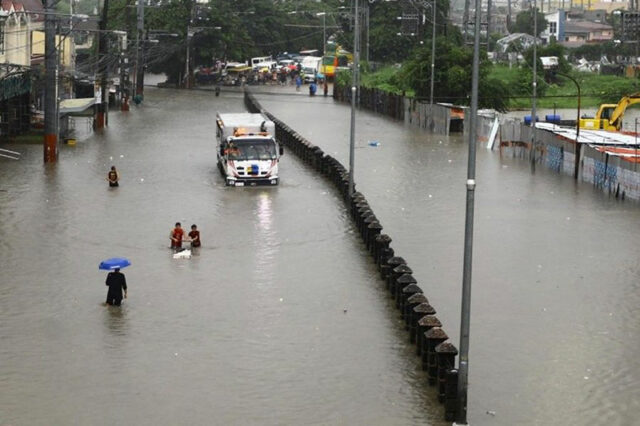
This comes as the national government ramps up its crackdown on questionable flood control projects, following the typhoons in July that exposed both the country’s overwhelmed drainage systems and alleged corruption in flood mitigation efforts.

In Pandag, flooding reached six villages, including Kabuling and Malangit, while in Buluan, five villages were submerged. Paglat reported four villages under water, with more than 8,000 people affected.

The low-pressure area, designated LPA 08F, was first detected on Aug. 22 outside the Philippine area of responsibility and has since remained within, with a fluctuating potential to strengthen into a tropical depression.

By late Monday, the weather bureau said it had only a “medium” chance of intensifying within 24 hours. The fresh flooding comes just days after Tropical Storm Isang, which later intensified into Typhoon Kajiki, battered northern Luzon and triggered monsoon rains across the country, affecting over 50,000 people. — Chloe Mari A. Hufana

CSC mulls sweeping gambling ban

A person holds cards near a keyboard, chips and dice in this illustration picture. — REUTERS/DADO RUVIC/ILLUSTRATION

THE Civil Service Commission (CSC) said on Tuesday it is considering a comprehensive ban on gambling for government employees but stressed that such a move would require legislation to take effect.

There needs to be a “legal cover” for a sweeping prohibition on gambling for government workers, CSC Chairperson Marilyn B. Yap said.

“The problem is what will be our legal cover for a comprehensive ban on all employees and branches of the government to engage in online gambling,” she told lawmakers during a House of Representatives hearing.

“I would recommend our study, and we can provide inputs for the possibility of passing a law in regard to the conduct of government employees on any form of gambling,” she added.

The Office of the President in 2016 issued a memorandum barring government officials and employees from entering casinos as it could be “prejudicial to the best interest of service.”

In early August, the Department of the Interior and Local Government issued an order banning its employees and officials of local government units from engaging in online gambling. — Kenneth Christiane L. Basilio

ADVERTISEMENT
ADVERTISEMENT