Home Blog Page 1094

To save Catholicism in the US, let’s talk nuns, not Popes

GIANNA B-UNSPLASH

By Frank Barry

THE ELECTION of an American pope, Leo XIV, is a fitting culmination of a conclave that had the feel of an American presidential election, except shrouded in secrecy and mercifully brief. Conservatives and liberals rallied around their favorite candidates, dished dirt on the opposition and adopted slogans (“unity” and “diversity”) aimed at swing voters. And like a presidential contest, it fixated public attention — and people’s hope for the future — on the wrong target: a savior-like figure who can deliver us from, if not evil, the other side of the aisle.

One of underlying causes of political polarization in the US — that all politics is now national instead of local — is afflicting Christianity, too. Among Catholics, it can be more common to talk about the pope’s politics than the parish’s food pantry, partly thanks to pundits more concerned with Vatican machinations than Gospel teachings. As a result, there’s more public interest in what’s happening with one bishop in Rome, Italy, than all the people in, say, Rome, New York. But what’s happening in Rome, New York — and so many places like it — reflects the need for a new spirit of localism, as opposed to clericalism, within the church.

In 2024, the last Catholic school in Rome, New York, closed its doors. Last week brought news of a church closure there, too, owing to a shortage of both priests and parishioners. Such closures are a familiar occurrence across the country. The number of US priests has fallen by nearly half since 1965, making it increasingly common for churches to share priests, if not shut down completely. In many cases, however, closures would not have been necessary if bishops did more to empower those who have long been relegated to second-class status in parish affairs: nuns and lay people.

On the day the world watched Pope Francis being laid to rest, I attended a 75th jubilee celebration for Sister Mary, a 94-year-old nun who lives outside of Philadelphia and is a beloved member of our family. Through her ’80s, she devoted her life to teaching the young, assisting the poor and caring for communities, all while living simply and humbly. I’ve learned far more about the Gospel by watching her live than by reading any papal encyclical.

That Pope Francis was so celebrated for the kind of humility that countless nuns display every day was a sad indictment of the upper tiers of the church hierarchy. While the world sang his praises for carrying his own luggage, the nuns who tirelessly bear burdens for their communities receive little of the recognition — and authority — they are due.

At the jubilee mass I attended, the priest noted in a moving homily that Pope Francis considered the church “a field hospital,” and he lauded the sisters for being first in line to care for the wounded, comfort the suffering, and support the needy. If churches are truly field hospitals, however, wouldn’t it be better for their doors to remain open under the care of a nun or a lay person, than to close because of a shortage of priests?

Sisters have proven themselves to be effective administrators of hospitals, as well as of schools and charities. And though church law forbids them from consecrating the Eucharist, they can run parish operations, lead worship services, hold Bible study classes, organize charitable work, and distribute communion to the sick and infirm — all duties that lay people can perform, too. No papal act is required for such a delegation of authority to occur, only greater public pressure on bishops to allow it. (A little encouragement from Pope Leo XIV would go a long way, too.)

The number of American sisters, like priests, has fallen dramatically. Allowing more sisters to run parishes would not save all churches, of course, but it could save some, while also helping to stem the decline in the vocation. And there are many more lay people who are up to the job, too.

At the jubilee celebration, I spoke with a priest who leads a small, rural parish on a part-time basis. He’s hopeful that his diocese’s next bishop will allow the parish to be run by lay people, with visiting priests saying mass when possible. Otherwise, he worries that after he’s gone — he’s approaching retirement age — the diocese will close the church, and the community will suffer the loss, both spiritually and, given the support it offers its neighbors, materially.

Before we said goodbye, Sister Mary showed us a full-page ad that her order, the Sisters of Saint Joseph, had taken out in the Philadelphia Inquirer in partnership with other orders of sisters. In a beautiful open letter that made no explicit mention of politics, the sisters made plain their disapproval of the current climate, lamenting the “sudden and devastating changes severely impacting people in our communities,” and urging people to join them in loving their neighbors, welcoming the stranger, caring for the vulnerable, speaking truth, and working for justice.

“Only when ‘We the People’ lead with compassion and empathy,” they wrote, “will a future filled with hope for all generations be possible.” We need more bishops and priests to fearlessly shout that message from the pulpit — and to let nuns and lay people join them.

BLOOMBERG OPINION

Toyota RentaCar, JoyRide partner for ‘value-added mobility’

From left are Toyota Mobility Solutions (TMS) Chief Operating Officer Ryo Yokoyama, TMS President Ma. Christina Fe Arevalo, JoyRide Philippines President Neil Sherwin Yu, and JoyRide Philippines Senior Vice-President for Special Projects Jerico Meneses. — PHOTO FROM TOYOTA RENTACAR

TOYOTA RENTACAR, the official car rental service of Toyota Motor Philippines, announced that it has partnered with “mobility super app” JoyRide to offer travelers “convenient long-term car rental solutions.” The collaboration is meant to give customers the ability to book multi-day rentals within the JoyRide app.

Managed by Toyota Mobility Solutions Philippines (TMSPH), Toyota RentaCar provides “a wide selection of vehicles — from sedans to SUVs and vans — available to be self-driven or chauffeur-driven.” Rental duration can vary from 10 hours to three years to fit travel and mobility requirements.

The “strategic partnership” between TMSPH and JoyRide Philippines Corp. allows customers to book Toyota RentaCar services directly through the JoyRide super app. Travelers arriving at NAIA terminals or other designated pickup locations across Metro Manila can “seamlessly reserve vehicles” for longer periods.

In a release, TMSPH said that the service is “especially advantageous for passengers based outside Metro Manila, those with multiple planned destinations, or anyone seeking a more personalized and flexible travel experience.” The user experience is made easy through a “hassle-free and scalable solution” for both immediate and extended car rental needs.

Users simply need to download the JoyRide app and select the car rental feature. First-time renters will be required to register on the Toyota RentaCar website. Payments can be made through various channels, including e-wallets, credit or debit cards via the app, or directly at Toyota RentaCar branches using cash or card options. The service will initially launch in Metro Manila.

“This partnership between Toyota RentaCar and JoyRide signifies a joint commitment to improving transportation accessibility and customer satisfaction. The shared goal is to enhance mobility services in and beyond Metro Manila — ultimately contributing to a more connected and commuter-friendly Philippines,” concluded the release.

For more information on booking and rental options, visit https://toyotacarrental.com.ph/ or download the JoyRide app.

Vote and get an upgrade on your Starbucks drink

JUST for today, May 12, all Starbucks Philippines branches will be giving customers a free single upsize on their beverage purchase when the customer presents proof that they voted — their index finger with indelible ink.

The offer is valid on any handcrafted beverage today and is available for dine-in, take-out, and drive-through transactions, with a maximum of two beverages per transaction (not per person) only.

Purchases made with Starbucks Rewards will earn Stars for the paid beverage, and purchases made with a personal cup/tumbler will still earn a P10 Cup discount.

Senior citizens and persons with disability (PWD) may still avail themselves of their discount for orders for their personal consumption, in conjunction with this promo.

For more information, visit starbucks.ph/promos for details.

Gov’t debt yields drop

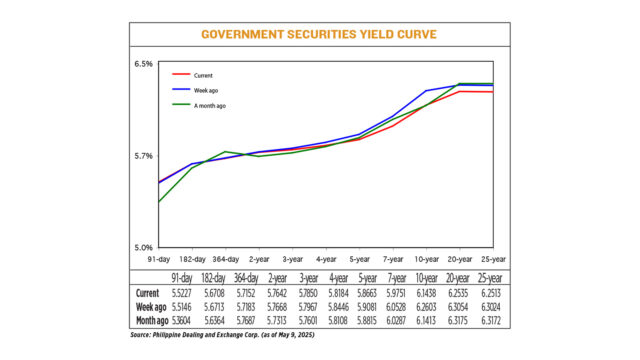
YIELDS on government securities traded in the secondary market fell last week after slower-than-expected economic growth in the first quarter and easing April inflation.

Bond yields, which move opposite prices, fell 3.41 basis points (bps) on average from a week earlier, based on PHP Bloomberg Valuation Service reference rates as of May 9 posted on the Philippine Dealing System website.

Last week, bond rates mostly fell across all tenors, while the traded volume of government rose to P81.85 billion from P29.46 billion a week earlier.

Easing inflation and slowing economic growth “fueled expectations of a potential Bangko Sentral ng Pilipinas rate cut in June,” a bond trader said in an e-mailed reply to questions.

BSP Governor Eli M. Remolona, Jr. as signaled 75 bps more in policy rate cuts this year, “which was more aggressive than market consensus of only delivering 50 bps more after the first reduction in key rates in April,” the trader said.

Noel S. Reyes, chief investment officer for Trust and Asset Management Group at Security Bank Corp., attributed the decline in debt yields and bond market rally to “softer-than-expected” GDP expansion and benign inflation.

“[These] were enough catalysts to spur buying in the bond market,” he said in an e-mail.

The Philippine economy grew 5.4% last quarter from 5.9% a year earlier, according to the Philippine Statistics Authority.

The expansion was driven by government spending that climbed 18.7%, and private consumption that rose 5.3%. Inflation in April slowed to 1.4%, the lowest in more than five years.

The bond trader expects the market to watch developments US-China trade talks in Switzerland.

“They will also wait for the reports on US consumer and producer inflation for April, which might indicate any realized inflationary impact from the partial imposition of tariffs since ‘Liberation Day,’” the trader added.

Mr. Reyes expects the trade talks to lead to volatile markets.

“What is certain is that there will be a tariff imposition at least at the blanket floor of 10%, which would still lead to higher prices, dampen demand and lower global GDP growth,” he said. “This should result in central bank cuts and lower bond yields.” — Abigail Marie P. Yraola

India monsoon to arrive early, brightening outlook for crops

REUTERS

NEW DELHI — Monsoon rains are expected to hit India’s southern coast on May 27, five days earlier than usual, marking the earliest arrival in at least five years, the weather office said, raising hopes for bumper harvests of crops such as rice, corn, and soybean.

The monsoon, the lifeblood of the country’s $4 trillion economy, delivers nearly 70% of the rain that India needs to water farms and recharge aquifers and reservoirs. Nearly half of India’s farmland, without any irrigation cover, depends on the annual June-September rains to grow a number of crops.

Forecasts of early and abundant monsoon rains are expected to alleviate concerns about potential risks to food supplies amid the current military conflict between India, the world’s most populous nation, and its neighbor Pakistan.

Summer rains usually begin to lash the southernmost coasts of Kerala state around June 1 and spread across the whole country by mid-July, triggering the planting of crops such as rice, corn, cotton, soybeans, and sugarcane.

The monsoon onset over Kerala is likely to be on May 27, with a model error of plus/minus four days, the India Meteorological Department said.

Last year, the monsoon reached the coast of Kerala on May 30, and overall summer rains were the highest since 2020, helping the country recover from a drought of 2023.

The India Meteorological Department last month forecast above-average monsoon rains for the second straight year in 2025.

The department defines average or normal rainfall as ranging between 96% and 104% of a 50-year average of 87 cm (35 inches) for the four-month season.

Early monsoon rains will encourage farmers in India, the world’s largest rice exporter, to start planting earlier. Reuters reported last week that a bumper crop would limit any rebound in global rice prices this year. — Reuters

Airlines seen posting stronger Q2 revenues on travel demand

REUTERS

By Ashley Erika O. Jose, Reporter

AIRLINE OPERATORS are expected to record higher revenues in the second quarter amid strong travel demand and higher passenger volumes, analysts said, even as recent first-quarter earnings showed mixed performance across carriers.

“We expect airline companies here to post healthy revenue growth in the second quarter on the back of strong travel demand during the summer,” China Bank Capital Corp. Managing Director Juan Paolo E. Colet said in a Viber message.

Mr. Colet said the lower inflation rate and the continued strengthening of the peso against the US dollar are likely to encourage more Filipinos to travel during the dry season and holidays.

Rizal Commercial Banking Corp. Chief Economist Michael L. Ricafort said a stronger peso and easing global crude oil prices are expected to lower operating expenses of local and international carriers.

The peso closed at P55.51 versus the greenback on Friday, appreciating by 12 centavos from P55.63 on Thursday, based on data from the Bankers Association of the Philippines.

“There is still potential for tourism to grow further locally amid improvements in infrastructure such as more modernized airports and mass transport systems for the coming year,” Mr. Ricafort said.

The government is aiming to privatize at least 15 regional airports by 2026 to support its modernization efforts.

PAL INCOME RISES
PAL Holdings, Inc. reported a 20.28% year-on-year increase in attributable net income to P4.33 billion in the first quarter from P3.6 billion a year earlier, driven by revenue growth.

The parent firm of flag carrier Philippine Airlines (PAL) posted consolidated revenue of P46.95 billion, up by 2.51% from P45.8 billion in the same period last year.

Passenger revenues rose by 0.45% to P40.53 billion from P40.35 billion; cargo revenues increased by 6.25% to P2.04 billion from P1.92 billion; and ancillary revenues grew by 23.93% to P4.35 billion from P3.51 billion. Revenues from other operations declined by 3.8% to P26.33 million from P27.37 million.

Total expenses climbed by 8.24% to P42.29 billion from P39.07 billion in the same period last year.

“We are greatly encouraged by the support of our valued customers who choose to fly on Philippine Airlines’ global network, and for whom we are investing in progressive product and service improvements, fleet renewal efforts and digital innovations, with safety and reliability as our topmost concerns,” PAL President and Chief Operating Officer Stanley K. Ng said.

PAL carried 4.1 million passengers in the first quarter, up by 5% year on year. Its cargo segment transported 52.6 million kilograms, with over 28,000 flights operated across its international and domestic networks.

The company said higher operating expenses during the period were driven by increased airport charges, third-party contract costs, and depreciation, partially offset by lower fuel expenses.

PAL also said its overall capacity remained steady for the quarter due to ongoing network expansion across both international and local destinations.

CEBU PACIFIC POSTS LOWER INCOME
Cebu Pacific, operated by Cebu Air, Inc., reported an attributable net income of P465.9 million for the first quarter, down by 79.19% from P2.24 billion in the same period last year, due to rising expenses despite double-digit revenue growth.

Total revenue increased by 20.23% to P30.42 billion from P25.3 billion previously.

Passenger revenue rose by 18.68% to P21.16 billion from P17.83 billion; cargo revenues climbed by 35.2% to P1.69 billion from P1.25 billion; while ancillary revenues increased by 21.7% to P7.57 billion from P6.22 billion.

Total expenses surged by 25.6% to P28.46 billion in the first quarter from P22.66 billion a year ago. Flying operations accounted for the largest share of expenses, reaching P10.78 billion, up by 15.42% from P9.34 billion last year, according to the airline’s financial statement.

“We remain optimistic on our financial outlook. Underlying demand for affordable air travel remains strong, and we’ve made earlier strategic investments to ensure resilient operations. Leveraging on these existing assets, CEB remains well positioned for sustainable growth, and improving profitability,” Cebu Pacific Chief Financial Officer Mark Julius V. Cezar said.

Repairs and maintenance expenses rose by 66.67% to P5.9 billion from P3.54 billion, the financial statement showed.

Cebu Pacific flew seven million passengers in the first quarter, up by 26% year on year.

As of end-March, the airline operated a fleet of 99 aircraft across 63 destinations and 127 routes, with more than 3,200 weekly flights.

Over the past 12 months, the airline took delivery of 15 aircraft and 13 spare engines to support capacity growth, which it said contributed to higher fleet and financing costs for the period.

Healthy youth for a healthy future

CHANG DUONG-UNSPLASH

With approximately 30 million Filipinos aged 10 to 24, young people make up 28% of the country’s population — representing the largest generation in Philippine history. According to the United Nations Population Fund (UNFPA), this demographic shift offers the Philippines a potential demographic dividend — an opportunity for accelerated economic growth fueled by a youthful population equipped with better health, education, and employment opportunities.

However, this potential is at risk. Many young people — especially adolescent girls — face health and social challenges that can derail their future. Chief among these is teenage pregnancy, which the Department of Economy, Planning, and Development (formerly the National Economic and Development Authority or NEDA) has declared a “national and social emergency.”

In a nationwide survey conducted by the Commission on Population and Development (Popcom) in 2020, adolescent pregnancy emerged as the most pressing youth issue across all socioeconomic and geographic groups. The numbers are sobering: in 2023, 3,343 girls under the age of 15 gave birth — a steady increase from previous years. Among teenage mothers aged 19 and below, 150,138 live births were recorded, up 10% from 2022. That’s equivalent to 411 babies born to teenage mothers every single day.

The World Health Organization warns that adolescent pregnancy increases the risk of anemia, sexually transmitted infections, unsafe abortions, postpartum complications, and mental health disorders. It also contributes significantly to maternal and infant mortality, especially in low- and middle-income countries like the Philippines. Studies estimate that 55% of unintended pregnancies among girls aged 15-19 end in abortions, many of which are unsafe.

The health risks extend to newborns, too. Babies born to adolescent mothers are more likely to be underweight, premature, or suffer from severe neonatal conditions. Beyond health, the economic and social costs are immense. Teenage pregnancy often disrupts education, limiting future employment opportunities. A local study pegged the potential lifetime earnings lost by young Filipinas due to early childbearing at P33 billion — equivalent to 1.1% of GDP in 2012.

In observance of Safe Motherhood Week which runs from May 6 to 12, it is imperative that we act collectively. To this end, the PHAPCares Foundation — the social responsibility arm of the Pharmaceutical and Healthcare Association of the Philippines (PHAP) — and AstraZeneca Philippines have partnered with local governments in Iloilo, Carles, Mina, and Pototan, as well as the Department of Education (DepEd), to roll out the “Healthy Youth, Healthy Future Program.”

The Department of Health’s Center for Health Development in Western Visayas provides technical assistance and data support. This two-year initiative aims to educate and empower adolescents by tackling issues like teenage pregnancy, HIV/AIDS, mental health, and noncommunicable diseases. Through lectures, health screenings, and wellness services delivered via schools and barangay health stations, the program targets 80% of the adolescent population in its pilot communities.

“Improving adolescent well-being will deliver significant positive impact for the Ilonggo youth, and create a ripple effect to their children in the future,” said Lotis Ramin, President of PHAPCares Foundation. “With this collaboration, we look forward to a healthier world for the youth that goes beyond treatment — a strong and preventive health ecosystem of disease awareness and lifestyle management. With the pilot’s success, we are positive we can replicate YHP across the province, and eventually throughout the Philippines,” she added.

AstraZeneca employees and the PHAPCares Volunteer Corps contribute actively by volunteering in communities, assisting trainers, and supporting communications and advocacy efforts. Dr. Rosarita Siasoco, PHAPCares executive director, notes that beyond raising awareness, the program is building systems of support that young people can count on.

“It is our hope that with this project, we can create a ripple effect of health and well-being that extends beyond individual lives of young people, transforming entire families and communities in the process,” Dr. Siasoco explained.

As this initiative grows, it offers a blueprint for scaling up youth-focused health programs across the country. Investing in the health and potential of young Filipinos today ensures a healthier, more prosperous Philippines tomorrow.


Teodoro B. Padilla is the executive director of Pharmaceutical and Healthcare Association of the Philippines which represents the biopharmaceutical medicines and vaccines industry in the country. Its members are in the forefront of research and development efforts for COVID-19 and other diseases that affect Filipinos.

Style (05/12/25)


May is for mothers at The Farm

THE FARM AT SAN BENITO honors mothers with exclusive wellness journeys designed to replenish their spirit. Achieve a healthful glow with an IV Infusion filled with Vitamin C for the immune system and pair it with a Magnetic Clay Foot Treatment to absorb impurities and heavy metals (P9,800++ per person). Enjoy a free 30-minute Acqua Hydrotherapy Session for pain relief to complement a Hilot Lakambini, a revitalizing therapy that enhances energy levels and supports hormonal balance for optimal well-being (P11,800++ per person).


Family bonding at Paseo Outlets

THIS SUMMER, the Paseo Outlets at Greenfield City is reimagining what a family day out can be. From May 30 to June 1, make memories that go beyond shopping with the launch of Sportscape, an outdoor adventure zone for kids, and a three-day summer sale with up to 70% off on top brands. From May 30 to June 1, enjoy up to 70% off across brands including Under Armour, Speedo, Crocs, Oaklet, West Elm, Levi’s, Payless, Lacoste, and other brands. On May 31 and June 1, the Paseo Outlets will become the stage for Sportscape, an outdoor attraction for families. At the heart of Sportscape is the Paseo Outlets Junior Warrior Challenge, an obstacle course designed for kids four to eight years old. Held at the newly launched Paseo Outlets Obstacle Park — now officially accredited by the Philippine Obstacle Sports Federation — for P350, participants get access to the full course and take home a finisher medal. Registration is now open at https://bit.ly/PaseoOutletsOCR2025. For younger kids aged two to four, there’s the Push Bike Race at Plaza Regina. Register and pay the fee of P450 to participate and receive a finisher medal upon completion. Register at https://bit.ly/PaseoOutletsPushBikeRace2025. Families can also try their luck at the game booths scattered around the area — just present a single receipt worth P1,000 to join. There will be a roller skate exhibition at Plaza Regina at 6 p.m. on both May 31 and June 1. Near the obstacle course is the new Rope Art Playground. There’s also the GoKart Adventure for kids and adults with pedal-powered go-karts. Soon, Playtopia will open at Laguna Central — an indoor inflatable playground. Treat the whole family to a break at the Paseo Outlet’s newest dining spots: Zus Coffee, Prima Kantina, or Aidalicious Chicken Inasal. The Paseo Outlets is located along Tagaytay Balibago Road, Greenfield City, Sta. Rosa, Laguna.


Montblanc watch inspired by Reinhold Messner

THIS YEAR, Montblanc unveils the latest timepiece in the Montblanc 1858 Geosphere Collection: the Montblanc 1858 Geosphere 0 Oxygen Mount Vinson Limited Edition, which pays homage to mountaineer and Montblanc Brand Ambassador Reinhold Messner and his ascent of Mount Vinson in Antarctica, the final peak that completed his variation of the Seven Summits Challenge. Now known as Messner’s list, the Seven Summits Challenge saw him climb the seven highest mountain peaks on each of the seven continents. Since the idea of climbing seven peaks began in the 1950s, only around 500 people have achieved the feat. The new Geosphere 0 Oxygen edition is limited to 986 pieces as a nod to 1986: the year when Mr. Messner climbed Mount Vinson. The timepiece comes in a 43.5mm titanium case with a new composite middle case crafted from quartz fibers, aluminized basalt fibers, CaCO3, and light blue resin. This composite mix creates a design reminiscent of the colors and patterns of glacial ice found in Antarctica with its interlocking networks of crystals. The middle case is adorned with a luminous outline of Mount Vinson. It is positioned on the left side of the case so only the wearer can see it. This icy theme continues onto the dial with a blue-green and light grey sfumato glacier pattern that was created using a special technique called gratté-boisé as the base. The dial is further highlighted by a light grey anodized aluminum bezel with blue luminescent cardinal points. Zero oxygen inside the case not only eliminates fogging, which can occur with drastic temperature changes at altitude, but also prevents oxidization. Each timepiece comes with a certificate as proof of this technology. The timepiece is powered by the Caliber MB 29.25, featuring an automatic movement with Montblanc’s Manufacture Worldtime complication with approximately 42 hours of power reserve. Like with all 1858 Geosphere models, both the Northern and Southern hemispheres are represented by two three-dimensional globes that turn anticlockwise and include a day and night indication. Dots mark the seven peaks of Messner’s List on the Northern Hemisphere globe and the Mont Blanc summit. There is also a date at three o’clock and a dual time indication at nine o’clock. Montblanc has also added an engraving of the peak on the caseback. This is the first time a watch in the 1858 collection has been fitted with a new, easily interchangeable rubber strap. The blue-green strap features a mountaineer’s rope motif and a mountainous profiles pattern on the inside to improve breathability and comfort on the wrist. The rubber strap includes stitching above the lugs, a signature feature on watches in the 1858 collection. Montblanc is available at Rustan’s Makati, Rustan’s Shangri-La, Rustan’s Cebu, Greenbelt 5, and Solaire Resort Entertainment City.

Gateway’s Mitsubishi Matina surpasses first-year targets

Mitsubishi Matina is located across Davao Global Township at Km. 3 Gen. Douglas MacArthur Highway, Matina, Davao City.

AFTER ITS INAUGURATION, Mitsubishi Matina — located across Davao Global Township at Km. 3 Gen. Douglas MacArthur Highway, Matina, Davao City — reportedly exceeded its targets for the year.

The Mitsubishi dealership, operated by the Gateway Group, is distinguished by an uninterrupted glass façade in its six-vehicle showroom. Elviro C. Ubaub, Jr., a 10-year Gateway veteran and currently Mitsubishi Matina’s Branch Head, shared how the first 3S Mitsubishi dealer in Davao — has grown. “It’s about quality service and great customer care. Our prime mission is to focus on great service and make our customer satisfied and happy, especially for sales and after-sales,” he said.

Sales are any dealership’s top priority, Mr. Ubaub added. “Sales are strong for the Mirage sedan, with customers comprised of new families or first-time new car owners. We’ve noticed that the Xpander is typically a second car, or for family use, and a favorite of OFWs. The Montero is mostly for business owners and second car users, the Triton is preferred by farm owners, businessmen, and OFWs; the L300 is mainly for business owners; and the Xforce is for young professionals and individuals with a lifestyle preference.”

Mitsubishi Matina shared that its service staff is composed of automotive graduates — NC1 and NC2 passers, and certified Mitsubishi technicians. “We offer quick services such as preventive maintenance service and general jobs like underchassis work, air-con, electrical, transmission, engine overhauling, and others,” explained Mr. Ubaub. “We can also cater to body repair and painting requirements. Our quick service takes an hour on average, but some general jobs can have a turnaround time of one to two hours. For major repairs, it can take days.”

He added, “Our service area has 16 working bays for after-sales service and has an average SIU of 25 daily, 600 plus per month. But we can cater to as many as 40 daily or 1,000 in a month.”

Mitsubishi Matina also entertains insurance claims, as well as regular walk-in clients who simply wish to have their Mitsubishi vehicles serviced. “We have a customer lounge with coffee area exclusively for Gateway customers, drinks and snacks, free Wi-Fi, entertainment TV, and a kids’ area,” Mr. Ubaub noted.

Mitsubishi Matina can be reached through 0977-102-3917. Customers may park in front of the showroom where 14 parking spaces are available.

BSP short-term debt rates fall

MARI GIMENEZ-UNSPLASH

RATES of the Philippine central bank’s short-term securities fell on Friday amid higher demand.

The Bangko Sentral ng Pilipinas (BSP) bills fetched bids worth P137.87 billion, higher than the P90-billion offer and P119.459 billion in tenders for the P80 billion auctioned off a week earlier. The central bank awarded P90 billion in securities as planned.

The tenders for the 28-day BSP bills reached P52.165 billion, more than the P40 billion placed on the auction block and higher than the P48.109 billion in bids for a P30-billion offer in the previous week. The central bank fully awarded the one-month debt.

Banks asked for rates ranging from 5.63% to 5.692%, lower than the 5.64% to 5.7135% margin a week earlier. This caused the average rate of the one-month securities to decline by 1.84 basis points (bps) to 5.6628%.

Meanwhile, bids for the 56-day bills hit P85.705 billion, more than the P50-billion offer and P85.705 billion in tenders for the same volume offered by the central bank a week earlier. The BSP fully awarded P50 billion in two-month bills.

Accepted yields were 5.625% to 5.675%, lower than 5.64% to 5.718% a week ago. The average rate of the 56-day securities went down by 4.86 bps to 5.6555%.

“The resulting bid-to-cover ratios stood at 1.30x for the 28-day tenor and 1.71x for the 56-day tenor,” the BSP said in a statement.

The central bank uses the BSP securities and its term deposit facility to mop up excess liquidity in the financial system and better guide short-term market rates towards its policy rate.

The BSP bills also contribute to improved price discovery for debt instruments while supporting monetary policy transmission, the central bank said.

The central bank securities were calibrated to not overlap with the Treasury bill and term deposit tenors also being offered weekly.

Data from the central bank showed that about 50% of its market operations are done through short-term BSP bills.

The bills are considered high-quality liquid assets for the computation of banks’ liquidity coverage ratio, net stable funding ratio, and minimum liquidity ratio. They can also be traded on the secondary market. — Aaron Michael C. Sy

UK farmers welcome no weakening of import standards in US trade deal

REUTERS

LONDON — The British farmers union gave on Thursday’s US-UK economic deal a mixed reception, welcoming the retention of British food standards on US imports and reciprocal market access for beef, but flagging concern over a removal of tariffs on bioethanol.

The deal gave UK farmers a US quota for beef of 13,000 metric tons, which the National Farmers Union (NFU) said was a positive. Under the deal, US farmers will have the same quota for sales into Britain.

Crucially there will be no weakening of UK food standards on US beef imports, which was a red line for the union and an election manifesto pledge for the Labor government. That means US beef bred with growth hormones still won’t be allowed into the UK.

“We appreciate the government’s efforts in listening to our concerns, particularly around maintaining high standards, protecting sensitive agricultural sectors and securing reciprocal access for beef,” NFU President Tom Bradshaw said.

Brooke Rollins, US Secretary of Agriculture, said the deal would “exponentially increase” US beef exports to Britain.

However, with little price differential between British produced beef and US beef that does meet UK standards, the US product could struggle to find a UK market.

Finding favor with the UK consumer may also be a tough task. Currently 100% of the fresh beef sold by Britain’s two biggest supermarket groups — Tesco and Sainsbury’s — is British and Irish.

Mr. Bradshaw also said he was concerned that the US had been given full access to Britain’s market for bioethanol, which is used to produce beer.

“Two agricultural sectors have been singled out to shoulder the heavy burden of the removal of tariffs for other industries in the economy,” he added. — Reuters

SM Foundation, TESDA partner to support workforce development

(From left) Frederic C. DyBuncio, president and CEO of SM Investments; Carmen Linda Atayde, executive director for education of SM Foundation; Technical Education and Skills Development Authority (TESDA) Secretary Jose Francisco Benitez; TESDA Deputy Director General for TVET Partnership and Community-Based TVET Nelly Dillera

SM FOUNDATION, Inc., the corporate social responsibility arm of the SM Group, has partnered with the Technical Education and Skills Development Authority (TESDA) to help enhance Filipino workers’ skills and expand access to employment opportunities.

Under the partnership, TESDA learners and graduates will be linked to various career opportunities within the SM Group, covering industries such as construction, food and beverage, hospitality, logistics, and others, SM Foundation said in an e-mail statement over the weekend.

The initiative is aligned with the SM Job Opportunities Building Skills advocacy, which aims to establish industry-responsive training standards and curricula, and implement skills training and enterprise-based education programs.

SM Foundation and TESDA recently signed a memorandum of understanding to formalize the partnership.

“We strongly believe that our continued growth as a business is deeply connected to the development of the people we serve and partner with. That’s why this partnership is important to us,” SMIC President and Chief Executive Officer Frederic C. DyBuncio said.

“We know it’s not always easy, especially in industries where finding qualified talent is a challenge, but it is exactly through collaborations like this that we can help build and strengthen our future workforce,” he added.

The agreement will also support job matching efforts through SM job fairs and other employment programs.

“This partnership is for our future, current trainees, employers, and industry leaders. May this endeavor bring us closer to a nation where every Filipino has the skills, tools, and opportunity to succeed,” Secretary Jose Francisco “Kiko” B. Benitez, director general of TESDA, said.

SM Foundation said the collaboration builds on its existing efforts to support upskilling and employment facilitation in coordination with other partners.

On May 1, in celebration of Labor Day, SM Supermalls hosted 20 job fairs across its malls nationwide, connecting around 15,000 job seekers with approximately 1,000 employers. The events resulted in over 2,000 individuals being hired on the spot.

Asia Pacific College, an SM-affiliated institution, is also conducting upskilling sessions in partnership with the American Chamber of Commerce of the Philippines. The programs cover artificial intelligence (AI) fundamentals and business applications, as well as data analytics and AI maturity. — Revin Mikhael D. Ochave