Home Blog Page 1087

Crawling beneath the bar of Caesar’s wife

PEOPLE and motorists wade through gutter-deep flood along United Nations Avenue in Manila after a sudden downpour on Aug. 16. | Philippine Star/Ryan Baldemor

In public service, the old adage remains timeless: “Caesar’s wife must be above suspicion.” It demands not just the absence of guilt, but the presence of unquestionable integrity and propriety.

Sadly, what we witness today is far from that standard. We are not just dealing with public officials who fail to rise above suspicion — they are, in fact, sinking deep into a mire of damning evidence. Guilt, in this case, is not a matter of conjecture but of documentation.

Let us remember Julius Caesar. When his wife, Pompeia, became entangled in a scandal during the Bona Dea festival, Caesar divorced her — not because she was proven guilty, but because her position demand-ed she be beyond any trace of suspicion. He famously declared, “My wife ought not even to be under suspicion.”

Today, it is not suspicion but actual proof that convicts many public projects, particularly those under the government’s flood control program. In his State of the Nation Address (SONA) on July 28, President Ferdinand Mar-cos, Jr. didn’t mince words: the corruption is real, the structures are substandard, and the people’s money is wasted.

FLOODED IN FUNDS, DROWNED
IN CORRUPTION
Since July 2022, a staggering P545 billion has been allocated to flood control projects. Yet what has emerged from these funds is not protection from floods, but a flood of evidence pointing to corruption, waste, and conspiracy.

• Concentration of Projects: Just 10 provinces cornered the lion’s share of these projects — Bulacan (668), Cebu (414), Isabela (341), Pangasinan (313), Pampanga (292), Albay (273), Leyte (262), Tarlac (258), Camarines Sur (252), and Ilocos Norte (224). Meanwhile, equally vulnerable areas such as Metro Manila, Maguindanao, and North Cotabato were conspicuously neglected.

• Concentration of Contractors: Only 15 contractors monopolized these projects, bagging nearly P100 billion in contracts. Five of them had nationwide reach. This tight concentration raises serious questions about transpar-ency, competitiveness, and favoritism.

• Ghost Projects and Substandard Work: The President himself uncovered abandoned or subpar projects — like the multi-million flood control structure in Baliwag, Bulacan that was declared “completed” in June but was visibly untouched by August. In Calumpit, Bulacan, dredging works certified as completed were found unfinished and made of substandard materials.

THE SENATE UNCOVERS A DELUGE OF DECEIT
On Aug. 19, the Senate’s Blue Ribbon Committee launched an inquiry aptly titled “The Philippines Under Water.” Its findings were chilling:

• Massive Anomalies: Out of 9,855 projects, 6,021 — worth around P350 billion — lacked details on the structure being built. This level of documentation failure all but invites duplication, poor accountability, and, yes, corruption.

• Shameless Sharing of the Pie: In his privilege speech, Senator Ping Lacson revealed that only about 40% of a typical P100-million flood control project actually goes to implementation. The rest is allegedly distributed among legislators, Department of Public Works and Highways (DPWH) officials, Commission on Audit (CoA) auditors, and “royalty owners.” What we need now, Lacson declared, is greed control.

This is no longer about suspicion — it is about plunder.

A TRAIL OF GHOSTS AND GOLD
In Bulacan alone, nearly 30 ghost projects have been discovered. One P77-million riverbank project in Malolos was still “ongoing” even after being marked as completed. A similar budget was used for a supposed flood structure in Hagonoy — contracted to the same ghost company. It seems many small contractors simply lease the licenses of triple-A builders and execute substandard work.

In Oriental Mindoro, another congressman proudly claimed credit for P3.6-billion worth of flood control projects. The quality of the work, however, did not match the claim. Some areas reportedly received up to P19 billion in just three years, even though they lacked the capacity to properly implement and monitor the projects.

It gets worse. Some legislators reportedly admitted that contractors involved in these scandals contributed to their electoral campaigns in the last two national elections. This opens the door to clear conflicts of interest, if not outright bribery.

Meanwhile, luxury watches worth over P10 million, fleets of high-end SUVs, and even private choppers owned by some government officials and contractors are now paraded on social media. Salaries alone and legitimate profit from operations could not justify such wealth. Something is terribly wrong.

PROPRIETY OVER POLITICS
The lesson from Caesar’s wife is not just about guilt or innocence — it is about propriety. Ethical behavior is non-negotiable in public service. Integrity must not only be presumed; it must be seen and felt by the public.

Yet today, we see legislators who once served in implicated agencies failing to recuse themselves from investigations. Both current and past Congresses approved budgets riddled with anomalies and turned a blind eye to dubious insertions that robbed funding from vital sectors such as public health, education, and social infrastructure.

Presidents Duterte and Marcos — along with their economic and technical advisers — must also bear some responsibility. After all, the President has the power to veto suspicious budget allocations. Why was that power not used?

WHAT MUST BE DONE
In response to the unfolding scandal, Malacañang ordered the DPWH to submit a list of all flood control projects since 2022. It tasked the Regional Project Monitoring Committees to audit failed, unfinished, and ghost projects, with the findings to be made public.

This is a good start, but insufficient. We need:

• Independent Audit: Civil society and independent auditing bodies must be empowered to review and validate government records. A whitewash is the last thing we need now.

• Prosecutions, Not Performances: The Senate has voiced support for the President’s directive. But will it walk the talk if some of its members are implicated? Can it resist protecting its own?

• House’s Toned-Down Response: The House of Representatives has echoed the President’s orders but watered down key points — such as replacing a proactive audit with a passive investigation. This does not inspire con-fidence.

Even the CoA, implicated in the notorious “sharing of the pie,” has only belatedly ordered a fraud audit in Bulacan. One wonders: what has CoA been doing all this time? Why does it now need the DPWH to hand over “rele-vant documents” before acting?

THE REAL COST OF CORRUPTION
This is not just about bureaucratic theft. Corruption of this magnitude weakens the nation’s capacity to grow. It erodes investor confidence, saps public morale, and steals resources that could have improved productivity, nur-tured human capital, and funded crucial infrastructure for connectivity and inclusion across the archipelago.

No, the biggest drag on our economic momentum is not inflation, nor interest rates. They have been tamed. It is corruption — plain, cruel, and devastating.

Indeed, Caesar’s dictum remains as relevant as ever. But today, we do not even need the moral high bar of Caesar’s wife. The bar is already on the ground. And yet, many in power and their kind, still manage to crawl be-neath it.

There is no suspicion anymore. Only facts.

And the facts are damning.


Diwa C. Guinigundo is the former deputy governor for the Monetary and Economics Sector, the Bangko Sentral ng Pilipinas (BSP). He served the BSP for 41 years. In 2001-2003, he was alternate executive director at the International Monetary Fund in Washington, DC. He is the senior pastor of the Fullness of Christ International Ministries in Mandaluyong.


FNI elects Dante Bravo as chair; Joseph Sy takes leave over citizenship issue

Dante R. Bravo & Joseph C. Sy
STOCK PHOTO | Image by GFNI.COM.PH

LISTED mining company Global Ferronickel Holdings, Inc. (FNI) said its chairman, Joseph C. Sy, has taken a voluntary leave of absence amid questions over his Filipino citizenship.

Mr. Sy took the leave to focus on “resolving his personal legal matters while safeguarding the best interests of the company and its stakeholders,” FNI said in a regulatory filing on Thursday.

With this, FNI said its board elected current president Dante R. Bravo as chairman effective Aug. 27.

“Mr. Bravo will serve in both roles, with his performance and dual capacity to be reviewed annually by the board and the corporate governance committee,” FNI said.

Mr. Sy was arrested by Bureau of Immigration (BI) operatives on Aug. 21 upon his arrival from Hong Kong over the alleged misrepresentation of his citizenship.

FNI denounced Mr. Sy’s arrest, saying his citizenship has been confirmed by at least six rulings from the BI, the Department of Justice, the Office of the President, the Securities and Exchange Commission, and the Supreme Court.

Meanwhile, FNI appointed lead independent director Jaime F. Del Rosario to the newly created role of vice-chairman to “strengthen independent oversight.”

Mr. Del Rosario will provide additional governance checks, preside over meetings in the chairman’s absence, and serve as intermediary between the chairman and other directors.

He will also convene and chair meetings of the non-executive directors and contribute to the performance evaluation of the chairman.

“These measures underscore FNI’s commitment to stability, transparency, and strong corporate governance, providing clear leadership structure and reinforcing independent oversight while the company continues to execute its business strategy,” FNI said.

FNI is engaged in nickel ore mining, logistics, cement and steel production, and port operations.

On Thursday, FNI shares fell by 0.77% or one centavo to P1.29 apiece. — Revin Mikhael D. Ochave

Berde Renewables to power KCC Malls, Biotech Farms in Mindanao

STOCK PHOTO | Image by unsplash/Evgeniy Alyoshin

SOLAR ENERGY FIRM Berde Renewables has entered into a power purchase agreement with a mall operator and an agro-industrial firm to advance sustainable retail and agriculture in Mindanao.

In a media release on Wednesday, Berde Renewables said it had signed a power purchase agreement with KCC Malls and Biotech Farms, Inc. for the supply of 8.4 megawatts (MW) of electricity.

“Berde Renewables has been building momentum in the country’s clean energy transition, and today we are accelerating that shift to a new peak,” said Berde Renewables President and Co-founder Patrick Zhu.

Under the partnership, Berde Renewables will deliver solar power to KCC Mall Gensan, KCC Mall Marbel, KCC Mall Zamboanga, and the Biotech Farms agro-industrial facility in South Cotabato.

The energy firm said it will fully finance the project and oversee engineering, procurement, and construction, as well as long-term operations and maintenance.

Once operational, the solar facility is expected to produce 13 million kilowatt-hours of energy annually, offsetting 9,600 tons of CO₂ emissions per year.

“By integrating clean energy into our operations, we are elevating our standards in retail sustainability while ensuring that our malls remain resilient, efficient, and aligned with the long-term needs of the communities we serve,” said KCC Malls Chief Executive Officer Arvin Chan.

Rainnyl Chiang, renewable energy director at Biotech Farms, said energizing its agro-industrial facility with solar power further strengthens its commitment to circular economy principles while ensuring “stable, cost-efficient power for our business.”

“This initiative not only reduces our environmental footprint but also supports the broader goal of building a greener, more resilient Mindanao,” he said.

Berde Renewables is the portfolio company of global infrastructure investor I Squared Capital, which focuses on solar and other clean energy technologies.

At present, the company has built 45.7 MW of solar projects in the Philippines, with 31 MW under construction and a 144 MW development pipeline. — Sheldeen Joy Talavera

Alt-rock and jazz-pop albums for the ‘ber’ months

By Brontë H. Lacsamana, Reporter

THREE unique albums were released last Friday, a wave of exciting, new music from the Western side of the world capping off the rainy month of August.

For fans of alternative rock and jazz-infused pop, these collections of songs — all powered by excellent female vocalists — are a great way to enter the “ber” months. Here’s an overview of three albums you can listen to that dropped towards August’s end.

THE CLEARING BY WOLF ALICE

Wolf Alice is an English alternative rock band based in London, UK. Made up of frontwoman Ellie Rowsell, guitarist Joff Oddie, bassist Theo Ellis, and drummer Joel Amey, they’ve been exploring genres like folk, dream pop, and grunge since 2010.

Their fourth album, The Clearing, was written in Seven Sisters and recorded in Los Angeles with Grammy-winning producer Greg Kurstin. Blending classic rock and pop, the band has described it as “Fleetwood Mac in North Lon-don.”

The 11 tracks in this strong record range from richly produced, powerful anthems to emotional midtempo bops, infusing pleasant beats with dreamlike rhythms. It’s a vivid run through the 1970s-inspired drama that Wolf Alice dynamically brings into modern day.

Songs that stand out are “Bloom Baby Bloom,” with Rowsell’s versatile vocals that evoke an invigorating mix of yearning and confidence; “Just Two Girls,” a catchy indie pop tune that highlights sweet yet intricate melodies; and “White Hors-es,” a guitar-driven folk anthem that starts out easygoing then kicks up a fun sonic journey.

A MATTER OF TIME BY LAUFEY

A lovely new album that many have been anticipating is A Matter of Time, created by jazz-pop musician Laufey (full name: Laufey Lín Bing Jónsdóttir).

Born to an Icelandic father and Chinese mother, she studied piano, cello, and singing in various schools in Reykjavik, Washington, DC, and Beijing. Now based in Los Angeles, her third album is more stripped-down, her usually polished veneer of elegance making way for a more vulnerable and unguarded period of her career.

In the second track, “Lover Girl,” playful orchestration drives forward Laufey’s syrupy voice. “Snow White,” a personal favorite from the album, follows it up with her melancholy vocals combined with a gentle tapestry of acous-tic and string sections. “Tough Luck” is a stunning track, which begins with a soft melody that later builds and explodes with surprising, pop song-like energy.

The album really showcases the old Hollywood, almost Disney princess-like picture that Laufey paints with her classically developed sensibilities. The track “Mr. Electric” encapsulates the fascinating progression of Laufey’s music — it is a danceable ballad, vibrantly sung atop some fun, percussive instrumentation.

BURY THE KEY BY TOPS

Canadian indie rock band TOPS has been making dreamy, alternative synthpop since 2011. Their fifth album, Bury the Key, continues to explore this combination of genres that the Montréal-based four-piece band, led by vocalist Jane Penny, is now known for.

This time, as evidenced by one of its most catchy tracks, “ICU2,” the album channels pared-back yet powerful instrumentation. The song has a wistful sound that evolves into an intoxicating, upbeat energy.

“Annihilation” is one of the funkier ones. It features groovy synths utilized to full effect along with Penny’s lilting vocals that make it feel so distinctly TOPS. A track that provides a memorable sonic experience is “Falling on my Sword,” a frenzied pop tune that varies in tempo, evoking the energy of dancing while everything falls apart.

Honorable mention goes to “Chlorine,” with more classic-rock arrangements and vocals, tying back to how new releases these days offer a comfortable 1970s nostalgia — but are refreshed with modern oomph and sensibilities.

PHL, Cambodia central banks hold talks on financial sector develop-ments

THE BANGKO SENTRAL ng Pilipinas (BSP) and the National Bank of Cambodia (NBC) met last week to discuss developments and challenges in the financial sector.

On Aug. 18, the two central banks concluded a high-level bilateral meeting in Bohol, Philippines that was led by BSP Governor Eli M. Remolona, Jr. and NBC Governor Chea Serey, the BSP said in a statement on Thursday.

“The two institutions exchanged insights on key developments and challenges in the financial sector, particularly cross-border payment initiatives, application of artificial intelligence in financial services, and strat-egies for combating financial fraud,” it said.

“The bilateral meeting reaffirmed the mutual commitment of the BSP and the NBC to cooperate and foster financial innovation, enhance the efficiency and interoperability of payment systems, and strengthen cooperation in various areas of central banking,” it added.

The two central banks also held bilateral talks in August last year, where they signed a memorandum of understanding aimed at strengthening their cooperation in central banking and payment connectivity.

The agreement also sought to promote collaborative efforts between the Philippines and Cambodia in areas such as payment system advancements, artificial intelligence, cybersecurity, sustainable finance and human resource development, among others.

The BSP has been working with other countries to enhance cross-border payments. — Katherine K. Chan

Basic, digital banking services help increase financial participation among underbanked — study

Peoples walk past automated teller machines in Makati City, June 23, 2016. — REUTERS

PROMOTING the use of basic and digital banking services will help encourage underbanked customers to increase their engagement with financial institutions, a study led by Mastercard in collaboration with Rizal Commercial Banking Corp. (RCBC) showed.

“Financial inclusion is not just about opening accounts — it’s about enabling sustained, active usage that unlocks real opportunities,” Mastercard Philippines Account Management Vice-President Judith Dayrit said in a statement on Thursday.

“At Mastercard, the goal is to help the underbanked move beyond access toward financial security and health, by encouraging frequent use and responsible credit adoption. This research with RCBC helps chart a path from first-time access to long-term, active participation — through intuitive design, thoughtful onboarding and robust security. We’re proud to undertake initiatives like this to support the Philippines in building a more inclusive and resilient financial future.”

The study used pseudonymized transactional data from over 25,000 DiskarTech consumers and 6,000 terminals of RCBC’s ATM Go partner-merchant network of mobile point of sale devices from January 2022 to October 2024, as well as qualitative findings from focus groups held in December 2024.

DiskarTech is RCBC’s financial inclusion “super app,” while ATM Go refers to its mobile automated teller machine terminals.

The data found that nearly 70% of DiskarTech users progressed beyond using basic banking services such as deposits, withdrawals, and fund transfers within 24 months.

“This advancement was consistent regardless of employment status, suggesting socioeconomic status alone does not determine financial progression,” the study said.

It said the responsible and consistent use of services such as bill payments, mobile top-ups, or saving regularly are the strongest indicators that a user will advance to deeper relationships with their financial institutions.

“Card usage in particular showed a stronger correlation with advancement than age or gender, reinforcing its value as both a behavioral tool and a commercial lever for financial service providers,” the study said.

Consumers with more than 10 transactions per month are two to four times more likely to use basic banking features such as digital payments more frequently or more advanced services such as applying for loans, or make timely bill payments compared to those with less than five transactions, it also found.

The study likewise showed that attracting consumers through gradual engagement is more effective than rapid adoption.

“Users who slowly integrated transactional tools over time were five times more likely to reach advanced stages than those who signed up for multiple features quickly, often driven by short-term incentives,” it said.

Consumers who developed steady usage over six or more months consistently reached the “security” stage, or consistently using basic banking services, between months 18 and 24.

“Consumers who took more than six months when adopting transactional products like Bill Pay and E-Load mobile airtime are also up to five times more likely to advance to security over a two-year timeframe,” the study said.

While rewards and promos are effective in encouraging engagement and advancing users along the financial inclusion journey, it could also result in short-term participation, it added.

“That said, users who joined primarily for promotional rewards often disengaged once those incentives ended. Without a sustained rewards strategy, there’s a risk of losing these users to competitors offering similar benefits.”

The study showed that more than 20% of DiskarTech users eventually transitioned into RCBC’s traditional banking products, typically opening a savings account within 11 months and a credit card by month 16.

In addition, DiskarTech consumers who later acquired an RCBC credit card had greater progression on average than non-card holders over a two-year span, with 67% moving on to frequently using basic banking services com-pared to 61% for non-cardholders.

“As users move from initial Access to active Usage, their annual transaction value — measured by gross dollar volume per account — increased more than fourfold, or 342%,” the study said, noting this was driven by increased usage of core banking services such as fund transfers.

It said that expert guidance and practical examples of using more complex banking products like loans, insurance, and investments can help increase customer engagement.

“This research came at a crucial moment for financial organizations. Amid the increasing calls for financial inclusion, this paper sheds light on the role of tech-enabled CX (customer experience) in developing relevant and im-pactful innovations. We are proud to have been featured in Mastercard’s white paper as we pursue our shared vision of promoting greater financial inclusion in the country,” RCBC President and Chief Executive Officer Reginaldo Anthony B. Cariaso said.

“Mastercard’s white paper on DiskarTech is a monumental step towards further showcasing the Philippines on the global map of sustainable inclusion… It underscores the tangible gains from our strategic collaborations with government, private sector partners, and industry peers,” RCBC Executive Vice-President and Chief Innovation and Inclusion Officer Angelito “Lito” M. Villanueva added. — Aaron Michael C. Sy

Global Ideas, Local Impact: What the Philippines can learn from international sus-tainability laws — 2

STOCK PHOTO | Image from Unsplash

In Part 1 of this series*, we outlined 10 sustainability laws that the Philippine Congress must pursue to build a greener and more resilient nation. But the Philippines need not reinvent the wheel. Around the world, countries are already making bold legislative moves to align development with sustainability and their laws offer powerful templates we can learn from.

Here are seven internationally inspired sustainability laws the Philippine Congress can adapt to local needs:

1. Climate Accountability and Net-Zero Transition Act. Inspired by: Canada’s Net-Zero Emissions Accountability Act (2021). Canada’s law sets legally binding targets for carbon neutrality by 2050. The Philippines can follow suit by mandating net-zero targets for 2050, with interim goals and annual reports to Congress.

Adaptation ideas:

• Establish a Climate Accountability Council;
• Require alignment of national budgets with climate goals;
• Penalize non-compliance across government agencies.

2. Philippine Circular Economy and Right to Repair Act. Inspired by: The Circular Economy laws of France and the European Union. France mandates product reparability and bans planned obsolescence. The Philippines can pass a law requiring repair-friendly product design and tax benefits for local repair ecosystems.

Potential impact:

• Boost MSMEs involved in electronics and appliance repair;
• Reduce e-waste and consumer costs;
• Encourage product innovation with longevity in mind.

3. Green Economy Transition and Incentives Act. Inspired by: US Inflation Reduction Act (2022). The US law injects billions into green industries. A Philippine version could build our clean energy and green tech sectors through fiscal incen-tives, subsidies, and PPPs.

Key features:

• Green enterprise zones;
• Local government pilot hubs for green innovation;
• Domestic manufacturing for solar panels and EV components.

4. Blue Carbon and Coastal Resilience Act. Inspired by: Indonesia’s Blue Carbon Registry, Seychelles’ Blue Bonds. Indonesia and the Seychelles use marine conservation as a climate solution. A Philippine law could define mangroves, seagrass, and reefs as “blue carbon” assets and monetize their protection.

Mechanisms:

• Carbon credit markets tied to marine conservation;
• LGU partnerships for restoration projects;
• Blue carbon offsets for tourism and shipping sectors.

5. Green Public Procurement Act. Inspired by: South Korea and Chile’s Green Public Procurement laws. South Korea mandates government purchases of eco-friendly goods. A similar Philippine law could create demand for sustainable products and transform supply chains.

Proposed inclusions:

• 20% green procurement targets for all agencies;
• Eco-label certification system;
• Oversight board and compliance incentives.

6. Future Generations and Intergenerational Justice Act. Inspired by: Wales’ Well-being of Future Generations Act. Wales legally requires the government to consider the impact of today’s policies on future generations. The Philippines, with its strong indigenous traditions of stewardship, can lead ASEAN in this domain.

Key elements:

• “Future Impact Assessments” for new legislation;
• A Constitutional Commission on Intergenerational Justice;
• Budget filters for long-term environmental and social costs.

7. Biodiversity and Ecosystem Services Credit Act. Inspired by: Costa Rica and Colombia’s biodiversity payment systems. Costa Rica restored its forests by paying landowners to conserve. The Philippines can develop a biodiversity credit system linked to protected areas, farming communities, and indigenous peoples.

Proposal points:

• Payment for ecosystem services (PES) schemes;
• Public-private biodiversity credit trading;
• Integration into the Department of Environment and Natural Resources’ reforestation and protection programs.

FROM GLOBAL INSPIRATION TO LOCAL ACTION
These laws aren’t merely aspirational. They are actionable, proven, and adaptable. They show us that legislation can steer economies, incentivize innovation, and build resilience.

But success depends not just on policy design but on political will, stakeholder participation, and effective implementation.

A CALL TO BOLDNESS
As global sustainability standards evolve, the Philippines must choose: lead or lag. We are not starting from zero, but we must accelerate. Our new Congress has the tools, templates, and talent. What we need now is boldness.

Let us not wait for the next typhoon, the next drought, or the next international reprimand. Let us legislate a greener future, today.

* https://tinyurl.com/233l3wlk


Dr. Ron F. Jabal, APR, is the CEO of PAGEONE Group (www.pageonegroup.ph) and founder of Advocacy Partners Asia (www.advocacy.ph).
ron.jabal@pageone.ph
rfjabal@gmail.com

Thoughts on the BSP art exhibit

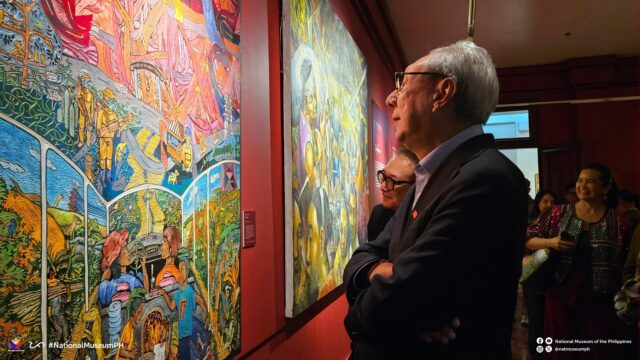
PHOTO CREDIT | www.facebook.com/nationalmuseumofthephilippines

Kultura. Kapital. Kasalukuyan is the title of the Contemporary art collection of the Bangko Sentral ng Pilipinas (BSP) that is on exhibit at the National Museum of Fine Arts until 2027.

“The works on display are not just for viewing. It tells stories of our identity, our struggles, and our hope. They remind us that building a nation takes both economic strength and cultural depth,” BSP Governor Eli Remolona said in his welcome speech.

“This has been a wonderful collaboration… It occurs to me that artists and central bank economists are not all that different. Both build new worlds, maybe imagined worlds. Both challenge norms and both imagine the fu-ture.

“The artist constructs these worlds through brushstrokes or found objects such as a toilet seat — like Marcel Duchamp. Economists will do it through complicated equations and mathematical models.

“That is why I love both… art and economics,” Mr. Remolona emphasized. (He was based in Basel, Switzerland for many years. The economist-banker is a certified art lover.)

Deputy Governor Berna Romulo-Puyat explained, “KKK brings together works that reflect the spirit of our times. The exhibit follows two key themes that spans two galleries… together, they tell a story of evolving culture, shifting values, and creative expression shaped by our time.

“We shine a light on contemporary artists whose perspectives and experiences continue to shape our national identity.

“Art should not be hidden away. It should be seen, explored, and discussed. Though this exhibit, we hope to inspire more people to engage with Filipino art and reflect on how it tells our shared story,” Ms. Romulo-Puyat en-thused.

Also at the opening was art connoisseur and collector Deanna Ongpin Recto, a former diplomat based in Paris who worked with UNESCO, who was also one of the key persons involved in the collection. “I was a member of the BSP Cultural Properties Acquisition Advisory Committee that (Gov.) Paeng Buenaventura created to update the BSP collection during his term, which is what is on exhibit. Dr. Jimmy Laya was chair and (art critic) Cid Reyes was a member too,” she explained.

Dr. Jaime C. Laya laid the foundation for the BSP’s collection — the artworks and the famous gold collection — when he was Central Bank Governor. His lifelong dedication to art and culture has been a guiding force. He has served as National Commission of Culture chair and is currently Cultural Center of the Philippines chair.

“Understanding a nation requires knowing its people — their aspirations, history and way of life — reflected in their art and culture,” said Dr. Laya.

The collection started in the early 1980s. Dr. Laya’s predecessor, Governor Gregorio Licaros, had begun buying Philippine artworks for the newly built Central Bank building. Paintings were needed for the Mone-tary Board room and the Governor’s office. Dr. Laya bought Spanish colonial art and “older works.”

Dr. Laya explained the history of the collection and the well-respected individuals who dealt with artworks that the central bank acquired slowly. He pointed out the significant art, such as a painting by National Artist Carlos “Botong” Francisco, the portrait by Simon Flores, the beautiful Juan Luna and Paz Paterno landscapes.

“I had to exercise my judgments on quality, rarity and price itself,” Dr. Laya said of the slow acquisition of artworks through the decades.

Romeo Bernardo, Monetary Board Member and advisor to the art collection committee, remarked during the opening: “This partnership is the natural evolution of an early vision at BSP that recognized Filipino art as both Kultura and Kapital (culture and capital), nurtured initially by Gov. Laya, and further built upon by his successors, notably Governors Rafael Buenaventura and Amando Tetangco. This vision is now car-ried forward by Gov. Eli Remolona and DG Berna Romulo-Puyat — perhaps toward a future we might call Kultura. Kapital. Kinabukasan. (Culture, Capital, Future).”

“This all started as a brainstorm between DG Berna and me, and really took off after we invited our mutual friend, NM (National Museum) Chairman Andoni Aboitiz, to lunch on Aug. 13, 2024, a year ago,” Ms. Bernardo said about the exhibit.

The exhibit at the National Museum is divided into sections.

Gallery XVIII’s Pagmulat (Awakening) reflects the everyday realities of Filipinos and how artists use “visual storytelling to speak the truth, invite reflection and keep history alive.”

Gallery XIX shows Pagtanaw (perspective, point of view), with works that reveal past realities and explore expressions from 1980s to1990s.

Among the prominent artists whose works are found in the two galleries are Edgar Talusan Fernandez, Ofelia Gelvezon-Tequi, Santiago Bose, Junyee, Onib Olmedo, Charlie Co, Roberto Chabet, National Artist Benedicto “Ben-

Cab” Cabrera, Gus Albor, Imelda Cajipe-Endaya, Elaine Navas, Cesare A.X. Syjuco, Riel Hilario, and Ambie Abaño.

The styles of the artists are diverse, colorful, provocative, and insightful.

The public, students of all levels, expats and tourists would learn much about the thoughts and sentiments, and “hear” the voices of the art. It is truly worth a long visit to experience the masters and the established contem-porary artists.

Maraming salamat Bangko Sentral ng Pilipinas, The National Museum and their respective art teams led by Monetary Board member Romeo Bernardo and Museum Director Jeremy Barns for this amazing milestone collab-oration.

Warm congratulations and mabuhay!


Maria Victoria Rufino is an artist, writer and businesswoman. She is president and executive producer of Maverick Productions.

mavrufino@gmail.com

PAL taps Trip.com for wider ticket access

BW FILE PHOTO

FLAG CARRIER Philippine Airlines (PAL) has partnered with online travel agency Trip.com to expand its air ticket distribution system.

“The partnership between Philippine Airlines and Trip.com will provide our customers a personalized and seamless flight booking and buying experience through NDC integration with Travelfusion,” PAL Vice-President for Sales and Distribution Justin Warby said in a media release on Thursday.

Global travel service platform Trip.com will provide PAL with new distribution capability (NDC) integration, which will allow customers abroad to access the same fares and reservation services available on PAL’s website.

NDC integration is a data exchange format based on offer and order management processes, allowing airlines to create and distribute offers to customers, the International Air Transport Association (IATA) said.

“With NDC integration, Trip.com now offers a wider selection of fares — from lower fares to student fares, as well as personalized ancillary products,” PAL said, noting that this will also enable the airline to offer exclusive and personalized offers as well as bundled ancillary products.

Trip.com Regional Director for Oceania, Southeast Asia, ISC, and the Middle East Kirk Wong said the company hopes to further expand its partnership with PAL to address the growing needs of travelers.

“This partnership will enable our users to enjoy better fare options and booking experiences, leveraging our extensive network and experience to expand PAL’s reach to customers in the region and beyond. We look forward to deepening our partnership with PAL to deliver seamless travel experiences to meet the evolving needs of today’s travelers,” he said. — Ashley Erika O. Jose

Venice Film Festival: Jury chief says films don’t change the world, but document it; Sorrentino’s presidential drama raises curtain

LABIENNALE.ORG

VENICE — US director Alexander Payne, president of the jury at this year’s Venice Film Festival, said on Wednesday that while movies rarely alter the course of society, they serve as vital documents of their times and shape memory.

“Can a film really change society or culture? I don’t know. Doubtful,” Mr. Payne said, recalling that films such as Charlie Chaplin’s The Great Dictator did not stop World War II, but rather showed that people were aware of what was going on.

“We have those as documents and, as such, we can try to learn from them,” he said ahead of the formal opening of the 11-day festival later on Wednesday.

Mr. Payne, whose credits include the Oscar-winning comedies Sideways and The Holdovers, lamented the shrinking space for theatrical releases in the age of streaming, saying movies that were only seen online struggled to make a broad impact on society.

“It’s typically films which have theatrical release, which become a part of a cinema conversation, of a cultural conversation, and then have some kind of impact,” he said.

Big streamers such as Netflix and Amazon regularly showcase their films at Venice but then offer little or no exposure for those movies in cinemas, reserving them instead for their subscribers. In the run-up to the 2025 event, some 1,500 film industry figures signed a petition urging the festival to take a robust stand over the war in Gaza, calling on the organizers to promote Palestinian voices and denounce Israeli actions.

Mr. Payne declined to say if he supported their call, while the head of the festival, Alberto Barbera, said he welcomed open debate but rejected suggestions that Israeli filmmakers or actors should be banned.

“We reject outright the demand to disinvite artists who wish to take part in the festival. At the same time, we have never hesitated to express our enormous anguish at what is happening in Gaza,” he told reporters.

The Venice festival opened on Wednesday night with the world premiere of Italian director Paolo Sorrentino’s La Grazia. Twenty-one films are competing for the prestigious Golden Lion prize, including works by Guillermo del Toro, Kathryn Bigelow, and Yorgos Lanthimos.

The event ends on Sept. 6 when Mr. Payne and his fellow jury members announce who has won the top Golden Lion award.

LOOKING FOR GRACE Paolo Sorrentino’s La Grazia opened the 82nd Venice Film Festival on Wednesday, with the Oscar-winning director revealing that his latest movie was inspired by a real-life political dilemma that raised profound moral questions.

Starring Mr. Sorrentino’s longtime collaborator Toni Servillo and Anna Ferzetti, the film follows the final months in office of a fictional Italian president who must decide whether to approve a law allowing euthanasia and wheth-er to pardon two prisoners convicted of murder.

Mr. Sorrentino told reporters the story was prompted by President Sergio Mattarella’s 2019 decision to grant clemency, (“grazia” in Italian), to a man who killed his Alzheimer’s-afflicted wife.

“It immediately seemed like an interesting moral dilemma to tell,” Mr. Sorrentino said. “For years I’ve thought that moral dilemma was a formidable narrative engine, more than any other narrative tool usually used in cinema.”

Although the main character shares many traits with the highly popular Mr. Mattarella, Mr. Servillo said it was fusion.

“There are countless widowed presidents of the republic, several presidents of the republic who are men of law, several presidents of the republic with only one daughter,” Mr. Servillo said.

Mr. Sorrentino won the Oscar for best foreign language picture in 2014 for The Great Beauty and took the Silver Lion runners-up prize in Venice in 2021 for The Hand of God about his childhood in Naples — both of which also starred Mr. Servillo.

Many of his films are sensual, opulent, and even surreal. La Grazia by contrast is often austere and sparse as it follows the elderly president grappling with his conscience, sparring with his intellectual daughter and mourning his late wife.

Mr. Sorrentino described his protagonist as a man who, behind his rigorous exterior, embodies “a high idea of politics,” which he said was increasingly hard to find in real life.

Amid the drama come trademark flashes of Sorrentino comedy, with the president learning the lyrics to a rap song, much to the surprise of a ceremonial guard, and seeking counsel from a black, scooter-driving pope.

But the core themes are dealt with sensitively and Mr. Sorrentino said he hoped his movie might help convince politicians in Italy to finally draw up a law on assisted dying.

“It’s well known that (cinema) no longer has the devastating impact of popularity it once had, but it can still try. So I can simply hope that a film, in this case my film, can bring attention back to a theme that… is fundamental,” he said. — Reuters

Peso strengthens vs dollar on BSP rate cut, dovish Fed bets

BW FILE PHOTO

THE PESO rose slightly against the dollar on Thursday after the Bangko Sentral ng Pilipinas (BSP) delivered a widely-expected rate cut and amid dovish expectations for the US central bank’s easing cycle.

The local unit closed at P57.12 per dollar, strengthening by four centavos from its P57.16 finish on Wednesday, Bankers Association of the Philippines data showed.

The peso opened the session sharply higher at P57.05 against the dollar. Its intraday best was at P56.93, while its worst showing was at P57.17 versus the greenback.

Dollars exchanged went down to $1.86 billion on Thursday from $1.9 billion on Wednesday.

“The dollar-peso closed a tad lower because the BSP delivered a rate cut. But profit taking ensued because the market is awaiting US PCE (personal consumption expenditures) data,” a trader said in a phone interview.

The BSP on Thursday cut its target reverse repurchase rate by 25 basis points (bps) to 5%, as expected by all 20 economists in a BusinessWorld poll conducted last week. Rates on the overnight deposit and lending facilities were likewise lowered by 25 bps to 4.5% and 5.5%, respectively.

This marked the third straight 25-bp reduction since April. Since starting its easing cycle in August 2024, the BSP has now slashed borrowing costs by a cumulative 150 bps.

The dollar was also generally weaker on Thursday amid dovish signals from US Federal Reserve officials, Rizal Commercial Banking Corp. Chief Economist Michael L. Ricafort said in a Viber message.

For Friday, the trader sees the peso moving between P56.90 and P57.30 per dollar, while Mr. Ricafort expects it to range from P57 to P57.2.

The dollar was little changed on Thursday as traders added to bets for a Federal Reserve interest rate reduction next month after New York Fed chief John Williams signalled a cut was possible, Reuters reported.

The US currency has been under renewed pressure from President Donald J. Trump’s ramped-up campaign to exert more influence over monetary policy decisions, as he attempts to fire Fed Governor Lisa Cook and replace her with a loyalist.

The dollar flattened against the euro even after France’s prime minister on Monday unexpectedly called a confidence vote for next month, which is likely to result in the fall of his minority government.

The Fed’s Mr. Williams said in an interview with CNBC on Wednesday that it is likely interest rates can fall at some point, but policymakers will need to see what upcoming data indicate about the economy to decide if it’s appro-priate to make a cut at the Sept. 16-17 meeting.

Key among data releases before that meeting are the PCE price index on Friday — the Fed’s preferred inflation measure — and the monthly payrolls report a week later.

Traders currently lay around 89% odds of a quarter-point rate cut next month, and have priced in a cumulative 55 bps of easing by yearend, according to LSEG data.

That helped send two-year Treasury yields, which are sensitive to policy expectations, sliding to the lowest level since May 1, adding to pressure on the dollar.

Mr. Trump’s push to place hand-picked, dovish-leaning candidates into the central bank’s decision-making committee also pulled short-term yields lower, even though his attack on Ms. Cook could spark a protracted legal battle after she sued to keep her job.

“Short-dated US yields remain near their recent lows, and most would conclude that this week’s (attempt to remove) Fed’s Lisa Cook by President Trump is dollar-negative,” said Chris Turner, global head of markets at ING.

The dollar index, which gauges the currency against six major peers, edged 0.1% higher at 98.225, following two days of declines.

The euro was little changed, down 0.07% at $1.1630.

Against the yen, the dollar slipped 0.03% to 147.34 yen.

Japan’s chief trade negotiator Ryosei Akazawa canceled a trip to Washington at the last minute on Thursday, delaying an announcement of the details of Japan’s $550-billion investment pledge in the United States as part of a tariff deal.

A government spokesperson said the decision was taken after talks with the US side revealed some points that need further discussion “at the administrative level.”

The dollar slipped to its lowest level against China’s offshore yuan since November, last down 0.2% to 7.1360 yuan in offshore trading. — A.M.C. Sy with Reuter

Debate over 14th month pay called a ‘distraction’

PHILIPPINE STAR/NOEL B. PABALATE

By Kenneth Christiane L. Basilio, Reporter

THE LABOR movement continues to prioritize the campaign for a P200 daily minimum wage and warned that calls for 14th month pay could serve as a “distraction” from this effort.

Federation of Free Workers President Jose Sonny G. Matula said via Viber: “Our foremost priority is the P200 nationwide legislative wage hike… We hope the 14th month pay will not become a distraction or a substitute for a genuine wage hike.”

Senate Minority Leader Vicente C. Sotto III filed in July a bill seeking to require employers to grant workers 14th month pay to help them deal with the cost of living.

Senate Bill No. 193 also proposed that the 13th month pay be released no later than June 14, with 14th month pay disbursed no later than Dec. 24 of every year.

Presidential Decree No. 851 of 1976 requires employers to pay workers 13th month pay, equivalent to one-twelfth of an employee’s total basic salary earned within a calendar year.

Mr. Sotto’s bill “recognizes the indispensable value of labor to the growth of capital,” National President of Bukluran ng Manggagawang Pilipino Renecio S. Espiritu said via Viber.

Benjamin B. Velasco, an assistant professor at the University of the Philippines Diliman School of Labor and Industrial Relations, said: “A 14th month pay is one way to address and attend to retention issues of firms,” he said via chat. “Happy workers are hard workers.”

But the productivity boost will likely be short-lived if monthly wages still lag the rising cost of goods, Josua T. Mata, Sentro ng mga Nagkakaisa at Progresibong Manggagawa secretary-general, said.

“Bonuses can indeed incentivize employees. However, this effect is short-lived if underlying pay remains inadequate,” he said via Viber.

Mr. Sotto’s proposal represents two pump-priming events each year, boosting domestic demand and providing support to local businesses, Mr. Velasco said.

“The 14th month will hit firms’ profits as it means bigger labor costs. But this can be offset by higher productivity and bigger demand,” he said.

ADVERTISEMENT
ADVERTISEMENT