Home Blog Page 1062

Globe partners with Bolttech to drive flagship smartphone access

BW FILE PHOTO

GLOBE TELECOM, INC. has partnered with global insurance technology (insurtech) company Bolttech to upgrade the telecommunications company’s device upgrade program.

“Our partnership with Bolttech allows us to make premium phones very accessible and reachable, a reflection of our commitment to provide curated experiences and customer-centric solutions that truly meet our customers’ needs,” Globe Head of Platinum Mark Gil Pasaylo said in a media release on Tuesday.

Through this partnership, Globe will launch Flagship Forever, a program designed to give Globe’s customers flexibility and accessibility in owning flagship smartphones, the company said.

Flagship Forever will allow customers to upgrade to the newest models each year without the burden of pre-termination fees for every upgrade, it said, adding that it also enables customers to easily trade their current units without paying pre-termination fees.

“We are thrilled to expand our ongoing collaboration with Globe to bring Flagship Forever to customers in the Philippines. By combining annual upgrades with complete device protection, customers can stay connected through the latest technology while enjoying meaningful savings in this accessible program,” said Bolttech Philippines General Manager Alexander Sarmiento.

The Ayala-led telecommunications company said it is boosting connectivity in Metro Manila with new tower builds and upgrades.

Globe said it had reached 62.5 million mobile subscribers to date, representing a 5% year-on-year increase as of end-June, up from 59.5 million in the same period last year.

For the second quarter, Globe’s attributable net income fell by 29.46% to P5.46 billion as weaker revenues and higher expenses weighed on earnings.

Its combined revenues for the second quarter declined by 1.92% to P43.47 billion from P44.32 billion in the second quarter of 2024, while gross expenses rose by 0.72% to P39.21 billion from P38.93 billion in the same period last year.

At the local bourse on Wednesday, shares in the company closed P15, or 1% higher, at P1,520 apiece. — Ashley Erika O. Jose

Arts & Culture (09/03/25)


Joel Wijangco’s shoe exhibit at Yuchengco Museum

AVANT-GARDE footwear designer and art provocateur Joel Wijangco has unveiled his latest exhibit at the Yuchengco Museum, blurring the line between fashion, sculpture, and social commentary. The exhibit showcases over 25 handcrafted shoes, each one acting as a sculptural narrative, from twisted stilettos exploring body dysmorphia to pieces inspired by the fishwife Amazons of Malabon’s wet markets. It is on view at the Yuchengco Museum, RCBC Plaza, Makati City, until Oct. 15.


Gateway Gallery hosts Pen Medina’s solo exhibit

VETERAN actor Pen Medina is holding his first solo painting exhibit at Gateway Gallery. Titled Paikot-ikot Lang: (Human Condition.ed) The Prelude, the exhibit serves as both a personal milestone and a meditation on the cycles of life, art, and the profound question of humanity’s purpose. It runs until Sept. 12 at the Gateway Gallery on the 5th floor of Gateway Tower, Gateway Mall, Cubao, Quezon City.


CCP welcomes deaf and hard-of-hearing apprentices

THE Cultural Center of the Philippines (CCP) has recently conducted its Front-of-House apprenticeship program with participants belonging to the Deaf and Hard-of-Hearing community. It provides opportunities for differently abled youth through training in different aspects of arts management and appreciation, as well as theater operations, especially in the frontline service areas. Ten Deaf and Hard-of-Hearing participants went through the two-week-long series of lectures and workshops.


UNICEF, Ang INK collaborate on gifts for a cause

UNICEF Philippines has launched the Hiraya Collection, a new line of all-occasion cards and merchandise. Created in collaboration with Ang Ilustrador ng Kabataan (Ang INK), the collection is “all about bringing hope to vulnerable children through beautiful, art-filled gifts.” The limited-edition collection features designs that signify hope, inspired by Ang INK artists’ fondest childhood memories. Among the participating artists are Iori Espiritu, a ceramic artist and illustrator, who designed Sama-Sama, Salo-Salo, which shows children gathering ingredients for a meal; designer and illustrator Kat Mel made Sayaw ng Santan; and grade school teacher and illustrator Al Estrella titled his piece on school Pangalawang Tahanan. The Hiraya Collection includes the UNICEF Cards for Every Occasion, featuring 12 unique designs available for P1,000. The collection also consists of the UNICEF Tote Bag, which comes with a keychain and is available in three different designs for P1,500. Every purchase from the Hiraya Collection supports UNICEF’s programs for children in education, health and nutrition, immunization, protection, climate, environment, resilience, and aid in emergencies. The Hiraya Collection and other UNICEF merchandise, such as the UNICEF Mini Backpack Charm (P1,200), UNICEF Notebooks (P500), and UNICEF Gift Bag (P200), are available exclusively on the UNICEF Giving Shop, UNICEF Philippines’ official online store.


Art House exhibit with 0270501, Veronica Ibarreta

THE upcoming exhibit HUGIS: When Memories Take Shape is set to showcase contemporary art by two artists: 0270501 and Veronica Ibarreta. The exhibit, curated by Marika Constantino, showcases the indigenous materials and unconventional processes of each artist. For 0270501, his pieces are artifacts and mementos best described as controlled chaos. Meanwhile, Ibarreta, known for her pointillism technique and floral series, contributes canvases resulting from contemplation and meditation. The dual exhibit will run from Sept. 5 to 21 at the ArtistSpace, Ayala Museum, Makati Ave., Makati City.


Two-day comics workshop at Y Space

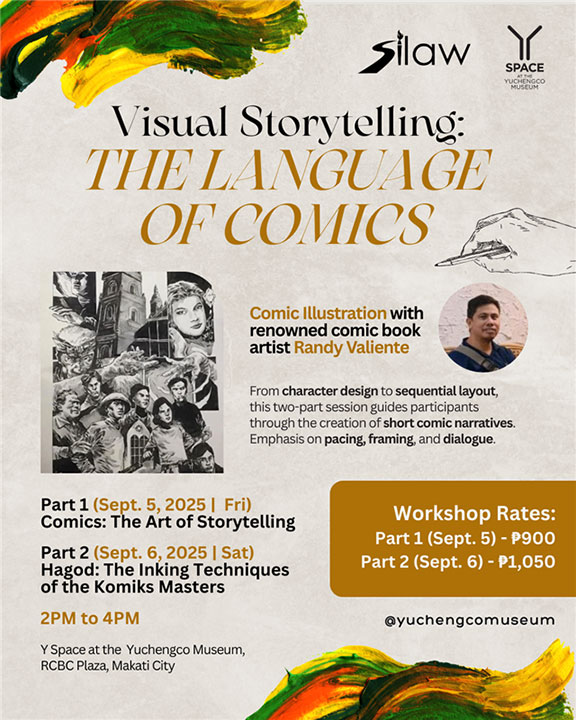
ON Sept. 5 and 6, Y Space will host the workshop “Visual Storytelling: The Language of Comics” which will tackle comic illustration, led by renowned comic book artist Randy Valiente. It will cover character design, sequential layout, and short comic narratives with an emphasis on pacing, framing, and dialogue, all in the span of a two-part session. It takes place on Sept. 5 and 6, 2-4 p.m. The first part costs P900 while the second costs P1,050. Y Space is located at the Yuchengco Museum in RCBC Plaza, Makati City. Register via yuchengcomuseum.org.


Sean Go mounts exhibit on the monumental

FOLLOWING successful exhibitions in Japan, the US, and across Europe, Filipino contemporary artist Sean Go is back in Asia with his solo exhibition Colossus, opening on Sept. 6 at León Gallery International in Makati City. This show presents looks into what it means to be small, overwhelmed, and in awe of things that are bigger. It features towering works reaching up to seven feet in height with widths extending to nine feet, each boasting a mechanical aesthetic. The exhibit will run from Sept. 6 to 16 at León Gallery International in Corinthian Plaza, Paseo de Roxas, Makati City.


PPO set to open 41st concert season

THE 41st music season of the Philippine Philharmonic Orchestra (PPO) will open on Sept. 12 with Concert I: Overture. It will feature acclaimed pianist Andrey Gugnin playing various pieces with the orchestra, including Antonín Dvořák’s Carnival Overture, Op. 92, Sergei Rachmaninov’s Rhapsody on a Theme of Paganini, Op. 43, and Johannes Brahms’ Symphony No. 4, Op. 98, E minor. It will take place at The Metropolitan Theatre in Manila. Tickets are priced from P500 to P3,000.


Shell’s 58th NSAC enters partnerships

SHELL Pilipinas Corp. will continue to champion young Filipino artists through this year’s 58th Shell National Students Art Competition (NSAC), this time with a roster of partners. These are Boysen Philippines, IFEX, and Airspeed, along with various museums and galleries nationwide. This year’s theme has also been revealed: “Alab” (Flame), “which calls on college students to ignite their creative passion and express ideas that resonate with today’s generation.” For updates on the competition, follow Shell Pilipinas Corp.’s official website and social media channels.


Cecile Licad concert at MiraNila in October

MIRANILA Heritage House & Library, in partnership with the Erehwon Center for the Arts and the P. Ilusorio Foundation, will be presenting the piano concert Cecile Licad Up Close next month. Ms. Licad will play in the garden-surrounded setting of the Gallery MiraNila, with a repertoire of Beethoven, Chopin, Joplin, Liszt, and Schumann. The concert is scheduled for Oct. 1 at 6:30 p.m. at the MiraNila Heritage House, 26 Mariposa St., Brgy. Bagong Lipunan ng Crame, Quezon City.

Finding the sweet spot between technology and security

STOCK PHOTO | Image from Freepik

On the one hand, we have to take advantage of advances in technology, aiming not just for digital literacy but sophistication. Developments over the past few years have made many things possible, and many Filipinos have benefitted from the convenience and reach offered by technological progress.

For example, communication between different places in the country and across different countries is now possible at no additional cost. Meetings and even classes can be held virtually, grocery items could be purchased online, and transferring funds or engaging in any financial transaction could be done in a matter of minutes, even seconds.

On the other hand, technology has its drawbacks, security not being the least of all. And because it is ever evolving, it is impossible to completely anticipate and prepare for its pitfalls.

Thus, it is not uncommon to hear about fraud, invasion of privacy, or security breaches.

How, then, do we navigate this fragmented world and complex environment wherein we have to rely on technology as a means to achieve economic goals, be competitive with the rest of the world, and improve the people’s quality of life, while also guarding ourselves against its excesses? More than individuals being at risk, there is a larger danger: as global trade expands, shifting geopolitical realities are reshaping economies and national security.

Specifically, global trade is driven by regional partnerships, strategic alliances, and the rise of a multipolar world. Surviving and thriving in this evolving Indo-Pacific entails adaptation and leadership in innovation, investment, and solutions. The Philippines plays a crucial role here, because it is strategically positioned across sea lanes, trade routes, data connectivity, digital services, and supply chain diversification. This makes the country central to both opportunity and security imperatives.

Trade and investment now sit at the intersection of economic resilience and national security. Emerging technologies must be harnessed with this same goal: enabling progress while protecting sovereignty.

At the opening of the Manila Tech Summit 2025, President Ferdinand Marcos, Jr. said that technology should not only deliver efficiency through faster transactions, broader services, and expanded access. Rather, it must also uplift lives and create opportunities for every Filipino. The digital economy is currently valued at P2.25 trillion, or equivalent to 8.5% of the 2024 gross domestic product, Hence, investments in digital innovation promise far more returns than their costs.

A truly digital Philippines, he said, expands connectivity across the archipelago, strengthens trust and inclusion, and positions the country as both a fintech hub and a leading voice in the global financial system.

According to the President, the Philippines must continue investing in technology, information and communications, and advanced electronics, while deepening partnerships with its most trusted economic allies. A Pulse Asia survey revealed that these trusted economic allies are the United States (66%), Japan (43%), Australia (32%), Canada (31%), and the United Kingdom (16%).

Paul Taylor, Head of the US Commercial Service in the Philippines, highlighted the strong interest of American companies in investing in the country, citing the US government’s recent $15 million commitment to support private-sector development through the Luzon Economic Corridor Initiative.

This initiative translates into projects in ports, rail, power, and digital backbones, which strengthen supply chain resilience and unlock the country’s potential in semiconductors, AI, and cloud centers. These find solid footing on the enduring US-Philippine alliance, anchored in one of the world’s oldest mutual defense treaties.

Meanwhile, Australia’s Trade and Investment Commissioner to Manila, Bernice Vanguardia, highlighted Australia’s sustained investments in the Philippines, recognizing the country as an emerging player in regional value chains under Australia’s Southeast Asia Economic Strategy to 2040. She cited Australia’s investments in the Philippines’ digital infrastructure sector, including an agreement designed to enhance cyber skills development, information sharing, and collaboration on emerging digital threats and frameworks for a trusted digital economy.

Rhiannon Harries, the UK Department of Business Deputy Trade Commissioner for Southeast Asia, highlighted the UK’s 10-Year Modern Industrial Strategy, emphasizing its focus on clean energy, particularly offshore wind, frontier technologies such as AI, and strengthening its role as a globally connected financial center that deepens ties with both advanced and emerging markets. She noted that the UK is expanding its investment in Southeast Asia, including support for renewable energy projects in the Philippines.

Meanwhile, from the private sector, Citibank Philippines Managing Director Paul Favila said that the rapid adoption of e-wallets and online banking demonstrates how technology is driving financial inclusion and enabling broader participation in the economy. As global supply chains diversify, he emphasized that the Philippines has a unique opportunity to position itself as a trusted hub by leveraging its skilled workforce, strong digital adoption, and strategic location.

In a fragmented world, securing the Indo-Pacific region demands a whole-of-society approach that is anchored on strong partnerships, resilient systems, and strategic collaboration amid intensifying geoeconomic competition. This shared recognition was echoed by key partners and stakeholders, who underscored their strong commitment to investing in the Philippines and advancing regional cooperation.

At a time of intensifying geoeconomic tensions, the Philippines stands at the crossroads of opportunity and responsibility. With its strategic location, skilled workforce, and expanding industries, the country is poised to lead in shaping resilient supply chains, advancing digital innovation, and fostering regional security — emerging not just as a participant, but as a driving force in the global economy.


Victor Andres “Dindo” C. Manhit is the president of the Stratbase ADR Institute.

PCCI urges focus on storage, AI in MSME funding

FACEBOOK.COM/DTI.GOLOKAL

By Beatriz Marie D. Cruz, Reporter

STATE FUNDING for micro, small and medium enterprises (MSME) should prioritize storage and artificial intelligence (AI) adoption, according to the Philippine Chamber of Commerce and Industry (PCCI), citing heightened risks from climate change and disruptive tech.

“One of the sectors which has a lot of MSMEs is the agriculture and aquaculture sectors, as they form a whole supply chain,” PCCI Chairman George T. Barcelon told BusinessWorld by telephone. “They are food-related and subject to climate change, so they have a higher risk involved.”

“So, the kind of financing for MSMEs must tailor-fit those prevailing conditions, like post-harvest and storage financing,” he added.

Mr. Barcelon also cited the need to help MSMEs integrate AI and robotics into their operations, noting that many small firms lag in adapting to technological shifts.

“We are now embarking on disruptive technology, such as AI, robotics and the like, but of course, many firms are involved in this since this is just something very recent,” he said.

He added that financing schemes similar to venture capital could also help startups and small entrepreneurial projects that form part of the MSME sector.

The Department of Trade and Industry earlier said it is pushing for bigger MSME financing, in line with President Ferdinand R. Marcos, Jr.’s call during his State of the Nation Address on July 28.

MSMEs, dubbed the backbone of the economy, account for 99% of all registered businesses in the Philippines.

However, a recent study by the Boston Consulting Group (BCG) showed that 50% of surveyed MSMEs cited lack of access to capital as their biggest challenge.

BCG Principal Lance Katigbak said many MSMEs are aware of financing options but hesitate to apply for loans due to fear of debt, lack of collateral and the perceived complexity of applications.

“Government funding should focus on unlocking access, not just increasing availability,” Mr. Katigbak said in a Viber message. “This means developing programs should capture a deep understanding of the specific needs of different MSME segments.”

He added that streamlining and digitizing the loan application process, while expanding eligibility for microenterprises, could ease the burden.

“Many MSMEs — especially sari-sari (mom-and-pop) stores — feel excluded due to lack of collateral, limited credit history or informal operations,” he said.

Mr. Katigbak also suggested short-term working capital for food service MSMEs and retailers, along with broader support measures such as financial literacy programs, mentorship, supply chain linkages, digital adoption incentives, job-matching services and eased labor compliance.

Michael L. Ricafort, chief economist at Rizal Commercial Banking Corp., said creating a centralized credit bureau would boost bank lending to MSMEs by improving borrower information.

“There is great opportunity to further boost MSME lending in the country, partly through loan guarantees for some MSME borrowers that do not have the track record on borrowings as well as on financials,” he said in a Viber message.

Banks have lent only 4.63% of their total loan portfolio to MSMEs as of end-March, far below the 10% quota required by law, according to central bank data.

Pru Life UK unveils 2 insurance plans

PRULIFEUK.COM.PH

PRU LIFE Insurance Corp. of UK Philippines (Pru Life UK) has rolled out two traditional life insurance policies with guaranteed cash payouts and maturity benefits, as part of its strategy to expand the share of traditional products in its portfolio.

At a launch event on Tuesday, Pru Life UK Chief Product Officer Garen U. Dee said the company aims to meet customer needs across different life stages by offering guaranteed returns alongside protection.

“There’s guaranteed payout, guaranteed maturity benefit, and guaranteed protection,” she said. “We have the right solutions depending on the needs of the customer for whatever stage of life they are in.”

The two products — PruSteady Income and PruWealth 10 — target distinct customer segments.

PruSteady Income was designed for freelancers, parents and overseas Filipino workers. It provides a 10% net annual cash payout from the end of year 11 until the policy matures at year 20.

At maturity, policyholders get 100% of the sum insured. The plan also includes access to loanable funds based on the policy’s cash value, while protection worth 200% of the sum insured applies from day one, payable to beneficiaries in case of death.

PruSteady Income requires a minimum investment of P50,000, with payment terms ranging from five to 10 years.

Meanwhile, PruWealth 10 caters to affluent clients seeking wealth diversification. It offers guaranteed 5% net annual cash payouts for 10 years, a full 100% premium return upon maturity, and life coverage equal to 110% of the sum insured. The product, which requires a minimum investment of P500,000, will be offered only while supplies last.

Company officials noted that the guaranteed returns are competitive compared with time deposit (TD) rates, which have fallen amid the Bangko Sentral ng Pilipinas’ easing cycle. “This one guarantees 5% for 10 years, whereas we can see TDs ranging way below that,” she said, adding given the recent rate cut and tax considerations, this stands at a very competitive level.

Pru Life UK said it plans to launch more guaranteed products to balance its portfolio, which is dominated by variable-unit linked (VUL) insurance.

“The difference between VUL and traditional products is really the promise of guarantee,” Ms. Dee said. “There are segments of the market who would want to have that kind of feature.”

She added that the company is not shifting away from VUL policies but rather broadening its offering. “We do not stop carrying VULs because we believe it’s an integral part of the portfolio, but we are also starting to offer guarantees.” — AMCS

ERC allows transfer of net-metering credits for property ownership changes

BW FILE PHOTO

THE Energy Regulatory Commission (ERC) has amended the rules on net metering to streamline and make renewable energy adoption more accessible to qualified end-users, including the rollout of net-metering credits.

In a statement late Monday, the ERC said it has introduced key amendments aimed at “strengthening consumer protection and simplifying processes for availing of the program.”

Net metering allows power users who generate their own electricity via renewable energy to sell some of their excess output to the grid, with the proceeds credited against their power bills.

Among other key amendments made by the ERC is the allowance for banking and rollover of net-metering credits for transfer in the event of a change in property ownership.

“In the event of a property ownership change, the credits may be transferred to the new owner, subject to conditions such as a conformed letter from the original owner,” the ERC said.

The regulator also revised the rules to make the installation of renewable energy certificate (REC) meters voluntary.

RECs are issued to participants in the Renewable Portfolio Standard (RPS) scheme, indicating that the energy sourced, produced, and sold or used comes from eligible renewable energy systems.

Under RPS, distribution utilities, electric cooperatives, and retail electricity suppliers are required to source a portion of their energy supply from eligible renewable energy sources.

“In case of waiver of the installation of said REC meter, energy generated from the RE Resource shall be computed using the appropriate formula provided under the Rules, subject to the submission of an affidavit and waiver,” the agency said.

To further promote transparency, the ERC has directed distribution utilities to publish on their websites detailed information on their net-metering programs, including application forms, processes, and quarterly postings of their hosting capacities on a per-distribution-transformer basis. — Sheldeen Joy Talavera

Italy exhibition explores how sound helps us to savor food

MUSE.IT

TRENTO, Italy — An exhibition in northern Italy is expanding traditional ideas about taste by exploring how sound influences the way people experience their food.

Hosted at the MUSE science museum in Trento, Food Sound examines how auditory cues — from the crunch of an apple to the sizzle of a pan — affect appetite, perception of flavor and emotional response.

“If neuroscience has transformed fields from psychology to economics, it’s also reshaping how we understand cooking and food,” said Patrizia Famà, director of the museum’s Office of Public Programs.

Visitors are guided through mock-ups of trattorias and dining pods, learning how the brain processes sound and how acoustics can influence food choices.

One interactive display invites guests to select food based solely on sound.

“Food perception is the ultimate multi-sensory experience, engaging all five senses,” said Massimiliano Zampini, a researcher at the University of Trento and a member of the exhibition’s scientific committee.

Mr. Zampini and Charles Spence, an experimental psychologist at Britain’s Oxford University, were among the first to study how sound — often overlooked in discussions of taste — affects flavor and emotional response.

In a landmark experiment in 2004, they found that potato chips were perceived as being both crisper and fresher when either the overall sound level was increased, or when just the high frequency sounds were selectively amplified.

The idea for the exhibition came to creator Vincenzo Guarnieri after overhearing children describe a visit to a potato chip factory.

“They said the fryers sounded like other children crying. That moment struck me, and I realized sound could be a powerful tool to raise awareness about food,” Mr. Guarnieri said.

The food industry has taken notice of the research to try to attract consumers.

British food ingredients maker Tate & Lyle has identified “Hyper Crunch” as a rising trend, with consumers adding baked rice to salads and seeking out snacks that deliver a satisfying crunch.

In a report published in November, Tate & Lyle predicted that the trend would expand into sweet categories. It cited examples such as a chocolate bar with a kunefe filling, a traditional Middle Eastern dessert, and iced coffee served in chocolate-coated cups that crackle when squeezed.

Betti Nincioli, from Florence, said that she had already realized how much background music contributed to her sense of serenity and positive mood when she was picking up products from supermarket shelves or dining in restaurants.

“Now I am more aware of how a product’s sound can make it seem like something else,” she said after visiting the exhibition which is in a museum designed by Italian architect Renzo Piano. — Reuters

The only way to solve our corruption problem

STOCK PHOTO | Image from Freepik

The recent flood-control scandal in the Department of Public Works and Highways (DPWH) is a painful reminder of how corruption in public procurement continues to cost lives and livelihoods. Funds meant to protect vulnerable communities from flooding were allegedly lost to ghost projects, padded bids, and questionable contractors. Instead of drainage systems and flood barriers, Filipinos are left with headlines of collusion and waste.

This is not a new story. The Philippines has struggled for decades with leakages in procurement, whether in infrastructure, education, or health projects. Paper trails are easily manipulated. Oversight is often too slow, too weak, or too compromised to prevent corruption in real time. The result is the same: billions of pesos intended for public service never reach their rightful destination.

Blockchain offers a solution. By design, it creates transparent, tamper-proof records of transactions. Once an entry is logged, it cannot be altered without consensus. If public bidding processes and government contracts were placed on the blockchain, every bid, evaluation, award, and fund release would be verifiable and immutable. Contractors could no longer alter submissions or backdate documents. Ghost projects would be impossible because disbursements could be tied to verifiable milestones and project completion reports.

Other countries are already showing us how this works. In Colombia, blockchain was piloted to monitor public contracts, making them transparent to citizens and civil society. Georgia digitized its land registry using blockchain, drastically reducing disputes and eliminating the bribes once common in land transactions. South Korea has integrated blockchain into aspects of its procurement to strengthen oversight, while the World Food Program has used blockchain to track aid funds to ensure money goes directly to intended beneficiaries.

The implications for the Philippines are enormous. If the DPWH had conducted its flood-control project bidding on blockchain, the allegations of collusion and fake projects could have been eliminated at the source. Each bid would have been immutably recorded, visible to auditors, regulators, and even the public. Every peso released by DPWH would have had a traceable trail to contractors, making ghost projects virtually impossible.

Underlying this approach is a principle well known in technology: Zero Trust. At its core, Zero Trust means “never trust, always verify.” If we have difficulty trusting government officials, then the only way forward is to design systems where trust is unnecessary because verification is automatic. Blockchain is, in essence, a Zero Trust system applied to governance. It does not rely on the integrity of individuals; it relies on the immutability of code and consensus. For a country long plagued by corruption, this is not just desirable — it is essential.

We already have a local proof of concept: the decision of the Department of Budget and Management (DBM) to put its Special Allotment Release Orders (SAROs) on the blockchain. Every SARO issued is now logged immutably, creating a transparent record of fund releases. This system provides auditors and agencies with real-time verification of how money is allocated. It is a practical demonstration that blockchain can work within our bureaucracy, cutting through complexity and embedding accountability directly into government finance.

If the DBM can do it, why can’t the DPWH? Pushing this question further: why can’t the Department of Education apply it to school-building contracts, or the Department of Health to the procurement of medicines and equipment? If blockchain can track the release of funds at DBM, it can also track bidding, contractor performance, and milestone payments in any other agency. The technology exists, and the precedent is already here. What is missing is the mandate to scale.

The benefits extend beyond corruption prevention. By digitizing and securing procurement processes, blockchain also improves efficiency, reduces paperwork, and accelerates project implementation. International donors and investors are more likely to support projects in a country where transparency is embedded by default. Local communities, meanwhile, gain greater confidence when they can see public funds being deployed in real time for projects that directly impact their lives. In this way, blockchain does not only clean up governance — it strengthens public trust in government institutions themselves.

The DPWH scandal should not simply be another case study of graft. It should be the turning point that finally forces a digital upgrade of government procurement. By adopting blockchain across all agencies, we can make corruption technically impossible. Citizens could see where their taxes go, auditors could monitor projects in real time, and contractors would compete on fair and transparent terms.

The Philippines already has the proof: DBM’s SARO blockchain system works. The question now is whether other agencies will follow. If they don’t, then the only conclusion the public can draw is that opacity is being protected for the benefit of those who profit from it.

The choice is clear. Continue with scandals or embrace transparency. Blockchain is not just a technology for finance or business. It is a governance tool — a Zero Trust system that restores accountability, protects public funds, and ensures every peso goes where it is meant to go.

If DBM can put SAROs on the blockchain, then every agency can put its procurement and projects on the chain as well. For the sake of good governance, accountability, and the Filipino people, it is time to make that leap.


Dr. Donald Lim is the founding president of the Blockchain Council of the Philippines and the lead convenor of the Philippine Blockchain Week. He is also the Asian anchor of FintechTV.

DTI pushes coco ventures to boost local, global demand

PHILSTAR FILE PHOTO

By Almira Louise S. Martinez, Reporter

THE Department of Trade and Industry (DTI) wants more Filipino entrepreneurs to venture into the coconut industry to boost the local market and meet international demand.

“We’re really encouraging more people to really get into the coconut business because it’s a star product, it’s a star fruit,” Trade Secretary Ma. Cristina A. Roque told reporters on the sidelines of a coconut trade fair last week. “Globally, there’s a huge market, and locally, there’s also big demand.”

Although the Philippines is the world’s second-biggest producer of coconuts — harvesting 14.7 billion annually — and the top exporter of more than 50 coconut-based products to at least 24 countries, the country generates limited domestic returns.

“We need to increase our domestic utilization,” Philippine Coconut Authority Administrator Dexter R. Buted said in a speech. “Unlike other countries like Thailand and Indonesia which have high domestic returns, ours is quite low,” he added in Filipino.

Marlyn B. Amorao, co-owner of Mang Ed’s Handicraft, which produces various handcrafted coconut products, said aspiring entrepreneurs could start their small business with little to no capital.

“During the pandemic, my husband used to bring home coconuts and coconut shells he found on the ground,” she told BusinessWorld. “He would then create plant pots out of them just for fun.”

“We had no capital back then, but we were still able to sell it on Facebook for P100,” she added. Their business now earns about P10,000 a month.

Ms. Amorao said she wants to help other aspiring entrepreneurs in the industry if she had adequate equipment to teach.

“What we hope for is to have the necessary equipment, because we also want to help by teaching other people how to make products from coconuts,” she said in Filipino. “If we have the right equipment, we can teach them how to create products to help them earn.”

About 2.8 million workers and farmers rely on coconut, making it a cornerstone of the Philippine agriculture sector, according to the Department of Agriculture.

“The industry is deeply woven in our economy and Filipino way of life,” Agriculture Assistant Secretary and Special Assistant for Export Development Phillip C. Young said at the event.

“We want Filipinos to take pride and benefit from our very own coconut products,” he added.

The government has allotted P1 billion for coconut planting and replanting and P1.8 billion for fertilization this year, with a target of planting 100 million trees nationwide by 2028.

“Coconut farming is the backbone of many rural economies,” Mr. Young said. “Through mechanization, irrigation and science-based practices, we are helping farmers boost productivity and resiliency.”

“Supporting coconut farmers mean supporting the broader agri-value chain,” he added.

FWD Philippines launches two-pay investment-linked insurance plan

PHILIPPINE STAR/MIGUEL DE GUZMAN

FWD LIFE INSURANCE CORP. (FWD Philippines) has introduced its first two-pay investment-linked insurance plan as it seeks to provide Filipinos with more flexible financial protection and investment options.

Called FWD Fast Lane, the product requires a minimum premium of P200,000 annually for two years and provides life coverage starting at five times the annual premium. The insurer said the plan combines the advantages of regular-pay and single-pay investment-linked products.

“Filipinos deserve financial success,” FWD Philippines President and Chief Executive Officer Soon Liang Lau said in a statement on Tuesday. “They deserve a plan that keeps up with them. Whether they’re advancing in their careers, growing their businesses or building their investment portfolio, they need a protection plan that moves at their pace.”

Regular-pay plans often demand longer investment periods of five to 10 years, while single-pay plans allow faster investment growth but require larger upfront payments, according to the insurer. Fast Lane aims to bridge these gaps.

The product offers a start-up bonus equal to 20% of the basic annual premium, which is invested immediately to boost the chosen fund value. It also comes with a loyalty bonus and an investment protector bonus, the latter doubling the loyalty bonus if the Philippine Stock Exchange Composite Index (PSEi) falls below its level from five years earlier.

Policyholders may also opt for quarterly payouts by investing in Velocity and Nitro Global Payout funds, which were previously limited to single-pay products.

The company said Fast Lane forms part of its push to expand financial protection in the country, where many Filipinos remain underinsured despite improving economic conditions.  AMCS

Meralco subsidiary completes CFS share purchase from Bayad Center

MERALCO.COM.PH

PANGILINAN-LED Manila Electric Co. (Meralco) said its subsidiary Meralco Industrial Engineering Services Corp. (Miescor) has completed the acquisition of shares in Customer Frontline Services Corp. (CFS) for P74 million.

In a regulatory filing on Tuesday, Meralco said that Miescor acquired 400,000 common shares of CFS from bills payment platform CIS Bayad Center, Inc.

CFS, a subsidiary of Bayad Center, is a provider of outsourced tellering, frontline customer services, and customer solutions.

Miescor and its subsidiaries provide expertise in engineering, procurement, and construction; distribution utility and pole attachment services; telecommunications services and infrastructure; logistics and facilities management; and trading of electrical supplies and equipment.

CFS and Bayad are affiliates through Corporate Information Solutions, Inc.

In a separate disclosure, Meralco said that another Pangilinan-led firm PLDT Inc. has executed a subsidiary agreement for 594 million additional common shares in Kayana Solutions, Inc.

Following the subscription, the equity interest of PLDT in Kayana remains unchanged at 45%.

Metro Pacific Investments Corp. and Meralco each hold a 27.5% equity interest in Kayana.

Meralco’s majority owner, Beacon Electric Asset Holdings, Inc., is partly owned by PLDT Inc.

Hastings Holdings, Inc., a unit of the PLDT Beneficial Trust Fund subsidiary MediaQuest Holdings, Inc., has an interest in BusinessWorld through the Philippine Star Group, which it controls. — Sheldeen Joy Talavera

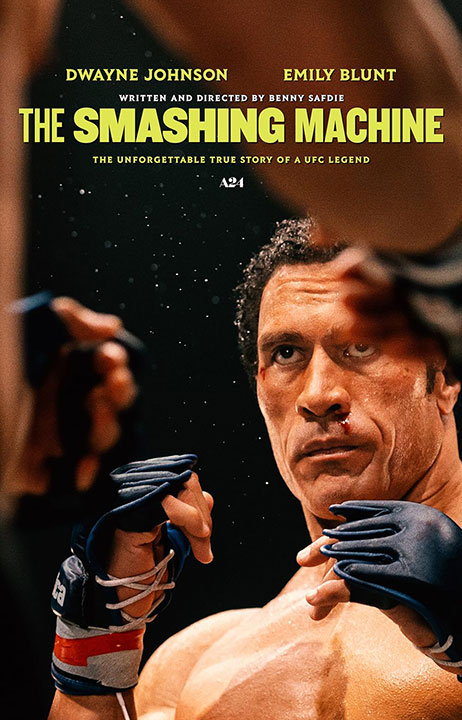
Venice Film Festival: Dwayne Johnson breaks Hollywood mold in gritty fight drama

The Smashing Machine (2025)

VENICE — Dwayne “The Rock” Johnson, best known for his high-octane action roles, has stepped away from his Hollywood comfort zone to take on a bruising dramatic turn in The Smashing Machine, which premieres at the Venice Film Festival on Monday.

The former wrestling star and box-office powerhouse plays the real-life, mixed martial arts pioneer Mark Kerr, whose towering physique and prowess in the ring belied a soft-spoken nature and private struggles.

The role marks a sharp turn for Mr. Johnson, who has spent the past two decades headlining family franchises such as Jumanji and the Fast & Furious series.

“Sometimes it’s harder to know what you’re capable of when you’ve been pigeonholed into something,” Mr. Johnson told reporters in Venice.

“It could push you into a category and into a corner, and this is your lane, this is what people want you to be, this is what Hollywood wants you to be. I just had this burning desire, this voice that was saying, ‘Well, what if there is more?’”

Directed by Benny Safdie, The Smashing Machine traces Mr. Kerr’s rise in the early days of mixed martial arts (MMA) and the Ultimate Fighting Championship (UFC), when brutal combats in Japan helped define the nascent sport.

The story also shows the toll it took on Mr. Kerr — a dependence on painkillers, a turbulent romance with his girlfriend Dawn, played by Emily Blunt, and the crushing pressure to deliver victory after victory.

“It’s about the pressure to win, the pressure to deliver, and what happens when winning becomes the enemy,” Mr. Johnson said.

“It’s a love story about Mark and Dawn, but also about Mark’s love for the thing he did, and his struggle to deliver and overcome his challenges.”

TRANSFORMATION
Mr. Johnson is almost unrecognizable in the role, sporting curly brown hair and appearing even more muscular than usual to reflect the physical stature of Kerr himself.

“I cannot believe I even asked, but I said, ‘Dwayne, I think you need to get a little’ and I was like, how do I say this? ‘bigger, puffier’?” said Mr. Safdie, making his debut as a solo director after previously sharing credits with his brother Josh.

Ms. Blunt, who had co-starred with Johnson in Disney’s 2021 adventure Jungle Cruise, said she had been “spooked” by his transformation. “I remember when he walked in as Mark for the first time. It changed the air in the room. It was like everyone parted, everyone went very quiet,” she said.

Mr. Kerr himself was in the room for Monday’s news conference and tears appeared in his eyes as he was introduced.

Mr. Johnson said Mr. Kerr was “a walking contradiction, at one time the greatest fighter on the planet, but also kind, gentle, tender, empathetic.”

Mr. Johnson’s own father was a professional wrestler, but the actor said he had not been a model for this role.

“I don’t think my dad was an inspiration in terms of his tenderness. It wasn’t really my dad. He was homeless by the time he was 13, so his capacity for love was very limited,” said Mr. Johnson, who acknowledged feeling nerves at his first appearance at a major European film festival.

The Smashing Machine is one of 21 films competing for the festival’s prestigious Golden Lion prize, which will be awarded on Sept. 6. — Reuters

ADVERTISEMENT
ADVERTISEMENT