Home Blog Page 1061

ABC Impact closes initial tranche of investment in Ayala’s AC Health

ACHEALTH.COM.PH

INVESTMENT FIRM ABC Impact Fund II LP has closed its initial tranche investment in the Ayala group’s healthcare arm Ayala Healthcare Investment Holdings, Inc. (AC Health).

ABC Impact finalized its investment by subscribing to 121.09 million common shares and 208.28 million redeemable preferred shares in AC Health, Ayala Corp. said in a disclosure on Tuesday.

“The transaction is aligned with AC Health’s vision of transforming healthcare for every Filipino, by building a seamless and integrated healthcare ecosystem,” it said in a statement.

Singapore-based ABC Impact operates under Temasek Trust Asset Management and is supported by Temasek Trust, Temasek, the Asian Development Bank, and other institutional investors.

The subscription made on Monday is part of ABC Impact’s initial committed investment tranche, giving it an estimated 16% economic interest in the company.

“The investment supports AC Health’s expansion across its core pillars of hospitals, multi-specialty clinics, and retail pharmacies — through a combination of organic initiatives and targeted acquisitions,” Ayala Corp. said.

As part of its growth strategy, AC Health intends to expand its network by 2027 to at least 10 hospitals, 300 clinics, and 1,150 pharmacies, with support from the recent investment.

AC Health, the healthcare unit of Ayala Corp., is structured around two core segments — provider and pharma. Its businesses include Healthway Medical Network, Generika Drugstore, pharmaceutical distributors IE Medica and MedEthix, and the St. Joseph Drug pharmacy chain.

Ayala Corp. shares closed at P543 on Tuesday, down P3 or 0.55%. — Alexandria Grace C. Magno

Vitarich eyes 8% breeder output boost from Davao farm deal

PHILSTAR FILE PHOTO

LISTED poultry integrator Vitarich Corp. (VITA) aims to increase its breeder output by 8% with the P280-million acquisition of breeder farm facilities in Davao del Sur.

In a stock exchange disclosure on Tuesday, Vitarich said its board had approved a memorandum of agreement (MoA) with Broilers Club, Inc. (BCI) and its shareholders.

“After exhaustive discussions in several meetings, the Board of Directors of the Corporation, upon the recommendation of the Organizational and Business Development Committee, approved the terms and the execution of the MoA,” it said.

The deal covers Vitarich’s acquisition of breeder farm facilities — including land, improvements, equipment, 125,000 common shares of stock, and advances of BCI shareholders.

BCI is a private domestic corporation engaged in poultry and egg production, among others, with operations in Davao. The transaction will be subject to a due diligence review, which will begin after the signing of the MoA and must be completed within 90 days from the submission of all documents requested from BCI and its shareholders.

“Should the conditions be fully satisfied and the intended transactions eventually materialize, the above-mentioned facilities will be used as VITA’s breeder farm, while BCI will become a subsidiary of VITA,” it said.

Vitarich said the acquisition is not expected to have any adverse impact on its operations.

“Rather (assuming conditions are met), the transaction is a strategic step to the current breeder farm operations of VITA,” it added.

Vitarich shares closed flat at 55 centavos apiece on Tuesday. — Beatriz Marie D. Cruz

Plays and musicals to watch during the ‘ber’ months

JUST as the year enters the home stretch (and starts the Philippines’ extended Christmas season) the theater scene heats up even more, closing the year with a wide variety of plays and musicals from September to December.

There are new shows, and for those who missed them the first time, some restagings set to fill up theater lovers’ calendars until the end of 2025.

Dear Evan Hansen
Sept. 4 to Oct. 5

GMG Productions presents the Manila run of the UK touring production of Tony Award-winning musical Dear Evan Hansen at The Theatre at Solaire in Parañaque. It tells the story of Evan, an anxious high school student longing for a sense of belonging, and features music by Benj Pasek and Justin Paul and a book by Steven Levenson. It stars Ellis Kirk in the titular role. Tickets are available through TicketWorld.

Kaliwaan
Sept. 5-7

Stages Production Specialists, Inc., with MusicArtes, Inc., presents an adaptation of Betrayal by Harold Pinter. Titled Kaliwaan, it is a Filipino translation by Guelan Varela-Luarca, directed by Loy Arcenas and starring Missy Maramara, Nor Domingo, and Ron Capinding. Its final weekend, an extension from its August run, will be staged at The Mirror Studio Theater, SJG Bldg., 8463 Kalayaan Ave., Makati City. Tickets can be purchased through the Google Form here: https://bit.ly/KaliwaanMNL2025.

Walang Aray
Sept. 5-Oct. 12

Two years after its debut, the original Filipino musical Walang Aray is back at the PETA Theater Center, running until Oct. 12. It is centered on the love story between Julia and Tenyong, set during the Philippine revolution of 1896. Many of the award-winning lead cast from 2023 are returning: Shaira Opsimar and Marynor Madamesila who alternate in the role of Julia, and Gio Gahol and Jon Abella as Tenyong. They are joined by a new cast member, Lance Reblando who also plays the role of Julia. Tickets are available through Ticket2Me.

Alice in Wonderland
Sept. 7-Dec. 14

Repertory Theater for Young Audiences presents the fantastical world of Alice in Wonderland. Based on the book by Lewis Carroll, with music and lyrics by Janet Yates Vogt and Mark Friedman, it is directed by Joy Virata and Cara Barredo. As Alice follows the rabbit into Wonderland, the production highlights audience participation with kids in attendance. It runs at the REP Eastwood Theater in Quezon City. For ticket inquiries and showbuying opportunities, message REP’s pages @repertoryphilippines, call 0962-691-8540 or 0966-905-4013, or e-mail info@repphil.org or sales@repphil.org.

Juan Tamad and Other Ballets
Sept. 12-14

Alice Reyes Dance Philippines (ARDP) brings Juan Tamad and Other Ballets to the Hyundai Hall, Areté, Ateneo de Manila University, Quezon City, for one weekend. The program presents four works that blend classic stories with modern ballet. The titular “Juan Tamad” is directed by Erl Sorilla with music by Toto Sorioso, following the adventures of Juan Tamad and his monkey friend, Matsing. Complementing it are three pieces from ARDP’s repertoire: “Nocturne,” “C’est La Cie,” and “Moon.” Inquiries can be sent through Viber (0967-153-6173) or e-mail (ardancephilippinesinc@gmail.com).

Para Kay B
Sept. 12-28

Based on National Artist Ricky Lee’s bestselling novel of the same name, Para Kay B weaves together five interconnected love stories, as written by Eljay Castro Deldoc and directed by Yong Tapang, Jr. The production initially ran in March and returns to the Doreen Black Box Theater, Ateneo de Manila University, Quezon City, this month. Returning cast members include Ava Santos, Liza Diño, Martha Comia, Sarah Garcia, Via Antonio, AJ Benoza, Esteban Mara, Jay Gonzaga, Aldo Vencilao, Divine Aucina, and Vincent Pajara. Joining the cast are Mario Magallona, Sarina Sasaki, Maria Alilia “Mosang” Bagio, Ingrid Joyce, Phi Palmos, Manok Nellas, Drew Espenocilla, and Air Paz. Tickets are available through Ticket2Me.

Pingkian: Isang Musikal
Sept. 12-Oct. 12

Adjudged the Best Musical at the 2024 Aliw Awards, Tanghalang Pilipino’s Pingkian: Isang Musikal will be restaged this month. The full-length musical follows the journey of Emilio Jacinto (played by Vic Robinson), a young revolutionary who navigates the complexities of leadership in the final years of the Philippine Revolution and the beginning of the Philippine-American War. It stars Vic Robinson as Emilio Jacinto/Pingkian. Also in the cast are Gab Pangilinan, Tex Ordoñez-De Leon, Kakki Teodoro, Paw Castillo, Almond Bolante, Joshua Cadeliña, Marco Viaña. Directed by Jenny Jamora and written by Juan Ekis with music by Ejay Yatco, it will run at the Tanghalang Ignacio Gimenez, CCP Complex, Pasay City. Tickets are available at TicketWorld and Ticket2Me.

Dagitab
Sept. 20-28

Following a debut run in July, Scene Change is bringing back Dagitab, a stage adaptation of the award-winning Cinemalaya film of the same name by Giancarlo Abrahan. Written and directed by Guelan Varela-Luarca, the story examines the longtime marriage of two professors, Issey and Jimmy, who are on the brink of separation. The original cast returns: Agot Isidro, Jojit Lorenzo, Elijah Canlas, and Benedix Ramos. They are joined by Sam Samarita. The limited two-weekend run takes place at the Power Mac Center Spotlight Blackbox Theater in Circuit, Makati. Tickets are available through Ticket2Me.

Shorts & Briefs
Sept. 20-Oct. 5

First-time theater creatives and performers will grace the stage for Eksena PH’s 11th edition of Shorts & Briefs, a theater festival for newbies. This year, the lineup of entries boasts of adult themes: Ang Babae at ang Mangga, Josefino at ang Statwa, The Red Hotel; Reklamasyon Headquarters, Shit, and Warla Arena. The theater festival will run for three weekends, with 2 and 7:30 p.m. shows, at Café Shylo at the Skyway Twin Towers Condominium, 327 Capt. Henry P. Javier St., Pasig. For tickets send inquiries via Eksena PH on Facebook and Instagram.

The Bodyguard The Musical
Sept. 26-Oct. 19

The Bodyguard The Musical is 9 Works Theatrical’s latest production. It is an adaptation of the 2012 stage musical with a book by Alexander Dinelaris, which in turn was based on the 1992 film The Bodyguard with songs by Whitney Houston. Directed by Robbie Guevara, and with musical direction by Daniel Bartolome, it will be the first theater production staged at the brand-new Proscenium Theater in Rockwell, Makati City. Telling the story of a musical superstar and her bodyguard as their relationship develops while she is under threat, the musical features West End stars Christine Allado and Matt Blaker as the leads, alongside Sheena Palad, Elian Santos and Giani Sarita, Tim Yap, John Joven-Uy, Vien King, Jasper Jimenez, CJ Navato, Paji Arceo, and Radha. Tickets are available at TicketWorld.

Anino sa Likod ng Buwan
Oct. 17-Nov. 9

IdeaFirst Live, the theater arm of IdeaFirst Company, will be presenting filmmaker Jun Robles Lana’s award-winning play, Anino sa Likod ng Buwan, which was initially staged 30 years ago and last staged in March this year. This time, it will be performed at the PETA Theater Center in Quezon City. Set in a remote village in the rebel-wracked countryside of the 1990s, it revolves around the relationship of a couple and a soldier. The play is directed by Tuxqs Rutaquio, and stars Martin del Rosario, Elora Españo, and Ross Pesigan. Tickets are available through Ticket2Me.

Dedma twin bill
Oct. 17-26

Theatre Titas is bringing back its twin bill Dedma, last staged in April. It is made up of two plays — Let’s Do Lunch (directed by Maribel Legarda) and The Foxtrot (directed by Paul Alexander Morales) — both penned by Theatre Titas co-founder Chesie Galvez-Cariño. It follows members of Manila’s elite whose beautiful pretenses are mixed with ugly truths. The play runs at the Mirror Studio Theatre 2, with 8 p.m. performances Fridays through Sundays and 3 p.m. matinées on Saturdays and Sundays. Issa Litton, Ash Nicanor, Naths Everett and Mayen Cadd star in Lets Do Lunch while Royce Cabrera and Jackie Lou Blancostar in Foxtrot. Tickets are available through Ticket2Me.

Bar Boys: The Musical
Oct. 24-Nov. 23

The Barefoot Theatre Collaborative will restage last year’s hit Bar Boys: The Musical. This is a new production helmed by Mikko Angeles, and it will run at the Power Mac Center Spotlight Blackbox Theater in Circuit, Makati. The musical follows four friends and aspiring lawyers as they navigate friendship, dreams, and the doubts in between. The cast includes Benedix Ramos, Alex Diaz, Jerom Canlas, Omar Uddin, Sheila Francisco, Juliene Mendoza, Lorenz Martinez, Nor Domingo, Gimbey dela Cruz, Carlon Matobato, Natasha Cabrera, and Gio Gahol. Tickets can be purchased through Ticket2Me or bit.ly/barboystickets.

Shrek The Musical
Oct. 31-Dec. 6

Full House Theater Company’s final production of the year is Shrek The Musical, a Broadway comedy-fantasy musical created especially for the Newport Performing Arts Theater stage. It is based on the DreamWorks Animation film and book by William Steig. The show features the swamp world of Shrek the ogre — played by theater stalwart Jamie Wilson — with a vibrant roster of characters like his best friend Donkey (Topper Fabregas) and spunky love interest Fiona (Krystal Kane). Tickets are available via Ticketworld, the Newport World Resorts Box Office, and Helixpay.

Gregoria Lakambini: A Pinay Pop Musical
Nov. 14-Dec. 14

Tanghalang Pilipino’s second musical based on a hero of the Philippine Revolution is the new production, Gregoria Lakambini: A Pinay Pop Musical. It stars Marynor Madamesila in the titular role of Gregoria de Jesus. Modeled after the sound and energy of P-pop, the musical follows her journey of love and revolution as written by Nicanor Tiongson and Eljay Castro Deldoc, with music by Nica del Rosario and Matthew Chang. It is directed and choreographed by Delphine Buencamino. It will run at the Tanghalang Ignacio Gimenez, CCP Complex, Pasay City. Tickets are available through TicketWorld and Ticket2Me. — Brontë H. Lacsamana


Ayala Land Premier launches 65-storey Makati dev’t for high-end buyers

LAUREAN RESIDENCES — AYALA LAND PREMIER

AYALA LAND PREMIER (ALP), the flagship luxury brand of Ayala Land, Inc. (ALI), is banking on demand in the luxury residential segment with sustainability features for its latest ultra-luxury development in Makati City.

The 65-storey Laurean Residences will rise on a land area of 3,853 square meters (sq.m.). Construction is scheduled for completion by Mar. 31, 2033, according to ALP’s website.

“Conceived for a discerning niche within the luxury market, the development reimagines urban living as both sophisticated and connected — an address that resonates with the rhythm of the city while offering an intimate sanctuary at its heart,” ALP said in a statement.

The development will have 388 units, comprising 72-sq.m. suites, bi-level villas, and two- to four-bedroom units ranging from 127 sq.m. to 402 sq.m.

International design firms HB Design, Joyce Wang Studio, and Landscape Tectonix were engaged to design the project, alongside inputs from local designers, ALP said.

Over half of its exclusive amenities will be managed by Ayala Land Hospitality, the company added.

The project also holds an EDGE (Excellence in Design for Greater Efficiencies) certification, featuring electric vehicle (EV) charging stations and EV-ready parking slots.

“More than a collection of homes, it is an urban sanctuary where timeless architecture, purposeful amenities, and meticulous craftsmanship come together to elevate everyday life,” ALP President Michael Z. Jugo said.

Located along Dela Rosa Street in Barangay San Lorenzo, the property sits at the heart of the Makati Central Business District, near malls, weekend markets, schools, hospitals, and community events.

The Dela Rosa Walkway also provides access to green spaces such as the Ayala Triangle Gardens, Washington Sycip Park, Legazpi Active Park, and Jaime Velasquez Park.

On Tuesday, ALI shares rose by 0.7%, or 20 centavos, to close at P28.70 apiece. — Beatriz Marie D. Cruz

Treasury fully awards reissued bonds after BSP rate reduction

STOCK PHOTO | Image by iiijaoyingiii from Pixabay

By Aaron Michael C. Sy, Reporter

THE GOVERNMENT fully awarded reissued Treasury bonds (T-bonds) on Tuesday at lower yields, as investors placed strong bids after the Bangko Sentral ng Pilipinas’ (BSP) latest policy rate cut and signals that its easing cycle might end soon.

The Bureau of the Treasury (BTr) raised P30 billion as planned from the reissued 10-year bonds, with tenders reaching P66.69 billion — more than double the offer. This brought the outstanding volume for the series to P485.6 billion.

The securities, which have a remaining life of seven years and 13 days, were awarded at an average rate of 5.939%. Accepted yields were 5.9% to 5.95%.

The average rate dropped by 18.9 basis points (bps) from July 8 and was 81.1 bps below the 6.75% coupon. Still, it was slightly higher than secondary market levels — 2.1 bps above the 5.918% yield for the same series and 3.4 bps over the 5.905% rate for seven-year debt as of Sept. 1, based on PHP Bloomberg Valuation Service reference rates.

A trader said demand was solid, with a bid-to-cover ratio of 2.22.

The T-bond’s yield fell from its last auction “likely due to the after-effects of BSP’s rate cut last week, as well as the threat of more rate cuts before the year ends,” a trader said in a text message.

Michael L. Ricafort, chief economist at Rizal Commercial Banking Corp., noted that the seven-year bond yield was among the lowest in eight-and-a-half months, reflecting market optimism after the BSP move.

“BSP Governor Remolona gave less dovish signals on a possible one 25-bp BSP rate cut for the rest of 2025 if economic data remained weak, or even no more rate cut for the rest of 2025 if the economic data remained the same,” he said in a Viber message.

He added that expectations of sustained liquidity, benign inflation and possible inclusion of Philippine sovereign bonds in the JPMorgan Global Emerging Market Bond Index might be supporting demand.

Such index inclusion could draw more foreign investor flows into peso-denominated government securities.

The BSP on Thursday delivered its third straight 25-bp cut this year to 5%. Since August 2024, the central bank has slashed benchmark borrowing costs by 150 bps.

BSP Governor Eli M. Remolona, Jr. said the central bank could still implement one more 25-bp cut within the year to support the economy if needed, though this might also mark the end of the easing cycle.

He added that the likelihood of additional moves would depend on economic data in the coming months. The Monetary Board has two remaining meetings scheduled for October and December.

The Treasury aims to raise P220 billion from the domestic market this month — P100 billion in T-bills and P120 billion in T-bonds — to help fund the budget deficit, capped at P1.56 trillion or 5.5% of gross domestic product this year.

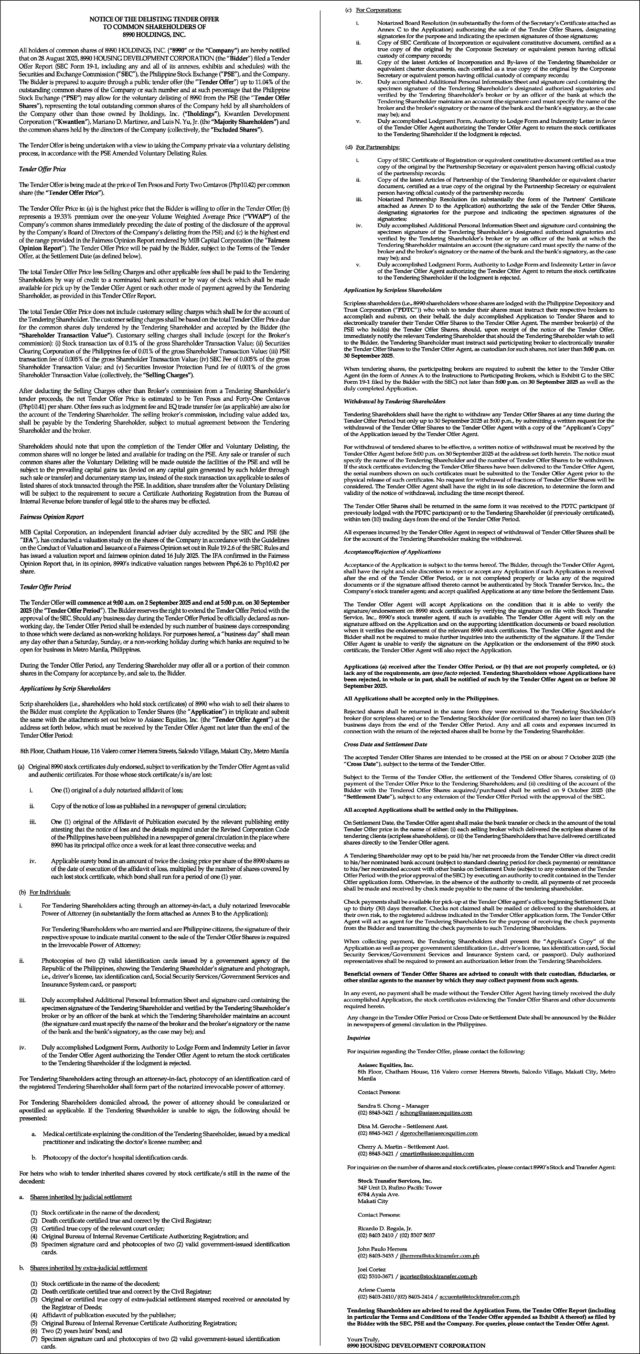
8990 Holdings, Inc. notifies common shareholders of the delisting tender offer

Click to Enlarge


Spotlight is BusinessWorld’s sponsored section that allows advertisers to amplify their brand and connect with BusinessWorld’s audience by publishing their stories on the BusinessWorld Web site. For more information, send an email to online@bworldonline.com.

Join us on Viber at https://bit.ly/3hv6bLA to get more updates and subscribe to BusinessWorld’s titles and get exclusive content through www.bworld-x.com.

Inclusive Archaeology: A new look at Ifugao history

By Jonathan Best

Book Reviews
Indigenous Archaeology in the Philippines: Decolonizing Ifugao History
By Stephen B. Acabado and Marlon M. Martin
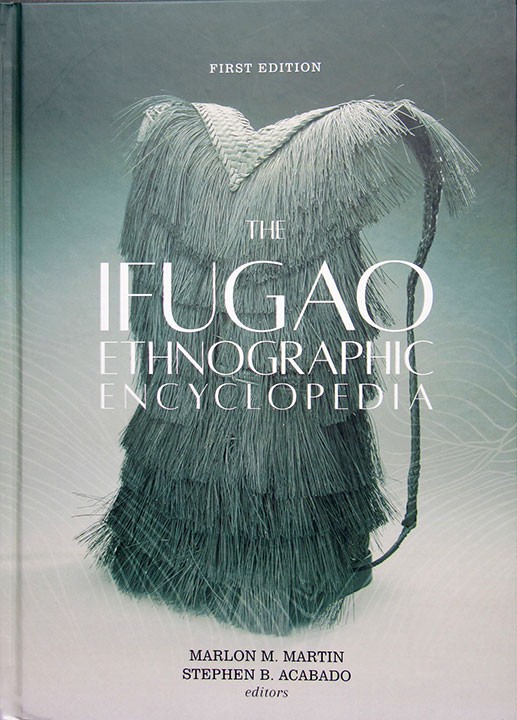
The Ifugao Ethnographic Encyclopedia
Edited by Stephen B. Acabado and Marlon M. Martin

TWO NEW BOOKS by the same two authors have come out recently and are major contributions to the understanding of Ifugao culture on the Grand Cordillera mountains of Northern Luzon and a new approach to historical research and archaeology. Neither book is a conventional historical narrative but they both contain important historical information regarding the extended Ifugao community and a great deal of information and commentary regarding Ifugao the Rice Terraces, Ifugao material culture, folkways, spiritual life, and their relationship to the outside world.

The first book, published by the University of Arizona Press in 2022, titled Indigenous Archaeology in the Philippines: Decolonizing Ifugao History by Stephen B. Acabado and Marlon M. Martin, reports on the archeological findings of the Ifugao Archaeological Project in collaboration with the Save the Ifugao Terraces Movement. The two authors started working together with their respective colleagues over 10 years ago to research Ifugao history from a primary excavation they initiated at the old site of Kiyyangan Village in Ifugao Province. While doing so they tried to develop a more “ethical role” for archaeology, embracing community inclusive research methods with serious attention paid to local folk knowledge and traditions and concern for the education and cultural needs of the current “descendent community.”

The second book, The Ifugao Ethnographic Encyclopedia by the same two articulate authors, this time as editors, came out just this year and is a very useful follow-up to their first book. Whereas the first book tended to focus primarily on early historical anecdotes and new archaeological evidence along with recorded interactions with the present-day community, this second book is a wealth of visual and written information about the material culture and mythology of the present-day Ifugaos living and working in the spectacular landscape of their ancestral rice terraces.

Of the two authors Mr. Martin is a member of the Ifugao community and head of the Save the Ifugao Terraces Movement and an advocate for preserving cultural landscapes using modern scientific research methods in close collaboration with indigenous stakeholders. Mr. Acabado is a professor at the University of California – Los Angeles (UCLA) in the United States, and works on many archaeological projects around the world with an emphasis on interdisciplinary collaboration, indigenous partnerships, and cultural sustainability. The funding for their first book was provided in part by the UCLA, American Indian Studies Center, the Cotsen Institute of Archaeology, and the UCLA Dean of Social Sciences. Their second book’s research and publication was assisted by a grant from the Henry Luce Foundation through the Center for Southeast Asian Studies of the University of California, and was published by the Savage Mind Publishing House in Naga City in the Philippines, an up-and-coming provincial bookshop and gallery.

Their first book reports on their current archaeological research, based on carbon dating of organic material from the stratified layers of their excavations and historical analysis of the pottery shards and beads recovered there. From these findings they estimate that the age of the rice terraces and the introduction of wet rice agriculture to Ifugao Province began approximately in 1650. From this they speculate that the transition from a reliance on tubers, gabi (taro), and camote (sweet potatoes), to wet rice cultivation for community subsistence might have been a direct result of lowland Filipinos fleeing up the Magat River valley to the Cordillera mountains to escape the Spanish colonizers. Their findings also confirm that the mountain inhabitants were not an isolated community and were actively trading with the lowlands for centuries, even acquiring foreign materials such as stoneware and porcelain jars, glass beads, and other manufactured goods.

These archeological findings lead them to discuss at length the negative effects of relying on “assimilationist” and “colonialized histories,” or even Filipino nationalist historians who have tended to gloss over, exoticize, or just ignore the national ethnic minorities’ cultural and spiritual accomplishments. These historians often times repeat urban-based, mestizo and elite Tagalog narratives. Despite the many claims that the Rice Terraces are 2,000 years old, the authors point out that there is very little if any evidence to prove that they are that old, as originally postulated by Western anthropologists such as Otley Beyer. This myth has been repeated over and over again by tour operators and on tourist brochures. Earlier writers had a tendency to either “romanticize” the indigenous minorities as lost tribes, or demonize them as wild, naked headhunters and avoided discussing the more painful political issues of resistance to colonialism and Western imperialism.

Jonathan Best is a senior consultant at the Ortigas Foundation Library.

The author’s second book, The Ifugao Ethnographic Encyclopedia, unlike their first, follows the format of an academic reference book but in a large format with numerous colorful illustrations and a great deal of informative annotations accompanying each entry. Messrs. Martin and Acabado list themselves as editors as this is a community project with much of the material provided by cooperative local informants. The writers continue with their advocacy for direct community participation, and this time present a rich display of Ifugao arts, crafts, and information concerning the accompanying rituals and beliefs which have been for centuries the foundation for the Ifugao’s technological and social accomplishments.

Many of these traditions, including the maintenance of the Rice Terraces, are threatened by the transition to modern social, economic, and technological developments. Much of the Ifugao’s relationship with their departed ancestors, core family genealogies and values, polytheistic beliefs determining seasonal planting and harvesting cycles, land ownership, health and general welfare have been preserved in their sophisticated rituals and chanted oral histories. At times, many of these rituals have been thoughtlessly censored by invasive and inappropriate Christian evangelization which has chastised older spiritual practices, and by well-meaning but naïve outside educators. This has had a “detrimental effect on Ifugao social cohesion” over the years.

Although a very inclusive community, the Ifugaos have had a well-defined class structure with the richest Kadangyan elite on top. Their social status was signified by their ownership of rice paddies, high quality textiles, gold and agate jewelry, antique Chinese jars, and the formidable carved Hagabi benches which took weeks of expensive ritualistic labor and feasting, to produce. Some rituals, like the famous Hudhud chant, recognized by UNESCO for its priceless addition to world oral histories, take days to complete by Mumbaki (ritual specialists) and elderly Ifugao women.

However, Martin and Acabado are eager to point out that despite modern challenges, the various Ifugao communities on the Cordillera are not static, dying historical entities as often characterized by Western “assimilationist historians,” but active and evolving communities which are confronting these evolutionary changes like many other marginalized communities around the world.

The colorful illustrations of Ifugao Gods in traditional attire, painted in a super-hero style by Matt Bulahao and the amusing drawings by Marcial Dulnuan, along with numerous photographic illustrations of artifacts add to the overall attractiveness of the second book. The authors have added some contemporary local photos and many important vintage photos by R. F. Barton, a thoughtful American writer and anthropologist who lived among the Ifugao and Kalinga communities in the first half of the 20th Century and was granted a Guggenheim Fellowship for his research on the Ifugao in the 1930s.

All-in-all, both books give a fairly comprehensive look at Ifugao history and material culture while at the same time making the case for indigenous communities to take control of their own historical narratives with the help of and progressive collaboration with outside experts. The communities themselves, whether Ifugao or others, should be consulted as to how best to pass on cultural and historical information to the next generation. As the authors conclude in their first book, Indigenous Archeology in the Philippines: “For the modern Ifugao who stands on the threshold of cultural loss, community archaeology serves as an aid to self-discovery and revitalized ethnic identity.”

The books can be ordered online from their respective publishers.


Jonathan Best is a senior consultant at the Ortigas Foundation Library.

PLDT says MSCI ESG rating upgraded to ‘BBB’

PLDT and Smart Communications, Inc. Chairman and Chief Executive Officer Manuel V. Pangilinan — PHILSTAR FILE PHOTO

PLDT INC. said its environmental, social, and governance (ESG) rating improved to “BBB” in 2025 from “BB,” based on the latest assessment by MSCI ESG Ratings, a global provider of ESG research and ratings for public and select private companies.

“Our improved MSCI rating is a recognition of our efforts to uphold practices that aim to continuously manage our ESG risks, support the company’s drive towards long-term profitability, and ensure that our business contributes to the wellbeing of our stakeholders and the planet,” PLDT First Vice-President and Chief Sustainability Officer Melissa Vergel de Dios said in a media release on Tuesday.

“We remain focused on the work needed to further enhance our ratings and ESG performance.”

MSCI ESG Research provides ESG ratings on global public and select private companies on a scale from “AAA” (leader) to “CCC” (laggard).

Companies are evaluated based on their industry-specific ESG risks and their ability to manage these risks relative to peers.

The Pangilinan-led telecommunications company said its rating reflects continuing efforts to adopt sustainable practices in its business while improving ESG risk management.

“PLDT continues to integrate sustainability and risk management in its employee performance management and executive compensation metrics, enjoining institutional action and workforce contribution to its ESG goals and focus areas,” the company said.

PLDT said its sustainability efforts include a comprehensive policy for data protection, robust measures to address data breaches, and stringent access controls to safeguard information.

It added that the company continues to identify climate change as one of its top enterprise risks.

Earlier this year, PLDT and its wireless unit, Smart Communications, Inc., established policies to conserve biodiversity and support nature-based solutions as the company expands its network infrastructure.

Last year, PLDT secured a P2-billion social loan to expand its fiber network and a P1-billion green loan for network upgrades and expansion.

At the local bourse, shares in the company gained P16, or 1.42%, to close at P1,139 apiece.

Hastings Holdings, Inc., a unit of PLDT Beneficial Trust Fund subsidiary MediaQuest Holdings, Inc., holds a majority stake in BusinessWorld through the Philippine Star Group, which it controls. — Ashley Erika O. Jose

Peso hits one-month low as dollar rises

BW FILE PHOTO

THE PESO weakened to a more than one-month low against the dollar on Tuesday as the greenback gained strength, supported by a weaker euro and investor anxieties over the UK fiscal position.

It closed at P57.51 a dollar, down 35 centavos from P57.16 on Monday, based on Bankers Association of the Philippines data posted on its website. This was its weakest close since Aug. 1, when it ended at P58.145 a dollar.

The peso opened the session at P57.22. It hit an intraday best of P57.14 and touched a low of P57.54 before settling at its close. Dollar turnover rose to $1.92 billion, sharply higher than $1.06 billion the previous day.

A trader said the peso tracked the dollar’s late-session gains, which came after the euro opened weaker following a spike in the UK’s long-term borrowing costs. Britain’s 30-year government bond yield climbed to its highest level since 1998, fueling worries over its fiscal position.

Sterling and the Japanese yen also slumped on Tuesday amid mounting concern about government finances, allowing the dollar to regain ground after five days of selling, Reuters reported.

Renewed pressure on global bond markets spilled into currencies, with gold prices simultaneously hitting record highs. Sterling fell 1.1% to $1.1396, its weakest level since Aug. 22, while the dollar rose 1% to 148.64 yen. The euro gained against both sterling and the yen, up 0.5% and 0.3%, respectively.

“Capital markets across equities and credit are still optimistic on the US, which suggests that foreign holders of US assets are not in retreat,” analysts from DBS wrote in a client note.

Traders have sold the greenback as US President Donald J. Trump’s attacks on the Federal Reserve, including his decision to remove Governor Lisa Cook, raise fear that the White House is undermining the central bank’s independence at a time when the case to begin cutting interest rates is far from clear.

“The Fed could be ominously poised to start its rate-cutting cycle,” said Chris Weston, head of research at Pepperstone Group in Melbourne. “People see the attraction of being in gold.”

At home, Rizal Commercial Banking Corp. Chief Economist Michael L. Ricafort said the peso’s decline was also partly driven by continued weakness in local equities as net foreign selling persisted.

The Philippine Stock Exchange index (PSEi) slipped 0.18% or 11.46 points to close at 6,128.89, while the broader all-share index shed 0.06% or 2.52 points to 3,681.03.

The trader expects the peso to move within P57.20 to P57.70 against the dollar on Wednesday, while Mr. Ricafort expects a narrower band of P57.40 to P57.65. — Aaron Michael C. Sy

Expressing the deepest of human emotions with whimsy

Lady Bottle Series Mini Me, 2025 — OFFICIAL PHOTO FROM THE ARTIST

Contemporary artist Inha Arceo to mount 3rd exhibit

THERE are many mental states and stages in life that people choose to bottle up and keep to themselves.

For artist Gracinha “Inha” Arceo, expressing all of this in bold, vibrant paintings serves not just as a personal outlet, but also an opportunity to connect with others who may be going through the same thing.

Most of all, it has become her full-time job.

“I have a corporate background. Marketing was my passion for about 10 years, but I resigned in the pandemic because I got burnt out,” Ms. Arceo told BusinessWorld in an interview.

She explained that it all started with doing art on the side. “In 2020, I was doing illustrations digitally, primarily highlighting my thoughts. It became an outlet of sorts, painting based on my own emotions and what I see around me, and people online felt a connection.”

It was on Etsy, an online marketplace for creators, where she gained a following selling digital prints and painting commissions. Her clients come from all over the world — mainly the US, Europe, and Australia.

Ms. Arceo’s style, gravitating towards vibrant, dreamlike florals and female figures clad in Filipiniana, allows for a strong overlap between digital prints and acrylic paintings.

“My vision as an artist is to bring more contemporary Filipino art into the global scene,” she said. Online, this has manifested in 65,000 followers on Instagram and more than 15,000 on TikTok.

BOTH GLOBAL AND LOCAL
In 2024, Ms. Arceo finally decided to make art her full-time job. She exhibited in Monaco and Madrid, where she took the opportunity to expose herself to various artists, curators, and styles.

“I love Spanish painters. My inspirations are Pablo Picasso and Joan Miró. I’m also inspired by the works of (Filipino artists) Juan Luna and Fernando Amorsolo,” she said.

To balance her international market, she began joining group shows and mounting solo exhibitions in the Philippines this year. In March, she had her first solo exhibition at RiseSpace Art Gallery in Comuna, Makati.

Her second and ongoing exhibition, Daily Rhythms, can be found at Art Elaan in Festival Mall, Alabang.

“I like appreciating the little mundane things that go on in life. There’s the Lady Bottle collection and the figures I paint that highlight the various emotions and little joys,” Ms. Arceo explained.

Those who see her works will find a mix of abstract floral elements and bold brushstrokes that give shape to the colorful women she paints. Be it the depiction of a girl blooming into maturity or a lady hunched over doomscrolling on her phone, her vibrant, almost whimsical style evoke something personal.

OF RADICAL VISIONS AND FORMS
The fear of breaking into the art scene coming from what started as an online hobby has continued to be part of Ms. Arceo’s journey.

Her third solo exhibition, Of Radical Visions and Forms, is set to open on Sept. 24. She told BusinessWorld that it’s ultimately a show about “vulnerability,” and will showcase more whimsical and abstract works.

“I realized in my journey that there’s always a fear, which is normal. I’m scared about all of this because I know I care. I’m not settling and I’m not complacent. The exhibit is about really challenging myself to expose another side of me, to feel all sorts of emotions,” she said.

Ms. Arceo said that she has been advising younger, newer artists to firstly be authentic in order to “build a brand” — something that came easy to her given her corporate and marketing background.

“From me specifically, you can expect letting loose a bit in terms of brushstrokes. I think it’s healthy to release these emotions,” she said, about the new works that are currently in progress.

“It’s radical because you get to let go of certain things and imagine life the way you want it to.”

Daily Rhythms is ongoing until Sept. 7 at Art Elaan in Festival Mall, Alabang, Muntinlupa City. Of Radical Visions and Forms will run from Sept. 24 to Oct. 8 at RiseSpace Art Gallery, Comuna Building, 238 Pablo Ocampo Sr. Ext., Makati City. — Brontë H. Lacsamana

Pros and cons of minimum wage legislation: How much is enough?

STOCK PHOTO | Image by Jcomp from Freepik

(Part 2)

How do we help employers who want to comply with the ethical standard set by the Social Doctrine of the Church, that a living wage must enable the worker and his family to attain a minimum level of comfort and decency with the wage that he or she is paid.

First, let us calculate what the actual monthly income of a worker who is paid the legal or statutory minimum wage is. We can use the formula: monthly income = daily wage x workdays per month or P645 x 22 standard days = P14,190 per month.

Let us compare this to what a “just” minimum wage should be considering minimum consumption requirements for minimum comfort and human dignity for the worker and his family.

Without using his case as the standard for all workers, just to illustrate, the following were the estimated monthly costs for the various items in the consumer basket reported by an average worker: Food (P5,000); Rent and Utilities (P7,000); Transportation (P1,500); Healthcare (P1,000); Education (P1,000); Clothing/hygiene (P1,000), Emergency savings (P1,000) totaling monthly expenses of P17,500. In this case the legal wage is too low.

It would be useful to cite some studies that have been made in calculating what a family with four members (the present statistical average according to the Philippine Statistics Authority or PSA) would need to live with minimum comfort and human dignity. According to a PSA study (2023), a family of five (the average among the poorest of the poor) would need at least P13,873 per month to be at the poverty threshold (not sufficient for minimum comfort and dignity). About 16% of total households in the Philippines fall below this poverty line. It is clear that this amount does not comply with the doctrine of Rerum Novarum and other papal encyclicals. According to the Social Weather Station (2025), families surveyed say that they need P12,000 per month (for the whole country) while those who reside in Metro Manila estimate it at P20,000, just to feel that they are not poor. These official figures may be useful as possible guides for employers and the Government to consider but they clearly understate what families feel is realistic.

Some publications have attempted to estimate what would be needed by a family of four, which is the national average. According to one study published by Numbeo/Tribune, a family of four in Metro Manila would need P109,770 monthly for a modest lifestyle covering food, utilities, transport, and leisure, excluding rent and education. FilePino (2025) calculated an urban family budget would have monthly costs ranging from P45,000 to as high as P83,000, including food, rent (two bedrooms), utilities, education, healthcare, and personal expenses. A Reddit user shared a breakdown for a family of four in Metro Manila, citing P100,000 as an ideal, broken down into P25,000 for housing; P15,000 to P20,000 for groceries; P4,000 to P8,000 for utilities; and P5,000 for transportation. All totaling P77,000. If extras are added for eating out, savings, or a house helper, the total budget can reach as high as P100,000 monthly.

As summary, the following amounts can be considered as monthly threshold family income depending on how one wants to interpret the phrase “a minimum of comfort and human decency.”

• Bare minimum (PSA threshold): P13,873 monthly for a family of five;

• Self-perceived survival threshold: P12,000 to P20,000 (varying by region);

• Living decently with savings (NEDA): P42,000 to P45,000;

• Modest comfort (basic lifestyle): P45,000 to P83,000;

• More realistic comfort (urban lifestyle): P80,000 to P110,000;

• More affluent lifestyle (savings, leisure, tuition): P150,000 to P250,000.

As can already be realized at this stage of translating doctrine to specific policy recommendations, the issue of minimum wage can be subject to various interpretations depending on family size and costs of living in various geographical settings, whether urban or rural, whether in Metro Manila or other urban centers.

To summarize the various computations above, we can conclude that the barest subsistence level (poverty line) is around P11,000 to P14,000. This does not comply with the criterion of “minimum comfort and human dignity.” A more adequate monthly income for a family of four — ensuring dignity, essentials, and savings — is around P40,000 to P45,000 a month. At the lower level, this would translate to a required daily income of P1,818 (assuming 22 standard working days monthly). This is almost three times the actual minimum wage of P645.

There is, however, a further question about a just family wage. Must it be earned by a single breadwinner, either the husband or wife? Practically every household today in the Philippines has at least two breadwinners, with one of the spouses or a close relative joining one other breadwinner. In a good number of households, there are breadwinners who are overseas workers.

Whatever the actual conditions may be in the average Philippine household, there are those who maintain that one of the spouses, ordinarily the wife, must be given the choice to take on some remunerative work, whether full or part time, or to be a full time wife and mother, doing all the necessary household chores and especially taking care of the children. There are actual methods of imputing financial values to these tasks, thus increasing the real income of the household. In some countries that are suffering severely from extremely low fertility rates, there are serious recommendations that stay-home mothers be actually compensated by the State for addressing a national crisis. In the future the Philippines may have to consider this policy recommendation because our fertility rate has already dropped to 1.9 babies per fertile woman, which is already below replacement. The State may have to compensate stay-home parents if we are to avoid the serious population crisis of rapid ageing that practically all developed countries in the world are experiencing.

It is understandable that President Ferdinand Marcos, Jr. was not ready to take a stand about the debate on the daily P200 wage hike being requested by labor groups. There should be more discussion on the pros and cons of this very complex issue.

The majority of Filipinos who are poor are not wage earners. These are the ones who may be prejudiced by high minimum wages.

To end, let me summarize the pros and cons of setting a high minimum wage. On the pros side, workers can better afford their basic needs and they do not have to rely on government assistance or debt; a high wage helps lift low-income workers above the poverty line and narrows the wage gap between high and low earners. More spending power in workers’ hands can stimulate consumer spending, which is the primary engine of growth of the Philippine economy. Higher wages can improve motivation, loyalty, and work quality and can reduce absenteeism and turnover. Employers may be motivated to invest in advanced technology or streamline processes rather than rely on cheap labor. Greater social stability may be attained through reduced crime, labor unrest, and social tensions.

On the other hand, high wages may lead to job losses or reduced hiring for those who are unemployed or underemployed. Employers may cut staff, reduce hours, or freeze hiring to offset higher labor costs. The MSME sector may be the hardest hit because they are more labor-intensive. Businesses may pass on the higher labor costs on to consumers, thus fueling inflation and reducing the real value of the wage increase. Employers may avoid regulation by hiring informally or underreporting hours, thus increasing job insecurity. There may be greater incentives to automate and outsource as businesses are encouraged to replace workers with machines or shift jobs overseas. The jobs that are most affected are the low-skill ones. There may result wage compression in which wage differentials between entry-level and experienced workers are reduced, causing dissatisfaction.

People in Congress and labor leaders must consider all the stakeholders in the entire economy before suggesting further increases in the minimum wage.

(To be continued.)


Bernardo M. Villegas has a Ph.D. in Economics from Harvard, is professor emeritus at the University of Asia and the Pacific, and a visiting professor at the IESE Business School in Barcelona, Spain. He was a member of the 1986 Constitutional Commission.

bernardo.villegas@uap.asia

Recto: One more BSP rate cut possible this year

THE BANGKO SENTRAL NG PILIPINAS (BSP) may deliver one more rate cut before yearend, depending on economic data, Finance Secretary Ralph G. Recto said on Tuesday.

“So far, I think we can probably ease one more time. Hopefully,” he told reporters at the Senate. “But let’s see what the data show.”

The Monetary Board last week cut the target reverse repurchase rate by 25 basis points (bps) to 5%, the lowest since November 2022.

Since beginning its easing cycle in August 2024, the central bank has trimmed rates by 150 bps, including two 25-bp cuts each in April and June.

BSP Governor Eli M. Remolona, Jr. earlier said there might be room for one more cut this year, though he noted the cycle is nearly over.

The Monetary Board still has two meetings left, in October and December. — Katherine K. Chan

ADVERTISEMENT
ADVERTISEMENT