Home Blog Page 1029

Entertainment News (09/09/25)



Ayala Malls shows Asian films

AYALA MALLS CINEMAS is turning the spotlight on Asian filmmaking with “A-Reel Asia: Stories from the Heart of the East,” a new platform for Asian cinema starting this September. It will showcase titles from Indonesia, India, South Korea, Japan, and China. First in the lineup is director Hanung Bramantyo’s Traditional Kamasutra Teacher, a tale of love, betrayal, and power from Indonesia. It stars Raihaanun as Ratri, a young woman who was raised by a respected gowok, or a woman who teaches young men about household and sexuality before marriage. It will be shown in the following Ayala Malls Cinemas: Manila Bay, Circuit, Glorietta, Feliz, Solenad, Central Bloc, Centrio, TriNoma, and Fairview Terraces.


Sponge Cola to perform live in Abu Dhabi

OPM BAND Sponge Cola will be in Abu Dhabi on Sept. 13 to belt out their rock anthems at The Hall Al Qana, Abu Dhabi, United Arab Emirates. The band, known for their emotionally resonant music, will be performing the best hits of their discography. It will be their third time to have a concert in Abu Dhabi, the last one was over 10 years ago. Tickets are available via Ticketmaster.


Downton Abbey movie finale to arrive in cinemas

THE global phenomenon Downton Abbey will have a cinematic end following years of TV shows and films. Creator Julian Fellowes is back at the helm as the Crawley family and their staff navigate the 1930s with all its modernity, public scandal, and social disgrace. The ensemble cast will return to the big screen, including Hugh Bonneville, Laura Carmichael, Jim Carter, Michelle Dockery, and Paul Giamatti. Downton Abbey: The Grand Finale opens exclusively in Ayala Malls Cinemas starting Sept. 10.


Ayala Malls, G-Force turn malls into dance halls

THIS SEPTEMBER, Ayala Malls and dance authority G-Force are teaming up to bring mallgoers “The Dance District,” which turns everyday mall spaces into dance playgrounds. Dance lovers can come and groove with G-Force on: Sept. 9, 6 p.m., at One Ayala’s Level 2, Panco Cafe (the Ayala Malls x G Force Kick Off); Sept. 11, 6 p.m., at the Activity Center of TriNoma, featuring Jaja’s Blue Battalion; Sept. 16, 6 p.m., at the Amphitheatre of the UP Town Center, with K-Pop Random Play Like; Sept. 17, 6 p.m., at the Activity Center of Alabang Town Center with South Move Mania; Sept. 18, 6 p.m., at the Garden Ring of Ayala Malls Manila Bay with Fusion Fest; and on Sept. 19, 6 p.m., at The Deck at Circuit Lane at Ayala Malls Circuit: with Mixed Synergy. Beyond the free G-Force dance sessions, mallgoers are invited to join The Dance District Challenge. They can share their best dance moments from The Dance District on TikTok and Instagram using the official sticker template and dedicated hashtag #ThatFeelingWhenTheMallIsYourDanceFloor for a chance to get surprise treats. The Dance District will culminate in a G-Force Groove Gala at the Courtyard, Ayala Triangle Gardens, on Oct. 5. For more information, visit www.ayalamalls.com or follow Ayala Malls on social media.


Vatican City concert to stream on Disney+

ON SEPT. 14, a cultural and spiritual event in Vatican City will stream live exclusively on Disney+. Co-directed by singers Pharrell Williams and Andrea Bocelli, it will be held in St. Peter’s Square to mark the closing of the third World Meeting on Human Fraternity and the celebration of the 2025 Jubilee Year. The concert features a huge lineup of performers, including Mr. Williams, Mr. Bocelli, the Voices of Fire Gospel Choir, Karol G, John Legend, Clipse, Teddy Swims, Jelly Roll, and Angélique Kidjo. There will also be an aerial drone and light show by Nova Sky Stories, featuring imagery inspired by the Sistine Chapel, and reflections from world leaders in culture, diplomacy, and sport.


GMA to show FPJ movies this month

THE program “FPJ sa GMA” will be highlighting the movies of Fernando Poe, Jr. (FPJ) every Sunday at 3:15 p.m. on GMA. To be shown on Sept. 14 is the action-filled Kapag Buhay ang Inutang (1983), which features FPJ with another Filipino icon, Eddie Garcia. On Sept. 21, Patayin si Mediavillo (1978) will be shown, where FPJ plays a police officer pursued by multiple assassins. Finally, on Sept. 28, Mabuting Kaibigan, Masamang Kaaway (1991) will present FPJ and Vic Vargas joining forces as two men who end their close friendship following a betrayal.


Freestyle, Neocolours to share the stage at Newport

THE 1990s OPM band Freestyle is performing live at Newport World Resorts this September in a concert titled It’s About Time Freestyle, set for Sept. 19, 8 p.m., at the Newport Performing Arts Theater in Pasay City. Joining them is special guest Neocolours, another nostalgic OPM vocal group, providing an ’80s flavor to the show. Tickets, priced from P1,000 to P6,300, are available via TicketWorld.


Fil-Norwegian R&B star HILLARI performs in Manila

SINGER-SONGWRITER HILLARI, born in Norway with Filipino roots, is set to headline her first solo show in the Philippines on Sept. 21 at the Sari-Sari bar in Makati City. The rising R&B performer will be performing an intimate set on the strength of her recently released seven-track EP, New Beginnings. The show is considered her official homecoming. It will be the debut live performance of her upcoming single “I’m Still,” a laid-back, soul-infused track. Tickets, costing P800, are available exclusively at https://hillariliveinmanila.helixpay.ph.


TBA gives student, teacher ticket prices for Quezon

STUDENTS and teachers can watch the much-awaited historical biopic Quezon at a special price when the film begins its Philippine theatrical run on Oct. 15. TBA Studios has officially announced the discounted price of P250, which can be availed by presenting a valid school ID at cinema ticket counters. Directed by Jerrold Tarog, Quezon is the conclusion to the “Bayaniverse” trilogy, a series of films based on Philippine history.


SEC clears RCR’s P30.67-B mall infusion from Robinsons Land

Robinsons Magnolia — ROBINSONSLAND.COM

By Alexandria Grace C. Magno

RL COMMERCIAL REIT, Inc. (RCR), the listed real estate investment trust (REIT) of Robinsons Land Corp. (RLC), said it has received approval from the Securities and Exchange Commission (SEC) for its P30.67-billion property-for-share swap with its sponsor.

“Today, Sept. 5, 2025, RCR received the certificate of approval of valuation dated on the same date from the SEC for the property-for-share swap certifying that the valuation of the properties in the total amount of P30,674,860,000 be applied as payment for the additional issuance of 3,834,357,500 common shares of RCR,” the listed company said in a disclosure on Monday.

With the approval and the issuance of the new shares, RCR will have 19.55 billion common shares issued and outstanding.

The company said public ownership will stand at 34.22% of the enlarged total shares, above the one-third minimum public ownership required under the Real Estate Investment Trust Implementing Rules and Regulations.

RCR said it will file the relevant disclosures once the 3.83 billion new shares are issued and booked under the name of RLC, one of the country’s largest property developers.

On Aug. 13, RCR executed its fourth property-for-share swap with RLC through the signing of a deed of assignment for the infusion of nine mall assets. These are Robinsons Dasmariñas in Cavite, Robinsons Starmills in Pampanga, Robinsons General Trias in Cavite, Robinsons Cybergate Cebu, Robinsons Tacloban in Leyte, Robinsons Malolos in Bulacan, Robinsons Santiago in Isabela, Robinsons Magnolia in Quezon City, and Robinsons Tuguegarao in Cagayan.

Asian Appraisal Co., Inc. prepared the appraisal reports, while FTI Consulting Philippines, Inc. issued a third-party fairness opinion supporting the valuation.

The transaction has been cleared by the board of directors and stockholders of RCR, the board of RL Fund Management, Inc., the fund manager of RCR, and the REIT’s Related Party Transactions Committee.

China Bank Capital Corp. Managing Director Juan Paolo E. Colet said the infusion of nine malls into RCR’s property portfolio will further broaden its range of assets and enhance its standing among the country’s leading REITs.

“The mall assets are seen as attractive given favorable consumer trends. Moreover, they provide a healthy balance to RCR’s office properties, so the infusion will result in a better risk profile for the REIT’s shareholders,” he said in a Viber message.

“The valuation is fair, and we expect the deal to be dividend-accretive,” he added.

Meanwhile, AP Securities, Inc. Research Head Alfred Benjamin R. Garcia said incorporating retail assets into RCR’s property portfolio will mitigate risk, as retail properties are currently outperforming office spaces.

“Retail assets have more room for upward lease rate adjustments compared to office spaces, so diversification into retail should ensure lease income growth for RCR,” he said in a separate Viber message.

The infusion will expand RCR’s current portfolio, which comprises 828,000 square meters (sq.m.) of gross leasable area (GLA), consisting of 12 malls with 289,000 sq.m. of GLA and 17 office properties with 539,000 sq.m. of GLA.

On Monday, RCR shares gained 0.88% to close at P8.05 each, while RLC shares rose 0.27% to P14.96 apiece.

Pru Life UK books P4.94 billion in new business premiums in first half

PRU LIFE Insurance Corp. of UK Philippines (Pru Life UK) booked a new business annual premium equivalent (NBAPE) of P4.94 billion in the first semester.

It said it was the top life insurer in terms of NBAPE in the period.

“Our 2025 half-year achievement affirms the strength of our purpose — to be the most trusted partner and protector for every life and every future — for over a million Filipinos. We are deeply grateful to our customers for their continued trust and to our agency force, the largest in the country, whose dedication drives our market leadership,” Pru Life UK Chief Finance Officer Francis P. Ortega said in a statement.

The insurer said its premium growth was supported by the continued expansion of its product line after it recently rolled out life policies with guaranteed payouts and a plan compliant with Islamic laws called PRUTerm Lindungi.

The company was one of two insurers to receive a Takaful window license from the Insurance Commission (IC). Takaful insurance needs to be compliant with Shari’ah law, which prohibits riba (interest), al-maisir (gambling), and al-gharar (uncertainty) principles.

The life insurer added that its agency force of nearly 38,000 also supported its growth.

Pru Life UK booked a premium income of P48.15 billion and a net income of P3.72 billion in 2024, IC data showed. — A.M.C. Sy

The future won’t wait: Building the Filipino workforce for the AI Age

PHILIPPINE STAR/MIGUEL DE GUZMAN

Our neighbor Singapore recently celebrated the Diamond Jubilee of its independence, nicknamed “SG60.” When Prime Minister Lawrence Wong addressed the nation at the “SG60 and Beyond” dialogue and the 2025 National Day Rally, many listened closely to his vision for Singapore’s future. His message was clear and urgent: “AI will be the defining technology of our time.” He underscored AI’s transformative power as the next great technological revolution, rivaling the personal computer and the Internet. It was both a warning and an opportunity — countries cannot afford to stand still on AI, and leaders must think carefully about how to apply it to uplift jobs and people.

Technology and AI took center stage, occupying nearly 30 minutes of his 90-minute address, alongside other critical topics, like the economy, regional security, territory, and healthcare for Singapore’s aging population. But what stood out was that his remarks were not just about technology — they were about people. His vision placed Singaporeans at the heart of the AI transition: a government coordinating employers, schools, and communities to prepare its workforce for the opportunities and disruptions ahead. As he emphasized, while many jobs will evolve or disappear, new ones will also emerge, and Singapore intends to equip every citizen with the tools to thrive.

I then thought, where is the Philippines in the race to AI? We stand at a pivotal moment where our demographic strengths, economic ambitions, and technological gaps converge. With one of the youngest and most resilient workforces in the region, we have a tremendous opportunity to lead. But to fully realize this potential, we need a more unified approach to AI education, reskilling, and workforce integration — so we can keep pace with neighbors rapidly advancing in this space.

To be fair, the Philippine government has begun laying the groundwork. The Department of Science and Technology launched the National AI Strategy (NAIS-PH), a framework through 2028 focused on research, innovation, and workforce development. In July 2024, the Department of Trade and Industry introduced the National AI Strategy Roadmap 2.0 (NAISR 2.0) to drive education reform, worker reskilling, and AI-powered industries. Meanwhile, the Philippine Skills Framework for Analytics and AI (PSF-AAI), led by the Department of Information and Communications Technology and the Analytics and AI Association of the Philippines, provides structured guidelines on AI competencies for schools, professionals, and employers.

These are significant initiatives, but they remain fragmented. To maximize their impact, we need a fully integrated and nationally coordinated execution plan — one that brings together government agencies, private sector leaders, educators, and local communities to prepare the Filipino workforce for the future of work. Without stronger alignment and faster implementation, we risk missing opportunities while other nations move quickly to harness the benefits of AI and emerging technologies.

The need for urgency is highlighted by the IMD World Competitiveness Yearbook 2025, which ranked the Philippines 51st among 69 economies, a modest improvement from the previous year. The bright spot, however, was in employment competitiveness, where we climbed from 10th place in 2024 to 7th globally in 2025. This shows that Filipino workers are among the world’s most resilient and adaptable. But resilience alone is not enough. Without an aggressive, unified strategy to upskill and reskill millions, we risk failing to convert potential into productivity.

A national AI strategy must go beyond slogans and administration timelines — it must become a mission to bring technology into every sector of the economy. AI integration cannot be confined to elite industries or large corporations; it must extend to agriculture, education, manufacturing, healthcare, and micro, small, and medium enterprises (MSMEs), which make up 99% of Philippine businesses. Affordable AI tools, training subsidies, and shared digital infrastructure should be made widely accessible so that innovation scales broadly, rather than being concentrated in a privileged few.

Equally critical is reskilling the workforce. Singapore has shown that job redesign can empower workers, instead of displacing them, but this requires foresight and investment. The Philippines needs government-backed partnerships with the Education and Labor departments, with the Technical Education and Skills Development Authority (better known as TESDA), the Commission on Higher Education, and industry groups to deliver nationwide AI training programs — from micro-credentials for entry-level workers to advanced certifications for professionals. Barangay-level employment hubs and public-private traineeship programs could bridge the gap between education and employment, ensuring that Filipinos gain not only theoretical knowledge but practical, market-ready skills.

At the same time, policies must support lifelong learning. AI evolves too quickly for one-time degrees or short courses to suffice. Continuous access to upskilling pathways, aligned with industry demands, must become a national priority, supported by collaboration among government agencies, educational institutions, and the private sector.

Finally, a truly effective strategy must be anchored on trust and inclusion. Singapore is embracing a “we-first” approach, where society shares responsibility for ensuring no citizen is left behind. In the Philippines, we have our own bayanihan* spirit. Harnessing it means involving workers, educators, businesses, and communities in shaping the future, not simply imposing solutions from the top. AI is not just a technological shift — it is a social transition.

The Philippines has a remarkable opportunity, but time is running out. We have one of the youngest, most dynamic labor forces in the region and a proven ability to adapt. Yet without deliberate action, we risk watching other economies — Indonesia, Vietnam, Malaysia, and Singapore — outpace us in innovation and productivity.

AI is reshaping the global economy, whether we are ready or not. To compete, we need more than frameworks; we need execution. We need leadership that treats workforce development not as a policy footnote but as a national imperative.

The Filipino workforce is ready. Our people are ready.

* communal unity

This article reflects the personal opinion of the author and not the official stand of the Management Association of the Philippines.


Ira Paulo Pozon is the chair of the MAP Ease of Doing Business Committee. He is the government relations director of Salmon. He was the chief of staff and OIC director for the Better Regulations Office of ARTA. He is a senior partner of Pozon Recto Peteache and Laiz.

map@map.org.ph

irapaulopozon@gmail.com

Toronto Film Festival: Angelina Jolie reflects on family cancer history before Couture premiere

Angelina Jolie and Louis Garrel in a scene from Couture.

TORONTO — Academy Award winner Angelina Jolie had a strong message about hope and living her best life as she reflected on her family’s history of cancer before the world premiere of Couture on Sunday.

The Salt and Mr. & Mrs. Smith actor was at the Toronto International Film Festival promoting her film Couture, the story of an American film director navigating the Parisian fashion industry while she is given a serious medical diagnosis and is in the midst of a divorce.

“I’m 50 now. My mother and grandmother by this age were in chemo,” Ms. Jolie said, walking down the red carpet with her co-stars.

“We all have these things we worry about or people we love. And it’s either going to make us slow down and almost feel we can’t move, take a step, or we’re going to make the most of this life before it’s over.”

Ms. Jolie underwent a preventive double mastectomy in 2013 after learning she had inherited a high risk of breast cancer and said she hoped her story would inspire other women fighting the life-threatening disease.

She went through with the operation in part to reassure her six children that she would not die young from cancer, as her own mother did at age 56.

“She has a personal connection to the subject of illness and what that does to a body and being confronted to that. And I believe she talks the best about that,” co-star Ella Rumpf said. — Reuters

SM Prime eyes US dollar bond issue as REIT IPO deferred

PHILSTAR FILE PHOTO

SM PRIME HOLDINGS, INC. (SMPH) said it has mandated a group of global and domestic banks to arrange fixed-income investor meetings ahead of a possible issuance of US dollar-denominated senior notes.

In a disclosure to the stock exchange, SMPH said it has tapped HSBC, JP Morgan, Standard Chartered Bank, and UBS as joint lead managers and joint bookrunners, along with BDO Capital & Investment Corp. and China Bank Capital Corp. as joint domestic managers, to organize a series of investor calls in Asia and Europe starting Sept. 8.

“A USD-denominated benchmark-sized Regulation S offering of 5-year senior notes by SMPHI SG Holdings Pte. Ltd. guaranteed by SMPH may follow, subject to market conditions,” the company said.

The notes are expected to be issued under the Singapore-based subsidiary’s $3-billion Euro Medium Term Note (EMTN) program.

SMPH said its legal advisers are SyCip Salazar Hernandez & Gatmaitan for Philippine law and Latham & Watkins LLP for English law.

The joint lead managers and bookrunners are being advised by Picazo Buyco Tan Fider Santos & Dee for Philippine law and Linklaters Singapore Pte. Ltd. for English law.

The planned notes offering comes after SM Prime deferred the initial public offering (IPO) of its planned real estate investment trust (REIT) to beyond 2026, citing unfavorable market conditions.

“Instead of coming up with a REIT in 2026, we may have to defer it a bit and we have to take into account market conditions as well as liquidity in the market,” SM Prime Chief Finance Officer John Nai Peng C. Ong said during a Philippine Stock Exchange investor event in August.

“While the view on REIT is still there, the timing may have to be deferred beyond the year 2025 and I think personally even beyond 2026,” he added.

SM Prime is pursuing an extensive expansion pipeline, which includes the opening of a new mall in Xiamen, China next month and another in Fujian province by 2027.

Locally, the company has allotted more than P150 billion for 16 major redevelopments and 12 new lifestyle malls from 2026 to 2030, with plans to open one landmark flagship mall each year.

On Monday, SM Prime shares rose by 0.87% or 20 centavos to close at P23.20 apiece. — B.M.D. Cruz

Manulife, MCBL launch new plan with investment fund options

THE MANUFACTURERS Life Insurance Co. (Phils.), Inc. (Manulife Philippines) and Manulife China Bank Life Assurance Corp. (MCBL) have launched a new unit-linked plan that offers life insurance coverage along with various investment options.

Manulife GoalReady is a peso-denominated variable unit-linked (VUL) insurance product that has various payment and investment fund options. It is now available via Manulife Philippines’ financial advisors and MCBL’s financial sales associates in branches of China Banking Corp. (Chinabank) and China Bank Savings, Inc. nationwide.

“Our new Manulife GoalReady plan empowers customers in the Philippines to take control of their financial future — by making their money work harder through smart diversification and consistent investing. Amid global economic and sociopolitical shifts, our Filipino customers can navigate financial uncertainties with a plan that can help them secure their future while maximizing investment potential,” Manulife Philippines President and Chief Executive Officer Rahul Hora said in a statement on Monday.

The new product was developed based on findings from the Manulife Asia Care Survey, the company said. “The survey uncovered a significant gap between the future well-being they aspire to and what they realistically expect to attain — especially in the areas of financial security, physical health, and mental wellness.”

Manulife GoalReady offers life insurance coverage until age 99.

For the plan’s investment options, policyholders may choose from global and local funds depending on their goals and risk profiles. These include Global Multi-Asset Income Fund for income generation and Global Market Leaders Fund for growth and protection, which are both managed by Manulife Investment Management and Trust Corp.

The policy also offers clients a 1.75% loyalty bonus on their fund value from years six to 10 of their plan, with continued bonuses from the 11th year onwards.

Manulife GoalReady offers two payment options: regular pay with a minimum premium of P24,000 annually or P2,000 monthly, and five-pay, which has a minimum premium of P60,000 annually or P5,000 monthly.

Customers can choose from optional health and protection riders, the insurer added. The Manulife GoalReady calculator also allows clients to estimate how much they need to save based on their specific financial goal, budget, saving horizon, or income protection needs.

Manulife Philippines and Chinabank this year renewed their bancassurance agreement via MCBL that began in 2007 for another 15 years.

Manulife Philippines’ premium income stood at P15.83 billion last year, while its net income was at P2.78 billion.

Meanwhile, MCBL booked a premium income of P10.35 billion in 2024, latest data from the Insurance Commission showed. Its net income stood at P1.39 billion last year. — Aaron Michael C. Sy

Shame on the senators and representatives

STOCK PHOTO | Image by from Freepik

“Let us not pretend anymore. The general public already knows there is racket involved in the projects — kickbacks, initiative, errata, SOP ‘for the boys.’ That is why, to those who conspire to rob the nation’s funds and steal the future of our countrymen, shame on you! Your fellow Filipinos were swept by floods or were submerged in floodwaters. Shame on you, especially to our children who will inherit the debt you incurred because you only pocketed the money.

“So that this will not happen again, first, the DPWH (Department of Public Works and Highways) will immediately submit to me a list of all flood control projects from every region that were started or completed in the last three years. Second, the Regional Project Monitoring Committee shall examine that list of projects and give a report on those that have been failures, those that were not completed, and those that are alleged to be ghost projects. And third, we will make public this list, so that the people can see these projects for themselves and freely study the list and share what they know so that they can help in our investigations.

“There will also be an audit and performance review regarding these projects to verify them and how the taxpayers’ money was spent. In the following months, charges will be filed against all those found guilty of wrongdoing, including all the contractors complicit in the corruption. The whole country must know the whole truth. Some people have to account for this large-scale corruption.”

That is what President Ferdinand Marcos, Jr. bluntly told the members of both chambers of Congress towards the end of his fourth State of the Nation Address on July 28.

The President has done what he said he will do: come out with a list of flood control projects in the last three years, make known the status of those projects, and make public those reports. The mainstream media had done a remarkable job in exposing the miserable state of those projects, the public exposure enraging the citizenry, most especially the poor.

They shrugged their shoulders in past exposures of large-scale graft and corruption, as in the fertilizer and pork barrel scams, because they didn’t feel the impact of the thievery of senators and congressmen directly. The impact of the recent floods on them was palpable. No less than the President made known to them why their humble homes were submerged in floodwaters and why their few but cherished belongings and even their beloved children were swept away by surging floods.

The President revealed that the people’s own representatives in Congress had conspired with crooked contractors to pocket the money allotted for flood control projects. He also said that a large number of House members double as flood control contractors, a flagrant example of conflict of interest.

The infuriated people can’t understand though why the President said that charges against the corrupt members of Congress and devious contractors will be filed in the coming months. Well, incontrovertible evidence that the accused have violated the law has first to be gathered exhaustively. In the pork barrel scam, Senators Juan Ponce Enrile, Jinggoy Estrada, and Bong Revilla were accused of pocketing millions of pork barrel funds. All three were eventually acquitted by the Sandiganbayan because the “state prosecutors failed to submit sufficient evidence.”

The President finally yielded to calls to remove Manuel Bonoan as head of the DPWH and named Transportation Secretary Vince Dizon as Bonoan’s replacement. Mr. Dizon filed a case against the obviously guilty Henry Alcantara, former Bulacan DPWH 1st District Engineer, just last Friday. Mr. Dizon said he will file charges against Alcantara’s subordinates, former Assistant District Engineer Brice Ericson Hernandez, Construction Section Chief Engineer Jaypee Mendoza, and Accountant III Juanito Mendoza, all from the Bulacan 1st District Engineering Office in the coming days.

“Shame on you!” President Marcos told the corrupt lawmakers to their face. Some of them jumped to their feet, yelled, and clapped in feigned innocence when the President expressed his disgust. What the angry citizens can do while waiting for charges against congressmen to be filed is to shame the obviously guilty, particularly those who flaunted their ill-gotten wealth. But let us shame them within the bounds of civility.

In 1988, leaders of the Anti-Crony Movement were organizing a demonstration at the lobby of the hotel where a wedding reception was going to be held. The plan called for members of the Movement to greet the guests with placards saying “Nakaw na Kayamanan Ibalik sa Bayan (Return Stolen Wealth to the Nation).” The father of the bridegroom was said to be getting a 5% commission on every purchase of the ministry he headed. However, the planned demonstration was called off as it was deemed to be in bad taste. Also, it was considered unfair to the innocent newlyweds.

But an incident in 2013 was fitting and proper. During the Million People March against the pork barrel scandal at the Luneta on National Heroes Day, a former high-ranking public official, who had been removed from a supreme public office in disgrace for his failure to disclose millions of dollars in his statement of assets, joined the protest march. Upon seeing him, the marchers surrounded and booed him. His family had to lead him away from the hooting and charging crowd in shame.

But let us not allow the trapos* to exploit those demonstrations of anger, as many are already doing in the halls of the Senate and of the House to gain the people’s goodwill — in aid of their re-election. As in the Senate hearings on Alice Guo, Senators Jinggoy Estrada and Joel Villanueva are grandstanding in the on-going investigation of the flood control ignominy.

Neophyte senator Rodante Marcoleta, chairman of the Blue Ribbon Committee, reminds me of the way Richard Gordon, former chairman of the Senate Blue Ribbon Committee multiple times, conducted Blue Ribbon Committee hearings — as producer, scriptwriter, director, and star of the Big Show that Blue Ribbon inquiries often are.

Days after his State of the Nation Address, President Marcos Jr. said he will create an Independent Commission that will investigate the anomalies of flood control projects. He has very good reasons to form an independent investigation body as members of both chambers of Congress may be complicit in the grand scam.

Senate President Francis Escudero, Senate Majority Floor Leader Joel Villanueva, and Senators JV Ejercito and Robin Padilla are recipients of tens of millions of pesos in election campaign funds from flood control contractors. Mr. Escudero denied extending help to Centerways Construction and Development, Inc., which won several flood-control projects and whose president donated P30 million to his campaign in the 2022 elections.

Mr. Villanueva stood on the Senate floor and declared that none of his colleagues were linked to the 15 contractors President Marcos Jr. had named. But according to the Philippine Center for Investigative Journalism, he himself received from New San Jose Builders, Inc. (which is not one of the 15 contractors in the President’s list) P20 million for his 2022 Senate campaign.

The Omnibus Election Code explicitly prohibits government contractors from contributing to political campaigns, and politicians from accepting such donations. I suppose that is meant to prevent quid pro quo deals. Quid pro quo is a Latin phrase that literally means something for something. It’s often used to refer to an exchange of favors. Quid pro quo deals are normal everywhere. In the Philippines, politics is often a game of quid pro quo.

During his campaign for president in 2016, Rodrigo Duterte repeatedly said that former president Gloria Macapagal Arroyo and Ilocos Norte Governor Imee Marcos were major contributors to his campaign fund. In the first month of Duterte’s presidency, the Supreme Court acquitted Arroyo of the charge of plunder and in the fifth month, the Supreme Court allowed the burial of former president Marcos, Imee’s father, in the Libingan ng mga Bayani.

In 2000, President Joseph Estrada was accused of plunder for pocketing P4 billion from jueteng** pay-offs and misappropriating tobacco excise tax funds. In 2007, the Sandiganbayan found Estrada guilty of plunder “beyond reasonable doubt.” In 2007, Sen. Jinggoy Estrada had said the appointment to the Supreme Court of Sandiganbayan Justices Teresita De Castro and Francisco Villaruz by President Arroyo seemed like a reward in exchange for the guilty verdict against his father.*** Sandiganbayan Justice Diosdado Peralta was elevated to the Supreme Court two years later.

Could the Supreme Court’s declaring the impeachment of Sara Duterte unconstitutional be a case of quid pro quo? Of the 13 Supreme Court associate justices who voted that the impeachment was unconstitutional, 11 were appointed to the Court by Sara’s father.

Political allies of those who might be dragged into the scam appear to be shielding them. During the Senate Blue Ribbon Committee’s first hearing on the flood control projects, Sen. Bato de la Rosa was grilling flood control contractor Sarah Discaya aggressively. When he asked when Discaya started doing business with the government, she answered “2016 onwards.” That stopped Dela Rosa dead on his tracks.

Discaya’s simple answer meant she began bidding on flood-control projects in 2016, the start of the administration of President Rodrigo Duterte, Dela Rosa’s patron. The secretary of Department of Public Works and Highways from 2016 to 2021 was Mark Villar, De La Rosa’s fellow senator and political ally. If she had been doing business with the DPWH since 2016, then DPWH Secretary Villar was remiss at least in being oblivious to the many flawed projects of Discaya.

That is not a gratuitous assumption. Mark Villar is the engineer in the Villar family. The family’s Siquijor Power Corp. was shut down by Energy Secretary Sharon Garin for its poor service in the Central Visayas island. The family’s Prime Water has been the object of complaints of frequent and prolonged water interruptions, dirty and foul-smelling water, and exorbitant rates.

So, right on with your Independent Commission, Mr. President, so the whole country will know who the shameful members of Congress are. Shame those who are already known, citizens for good government.

*A play on “traditional politicians,” the word trapo means “rag.”

** An illegal numbers game.

*** Senator Jinggoy Estrada, in a privileged speech on Nov. 5, 2007, vowed to block the appointment to the Supreme Court of Sandiganbayan Justices Teresita De Castro and Francisco Villaruz, Jr. who convicted President Joseph Estrada. “Such a promotion would seem like a reward in exchange for the guilty verdict against the deposed President. We are convinced, then and now, that the special court created to exclusively try the case of President Estrada was established precisely to convict him, which is what exactly happened,” he said.


Oscar P. Lagman, Jr. has been a keen observer of Philippine politics since the late 1950s.

Toronto Film Festival: Daniel Craig returns as detective Benoit Blanc in Wake Up Dead Man: A Knives Out Mystery

DANIEL CRAIG (R) and Josh O'Connor in Wake Up Dead Man.

TORONTO — The charismatic, sharply dressed detective Benoit Blanc, played by Daniel Craig, is back to solve another murder case in Wake Up Dead Man: A Knives Out Mystery, the third installment in the franchise. It’s big, it’s dark, and it’s fun.

Writer-director Rian Johnson takes viewers to a small-town church in upstate New York for his latest in the whodunit genre, giving it a much more grounded tone.

“We’re trying to do something kind of different each time,” Mr.  Johnson told Reuters on the red carpet ahead of the film’s premiere at the Toronto International Film Festival.

“The first one was kind of a cozy mystery. The second one was a big kind of broad vacation comedy mystery. This one is a little more gothic in tone, it’s a little darker, but I think it’s still very fun,” he said.

Mr. Craig couldn’t agree more.

“It’s a departure. It’s a different kind of movie. But it’s still a Benoit Blanc mystery,” the former James Bond star told Reuters.

The ensemble cast includes Josh O’Connor, Glenn Close, Josh Brolin, Mila Kunis, Jeremy Renner, Kerry Washington, Andrew Scott, Cailee Spaeny, Daryl McCormack, and Thomas Haden Church.

Mr. O’Connor was full of praise for Mr. Johnson, who he described as an “idol” of his. “He is a genius writer and director,” he said.

The rising British actor, who played Prince Charles in the TV series The Crown, received some of the loudest applause following the premiere for his performance as a young priest.

Ms. Spaeny, who plays a cellist in the mystery film, said she was grateful for the opportunity and tried to take in every moment while on set. The American actress learned to play the instrument in preparation for her role and stars in a comedy for the first time in her career.

“It felt wrong that we were getting paid to do this job,” she said.

Mr. Craig was also full of praise for the “bubbly” cast.

“We’ve been incredibly lucky with the whole series and we nailed it again,” he said.

The film will have a limited theatrical release on Nov. 26 before making its way to streaming on Netflix on Dec. 12. — Reuters

MPower to power Maynilad’s over 50 water, wastewater facilities

MAYNILAD

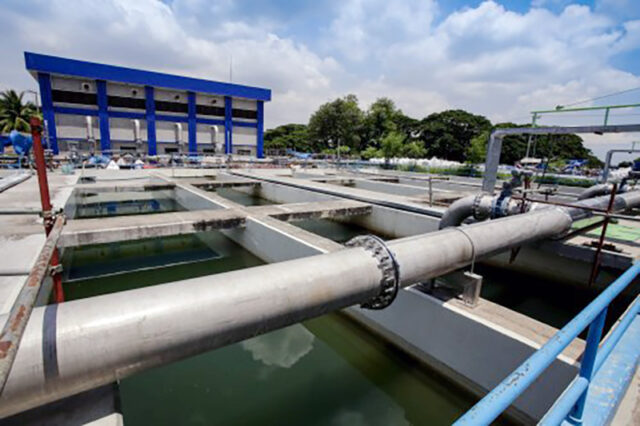
WEST ZONE concessionaire Maynilad Water Services, Inc. has tapped MPower, the local retail electricity supplier of Manila Electric Co. (Meralco), to power over 50 water and wastewater facilities with a portion of renewable energy.

In a statement on Monday, Maynilad said it signed a new deal with MPower to deliver power to its Poblacion Water Treatment Plant (WTP) in Muntinlupa City and 54 other water and wastewater facilities through the government’s retail aggregation program.

Under the agreement, Poblacion WTP — the water firm’s newest water treatment facility — has been enrolled in the retail electricity supply (RES) program.

Other facilities include pump stations, reservoirs, and wastewater treatment plants, enabling the bulk purchase of electricity and consolidation of accounts for greater operational efficiency.

MPower will provide an energy mix of 90% non-renewable and 10% renewable power. It will also work with Maynilad to manage the plant’s energy use in preparation for a future increase in renewable energy.

“These initiatives form part of our broader strategy to optimize energy consumption while reducing our overall environmental footprint,” said Maynilad President and Chief Executive Officer Ramoncito S. Fernandez.

As part of its goal of carbon neutrality by 2037, Maynilad is implementing a comprehensive strategy centered on the transition to renewable energy sources and the establishment of a carbon sink equivalent to 180,000 metric tons of carbon dioxide.

As of March, the company aims to increase its reliance on clean energy to 15% of total power requirements, with a target range of 35% to 50% by 2037.

Metro Pacific Investments Corp., which has a majority stake in Maynilad, is one of three Philippine units of Hong Kong-based First Pacific Co. Ltd., the others being Philex Mining Corp. and PLDT Inc.

Meralco’s controlling stakeholder, Beacon Electric Asset Holdings, Inc., is partly owned by PLDT Inc. Hastings Holdings, Inc., a unit of PLDT Beneficial Trust Fund subsidiary MediaQuest Holdings, Inc., has an interest in BusinessWorld through the Philippine Star Group, which it controls. — Sheldeen Joy Talavera

Negros reunited: The Visayas’ new frontier for renewables, warehousing, and BPO

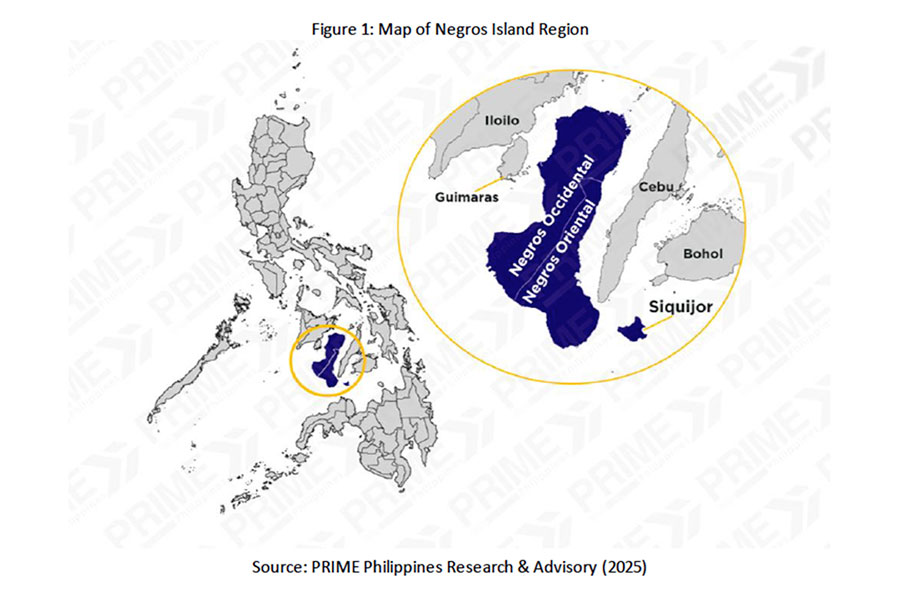
Negros Island is rewriting its economic story. Once known as the country’s sugar bowl, the newly reestablished Negros Island Region (NIR) is emerging as the Visayas’ renewable energy capital, capturing nearly half of all approved investments in the second quarter (Q2) of 2024.

For decades, residents of Negros Occidental and Negros Oriental were compelled to travel to Iloilo or Cebu for regional government services due to the island’s segregation between Western and Central Visayas. To address this, President Ferdinand R. Marcos, Jr. in 2024 officially reestablished the NIR and fulfilling a long-standing aspiration of Negrenses. Unlike previous executive attempts, RA 12000 provides a stronger legal and administrative framework, enabling full decentralization of government functions and streamlined inter-agency coordination across Negros Island and Siquijor. The unified regional administration is designed to accelerate investment, stimulate economic growth, and enhance regional competitiveness by harnessing the island’s full potential.

Prior to the creation of the Negros Island Region, Negros Occidental residents were included in Western Visayas, while Negros Oriental and Siquijor residents were included in Central Visayas. In the 2024 census, the exclusion of these provinces resulted in a notable population decline in Central Visayas (-3.9%) and Western Visayas (-1.8%), impacting on the regional demographic profiles and planning considerations.

Beyond the political symbolism, the impact is already visible on the ground. From billion-peso solar farms and biomass facilities fueling the energy grid, to Bacolod’s growing role as a logistics and outsourcing hub, Negros is positioning itself as one of the most dynamic growth centers in the Visayas. This is a clear shift that signals both opportunity and challenge for investors.

AGRICULTURE POWERS NIR’S TRANSITION INTO A DYNAMIC AGRO-INDUSTRIAL AND RENEWABLE ENERGY POWERHOUSE
NIR’s strong agricultural base makes it a hub for agribusiness and value-added industries, fueling demand for logistics and infrastructure expansion. In 2024, the Agriculture, Forestry, and Fishing (AFF) sector generated P83.39 billion, ranking second in the Visayas. Negros Occidental, known as the “Sugar bowl of the Philippines,” also accounts for more than half of national sugar production, supported by 13 sugar mills and six refineries, including Victorias Milling the largest integrated mill and refinery in the country.

Sugar by-products, particularly bagasse and cane trash, have become critical inputs for renewable energy. Biomass facilities now form a cornerstone of the island’s power mix, contributing to the fact that 99.1% of Negros Occidental’s electricity production comes from renewable sources.

The clean energy transition has also reshaped the investment landscape. In Q2 2024, NIR secured P86.5 billion in approved foreign investments, equivalent to 45.6% of the national total, with the bulk directed toward renewable energy. Furthermore, other key projects include AboitizPower’s 173-MWp Calatrava solar farm, Citicore’s 100-MWp Silay facility, and the P6.9-billion Bacolod-Bago solar plant (150 MWp) slated for completion in 2025. In total, more than 1,000 MW of renewable capacity is in the Department of Energy (DoE) pipeline for Negros.

COST COMPETITIVENESS AND NEW INFRASTRUCTURE FUEL BACOLOD’S WAREHOUSING GROWTH
Building on this agricultural and green foundation, the NIR is also seeing steady growth in industrial and logistics activity, particularly in Bacolod City. Demand is driven by its proximity to ports, airports, and major urban centers. Most occupiers are engaged in logistics, distribution, and personal storage, with rising interest from FMCG firms targeting the local consumer market.

At the heart of this activity is the Bacolod Real Estate Development Corp. (BREDCO) port, which serves as the city’s logistics backbone and is evolving into a warehousing hub, with facilities ranging from 1,700 to 5,000 sq.m. While flooding challenges persist within the port area, adjacent sites offer room for expansion that supports sustained growth.

The Negros Island Region accounted for 61% of total shipcalls in the Visayas, underscoring its pivotal role in regional maritime activity. Within the region, Panay/Guimaras recorded 91,337 shipcalls, significantly higher than Cebu’s 39,576, and among the highest compared to major ports in Luzon and Mindanao. In terms of cargo movement, the region handled 37% of the Visayas’ total volume, with Panay/Guimaras emerging as the top contributor in the NIR and the second highest across the Visayas.

The reestablishment of the Negros Island Region presents an opportunity to strengthen logistics and inter-island connectivity, particularly as Negros Occidental accounts for most of the country’s sugarcane output. However, the region’s dependence on sugar leaves it vulnerable to climate risks and price volatility. Thus, the diversification to other industries and services as mentioned above is crucial in sustaining the growth of NIR.

Bacolod also enjoys a cost advantage. Warehouse rental rates range from P150-250 per sq.m. per month, at par with Iloilo and below Cebu’s P185-300, giving the city a competitive edge for occupiers. Looking ahead, strategic infrastructure projects such as the Bacolod–Negros Occidental Economic Highway, the New Dumaguete Airport in Bacong, and the Panay–Guimaras–Negros Island Bridges are poised to enhance connectivity across key gateways. These include the established BREDCO and Dumaguete Ports as well as the Bacolod–Silay and Sibulan Airports, with the upcoming Bacong Airport expected to significantly boost trade and regional integration.

EMERGING OPPORTUNITIES POSITION BACOLOD AS THE NEXT BPO FRONTIER
Bacolod City’s office market is gaining traction, driven by the expansion of the BPO sector. Recognized as a “Center of Excellence” for IT-BPM and one of the country’s “Next Wave Cities,” the industry employs about 40% of the city’s white-collar workforce, underscoring both its reliance on outsourcing and the sector’s confidence in Bacolod as an alternative to Cebu and Metro Manila.

In the first half of 2025, Bacolod’s office occupancy dipped below 80% due to new stock in the market.  The flip-side of the market is that it gives ample room for new entrants and providing occupiers with greater leverage in negotiations. Rental rates average P500-800 per sq.m., comparable to Cebu but well below Metro Manila’s P900-1,100, making Bacolod a cost-efficient option for firms seeking scalability without compromising talent access. This is supported by a steady pipeline of over 20,000 college graduates annually and lower operating costs than in Metro Manila.

Developers are reinforcing this momentum. Megaworld’s Upper East Township delivered Bacolod’s first LEED-certified office building and, in June 2025, became the city’s first PEZA-accredited IT Park, with a second tower underway. Other major developers such as Ayala Land and Robinsons Land also have their respective mixed-use developments in the city.

While Bacolod is gaining ground, its office market will reach its potential only if key hurdles are cleared. Foremost is the difficulty local developers face in securing PEZA accreditation, which limits the supply of fiscally incentivized space that outsourcing firms prioritize when choosing sites. By contrast, Cebu hosts dozens of PEZA-accredited buildings, and Iloilo’s accredited stock is clustered in Iloilo Business Park.

NIR ADVANCES ITS POSITION AS A KEY REGIONAL GROWTH CENTER
Anchored by agriculture, fueled by renewable energy, and supported by competitive industrial and office markets, the Negros Island Region is steadily transforming into a diversified investment hub. This convergence signals its evolution from a traditional agricultural economy into a dynamic center for industry, services, and sustainable growth, firmly positioning it as one of the most promising emerging markets in the Visayas.


Jet Yu is the founder and chief executive officer of PRIME Philippines, a commercial real estate advisory firm.

UnionBank rolls out NFC payment feature on its app

BW FILE PHOTO

UNION BANK of the Philippines, Inc. (UnionBank) has launched the Mobile Tap to Pay feature on its online application, letting its users make contactless transactions using a near-field communication (NFC)-capable Android device.

Users of the bank’s mobile app can now pay by just tapping their mobile device linked to their UnionBank Visa debit or credit card at Visa contactless terminals worldwide, eliminating the need to use their physical cards.

The feature can be launched directly from the UnionBank online app’s login screen upon activation and can be accessed after biometric authentication. It can be set up and activated via the app.

“With Mobile Tap to Pay, UnionBank is elevating the everyday payment experience for Filipinos. This isn’t just a new feature — it’s a customer-first innovation that brings security, speed, and simplicity of making payments directly via our mobile app. By making digital payments as effortless as a tap without the need to bring out the physical debit or credit card, we’re empowering our customers to move through their day with confidence and ease,” UnionBank Chief Marketing & Experience Officer Albert C. Cuadrante said in a statement.

“Whether it’s a quick coffee run, a spontaneous purchase, or a fast-paced commute, Mobile Tap to Pay is designed to keep up with our customers’ lives — making every transaction seamless and stress-free,” Mr. Cuadrante said.

Users can also link or unlink their preferred debit or credit card for their payment needs via the app.

UnionBank added that transactions are protected by Visa’s tokenization technology, which replaces their card details with a unique, encrypted code.

“This ensures critical information remains secure and is never stored or shared with merchants.”

UnionBank saw its net income fall by 40.54% to P1.82 billion in the second quarter. This brought its profit for the first half to P3.25 billion, down by 38.86%.

Its shares went down by 10 centavos or 0.33% to close at P30.10 apiece on Monday. — A.M.C. Sy

ADVERTISEMENT
ADVERTISEMENT