THE PESO slipped back to the P57-a-dollar level on Thursday after the US Federal Reserve delivered a widely expected rate cut and hinted at more easing later this year.
It closed at P57.06 against the greenback, down 17 centavos from P56.89 on Wednesday, according to Bankers Association of the Philippines data posted on its website. It opened at P56.97, its strongest for the day, before hitting an intraday low of P57.10.
Dollar turnover rose to $1.55 billion from $1.49 billion on Wednesday.
“The dollar-peso closed higher as the market responded to a less dovish stance from the US Federal Reserve after the rate cut announcement overnight,” a trader said by telephone.
The US central bank trimmed its policy rate by 25 basis points (bps) to 4% to 4.25%, its first reduction since December. Fed Chairman Jerome H. Powell said the Federal Open Market Committee could cut again in October and December, citing slowing job creation and labor market fragility.
“You see minority unemployment going up,” he said. “You see younger people more susceptible to economic cycles,” he added, noting that the pace of hiring had fallen below the level needed to keep the jobless rate steady.
The dollar initially fell to its lowest since February 2022 at 96.224 against a basket of peers after the Fed decision but quickly rebounded, rising as much as 0.44% before settling around 97.06.
Michael L. Ricafort, chief economist at Rizal Commercial Banking Corp., said the greenback’s recovery weighed on Asian currencies, including the peso. “The dollar was generally stronger after the Fed cut, coupled with signals of more easing this year,” he said in a Viber message.
The weaker peso adds pressure on the Bangko Sentral ng Pilipinas (BSP), which has said its own policy moves would partly depend on the Fed. Finance Secretary Ralph G. Recto, who sits on the Monetary Board, said this week the BSP could still cut by 25 bps each in October and December if inflation risks remain manageable.
Mr. Ricafort sees the peso trading from P56.95 to P57.20 a dollar on Friday, while the trader sees it at P56.90 to P57.20.
Meanwhile, focus also turned to the Bank of England’s scheduled policy decision, with no change on rates expected.
Sterling was down 0.1% at $1.3615 after briefly leaping to the highest since July 2 at $1.3726 in the prior session.
The euro was steady at $1.1823 after retreating from its highest level since June 2021 at $1.19185 on Wednesday in a knee-jerk reaction to the Fed announcement.
Analysts differed over the signals sent by the Fed. While those at Goldman Sachs said that many hints had pointed to Wednesday’s cut being the first among many, their counterparts at ANZ characterized the Fed Chair’s commentary as “not at all dovish.”
“The (Fed’s) revised forecasts highlighted the degree of uncertainty that remains over the outlook,” said Elliot Clarke, head of international economics at Westpac. “The timing and scale of the forecast rate cuts also point to lingering risks for inflation.”
Meanwhile, the Bank of England was widely anticipated to keep rates at 4% when it announces its own policy decision later on Thursday, with financial markets focusing on the potential for a slowdown in its pace of quantitative tightening.
“Any negative surprises on QT today could trigger gilt sell-offs that have proven to spill over significantly onto GBP,” Francesco Pesole, an FX strategist at ING, said in a note.
Official figures on Wednesday showed British inflation at 3.8% in August, reinforcing market expectations that further rate cuts are unlikely to be imminent. — Aaron Michael C. SywithReuters
JIMMY KIMMEL in a skit on the show Jimmy Kimmel Live!
LOS ANGELES/WASHINGTON — Walt Disney-owned ABC said on Wednesday it was pulling Jimmy Kimmel Live! off the air, after comments by the late-night show’s host about the assassination of conservative activist Charlie Kirk prompted a threat by the head of the top US communications regulator against Disney.
President Donald J. Trump, who has repeatedly pressured broadcasters to stop airing content he has found objectionable, celebrated the news in a social media post. A number of Democratic lawmakers assailed the decision, saying free speech was under attack.
The suspension of Mr. Kimmel’s show marked the latest action taken against media figures, academic workers, teachers, and corporate employees over their remarks about Mr. Kirk following his assassination.
Republican leaders and conservative commentators have warned Americans to mourn Mr. Kirk respectfully or suffer consequences, and some people have been fired or suspended after discussing the killing online.
Mr. Kimmel, who has frequently targeted Mr. Trump on his late-night comedy show, drew fire for remarks he made about the killing in his monologue on Monday.
“We hit some new lows over the weekend, with the MAGA gang desperately trying to characterize this kid who murdered Charlie Kirk as anything other than one of them, and doing everything they can to score political points from it,” Mr. Kimmel said.
Mr. Kirk, a 31-year-old activist and Trump-world celebrity known for his right-wing views and pugnacious debating style, was shot in the neck while speaking at a Utah university a week ago. A 22-year-old suspect has been charged with his murder, and his precise motive remains unclear.
Mr. Kimmel’s comments led to a response from Federal Communications Commission (FCC) Chair Brendan Carr, who urged local broadcasters to stop airing Jimmy Kimmel Live! on ABC. Mr. Carr suggested the commission could open an investigation and that broadcasters could potentially be fined or lose their licenses if there was a pattern of distorted comment.
“This is a very, very serious issue right now for Disney. We can do this the easy way or the hard way,” Mr. Carr said in a podcast interview with conservative commentator Benny Johnson that aired Wednesday.
“Disney needs to see some change here, but the individual licensed stations that are taking their content, it’s time for them to step up and say this, you know, garbage to the extent that that’s what comes down the pipe in the future isn’t something that we think serves the needs of our local communities.”
After Mr. Carr spoke, Nexstar Media Group said it would stop airing the show on its 32 ABC affiliates, citing Mr. Kimmel’s comments. Nexstar, which needs FCC approval for its $6.2-billion deal to acquire smaller rival Tegna, drew praise from Mr. Carr, who thanked Nexstar for “doing the right thing.”
Shortly after Nexstar announced its decision, ABC, which holds FCC-approved licenses for the local broadcast affiliates that it owns, also said Mr. Kimmel would be pulled from the air.
“Jimmy Kimmel Live! will be preempted indefinitely,” an ABC spokesperson said, without elaborating.
Sinclair, the nation’s largest ABC affiliate group, then said it would not air Mr. Kimmel’s show, even if ABC decides to bring it back, unless “appropriate steps” were taken. Sinclair called on Mr. Kimmel to apologize and said it would air a tribute to Mr. Kirk in Mr. Kimmel’s time slot on Friday.
Mr. Kimmel, who was seen on Wednesday leaving the El Capitan Theatre where his show is taped, did not respond to a request for comment.
TRUMP CHEERS, DEMOCRATS CRITICIZE As broadcasters took action, Mr. Trump applauded the news in a post on Truth Social while also calling on Comcast-owned NBC to fire Jimmy Fallon and Seth Meyers, the hosts of late-night comedy shows on the network who often make jokes at Mr. Trump’s expense.
“Congratulations to ABC for finally having the courage to do what had to be done,” Mr. Trump said.
Democrats in turn criticized the removal of Mr. Kimmel from the air, with Senator Ed Markey calling it “censorship in action.”
FCC Commissioner Anna Gomez, the FCC’s only Democratic member, said US free-speech laws should prevent the FCC from telling broadcasters what they can air.
“This administration is increasingly using the weight of government power to suppress lawful expression,” she told CNN.
Mr. Trump has repeatedly sued, berated, and threatened media companies whose coverage he disputes with legal or other action.
Mr. Trump this week filed a $15-billion defamation lawsuit against the New York Times and book publisher Penguin Random House, accusing them of treating him unfairly.
CBS-parent Paramount paid $16 million in July to resolve a civil suit over what Mr. Trump alleged was the network’s deceptive editing of an interview with presidential candidate Kamala Harris. ABC in December paid $15 million to settle a defamation lawsuit filed by Mr. Trump over anchor George Stephanopoulos’ on-air description of the president’s conduct in the E. Jean Carroll case.
Following Mr. Kirk’s killing, political analyst Matthew Dowd was fired from MSNBC after he described the activist as a “divisive” figure who spread “hate speech,” and added “hateful thoughts lead to hateful words, which then lead to hateful actions.”
MSNBC president Rebecca Kutler issued a statement apologizing for Mr. Dowd’s comments, which she said were “inappropriate, insensitive and unacceptable.”
Washington Post columnist Karen Attiah said on Monday she was fired by the newspaper over a series of social media posts she made following the killing of Mr. Kirk, including one in which she noted Mr. Kirk’s past comments on Black women. The Post has said it does not comment on personnel matters and the newspaper’s union condemned the firing. — Reuters
GCASH has partnered with InvestaTrade, the stock trading arm of Investa, to roll out an upgraded version of its GStocks platform aimed at first-time investors.
The enhanced platform, launched on Sept. 15, allows users to register, fund their accounts, and begin investing in local stocks directly through the GCash app.
It also includes built-in educational content to promote financial literacy and ease of stock selection.
“This collaboration allows us to take what we’ve built at Investa — tools, education, and a supportive community — and make it available to a wider audience through GCash,” Investa Chief Executive Officer and Co-founder John Christian Bisnar said in a statement.
Investa Chief Technology Officer and Co-founder Airwyn Tin said the partnership leverages InvestaTrade’s platform features with GCash’s reach “to simplify the learning curve and equip first-time and experienced users alike with reliable tools.”
GCash Wealth Management General Manager Arjun Varma said the initiative seeks to “meet people where they are and give them room to grow at their own pace.”
To access GStocks, users must be fully verified on GCash with updated know-your-customer records in the past three years. — Aaron Michael C. Sy
REPRESENTATIVES from various church organizations and progressive groups encourage the public to join the Sept. 21 anti-corruption rally at the Luneta Park and the People Power Monument to hold accountable the government officials, contractors and others allegedly involved in the massive corruption in the government. — PHILIPPINE STAR/MIGUEL DE GUZMAN
No, what is unfolding day after day toward the Sept. 21 Martsa ng Bayan (March of the Nation) is not, to borrow Shakespeare’s words, “a walking shadow… a poor player that struts and frets his hour upon the stage, and then is heard no more.”
Neither is it “a tale told by an idiot, full of sound and fury, signifying nothing.”
What the nation is seeing take shape is no mere spectacle, no passing fit of political theater. It is the gathering response of a people who, for too long, have been robbed blind and treated as if their outrage were irrelevant. The coming march is not an empty exercise — it is a reckoning, perhaps even a turning point, against the monstrous flood-control scandal that has already siphoned away at least a trillion pesos from the Filipino people.
This is not just theft — it is theft weaponized against our future. A trillion pesos gone is a trillion pesos not spent to cure the sick, educate our children, or strengthen our communities. It is a trillion pesos transformed into the cement of corruption, poured over our hospitals, our schools, our moral fiber, suffocating hope.
The Trillion Peso March is the people’s answer to a reign of greed so brazen, so unrepentant, that one meme captures it perfectly: “sinindikato ang buong gobyerno.” The government itself has been made a syndicate — operating not as a guardian of the common good, but as a criminal enterprise.
FINGER POINTING AND CONNECTING THE DOTS When former Department of Public Works and Highways (DPWH) Secretary Rogelio Singson said bluntly, “Lahat sila involved (all of them are involved),” he was not indulging in exaggeration. He was naming what has long been obvious: that the rot runs not only through contractors but through legislators, senators, and members of the executive branch itself.
The finger-pointing has begun, and in that desperate exercise, the lines connecting one corrupt hand to another have only become clearer.
Consider: this scandal did not emerge from Congress. Neither Senate nor House initiated the exposé. It came from the President himself, who in his July 28 State of the Nation Address declared that of the P545 billion allocated for flood control, some P100 billion went to only 15 contractors since July 2022 — many of those projects in areas not even among the most flood-prone.
If this was meant as candor, it was a poisoned gift. For the President is not merely an observer. He is head of the executive branch, responsible for both DPWH and the Department of Budget and Management. His disclosure is not neutral; it is an admission of command responsibility.
Then came Senator Ping Lacson, unveiling in August that 67 lawmakers had been double-dealing — acting both as legislators who secure funds and contractors who pocket them. Forty percent commissions on projects became standard loot, with DPWH officials, Commission on Audit auditors, and bidding committees taking their cuts like practiced vultures.
This is not simply corruption — it is cannibalism. Lawmakers carve into the very body of the nation they swore to protect. And they do so with the cold logic of seasoned predators.
THE PRICE OF CRIMINAL BUDGETING The mechanics are clear enough: improper budget insertions at the House Appropriations, the Senate Finance Committee, or the bicameral conference. The law forbids inflating the budget, so funds are siphoned by deprioritizing what matters most: hospitals, schools, roads, healthcare, teachers, bridges.
Two blows fall on the Filipino taxpayer.
First, we are left with a skeletal state: too few hospital beds, too few doctors, crumbling schools, underpaid teachers, textbooks that arrive years late. No wonder our students rank among the lowest worldwide in math, science, and reading. No wonder our infrastructure lags behind even our Southeast Asian neighbors.
Second, the projects we do receive are often ghostly in every sense — nonexistent, half-finished, or completed with materials so substandard they may as well not exist. And when the rains come, it is we who drown — sometimes literally — in the floods these fraudulent projects were supposed to prevent.
CRACKS IN THE SYNDICATE But even the most disciplined cartel eventually shows fissures.
The DPWH district office in Bulacan has already begun to betray its own, exposing millions of pesos stacked in offices like loot waiting to be dispatched. This is not hearsay, not rumor — it is evidence. Senator Lacson has signaled he will go further, demanding CCTV recordings of bagmen delivering cash to legislators.
Other institutions have stirred as well. President Ferdinand Marcos, Jr. has created an Independent Commission for Infrastructure. The House has floated legislation to form a body with subpoena and contempt powers. These may sound promising, but they could still be fragile, perhaps cosmetic. Unless armed with real authority and real independence, such commissions risk becoming just another diversion, another mask worn by the same old face of impunity.
The people will not be placated by scapegoats or token resignations. Changing figureheads in DPWH or Congress is no cure when the same mold infects the entire structure.
Justice demands more: prison for both public officials and private contractors guilty of plunder. Full recovery of stolen funds. Confiscation of ill-gotten assets. Anything less is betrayal.
FREEZING THE BLOOD MONEY There are flickers of action worth noting.
The Court of Appeals has approved the Anti–Money Laundering Council’s petition to freeze 135 bank accounts and 27 insurance policies linked to the scandal. The Bangko Sentral ng Pilipinas is investigating under the Anti-Financial Account Scamming Act (Afasa Law), criminalizing money mules and asset laundering. Twenty DPWH personnel and private contractors are under freeze orders.
But here lies the test: will these moves end with frozen accounts that quietly thaw months later? Or will they end in confiscation, conviction, and restitution?
Ghost projects cannot be fought with ghost accountability.
WHAT THE MARCH MUST DEMAND The Martsa ng Bayan cannot afford to dissolve into incoherence and irrelevance.
To call for mass resignations would be reckless, leaving a constitutional vacuum that benefits no one but the guilty. To demand voluntary resignations is naïve — our politicians abandoned delicadeza (propriety) long ago.
What is needed is sharper, lawful, and relentless insistence for:
• A comprehensive independent investigation of all flood control projects of the last decade.
• Forensic accounting to flush out hidden assets.
• Criminal charges against all with probable cause.
• Confiscation of frozen and laundered assets for the Republic.
• Public oversight at every stage, to guard against whitewash and neglect.
The march must be the people’s declaration that the Republic is not theirs to steal.
ANGER, BUT DISCIPLINED ANGER Yes, anger is inevitable. Anger is righteous. As Archbishop Soc Villegas reminds us: “If you don’t know how to get angry at the corruption, at the money that should be given to the poor but goes to the pocket of powerful people, then something is wrong with your Christianity.”
But let our anger not descend into mob vengeance. Due process remains essential. No one should be above scrutiny — but no one should be condemned without trial.
For what we are fighting is not just theft of money. It is the theft of justice, the corruption of decency, the erosion of trust itself. To answer that theft with lawlessness would only repeat the crime in another form.
The Trillion Peso March is not a mere march. It is the people’s testimony: that we see the rot, that we connect the dots, that we will not be silent.
What was stolen was not just pesos, but dignity. What was looted was not just the treasury, but the promise of our children.
So let us march, not in the hope that the powerful will suddenly rediscover shame, but to prove that the powerless many are no longer afraid.
The flood that rises now is not of water, but of people.
And unlike the ghost projects, this flood is real.
Diwa C. Guinigundo is the former deputy governor for the Monetary and Economics Sector, the Bangko Sentral ng Pilipinas (BSP). He served the BSP for 41 years. In 2001-2003, he was alternate executive director at the International Monetary Fund in Washington, DC. He is the senior pastor of the Fullness of Christ International Ministries in Mandaluyong.
BANK OF THE PHILIPPINE ISLANDS (BPI), in partnership with BPI MS Insurance Corp., has launched an accident insurance plan tailored for freelancers, consultants, digital nomads and other self-employed workers, tapping into a fast-growing segment of the economy.
The product, dubbed BPI Freelancer, offers lump-sum cash benefits in case of accidental death or permanent disability, whether work-related or not. Policyholders are also entitled to a P1,000 daily cash allowance for up to 10 days of hospitalization from accidents or covered illnesses.
The plan provides up to P20,000 in assistance for utility bills during recovery or loss and includes motorcycle accident coverage for both riders and passengers. Customers may opt for auto-renewal for uninterrupted protection.
“As more Filipinos carve their own path in the freelance and entrepreneurial space, BPI and BPI MS are leading the way in crafting inclusive financial solutions for this new generation of workers,” BPI MS Insurance President and Chief Executive Officer Noriyuki Kobayashi said in a statement on Thursday.
Open to Filipinos aged 18 to 65, the plan allows holders to extend coverage to as many as four dependents or form a group of up to five people without including themselves.
“This versatility makes the plan ideal not only for independent freelancers but also for those seeking to safeguard their families, partners or teams,” BPI said.
The annual premium starts at P499 for the basic package, P699 for the prime plan and P1,099 for the elite tier.
“BPI Freelancer represents our deep understanding of modern Filipino needs and our commitment to helping them thrive,” Mr. Kobayashi said.
BPI Consumer Banking Head Maria Cristina Go said the initiative responds to the growing number of Filipinos outside traditional employment. — AMCS
Country’s top community builders recognized at Dot Property Philippines Awards 2025
By Jomarc Angelo M. Corpuz, Special Features and Content Writer
The Dot Property Philippines Awards 2025 marked its 10th anniversary in an unforgettable night at the luxurious Okada Manila, honoring the nation’s most forward-thinking developers, groundbreaking projects, and premier real estate agencies.
Since 2015, the Dot Property Awards have become the measure of excellence in Southeast Asia as they shed the limelight on developers who go beyond building properties to shaping lifestyles, driving innovation, and redefining communities. This year’s Philippine edition proved why it is considered one of the nation’s most prestigious real estate achievements, gathering the industry’s most renowned and respected names together in celebration of a decade of progress.
“This year marks the 10th anniversary of the Dot Property Philippines Awards — a decade of celebrating excellence and honoring the very best of the Philippines’ real estate industry. Over the past 10 years, this stage has become more than just a platform of recognition. It has become a testament to a vision of resilience and innovation that continues to shape our nation’s property landscape,” Dot Property Philippines Country Manager Tanya Peralta-Yu said during her opening remarks.
For 10 years, the Dot Property Awards have painted the changing landscape of real estate in the Philippines, from the vivid strokes of green developments and smart homes to the intricacies of conceptualizing integrated communities and investor-driven projects.
This year’s landmark edition highlighted more than 30 award categories, each crafted to recognize the distinct achievements of developers nationwide. The awards celebrate excellence in design and construction, as per usual, while also marveling at the leadership in sustainability, corporate responsibility, and innovation-values that continue to be a sneak peek into the next era of Philippine real estate.
“The Philippine real estate industry stands at an exciting crossroads. We are seeing unprecedented growth in residential developments, the continued transformation of urban centers, the rise of sustainable and green communities, and expanding opportunities brought by digital platforms,” Ms. Peralta-Yu explained.
As a brand that has consistently pushed the boundaries of modern living, the most prestigious recognition of the evening, Developer of the Year 2025, was awarded to RLC Residences for the second year in a row. Aside from delivering high-quality developments, RLC Residences was celebrated for its future-forward, sustainable, and smart communities.
From left: Dot Property Philippines Country Manager Tanya Peralta-Yu; RLC Residences Vice-President and Head of Human Resources Quirino John Calica; Senior Director, Marketing Head and Chief Integration Officer Karen Cesario; Head of Operations Jeniflor Santos; Head of Property Management Atty. Eugenie Celie Sy; Vice-President and Head of Sales Carissa Denise Lao, Officer-in-Charge Business Unit General Manager Teddy Bernas, Vice-President and Head of Business Development and Leasing Stephanie Anne Go, Head of Legal Atty. Deogracias Grafil II; and Dot Property Group Director Adam Sutcliffe
“It really is an honor for us, and it’s extra meaningful for us because we are celebrating our 45th anniversary. I think this is a testament that the team is continuously honoring the vision of our late founder, John Gokongwei, and we do hope that we continue to make our founder proud and consistently deliver the best homes in the country,” a representative from RLC said as they accepted the award.
Aside from being awarded the Best Developer for the year, RLC also won the Best Starter Home Condominium Development, Best Smart Home Condominium Development, Best Sustainable Development, Best Condominium Architectural Design, and the Special Recognition Award for Sustainable Construction.
One of the most coveted awards given away during the event, the People’s Choice Award for Project of the Year 2025, was taken home by Federal Land, Inc. for Grand Hyatt Manila Residences South Tower. Known as the first Grand Hyatt-branded residence in Southeast Asia, the project adds the distinction to its long list of awards.
From left: Dot Property Country Manager Tanya Peralta-Yu; Federal Land Project Development Group Head Stephen Comia; Vice-Chairman Thomas Mirasol; President Jose Mari Banzon; Product Planning Senior Manager Coney Mirhan; and Dot Property Group Director Adam Sutcliffe
“We’d like to thank Dot Property for this award. It’s especially satisfying given the distinguished company we share tonight’s awards with. Everyone here, I think, is a winner. We are very grateful that the project has received this recognition, and we look forward to continuing on the same route,” Thomas F. Mirasol, vice-chairman of Federal Land, said.
The real estate company also won several other awards during the night, including Best Developer Metro Manila, Best Mixed-Use Development, Best Affordable Condominium Development, Best Luxury Condominium Development, Best Retail Development, Best Transit-Oriented Development, and Best Community-Centric Design.
Vista Land’s Verida was also named the Best Township Development at the awards. The township spanning 50 hectares and zoned into eight distinct districts draws inspiration from Singapore and is designed around three key sustainability-driven nodes: verdant spaces for renewable energy and eco-tourism; socio-cultural hubs celebrating local community; and a smart, connected city within a city powered by technology and innovation.
From left: Vista Land Concept Development Officer Laimar Austin Lucena; Masterplanner Ar. Peter Estanislao; Concept Development Officer Ar. Frances Francisco; Senior Marketing Officer Junina Dela Cruz; and Lamudi Philippines CEO Mart Polman
“Townships are redefining Philippine real estate by nurturing local economies, encouraging social interaction, and creating lasting value for residents and investors. Guided by this mission, Vista Land will remain a catalyst of inclusive growth, shaping not only the physical landscape but also the lifescapes of Filipinos wherever they choose to reside,” Vista Estates Master Planner Ar. Peter Estanislao noted.
Another interesting highlight from this year’s edition was the awarding of the Agency Excellence Awards to four companies, including Cebu Grand Realty, Kondo Ko Property Management, Llorico Realty, and Luxe Realty and Development Corp. The honor was given to recognize the agency’s client-focused approach as well as its outstanding brokerage of residential, commercial, and industrial properties.
“We are grateful to our clients, partners, and colleagues whose trust, referrals, and continuous support have made this possible. This award reminds us that what we have built today lays the foundation for the future, and we look forward to many more years of adding value to the Philippines’ real-estate industry,” Luxe Realty and Development Corp. President Trisha Liu said in her acceptance speech.
Other major winners include Aboitiz InfraCapital Economic Estates, which was awarded Best Industrial Developer and Best Industrial Development. Filinvest Land also took home various accolades, such as Best Developer Visayas, Best Developer Mindanao, and Special Recognition Award for Corporate Social Responsibility. Other developers who were given more than one award is Pueblo de Oro Development Corp., which was honored with the Best Affordable Housing Development and Best Green Development, and Makiling Mews Corp., which secured Best Boutique Developer and Best LEED Development.
From left: Dot Property Country Manager Tanya Peralta-Yu, Aboitiz InfraCapital Economic Estates Assistant Vice-President for Brand and Marketing Communications Marice Ofrin, Assistant Vice-President for People & Culture Bernadette Magmanlac, Vice-President for Operations Clifford Academia, and Dot Property Group Director Adam Sutcliffe
Century Properties Group, Inc. (CPGI) won Best Lifestyle Condominium Development, Costa del Hamilo, Inc. received the Best Resort Condominium Development award, and Dolmar Land earned Best Investment Property-Emerging Communities. Similarly, Golden Bay Prime Landholdings, Inc. garnered Best Green Lifestyle Development, with Malveda Properties and Development Corp. emerging with the Best Serviced Apartment achievement.
From left: Dot Property Country Manager Tanya Peralta-Yu, FLI Area Manager Cebu Carl I. Mondala, FLI VP Regional General Manager-Visayas Louie D. Carandang, SharePro President Cherie B. Fernandez, FLI Senior AVP Special Projects Visayas and Mindanao Archie M. Igot, and Dot Property Group Director Adam Sutfcliffe
Furthermore, Dot Property Philippines Awards honored Omaha Development Corp. for Best Mid-Range Townhouse Development, Taylormade Development Corp. as Best Townhome Developer, and Vista Land & Lifescapes, Inc. for Best Township Development. Ortigas Land earned recognition for Best High Rise Condominium Development, while PHirst Park Homes, Inc. was named Best Developer, Luzon. R Land Development, Inc. received the award for Best Wellness Community Development, and Ayala Property Management Corp. (APMC) was acknowledged for Best Real Estate Property Management.
1 of 2
From left: Dot Property Country Manager Tanya Peralta-Yu; Makiling Mews Corp. Managing Director Gerrett Lim; Directors Gene Lim, Elvira Poon, Stephanie Poon, and Fritz Dy; and Dot Property Group Director Adam Sutcliffe
From left: ICCP Group AVP of Purchasing Oliver B. Cariño, VP of Treasury Rhodora C. Lao, PDO VP of Sales and Marketing John Vincent R. Rapiz, Senior Manager for Operations Mario J. Mallari, Manager for Sales and Marketing-Batangas Patrick L. Marasigan, and Lamudi Philippines CEO Mart Polman
Lamudi-Dot Property Philippines partnership
During the event, Dot Property Philippines also announced a merger with real estate marketplace Lamudi. With a stronger platform, wider audience, and smarter solutions, the partnership between two of the country’s leading property platforms opens doors to new opportunities for the real estate industry in the country.
“Together, these two platforms give us unmatched reach, trust, and influence in the market. But more importantly, it allows us to serve developers, agents, and the entire real estate industry in bigger and better ways,” Ms. Peralta-Yu concluded in her speech.
“This merger has created something truly powerful and a platform that is unified with unmatched reach here in the Philippines. We bring together the two strongest and most trusted platforms in the country. Together, we are now leading the real estate industry in the Philippines, but also across Southeast Asia,” Lamudi Philippines Chief Executive Officer Mart Polman added later on in the event.
Nurturing and inspiring
The support of its principal media partners, among them BusinessWorld, further strengthened the prestige of the Dot Property Philippines Awards 2025.
In his speech, BusinessWorld Executive Vice-President Lucien C. Dy Tioco highlighted the importance of real estate especially in terms of nurturing communities.
“In honoring developers, projects, and agencies across Southeast Asia, Dot Property Awards have helped shine the spotlight on the missionaries who shape our skylines, our communities, and indeed, the way we believe. This is not being hyperbolic. Real estate is one of those things that has an immeasurable impact on all of our lives,” he said.
As the awards celebrate their 10th year, one thing remains clear: the Philippine real estate industry continues to evolve in ways that inspire confidence and pride. From smart homes and green developments to boutique residences and world-class condominiums, the winners of the Dot Property Philippines Awards 2025 have set the stage for an even brighter future.
The Dot Property Southeast Asia Awards will take place later this year in Bangkok, where developers from across the region will come together for another opportunity to showcase their achievements in the international stage.
THE CIVIL Aeronautics Board (CAB) will retain the passenger fuel surcharge at level 4 for October, keeping airline fuel charges steady for the third straight month.
At level 4, the passenger fuel surcharge will range between P117 and P342 for domestic flights, and between P385.70 and P2,867.82 for international flights originating from the Philippines.
For airlines collecting fuel surcharges in foreign currency, the applicable rate for the period will be P57.04 to the dollar, the CAB said in an advisory on Thursday.
Fuel surcharges are adjusted based on the movement of jet fuel prices, using the Mean of Platts Singapore (MOPS) benchmark.
According to the International Air Transport Association (IATA), the global average jet fuel price slipped by 0.1% to $89.33 per barrel week on week as of Sept. 12.
On an annual basis, the global average jet fuel price dropped 9.8%, IATA said.
In a June report, the trade association said airlines are projected to record a net profit of $36 billion this year, driven mainly by passenger revenues and steady jet fuel prices.
Jet fuel is expected to average $86 per barrel in 2025, below last year’s $99 average, translating to about $236 billion in fuel costs, or 25.8% of total airline operating costs.
Separately on Thursday, flag carrier Philippine Airlines (PAL), operated by PAL Holdings, Inc., said it will boost flights on key domestic routes starting October to capture anticipated demand during the peak travel season.
PAL said it will increase flights between Manila and Butuan to 21 from 14 weekly; Manila and Cagayan de Oro to 42 from 35; Manila and Cotabato to 14 from 11; and Manila and Legazpi to 28 from 21.
The flag carrier will also raise services between Manila and Tacloban to 25 from 21 flights weekly, while operating daily Manila-Siargao flights and 21 weekly Cebu-Siargao services.
By October, PAL will mount daily flights between Clark and Siargao, while offering 42 weekly flights between Manila and Boracay, seven weekly flights between Cebu and Boracay, 14 weekly Manila-Coron flights, and 14 and 21 weekly flights on the Clark-Coron and Cebu-Coron routes, respectively.
“For the peak season, PAL will operate a total of 1,154 weekly flights between Manila and key domestic destinations, with overall flight frequencies rising by 7%,” PAL Express President Rabbi Vincent L. Ang said in a statement.
The airline said it expects seat capacity out of Manila to expand by more than 14,000 seats due to the additional flights starting next month.
PAL is also set to launch a Cebu-Calbayog service on Oct. 26 to strengthen its Visayas and Mindanao hubs.
“This new service will provide travelers from Eastern Visayas direct access to Visayas and Mindanao, enhancing connectivity and convenience. We’re investing in Cebu as a strategic hub to help drive tourism and economic growth across the region,” Mr. Ang said.
For the January-to-June period, PAL carried 8.47 million passengers and operated 57,598 flights.
The flag carrier earlier said it is preparing to operate 22 brand-new aircraft in the coming years, starting with the delivery of the Airbus A350-1000 by yearend.
PAL is also expecting the delivery of additional A350-1000s and 13 A321neo regional aircraft starting in 2026, along with the arrival of 18 retrofitted Airbus A321ceo aircraft by October this year.
At the local bourse on Thursday, shares in PAL Holdings closed unchanged at P3.99 apiece. — Ashley Erika O. Jose
THE Pod Network has launched Stories @ The Pod, an audio anthology series that transforms Filipino literary works into immersive podcast experiences. Co-produced by audio production company Hit Productions, the limited series is designed to showcase contemporary Philippine literature through audio. The first season kicks off with four tales from Kwentoys, the upcoming book by Budjette Tan, the writer behind Trese. Kwentoys is a collection of short stories he wrote over a span of 20 years, blending folklore, memory, and the magic of everyday Filipino life, and features illustrations by his brother Brandie Tan. Episodes of Stories @ The Pod feature a fully produced audio drama adaptation from Steve and Nyx of the Book of Bad Ideas podcast. It is available on Spotify and other podcast streaming platforms.
Watch Kara David and Shuvee Etrata on video podcast
GMA Public Affairs’ newest video podcast, I-Listen, premiered on Sept. 17. Hosted by Kara David, the first episode features Sparkle artist and Pinoy Big Brother Celebrity Collab Edition housemate Shuvee Etrata who talks about the beginnings of her showbiz career. I-Listen contains conversations that highlight Filipino stories. I-Listen is now on Spotify, Apple Music, and the official GMA Public Affairs YouTube Channel.
Go to the PPO concert with Diomedes Saraza, Jr.
THE upcoming Concert II: Le Retour, part of the 41st concert season of the Philippine Philharmonic Orchestra (PPO), will be featuring concertmaster and artist-in-residence, violinist Diomedes Saraza, Jr. A Juilliard-trained musician and NAMCYA first prize winner, Mr. Saraza has performed on international stages, including a celebrated appearance with the PPO at Carnegie Hall. Under the baton of Grzegorz Nowak, he will take on Ralph Vaughan Williams’s The Lark Ascending on Sept. 19 at 7:30 p.m. at the Samsung Performing Arts Theater, Circuit, Makati. Tickets are available via TicketWorld.
Watch Superman fly exclusively on HBO Max
DC STUDIOS’ blockbuster movie Superman is making its global streaming debut on Sept. 19, exclusively on HBO Max. Written and directed by James Gunn, the movie stars David Corenswet as Superman, Rachel Brosnahan as Lois Lane, and Nicholas Hoult as Lex Luthor.
Be welcomed toTuloy Po Kayo: The Concertat UP
THE Pan Xenia Fraternity and Adelfe Enu Crea Sorority have organized a night of music and movement called Tuloy Po Kayo: The Concert. It will feature performances by the UP Concert Chorus, the UP Symphony Orchestra, and the UP Filipiniana Dance Group. These groups will come together to honor 102 years of Business Unusual. It takes place on Sept. 20, 7 p.m., at the UP Theater, Diliman, Quezon City. Tickets can be found through the link https://tuloypokayo-theconcert.xperto.ph.
Watch films on EJKs in human rights festival
SHORT FILMS and documentaries on extrajudicial killings (EJKs) amid the Philippines’ war on drugs will be screened for free at De La Salle-College of Saint Benilde (DLS-CSB). The screenings are part of the 2025 Benilde Human Rights, Democracy, and Peace Festival. The lineup includes Basurero (2019) by Eileen Cabihing, Alunsina (2020) by Kiri Dalena, and Iiyak ang Langit (2025) by Kasharelle Javier and Monica Calderon. The event, slated for Sept. 19, from noon to 2 p.m., is free and open to the public. It will be held at the MCAD Multimedia Room, Benilde Design + Arts Campus, Dominga St., Malate, Manila. For more information, visit facebook.com/MCADManila.
See Dagitab’s transformation to stage from screen
FOLLOWING a debut run in July, Scene Change is bringing back Dagitab, a stage adaptation of the award-winning Cinemalaya film of the same name by Giancarlo Abrahan. Written and directed by Guelan Varela-Luarca, the story examines the longtime marriage of two professors, Issey and Jimmy, who are on the brink of separation. The original cast returns: Agot Isidro, Jojit Lorenzo, Elijah Canlas, and Benedix Ramos. They are joined by Sam Samarita. The limited two-weekend run from Sept. 20 to 28, takes place at the Power Mac Center Spotlight Blackbox Theater in Circuit, Makati. Tickets are available through Ticket2Me.
Catch the newbies’ works in Shorts & Briefs
FIRST-TIME theater creatives and performers will grace the stage for Eksena PH’s 11th edition of Shorts & Briefs, a theater festival for newbies. This year, the lineup of entries boasts of adult themes: Ang Babae at ang Mangga, Josefino at ang Statwa, The Red Hotel, Reklamasyon Headquarters, Shit, and Warla Arena. The theater festival will run for three weekends, from Sept. 20 to Oct. 5, with 2 and 7:30 p.m. shows, at Café Shylo at the Skyway Twin Towers Condominium, 327 Capt. Henry P. Javier St., Pasig. For tickets send inquiries via Eksena PH on Facebook and Instagram.
Attend the Cup of Joe fan event
CUP OF JOE’S fans, who call themselves the Joewahs, will be decorating and setting the mood to celebrate the OPM band’s 7th anniversary at the Activity Area on the upper ground floor of Gateway Mall 1, in Cubao, Quezon City. Taking place on Sept. 20 and 21, the event aims to be a space where fans can connect through a variety of activities, games, and music. Entrance is free. Gates open at 1 p.m.
Go to the K-Wave festival in Cagayan De Oro
THE 2025 Korea Festival On the Go is happening on Sept. 20 to 21 at SM CDO Downtown Premier in Cagayan De Oro (CDO) city. The two-day event will feature all things K-culture, from hanbok-wearing to K-pop competitions and taekwondo showcases. Organized by the Korean Cultural Center (KCC) in the Philippines, one of its most awaited segments is “Everyone’s KPOP Cagayan de Oro,” a talent competition that will gather some of the best K-pop-inspired talents from CDO and nearby regions. Yeobaek from Korea will introduce a fusion of traditional music, while Liceo Folkloric Dance Troupe from the Philippines will showcase theatrical presentations of traditional Philippine dances. The Korea Taekwondo Association Demonstration Team will also thrill audiences with a dynamic demo performance.
Figure out the complexity ofPara Kay B
BASED ON National Artist Ricky Lee’s bestselling novel of the same name, Para Kay B weaves together five interconnected love stories, as written by Eljay Castro Deldoc and directed by Yong Tapang, Jr. The production initially ran in March and returns to the Doreen Black Box Theater, Ateneo de Manila University, Quezon City, ongoing until Sept. 28. Returning cast members include Ava Santos, Liza Diño, Martha Comia, Sarah Garcia, Via Antonio, AJ Benoza, Esteban Mara, Jay Gonzaga, Aldo Vencilao, Divine Aucina, and Vincent Pajara. Joining the cast are Mario Magallona, Sarina Sasaki, Maria Alilia “Mosang” Bagio, Ingrid Joyce, Phi Palmos, Manok Nellas, Drew Espenocilla, and Air Paz. Tickets are available through Ticket2Me.
See whyPingkian was named Best Musical
ADJUDGED the Best Musical at the 2024 Aliw Awards, Tanghalang Pilipino’s Pingkian: Isang Musikal is being restaged, with performances ongoing until Oct. 12. The full-length musical follows the journey of Emilio Jacinto (played by Vic Robinson), a young revolutionary who navigates the complexities of leadership in the final years of the Philippine Revolution and the beginning of the Philippine-American War. It stars Vic Robinson as Emilio Jacinto/Pingkian. Also in the cast are Gab Pangilinan, Tex Ordoñez-De Leon, Kakki Teodoro, Paw Castillo, Almond Bolante, Joshua Cadeliña, Marco Viaña. Directed by Jenny Jamora and written by Juan Ekis with music by Ejay Yatco, it will run at the Tanghalang Ignacio Gimenez, CCP Complex, Pasay City. Tickets are available at TicketWorld and Ticket2Me.
Go dancing at Ayala Malls with G-Force
THIS SEPTEMBER, Ayala Malls and dance authority G-Force are teaming up to bring mallgoers “The Dance District,” which turns everyday mall spaces into dance playgrounds. The next event will be on Sept. 19, 6 p.m., at The Deck at Circuit Lane at Ayala Malls Circuit with Mixed Synergy. Beyond the free G-Force dance sessions, mallgoers are invited to join The Dance District Challenge. They can share their best dance moments from The Dance District on TikTok and Instagram using the official sticker template and dedicated hashtag #ThatFeelingWhenTheMallIsYourDanceFloor for a chance to get surprise treats. The Dance District will culminate in a G-Force Groove Gala at the Courtyard, Ayala Triangle Gardens, on Oct. 5. For more information, visit www.ayalamalls.com or follow Ayala Malls on social media.
WatchDear Evan Hansen at Solaire
GMG PRODUCTIONS presents the Manila run of the UK touring production of Tony Award-winning musical Dear Evan Hansen at The Theatre at Solaire in Parañaque until Oct. 5. It tells the story of Evan, an anxious high school student longing for a sense of belonging, and features music by Benj Pasek and Justin Paul and a book by Steven Levenson. It stars Ellis Kirk in the titular role. Tickets are available through TicketWorld.
Catch PETA’sWalang Aray
TWO YEARS after its debut, the original Filipino musical Walang Aray is back at the PETA Theater Center, running until Oct. 12. It is centered on the love story between Julia and Tenyong, set during the Philippine revolution of 1896. Many of the award-winning lead cast from 2023 are returning: Shaira Opsimar and Marynor Madamesila who alternate in the role of Julia, and Gio Gahol and Jon Abella as Tenyong. They are joined by a new cast member, Lance Reblando who also plays the role of Julia. Tickets are available through Ticket2Me.
Bring the kids to Rep’s Wonderland
REPERTORY THEATER for Young Audiences presents the fantastical world of Alice in Wonderland every weekend until Dec. 14. Based on the book by Lewis Carroll, with music and lyrics by Janet Yates Vogt and Mark Friedman, it is directed by Joy Virata and Cara Barredo. As Alice follows the rabbit into Wonderland, the production highlights audience participation with kids in attendance. It runs at the REP Eastwood Theater in Quezon City. For ticket inquiries and showbuying opportunities, message REP’s pages @repertoryphilippines, call 0962-691-8540 or 0966-905-4013, or e-mail info@repphil.org or sales@repphil.org.
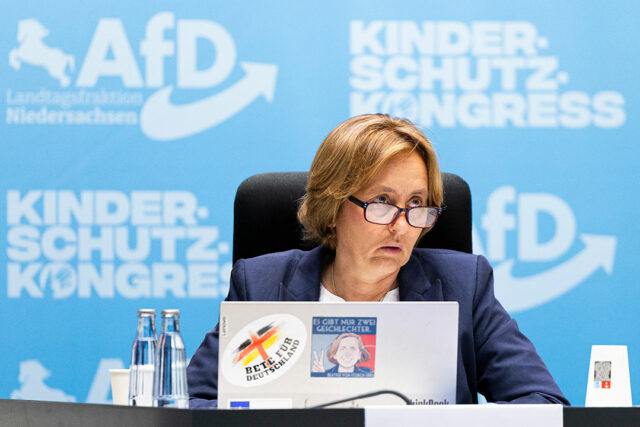
BEATRIX VON STORCH, deputy chairwoman of the AfD in the Bundestag, during a child protection conference of the AfD parliamentary group in the Lower Saxony state parliament. — REUTERS/DPA/PICTURE ALLIANCE
By Andreas Kluth
THE world’s attention this week has been fixated on Donald Trump’s official visit to Britain, with castles and carriages and all the pageantry that delights a leader who views his own presidency as the apotheosis of reality TV. Less noticed, but just as telling, has been a simultaneous visit to Washington by Beatrix von Storch.
Beatrix who? You’re forgiven for asking. Von Storch is a far-right German parliamentarian and second-row leader of the Alternative for Germany (AfD). I met her in Berlin in 2013, when she and the then-newly founded AfD seemed zany but harmless — destined, as other far-right parties in postwar Germany had been, for petty infighting and eventual irrelevance.
That assessment turned out to be dead wrong, though not immediately. For two more years, the AfD followed the old pattern, and by the summer of 2015 was down in the polls and close to collapse, with the original founders — conservative economics professors whose single issue was abolishing the euro — distancing themselves from the far-right nationalists whose following increasingly included neo-Nazis.
Then the refugee crisis began. Suddenly the AfD, like populist parties across Europe, found its raison d’etre: a rejection of alien-looking migrants at first, then of everything and anything that seemed elitist or, in the current parlance (even in German), “woke.”
Austria, right next door, had pioneered this right-wing shift decades earlier. France, Scandinavia, and others were well along the way. Hungary, one country over, had already gone all the way, with Viktor Orban ensconced as an authoritarian strongman. So had Turkey and India, where Recep Tayyip Erdogan and Narendra Modi were already in power.
In 2016 the dam broke, first with Brexit, then with Trump’s first electoral victory. A year later, the AfD entered Germany’s federal parliament for the first time, and Von Storch left the European parliament to sit in the Bundestag. In the following years, right-wing populists chalked up successes far and wide, from Jair Bolsonaro in Brazil to Georgia Meloni in Italy and Robert Fico in Slovakia.
They felt and cultivated an affinity. Trump and other aspiring strongmen studied Orban in particular for pointers about co-opting the judiciary, academia, press, business, and “deep state.” Personal contacts deepened. While in office, Bolsonaro enthusiastically hosted Von Storch, for example. (The Trump administration is now berating Brazil for convicting Bolsonaro of attempting — in 2023, after losing an election — a coup that looked remarkably like something that Trump supporters had tried two years earlier.)
The first Trump administration already committed grave diplomatic faux pas, such as sending a firebrand ambassador, Richard Grenell, to Germany to proselytize for far-right parties across Europe. The second Trump administration then burst all remaining taboos.
In February, Vice-President JD Vance harangued a gobsmacked European audience at the Munich Security Conference, telling them that the enemy is not Russia but “the threat from within.” Across Europe, Vance claimed as eyebrows went up, “free speech, I fear, is in retreat.”
In particular, Vance railed against the exclusion of the AfD from government (because the centrist parties refuse to form coalitions with it) and against censorship of the party and its supporters (for which there is no evidence). He then met with Alice Weidel, an AfD leader whom Elon Musk, Trump’s sidekick at the time, had already given a global stage with a long flirt on his X platform.
Such meddling by the superpower and former leader of “the West” in the democratic processes of its allies is beyond uncouth. It also has historical parallels on the Marxist-Leninist left.1 Last century’s evanescent Comintern (Communist International) springs to mind, based on the (now bizarre-sounding) idea that the workers of the world were ready to form a transnational alliance against capitalist elites. The stated premise of this new incarnation — I’ll call it the Popintern (Populist International) — is that nationalist White Christians across the West are ready to rise up against sexually and otherwise dysmorphic cosmopolitan elites.
If Trump, Vance and the rest of MAGA paused for a moment of reflection, they’d realize that any Popintern, like the Comintern, can’t and won’t work, and could lead to disaster. You can’t build lasting affinities when everyone involved wants to Make My Nation Great Again and put My Nation First. Just look at the falling-out between Trump and Modi.
Nor can you keep glossing over the many other hypocrisies and internal contradictions. From Orban to Trump and the AfD, the far right tends to indulge, if not idolize, Russian President Vladimir Putin, and correspondingly disdains Ukrainian President Volodymyr Zelenskiy.2 One of Trump’s leitmotifs is that their war is none of America’s business because the Europeans should step up and pacify it. But Trump’s own Popintern pals are precisely the ones opposing (in the case of the AfD) or blocking (Orban) a tougher and more united European stance against Putin.
So it amounts to a confession of failure and a bitter irony when Trump lectures NATO that he’s finally “ready to do major Sanctions on Russia,” but only when all other NATO countries “STOP BUYING OIL FROM RUSSIA.” Most of the nations that want to contain Putin, such as Germany, have already weaned themselves from most Russian hydrocarbons. The ones that haven’t notably include, you guessed it, those led by Orban, Erdogan, and Fico. Don’t you think Trump would have a discreet word with them if he meant it?
I don’t expect Trump, Vance, or anybody else in their circles to dwell on such contradictions. Not while they’re busy with their domestic culture wars and cracking down on lefties.
And so the Popintern keeps mobilizing. That’s what brought Von Storch and another AfD politician to Washington this week. They didn’t see Trump or Vance personally, but met with officials on the vice-president’s staff, at the national security council and in the state department.
The likes of Putin should be delighted about such socializing in the West. By contrast, America’s traditional allies, to the extent that they’re struggling both to remain liberal democracies and to deter autocratic aggression, have yet another reason to worry.
BLOOMBERG OPINION
1Then again, the so-called horseshoe theory in political science says that the extreme left and right are more similar than they’d care to admit.
2Italy’s Georgia Meloni is a welcome exception to this rule, although her deputy prime minister from another populist party on the far right, Matteo Salvini, fits it.
FWD Life Philippines is looking to launch its high net-worth insurance business in the country, as it seeks to replicate its success in other Asian markets.
“We studied the feasibility of what we call the high-level corridor because different countries have different regulations on how you can actually do business,” FWD Life Philippines President and Chief Executive Officer Lau Soon Liang told reporters on Sept. 17. “The Philippines may be a possibility.”
FWD’s high net-worth operations run out of Hong Kong, Singapore and Bermuda, offering both onshore and offshore solutions tailored for wealthy and ultra-wealthy clients.
These products typically cover wealth transfer, estate planning and legacy preservation — areas where insurers compete aggressively for high-margin business.
While FWD Life Philippines is still in the process of mapping out the regulatory environment, Mr. Liang said the insurer is preparing to adapt its products to local market conditions.
“Innovation doesn’t really come in terms of the product, but the overall solution,” he said. “We have quite a bit of digital innovation happening, and how to actually bring it to the customer is one way.”
He acknowledged that innovation could be constrained by the Philippines’ relatively low financial literacy and slow insurance penetration, which remains among the lowest in Asia.
To bridge that gap, FWD plans to introduce Project Clarity, an initiative that simplifies insurance contracts by eliminating legal jargon, fine print, and complicated exclusions.
“We want to make insurance easy to understand,” Mr. Liang said. “Project Clarity was already implemented many years ago in other countries, and we want to lead in bringing it to the Philippines.”
The initiative will need clearance from the Insurance Commission before rollout. “It’s not a simple task,” he said, adding that the wording has to be enforceable and regulators must ensure it won’t be misinterpreted.
“There is a lot of complex mechanics behind the simplification of the terms,” he added.
FWD is also considering a redesign of policy exclusions, building on its experience in Vietnam where the company reduced more than 30 exclusions to just six within six months.
“It was already a big win for us,” he said, adding that regulators were really supportive. “We have to make sure we are protected,” he added, apart from the need to reinsure early and manage excess risk.
FWD Life Philippines, which entered the market in 2014, has grown into one of the country’s leading insurers. It reported P39.85 billion in premium income last year, with net income reaching P848.51 million, according to Insurance Commission data. — Aaron Michael C. Sy
FOR Filipino singer-songwriter Gab Cabangon, music must have a certain level of vulnerability. So it is not a surprise that his debut single, “Pieces,” written as an anniversary gift during the pandemic for his then-girlfriend (now wife), bares a piece of his soul.
“My visual metaphor for it is picking up a broken glass and repairing it. In the song, I say that it’s okay to break down or fall apart, because I’ll help you pick up the pieces,” Mr. Cabangon told BusinessWorld on Sept. 16 in Mandaluyong City.
Produced in collaboration with music director David Lina and mixed and mastered by Shadiel “Shad” Chan and Jan Fuertez, the guitar-pop track aims to be “a warm embrace during difficult times.”
“At the height of the pandemic, when music was mostly livestreaming gigs, I started doing ‘Pieces’ and found that people were relating to it, and it became more than just an anniversary gift,” the singer said.
“Later on, I made the conscious decision that, if I were to record new music, it would be my debut single. It encapsulates my style of music and songwriting.”
A RICH BACKGROUND “Pieces” marks Mr. Cabangon’s first official single as a solo artist. Over the years, he has been working behind-the-scenes as executive director of Organisasyon ng Pilipinong Mang-aawit (OPM), and before that as frontman for his band KE.
This background — plus having Filipino music icon Noel Cabangon as his father — has given him “a better understanding of the intricacies of songwriting as well as the business side of music.”
“Ten years ago, had I released this song, I wouldn’t have known any better,” he said. “I’ve also learned that collaboration matters. You have to be open to other ideas, to have direction, to be better as an artist and as a person.”
He added that the best advice his father gave him with regards to music would be technical stuff like vocal clarity. “It’s more of how to enunciate, how to not eat your words when singing,” he said.
Mr. Cabangon described his musical persona as “nonchalant millennial sadboi artist,” a product of different influences, from John Mayer and Jason Mraz to Ebe Dancel and Ely Buendia.
For him, “Pieces” is only the beginning, with more music lined up as he launches his career as a solo artist.
“It’s a song that’s relatable because of how uncertain the world is. We’re dealing with a lot of uncertainty, and people can be depressed and frustrated by it. ‘Pieces’ acknowledges that those feelings are okay and that you have to go through it so that you can eventually heal and find the light at the end of the tunnel,” Mr. Cabangon said.
“Most importantly, you won’t be alone, because people will be there to help you pick up the pieces.”
“Pieces” is now on digital music streaming platforms. — Brontë H. Lacsamana
LISTED food and beverage company RFM Corp. on Thursday declared a P0.08903 per share cash dividend, payable on Oct. 22 to shareholders on record as of Oct. 1.
The P300-million payout is the company’s fourth dividend for 2025, bringing total cash dividends for the year to P1 billion, compared with P1.3 billion in 2024.
At the share price of P4.27 on Sept. 16, RFM’s 2025 dividend yield is roughly 7%, the company said.
RFM Chief Executive Officer Jose Ma. “Joey” A. Concepcion III said the balance sheet is “very strong to support this level of cash dividends,” while leaving surplus cash for potential projects or acquisitions.
The company said it is on track for stronger earnings in 2025 versus its 2024 net income of P1.4 billion.
Mr. Concepcion noted that softer commodity prices and volume growth in RFM’s brands and institutional segments, including the ice cream joint venture, are key drivers of 2025 income.
“The recent flooding and heavy rainfall disrupted logistics, but underlying demand remained resilient. We expect this consumer demand to continue into the fourth quarter, supported by easing inflation,” he added.
RFM’s portfolio includes Selecta milk, Fiesta and Royal pasta, flour and buns, and ice cream through a joint venture with the country’s leading ice cream company, selling Magnum, Cornetto, and Selecta brands.
At the local bourse on Thursday, shares in the company rose 2.58%, closing at P4.38 apiece. — Sheldeen Joy Talavera











 “We are grateful to our clients, partners, and colleagues whose trust, referrals, and continuous support have made this possible. This award reminds us that what we have built today lays the foundation for the future, and we look forward to many more years of adding value to the Philippines’ real-estate industry,” Luxe Realty and Development Corp. President Trisha Liu said in her acceptance speech.