Home Blog Page 9762

LGUs need to take the lead on ASF, DA says

LOCAL Government Units (LGUs) need to take the lead as “first responders” in containing African Swine Fever (ASF) after the spread of the disease nationwide, Agriculture Secretary William D. Dar said.

In testimony before the House, Mr. Dar said the Department of Agriculture’s (DA) mandate requires it to regulate imports and monitor ports of entry, but LGUs need to be prepared for local outbreaks in the various provinces and towns.

“(The DA is) only first responder in international ports, seaports and airports. However, if it occurs in their respective provinces, the local government units should be the first responders,” Mr. Dar told a House joint hearing of the Agriculture and Food and Local Government committees.

At the hearing, Mr. Dar said as of March 2, ASF has been detected in 625 barangays across eight regions, with 237,406 animals culled as a preventive measure against the outbreak.

Mr. Dar said some hog traders have been persistent in selling infected animals, complicating containment efforts.

Madali sana patayin ang virus sa isang area. Pero kung tinitinda mo pa rin sa isang lugar ang baboy (It should have been easy to contain the virus in one area. However, if hog traders still sell these infected hogs, how can we stop that)?” Mr. Dar said.

Mr. Dar added that some measures to address the ASF outbreak have failed. He added that some agencies have underperformed.

Undersecretary Ariel T. Cayanan added that the more serious concerns that need to be addressed relate to the trading and movement of pigs.

Meanwhile, the committees were told that ASF was not included in the routine conditions tested for by the Food and Drug Administration (FDA).

Director Pilar Marilyn P. Pagayunan of the Center for Food Regulation and Research of the FDA, confirmed that ASF food inspections are deputized to the National Meat Inspection Service (NMIS) and the Bureau of Animal Industry (BAI).

The committees were also told that the FDA is only responsible for checking processed pork products while NMIS only inspects raw pork material.

AGAP Party-list representative Rico B. Geron called for stronger action from the national inter-agency task force dealing with the ASF outbreak. — Revin Mikhael D. Ochave

Agricultural trade falls in fourth quarter on import decline; exports rise

INTERNATIONAL trade in agricultural goods fell 4.8% year-on-year to $5.06 billion in the fourth quarter of 2019, with exports growing and imports declining, the Philippine Statistics Authority said (PSA) said Monday.

Exports rose 6.6% year-on-year to $1.63 billion while imports fell 9.4% year-on-year to $3.43 billion.

In the fourth quarter, the top three agricultural exports were edible fruits and nuts and peel of citrus fruits or melons, which accounted for 39.4% of total agricultural exports or $643.85 million. These were followed by animal or vegetable fats and oils and their cleavage products; prepared edible fats; animal or vegetable waxes at 13.5% of the total or $220.23 million; and preparations of vegetables, fruits, nuts or other plants at 9.9% of the total or $162.17 million.

The top three agricultural imports were cereals at 15.5% of the total or $531.91 million; miscellaneous edible preparations at 11.9% or $407.39 million; and prepared animal fodder at 11.8% of the total or $404.30 million.

In a text message, Rizal Commercial Banking Corp. (RCBC) Chief Economist Michael L. Ricafort said the increase in agricultural exports was due to improved diplomatic and business links with foreign markets.

“Agricultural exports in 4Q 2020 grew by 6.6% (on) improved diplomatic/business relations with major… export markets such as Japan, China, South Korea, and other Asian countries that are the biggest buyers of the country’s agricultural exports in recent years, as well as the further diversification of the country’s export markets to more countries around the world,” Mr. Ricafort said.

However, Mr. Ricafort said the decline in agricultural imports was due to the adverse effects of the global economic and trade slowdown caused by the lingering effects of the US-China trade war, which reduced demand and prices of oil and other major global commodities being imported by the Philippines.

“These events caused the year-on-year decline in the dollar value of agricultural imports,” Mr. Ricafort added.

In an e-mail interview, UnionBank of the Philippines chief economist Ruben Carlo O. Asuncion expects the decline in agricultural trade to continue due to, among others, the coronavirus outbreak (Covid-19).

“It is expected to be further challenged as 2020 started with various potential shocks such as the impact of Covid-19 on the demand for Philippine agriculture exports and local demand for imports moving forward,” Mr. Asuncion said.

Mr. Ricafort added that the global coronavirus outbreak will hit agricultural trade and dampen overall economic growth.

“Potential headwinds for Philippine agricultural exports and imports, especially the expected economic slowdown in China, which is the world’s second-biggest economy and among the biggest export markets for the Philippine agricultural exports such as tropical fruits (like) bananas and pineapples and other agricultural products,” Mr. Ricafort said. — Revin Mikhael D. Ochave

Fitch sees telco capex needs delaying deleveraging

FITCH RATINGS said the increased capital expenditure (capex) by PLDT, Inc. and Globe Telecom, Inc. in 2020 will delay their deleveraging despite higher revenue from data and the more stable competition observed in the last quarter of 2019.

In a statement e-mailed to reporters Monday, Fitch Ratings said that it has a negative outlook on the Philippines’ telecommunications sector for this year, reflecting its expectations “that average FFO (funds from operations) adjusted net leverage will rise towards 3.0x in 2020.”

Fitch noted that the capex push by both Globe and PLDT “will delay” their deleveraging despite their strong performance in the last quarter of 2019, driven by “accelerating data monetization and more stable competition.”

It said it expects the Philippine telco firms to “grow by the mid-to-high single digits” this year.

Globe is keeping its capital spending target at P63 billion this year, which includes spillover of commitments from 2019. The amount is 23.5% higher than its spending last year, as it continues to expand and enhance its network.

PLDT, for its part, is allocating P83 billion, up 36.1% from a year earlier. The company aims to serve better the “fast-growing” data usage of its customers.

“The resultant increase will take telecoms capex to above 40% of total revenue, amongst the highest within Fitch’s Asia-Pacific telecoms portfolio. Both PLDT and Globe had revised their debt/EBITDA (earnings before interest, taxes, depreciation and amortization) covenant ratio in their bond trust indentures over the past 12 months, increasing their financial flexibility to raise more debt to fund future capex,” Fitch noted.

It added: “Fitch believes deleveraging would depend on the flexibility to manage their balance-sheet strength. PLDT and Globe had previously cut dividends to payout policies of respective 60% and 60%-75% of the previous year’s core income.”

Fitch said in November that telcos were expected to spend more than they can generate internally over the next 18 months as they turn more to debt to fund capex.

It said it expects “intensified” competition with the entry of China-backed DITO Telecommunity Corp., which hopes to capture nearly a third of the market in two to three years.

“However, the newcomer’s pledge to provide coverage for 37% of the population by July 2020 (with 27Mbps minimum broadband speed) and up to 84% by 2024, suggests limited coverage in the short-term,” it noted. — Arjay L. Balinbin

House bill filed penalizing bulk cash smuggling

A MEASURE penalizing bulk cash smuggling and adding to the Anti-Money Laundering Council’s (AMLC) powers against money-laundering was filed in the House of Representatives Monday.

House Bill 6516, which if passed will become the Anti-Bulk Cash Smuggling Act, was filed by Albay Representative Jose Maria Clemente S. Salceda, Nueva Ecija Rep. Estrellita B. Suansing, AAMBIS-OWA Partylist Rep. Sharon S. Garin, Sultan Kudarat Rep. Horacio P. Suansing, Muntinlupa Rep. Rozzano Rufino B. Biazon and Marikina Rep. Stella Luz A. Quimbo.

The bill seeks to expand the coverage of the Anti Money Laundering Act (AMLA) to include one-time cash transport of more than P500,000 or its equivalent in foreign currency at any one time.

To ensure that the evasion of a paper trail for cash transfers “is not tolerated under the law”, the bill seeks to criminalize bulk cash smuggling.

The bill also appoints the National Treasurer to the AMLC to facilitate inter-agency cooperation.

Escorting cash smugglers will also be deemed conspirators in the crime of smuggling cash.

The measure also expands the AMLC’s powers of surveillance over airports and ports and permits civil forfeiture in favor of the Philippines of assets seized in cases of cash smuggling.

Quirino Rep. Junie E. Cua, who chairs the House committee on banks and financial intermediaries, said that the foreign currency declaration form does not ensure that the “one carrying the money is really the owner of the money.”

“It looks like this form… just triggers further investigation. It does not in any way compel a process of verification whether the declarations, as to source, as to purpose are truthful or not. There is no such mechanism at the moment that is put in place so that government will be able to find out where these money is really coming from,” he said in a House hearing Monday.

One of the provisions of the bill is to make declarations of cash transports “under oath”, which “effectively making misdeclarations perjurious.” — Genshen L. Espedido

Empowering taxpayers during tax assessments

March is International Women’s Month; we are celebrating the contributions of women to society, upholding women’s rights, and advocating women empowerment.

Speaking of empowerment, the Bureau of Internal Revenue (BIR) recently issued Revenue Memorandum Circular (RMC) No. 15-2020, directing all revenue officials and employees to provide a printed copy of the procedures in a tax assessment. RMC No. 15-2020 intends to inform taxpayers on the proper procedures in responding to a deficiency tax assessment arising from the conduct of an audit or investigation. Printed guidelines detailing the procedures shall be furnished to the taxpayer; and the revenue officer is required to fully explain the contents to the taxpayer. The RMC was issued in line with a BIR campaign to empower taxpayers with a clear understanding of their rights to due process on administrative protests at the beginning of the audit or assessment.

The BIR’s efforts in highlighting taxpayers’ rights to due process were lauded when the Bureau issued Revenue Regulations (RR) No. 7-2018, restoring the provision on Notice of Informal Conference (NIC). The provision was restored to give the taxpayer an opportunity to present his or her side of the case. The NIC stage provided in RR No. 12-99 was previously revoked by RR No. 18-2013.

During the effectivity of RR No. 18-2013, no other discussion could take place after the Letter of Authority (LoA) is served to the taxpayer and the documents are provided to the BIR. After the documents are evaluated and the BIR determines that there is sufficient basis to assess the taxpayer for deficiency tax, a Preliminary Assessment Notice (PAN) is issued. The taxpayer was given only 15 days to respond, after which a Final Assessment Notice (FAN) was promptly issued and the taxpayers would either need to pay the assessment or file an administrative protest. After five years of effectivity, the BIR recognized that RR No. 18-2013 was demanding and that doing away with the NIC stage made the assessment process more challenging instead of more efficient.

As a tax practitioner handling mostly assessment cases, I have come to appreciate the restoration of the NIC in RR No. 7-2018. Discussing the itemized audit finding in an assessment is not easy with the constant, back-and-forth discussions with the BIR on the factual and legal basis of the taxpayer’s contentions. The issuance of RMC No. 15-2020 bolstered the purpose of RR No. 7-2018: to give the taxpayer the opportunity to present their case and exercise their right to due process. RMC 15-2020 prescribes how taxpayers are to be informed of the procedures in responding to the issuance of deficiency tax assessments arising from the conduct of an audit or investigation. Printed guidelines, as provided in Annex A of the RMC, must be furnished to the taxpayer during the Discussion of Discrepancy stage of the assessment. More importantly, Annex A also clearly identifies the type of assessment documents that must be issued by the BIR and the proper BIR official who must issue such assessment document.

Any findings of discrepancies or disallowances that may lead to deficiency assessments that were discovered during the audit or investigation by the BIR are to be sent in a “Notice of Discrepancy.” The contents of the Notice must be explained by the BIR to the taxpayers or their authorized representative during the Discussion of Discrepancy. If the taxpayer agrees with the audit findings as presented and explained, the taxpayer may sign the “Agreement Form” and pay the deficiency taxes, including penalties and interest.

Currently, the BIR issues the NIC and, if the taxpayer does not contest the findings, the amount contained in the NIC will be settled by the taxpayer. I have encountered several cases wherein the Notice of Informal Conference was sent accompanied by some sort of agreement form, where options were presented to the taxpayer: if the taxpayer fully subscribes to the findings, if the taxpayer does not subscribe, or if the taxpayer wants to avail of other administrative and legal remedies.

Aside from the NIC, discussions between the taxpayer and the BIR are encouraged in order to duly inform the taxpayer of their assessment. Based on my experience, there are many issues that can be resolved at this stage, considering the BIR and the taxpayer can freely discuss issues that can be easily resolved. In cases where an Improperly Accumulated Earning Tax (IAET) is being assessed, for example, the taxpayer can present proof that its ultimate parent is a publicly held company or that a loan agreement exists, which restricts the company from declaring dividends unless the loan is paid. There are also other items in the assessment that can be easily cancelled if the proper explanation and evidence is presented, such as professional expenses that were not subject to withholding tax, because they were paid to General Professional Partnerships or certain compensation expenses that were not subject to withholding tax on compensation, because they were paid to minimum wage earners.

If these issues are properly explained and resolved during the discussion stage, there is no need to include these items in the deficiency assessment. The BIR and the taxpayer can concentrate on the more contentious items. More often than not, the taxpayer gets intimidated by the size of the deficiency assessment presented in the BIR’s initial findings; thus, making the task seem insurmountable and hopeless.

The new circular (RMC 15-2020) will be appreciated if the contents of Annex A are fully discussed with the taxpayer and both parties can properly follow the procedures. It is when the BIR deviates from the established procedures that the taxpayer gets lost and is unable to decide on a course of action. One can hope that the RMC will achieve its true purpose of reinforcing the right to due process of taxpayers. Sometimes, the taxpayer is powerless to contend with the discretionary powers of the BIR during the assessment and is left with no recourse in the event such discretion is exercised. To be empowered with the information given and explained during the initial stage is indeed a welcome step forward. I hope that with the issuance of the RMC the procedures outlined are followed, giving both parties clarity and guidance on the entire assessment process.

Let’s Talk Tax is a weekly newspaper column of P&A Grant Thornton that aims to keep the public informed of various developments in taxation. This article is not intended to be a substitute for competent professional advice.


Gemmalu O. Molleno-Placido is a senior associate of Tax Advisory & Compliance division of P&A Grant Thornton, the Philippine member firm of Grant Thornton International Ltd.

pagrantthornton@ph.gt.com

Dignity of labor versus the capitalist ethos: equality or hierarchy?

In recent weeks, the internet has been bursting with viral stories on disgruntled labor: a Virra Mall security guard taking hostages and demanding that “his voice be heard,” a young girl enslaved as a POGO worker, Honda workers demanding a “dignified ending” and fair severance pay, and, workers of ABS-CBN protesting the non-renewal of the TV network’s franchise. In this piece, I argue that these recent events reveal that there is a clear conflict between the value for equality (i.e which informs the belief that there is dignity in labor) and hierarchy (or management prerogative as the foundation of the capitalist ethos).

THEORY OF ALIENATION
If Karl Marx were alive today, he would have described these recent displays of worker protest as indicative of “estranged labor.” In his theory of the alienation of labor, Marx claims that in capitalism, the laborer is “alienated” from the products that he or she produces, from his or her labor activity, from his or her essence as a human being, and, from other human beings. In other words, labor is objectified and the laborer is compelled to separate their labor from their “person.”

To quote Marx (1884): “It is true that labor produces for the rich wonderful things — but for the worker it produces privation. It produces palaces — but for the worker, hovels. It produces beauty — but for the worker, deformity. It replaces labor by machines, but it throws one section of the workers back into barbarous types of labor and it turns the other section into a machine. It produces intelligence — but for the worker, stupidity, cretinism.”

This kind of framing can help us understand how a security guard, sworn “to protect” by virtue of his job, ended up being “destructive.” Or, at the very least, it should lead us to ask: Why do workers have to go through such (violent) lengths just to validate one’s self and insist on one’s dignity as a worker?

HIERARCHY OF OCCUPATIONS
Ano’ng trabaho mo? Security guard lang. Kasambahay lang. Construction worker lang. Waiter lang. Titser lang. (What is your job? Just a secutiry guard. Just a house helper. Just a construction worker. Just a waiter. Just a teacher.) These declarations are commonplace and they all signify that some types of work — and thereby, some types of workers — are more important than others.

Even government data is heirarchical. In the latest (2012) Philippine standard occupational classification (PSOC) of the Philippine Statistics Authority, occupations are listed and ranked as follows: 1.) managers, 2.) professionals, 3.) technicians and associate professionals, 4.) clerical support workers, 5.) service and sales workers 6.) skilled agricultural, forestry and fishery workers, 7.) craft and related trades workers, 8.) plant and machine operators and assemblers, 9.) elementary occupations, and 10.) armed forces occupations, nongainful activities and special occupations.

Employment in the country is highest in “elementary occupations” (around 26% of all workers) and “service and sales workers” (around 15%). Elementary occupations are at the bottom of the classification list because they “involve the performance of simple and routine task which may require the use of hand-held tools and considerable physical effort.”

Service and sale workers are deemed higher in the classification as they “provide personal and protective services related to travel, housekeeping, catering, personal care…” but in terms of societal status, they are perceived to be of low status equal to those in elementary occupations (e.g. that security guard in Virra Mall).

Needless to say, those on top of the classification list receive higher wages than those at the bottom of the list. According to the Occupational Wages Survey of 2016, the top 10 highly paid occupations are: 1.) aircraft pilots, navigators and flight engineers, 2.) securities and finance dealers and brokers, 3.) civil engineers, 4.) actuaries, 5.) computer programmers 6.) system analysts and designers, 7.) computer engineers, 8.) accountants and auditors, 9.) production supervisors and general foremen, and, 10.) statisticians. The average monthly wage rate of the top occupation (pilots) is P116,714 while the rate of the top 10th (statisticians) is P41,480.

Those in elementary occupations receive a lot less. As of 2016, the average monthly wage rate of “unskilled workers” is P10,162.

Even the deployment of Filipino workers abroad is classified based on occupational groups. The trend is the same. As of 2018, of the 2,299,000 OFWs deployed, 37.1% were deployed to elementary occupations while 18% were deployed to service and sales.

GENDERED HIERARCHY OF OCCUPATIONS
The abovementioned classification of workers by occupational groups is based on international standards, specifically the United Nations’ international standard classification of occupations (ISOC). These standards are based on an assessment of the following: nature of work performed, formal and informal education and training requirements. In a nut shell, these standards are based on the level and extent of human capital development needed for particular economic activities.

In the global labor market, it is not only human capital that matters, but also gender. In the “race to the bottom,” human capital is not even the determinant anymore, rather, the worker must be low-skill and low-education (thus, often originating from developing countries), of a particular race (e.g Asian/Filipino), and of a particular gender (female). It is therefore not surprising that of the 1,284,000 Filipino women deployed overseas in 2018, 58.7% were in elementary occupations and 18.6% were service and sale workers. The men, meanwhile, were mostly plant and machine operators and assemblers (27.8% of 1,016,000 men deployed overseas).

Here at home, labor force participation is roughly 50% for women and 77% for men (2015 figures). Working women are found mostly in the services sector (71%).

Less than 40% of women in the labor force are said to be in paid employment while the rest are in unpaid jobs. As for the gender wage gap, there are studies that show that Filipino male workers earn, on average, P5,000 more than Filipino female workers.

Inequality in workplaces, thus, is not only based on class but also on gender.

OPTIONS FOR LABOR: EXIT VERSUS VOICE
A worker who is dissatisfied with his or her job has two options: exit or voice. The worker can opt to leave his/her job or raise their voice and demand for better working conditions. This option is said to be similar to eating in a restaurant: a dissatisfied customer can leave and eat in another restaurant or he or she could stay and negotiate with the chef so that the meal is adjusted to meet his/her satisfaction.

In the 1980s, American economists Richard Freeman and James Medoff theorized about the “two faces of unionism” (monopoly face and voice face) based on the exit versus voice choices of workers. According to these economists, the first choice was the “classic market mechanism of exit and entry, individual mobility” while the second choice was the more “political mechanism” as it entailed raising “voice” (i.e political participation and bargaining). The latter mechanism suggests that unionism is important for workers to negotiate with their employers either to determine wages (monopoly face or economic unionism) or to negotiate for the well-being of workers (voice face or political unionism). In both types of unionism, collective action, rather than individual action, is necessary. Recent episodes such as the hostage taking in Virra Mall should remind us that “voice” can come in many forms and that raising voice on an individual basis, no matter how radical or violent, is not likely to be very productive or effective. It is only collective action that will push employers — and governments — to narrow the inequality gap between capital and labor.

Perhaps, if the security guard in Virra Mall was a member of a strong labor union, he would not have needed to go to the extreme of hostage taking just to keep his dignity as a worker and to demand better working conditions. The collective voice, however, is necessarily composed of individual voices. In this sense, the voice of that security guard is hugely important. An individual voice may be needed to spark public interest but it is collective action that will uphold the dignity of labor — in all workplaces, and for all workers.


Carmel V. Abao is a faculty member of the Political Science Dept of the Ateneo de Manila University. She teaches political theory and international political economy.


State of the national health emergency

Last Saturday, March 8, President Rodrigo Duterte declared a nationwide state of public health emergency pursuant to a Department of Health (DoH) letter of recommendation from Health Secretary Francisco Duque dated Feb. 21 should local transmissions occur. The day before, we learned that the number of confirmed cases of COVID-19 in the country had risen to six, two of which were deemed locally transmitted. Yesterday, four more cases were confirmed. We’re now on alert level Code Red sub-level one. It means we’re one step away from the “possible sustained community transmission” of the virus, or Code Red.

The new alert level is a preemptive call to ensure that national and local governments, as well as public and private health care providers, can prepare for possible increase in suspected and confirmed cases. It alerts the public to stay calm, be situationally aware, and to fully cooperate with concerned government agencies to ensure the nation’s safety and general welfare. For her part, Vice-President Leni Robredo called for national unity and for the right information to be disseminated to the public to stop its spread.

What does Code Red require of everyone? This is what I came across:

“Under the Code Red Alert, the inter-agency should include more government agencies to expand its response to the spread of the viral infection. Selective contact tracing will be done. Vulnerable and high-risk groups will be the priority for testing and care. Authorities should intensify its awareness to minimize the fear, anxiety, and unrest of the public. The government should pursue a “sustained inter-agency, multi-level, whole-of-society coordination and response in its combat against the virus.”

To begin with, this is not the way to communicate with government stakeholders and the general public. They want to hear SPECIFIC instructions. Spell out up front what everyone needs to know. Selective contract tracing means we lack the capacity to cast a wider net; which means many will escape through the cracks; which means that many more out there are likely infected with the virus that we don’t know about. Who are the vulnerable and high-risk groups? How will they be tested? Random just doesn’t cut it. Do we have isolation centers for those under investigation and quarantine centers for confirmed cases? Where are they located, contact details, contact persons?

The government needs to improve the accuracy and quality of information it disseminates (transparency, timeliness, thoroughness). Mass and social media have much to contribute in this area. Make it reader-friendly, clear, crisp, concise. Forget the bureaucratic jargon that puts people in a bad mood. At the moment, the people sense that the information being dished out is inaccurate, late, incomplete; transparency is suspect on account of the attitude that “panic must be averted.” That mindset doesn’t prepare the public mentally for the worst case. It only tends to anger them. The more information we have, the better for mental preparedness and orchestration of specific “whole-of-nation” (government and society) prescribed responses.

The suspicion is instinctive that the figures being fed to us are underreported, considering that the risk posed by COVID-19 is due to our proximity to China. We’re at a far greater risk of witnessing increased cases of the novel coronavirus infection compared to other countries. The country hosts hundreds of thousands of students, tourists, workers (legal and illegal) from China. They’re engaged in Philippine Offshore Gambling Operations (POGOs), mining, micro-small enterprises, construction, supply chains and prostitution; most of them unlicensed or fronted by dummies. Additionally, we have over 230,000 Overseas Filipino Workers (OFWs) working in China and its autonomous territories, excluding South Korea, Japan, and Singapore.

The World Health Organization (WHO), the DoH, and local authorities keep reminding us to take care of our health and to protect others by doing the following:

1. Regularly and thoroughly clean your hands with an alcohol-based hand rub or wash them with soap and water.

2. Maintain social distancing at least one meter (three feet) distance between yourself and anyone who’s coughing or sneezing. They spray small liquid droplets and if you’re too close, you can breathe in the virus.

3. Avoid touching your eyes, nose, and mouth because hands touch many surfaces and can pick up viruses. The virus can enter your body and can make you sick.

4. Practice respiratory hygiene, and make sure that the people around you do too. Cover your mouth and nose with a bent elbow or tissue when you cough or sneeze. Dispose of the used tissue immediately.

5. Stay home if you feel unwell. If you have a fever, cough, and difficulty breathing, seek medical attention and call in so you could be directed to the right health facility.

Governments have responded in different ways. Common among them is travel restrictions — to and from cities, regions or countries — where the virus has reared its ugly head. China locked down specific areas; Italy followed suit. Japan canceled classes till April; Iran is dispensing with Friday prayers (equivalent to our Sunday Masses). Money is being washed and disinfected. Football matches are being played without the fans; classes are being held online. Foreign travel, public events, concerts, and conferences are being canceled. The Tokyo Olympics may fall victim too. In my case, I’ve indefinitely postponed a trip that I was planning for in June.

All that turbulence has devastated stock markets worldwide; trillions in market value have vaporized in the past two weeks. Bankruptcies and unemployment are rising. Malls are tail spinning; travel and tourism are in free fall. Manufacturing and global supply chains are experiencing steady disruption. Compounding matters are billions of locusts that are ravaging parts of Africa and South Asia. The steady plunge in supply and demand has everyone talking about global recession.

From a global pandemic to a global recession, all in one year. Did you ever think in your wildest dreams that 2020 would turn out this way? What else — global food shortages? WW3? That won’t surprise me any longer.


Rafael M. Alunan III is a former Secretary of Interior and Local Government and chairs the Philippine Council for Foreign Relations.

rmalunan@gmail.com

CITIRA vs. EODB

The Philippines made remarkable progress in the ranking of the World Bank’s Doing Business (DB) 2020 Report, from ranking 124th rising by 29 notches and landing at 95.

According to the DB 2020 Report, the Philippines has made significant improvements in three areas: starting a business, dealing with construction permits, and protecting minority investors.

Package 1a or the TRAIN (Tax Reform for Acceleration and INclusion) Law was supposed to improve as well our scores in paying taxes with the reduction of the number of income tax return pages from 12 to only four. But such an improvement was offset by the 100% increase in the DST (Documentary Stamp Tax) which means higher costs in doing business.

Unfortunately, the reduction in personal income tax didn’t make an impact as the DB Report monitors ease of doing business for corporations, particularly SMEs. Also, while TRAIN gave some tax relief to middle income earners, it penalized individuals with compensation or taxable income above P8 million by imposing the highest personal income tax rate of 35%.

The Comprehensive Tax Reform Program of the Duterte administration made its goal very clear — to have a simpler, fairer, and more efficient tax system. Although being competitive was not explicitly mentioned, with the amount of time and effort spent in improving ease of doing business and the passage of Ease of Doing Business (EODB) Law or RA 11032 in 2018, the government is committed to really making sure it’s easy and competitive to do business in the Philippines.

But it seems that our Senators and Congressmen overlooked EODB or our competitiveness ranking in drafting Package 2 or CITIRA (the Corporate Income Tax and Incentives Reform Act) as it proposes a reduction of corporate income tax (CIT) from 30% to 20% by 1% every year until 2029. This means improving our ranking in paying taxes will take 10 years — that is if other countries will not decide to further reduce their CIT, as Singapore’s is currently at 17% and the average tax rate in the Asean region is around 24%.

Since most business organizations and sectors have expressed their support for CITIRA, the following proposals will be in addition to existing provisions of HB 4157 and SB 1357. It may take another Congress to revise and pass CITIRA if the goal of making our tax system simpler, fairer and more efficient will be the basis of discussion or argument:

1. If the TRAIN Law included a small business provision, why not consider allowing the same optional 8% for small corporations but with a higher annual sales threshold, e.g., from P3 million to P10 million, so more small corporate taxpayers will declare true profit and pay the right taxes? This is far better than the 5% threshold of the Bureau of Internal Revenue (BIR). If we fail to consider this, a small corporation with annual sales of P3 million will be paying P86,000 more in total taxes since it will be subject to both business and income tax, 3% and 30% respectively, without the benefit of the P250,000 exemption which an individual or a sole proprietor enjoys under the TRAIN Law.

2. Instead of removing the Optional Standard Deduction (OSD) entirely, why not make it available to SMEs only so they will no longer be subject to the usual and costly BIR audit where most of their expenses are disallowed anyway? At the current 30% CIT, the effective rate of a corporation with 60% gross income rate which will use OSD is at least 10% versus the 2% threshold of BIR for income tax payment.

More than improving our competitiveness ranking, this will also help BIR collect more voluntary payments without the need for regular audit and investigation which is the usual suspect or window for corruption.

3. Inevitably, we need to legislate a VAT refund system which will allow at least small corporations to claim a cash refund for unused input tax. The World Bank DB Survey clearly requires this as it gives 50 points to countries with a VAT refund system. This is a big leap for the Philippines since we continue to get zero points in this aspect every year.

The government may have apprehensions about this considering the impact on the budget, but since the priority is to provide a VAT refund to small businesses, we can put a ceiling or threshold on it, e.g., a P100,000 refund per year and make it available only to small businesses. This will definitely favor start-ups and small businesses which will have to invest on truck or equipment during their first two years in operations but will not yet have enough sales to use the input tax. Instead, they may be given an option to avail of a VAT refund.

4. Although the TRAIN Law mentioned simplified bookkeeping, it didn’t address the overly burdensome and costly maintenance of Books of Accounts. For small businesses that will not avail of optional 8% tax, they should be given one book only to record their daily sales and expenses.

But for those who wish to use Excel or spreadsheet, they should be allowed to do so provided they e-mail a PDF copy upon filing of their quarterly income tax return to make sure they will not be able to alter the data provided. This will simplify the bookkeeping requirements, especially since as VAT taxpayers, they are already required to submit the Summary List of Sales and Purchases (SLSP) electronically.

At present, the BIR has three bookkeeping methods: manual, loose leaf, and computerized accounting systems. For the computerized accounting system, the BIR already allows the immediate use of it provided it is subject to post-audit. However, most taxpayers are required to use manual bookkeeping as a default method. This consumes much time and effort for small businesses since they have to manually record what their accountant has encoded using Excel or spreadsheets.

Therefore, making the spreadsheet a default bookkeeping method and having only one book as an option for small businesses will definitely improve EODB, and hopefully improve tax collections.

5. Although preparation of financial statements is management’s responsibility, the accountant and external auditor must be held accountable and equally liable for erroneous and material misstatement that unduly reduces profit and tax payments.

It’s quite ironic that most financial statements are audited but BIR will still find huge tax assessments. This is only possible if the revenues are understated or expenses are overstated which should have been detected by the independent auditor.

The five major points which can be added in the existing CITIRA bill will definitely make a major impact in our competitiveness ranking. It will be best though if reduction of CIT will go from 30% to 25% immediately, and then gradually to 20% rather than go down by 1% every year. This is not just about revenue collections, but fair and efficient taxation.

This article reflects the personal opinion of the author and does not reflect the official stand of the Management Association of the Philippines or the MAP.


Raymond A. Abrea is a member of the MAP Tax Committee and MAP EODB Committee. He was recognized as one of the 2017 Outstanding Young Persons of the World, 2016 Digital Mover, one of the 2015 The Outstanding Young Men of the Philippines (TOYM), and an Asia CEO Young Leader because of his tax advocacy. Currently, he is the Chairman and Senior Tax Advisor of the Asian Consulting Group (ACG) and founding Trustee of the Center for Strategic Reforms of the Philippines (CSR Philippines).

consult@acg.ph.

map@map.org.ph

http://map.org.ph

Thank you, Metro Manila water concessionaires

In a speech before new appointees in Malacañang on Feb. 6, President Rodrigo Duterte blasted again the two Metro Manila water concessionaires. He said, “Where is the money of the average Filipino who are poor who pays his water bill and he has to pay because if (not) it will be cut off? Where is the money of that son of a b****? Give us back the money. Give it back to the people and maybe we can talk about solving your problem.”

Last December, this column has actually provided some answers to those question (see https://www.bworldonline.com/thank-you-maynilad-manila-water/ Dec. 23, 2019). The table there is expanded here, and the quick answers to “where did the money go” are: the money went to improve service delivery to some 8.5 million additional consumers of both concessionaires, it added 1.66 million new water connections, it expanded 24 hours water service by 70%, and it reduced water leaks and theft by 43% (see Table 1).

Thank you, Maynilad and Manila Water. The public already got the services for the money they paid for. It cannot be “given back” to them or the government via the Metropolitan Waterworks and Sewerage System (MWSS).

In previous attacks by the President, he said that the contracts with the two concessionaires are “onerous” and not beneficial to the public and government. Let us check the numbers again.

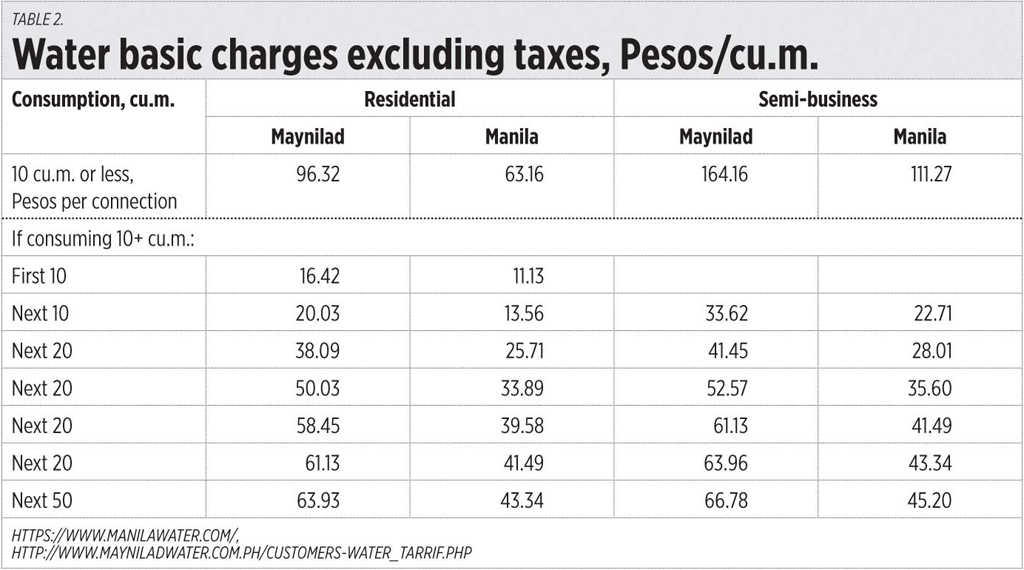
One cubic meter (cu.m.) is 1,000 liters. One drum of water is 208 liters so one cu.m. is nearly five drums. Currently, lifeline customers or those consuming 10 cu.m. or less per month pay only P6.13/cu.m. and P9.63/cu.m. basic charges in Manila Water and Maynilad areas respectively. That is very cheap, thank you concessionaires.

If residents consume 11 to 20 cu.m. in a month which is a lot, they will pay only P11.13/cu.m. and P16.42/cu.m. for Manila and Maynilad areas, respectively (see Table 2).

The 11 cu.m. is equivalent to 54 drums of water in a month — that’s a lot and residents will pay only P121 and P170 in basic charges in Manila and Maynilad Water, respectively. That is not “onerous” or “abusive.”

Now, the continuing political harassment of these two water companies has affected them, banks have limited if not stopped lending to them, they will not have enough funds to develop even short-term solutions to the rising water demand.

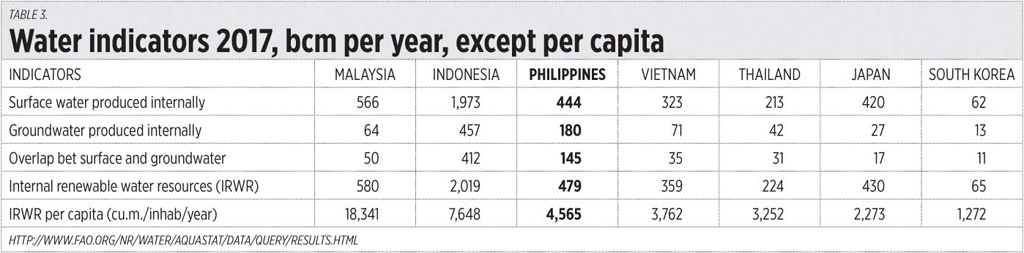
Data from the Food and Agriculture Organization (FAO) showed that in 2017, the Philippines has natural water production of some 479 billion cubic meters (bcm), higher than those in Vietnam, Thailand, Japan, and South Korea and yet we do not hear of these countries experiencing “water crisis.” Our internal water production of 4,565 cu.m. per person per year is also higher than these four neighbors (see Table 3).

So natural water is there, lots of rain water during the wet months resulting in frequent flash flooding that kill many people and destroy properties. MWSS has failed to build dams to “harvest” and store this huge surplus water which just go straight to the sea. So the two concessionaires have to develop short-term sources of water but their funding is limited.

The President and his supporters should be grateful, not vengeful, to these two water companies. The concession agreement until 2022 should proceed without further harassment, and if possible, the concession extension until 2037 should be honored, not discontinued.

We need more risk-taking concessionaires developing more immediate water supply and charging cheap water rates, not more politics. We need more facts-based discussion of the issue, not more emotional and mindless outbursts.


Bienvenido S. Oplas, Jr. is the president of Minimal Government Thinkers.

minimalgovernment@gmail.com

Stories into the future

By Raju Mandhyan

“THERE IS A LOT of heart and scientific focus that went into bringing this probiotic into the world,” claims Singh. “We made hundreds of attempts, and failed as many times.” With a background in naturopathy and a bias for a vegan diet, Singh and his wife had made up their mind to create something good and something worthwhile. Today, they claim that their yoghurt is getting accolades the world over. “We are kind of persistent when it comes to health and well-being,” he adds smilingly.

That sounds a bit like the story of Thomas Edison and his 1,000 attempts at making the first ever light bulb that would work on electricity. Yet, every story is made up of a certain, simple truth. In this case, the truth being that an Indian man, Ravi Singh, and his loving Filipina wife, Rashmi Tolentino, have come up with a yoghurt form that beats all yoghurts since it does not use any animal products. It uses coconut milk strained out of the millions that our 7,107 islands produce abundantly.

Yet my point is not the coconut or the yoghurt it can produce. My point is that success stories such as this one do not just inspire us but also become a beacon of light for us to innovate projects, processes, and products. Stories are truths wrapped in roses, rainbows, and rhythm, but they also create the future — that which is possible and which can indeed be beautiful.

“Success stories from the past empower us, but it is the stories into the future — stories yet to be lived out — that catapult us into action and success.” These words are etched on the mental corridors of all the workers in this company that supplies milk and milk derivatives to nearly half the world.

Individuals are shaped by different experiences, yet our shared values enable us to combine our strengths to make us innovative and successful. There are just four simple truths that guide us: the spirit of co-operation, doing what is right, challenging boundaries, and making it happen.

These values are images that are colorful and crystal-clear to the farmers and managers of Fonterra of New Zealand. The clarity and vividness make these values a dynamic living image. It is the vision and the story that serves as the springboard for creating an unfolding future, a future they continue to create.

Made up of over 400 members, this co-operative has been around for over 100 years. They have been steadily growing for decades and have consistently and continuously become efficient and innovative. Why? Because where they have come from is clear in this organization, and where they are heading to, is just as crystal clear.

The vivid, colorful story of the future in their minds drives them to easily implement relevant changes every day. The living, dynamic, future-projected story is a compelling magnet. It becomes a self-driven desire to change rather than something that the organization members need to be cajoled and pushed into. Furthermore, this story of their future is easily communicated and has the potential of naturally turning viral in the organization.

The wonderful coconut yoghurt of the Singh Tolentino endeavor can be found selling like hotcakes at the Sunday market of Legaspi Village, and in many other places in the Philippines.


Raju Mandhyan author, coach and learning facilitator.

www.mandhyan.com

Peso climbs as oil prices decline

THE PESO strengthened against the greenback on Monday on the back of lower oil prices, which could mean slower inflation expectations.

The local unit finished trading at P50.58 against the dollar yesterday, appreciating by six centavos from its P50.64 close on Friday, according to data published on the website of the Bankers Association of the Philippines.

The peso opened the session at P50.63 per dollar. Its weakest showing was at P50.715, while its intraday best was at P50.54 versus the greenback.

Dollars traded dropped to $771.1 million on Monday from $1.389 billion on Friday.

A trader attributed the peso’s resilience to a sharp decrease in oil prices.

“Major factor is the falling oil prices…since the Philippines is an oil importing country… It will also lower inflation expectations,” the trader said in a phone call.

Reuters reported that oil prices sank by 30% after Saudi Arabia slashed its selling price in a bid to start a price war with Russia amid falling demand in the market on the back of the coronavirus disease 2019 (COVID-19) outbreak.

Saudi Arabia, the world’s biggest oil exporter, is looking to punish Russia, the world’s second-largest producer, for balking on Friday at production cuts proposed by the Organization of the Petroleum Exporting Countries (OPEC).

This caused Brent crude futures to decrease by 31.5% or by $14.25 to $31.02 a barrel, the biggest drop since the start of the first Gulf War and the lowest price recorded since 2016.

Meanwhile, US West Texas Intermediate crude shed as much as 27.4% or $11.28 to $30 a barrel, also the biggest slip since the first Gulf War and also the cheapest price since 2016.

Aside from lower oil prices, Rizal Commercial Banking Corp. Chief Economist Michael L. Ricafort said lower yields on US benchmark bonds also boosted the peso.

“The peso was stronger today after global crude oil prices sharply declined by more than 30% to the lowest in more than four years,” Mr. Ricafort said in a text message on Monday.

“Dramatic decline in key US bond yield benchmarks also supported sentiment on the peso exchange rate…,” he added.

On Monday, the yield on the 10-year US Treasuries succumbed to new record lows and logged its biggest one-day fall in more than a decade due to market fears caused by the virus, leading investors to prefer safe-haven bonds.

The 10-year US Treasury yield fell to as low as 0.318%. It was last down almost 30 basis points (bps) on the day and was set for its biggest daily fall since 2009.

Meanwhile, 30-year US Treasuries were last down 26 bps on the day to its new record low of 0.7%.

For today, the trader expects the peso to move around the P50.40-50.70 levels, while Mr. Ricafort gave a forecast range of P50.45 to P50.75 for the peso-dollar rate. — L.W.T. Noble with Reuters

PHL shares plunge on worries over coronavirus

By Denise A. Valdez, Reporter

LOCAL STOCKS dropped to enter bear territory on Monday, battered by sustained worries on the coronavirus disease 2019 (COVID-19) and the collapse of oil prices globally.

The benchmark Philippine Stock Exchange index (PSEi) plunged by 457.77 points or 6.76% to close at 6,312.61 yesterday, while the broader all shares index slumped 224.33 points or 5.55% to 3,815.22.

“With the breaching of 6,700, the local market has entered the bear market,” Diversified Securities, Inc. Equity Trader Aniceto K. Pangan said in a text message. “Market was down heavily as regional markets were down with (COVID-19) spreading rapidly and causing lockdown to other nations.”

The Philippines declared a State of Public Health Emergency yesterday following the Health department’s confirmation of local transmission of the virus over the weekend. Confirmed cases of patients with COVID-19 in the country was at 20 as of writing, including the 10 new cases announced yesterday afternoon.

The panic was not limited to local investors as foreigners also sold their holdings to record a net foreign outflow of P839.29 million, up from the last session’s P271.03 million.

Another reason for the market’s decline yesterday was the oil price war between Saudi Arabia and Russia.

“With the global economy slowing down, oil price war emerged among oil producing countries, particularly Saudi Arabia and Russia, as oil demand slows with slowing global economy, threatening oil producing countries with high debt exposure,” Mr. Pangan said.

The price of oil fell more than 30% as oil producing countries try to address the declining demand for oil due to COVID-19.

“The sudden decrease in the demand for oil due to (COVID-19) was already driving prices lower, but the lack of cooperation between oil producing countries has countries has pushed the price over the edge,” AAA Southeast Equities, Inc. Research Head Christopher John Mangun said in an e-mail.

Sectoral indices at the local bourse all closed lower as well: financials by 136.60 points or 8.55% to 1,459.63; services by 89.15 points or 6.70% to 1,241.39; industrials by 515.88 points or 6.35% to 7,598.19; holding firms by 409.88 points or 6.19% to 6,202.38; mining and oil by 380.96 points or 6.06% to 5,900.75; and property by 217.92 points or 5.91% to 3,466.95.

Value turnover rose to P6.31 billion with 1.15 billion issues switching hands, against last Friday’s P5.89 billion worth of 632.65 million issues.

Decliners beat advancers by a mile, 204 against 30, with 23 names ending unchanged.

“Not a single stock ended on our top gainers for the day as investors run for the exits. This panic selling may continue till the end of the week,” AAA Southeast Equities’ Mr. Mangun said.