Home Blog Page 9763

CITIRA vs. EODB

The Philippines made remarkable progress in the ranking of the World Bank’s Doing Business (DB) 2020 Report, from ranking 124th rising by 29 notches and landing at 95.

According to the DB 2020 Report, the Philippines has made significant improvements in three areas: starting a business, dealing with construction permits, and protecting minority investors.

Package 1a or the TRAIN (Tax Reform for Acceleration and INclusion) Law was supposed to improve as well our scores in paying taxes with the reduction of the number of income tax return pages from 12 to only four. But such an improvement was offset by the 100% increase in the DST (Documentary Stamp Tax) which means higher costs in doing business.

Unfortunately, the reduction in personal income tax didn’t make an impact as the DB Report monitors ease of doing business for corporations, particularly SMEs. Also, while TRAIN gave some tax relief to middle income earners, it penalized individuals with compensation or taxable income above P8 million by imposing the highest personal income tax rate of 35%.

The Comprehensive Tax Reform Program of the Duterte administration made its goal very clear — to have a simpler, fairer, and more efficient tax system. Although being competitive was not explicitly mentioned, with the amount of time and effort spent in improving ease of doing business and the passage of Ease of Doing Business (EODB) Law or RA 11032 in 2018, the government is committed to really making sure it’s easy and competitive to do business in the Philippines.

But it seems that our Senators and Congressmen overlooked EODB or our competitiveness ranking in drafting Package 2 or CITIRA (the Corporate Income Tax and Incentives Reform Act) as it proposes a reduction of corporate income tax (CIT) from 30% to 20% by 1% every year until 2029. This means improving our ranking in paying taxes will take 10 years — that is if other countries will not decide to further reduce their CIT, as Singapore’s is currently at 17% and the average tax rate in the Asean region is around 24%.

Since most business organizations and sectors have expressed their support for CITIRA, the following proposals will be in addition to existing provisions of HB 4157 and SB 1357. It may take another Congress to revise and pass CITIRA if the goal of making our tax system simpler, fairer and more efficient will be the basis of discussion or argument:

1. If the TRAIN Law included a small business provision, why not consider allowing the same optional 8% for small corporations but with a higher annual sales threshold, e.g., from P3 million to P10 million, so more small corporate taxpayers will declare true profit and pay the right taxes? This is far better than the 5% threshold of the Bureau of Internal Revenue (BIR). If we fail to consider this, a small corporation with annual sales of P3 million will be paying P86,000 more in total taxes since it will be subject to both business and income tax, 3% and 30% respectively, without the benefit of the P250,000 exemption which an individual or a sole proprietor enjoys under the TRAIN Law.

2. Instead of removing the Optional Standard Deduction (OSD) entirely, why not make it available to SMEs only so they will no longer be subject to the usual and costly BIR audit where most of their expenses are disallowed anyway? At the current 30% CIT, the effective rate of a corporation with 60% gross income rate which will use OSD is at least 10% versus the 2% threshold of BIR for income tax payment.

More than improving our competitiveness ranking, this will also help BIR collect more voluntary payments without the need for regular audit and investigation which is the usual suspect or window for corruption.

3. Inevitably, we need to legislate a VAT refund system which will allow at least small corporations to claim a cash refund for unused input tax. The World Bank DB Survey clearly requires this as it gives 50 points to countries with a VAT refund system. This is a big leap for the Philippines since we continue to get zero points in this aspect every year.

The government may have apprehensions about this considering the impact on the budget, but since the priority is to provide a VAT refund to small businesses, we can put a ceiling or threshold on it, e.g., a P100,000 refund per year and make it available only to small businesses. This will definitely favor start-ups and small businesses which will have to invest on truck or equipment during their first two years in operations but will not yet have enough sales to use the input tax. Instead, they may be given an option to avail of a VAT refund.

4. Although the TRAIN Law mentioned simplified bookkeeping, it didn’t address the overly burdensome and costly maintenance of Books of Accounts. For small businesses that will not avail of optional 8% tax, they should be given one book only to record their daily sales and expenses.

But for those who wish to use Excel or spreadsheet, they should be allowed to do so provided they e-mail a PDF copy upon filing of their quarterly income tax return to make sure they will not be able to alter the data provided. This will simplify the bookkeeping requirements, especially since as VAT taxpayers, they are already required to submit the Summary List of Sales and Purchases (SLSP) electronically.

At present, the BIR has three bookkeeping methods: manual, loose leaf, and computerized accounting systems. For the computerized accounting system, the BIR already allows the immediate use of it provided it is subject to post-audit. However, most taxpayers are required to use manual bookkeeping as a default method. This consumes much time and effort for small businesses since they have to manually record what their accountant has encoded using Excel or spreadsheets.

Therefore, making the spreadsheet a default bookkeeping method and having only one book as an option for small businesses will definitely improve EODB, and hopefully improve tax collections.

5. Although preparation of financial statements is management’s responsibility, the accountant and external auditor must be held accountable and equally liable for erroneous and material misstatement that unduly reduces profit and tax payments.

It’s quite ironic that most financial statements are audited but BIR will still find huge tax assessments. This is only possible if the revenues are understated or expenses are overstated which should have been detected by the independent auditor.

The five major points which can be added in the existing CITIRA bill will definitely make a major impact in our competitiveness ranking. It will be best though if reduction of CIT will go from 30% to 25% immediately, and then gradually to 20% rather than go down by 1% every year. This is not just about revenue collections, but fair and efficient taxation.

This article reflects the personal opinion of the author and does not reflect the official stand of the Management Association of the Philippines or the MAP.


Raymond A. Abrea is a member of the MAP Tax Committee and MAP EODB Committee. He was recognized as one of the 2017 Outstanding Young Persons of the World, 2016 Digital Mover, one of the 2015 The Outstanding Young Men of the Philippines (TOYM), and an Asia CEO Young Leader because of his tax advocacy. Currently, he is the Chairman and Senior Tax Advisor of the Asian Consulting Group (ACG) and founding Trustee of the Center for Strategic Reforms of the Philippines (CSR Philippines).

consult@acg.ph.

map@map.org.ph

http://map.org.ph

Thank you, Metro Manila water concessionaires

In a speech before new appointees in Malacañang on Feb. 6, President Rodrigo Duterte blasted again the two Metro Manila water concessionaires. He said, “Where is the money of the average Filipino who are poor who pays his water bill and he has to pay because if (not) it will be cut off? Where is the money of that son of a b****? Give us back the money. Give it back to the people and maybe we can talk about solving your problem.”

Last December, this column has actually provided some answers to those question (see https://www.bworldonline.com/thank-you-maynilad-manila-water/ Dec. 23, 2019). The table there is expanded here, and the quick answers to “where did the money go” are: the money went to improve service delivery to some 8.5 million additional consumers of both concessionaires, it added 1.66 million new water connections, it expanded 24 hours water service by 70%, and it reduced water leaks and theft by 43% (see Table 1).

Thank you, Maynilad and Manila Water. The public already got the services for the money they paid for. It cannot be “given back” to them or the government via the Metropolitan Waterworks and Sewerage System (MWSS).

In previous attacks by the President, he said that the contracts with the two concessionaires are “onerous” and not beneficial to the public and government. Let us check the numbers again.

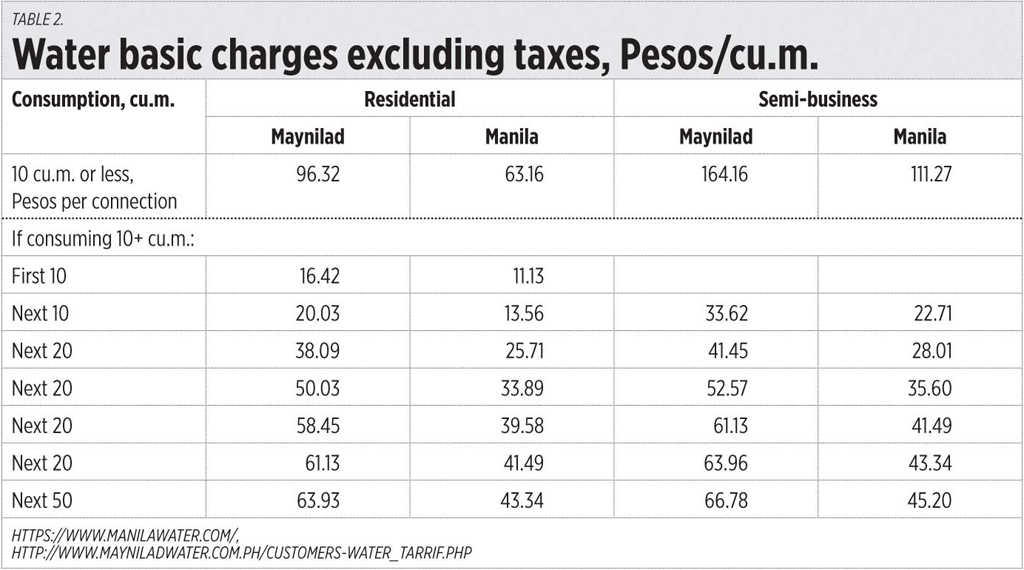
One cubic meter (cu.m.) is 1,000 liters. One drum of water is 208 liters so one cu.m. is nearly five drums. Currently, lifeline customers or those consuming 10 cu.m. or less per month pay only P6.13/cu.m. and P9.63/cu.m. basic charges in Manila Water and Maynilad areas respectively. That is very cheap, thank you concessionaires.

If residents consume 11 to 20 cu.m. in a month which is a lot, they will pay only P11.13/cu.m. and P16.42/cu.m. for Manila and Maynilad areas, respectively (see Table 2).

The 11 cu.m. is equivalent to 54 drums of water in a month — that’s a lot and residents will pay only P121 and P170 in basic charges in Manila and Maynilad Water, respectively. That is not “onerous” or “abusive.”

Now, the continuing political harassment of these two water companies has affected them, banks have limited if not stopped lending to them, they will not have enough funds to develop even short-term solutions to the rising water demand.

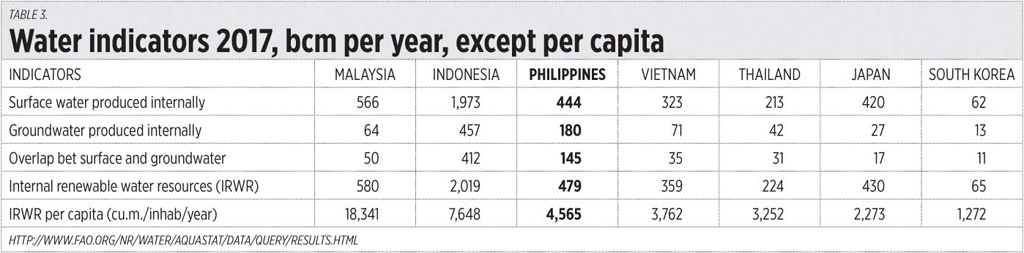
Data from the Food and Agriculture Organization (FAO) showed that in 2017, the Philippines has natural water production of some 479 billion cubic meters (bcm), higher than those in Vietnam, Thailand, Japan, and South Korea and yet we do not hear of these countries experiencing “water crisis.” Our internal water production of 4,565 cu.m. per person per year is also higher than these four neighbors (see Table 3).

So natural water is there, lots of rain water during the wet months resulting in frequent flash flooding that kill many people and destroy properties. MWSS has failed to build dams to “harvest” and store this huge surplus water which just go straight to the sea. So the two concessionaires have to develop short-term sources of water but their funding is limited.

The President and his supporters should be grateful, not vengeful, to these two water companies. The concession agreement until 2022 should proceed without further harassment, and if possible, the concession extension until 2037 should be honored, not discontinued.

We need more risk-taking concessionaires developing more immediate water supply and charging cheap water rates, not more politics. We need more facts-based discussion of the issue, not more emotional and mindless outbursts.


Bienvenido S. Oplas, Jr. is the president of Minimal Government Thinkers.

minimalgovernment@gmail.com

Stories into the future

By Raju Mandhyan

“THERE IS A LOT of heart and scientific focus that went into bringing this probiotic into the world,” claims Singh. “We made hundreds of attempts, and failed as many times.” With a background in naturopathy and a bias for a vegan diet, Singh and his wife had made up their mind to create something good and something worthwhile. Today, they claim that their yoghurt is getting accolades the world over. “We are kind of persistent when it comes to health and well-being,” he adds smilingly.

That sounds a bit like the story of Thomas Edison and his 1,000 attempts at making the first ever light bulb that would work on electricity. Yet, every story is made up of a certain, simple truth. In this case, the truth being that an Indian man, Ravi Singh, and his loving Filipina wife, Rashmi Tolentino, have come up with a yoghurt form that beats all yoghurts since it does not use any animal products. It uses coconut milk strained out of the millions that our 7,107 islands produce abundantly.

Yet my point is not the coconut or the yoghurt it can produce. My point is that success stories such as this one do not just inspire us but also become a beacon of light for us to innovate projects, processes, and products. Stories are truths wrapped in roses, rainbows, and rhythm, but they also create the future — that which is possible and which can indeed be beautiful.

“Success stories from the past empower us, but it is the stories into the future — stories yet to be lived out — that catapult us into action and success.” These words are etched on the mental corridors of all the workers in this company that supplies milk and milk derivatives to nearly half the world.

Individuals are shaped by different experiences, yet our shared values enable us to combine our strengths to make us innovative and successful. There are just four simple truths that guide us: the spirit of co-operation, doing what is right, challenging boundaries, and making it happen.

These values are images that are colorful and crystal-clear to the farmers and managers of Fonterra of New Zealand. The clarity and vividness make these values a dynamic living image. It is the vision and the story that serves as the springboard for creating an unfolding future, a future they continue to create.

Made up of over 400 members, this co-operative has been around for over 100 years. They have been steadily growing for decades and have consistently and continuously become efficient and innovative. Why? Because where they have come from is clear in this organization, and where they are heading to, is just as crystal clear.

The vivid, colorful story of the future in their minds drives them to easily implement relevant changes every day. The living, dynamic, future-projected story is a compelling magnet. It becomes a self-driven desire to change rather than something that the organization members need to be cajoled and pushed into. Furthermore, this story of their future is easily communicated and has the potential of naturally turning viral in the organization.

The wonderful coconut yoghurt of the Singh Tolentino endeavor can be found selling like hotcakes at the Sunday market of Legaspi Village, and in many other places in the Philippines.


Raju Mandhyan author, coach and learning facilitator.

www.mandhyan.com

Peso climbs as oil prices decline

THE PESO strengthened against the greenback on Monday on the back of lower oil prices, which could mean slower inflation expectations.

The local unit finished trading at P50.58 against the dollar yesterday, appreciating by six centavos from its P50.64 close on Friday, according to data published on the website of the Bankers Association of the Philippines.

The peso opened the session at P50.63 per dollar. Its weakest showing was at P50.715, while its intraday best was at P50.54 versus the greenback.

Dollars traded dropped to $771.1 million on Monday from $1.389 billion on Friday.

A trader attributed the peso’s resilience to a sharp decrease in oil prices.

“Major factor is the falling oil prices…since the Philippines is an oil importing country… It will also lower inflation expectations,” the trader said in a phone call.

Reuters reported that oil prices sank by 30% after Saudi Arabia slashed its selling price in a bid to start a price war with Russia amid falling demand in the market on the back of the coronavirus disease 2019 (COVID-19) outbreak.

Saudi Arabia, the world’s biggest oil exporter, is looking to punish Russia, the world’s second-largest producer, for balking on Friday at production cuts proposed by the Organization of the Petroleum Exporting Countries (OPEC).

This caused Brent crude futures to decrease by 31.5% or by $14.25 to $31.02 a barrel, the biggest drop since the start of the first Gulf War and the lowest price recorded since 2016.

Meanwhile, US West Texas Intermediate crude shed as much as 27.4% or $11.28 to $30 a barrel, also the biggest slip since the first Gulf War and also the cheapest price since 2016.

Aside from lower oil prices, Rizal Commercial Banking Corp. Chief Economist Michael L. Ricafort said lower yields on US benchmark bonds also boosted the peso.

“The peso was stronger today after global crude oil prices sharply declined by more than 30% to the lowest in more than four years,” Mr. Ricafort said in a text message on Monday.

“Dramatic decline in key US bond yield benchmarks also supported sentiment on the peso exchange rate…,” he added.

On Monday, the yield on the 10-year US Treasuries succumbed to new record lows and logged its biggest one-day fall in more than a decade due to market fears caused by the virus, leading investors to prefer safe-haven bonds.

The 10-year US Treasury yield fell to as low as 0.318%. It was last down almost 30 basis points (bps) on the day and was set for its biggest daily fall since 2009.

Meanwhile, 30-year US Treasuries were last down 26 bps on the day to its new record low of 0.7%.

For today, the trader expects the peso to move around the P50.40-50.70 levels, while Mr. Ricafort gave a forecast range of P50.45 to P50.75 for the peso-dollar rate. — L.W.T. Noble with Reuters

PHL shares plunge on worries over coronavirus

By Denise A. Valdez, Reporter

LOCAL STOCKS dropped to enter bear territory on Monday, battered by sustained worries on the coronavirus disease 2019 (COVID-19) and the collapse of oil prices globally.

The benchmark Philippine Stock Exchange index (PSEi) plunged by 457.77 points or 6.76% to close at 6,312.61 yesterday, while the broader all shares index slumped 224.33 points or 5.55% to 3,815.22.

“With the breaching of 6,700, the local market has entered the bear market,” Diversified Securities, Inc. Equity Trader Aniceto K. Pangan said in a text message. “Market was down heavily as regional markets were down with (COVID-19) spreading rapidly and causing lockdown to other nations.”

The Philippines declared a State of Public Health Emergency yesterday following the Health department’s confirmation of local transmission of the virus over the weekend. Confirmed cases of patients with COVID-19 in the country was at 20 as of writing, including the 10 new cases announced yesterday afternoon.

The panic was not limited to local investors as foreigners also sold their holdings to record a net foreign outflow of P839.29 million, up from the last session’s P271.03 million.

Another reason for the market’s decline yesterday was the oil price war between Saudi Arabia and Russia.

“With the global economy slowing down, oil price war emerged among oil producing countries, particularly Saudi Arabia and Russia, as oil demand slows with slowing global economy, threatening oil producing countries with high debt exposure,” Mr. Pangan said.

The price of oil fell more than 30% as oil producing countries try to address the declining demand for oil due to COVID-19.

“The sudden decrease in the demand for oil due to (COVID-19) was already driving prices lower, but the lack of cooperation between oil producing countries has countries has pushed the price over the edge,” AAA Southeast Equities, Inc. Research Head Christopher John Mangun said in an e-mail.

Sectoral indices at the local bourse all closed lower as well: financials by 136.60 points or 8.55% to 1,459.63; services by 89.15 points or 6.70% to 1,241.39; industrials by 515.88 points or 6.35% to 7,598.19; holding firms by 409.88 points or 6.19% to 6,202.38; mining and oil by 380.96 points or 6.06% to 5,900.75; and property by 217.92 points or 5.91% to 3,466.95.

Value turnover rose to P6.31 billion with 1.15 billion issues switching hands, against last Friday’s P5.89 billion worth of 632.65 million issues.

Decliners beat advancers by a mile, 204 against 30, with 23 names ending unchanged.

“Not a single stock ended on our top gainers for the day as investors run for the exits. This panic selling may continue till the end of the week,” AAA Southeast Equities’ Mr. Mangun said.

Gov’t confirms 14 more coronavirus cases

THE GOVERNMENT on Monday reported 14 new cases of the novel coronavirus in the Philippines, prompting President Rodrigo R. Duterte to suspend classes for five days to prevent an outbreak in schools.

Mr. Duterte last night said four more infections had been confirmed, bringing the total to 24. He made the announcement after meeting with members of an inter-agency task force against the disease.

“I am confident that we will survive this contagion,” the President told a news briefing.

Hours earlier, the Department of Health (DoH) said 10 more Filipinos aged 24 to 72 had tested positive for the coronavirus disease 2019 (COVID-19).

Eighteen cases were reported in the past 24 hours, while 21 of the total were confirmed just this month.

Before last week, the Philippines had not reported any new cases for weeks.

DoH received news of the 10 new cases before lunch yesterday and had sent teams to trace people who may have had contact with the patients, Health Assistant Secretary Maria Rosario S. Vergeire said at a briefing.

“DoH is also currently in coordination with concerned local government units and centers for health development for localized response and implementation of infection prevention and control measures,” the agency said in a separate statement.

The department was coordinating with police and other agencies “to immediately identify, and isolate if needed, those who may have had contact with the confirmed cases,” Health Secretary Francisco T. Duque III said in the statement.

Of the 10 new cases, two had been exposed to a known COVID-19 patient, according to DoH.

It had yet to determine the travel or exposure history of one patient. Three had no travel history overseas, and the rest had recently traveled to either the United Arab Emirates, Australia, Taiwan or Japan, it said.

DoH on Sunday night reported four new infections after confirming the first local transmission involving a Filipino couple last week.

It raised the country’s alert level to Code Red sublevel 1 on Saturday as health authorities “prepare for a possible increase in suspected and confirmed cases.”

DoH yesterday said 468 contacts from the fourth to 10th patients had been identified, six of whom were isolated.

Meanwhile, Mr. Duterte issued a proclamation dated March 8 declaring a state of public health emergency to “capacitate” the government to immediately act to contain an outbreak.

All citizens, residents, tourists and business owners must follow what is within the law and comply with government orders on the disease.

LIMITED KITS

Also yesterday, senators slammed health officials for failing to buy enough testing kits for suspected carriers of the COVID-19 that has killed more than 3,700 people and sickened about 109,000 more, mosty in China.

The agency only has 2,000 kits and expects to receive 4,500 more from the World Health Organization, Alethea De Guzman, a DoH medical specialist, told a Senate hearing.

The department is reviewing a decision it made earlier to limit the use of test kits to travelers from countries with cases of COVID-19, she said.

“You only have 2,000 testing kits out of a 100 million population? You think that’s enough?” a shocked Senator Maria Lourdes Nancy S. Binay said.

“I don’t want to panic, but you’re making me panic because it seems like you didn’t prepare for a local transmission,” she said in mixed English and Filipino.

Senator Imee R. Marcos said the agency should have prioritized the test kits instead of asking for a P43-million budget “for various needs.”

Mr. Duque earlier said there was a “global shortage” in COVID-19 test kits. He noted that testing 100 million people was ideal but it was not feasible.

Ms. Binay also criticized DoH for its slow public announcement of new coronavirus cases.

She said netizens on social media had been ahead in circulating reports about a new infection at Bonifacio Global City in Taguig.

“Speed up the announcement and the dissemination of information because the public will lose confidence,” she said in Filipino.

Ms. Binay noted that while a patient has privacy rights, the good of the majority should prevail.

Of the four COVID-19 cases announced on Sunday, one is a 38-year-old Taiwanese male, and another is a 32-year-old Filipino male who had traveled to Japan, according to DoH. An 86-year-old American male who had traveled to the US and South Korea, and a 57-year-old Filipino with no history of foreign travels have also been infected, it said.

The patients had been admitted at the Makati Medical Center, St. Luke’s Medical Center in Taguig, The Medical City and St. Luke’s Medical Center in Quezon City, the agency said yesterday.

Last week, DoH confirmed three COVID-19 cases — a 62-year-old man who had not traveled overseas tested positive for the virus, his wife and a 48-year-old man who had traveled to Tokyo.

Earlier, three Chinese visitors were infected with the virus — one of them died, and the other two have since recovered and left the country. The Philippines had not reported any new cases for weeks before last week.

Meanwhile, Albay Rep. Jose Maria Clemente S. Salceda recommended “isolation shock” to contain the deadly virus.

“During epidemics, everyone is a suspect, thus the need for isolation shock,” he told reporters.

“A lockdown of the National Capital Region should not be off the table if needed to slow down the transmission of COVID-19,” he added.

Mr. Salceda’s recommendations include suspending classes, stopping work for a week, suspending bus trips and domestic flights and and closing the South Luzon nd North Luzon Expressways.

The only exceptions to the lockdown should be food, medicines and health-related professions, he said. — Adam J. Ang, Charmaine A. Tadalan and Gillian M. Cortez

Patented drug imports an option during national emergency

THE Health department can import patented medicines through a compulsory license during a national emergency, the Intellectual Property Office of the Philippines said, amid rising cases of a deadly coronavirus strain.

The IPO office and Health department will come out with a joint memo on the compulsory licensing, Teodoro C. Pascua, the office’s deputy director general, said in an interview last week.

The Philippines is one of the World Trade Organization (WTO) member-countries where the prices of medicines are higher than neighbors with a similar income status.

“The government has no resort but to buy it at a higher price due to patent exclusivity and therefore cannot source out from other countries with the domestic capacity to manufacture these medicines at a much cheaper price,” according to the draft order.

The WTO in 2005 amended the trade-related aspects of intellectual property rights (TRIPS) agreement to allow member-countries that can’t make medicines to import through a compulsory license.

Under the proposed joint administrative order, DoH may file a petition with the IPO office during a national emergency and to protect public interest.

The petition may be filed if a judicial or administrative body finds that the patent is anti-competitive, among other reasons.

Mr. Pascua said the US pharmaceutical industry had expressed concerns about the move, fearing that their medical intellectual property rights would be disregarded.

“It’s not going to be dictatorial,” he said. “There will still be recognition of due process. They will be informed.”

“The concern is whether the necessary prerequisite conditions are present or fulfilled,” Beaver R. Tamesis, president of the Pharmaceutical and Healthcare Association of the Philippines (PHAP), said in a mobile-phone message.

“It is amazing that some other countries have applied compulsory licensing in a very arbitrary manner to the detriment of the overall industry in their countries,” he said. — Jenina P. Ibañez

SC asked to issue jurisprudence on treaty termination

PHILIPPINE senators on Monday asked the Supreme Court to issue jurisprudence on whether the Executive branch can unilaterally end a treaty that the chamber had concurred in.

This comes after President Rodrigo R. Duterte last month ended a two-decade-old military agreement with the US on the deployment of troops for war games.

“We will ask whether an agreement that is very difficult to enter into can be revoked by a simple letter,” Senate President Vicente C. Sotto III, who filed the lawsuit with five other senators, told reporters in a teleconference before the filing.

“In cases like these, the Supreme Court is the Oracle we consult,” he said. The 1987 Constitution is silent on the issue.

Joining him in the lawsuit were Senators Ralph G. Recto, Juan Miguel F. Zubiri, Franklin M. Drilon, Richard J. Gordon and Panfilo M. Lacson.

The senators asked the high court to require Senate concurrence by a vote of two-thirds before the Executive can end a treaty.

“It is a continuing effort of the Senate to define our powers,” Mr. Drilon told reporters separately.

Mr. Duterte on Feb. 11 officially notified the US of his decision to end the visiting forces agreement (VFA) after the US visa of Senator Ronald M. de la Rosa, his former police chief who led his deadly war on drugs, was canceled.

Mr. Duterte’s decision could complicate US military interests in the broader Asia-Pacific region as China’s ambitions rise.

The VFA is important to the overall US-Philippine alliance and sets out rules for US soldiers operating in the Philippines, a former US colony.

Washington has called the relationship “ironclad,” despite Mr. Duterte’s complaints that include allegations of US hypocrisy and ill treatment.

Ending the VFA complicates Washington’s efforts to maintain an Asia-Pacific troop presence amid friction over the presence of US personnel in Japan and South Korea and security concerns about China and North Korea. — Charmaine A. Tadalan

PHL boxer Marcial earns Summer Olympic spot

By Michael Angelo S. Murillo
Senior Reporter

COUNT boxer Eumir Felix Marcial as one of the athletes from the Philippines seeing action later this year at the Summer Olympic Games in Tokyo, Japan.

This, after the 24-year-old fighter officially booked a spot in the Games following his victory over Mongolia’s Byamba-Erden Otgonbaatar by referee stopped contest in the third round of their middleweight quarterfinal clash at the 2020 Asia and Oceania Olympic boxing qualifiers in Amman, Jordan, early Monday morning (Manila time).

Mr. Marcial became the third Filipino athlete who is Olympics-bound, joining pole-vaulter EJ Obiena and gymnast Carlos Yulo, who both qualified for the quadrennial sporting spectacle last year.

The qualification of Mr. Marcial was hard-earned as he labored to get it against Mr. Otgonbaatar.

The fighters had it tight in the opening round, trading hard punches early on before the Filipino got some leverage as the round progressed to claim the frame.

In the second round, Mr. Otgonbaatar got his strides on his way to take control.

Recognizing that he gave some ground to his opponent in the previous round, Mr. Marcial came out of the third and final frame with more aggression, pummelling his opponent with heavy punches.

And such tack proved to be successful as with 45 seconds left in the round, the referee deemed it fit to discontinue the fight with the punishment that Mr. Otgonbaatar was taking, handing Mr. Marcial the quarterfinal win and the ticket to his first-ever Olympics.

Mr. Marcial faces Ashish Kumar of India in the semifinals.

This latest feat of Mr. Marcial is a continuation of his impressive run of late, which includes his silver medal performance in the 2019 world championships in September and gold medal conquest in the 30th Southeast Asian Games in December.

The Tokyo Olympic Games is set for July 24 to Aug. 9.

For the Philippines, boxing is traditionally a steady source of athletes in the Olympics.

In 2016 in the Rio Games, two boxers competed for the country, namely light flyweight Rogen Ladon and lightweight Charly Suarez.

Boxing, too, has accounted for five of the total medals won by the Philippines in the Olympics, including two silver care of Anthony Villanueva (1964) and Mansueto Velasco (1996).

Agri-tourism and innovation center to rise in Abra

THE DEPARTMENT of Agriculture, together with the Abra provincial government, broke ground for an agri-tourism and innovation center in Tayum town last Saturday. Agriculture Secretary William D. Dar and Governor Maria Jocelyn-Valera Bernos led the ceremony for the facility that will serve as an educational hub on modern agricultural technologies and practices for farmers and students. It is also intended as a research and production facility to boost production of the region’s major commodities such as rice, corn, coffee, cacao, cassava, mango, lowland vegetables, organic products, beef cattle, and carabao. “This is such an important project of the Abra Provincial Government and we will see to it that the Department of Agriculture will do its share in turning this important facility into a showcase of modern and industrializing agriculture,” Mr. Dar said during the event that coincided with the Kawayan (Bamboo) Festival and Farmers’ Day celebration. The Agriculture secretary committed P31 million for the construction of a bamboo research and processing center and P7.5 million for a satellite Agricultural Research and Development Station in the province. Meanwhile, the DA has also given over P300 million in assistance funds to the province’s 27 municipalities, farmers, fisherfolk, and agricultural extension workers. — Revin Mikhael D. Ochave

COVID-19 regional updates: Lingayen disinfects schools, assisting in contact tracing for Covid-19+ visitor from Australia

WITH CLASSES suspended on Monday in Lingayen, the capital town of Pangasinan, schools were sanitized as authorities continue tracing those who came into contact with a homecoming Filipino who tested positive for the coronavirus 2019 (COVID-19) upon returning to Australia. “With reference to the recent news of a kababayan from Australia who attended a wedding in Manila, a high school reunion and other activities in Pangasinan in mid-Feb and reported positive of COVID-19 on her return to Australia last March 2, coordination is being done with appropriate agencies for proper contact tracing,” Mayor Leopoldo N. Bataoil said in a statement. He also assured residents that the local government “has been continuously conducting measures” since the virus was first reported earlier this year. “In the market, municipal hall and other gatherings, we instituted thermal monitoring, hand cleansing and use of face masks, among others,” he said. Meanwhile, Pangasinan Governor Amado I. Espino III said they have already asked for police assistance to speed up the contact tracing. “Kasi nga madami (Because there are a lot),” he told the media on Monday, live-streamed on the province’s social media page. “We’re taking all precautionary measures to test everyone,” he said. Mr. Espino also clarified that the Filipino migrant, who arrived in the Philippines on Feb 22, may not have acquired the virus in the country as the arrival date is less than 14 days from the positive test result on March 3. The Pangasinan provincial board issued a resolution last Feb. 10 directing all local government units to suspend all public gatherings. Mr. Espino also ordered a ban on all province-organized activities and the use of public social facilities.

Iloilo City mayor to meet barangay leaders after 46 villages fail road clearing assessment

ILOILO CITY Mayor Jerry P. Treñas is meeting village leaders this week after 46 areas failed in the assessment for compliance to the national government’s road clearing policy. The city has 180 barangays, of which 136 have been evaluated by the validation team composed of representatives from the police, Public Safety and Transportation Management Office, and Bureau of Fire Protection. “While I do not want to impose administrative sanctions, but if there will be a recommendation from the Department of Interior and Local Government (DILG) then I don’t have a choice but to do so,” Mr. Treñas said in an interview last week. “I was told that 25% of the rating was for the approved road ordinances and most of them have no approved ordinance,” he added. The meeting will include how the city government can assist the barangay leaders, who have been given until April 30 to comply with the directive’s provisions. “That is more than sufficient enough, that will give them sufficient time to comply,” the mayor said. The series of road clearing orders issued by the DILG involves removing obstructions on streets, sidewalks and other public spaces as well as a ban on tricycles along national highways. — Emme Rose S. Santiagudo