Home Blog Page 955

Peso down on safe-haven dollar demand

BW FILE PHOTO

THE PESO sank on Tuesday as concerns over the health of the French economy drove safe-haven demand for the dollar.

The local unit closed at P57.295 versus the greenback, falling by 23.9 centavos from its P57.056 finish on Monday, Bankers Association of the Philippines data showed.

The peso opened Tuesday’s session stronger at P56.95 versus the dollar, which was also its intraday high. Its worst showing was at P57.33 against the greenback.

Dollars exchanged surged to $1.86 billion on Tuesday from $1.27 billion on Monday.

“The dollar-peso closed higher on market risk-off sentiment due to escalating concerns over France’s economy, which favored the dollar safe-haven demand,” a trader said in a phone interview.

For Wednesday, the trader sees the peso moving between P57.10 and P57.40 per dollar.

The US dollar was steady on Tuesday as investors took a beat to parse a hawkish tilt in comments by members of the Federal Reserve, while awaiting remarks on the economic outlook by Chair Jerome H. Powell, Reuters reported.

The greenback fluctuated between gains and losses, last trading flat after snapping a three-day winning streak on Monday, with the US dollar index last at 97.36.

Mr. Powell was set to speak on the economic outlook later on Tuesday and some central bank policymakers renewed focus on inflation risks in remarks on Monday, prompting a slight easing of wagers on a rate cut by the Fed next month.

Meanwhile, markets showed a largely muted reaction to a mixed bag of business survey readings in Europe.

While data showed that euro zone business activity grew at its fastest pace in 16 months in September, it also pointed to French economic activity contracting the same month at the sharpest rate since April. — AMCS with Reuters

Davao chili sauce brand eyes Manila factory

FACEBOOK.COM/AYANASCHILI

By Almira Louise S. Martinez, Reporter

DAVAO-BASED chili sauce maker Ayana’s Siling Kinamayo is seeing stronger demand in Metro Manila as it boosts its participation in trade fairs and food expos in the National Capital Region.

“In Manila, the demand is really high compared with the Davao region,” Edlun A. Ferrando, owner of Ayana’s Siling Kinamayo, told BusinessWorld in an interview. “In Davao City, we also supply to the malls, that’s why it’s a bit saturated.”

Mr. Ferrando credited the Department of Trade and Industry (DTI) for helping the brand enter the Manila market through free trade fair slots. “That’s the No. 1 source. People got to know our brand, and we were able to enter the market because of the trade fairs.”

The chili enterprise traces its roots to the aftermath of Super Typhoon Pablo in 2012, which devastated farms across Mindanao and caused P8.5 billion worth of farm damage, based on the Philippine Crop Insurance Corp. The banana sector bore the heaviest losses, followed by rice, corn and coconut farms.

“The only thing that sprouted was the chili,” Mr. Ferrando said. “That’s the only thing they were able to produce. That’s why the farmers took advantage of it.”

To aid recovery, the Trade department rolled out livelihood training for affected residents. Mr. Ferrando’s wife Maricel, who had cooking experience from their former eatery, joined the program and showcased her chili sauce recipe.

“They discovered that she knows how to make chili sauce… so the DTI told her to focus on that,” he said.

Production started modestly with 50 bottles per batch using a household blender that often overheated. Today, Ayana’s produces 1,000 to 1,500 bottles daily across five variants, including its flagship Siling Kinamayo made with native chilies, and Dare Devil Sauce featuring Carolina Reaper peppers.

Flavor preferences differ by region, Mr. Ferrando said.

“In Manila, the people there are fond of something sweet,” he said. “In Mindanao, in the western part, they are fond of something spicy because of our Muslim brothers. In the Visayas, they are not fond of spicy food.”

“It depends on the taste of the people, that’s where we base our flavors,” he added.

To support its expanding Metro Manila market, Ayana’s is considering setting up a small processing facility in the capital to reduce shipping costs.

“It would be better if there were small batches of production there. We are looking for a small processing area, as long as it’s okay with the FDA (Food and Drug Administration),” Mr. Ferrando said.

The company aims to hit P500,000 in sales by year-end.

Keyland Corp. to open first boutique hotel in November

ALINOHOTEL.COM

PROPERTY developer Keyland Corp. is set to open its 128-room boutique hotel in New Manila, Quezon City, by November.

The 20-storey Alino Hotel is located along E. Rodriguez Sr. Avenue in New Manila, a growing business hub in northern Metro Manila.

The hotel is expected to cater to business travelers, medical guests, and families in the area, the company said in a statement on Tuesday.

“Keyland’s entry into hospitality through Alino Hotel marks a diversification for the developer, which has until now focused primarily on residential and office projects,” it said.

“The Quezon City property, scheduled to open in November 2025, is positioned to capture business travelers, medical guests, and families in one of the city’s busiest commercial districts,” the statement added.

The property will offer 27-square-meter (sq.m.) Essential Twin rooms and 31-sq.m. Deluxe Twin rooms, according to Keyland’s website. Deluxe Queen and Premier Queen rooms are sized up to 32 sq.m. and 36 sq.m., respectively.

Key facilities include on-site parking, restaurants, room service, an indoor pool, self-service laundry facilities, a 24-hour front desk, a gym, an elevator, interconnecting rooms, and conference/meeting rooms.

Keyland appointed veteran hotelier Lady May Elegado as general manager for the property.

Ms. Elegado has held senior roles at The Taaras Beach & Spa Resort in Malaysia, Berjaya Makati Hotel, and City Garden Grand Hotel in Makati City.

“Over the course of her career, Elegado has overseen hotel functions ranging from pre-opening to day-to-day operations in both luxury and standard-class properties, giving her broad exposure to multiple areas of management,” Keyland said.

Rexsan Abarquez, with over 20 years of experience in the culinary industry, will lead the hotel’s food and beverage program, including its all-day dining outlet, Kutchara.

Mr. Abarquez previously served as executive sous chef and Acting Executive Chef at Marco Polo Ortigas in Mandaluyong City.

He also worked with Conrad Manila’s pre-opening team and held positions at Sofitel Philippine Plaza, Mandarin Oriental Manila, and Makati Shangri-La.

“His experience in international kitchens and high-end hotels allows him to blend global techniques with Filipino flavors,” Keyland said.

Keyland’s real estate portfolio includes townhouses such as Vermira in Batangas and condominium towers including 110 Benavidez in Makati, Southkey Place in Muntinlupa City, and Casa de Sequoia in Las Piñas City.

Its office and retail developments include Southkey Hubs 1 and 2 and Southkey Place (retail) in Muntinlupa City; Casa de Sequoia (retail) in Las Piñas City; Keyland Plaza in San Juan City; and Keyland Arnaiz, Keyland Valero, and Keyland Ayala in Makati City. — Beatriz Marie D. Cruz

Arts & Culture (09/24/25)


Benefit concert for Pablo Tariman

FOR the benefit of veteran performing arts and classical music journalist Pablo Tariman, who is battling multiple health complications, longtime friends are putting up a concert. Internationally renowned tenor Arthur Espiritu is one of many musicians headlining the fundraising show Let the Wind Blow: A Bouquet for Pablo, set for Sept. 26, 7:30 p.m., at the Mirror Theatre Studio, SJG Center, Poblacion, Makati City. Other musicians performing are sopranos Stefanie Quintin Avila and Angeli Benipayo, theater actress Jay Valencia Glorioso, baritone Ruzzel Clemeno, guitarist Aaron Aguila, cellist Renato Lucas, pianists Gabriel Allan Ferros Paguirigan and GJ Frias, clarinetist Herald Sison, and violinists Ghio Karylle Esteban and Cedie Nuñez. Tickets are available via 0920-954-0053 or 0918-347-3027, or the e-mail josephuy@yahoo.com.


Inter Alia, The Importance of Being Earnest on screen

THE NEXT presentations of Cultural Center of the Philippines’ National Theatre will be Inter Alia and The Importance of Being Earnest, both shows that explore the complexity and fragility of one’s identity amidst established social and personal norms. Shot live at the theaters they were performed at in London, Inter Alia will be screening at Glorietta 4 while The Importance of Being Earnest will be shown at Ayala Malls Vertis North and Ayala Malls Central Bloc Cebu. Screenings will be on Sept. 30 at 6 p.m. Regular ticket prices are P300 in Makati and Cebu, and P350 in Vertis North, with special ticket price for students at P150 upon presentation of a valid ID. Visit the cinema ticket booths or book online via SureSeats.


Dear Evan Hansen has sign language show

GMG PRODUCTIONS has announced that a sign language-interpreted performance of the award-winning musical Dear Evan Hansen will be mounted during its Manila run. In collaboration with the Filipino Sign Language (FSL) Deaf consultants and interpreters of the College of Saint Benilde, the upcoming Oct. 2 show of Dear Evan Hansen will be accessible to the Deaf community. The musical will be interpreted in FSL live by Benilde’s FSL interpreters. The musical runs until Oct. 5 at The Theatre at Solaire, with tickets exclusively available via TicketWorld.


UP Symphony Orchestra presents Tunog at Kulay

THE UP Symphony Orchestra will be joined by harpist Madeline Jane Banta in the concert titled Tunog at Kulay. The repertoire features pieces by Mussorgsky, Ravel, Debussy, Shostakovich, and De Leon. The show is in support of the PGH Pediatric Hematology-Oncology Clinic. The evening also features the participation of a Fine Arts 10 (Visual Perception) class of Mitzi Aguilar-Reyes and UP Fine Arts Gallery (Parola) curator Lisa Ito-Tapang. It is set for Oct. 3, 6 p.m., at the UP Theater, Diliman, Quezon City. Tickets cost P750, with registration via http://tinyurl.com/upsottkreg.


Anik-anik, burloloy culture explored in art exhibit

YOUNG mixed-media artist Chleia Zyrille Samson, also known as ZYRIBUBUT, is tackling the maximalist culture of anik-anik, abubut, and burloloy in the Philippines in their exhibition ANAK NG ABUBUT!. The researcher-artist also explores how the oversaturated representation of online personas on social media subjects the culture merely to an “aesthetic.” The exhibit is free and open to the public at the 9th Floor Landing of the Benilde Design + Arts Campus. It runs until Oct. 4.


Ballet Manila restages Florante at Laura

BALLET MANILA will again stage their dance interpretation of Francisco Balagtas’ Florante at Laura at the Aliw Theater, with performances on Oct. 3 at 8 p.m., and Oct. 4 and 5 at 5 p.m. Live music will be performed by the Orchestra of the Filipino Youth under the baton of Toma Cayabyab, interpreting the original score composed by National Artist for Music Ryan Cayabyab. Tickets are now on TicketWorld.


Metrobank presents the 2025 MADE exhibit

THE Metrobank Foundation, Inc. (MBFI) is inviting the public to the 2025 Metrobank Art & Design Excellence (MADE) Exhibition titled Vast Horizons, which is ongoing until Oct. 18 at the 2F North and South Galleries of The M in Bonifacio Global City, Taguig. Free and open to all, the month-long exhibition features the awardees, semi-finalists, and national finalists of this year’s MADE competition. Now on its 41st year, this edition marked the return of the Mixed Media category since it was last seen in the 1980s. The 2025 Grand Awardees are Rober Mark A. Liwanag for Sculpture with Sariling Tahanan, (…And We Are Home); Jao Eugene S. Pelaez for the Mixed Media category with Tulad ng Isang Halaman na Minsan Nanirahan (Like a Plant That Once Lived); and Jack Enriquez De Castro for the Painting (Oil/Acrylic on Canvas) category with Finding the Light Within.


Noel Comia, Jr., Tomas Rodriguez cast in Bagets

TWO ACTORS have been cast in the lead role of Gilbert in the upcoming production of Bagets the Musical. Noel Comia, Jr. and Tomas Rodriguez will both be playing the geeky member barkada who was originally portrayed by Herbert Bautista in the iconic 1980s film about high school life. Mr. Comia has a musical theater background while this will be the first theater outing for Mr. Rodriguez, a member of the P-pop boy group ALAMAT. The musical is a joint effort of VIVA Communications, Inc., The Philippine STAR and NEXT by the Philstar Media Group, and Newport World Resorts. Bagets The Musical is scheduled to run from Jan. 23 to March 2026 at the Newport Performing Arts Theater.


Silverlens now represents Geraldine Javier

SILVERLENS GALLERY has announced that it is now representing Geraldine Javier, a leading figure in Philippine contemporary art with a body of work spanning three decades. Recognized for her expansive art practice, from paintings to textile installations, Ms. Javier works closely with her local community — a workshop of weavers and organic gardeners — in the countryside of Cuenca, Batangas.

Civil liability in condominium disputes: The Supreme Court clarifies the HSAC’s jurisdiction

STOCK PHOTO | Image by Anatolii Nesterov from Unsplash

The rise of condominium developments across the Philippines has inevitably given rise to a plethora of issues and disputes between buyers and developers. To address these, the current legal framework provides various remedies against erring developers. For instance, Presidential Decree No. 957, or the Subdivision and Condominium Buyers’ Protective Decree, allows buyers to pursue criminal cases against developers who fail to deliver condominium titles.

But what happens when buyers also want to seek damages for the harm that they have suffered? Should their claims for civil liability be filed with the Human Settlements Adjudication Commission (HSAC, formerly the HLURB or Housing and Land Use Regulatory Board), which has jurisdiction over various housing-related disputes, or with the regular courts?

The Supreme Court answered this in the case of Vivien M. Cadungog v. Sung Ha Jung (G.R. No. 254543, April 2, 2025), which involved a criminal case filed by a buyer against a developer for failure to deliver the title to the condominium unit.

THE CASE
The dispute arose out of a Contract to Sell between a buyer and a developer of a condominium building in Cebu City. Under the contract, the buyer agreed to pay a downpayment for the unit, with the balance to be paid upon its delivery.

Upon the completion of the unit, the developer refused to deliver it, claiming that the buyer had not yet fully paid the purchase price. This prompted the buyer to file a criminal complaint against the developer for violation of Presidential Decree No. 957. The buyer alleged that the developer failed to deliver the title of the unit despite acceptance of the full purchase price of the condominium unit.

The Regional Trial Court dismissed the criminal complaint, finding that since the buyer had yet to pay the full purchase price for the unit, then the developer was under no obligation to deliver the title. However, the Regional Trial Court ruled that the developer was civilly liable, ordering either the delivery of the condominium unit to the buyer upon full payment or reimbursement of the amount already paid by the buyer.

The developer then questioned the award of civil liability, arguing that jurisdiction over the civil aspect of the case belonged to the HLURB.

The Supreme Court found that the civil liability of the developer did not arise out of a crime, but from the parties’ contractual obligations. The Supreme Court noted that the dispute between the parties arose out of the Contract to Sell that they entered into. Since the dispute involved a condominium developer and a buyer, jurisdiction over the civil aspect fell exclusively with the HLURB’s authority.

THE HLURB’S (NOW HSAC) JURISDICTION
While regular courts exercise general jurisdiction over contractual disputes, P.D. No. 957, as amended, expressly vested the HLURB with exclusive and original jurisdiction over contractual disputes between condominium developers and buyers.

With the passage of Republic Act No. 11201, the HLURB was reconstituted, and its adjudicatory functions were transferred to the HSAC. Today, the HSAC continues to exercise jurisdiction over disputes between condominium developers and buyers.

The HSAC’s specialized jurisdiction over matters involving real estate development and homeowners associations is intended to provide an efficient and accessible forum for resolving disputes, while at the same time helping to decongest the dockets of regular courts.

THE SUPREME COURT’S CLARIFICATION
Acquittal from a criminal case does not necessarily mean that the accused is free from civil liability (Dominguez v. People, G.R. No. 167546). In fact, when an accused is acquitted due to the prosecution’s failure to establish guilt beyond reasonable doubt, civil liability ex delicto (or that which arises out of the crime) may still be recovered in the same criminal case, except if the source of the obligation stems from a contract (Cheng v. People, G.R. No. 207373).

While the criminal aspect of the case is within the jurisdiction of the Regional Trial Court, since the HLURB was not specifically conferred with power to hear and decide cases which are criminal in nature, the same cannot be said about the civil aspect of the case.

Since the civil liability of the developer did not arise out of a crime, but out of a contract, specifically a contract between a condominium developer and a buyer, then the jurisdiction over the civil aspect of the case is under the exclusive jurisdiction of the HLURB (now HSAC). This being the case, the Regional Trial Court had no jurisdiction to rule on the civil liability of the developer.

The Supreme Court’s ruling in Cadungog provides guidance to parties on the proper forum and remedy when pursuing claims against erring developers.

The views and opinions expressed in this article are those of the author. This article is for general informational and educational purposes only and not offered as and does not constitute legal advice or legal opinion.


Juan Carlo C. Cabero is an associate of the Litigation and Dispute Resolution department of the Angara Abello Concepcion Regala & Cruz Law Offices (ACCRALAW).

(632) 8830-8000

jccabero@accralaw.com

PHL growth may settle at low end of gov’t goal due to trade risks

PHILIPPINE STAR/EDD GUMBAN

PHILIPPINE economic growth may settle at the low end of the government’s target this year due to global trade risks, the central bank said.

“Domestic growth is expected to settle at the low end of the Development Budget Coordination Committee’s (DBCC) target range of 5.5-6.5% in 2025,” the BSP said in its Monetary Policy Report for August 2025.

“The moderation in domestic growth prospects for 2025 stemmed mainly from the lower-than-expected growth outturn in Q2 2025 amid slower construction activity due to the election-related ban on government projects. This will be partially offset by the BSP’s monetary policy easing. Nonetheless, uncertainty over global economic policies, particularly the potential impact of US policies on global trade and investment, poses additional downside risks to domestic growth.”

Gross domestic product (GDP) grew by 5.5% year on year in the second quarter, bringing the first-semester average to 5.4%, just a tad below the government’s goal.

Last month, the BSP slashed benchmark borrowing costs by 25 basis points (bps) for a third straight meeting to bring its policy rate to 5%. This brought cumulative cuts since August 2024 to 150 bps.

“Potential output growth is expected to slow in the near term, as subdued investment demand weighs on productivity. This is consistent with estimates showing trend total factor productivity growth remaining below pre-pandemic levels,” the BSP said. “Nonetheless, the output gap is seen to gradually improve and turn broadly neutral by 2027, supported by a more accommodative policy stance and expected real wage increases.”

It added that GDP expansion could fail to meet the government’s goal next year before returning within target in 2027. The government is targeting 6%-7% growth in the next two years.  

INFLATION
Meanwhile, results of the BSP’s survey of 23 external forecasters for August showed that analysts see inflation averaging 1.7% this year, down from the 1.9% in the July survey round, amid easing commodity price pressures.

This is below the BSP’s 2-4% annual target.

“Analysts cited the following upside risks to inflation: potential oil price hikes due to geopolitical tensions in the Middle East, rice-market policies involving the suspension of rice imports, and higher minimum wages. The downside risk cited was lower rice prices, which could weigh on the inflation outlook,” the central bank said.

The BSP likewise expects headline inflation to average 1.7% this year.

“The inflation outlook remains moderate over the near term. Inflation is projected to remain below the target range until Q4 2025,” the central bank said. “Compared with the previous round, the inflation projection for 2025 is slightly higher. This reflects the spillover effects of typhoons in July and the potential adverse impact of the approved rice import ban.”

In August, inflation picked up to 1.5%, faster than the 0.9% clip the prior month, bringing the eight-month average to 1.7%.

Analysts’ mean inflation forecast for 2026 also went down to 2.8% from 3%, while their projection for 2027 was unchanged at 3%.   

The BSP said they expect inflation to pick up in the next two years but still fall within its 2-4% target.

“Higher electricity rates and possible base effects from higher food prices are expected to drive inflationary pressures in 2026,” the BSP said. “Inflation is projected to approach the upper end of the government’s target range in Q4 2026 before easing in 2027, although it will remain above the midpoint, as global commodity prices stabilize.”

The analysts in the BSP survey expect the Monetary Board to cut benchmark rates by an additional 25 to 50 bps for the remainder of the year and by 25 to 50 bps more in 2026. For 2027, they expect the central bank to keep its policy settings steady.

The survey results are as of Aug. 22 or before the Monetary Board’s Aug. 28 meeting where it delivered a 25-bp cut. — K.K. Chan

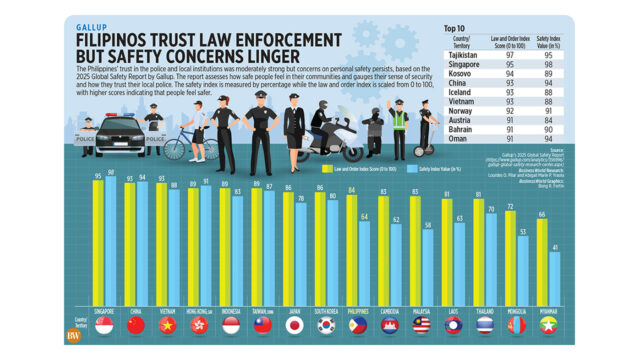
Gallup: Filipinos Trust Law Enforcement but Safety Concerns Linger

The Philippines’ trust in the police and local institutions was moderately strong but concerns on personal safety persists, based on the 2025 Global Safety Report by Gallup. The report assesses how safe people feel in their communities and gauges their sense of security and how they trust their local police. The safety index is measured by percentage while the law and order index is scaled from 0 to 100, with higher scores indicating that people feel safer.

Filipinos Trust Law Enforcement but Safety Concerns Linger

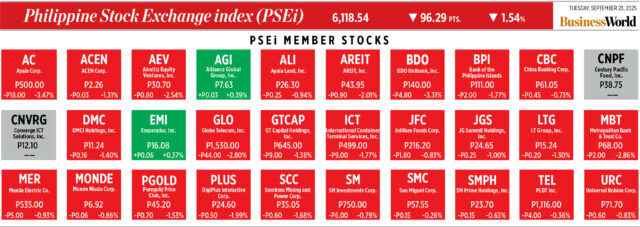
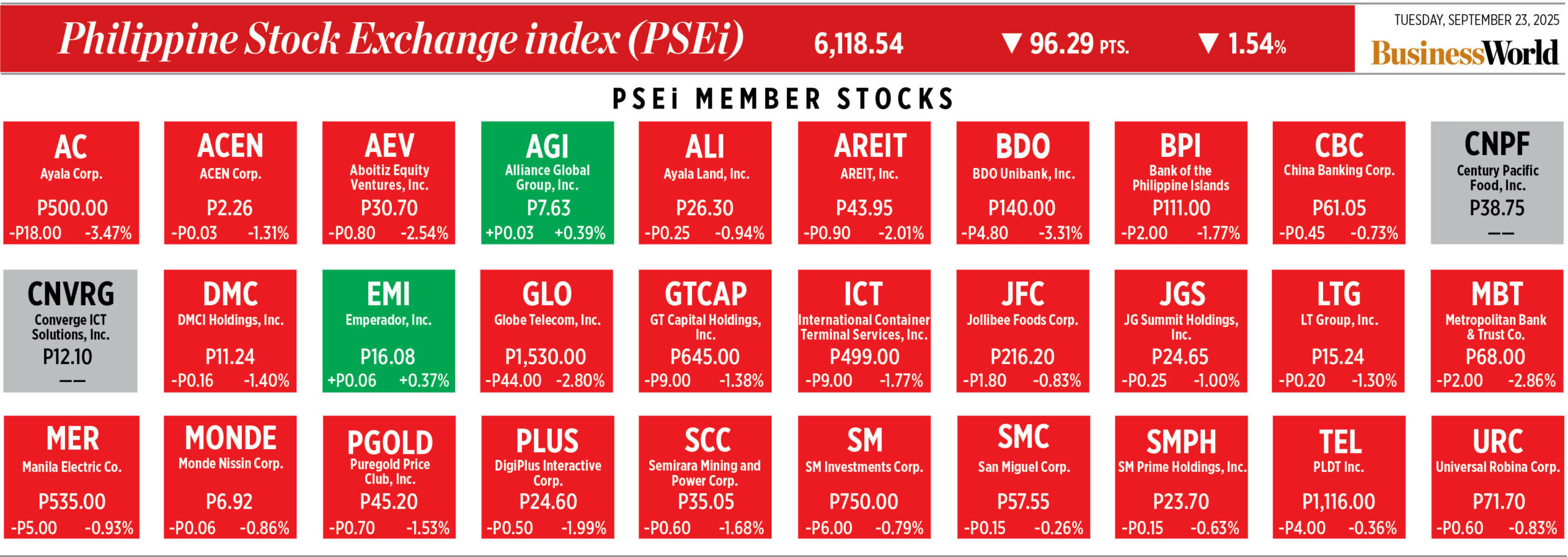
How PSEi member stocks performed — September 23, 2025

Here’s a quick glance at how PSEi stocks fared on Tuesday, September 23, 2025.


PHL consumer-driven growth fueled by borrowing, ANZ says

PJCOMP-FREEPIK

PHILIPPINE private consumption sets it apart in a region where such spending is more muted, ANZ Research reported, warning that credit card debt and salary loans are fueling the growth more than asset-creating loans like mortgages.

In its fourth quarter report, ANZ Research said household consumption accounts for over 70% of gross domestic product (GDP), but “growth in borrowings for asset creation (that is, mortgages) has been relatively muted, underscoring household concerns over income prospects. This pattern of spending is unhealthy.”

ANZ said domestic demand across Asian economies has softened, holding back growth, but the Philippines stands out as an exception.

“Except the Philippines, the private consumption impulse or the flow of new consumption relative to GDP, has either moderated or remained static in most economies,” it said.

Philippine GDP grew 5.5% in the second quarter, supported by a rebound in agricultural production and an acceleration in household spending.

Household final consumption expenditure rose 5.5% during the period.

ANZ Research flagged sluggish retail and auto sales as “frequency indicators” of weaker domestic demand in the region.

“As we have stressed in the past, the post-pandemic nature of job creation has been concentrated in low-paying jobs in segments like food and accommodation, which in turn has impacted consumption,” ANZ Research added.

The Bangko Sentral ng Pilipinas, citing preliminary data, reported that consumer loans grew 11.8% in July, slowing from 12.1% a month earlier.

Meanwhile, credit card loans rose 29.2% year on year in July from 29.9% in June. — Aubrey Rose A. Inosante

Farmers see no improvement in farmgate price of palay after 3 weeks of rice import freeze

REUTERS

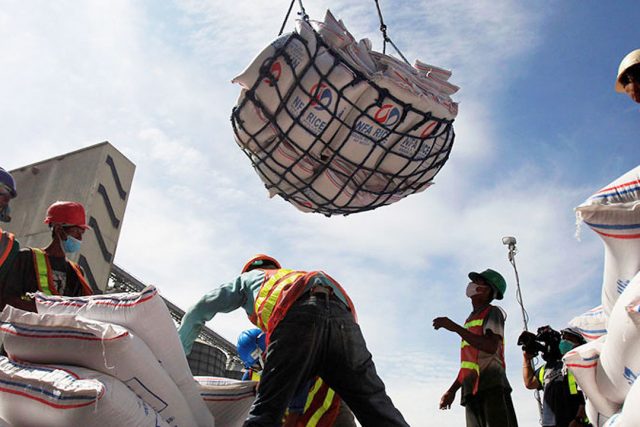
THE FARMGATE PRICE of palay (unmilled rice) has not improved despite a 60-day ban on rice imports which had been designed to provide relief for rice cultivators, a farm industry group said.

Jayson H. Cainglet, executive director for Samahang Industriya ng Agrikultura, said farmgate prices remain at P10-P12 per kilogram of palay.

In Tarlac, Pampanga, Nueva Ecija, Pangasinan, La Union, Bulacan, and Isabela, prices have even  gone down to P8 per kilo, he added.

The presence of cheap imported rice in the market is employed as leverage against domestic farmers, allowing traders to negotiate low prices to acquire the domestic harvest. The National Food Authority tries to offer palay buying prices that allow farmers to earn a return on their crop, but can only buy and store a small percentage of the domestic harvest. 

Mr. Cainglet, when asked whether he supported an extension of the ban, which started on Sept. 1, said: “Even if you extend it, peak harvest is over by the end of November.”

Farmers have begun to harvest despite the low farmgate price, he said, with such operations peaking in October, where prices could rise, he said.

He expressed support for the return of the 35% rice import tariff for Southeast Asian grain and 50% for rice originating elsewhere.

“We are also requesting a subsidy support price for palay of P5 per kilo on top of the current price, so farmers may stay competitive in the market,” Mr. Cainglet said. — Andre Christopher. H. Alampay

Flood-control contractor Hi-Tone also awarded Port of Tacloban upgrade project, regulator says

ICTSI

A LEADING flood-control contractor was also awarded a Tacloban port upgrade contract in 2024, the Philippine Ports Authority (PPA) said.

Hi-Tone Construction and Development Corp. was issued a notice of award for the P263.64-million upgrade of the Port of Tacloban on Jan. 29, 2024, the PPA said.

Hi-Tone, founded by Christopher S. Co, was among the 15 contractors that were identified cornering more than P100 billion worth of flood control projects between July 2022 and May 2025.

Mr. Co was an unsuccessful candidate for Congress in Albay in 2025. His brother is Rep. Elizaldy S. Co of the Ako Bicol party-list.

Rep. Co is himself the founder of Sunwest, Inc. another leading flood-control contractor. Rep. Co has said he has since divested from Sunwest.

Hi-Tone beat out four other bidders for the Tacloban project and passed the PPA’s post- qualification evaluation.

Asked to provide further comment, the PPA said the Tacloban Port project was 78% complete as of Aug. 25.

The contractor has completed the reinforced concrete pier component of the project, which is ready for turnover, the PPA said, Meanwhile, the roll-on/roll-off (RoRo) ramp remains under construction.

“The contractor has committed to complete the ramp within the next three months,” the PPA said.

“Amidst current challenges in flood control and infrastructure development nationwide, PPA underscores that only contractors who have passed the proper government bidding and procurement processes are awarded projects,” it said.

Nigel Paul C. Villarete, senior adviser on PPP (public-private partnership) at the technical advisory group Libra Konsult, Inc., said via Viber:

“It would certainly be advisable for closer and more serious consultations to take place, if only to further protect the integrity of the procurement process of the national government.”

Sunwest submitted bids for at least nine port projects in 2024 and 2025 including the P704.55-million Puerto Galera cruise terminal project, the P632-million Tagbilaran port expansion project, the P606.53-million expansion of the Port of Tapal in Bohol. It also bid for the Tacloban Port project  awarded to Hi-Tone.

“It would be advisable to review the award, for prudence, after Hi-Tone’s association in the flood control scandal. But if Notice to Proceed has been issued, it may be too late,” Rene S. Santiago, former president of the Transportation Science Society of the Philippines said via Viber.

Sunwest and Hi-Tone were among the top 1,000 largest companies in the Philippines, according to the 2024 edition of BusinessWorld Top 1000 Corporations in the Philippines.

Sunwest placed 286th in gross revenue in 2023, while Hi-Tone Construction ranked 642nd. — Ashley Erika O. Jose

Palace details key features of newly signed RoW law

PHILIPPINE STAR/WALTER BOLLOZOS

THE recently signed Accelerated and Reformed Right-of-Way (ARROW) will aid the Philippines in becoming an upper middle-income economy by facilitating the completion of infrastructure projects, the Presidential Communications Office (PCO) said in a statement on Tuesday.

The ARROW Act or Republic Act No. 12289, which revised key provisions of the 2016 Right-of-Way Act (R.A. No. 10752), overhauls the land acquisition process, compensation standards, expropriation and relocation rules governing infrastructure projects.

The PCO said the amended Section 10 of the law designates Republic Act No. 11966, or the 2023 Public-Private Partnership Code of the Philippines as the relevant document governing right-of-way acquisition in public-private partnership projects.

Meanwhile, compensation for affected land, structures, improvements, and immovable machinery will be determined according to the provisions of the New Civil Code, the PCO said.

The ARROW Act updates also require agencies and private concessionaires to make a deposit  on properties contemplated for acquisition, including crops, trees, and improvements, equivalent to 15% of market value.

Market value was defined as full replacement cost, accounting for depreciation.

The new law ties compensation to the schedule of market values set by the 2024 Real Property Valuation and Assessment Reform Act.

If no schedule is available, payments will instead refer to the Bureau of Internal Revenue zonal valuation and the assessed worth of improvements — such as immovable machinery, structures, crops, or trees.

For untitled land, owners or possessors must present a tax declaration, affidavits from disinterested local residents, a real property tax certificate, a certification from the Department of Environment and Natural Resources, and a technical description of the property.

The new relocation rules require the Department of Human Settlements and Urban Development to work with local governments in establishing and developing resettlement sites for informal settlers.

Section 12 holds private firms civilly or criminally accountable in the event of violations, including company presidents, managers, directors, and trustees.

President Ferdinand R. Marcos, Jr. signed into law Republic Act No. 12289 on Sept. 12. — Chloe Mari A.  Hufana

ADVERTISEMENT
ADVERTISEMENT