Home Blog Page 946

Missouri woman sentenced for trying to steal Graceland from Elvis Presley’s family

Graceland Memphis Tennessee — COMMONS.WIKIMEDIA.ORG

A MISSOURI woman was sentenced to nearly five years in prison for scheming to defraud the family of singer Elvis Presley of millions of dollars and steal their ownership interest in Mr. Presley’s iconic Graceland estate, the Department of Justice said on Wednesday.

The department said in a written statement that US District Court Judge John Fowlkes in Memphis sentenced Lisa Jeanine Findley, 54, to four years and nine months in federal prison on Tuesday. Ms. Findley, who had faced up to 20 years in prison, pleaded guilty to mail fraud in February.

Ms. Findley organized a scheme to conduct a fraudulent sale of Graceland — Mr. Presley’s former home which was opened to the public in 1982 and is designated as a National Historic Landmark — by falsely claiming Mr. Presley’s daughter, Lisa Marie, had pledged the estate as collateral for a non-existent $3.8-million loan that she failed to repay before her death in 2023, the department has said.

Elvis Presley died in 1977 at the age of 42 and is buried on the grounds of Graceland.

Ms. Findley, who used a fake company, forged documents, and false court filings to carry out the scheme, threatened to foreclose the property and auction it to the highest bidder if the Presley family did not pay the claim against the estate, according to the department.

Lisa Marie’s daughter, Riley Keough, who inherited the estate after her mother’s death, sued Naussany Investments, the company Ms. Findley used in her attempt to auction Graceland, saying her mother had never taken out the loan and that Naussany was engaged in fraud.

The sale was blocked by a judge, which led Naussany last May to withdraw all claims to the property, a popular tourist attraction that draws more than 600,000 visitors a year. — Reuters

Inspiring workers to volunteer outside of work

I’m the human resources (HR) manager of a medium-sized enterprise. My boss gave me the task of organizing and managing a new volunteer program for employees. How do I start it right? — Doctor Why.

Convincing employees to participate in weekend activities such as tree planting, feeding programs, or community clean-ups can be challenging. After all, weekends are sacred for many people.

That’s when people recharge with their family and relatives. Even unmarried workers spend their Saturdays and Sundays dating or pursuing hobbies.

With the right approach, volunteering can be enjoyable for employees as activities can foster camaraderie, instill a sense of purpose, and make them proud of their workplace.

Here’s how you can start. But first, ensure that your volunteer program encourages real volunteerism without compulsion. Don’t make them feel like they have no choice but to follow.

BEST PRACTICES
Here are certain best practices that you could emulate:

One, align with the company’s mission, vision, and values. Know the specific values that your organization can use to promote volunteer activities. This means practical application. If you’re in food manufacturing, it’s best to create activities that support hunger relief. However, it doesn’t mean giving away food nearing its expiry date.

Two, consult workers about their interests. You can start with workers belonging to an interest club. From there, you can create a committee composed of experienced volunteers. They can help you create programs and policies close to their interests. If necessary, conduct a survey to determine where to focus your activities.

Three, recognize and celebrate contributions. Acknowledge employees who spend personal time volunteering. Recognition can come via bulletin boards, newsletters, social media, or awards. Write brief articles featuring “volunteer champions” and their success stories. Focus on how they benefited from those programs.

Four, management must lead by example. Invite middle managers and top executives to roll up their sleeves. They can lead in planting saplings or serving food at shelters in evacuation centers. Imagine the value of seeing the CEO holding a shovel in muddy jeans. Employees will notice and should be proud of working for such managers.

Five, connect with the general interest of the workers. They don’t volunteer just because they’re told to. They show up because they believe their efforts matter. Your company must go beyond the logistical requirements. Emphasize why you have to be in a particular spot early in the morning. Share how planting 2,000 saplings can restore a watershed, or how one feeding program nourishes children who might otherwise skip a meal.

Six, make the program entertaining. Humans are social creatures. If an activity feels like an outing with friends, participation skyrockets. Add simple twists: play upbeat music while tree planting, create a “before and after” photo wall for clean-up drives, or hold a lighthearted contest between departments.

Seven, offer schedule flexibility. Instead of a rigid weekend schedule, provide options where the workers can do volunteer work during weekdays, say for two hours per day, morning or afternoon. Some may prefer tutoring kids or help out with NGOs to joining the company’s flagship program.

Eight, recognize and celebrate milestones. Recognition is a powerful motivator. Celebrate volunteers publicly with the greatest number of trees planted. Feature their photos in company newsletters, post highlights on social media, or create a “Volunteer of the Month” board. Small gestures work wonders.

Nine, make it an integral part of the company culture. Over time, volunteer programs can be woven into the company’s DNA. You can also use it as an occasional PR stunt to reflect on organizational values. When employees see that their organization invests in communities, they begin to view volunteerism as part of what it means to work there.

Ten, start small and level up in time. Don’t expect 100% participation on your first attempt. Start with light, high-impact projects, like a one-hour community clean-up or food distribution. Once employees experience the positive energy, they’ll be more open to bigger commitments. Momentum builds trust.

PURE VOLUNTEERISM
Encouraging employees to volunteer isn’t about filling buses with reluctant workers every weekend. It’s about creating meaningful opportunities, making them enjoyable, and ensuring people feel proud of their impact.

When organizations, through their executives and line leaders, lead by example, connect activities to purpose, and recognize efforts sincerely, volunteering stops being a “weekend sacrifice” and starts becoming a privilege.

And that’s when the real magic happens: employees discover that serving others not only helps communities but also deepens their sense of belonging and pride in their work.


Ask questions and receive Rey Elbo’s insights for free. E-mail elbonomics@gmail.com or DM him on Facebook, LinkedIn, X, or via https://reyelbo.com. Anonymity is guaranteed.

NGCP’s P93.68-B capex projects await ERC nod

PHILSTAR FILE PHOTO

THE National Grid Corp. of the Philippines (NGCP) has P93.68 billion in proposed capital expenditure (capex) projects awaiting approval from the Energy Regulatory Commission (ERC).

The ERC reviewed the 13 proposed capex projects submitted by NGCP, covering 2021–2025, during its open commission meeting on Thursday.

Alvin Jones M. Ortega, acting director at ERC’s regulatory operations service, said immediate approval of the projects is needed to allow NGCP to proceed.

Some of NGCP’s large-scale projects yet to obtain approval include the P44.41-billion Cebu-Leyte Interconnection Lines 3 and 4 Project; the P15.85-billion Sta. Maria 500kV Substation Project; the P10.47-billion Barotac Viejo-Unidos 230kV Transmission Line Project; and the P4.12-billion Pinamucan 500kV Substation Project.

The grid operator is also proposing the P3.91-billion Magalang 230kV Substation Project; the P2.79-billion Masiit 230kV Collector Station Project; the P2.67-billion Malaya 230kV Collector Station Project; the P2.6-billion Luzon Voltage Improvement Project 5; and the P2.52-billion Bolo 5th Bank Project.

The list also includes the P2.12-billion Dasol 230kV Substation Project; the P1.08-billion Plaridel 230kV Substation Project; the P733.92-million Tuguegarao-Enrile 69kV Transmission Line Project; and the P403.25-million Visayas Mobile Capacitor Bank Project.

According to Mr. Ortega, the projects were filed under NGCP’s fifth regulatory period (RP) rate reset, spanning 2021 to 2025.

“The due process under the 5th RP application is still ongoing so we are still not able to finalize…but because of NGCP’s intent to already pursue and start the implementation of certain projects that are under this application, they have submitted this motion for issuance of intent relief,” he said.

The rate reset process is typically a forward-looking exercise requiring the regulated entity to submit forecast expenditures and proposed projects over a five-year regulatory period.

The ERC then assesses the entity’s actual performance and adjusts rates as needed.

Under the Electric Power Industry Reform Act of 2001, the grid operator must seek ERC approval for any planned expansion or facility improvement, in line with its mandate to build, finance, and enhance the nationwide transmission system and grid.

ERC Chairperson and Chief Executive Officer Francis Saturnino C. Juan earlier said the agency hopes to issue a ruling on NGCP’s pending capex projects within the month.

Reacting to this, NGCP Spokesperson Cynthia P. Alabanza said the move is “more than welcome” as it will allow the company to pursue its projects.

“As we’ve been saying throughout the years, we really want expedited and on-time regulatory approvals because that will help NGCP fulfill its mandate,” she said. — Sheldeen Joy Talavera

Converge says prepaid brand Surf2Sawa reaches half a million users

CONVERGE

CONVERGE ICT Solutions, Inc. said its prepaid brand Surf2Sawa (S2S) has reached 500,000 active subscribers two years after its launch, reflecting adoption among budget-conscious broadband users.

“It’s been over two years since Converge introduced the prepaid model and we are pleased that this resonated deeply with consumers, as shown by the numbers… We see this as a win for wider broadband access,” Converge Officer-in-Charge for consumer unit John Paul Aguilar said in a stock exchange disclosure on Thursday.

Launched at the end of 2022, S2S aims to cater to the connectivity needs of the mass market — known to be budget-sensitive — by offering affordable and flexible top-up options, minimal installation requirements and fees, and a contract-free setup.

Converge Chief Executive Officer Dennis Anthony H. Uy said the growth in S2S subscribers reflects strong market adoption of prepaid broadband services, as customers seek budget-friendly and reliable connectivity.

“For years, many Filipinos have had to rely on wireless alternatives that, while useful, often fall short in offering reliable connectivity. S2S fills in that gap, and we’re glad to see that more customers are embracing this. The growth runway for us is still wide, as we continue to improve awareness and accessibility of our brand,” said Converge Vice-President and Product Management Business Unit Head of Surf2Sawa Conrado Pascual.

For the three months ending June, Converge’s attributable net income rose 6.93% to P2.93 billion from P2.74 billion in the same period a year ago, mainly driven by higher revenues.

The company recorded combined revenue of P10.98 billion, up 10.02% from P9.98 billion in the same period last year, according to its financial statement.

At the local bourse on Thursday, Converge shares closed 10 centavos, or 0.83% higher, at P12.18 apiece. — Ashley Erika O. Jose

Digital transparency for a cleaner Philippine budget

Corruption in public spending isn’t an abstraction for Filipinos; we see it every time a “completed” project turns out to be a patch of mud or a slab that cracks after the first rain. This year’s outrage over budget insertions made the pattern plain. Former Budget Secretary Florencio Abad called out what he described as an “unprecedented” P1.45 trillion in congressional insertions and reallocations in the national budget, the kind of maneuvering that bends priorities away from planning toward politics. When money is parked where it shouldn’t be, results follow, and not the good kind. The country is now digging through allegations that flood control funds were siphoned off through “ghost” or substandard projects that padded costs, enriched middlemen and left communities exposed to rising water.

If we want that cycle to break, we need digital transparency that exposes every peso’s path from proposal to payment. Not a dashboard that updates once a quarter, not a PDF dump, but a living system that lets citizens, journalists, contractors, auditors and line employees see the same data, in near-real time, with names, amounts, dates, locations, documents and decisions side by side. I want to be able to click on a barangay’s flood wall and see the bid notice, the winning supplier, the contract, change orders, progress payments, site photos and the engineer’s acceptance report. If anything looks off — like a firm with no equipment repeatedly winning, or unit prices jumping between adjacent towns — I should be able to flag it, and that flag should trigger a follow-up.

This isn’t utopian. Other countries have shown it can be done. Ukraine built ProZorro, an open-source e-procurement platform, after years of graft drained public trust. ProZorro mandates online publication of tenders, bids, awards and contracts, and its open data enables civil society to run independent checks. The World Bank has assessed the system as acceptable for use in development-financed projects and notes its legal mandate since 2016, with continuing upgrades for reconstruction. Researchers have also credited ProZorro’s “everyone sees everything” approach with real savings and fewer backroom deals.

Brazil launched a national Transparency Portal back in 2004, long before “open data” became a buzzword. It publishes detailed information on federal revenues and expenditures, transfers to states and municipalities and beneficiaries of programs, searchable and downloadable. The idea is simple: when the budget is visible to the public, misuse gets harder and honest officials gain allies. South Korea, meanwhile, runs KONEPS, a one-stop e-procurement system that covers planning, bidding, awards, contracting, delivery and payment while linking to hundreds of external databases. OECD reviews point to gains in efficiency and integrity because every step leaves a digital trace.

The Philippines isn’t starting from zero. We’ve taken steps with PhilGEPS and agency-level portals, and we rank respectably on some transparency measures. But public participation remains middling, and the newly exposed flood control mess shows how gaps are exploited. The International Budget Partnership’s 2023 survey gives the Philippines a public participation score of 33 out of 100, better than many neighbors, yet far from the kind of citizen involvement that can catch schemes early. If we want to stop insertions from morphing into overpriced riprap and “completed” projects that never existed, we have to move from scattered disclosures to end-to-end digital visibility.

What would that look like here? Start with a single public platform that stitches together the whole fiscal chain. The General Appropriations Act, budget releases, SAROs and NCAs, work programs, procurement plans, bidding documents, bid histories, contracts, variation orders, geo-tagged progress reports, acceptance and inspection forms and final payments should all live in one place with stable identifiers. Tie each project to a map and a timeline. Expose unit-cost catalogs so anyone can compare prices of gravel, steel or culverts across regions and years. Require suppliers and subcontractors to disclose ownership and related parties, then cross-reference those names against company registries and tax records. If a politician’s relative shows up in the beneficial ownership tree, that should be visible to everyone.

Make publication mandatory by law, with clear deadlines and penalties for noncompliance. Agencies that delay uploads should lose the ability to obligate new funds until they catch up. Give auditors read-write access for findings. Allow citizens to subscribe to alerts for specific projects or spending categories so they’re notified when a change order or payment is posted. Open up APIs so watchdogs, media and researchers can run their own analyses without begging for CSV files. And yes, protect privacy by redacting personal IDs, not the names of public officials or firms.

Procurement deserves special attention. The Ukraine and Korea examples show that integrity improves when every bidder sees the same information and every result is out in the open. We should mandate electronic auctions for standard goods, publish all evaluation scores and forbid opaque “post-qualification” maneuvers that can be abused. Every no-bid or negotiated award needs a detailed justification online, linked to the emergency or exception rule used, with automatic review by a central unit. Pair that with blacklisting that actually works: a company barred for collusion in one region shouldn’t reappear under a new name two provinces away.

We also need real-time risk flags. If a small contractor suddenly wins 10 flood control projects in adjacent districts, the system should raise a hand. If unit prices diverge sharply from the catalog, or if progress payments arrive without matching site photos and GPS tags, we should see warnings on the project page. Machine-assisted checks won’t replace auditors; they’ll help them aim faster.

Finally, transparency must be paired with consequences. When citizens can see the data, prosecutors and ethics bodies must act on credible signals. The recent flood control hearings and the swirl of testimony about kickbacks and ghost projects should end with cases filed and funds clawed back — not just headlines. If Abad’s alarm over massive insertions prompts deeper scrutiny of how last-minute budget changes feed corrupt networks, then digital transparency becomes more than a slogan, it becomes a guardrail.

I don’t want to marvel at another ribbon-cutting only to learn later that the structure was hollow. I want to open a public site on my phone, trace a peso from Congress to a culvert in my barangay and be able to say: this is where it went, this is who got paid, this is what we built. Other countries have shown that sunlight can be coded into the system itself. We can do the same, and we can do it now.

The views expressed herein are his own and do not necessarily reflect the opinion of his office as well as FINEX.


Reynaldo C. Lugtu, Jr. is the founder and CEO of Hungry Workhorse, a digital, culture, and customer experience transformation consulting firm. He is a Fellow at the US-based Institute for Digital Transformation. He teaches strategic management and digital transformation in the MBA Program of De La Salle University. The author may be e-mailed at rey.lugtu@hungryworkhorse.com

Why the most oil-rich country can’t keep the lights on

STOCK PHOTO | Image by Wiroj Sidhisoradej from Freepik

By David Fickling

IF YOU WANT an image of where the internal contradictions of the fossil fuel economy are headed as disruptive clean energy and a warming planet transform the 21st century, consider Kuwait.

The first real boomtown of the 1960s Arab oil rush, its people have a richer endowment of crude than any other nation on earth. The 101.5 billion barrels of reserves are equivalent to about 23,000 barrels for every resident — more than double the next-placed country. At current prices, this geological inheritance works out at about $4.3 million per citizen.*

And yet Kuwait is struggling to keep the lights on. In what was for decades one of the richest countries on the planet, rolling power outages have become a fact of life over the past two summers.

Electricity was cut to 30 regions in April as temperatures soared and households cranked up the air conditioning. At the peak, about 7.3% of demand went unmet, and the fire service warned locals not to use elevators in case they got stuck in apartment blocks that lost power for hours at a time. Factories were ordered to halt all operations between 11 a.m. and 5 p.m., a situation that persisted for five months until the bans were finally lifted last week.

Blackouts were still happening through May, with outages in 40 residential and 10 agricultural and industrial areas. By June, with temperatures hitting 51° Celsius (124° Fahrenheit), the government was begging residents to turn down air conditioners, install efficient light bulbs, and switch off appliances. Ministers even sent out drones to spot illicit cryptocurrency mining operations.

The simplistic explanation for this would be to tell the story that defenders of fossil fuels trot out to blame any network disruption on renewables. That’s not going to work in a country where 99.6% of generation is fueled by oil or gas, though. Every honest grid manager knows that such problems are never the fault of a single technology, but rather the result of years of miscalculations and under-investment.

In Kuwait, the biggest factors have been political gridlock, combined with a refusal to stare the reality of the energy transition and a changing climate in the face.

Unusually for the Gulf, Kuwait had a parliament with a measure of influence until the emir suspended democracy last year, but infighting has been endemic. With 15 different energy ministers over the past decade alone, decisions on necessary upgrades to creaking infrastructure were deferred until it was too late.

Added to that is the wasteful way the country consumes power. Subsidies of $3,200 per person mean electricity bills cover just 5% of grid costs. Some 60% of energy is used by air conditioners, but the sorts of narrow, shady streets that Middle Eastern people have been building for millennia to protect themselves from the heat are effectively illegal due to outdated building codes for the suburban sprawl of villas where citizens live.

There’s also been a dismal failure to take advantage of all that sunlight by installing photovoltaic panels. Imports in 2024 came to about $1.5 million, less than struggling states such as Liberia and South Sudan. Neighboring Saudi Arabia may be on track to shift 50% of its power generation to renewables by 2030, but even a more modest target of 15% in Kuwait “could be out of reach,” Nishant Kumar, an analyst with consultants Rystad Energy AS, wrote last week.

Kuwait could afford to be far more ambitious. It’s a small country, but about 90% is desert. Roughly 50 gigawatts of solar would be sufficient to meet all existing electricity demand, equivalent to what China installed in April alone. That would cover just 5% of the country, or 900 square kilometers — not a vast area, compared to the 116 sq km recently set aside for a new port northeast of the capital. It would also be cheaper than fossil power, and free up more oil and gas for export.

Such a move would also leave the country less at the mercy of foreign governments. About two-thirds of domestic gas production comes out of the same wells as its crude, so when the Organization of the Petroleum Exporting Countries cuts its oil output quota the emirate must pump less methane, too, forcing it to import from Qatar instead to fuel its generators. The result is a bizarre situation where a petrostate is also one of the world’s biggest LNG importers, bringing in about the same amount last year as the UK, which has 14 times as many people.

Cooler fall temperatures will give Kuwaitis some respite over the months ahead, but in a best-case scenario it will be years before the backlog of decaying infrastructure is fixed. While other Gulf emirates have diversified their economies for a post-petroleum era, Kuwait is still wedded to the dreams of the 1960s oil boom. The economy shrank in three out of the past five years.

Back in 2007, Kuwait was by some measures the richest nation in the world after Qatar and the United Arab Emirates. Right now, it’s barely ahead of Poland and Estonia. At a time when President Donald Trump is waging war on clean energy and even the European Union may be wavering, it’s a cautionary tale of where fossil fuel addiction can lead.

BLOOMBERG OPINION

*About two-thirds of Kuwait’s 4.4 million residents are non-citizen guest workers.

Fear of deportation grips undocumented women on California’s farms

REUTERS

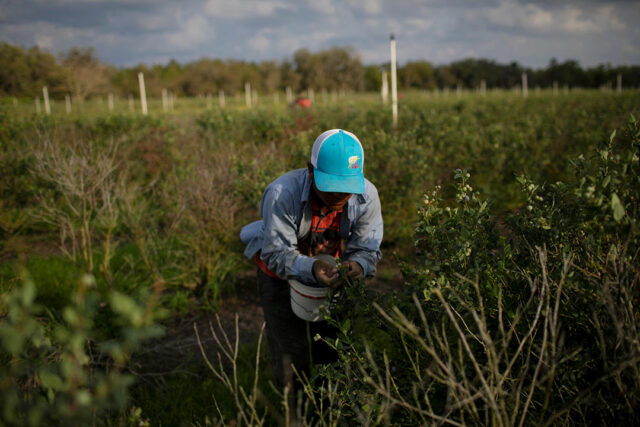
LOS ANGELES — At this time of the year, Maria should be hard at work picking grapes in California’s Central Valley, a crop so huge that it typically takes tens of thousands of workers to harvest.

This year, however, she is staying away from the vast vineyards, terrified of being arrested and deported in federal immigration raids targeting undocumented farm workers across the country.

While most of those being apprehended are men, the consequences can be devastating for families when the women who care for them are arrested.

Women carry the bulk of responsibilities for children and elderly relatives, and deportation can mean leaving behind young or vulnerable family members who need their support.

“I’m very scared,” said Maria, 45, whose name has been changed because she is undocumented and who spoke on the condition of anonymity.

Her two children, ages 10 and 20, have hearing disabilities that hamper their ability to communicate.

“My daughter is asking ‘What will happen if you get deported?’ She’s the one who’s the most afraid,” she said.

Maria, whose children are US citizens, has not worked since June when the administration of President Donald Trump scaled up its increasingly aggressive deportation plans.

More than 40% of the nation’s agricultural workforce is undocumented, according to the US Department of Labor.

Under pressure from the agriculture industry, on June 12, Mr. Trump instructed Immigration and Customs Enforcement (ICE) and other federal agencies to stop focusing on farm workers.

Those opposing the crackdown included the American Farm Bureau Federation, an advocacy organization representing two million farmers and ranchers.

But the respite was brief. The government reversed its stance four days later, putting hundreds of thousands of immigrant workers back in ICE crosshairs.

Since then, raids have increased. In July, a man died after falling from a building as he tried to escape agents during a chaotic raid and counter-protest at a cannabis farm in California.

NO CHOICE
In Ventura County, California, Ana, 44, whose name has also been changed, is still going to work cleaning and processing vegetables on a farm.

The undocumented single mother of three said she has no choice but to work in the fields out of economic necessity, although she too is frightened when she leaves home.

“I look at my children and I say, ‘I don’t know if I’m going to come back,’” she said.

“And I always tell them that I love them very much,” she added.

About half of undocumented women in the US are mothers of school-age children and bear the outsized share of caregiving of elders or other family members, according to the Gender Equity Policy Institute (GEPI), a non-profit organization based in Los Angeles.

That fact is intentionally absent from the Trump administration’s messaging about immigrants being criminals, said Nancy Cohen, CEO and founder of GEPI.

“Women immigrants have been disappeared from the debate by Trump and his enablers because that’s the only way they can get away with these illegal and cruel raids,” Ms. Cohen said.

“As soon as you think about this population being roughly half women with lots of children, that whole visual of the criminal immigrant man collapses,” she said.

For undocumented women, the threat of deportation adds insult to injury, as they are already paid less than their male coworkers.

In California, undocumented women in all categories of work make 87 cents for every dollar paid to undocumented men and 58 cents for every dollar paid to men in the general population, according to a report by GEPI.

Women have made up about 12% of those arrested by ICE this year, according to the Deportation Data Project, which collects government immigration enforcement information. The figure does not include arrests by other agencies such as Customs and Border Protection.

More than one third of the nation’s agricultural workforce is female, according to US Census data, and experts estimate as many as 40% of undocumented farm workers are women, although it is impossible to determine the exact number.

“Women play a huge role…. Many of them are mothers and many of them are single mothers,” said Teresa Romero, president of United Farm Workers (UFW), a national union.

“So they have two full-time jobs, and they’re as experienced, as efficient, as professional as the men are,” she said.

For women without legal authorization in California, agriculture is the second largest source of employment after domestic labor, according to Ms. Cohen’s research.

Given the potentially devastating loss of income, UFW does not advise laborers as to whether they should go to work. Instead, it asks farm owners with union contracts to deny immigration agents access to their farms.

Without undocumented workers, California agriculture’s gross domestic product would contract by 14%, according to June research by the Bay Area Council Economic Institute.

Grapes are the state’s second most valuable crop by revenue after dairy, bringing in $5.5 billion in annual revenue, according to the California Department of Food and Agriculture.

ECONOMIC IMPACTS
When women in particular are deported, adverse economic impacts ripple across entire communities, threatening to reverse years of gains reflected in decreased poverty rates and rising incomes in the US, experts say.

Ana, like many immigrants, regularly sends money home to relatives in Mexico.

Studies suggest that women send slightly more of their earnings to their home countries via remittances than do male immigrants.

Also, when women are deported with children who are US citizens, the already shrinking future US labor force is further diminished.

In fact, a recent report from the Bipartisan Policy Center, a Washington, DC-based nonprofit, recommended expanding immigration to help fill jobs left by an ageing workforce and declining domestic birth rate.

In one respect, Maria is fortunate because she is married and her husband is still working. But that does not lessen her anxiety.

If she were to be deported to Mexico, it would rip her family in two. Her son, a young adult, would stay while she would take her daughter with her, she said.

Ana is making a contingency plan to keep her children, all of them citizens, in the US if she is deported. She dreams of them completing their education.

“That’s why I’m here holding on for my children,” Ana said, adding that she has always paid taxes and has no criminal record.

“In this country, I have had a lot of opportunity because I have dedicated myself to working in the fields and doing well,” she said.

“We are good people.” — Thomson Reuters Foundation

UMG wins copyright lawsuit over Mary J. Blige’s 1992 sample

AMAZON.COM

UNIVERSAL Music Group convinced a New York federal court on Tuesday to dismiss a copyright infringement lawsuit over an allegedly unauthorized sample in Mary J. Blige’s 1992 hit song “Real Love.”

US District Judge Dale Ho ruled that “Real Love” was not sufficiently similar to the Honey Drippers’ 1973 song “Impeach the President” to support Tuff City Records’ case against UMG.

Spokespeople and attorneys for Tuff City and UMG did not immediately respond to requests for comment on the decision. Ms. Blige is not involved in the lawsuit.

Tuff City said in the lawsuit that it owns tens of thousands of music copyrights “from the genres of Blues, Rhythm and Blues, Jazz, Funk, Soul, Hip-Hop, New Orleans and Latin Music, much of which might otherwise fall into obscurity.” The label has previously filed copyright lawsuits over other songs by high-profile musicians including the Beastie Boys, Jay-Z, Ye (formerly known as Kanye West); and Frank Ocean.

The lawsuits against the Beastie Boys and Jay-Z were later dismissed. Ye’s label and Tuff City settled their dispute; while Tuff City dismissed its lawsuit against Ocean’s label two months after filing it.

Ms. Blige’s “Real Love,” from her debut album What’s the 411?, peaked at number seven on the Billboard Hot 100 chart in 1992.

Tuff City sued UMG last year and alleged that “Real Love” used a drum part from “Impeach the President” that the label had failed to clear.

Mr. Ho dismissed the case on Tuesday after finding that the songs were not “substantially similar.”

“The songs do not sound the same; a lay listener would not recognize ‘Real Love’ as having been appropriated from ‘Impeach the President’,” Mr. Ho said. — Reuters

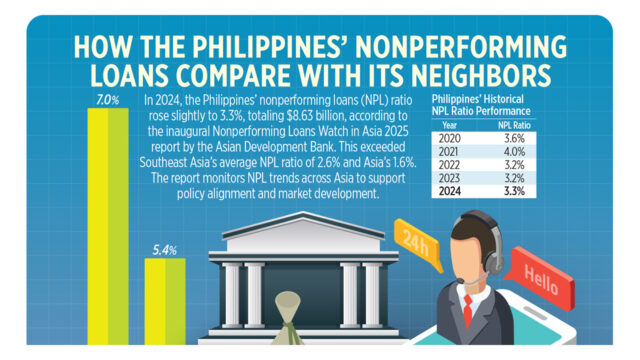
How the Philippines’ Nonperforming Loans Compare With Its Neighbors

In 2024, the Philippines’ nonperforming loans (NPL) ratio rose slightly to 3.3%, totaling $8.63 billion, according to the inaugural Nonperforming Loans Watch in Asia 2025 report by the Asian Development Bank. This exceeded Southeast Asia’s average NPL ratio of 2.6% and Asia’s 1.6%. The report monitors NPL trends across Asia to support policy alignment and market development.

How the Philippines’ Nonperforming Loans Compare With Its Neighbors

How PSEi member stocks performed — September 25, 2025

Here’s a quick glance at how PSEi stocks fared on Thursday, September 25, 2025.


Ex-DPWH official tags more senators in flood-control scam

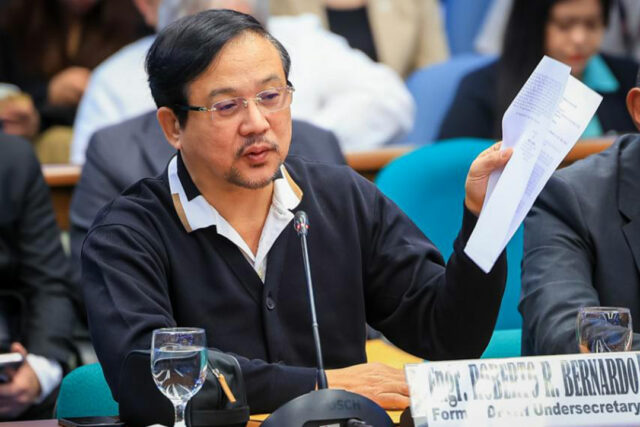
FORMER Public Works Undersecretary for operations Roberto R. Bernardo attended the Senate Blue Ribbon inquiry on the anomalous flood control projects of the Department of Public Works and Highways, Sept. 25, 2025. — SENATE PRIB

By Adrian H. Halili, Reporter

A FORMER Public Works undersecretary has implicated more Philippine lawmakers in a multibillion-peso kickback scheme tied to flood-control projects.

At a Senate blue ribbon committee hearing on Thursday, former Public Works Undersecretary Roberto R. Bernardo named Senators Francis “Chiz” G. Escudero, former Senators Ramon “Bong” B. Revilla, Jr., and Maria Lourdes Nancy S. Binay as among those who benefited from budget insertions.

The lawmakers had demanded as much as 20% in commissions, he said, while also accusing Party-list Rep. Elizaldy S. Co of getting a cut from project funds.

Mr. Bernardo admitted his role in the scam. “I made a mistake and allowed myself to be used as a tool in wrongdoing,” he told senators.

In a 12-page affidavit, the former official of the Department of Public Works and Highways (DPWH) claimed that he had delivered P160 million, or 20% of a P800-million project, to an associate of Mr. Escudero.

He added that the project list was inserted into the 2025 General Appropriations Act.

The senator was replaced as Senate president earlier this month after he admitted receiving campaign donations from a contractor but denied influencing contract awards.

Mr. Bernardo also claimed that a staff of former Senator Binay, who is now Makati City mayor, requested about P37 million, or 15% from projects amounting to P250 million.

He added that he had personally delivered the money to Ms. Binay in a house in Quezon City.

“Engineer Alcantara collected 15% commitment or about P37 million which was turned over to me and which I then delivered to Senator Binay at a house in Quezon City,” he said.

According to Mr. Bernardo, he met Mr. Revilla in Makati City in 2024 where he gave a list of projects given to him by Mr. Alcantara.

“Senator Revilla asked for a commitment, which I suggested, and he then approved at 25% of the total amount of the projects,” he added.

He said that the request for additional funds was relayed to Mr. Alcantara as support for Mr. Revilla’s 2025 senatorial campaign.

The former undersecretary also claimed that Mr. Co negotiated kickbacks through ex-district engineer Alcantara.

“Engineer Alcantara then told me that Cong. Zaldy Co was asking for a 25% commission. Out of that amount, 2% was to be shared equally between Engineer Alcantara and myself,” he said.

“Furthermore, Engineer Alcantara would tell me every time that he made deliveries of cash to Cong. Zaldy Co in compliance with his commitment,” he added.

Mr. Revilla and Mr. Co were also among the officials named by Mr. Alcantara last Tuesday allegedly benefiting from funds from flood mitigation projects, along with Senators Jose “Jinggoy” P. Estrada and Emmanuel Joel J. Villanueva. They have denied their involvement.

In a separate testimony, Mr. Co’s former security aide Orly Regala Guteza also implicated former House Speaker Martin Ferdinand Martin G. Romualdez and Benguet Rep. Eric G. Yap over the flood control scheme.

Mr. Guteza claims that he was part of a team that would deliver bags of money, which they referred to as basura (garbage), to the lawmakers.

“There are more occasions when we deliver ‘garbage’ to Speaker Romualdez’s house and Congressman Zaldy Co’s house because we have different detailed close-ins, backups, and advanced parties, which rotate,” he told reporters in mixed English and Filipino.

He also claimed that part of the team that delivered money to Mr. Co and Mr. Romualdez was the Benguet representative.

Mr. Romualdez earlier resigned from the speakership amid mounting criticism of his alleged role in the Philippines’ multibillion-peso flood control scandal. This came a week after the Senate leadership change.

WELL-ORCHESTRATED PLAN
Separately Mr. Escudero denied the allegations that he had any hand in acquiring funds from flood control projects.

“I vehemently deny the malicious allegations and innuendos made by former DPWH Usec. Roberto Bernardo in today’s Senate Blue Ribbon Committee,” the senator said in a statement. “By his own admission, he never had any contact with me directly regarding this matter—and I will prove that he is lying about my alleged involvement.”

He claims that there is a “well-orchestrated plan” to divert attention from the real perpetrators of the flood control scam by attacking the Senate and its members.

In a Facebook post, Ms. Binay also said that the accusations made against her were untrue.

“I am surprised and saddened that I am being implicated in the anomalies of the DPWH. The accusations against me are untrue,” she said.

She added that her name was being used to divert attention “from those who really need to be held accountable for this issue.”

Mr. Yap had also denied allegations involving him in the multi-billion-peso scandal, noting that he had never accepted or authorized the delivery of cash from flood control funds.

“I categorically deny any involvement in the acts being alleged. I have never accepted, nor authorized, the delivery of money in connection with flood control projects. These claims are untrue,” he said in a statement.

Mr. Revilla and the Office of Mr. Co did not immediately reply to a Viber message seeking comment.

However, Mr. Revilla earlier denied any hand in the flood control scam, while Mr. Co, who is overseas, has called the allegations against him “false and baseless.”

Mr. Romualdez, meanwhile, said he was “deeply surprised” by the allegations, which he described as “an outright and complete fabrication.”

In a statement, he said the McKinley property where the witness claimed to have made deliveries to in December 2024 has been under renovation since January 2024.

“I repeat: I have never received or benefited from kickbacks in any infrastructure project. I have never authorized, instructed, or allowed anyone to engage in any conduct that would betray the people or taint my name,” he said.

The Philippine Senate is investigating irregularities in the Public Works agency’s flood-mitigation projects, which have received about P500 billion since 2022.

Critics have warned that corruption undermines disaster preparedness at a time when the Philippines, battered by an average of 20 storms annually, is ranked the world’s most disaster-prone country in the world.

PROTECTED WITNESS
Meanwhile, Justice Secretary Jesus Crispin C. Remulla told reporters Mr. Bernardo has been granted provisional security as a “protected witness” while his application to the Witness Protection Program is under review.

Mr. Remulla urged senators to allow the Justice department to complete its assessment, citing the seriousness of the allegations. He said a protected witness is entitled to security and benefits while testifying, even before full admission to the WPP.

Becoming a state witness, however, requires a separate process and depends on the significance of the testimony in securing convictions.

“Once a person is granted state witness status, they are discharged from criminal and civil liability,” Mr. Remulla said. “That’s why our first demand is restitution, because once discharged, we have nothing more to gain.”

The agency earlier provisionally accepted five others as protected witnesses: contractors Cezarah Rowena C. Discaya and her husband Pacifico F. Discaya and three former DPWH engineers — Henry C. Alcantara, Brice Ericson P. Hernandez and Jaypee Mendoza. The engineers remain under Senate custody pending evaluation, though Mr. Remulla said they would also be given security.

Mr. Remulla also confirmed the National Bureau of Investigation is set to file charges of indirect bribery, malversation against those implicated in the flood control controversy.

“It is the same recommendation to (names from Mr. Alcantara), indirect bribery, malversations, and other charges under (Republic Act No.) 3019,” Mr. Remulla told reporters.

The Justice secretary confirmed that among those they intend to charge were Mr. Escudero, Ms. Binay, and Mr. Romualdez.

He added that he has already informed the Anti-Money Laundering Council to potentially freeze the accounts of the individuals named by Mr. Bernardo.

Mr. Remulla added that Ako Bicol party-list Rep. Zaldy Co is being tracked and has been included in an immigration lookout bulletin order (ILBO) following a prior request by Public Works Secretary Vivencio B. Dizon.

“Yes, he’s being tracked already. We are trying to track him, and many people are helping.”

He added that reports of Mr. Co being in Spain are being verified with flight details received by the Justice department. with Erika Mae P. Sinaking

Storm Opong triggers storm signals, class and gov’t work suspension in various areas

METROPOLITAN Manila Development Authority (MMDA) Chairman Romando S. Artes led an emergency meeting with representatives from various government agencies to prepare for Severe Tropical Storm Opong, at the MMDA head office in Pasig City on Thursday. — PHILIPPINE STAR/MIGUEL DE GUZMAN

TROPICAL WIND signals were hoisted in more than a dozen areas, as Severe Tropical Storm Bualoi, locally known as Opong, approaches and threatens to bring torrential rains and strong winds, according to the state weather bureau.

In a 5 p.m. advisory, the Philippine Atmospheric, Geophysical and Astronomical Services Administration (PAGASA) raised Signal No. 3 over Sorsogon and the northern portion of Masbate, including Ticao and Burias Islands, northern Samar and the northern portion of eastern Samar, and the portion of Samar, where storm-force winds pose a moderate to significant threat to life and property.

Placed under Signal No. 2 were the eastern portion of Batangas, the southern portion of Quezon, Camarines Norte, Camarines Sur, Albay, Catanduanes, the rest of Masbate, Marinduque, Romblon, and Oriental Mindoro.

It was likewise in effect over the central portion of Eastern Samar and Samar, BIliran, and the northwestern portion of Leyte.

Meanwhile, Signal No. 1 was raised in wide areas, including the central and southern portions of Isabela, Quirino, Nueva Vizcaya, Ifugao, the southwestern portion of Mountain province, Benguet, the southern portion of Ilocos Sur, La Union, La Union, Pangasinan, Aurora, Nueva Ecija, Tarlac, Zambales, Bataan, Pampanga, Bulacan, Metro Manila, Rizal, Cavite, the rest of Batangas and Quezon, Laguna, Occidental Mindoro, Cuyo Islands and Calamian Islands.

In the Visayas, Signal No. 1 covers the rest of Eastern Samar, Samar, and Leyte, along with Southern Leyte, northern Cebu including Bantayan and Camotes Islands, northern portion of Negros Occidental, northern Iloilo, Capiz, Aklan, and the northern portion of Antique. In Mindanao, it covers Siargao, Bucas Grande, and Dinagat Islands.

PAGASA noted that the highest Wind Signal it may hoist is Wind Signal No. 4 throughout the passage of Opong.

Packing maximum sustained winds of 110 kilometers per hour (kph) and gusts of up to 135 kph, Opong was last spotted 195 kilometers east northeast of Guiuan, Eastern Samar, moving westward at 15 kph, according to PAGASA’s 5 p.m. advisory.

The Southwest Monsoon is also expected to exacerbate the effects of Bualoi, bringing torrential rains that have prompted several rainfall warnings in large parts of Luzon and the Visayas.

CLASS, WORK SUSPENSION
This has also prompted Malacañang to announce government and class suspensions on Thursday through Memorandum Circular No. 102 signed by Executive Secretary Lucas P. Bersamin.

The Palace suspended government work and class suspensions in the following areas: Metro Manila, Biliran, Eastern Samar, Northern Samar, Samar, Masbate, Romblon and Sorsogon.

The circular noted agencies for vital and health services, preparedness and response duties must continue.

Meanwhile, class suspensions were announced for the following areas: Aklan, Albay, Antique, Batangas, Bataan, Camarines Norte, Camarines Sur, Capiz, Cavite, Catanduanes, Guimaras, Iloilo, Laguna, Leyte, Marinduque, Negros Occidental, Oriental Mindoro, Rizal and Quezon.

The circular said the localized cancellation or suspension of classes and work in government offices may be imposed by their respective local mayors.

Meanwhile, the National Disaster Risk Reduction and Management Council (NDRRMC) reported via Facebook that the Department of Social Welfare and Development (DSWD) is preparing by sending thousands of family food packs to areas that may be affected, such as Sorsogon and Camarines Sur.

Several cities in Metro Manila and more than a dozen areas also announced the suspension of classes in preparation for the storm’s impact. These include the cities of Las Piñas, Manila, Marikina, and Muntinlupa.

The Philippine government has also ordered the full implementation of its 2024 National Disaster Response Plan (NDRP) as the country braces for more storms during the peak of the typhoon season.

Mr. Bersamin signed Memorandum Circular No. 100 on Sept. 23, directing the NDRRMC, through the Office of Civil Defense, to lead the rollout of the plan, Malacañang said in a statement on Thursday.

“It is imperative for all National Government agencies and instrumentalities, including government-owned or -controlled corporations, and LGUs to support and cooperate towards the successful implementation of the 2024 NDRP,” MC 100 read.

“In accordance with their respective mandates, all concerned agencies and instrumentalities of the National Government, including government-owned or -controlled corporations, are hereby directed, and all LGUs are hereby encouraged, to undertake efforts in support of the implementation of 2024 NDRP, and the plans and programs specified therein,” it added.

The directive also requires the Presidential Communications Office to coordinate with the disaster council in ensuring the plan is disseminated to concerned agencies.

The NDRP, adopted on the NDRRMC’s recommendation, outlines strategies for disaster preparedness, response, and early recovery.

It aims to save lives, provide rapid assistance, and mitigate the socioeconomic impact of natural calamities that regularly batter the country.

The Philippines, among the most disaster-prone nations globally, is hit by about 20 tropical cyclones every year. — Edg Adrian A. Eva and Chloe Mari A. Hufana

ADVERTISEMENT
ADVERTISEMENT