Home Blog Page 937

Enhanced alignment, broader culture for stronger cyber defenses

BusinessWorld has also captured the attention of the business community, industries in particular, through BusinessWorld Insights.

BusinessWorld Insight’s Cybersecurity Series kicks off with discussions on securing organizations

By Krystal Anjela H. Gamboa

As digital innovation becomes an imperative in businesses across the Philippines and the risks that accompany have never been more sophisticated, implementation of cybersecurity becomes critical. Whether it may be a multimillion corporation or a small or medium enterprise, businesses have to equip themselves against cyber threats.

Recognizing the need for heightened awareness about cyber threats and wider understanding about cybersecurity, BusinessWorld, together with the Cybersecurity Council of the Philippines (CSCP), has spearheaded a series of BusinessWorld Insights fora, kicking off with a discussion on “Fortifying Cybersecurity Among Organizations” last Aug. 22 at the SEDA Manila Bay Hotel in Pasay City.

The series is part of BusinessWorld’s and PhilSTAR Media Group’s advocacy campaign that aims to forge partnerships between the government and businesses for better cybersecurity legislation; to educate the public on cybercrime prevention; and to increase awareness among sectors of the importance of cybersecurity.

“We are raising a call for a nation more empowered to defend itself against cyberthreats and cybercriminals. Cybersecurity is not solely a concern of our IT teams, but rather a foundational business imperative and a shared national responsibility,” BusinessWorld’s Executive Vice-President Lucien C. Dy Tioco said in his welcome address.

CSCP Founding Chairman Donald Patrick L. Lim

CSCP Founding Chairman Donald Patrick L. Lim shared the same sentiments in his keynote, noting that cybersecurity is becoming the backbone of governance and corporate survival as businesses integrate advanced technology into their operations.

“There is no gray area. It’s either you’re secure or not secure,” he said.

The forum gathered business, technology, and cybersecurity experts to identify the top cybersecurity threats businesses face today and to explore the strategies that can be employed in response to these threats.

The rise of cyberthreats

As the workplace is no longer confined to office cubicles and desktop computers, there has been an ever-expanding network growth in today’s hybrid setups. If not protected, these connections can be exploited by cybercriminals.

ePLDT and PLDT Enterprise Field CISO and Cybersecurity Product Head Alexis Bernardino

“Attackers are no longer breaking in, they are just logging in,” Alexis Bernardino, Field CISO and Cybersecurity Product Head at ePLDT and PLDT Enterprise, stressed during the first panel discussion.

Such cyberattacks have risen dramatically in recent years. As technology evolves, so does the crimes. What used to be simple viruses have evolved into highly organized and well-funded operations. Hence, companies can no longer afford to treat cybersecurity as an afterthought. One breach can wipe out years of hard work, drain finances, and destroy reputations.

As the Philippines accelerates its digital transformation — from embracing cloud platforms, e-wallets, to online government services — the country has also become a growing target. Ransomware has evolved into an industry of its own. Insider threats continue to undermine security from within.
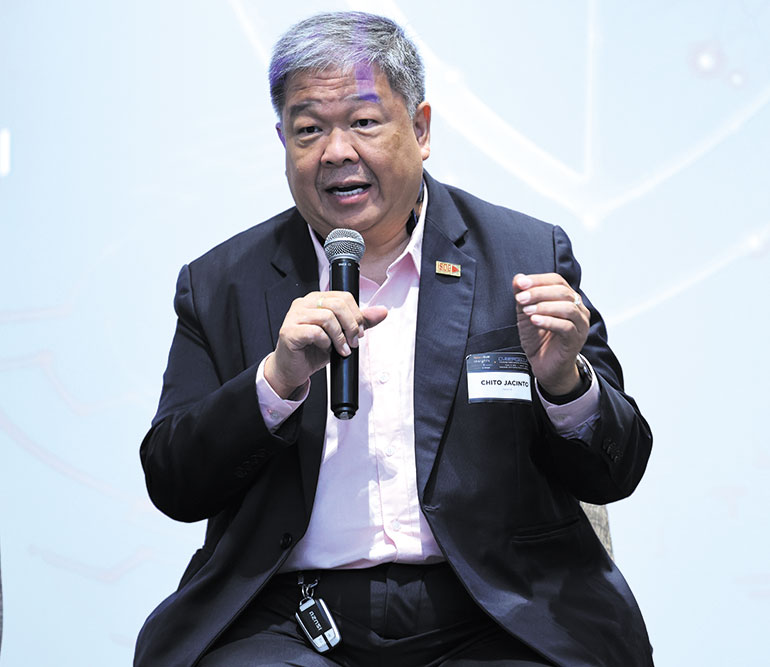
Information Security Officers Group (ISOG) President Chito Jacinto

“You don’t ask what you will do if you get breached, but what you will do when you get breached,” Chito Jacinto, president of the Information Security Officers Group (ISOG), emphasized.

On public-private collaboration

No one can stand alone against the speed of today’s cyber threats. Public and private collaboration extends beyond crisis response. It also involves long-term capacity-building such as joint training programs, research funding, and policy development.

While private sectors contribute expertise and resources, the government can craft frameworks that incentivize compliance and penalize negligence.

Police Colonel Jay Guillermo, chief of the Cyber Response Unit of the Philippine National Police Anti-Cybercrime Group, heeded the needed teamwork.

PNP Anti-Cybercrime Group Cyber Response Unit Chief Police Colonel Jay Guillermo

“We need a collaboration between private organizations and law enforcement. Investigations and police work are reactive,” he said. “Cybersecurity needs to be proactive.”

For workplaces, this will translate into strengthened protections: businesses gain access to more reliable security services and better-prepared employees. The government, then, will benefit from private sectors that are aligned with national cybersecurity goals.

Ultimately, in a digital economy where threats recognize no borders or industries, the only defense that is most effective is one built on trust and cooperation across sectors. This dual approach ensures that efforts are not fragmented, but sustainable.

Integrating AI into defenses

With its continuing relevance, artificial intelligence (AI) is positioned as a powerful defender. Since it can analyze billions of data in real time, it can flag unusual behavior such as suspicious logins or abnormal file transfers. Additionally, with its predictive systems feature, it can anticipate incoming attacks by studying existing patterns, reducing response times.

Yet, AI can also be a weapon for attackers. Cybercriminals have been utilizing it to craft phishing emails, generate deepfake voices, and deploy bots that test passwords or scan systems for vulnerabilities at scale.

“Every access point in your infrastructure is a valid entry point for cyber breaches,” Mr. Bernardino lamented. “They don’t even have to be sophisticated attacks, but simple attacks like email phishing and scams. What more with sophisticated AI?”

There had been calls for the government to pass legislations to protect the digital infrastructure, particularly in the usage of AI. As Mr. Jacinto of ISOG stated, “We don’t see much of an improvement in terms of implementation right now. The capabilities of the Data Privacy Act are not sufficient or clear enough.”

The urgency is clear: as more workplaces adopt AI and expand digital operations, legislations must also evolve just as fast. Without laws, businesses will remain vulnerable, and public trust in digital transformation could be compromised.

Cybersecurity culture

Despite advanced firewalls, AI-driven detection systems, and encryption protocols, the biggest vulnerability remains human error.

PwC Philippines Risk Services — Cybersecurity and Privacy Executive Director Mark Anthony Almodovar

To counter this, organizations are now recognizing that cybersecurity is not simply a technical issue, but a cultural one. Assessing a workforce’s knowledge and capacity with cybersecurity and equipping them with the knowledge will be key, as PwC Philippines Risk Services — Cybersecurity and Privacy Executive Director Mark Anthony Almodovar noted.

“Rather than saying people are the weakest links, think of people as the most important assets. Test your people. If you don’t test your people, they will not be able to protect against what is new to them,” he said during the second panel discussion. 
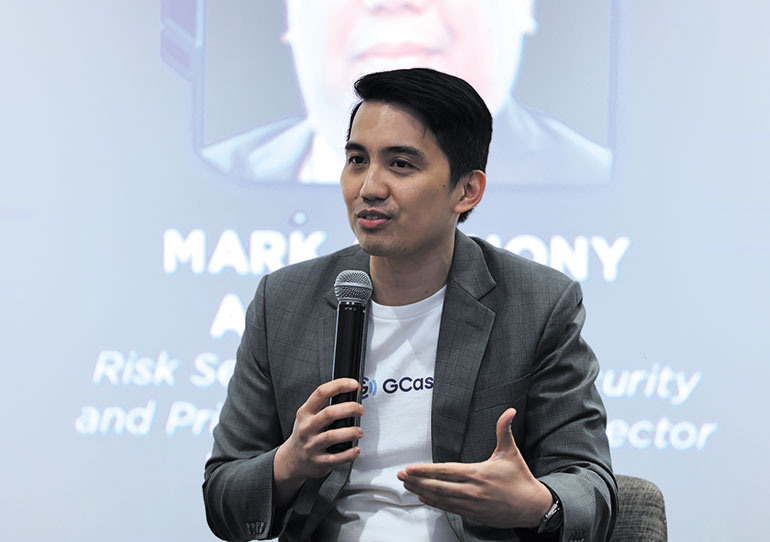
GCash Chief Information Security Officer Miguel Geronilla

Companies have been investing in cybersecurity training for their employees to equip them with knowledge to identify and respond to such risks, as GCash Chief Information Security Officer Miguel Geronilla shared.

“Having a security-first mindset means always thinking of security every day,” he said. “We must be secure by default, and that means being able to do secure practices on our own. It’s not about the usual awareness, but embedding it into everyday practices.”

Carmelo Rondain Alcala, a board of trustee of ISACA Manila Chapter, reiterated the four attributes of control, which organizations should couple with their people upskilling efforts.
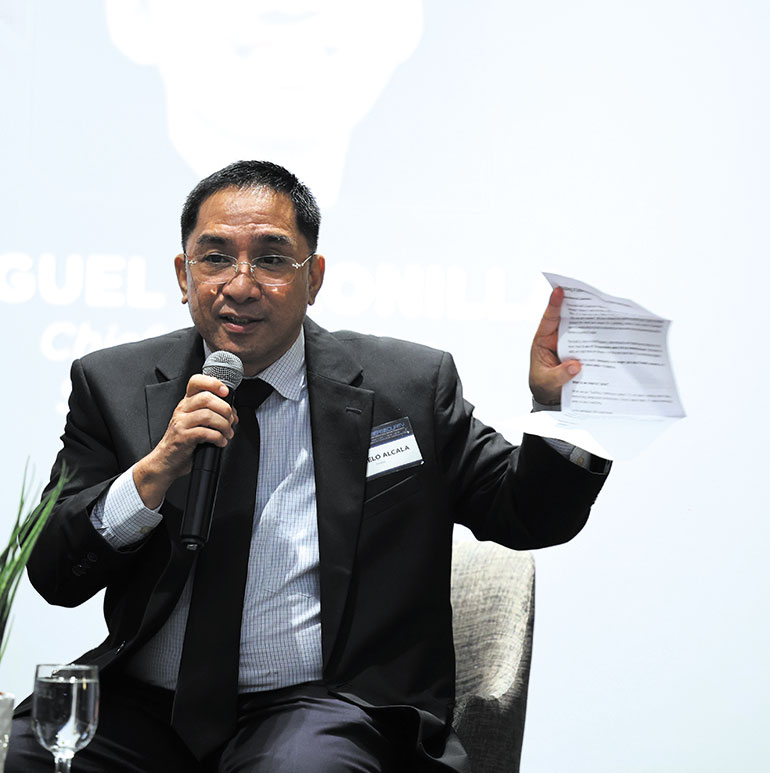
ISACA Manila Chapter Board of Trustee Carmelo Rondain Alcala

“Policies and procedures, configurations, monitoring, reporting — without these four attributes of control, your cybersecurity is weak,” Mr. Alcala said.

Such actions must involve education and awareness, where said training sessions keep the employees alert. Clear policies should also be held where leaders must be set as an example.

By cultivating a culture of vigilance, alongside investing in advanced technologies and preparations for inevitable threats, organizations can safeguard their digital frontlines and so gain more confidence to thrive in more digital world.

“Cybersecurity is only as tough as the people using them. This is why culture matters, from the CEO down. It’s not simply a boardroom topic,” CSCP Executive Director and Co-Founder Julian Louie Singson shared in his closing remarks synthesizing the discussions.
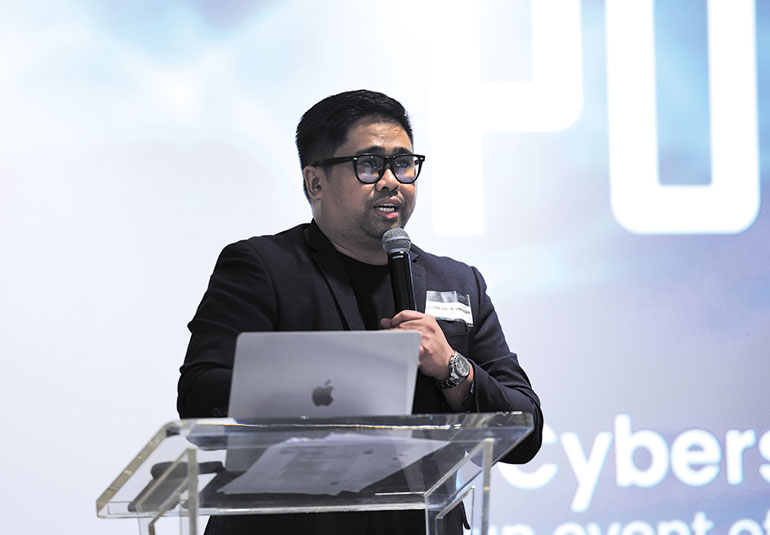
CSCP Executive Director and Co-Founder Julian Louie Singson

As the future brings new technology-driven opportunities, cyber threats will also come along. A secure digital environment has become more vital for organizations to gain trust from stakeholders and to build resiliency within. This calls for enhanced initiatives within organizations for firmer public-private alignment among stakeholders, stronger data protection across departments, and wider cybersecurity culture in the workplace.

Two more fora are under way for BusinessWorld Insight’s Cybersecurity Series, followed by a culminating Cybersecurity Summit in March next year.

This BusinessWorld Insights forum was presented by BusinessWorld Publishing Corp. and GCash, in partnership with the Cybersecurity Council of the Philippines, sponsored by PLDT, and supported by the Asian Consulting Group, American Chamber of Commerce of the Philippines, British Chamber of Commerce of the Philippines, Bank Marketing Association of the Philippines, CCI France Philippines, the Information Security Officers Group, Management Association of the Philippines, Philippine Chamber of Commerce and Industry, Philippine Franchise Association, Philippine Retailers Association, with official media partner The Philippine STAR.


Work from paradise: Astoria Boracay as a haven for remote work & bleisure

As remote work and hybrid setups become more common, digital nomads are transitioning from office cubicles to vibrant cafés, serene gardens, or refreshing beach views. Welcome to the bleisure life!

At the forefront of this is Astoria Boracay, a haven that perfectly blends productivity and paradise on the powdery white sand shores of Station 1. The resort provides a refreshing backdrop for remote work, combining the signature warmth of Filipino hospitality with world-class service.

A Workspace with a View

Set up your laptop in an open-air space at the resort, where the fresh island breeze and panoramic ocean views boost your creativity. Whether you are attending virtual meetings or racing against deadlines, you will find that the resort’s poolside loungers and pristine beachfront transform work into a delightful experience. For those moments when you crave tranquility, retreat to the resort’s lush garden and soak in the stunning views all around you.

Suites Designed for Every Work Style

If you prefer cozy and luxurious space, the exquisitely designed rooms and suites at Astoria Boracay are perfect for you. Each accommodation offers stable internet, spacious desks, and modern amenities tailored for today’s professionals.

Envision yourself in the Premier Room, with a private veranda that lets in gentle breezes — your tranquil oasis for uninterrupted focus. Imagine stepping straight from your Deluxe or Standard Room into the inviting pool for a refreshing break between tasks.

Crafted for Modern Meetings

When it is time to collaborate, Astoria Boracay’s meeting spaces are equipped with modern facilities that cater to both hybrid and in person gatherings. Choose from three function rooms: Cerulean Ceylon, Cerulean Blue, and Ceylon Blue. Each room is equipped with audio-visual technology and offers flexible seating options to suit your needs. Host your team meetings in comfort, accommodating groups of 30 to 80, and ensure that productivity remains a top priority.

The After Hours

After wrapping up your day’s work, let the charm of Boracay’s water sports draw you just outside the resort. If you’re someone who thrives on staying active, don’t miss a trip to Astoria’s gym, where you can enjoy stunning views of the lively surroundings. Prefer to unwind in solitude? Escape to your suite and indulge in a soothing in-room massage for a touch of luxury that will elevate your island getaway.

Wind down with a hearty buffet of international and local fresh cuisines at White Café, where acoustic nights create the perfect atmosphere for relaxation. From sunrise adventures to sunset cocktails, every moment at Astoria Boracay is crafted to recharge your spirit.

Your dream office by the sea is waiting for you!

Here, professional goals and personal fulfillment effortlessly coexist, proving that the office of the future can indeed be a beachfront suite overlooking Boracay’s legendary sunsets.

Contact the Astoria Boracay team today for reservations via email reservations@astoriaboracay.com, mobile (+63) 908-872-7922, or landline (+63 2) 8687-1111 locals 8739, 8740, 8738, and 8737.


Spotlight is BusinessWorld’s sponsored section that allows advertisers to amplify their brand and connect with BusinessWorld’s audience by publishing their stories on the BusinessWorld Web site. For more information, send an email to online@bworldonline.com.

Join us on Viber at https://bit.ly/3hv6bLA to get more updates and subscribe to BusinessWorld’s titles and get exclusive content through www.bworld-x.com.

PLDT Home accelerates fiber growth, delivers strong H1 performance

John Y. Palanca, SVP and Head of PLDT Home Business

PLDT Home accelerated its fiber-led growth in the first half of 2025, with fiber-only revenues rising 7% year-on-year to ₱29.5 billion. Fiber now accounts for 97% of Home revenues, underscoring PLDT’s continued transition away from legacy technologies. Overall, Home revenues grew 4% year-on-year to ₱30.4 billion, driven by aggressive fiber expansion, bundled services, and enhanced customer engagement.

“Our growth reflects the increasing demand for high-speed connectivity and value-rich digital experiences,” said John Y. Palanca, SVP and Head of PLDT Home Business. “We’re expanding our fiber footprint while delivering bundled services that meet evolving customer needs.”

In the first half of 2025, PLDT Home sustained its premium ARPU and grew net additions, which highlights the value and strength of its services that drive customers’ continued trust.

The telco added 169,000 new fiber subscribers in H1, tripling last year’s net additions and bringing total connections to 3.53 million.

This growth momentum goes beyond its network expansion, but also about delivering bundled lifestyle services, superior customer care, and personalized digital engagement. Flagship bundles such as Fiber Unli All and Fiber Plus Netflix, continue to attract subscribers with their mix of broadband, mobile, and content services. Over 80% of new customers in Q2 opted for higher-value plans priced at ₱1,299 and above, helping drive the industry’s highest average revenue per user (ARPU) at ₱1,485.

Customer service innovations such as faster installations, AI-powered support, and improved repair times have strengthened retention, keeping churn at the industry’s lowest rate, 1.93%.

PLDT Home is also tapping new household segments through Fiber Prepaid, designed for families who prefer the flexibility of prepaid services. Early results show that a disciplined and selective rollout of the prepaid service is gaining traction as ARPU levels have remained healthy, indicating that growth is incremental rather than shifting away from postpaid.

PLDT Home continues to play a critical role in enabling participation in the digital economy. The ongoing expansion of its fiber footprint increases accessibility to high-speed connectivity in more parts of the country. The PLDT Group’s fiber footprint remains the most extensive in the Philippines at around 1.2 million cable kilometers. Homes passed reached 19.01 million in 74% of the country’s towns and 91% of total provinces.


Spotlight is BusinessWorld’s sponsored section that allows advertisers to amplify their brand and connect with BusinessWorld’s audience by publishing their stories on the BusinessWorld Web site. For more information, send an email to online@bworldonline.com.

Join us on Viber at https://bit.ly/3hv6bLA to get more updates and subscribe to BusinessWorld’s titles and get exclusive content through www.bworld-x.com.

T-bill yields may drop as market eyes BSP, Fed

BW FILE PHOTO

RATES for the Treasury bills (T-bills) to be auctioned off this week could continue to go down to track yield movements at the secondary market as players continue to monitor statements from officials of both the Bangko Sentral ng Pilipinas (BSP) and the US Federal Reserve on their respective policy paths.

The Bureau of the Treasury (BTr) will auction off P22 billion in T-bills on Monday, or P7.5 billion each in 89-day and 182-day securities, and P7 billion in 364-day papers.

The three-month tenor’s maturity was adjusted from the usual 91-day term due to holidays.

T-bill yields could track the slight week-on-week decline seen for comparable benchmarks at the secondary market due to bets on the next moves of the BSP and the Fed, Rizal Commercial Banking Corp. Chief Economist Michael L. Ricafort said in a Viber message.

Last week, BSP Governor Eli M. Remolona, Jr. said they could lower benchmark rates further as early as next month if the economy shows signs of losing momentum.

The Monetary Board last month slashed borrowing costs by 25 bps for a third straight meeting to bring the policy rate to 5%. This brought cumulative cuts since August 2024 to 150 bps.

Mr. Remolona has described the policy setting as a “Goldilocks rate,” balancing inflation and growth.

“So, if the forecast stays… we’re going to stay where we are in terms of the policy rate. There may be small adjustments — a pause or an ease — but more or less, we’re going to be at the same range.”

He said 25-bp reductions at each of their October and December meetings are “possible but not likely.”

Meanwhile, the Fed this month lowered its target rate by 25 bps to the 4%-4.25% range, which was its first cut since December. This brought its total reductions since September 2024 to 125 bps. Its “dot plot” showed projections of two more rate cuts this year.

Mr. Powell said on Tuesday the central bank needed to continue balancing the competing risks of high inflation and a weakening job market in coming interest rate decisions, even as his colleagues staked out arguments on both sides of the policy divide, Reuters reported.

Market sentiment has also been affected by increased political noise due to the corruption allegations related to infrastructure projects, Mr. Ricafort added.

An ongoing Senate probe into anomalous flood control projects has led the National Bureau of Investigation to recommend the prosecution of several lawmakers and officials of the Department of Public Works and Highways.

At the secondary market on Friday, yields on the 91-, 182-, and 364-day T-bills dropped by 1.04 basis points (bps), 3.41 bps, and 4.34 bps to end at 4.9354%, 5.1635%, and 5.2607%, respectively, based on PHP Bloomberg Valuation Service Reference Rates data as of Sept. 26 published on the Philippine Dealing System’s website.

“We expect trading to consolidate at these levels towards the quarter end before players begin to pick up again,” a trader said in an e-mail on Friday.

Last week, the government raised P25 billion as planned from the T-bills it auctioned off as the offering was nearly five times oversubscribed, with total bids reaching P117.84 billion.

Broken down, the Treasury borrowed the planned P8.5 billion via the 90-day T-bills as total tenders for the tenor reached P35.805 billion. The three-month paper was quoted at an average rate of 4.883%, down by 6.7 bps from the previous auction. Yields accepted were from 4.815% to 4.924%.

The government also raised P8.5 billion as programmed from the 182-day securities as tenders amounted to P41.35 billion. The average rate of the six-month T-bill was at 5.081%, easing by 6.7 bps from the previous week, with accepted rates spanning from 5.025% to 5.11%.

Lastly, the Treasury sold P8 billion as planned in 364-day debt as demand for the tenor totaled P40.685 billion. The average rate of the one-year T-bill dropped by 7.7 bps to 5.195%. Bids awarded carried yields from 5.145% to 5.244%.

The BTr is looking to raise P180 billion from the domestic market this month, or P110 billion via T-bills and P70 billion through Treasury bonds.

The government borrows from local and foreign sources to help fund its budget deficit, which is capped at P1.56 trillion or 5.5% of gross domestic product this year. — A.M.C. Sy

Wildin’ Out

More aggressive than ever: The Ford Everest Wildtrak is predicated on the brand’s “Can’t Fake Tough” mantra. — PHOTO BY PABLO SALAPANTAN

The Ford Everest Wildtrak introduced at Island Conquest

By Pablo Salapantan

FORD IS CAPITALIZING on the hype and success of the Ford Everest with the launch of a highly anticipated variant, the Wildtrak.

Ford Philippines announced a few weeks ago that the Everest Wildtrak would be making its official debut. This comes after the brand sold the Wildtrak in limited numbers a few years ago. To formalize the launch, the company used the latest installment of the Ford Island Conquest recently held in SM Megamall as an occasion for the public to see the Wildtrak in the sheet metal for the first time.

The Wildtrak’s 4×2 and 4×4 variants now take over as top-of-the-line specimens in the Everest lineup. Predicated on Ford’s “Can’t Fake Tough” mantra, the Wildtrak bears new design cues as well: A unique grille with accent colors, Wildtrak-exclusive bumpers and fender flares in Bolder Grey, and a 3D “WILDTRAK” liftgate badge. Matrix LED headlamps with adaptive front lighting, 20-inch machined alloy wheels, dual recovery hooks, and a stand-off roof rail give the Everest Wildtrak a strong, premium stance. A panoramic moonroof completes the adventurous look — admitting more natural light and expansive views in every drive.

There is new orange stitching that complements the interior, along with Wildtrak badges found on the seats as well. According to the brand, the Wildtrak aesthetic ensemble is mainly for those looking for a more rugged and adventurous look compared to the “tamer” Titanium variants.

Powering the Everest Wildtrak are the familiar choices of engine and transmission pairings, with the 2.0L Turbo variant producing 170ps and 405Nm of torque. This mill is paired with a six-speed automatic transmission in the 4×2 version. For drivers seeking maximum performance, the 2.0L Bi-Turbo pushes output to 210ps and 500Nm, matched with a refined 10-speed automatic transmission in the 4×4.

One interesting feature about the 4×2 Wildtrak variant is that it’s the only 4×2 in the whole lineup that comes standard with advanced driver assistance system features like adaptive cruise control, lane keep assist, and many more.

Prices for the 2026 Ford Everest Wildtrak start at P2.379 million for the 2.0L Turbo 4×2 and P2.64 million for the 2.0L Bi-Turbo 4×4. Its exclusive colors include Luxe Yellow (limited units available), Blue Lightning, Absolute Black, Meteor Grey, and Snowflake White Pearl (for an additional P20,000). Every Everest Wildtrak comes standard with Ford’s five-year/150,000-km warranty, whichever comes first.

Diverted flood control money to boost Agri dep’t 2026 budget

FRANCISCO P. TIU LAUREL, JR. — PHILIPPINE STAR/JESSE BUSTOS

THE Department of Agriculture (DA) said it will receive additional budget funding in 2026 that the government has decided to redirect from flood control.

In a statement, the DA quoted Agriculture Secretary Francisco Tiu Laurel, Jr. that following a meeting with President Ferdinand R. Marcos Jr., he received word that the DA will receive some funds originally intended for flood control.

Ico-confirm ko na — nadagdagan na ang ating 2026 budget. Pasalamat tayo sa Pangulong Marcos. Magagamit ito para sa ating mga magsasaka at mangingisda (I can confirm that there will be additional funding in 2026. Thanks to President Marcos, we can use these funds for the benefit of farmers and fisherfolk,” he said at the National Agri-Fishery Investment Forum, without providing details.

Many flood control projects are currently under investigation after many of them failed or were found to have been nonexistent after the heavy July flooding.

Mr. Laurel added that he met with governors to determine investment priorities.

“The governors ang nakakaalam kung anong kailangan ng probinsya and kaya nilang i-prioritize (It is the governors who can determine what each province’s priorities are),” he added.

Mr. Laurel said the Philippine Rural Development Project Scale-Up was designed to support these provincial priorities through investment in infrastructure, enterprise development, and capacity building. — Andre Christopher H. Alampay

RCR shares down after block sale, shifting REIT sentiment

ROBINSONSOFFICES.COM

RL COMMERCIAL REIT, Inc. (RCR) shares declined last week, with analysts citing pressure from an overnight block sale and shifting sentiment on the sector.

Philippine Stock Exchange (PSE) data showed that Robinsons Land Corp.’s (RLC) REIT was the fifth most traded stock of the week, with 157.02 million shares worth P1.22 billion changing hands by Friday.

RCR’s share price fell by 8.5% to P7.56 from P8.26 in the previous week’s close. The week-on-week drop was steeper than those of the PSE index (PSEi) at 4.8% and the property sector at 3.8%.

Year to date, however, the stock has risen by 29.2% from its P5.85 close on the last trading day of 2024, outperforming the PSEi’s 7.7% decline and the property sector’s 2.2% dip.

On Tuesday last week, RLC completed a block sale of RCR shares at P7.75 apiece. The offering, which was oversubscribed by over 3.7 times, was increased to one billion shares.

Alexandra G. Yatco, equity analyst at Regina Capital Development Corp., said in a Viber message that the sale may have created short-term downward pressure on the stock “due to an increased share supply.”

The sale raised RCR’s public float to 7.69 billion shares, or 39.34% ownership.

“This move may have led to concerns about dilution, [sparking] selling,” Ms. Yatco added.

DragonFi Securities, Inc. Equity Research Analyst Jarrod Leighton M. Tin said in a separate Viber message that the stock’s price was pulled lower by “additional selling pressure” after trading near the P7.75 block sale price.

“The discounted block sale price contributed to its sharper week-on-week decline versus the property index,” he added.

Both analysts also noted that market conditions for REITs weighed on RCR during the week.

Ms. Yatco said that “shifting sentiment” on the real estate sector may have dragged property stocks, including RCR.

Mr. Tin added that cautious signals from the Bangko Sentral ng Pilipinas (BSP) and the US Federal Reserve on possible rate cuts also dampened sentiment.

Fed Chairman Jerome H. Powell told Reuters there is currently no “risk-free path” for monetary policy, adding that the Fed must weigh both high inflation and a weakening job market.

In the Philippines, BSP Governor Eli M. Remolona, Jr., said rate cuts in the two remaining policy meetings this year are “possible but not likely,” describing current policy as a “goldilocks rate.”

Looking ahead, Ms. Yatco said RCR’s performance will depend on investor response to the company’s reinvestment plan for the P7.75 billion raised from the block sale, as well as upcoming releases of inflation and employment data on Oct. 7 and 8.

Mr. Tin said bargain hunting may also emerge after last week’s drop, with dividend investors seeking to lock in attractive yields.

He added that RCR’s upcoming dividend could see “modest growth” from income contributions of nine malls infused in August under a property-for-share swap with RLC.

On Sept. 5, the Securities and Exchange Commission certified the value of RLC’s properties at P30.67 billion, to be paid through the issuance of 3.83 million additional RCR shares.

Mr. Tin said more asset infusions are possible as the REIT works toward building a P300-billion portfolio within three years. He projected RCR’s revenues to grow 4% in the third quarter and 32.98% for full-year 2025.

Ms. Yatco placed support and resistance levels at P7.45 and P7.70, respectively, while Mr. Tin identified near-term support at P7.45 and immediate resistance at P8.25. — Matthew Miguel L. Castillo

Paris Fashion Week tops off sweeping designer reset with Chanel, Dior

PARIS — Paris Fashion Week kicks off on Monday as the industry embarks on a creative overhaul, with a succession of new designers recruited to revive sales at brands including Chanel, Christian Dior and others.

Retailers, the fashion press, models and celebrities will be flocking to the French capital for the last leg of a month of runway shows that will feature design debuts at Chanel and Dior — both betting on designers who have built loyal fanbases at smaller labels — as well as other names including Balenciaga.

“There is a high level of excitement” around the creative reboots, said HSBC Analyst Erwan Rambourg.

The Paris shows run over nine days through Oct. 7, following New York, London, and Milan.

Chanel, where sales declined 4% last year, has picked former Bottega Veneta designer Matthieu Blazy, 41, to lead designs at the French fashion house known for its interlocking C logo.

Mr. Blazy fills a position held by only two others since the 1980s: Karl Lagerfeld and, following his death in 2019, his longtime collaborator Virginie Viard.

LVMH-owned Dior, meanwhile, where sales have declined this year, has selected Jonathan Anderson, also 41 years old. The Irish designer joined from Loewe, stepping into a combined menswear and womenswear role.

Mr. Anderson, who showed menswear in June, has teased new styles for women through an advertising campaign featuring Greta Lee lounging in a castle, wearing minimal makeup, feminine tailoring and a rugby shirt in muted pastels.

INDUSTRY IN CRISIS
Since the winding down of the post-pandemic boom, the sector has undergone a prolonged slump, sparking the flurry of change in management and creative direction.

Brands are facing a “certain weariness” from shoppers, said Amaury Saint Olive, associate partner at McKinsey.

Price hikes, which fueled profit at labels such as Chanel, Dior. and Vuitton in recent years, have weighed on appetite for handbags, especially from less wealthy clients.

Executives hope new designs will renew interest in designer clothing.

“They’re finally getting it and now we’re going to see evidence of that ramp up,” Mr. Rambourg said, noting luxury brands have begun addressing the issues of “greed inflation” and a lack of creativity. Mr. Rambourg expects creative reboots to prompt a return of shoppers to stores.

Mr. Anderson’s first womenswear show takes place on Oct. 1. Mr. Blazy’s debut at Chanel will be on Oct. 6 at Mr. Lagerfeld’s favored venue, the Grand Palais.

Other design debuts include Pierpaolo Piccioli at Balenciaga, Jack McCollough and Lazaro Hernandez at Loewe, and Duran Lantink at Jean Paul Gaultier. — Reuters

G-SHOCK’s ‘Tough Like You’ campaign leads the way with new G-STEEL GBM-2100 series

G-SHOCK is amplifying its message of resilience and strength with the latest iteration of its “TOUGH LIKE YOU” campaign.

This time, the spotlight shines on the new G-STEEL GBM-2100 models, embodying a theme of not just survival, but domination — leading the way and shattering barriers.

The “TOUGH LIKE YOU” campaign has always been about celebrating the spirit of personal evolution and breakthrough moments. It resonates deeply with young professionals who face pressure head-on, transforming challenges into opportunities.

This new phase of the campaign emphasizes that toughness isn’t just about enduring; it’s about rising above, leading with confidence, and making your mark.

The G-STEEL GBM-2100 series: Toughness redefined

The new G-STEEL GBM-2100 series perfectly encapsulates this ethos. These watches are more than just timepieces; they are a statement of intent.

Available in three distinctive dial colors — blue, burgundy, and light yellow-gold vapor deposition — the GBM-2100 series combines G-SHOCK’s signature toughness with cutting-edge technology and sleek design.

Each watch features Bluetooth® connectivity, solar-powered tech, and practical everyday functionality. The design ensures a seamless transition from the demands of a career to after-hours pursuits, making it a versatile companion for any challenge.

With a retail price of P18,300.00, the GBM-2100A-2B (blue), GBM-2100A-4B (burgundy), and GBM-2100A-8B (light yellow-gold) models are available in G-SHOCK stores and online through https://gshock.casio.com/ph/.

Dwight Ramos: The face of modern toughness

To represent this bold new direction, G-SHOCK has partnered with Dwight Ramos, a name synonymous with resilience, determination, and leadership.

As a basketball player, Dwight embodies the spirit of the “TOUGH LIKE YOU” campaign. His journey is a testament to pushing limits, silencing doubts, and leading by example, even when the road is uncharted.

“It’s about that internal pivot — where pressure becomes progress, and toughness becomes leadership; the G-STEEL series was made for those moments,” says Tomoaki Nakamura, General Manager at G-SHOCK.

“This timepiece is a true reflection of the toughness within today’s generation: composed, capable, and unapologetically driven.”

Tough by design

The G-STEEL GBM-2100 series isn’t just about looks; it’s built to last.

The watches feature a robust construction with a case size of 49.3 x 44.4 x 11.9 mm and a total weight of approximately 72g.

The case and bezel material combine resin and stainless steel, ensuring durability without compromising on style.

The band is made from a bio-based resin, reflecting G-SHOCK’s commitment to sustainability.

Additional specifications include:

Shock resistance, ensuring the watch can withstand the rigors of daily life;

Water resistance for 200 meters, making it suitable for swimming and water sports;

Power supply through solar energy, providing reliable and sustainable power;

Countdown timer, adding practical functionality; and

Double LED light (Super Illuminator), ensuring visibility in all conditions.

With approximately seven months on a rechargeable battery with normal use and up to 18 months when stored in total darkness with the power save function, the GBM-2100 series is designed for long-lasting performance.

The G-SHOCK legacy

Built from a mission by creator Mr. Ibe to create the unbreakable watch, G-SHOCK has defied conventional watchmaking logic.

G-SHOCK watches can resist gravity, freezing temperatures, high water pressure, and magnetic fields.

Launched in 1983, G-SHOCK celebrated its 35th Anniversary in 2018 and its watches have sold over 100 million in over 100 countries during that time.

The GBM-2100 G-STEEL series is available in all G-SHOCK stores and online. For more information, visit the official website: https://gshock.casio.com/ph/.


Spotlight is BusinessWorld’s sponsored section that allows advertisers to amplify their brand and connect with BusinessWorld’s audience by publishing their stories on the BusinessWorld Web site. For more information, send an email to online@bworldonline.com.

Join us on Viber at https://bit.ly/3hv6bLA to get more updates and subscribe to BusinessWorld’s titles and get exclusive content through www.bworld-x.com.

Classrooms of the future: AI, sustainability, and shared values

TAGPROS EDUCATION

Classrooms of the future are no longer imagined as spaces filled only with chalkboards, rows of desks, and overworked teachers. They are envisioned as living ecosystems where technology, sustainability, and shared responsibility converge. In the Philippines, where the education system is strained by a shortage of more than 100,000 teachers and declining performance in global assessments, this vision is not just aspirational, it is urgent.

That vision is beginning to take shape in GabAI, the country’s first AI-powered teaching sidekick. Developed by Filipino startup Tagpros Education, GabAI is more than just a tool to lighten the load of teachers; it is a platform for reimagining how government, the private sector, and educators can work together to meet national development goals and advance the United Nations Sustainable Development Goals (SDGs).

When I spoke recently with Chris Manansala, CEO of Tagpros Education, he described GabAI not as a replacement for teachers but as their “sidekick”: a partner that automates routine tasks like lesson planning, assessments, and administrative work. By reducing burdens that eat up countless hours, GabAI allows teachers to do what they do best: mentor, inspire, and connect with students.

What struck me most in our conversation was Mr. Manansala’s insistence that GabAI is not merely an app but a movement. “Together, we can ensure that every Filipino teacher is empowered, every student is supported, and the Philippines leads in shaping the future of education,” he told me. That perspective situates GabAI firmly within the sustainability agenda linking educational reform to national resilience.

Education has always been the bedrock of development. The SDGs may span 17 goals, but without SDG 4: Quality Education, progress on poverty, health, gender equality, decent work, and even climate action becomes fragile.

GabAI responds to this foundational need. By automating repetitive tasks, it enhances teacher efficiency and creates space for more meaningful engagement in classrooms. By extension, it also contributes to:

• SDG 8: Decent Work and Economic Growth – improving the quality of teachers’ working lives and enabling them to focus on high-value teaching and tutoring.

• SDG 17: Partnerships for the Goals – creating a model for multi-sector collaboration in education reform.

In this way, GabAI is not just an educational technology; it is a sustainability initiative. It redefines classrooms of the future as places where empowered teachers and engaged learners form the foundation of national development.

GOV’T AS ENABLER: DEPED’S ROLE
If classrooms of the future are to become reality, government must play the role of enabler. The Department of Education (DepEd) has already piloted GabAI in “GabAI-Powered Schools” under the National AI Research Program. These schools serve as living laboratories, generating evidence to inform national education policy.

As Mr. Manansala emphasized, the pilots are already offering critical data for policymakers. Imagine if DepEd, supported by Congress, scaled this across divisions nationwide. Instead of piecemeal reforms, we could have systemic, data-driven innovation that reduces workloads, personalizes learning, and strengthens policy outcomes.

Government’s task is not only to regulate or endorse but to create enabling environments:

• Embedding AI adoption into teacher training and accreditation.

• Budgeting for digital transformation as a strategic investment, not an afterthought.

• Ensuring equity so rural and underserved schools are not left behind.

In doing so, DepEd can make GabAI not just a pilot but a policy cornerstone, anchoring classrooms of the future within a coherent national AI strategy.

PRIVATE SECTOR AS PARTNER: FROM DONATIONS TO SUSTAINABLE CSR
If government enables, the private sector must energize. For decades, CSR in education has meant building classrooms, donating books, or funding scholarships. While valuable, these efforts are often fragmented, episodic, and hard to measure. GabAI introduces a new model: scalable, evidence-based, and Environmental, Social, and Governance (ESG)-aligned.

Corporations that adopt GabAI as part of their Corporate Social Responsibility (CSR) or sustainability programs can:

• Provide schools with a digital teaching support system.

• Track results with dashboards that measure teacher efficiency and student outcomes.

• Align their investments with global ESG standards by directly mapping impact to SDGs 4, 8, and 17.

This transforms CSR into shared value creation: schools gain real tools, policymakers get data, and corporations demonstrate measurable social impact.

One compelling example of how GabAI can complement existing CSR is PLDT’s long-running Gabay Guro initiative. For years, Gabay Guro has invested in the nation’s teachers through scholarships, livelihood support, digital connectivity, and training. It has touched the lives of thousands of educators by recognizing that teachers are at the core of nation-building.

GabAI adds a new dimension to this vision. Where Gabay Guro has built capacity and provided resources, GabAI offers a digital ally in the classroom: a tool that reduces workload, personalizes learning, and provides measurable data for impact. Together, they create a continuum of teacher empowerment: Gabay Guro uplifts and equips teachers, while GabAI sustains them in day-to-day practice.

This is where CSR evolves from traditional generosity to strategic sustainability. By integrating GabAI into Gabay Guro, PLDT could set a precedent for how corporations blend their flagship education programs with AI-driven innovation, ensuring that classrooms of the future are not only well-supported but also digitally enabled.

OVERCOMING CONCERNS: TRUST AND ADOPTION
As with any technological intervention, concerns exist. Some fear that AI may deskill teachers or widen the digital divide. Others worry about reducing education to algorithms.

Mr. Manansala acknowledged these anxieties, but underscored that GabAI is built to empower, not displace, teachers. Its recognition by the Professional Regulation Commission (PRC) as an official training platform strengthens this assurance. By embedding GabAI into professional development, teachers are not left behind; they are equipped to critically adopt AI, mastering its use rather than being mastered by it.

The key, however, is adoption that is participatory. Teachers must be consulted and supported, not dictated to. Parents must be informed transparently about GabAI’s impact on student learning. Communities must see GabAI not as technology imposed from above but as a tool co-created with them.

Trust will grow only when classrooms of the future are built with, not just for, the teachers, parents, and students who inhabit them.

For GabAI to deliver on its promise, it must be anchored in an ecosystem of shared values:

1. Government mainstreaming GabAI in DepEd’s digital transformation and aligning it with the National AI Strategy.

2. LGUs adopting GabAI in public schools, demonstrating grassroots innovation.

3. Corporations embedding GabAI in their CSR and ESG portfolios, ensuring measurable, sustained impact.

4. Universities and teacher associations integrating GabAI into pre-service and in-service training.

This collective approach transforms GabAI from a startup innovation into a national platform for resilience. Classrooms of the future will not be built by technology alone but by the synergy of policy, business, and pedagogy.

Education crises are never solved overnight. But they are also never solved by leaving the burden on one sector alone. GabAI offers us a different path: one where government enables, the private sector energizes, and teachers empower.

The Philippines now has a rare opportunity to lead, not just in AI adoption but in aligning technology with sustainability. By supporting initiatives like GabAI, we are not merely digitizing classrooms; we are future-proofing our nation.

As I reflected on my conversation with Mr. Manansala, one thought lingered: a nation that fails to educate cannot sustain itself. But a nation that empowers teachers, harnesses technology, and builds partnerships rooted in shared values? That is a nation prepared not just for the next decade, but for generations.


Dr. Ron F. Jabal, APR, is the CEO of PAGEONE Group (www.pageonegroup.ph) and Founder of Advocacy Partners Asia (www.advocacy.ph).

ron.jabal@pageone.ph

rfjabal@gmail.com.

Peso may stay weak as Fed cut bets ebb

BW FILE PHOTO

THE PESO may see sustained weakness against the dollar this week after stronger-than-expected US economic data led to reduced bets of US Federal Reserve rate cuts.

On Friday, the local unit closed at P58.10 versus the greenback, unchanged from the previous day’s finish, data from the Bankers Association of the Philippines showed.

However, week on week, the peso weakened by 95 centavos from its P57.15-per-dollar close on Sept. 19.

The peso was steady against the dollar on Friday after US gross domestic product (GDP) data for the second quarter was revised higher, which reduced expectations of rate cuts by the Fed, Rizal Commercial Banking Corp. Chief Economist Michael L. Ricafort said in a Viber message.

Mr. Ricafort said the dollar was generally stronger on Friday due to hawkish signals from Fed officials recently amid weak US jobs data.

In the Asian session on Friday, the dollar was steady against the euro and sterling, holding on to steep gains as investors awaited US consumer spending data after better-than-expected growth numbers dampened expectations of further easing by the Federal Reserve this year.

The euro was hovering near a three-week low at $1.1669 while sterling was flat at $1.3347 after touching a near two-month trough on Thursday.

The yen traded at an eight-week low following a new raft of tariffs announced by US President Donald J. Trump, which included a 100% levy on branded drugs, 25% on heavy-duty trucks, and 50% on kitchen cabinets.

The dollar index, which measures the greenback against major currencies, was poised for its biggest weekly advance in two months after figures on US economic growth, unemployment claims, durable goods and wholesale inventories all beat expectations on Thursday.

Markets are now pricing in about a 12% chance of the Fed keeping rates unchanged next month, up slightly from 8.1% a day earlier, according to the CME FedWatch Tool. The cumulative policy easing priced in by the end of the year has also dipped below 40 basis points.

The Commerce department reported on Thursday that US gross domestic product rose by an upwardly revised rate of 3.8% from April through June, higher than the 3.3% initially reported. Economists polled by Reuters did not expect the rate to be revised.

For this week, Mr. Ricafort said the market could take cues from the US economic data released later on Friday as these could affect Fed policy expectations.

He expects the peso to move between P57.75 and P58.45 per dollar this week.

US consumer spending increased slightly more than expected in August as households went on vacation and dined out, keeping the economy on solid ground as the third quarter progressed, while inflation continued to steadily pick up, Reuters reported.

The report from the Commerce department on Friday suggested the economy has so far retained most of its momentum from the April-June quarter. Signs of the economy’s resilience evident in other data last week showing low layoffs and strong demand by businesses for equipment would argue against the Federal Reserve cutting interest rates again this year after the US central bank resumed policy easing this month.

Consumer spending, which accounts for more than two-thirds of economic activity, rose 0.6% last month after an unrevised 0.5% advance in July, the Commerce department’s Bureau of Economic Analysis (BEA) said. Economists polled by Reuters had forecast consumer spending increasing 0.5%.

Spending has marched ahead despite the significant slowdown in the labor market. Consumption is being driven by high-income households as a robust stock market and still-elevated home prices boost their wealth. Fed data this month showed household wealth jumped to a record $176.3 trillion in the second quarter.

Meanwhile, the personal consumption expenditures (PCE) price index increased 0.3% in August after gaining 0.2% in July, the BEA said. PCE inflation was lifted by a 0.3% rise in services, reflecting airline fares, hotel and motel rooms as well as financial services and insurance, housing and utilities.

In the 12 months through August, the PCE price index advanced 2.7%. That was the biggest year-on-year increase since February and followed a 2.6% rise in July.

Excluding the volatile food and energy components, the PCE price index rose 0.2% last month after increasing 0.2% in July.

In the 12 months through August, the so-called core inflation index increased 2.9% after rising 2.9% in July. The Fed tracks the PCE price measures for its 2% inflation target.

The Fed this month cut its benchmark overnight interest rate by 25 basis points to the 4%-4.25% range. Financial markets continued to expect two more rate reductions this year. — A.M.C. Sy with Reuters

Hybrid Porsche 911 Carrera GTS models now available

The Porsche 911 Carrera 4 GTS (or 992.2) on display at the PGA Cars Studio — PHOTO BY KAP MACEDA AGUILA

THERE ARE few vehicles accorded the same reverence as the iconic Porsche 911.

Eight generations of the two-door, rear-engine vehicle have cycled since the model emerged as a replacement for the so-called 356 in 1963.

Throughout the years, the 911 has epitomized, in a way, the concept of changing by staying the same. While largely retaining its signature profile and fascia, the sports car has gone through an evolution inside and out.

Now in the Philippines is the once-improbable but now very real electrified 911 Carrera GTS (also known as the T-Hybrid or turbocharged hybrid). Derived from Porsche’s experience in motorsports, its electrified powertrain submits 544hp and 610Nm. Two versions — a rear-wheel-drive and an all-wheel-drive — are available.

The powertrain is comprised of an electric exhaust turbocharger (or eTurbo), a high-output drive battery, and an electric motor integrated into Porsche’s eight-speed dual-clutch PDK transmission. At its heart is a newly developed 3.6-liter six-cylinder boxer engine.

An electric motor is affixed onto the eTurbo — located between the compressor and turbine wheel. “The electric motor spins the turbine shaft directly connected to it, instantaneously providing full boost pressure regardless of engine speed,” said Porsche Philippines in a release. This is something we experienced for ourselves recently via a drive in Chiang Mai, Thailand. The driver benefits from nearly instantaneous torque without the usual lag associated with turbocharged mills.

“The T-Hybrid system really eliminates the lag. What we’ve got is a three-part system: a 1.9-kWh lightweight battery in the front, an electric motor inside the transmission supplies some 54hp, and an electric turbo delivers an additional 15hp. The engine itself submits 475hp. Combined, that’s 544hp,” shared Porsche Asia-Pacific Head of PR and Communications Brendan Mok during the aforementioned drive in Thailand.

On the proving ground of the Nürburgring Nordschleife, Porsche reported that the GTS T-Hybrid slashed a hefty 8.7 seconds off the time of the older GTS, completing a lap in seven minutes, 16.93 seconds.

In addition, the eTurbo can recover up to 11kW of electrical energy to charge the high-output battery or power the electric motor in the PDK. “The setup removes the need for a second turbocharger and a traditional wastegate, streamlining the new 911 Carrera GTS’s turbocharging system,” continued the release. “A permanently excited synchronous motor in the PDK is coupled directly to the crankshaft via a dual-mass flywheel, saving weight and ensuring immediate assistance to the engine.” During braking or coasting, up to 40kW of energy can be fed to the high-output battery.

In terms of performance, the 911 Carrera GTS can speed from a standstill to 100kph in just three seconds — on the way to a top speed of 312kph. — Kap Maceda Aguila

ADVERTISEMENT
ADVERTISEMENT