Home Blog Page 910

Colbert is latest casualty of late-night TV’s fade-out

LOS ANGELES — Late-night television had been fighting for its survival even before The Late Show with Stephen Colbert was canceled this week.

The announced end of one of the most popular broadcast late-night shows, days after host Stephen Colbert accused the network owner of bribing President Donald J. Trump to approve a merger, drew cries of political foul play from liberal politicians, artists and entertainers.

“Stephen Colbert, an extraordinary talent and the most popular late-night host, slams the deal. Days later, he’s fired. Do I think this is a coincidence? NO,” Vermont Senator Bernie Sanders, an independent, wrote on X.

CBS executives said in a statement that dropping the show was “purely a financial decision against a challenging backdrop in late night. It is not related in any way to the show’s performance, content or other matters happening at Paramount.”

Whether or not politics were at play, the late-night format has been struggling for years, as viewers increasingly cut the cable TV cord and migrate to streaming. Younger viewers, in particular, are more apt to find amusement on YouTube or TikTok, leaving smaller, aging TV audiences and declining ad revenues.

Americans used to religiously turn on Johnny Carson or Jay Leno before bed, but nowadays many fans prefer to watch quick clips on social media at their convenience. Advertising revenue for Mr. Colbert’s show has dropped 40% since 2018 — the financial reality that CBS said prompted the decision to end The Late Show in May 2026.

One former TV network executive said the program was a casualty of the fading economics of broadcast television.

Fifteen years ago, a popular late-night show like The Tonight Show could earn $100 million a year, the executive said. Recently, though, The Late Show has been losing $40 million a year, said a person briefed on the matter.

The show’s ad revenue plummeted to $70.2 million last year from $121.1 million in 2018, according to ad tracking firm Guideline. Ratings for Mr. Colbert’s show peaked at 3.1 million viewers on average during the 2017-18 season, according to Nielsen data.

For the season that ended in May, the show’s audience averaged 1.9 million.

‘SHOCKED BUT NOT SURPRISED’
Comedians like Mr. Colbert followed their younger audiences online, with the network releasing clips to YouTube or TikTok. But digital advertising did not make up for the lost TV ad revenue, the source with knowledge of the matter said.

The TV executive said reruns of a hit prime-time show like Tracker would leave CBS with “limited costs, and the ratings could even go up.”

The Late Show with Stephen Colbert is just the latest casualty of the collapse of one of television’s most durable formats. When The Late Late Show host James Corden left in 2023, CBS opted not to hire a replacement. The network also canceled After Midnight this year, after host Taylor Tomlinson chose to return to full-time stand-up comedy.

But the end came at a politically sensitive time.

Paramount Global, the parent company of CBS, is seeking approval from the Federal Communications Commission for an $8.4-billion merger with Skydance Media. This month Paramount agreed to settle a lawsuit filed by Mr. Trump over a 60 Minutes interview with his 2024 Democratic challenger, Kamala Harris.

Mr. Colbert called the payment “a big fat bribe” two days before he was told his show was canceled.

Many in the entertainment industry and Democratic politicians have called for probes into the decision, including the Writers Guild of America and Senator Edward Markey, who asked Paramount Chair Shari Redstone whether the Trump administration had pressured the company.

Paramount has the right to fire Mr. Colbert, including for his political positions, Mr. Markey said, but “if the Trump administration is using its regulatory authority to influence or otherwise pressure your company’s editorial decisions, the public deserves to know.”

A spokesperson for Redstone declined comment.

“It’s a completely new world that artists and writers and journalists are living in, and it’s scary,” said Tom Nunan, a veteran film and TV producer who is co-head of the producers program at UCLA’s School of Theater, Film and Television. “When the news came in about Colbert, we were shocked but not surprised.” — Reuters

Bloomberry unit renews education partnership with DLS-CSB

FROM LEFT: De La Salle-College of Saint Benilde (DLS-CSB) Center for Partnership Advancement Director Robin Serrano and Vice Chancellor for Academics Angelo Marco Lacson with Sureste Properties, Inc. Vice-President for Human Resources Maria Rosario Razon and Director for Human Resources Trishia Osorio.

SURESTE PROPERTIES, INC. (SPI), a subsidiary of Bloomberry Resorts Corp., has renewed its partnership with De La Salle-College of St. Benilde (DLS-CSB) to provide scholarships to students in international hospitality, cybersecurity, and business analytics.

Under the partnership, SPI will cover fees and allowances for tuition, laboratory, library, internet, and miscellaneous expenses for ten trimesters over three years, the school said in a statement.

To qualify, an applicant must be a Filipino citizen and at least 18 years old. The individual must be a high school graduate with a general weighted average (GWA) of not less than 85% or its equivalent, and must have good moral character.

Scholars may enroll in the following degree programs offered by DLS-CSB: Bachelor of Science in Cybersecurity, Bachelor of Science in Business Administration Major in Business Intelligence and Analytics, and Bachelor of Science in International Hospitality Management.

The school’s cybersecurity program helps learners gain technical and managerial expertise in key areas of information security policy and governance, digital forensics, data protection, security threat assessment, and incident response, it said.

Students in the business intelligence and analytics program are taught how to explore and maximize data through industry-grade tools and applications to enhance an organization’s economic sustainability and competitiveness, DLS-CSB also said.

Lastly, the International Hospitality Management course is the first international double bachelor’s degree under the Commission on Higher Education’s new transnational guidelines. Under the program, students can also earn both Philippine and French degrees.

Enrollees in the program also benefit from its partner, the Vatel International Business School’s global network of institutions with renowned programs in business, hotel, and tourism management.

The memorandum of agreement (MoA) was signed by SPI Vice-President for Human Resources Maria Rosario Razon, Senior Vice-President and Property Chief Financial Officer Arcan Lat, and DLS-CSB President Br. Edmundo L. Fernandez, FSC.

Mr. Lat was represented by Sureste Properties, Inc. Director for Human Resources Trishia Osorio, while Mr. Fernandez was represented by Vice Chancellor for Academics Angelo Marco Lacson and Center for Partnership Advancement Director Robin Serrano.

Bloomberry’s integrated resort portfolio includes Solaire Resort Entertainment City in Parañaque City, Solaire Resort North in Quezon City, and Jeju Sun Hotel & Casino in Jeju City, South Korea.

On Monday, Bloomberry’s stocks dropped by 3.37% or 15 centavos to P4.30 apiece. — Beatriz Marie D. Cruz

Why the world is haunted by this White House

STOCK PHOTO | Image by René DeAnda from Unsplash

By Max Hastings

DONALD TRUMP is the 14th US president of my lifetime, and he claims a unique distinction. Through all the previous White House incumbencies, months went by when even educated, informed British, German, Indian, Brazilian, French, or Australian people did not give a moment’s thought to America’s leader.

Sure, we noticed when a president visited our country or started a war or got impeached or had an incredibly beautiful wife who dressed wonderfully. We knew that the US was the richest and most influential nation on earth, and that on the big things we needed to play follow-my-leader. But even somebody like me, who lived in the US for a couple of years, and visited regularly until January 2025, did not lie awake nights wondering what our neighborhood superpower might do next.

Today, that has changed. We used to mock nervous nellies who went through life terrified that a plane might crash into their house. Now, however, we know exactly how the plane-crash neurotics feel.

We are mesmerized, haunted, by everything Trump says and does, because nobody can predict his next mood swing. This delights the man himself. All he wants from life is unimaginable wealth and the rest of us bowing to his every whim. He is the Sun King, the epicenter of global attention, because he has shown the willingness as well as the power to make rain or shine in accordance with impulse.

Nobody should be allowed to pretend that this is normal. It is absolutely abnormal. It represents political climate change in some ways more bewildering than living on a planet that is getting hotter, because on some days our country — whichever that may be — finds itself microwaved by the White House, while on others it is suddenly exposed to permafrost.

The latest example is Trump’s announcement that the US will send new air-defense systems to Ukraine, purchased by NATO members, together with long-range missiles. This is unequivocally a good thing. Ukrainian city-dwellers have been enduring a nightly battering from Russian missiles and drones against which they have become almost defenseless, as the flow of US weapons has slowed.

The big question is how serious is the president’s change of heart after months of rubbishing Ukraine and its leader — and how long it will last. He himself says he is “disappointed” by Vladimir Putin, but “not done with him.” Since the inauguration, Russian oligarchs have been freer to do business in the US, and Washington agencies charged with monitoring their activities have been shut down.

Trump has renewed support for Ukraine mostly because he feels personally snubbed by Putin. If that changes, so once again could American policy.

Then there is the global economy. Some of the smartest economists say they are unsure whether US business can survive the roller-coaster ride launched by Trump, most conspicuously through tariffs, or whether the economy will tank. Willful uncertainty about the future of Jerome Powell and the Federal Reserve, with attacks renewed this week by Trump, further rocks confidence.

The respected Martin Wolf of the Financial Times is among those who characterize the Trump tariffs as “crazy,” an adjective he reprised this week. Mohamed El-Erian, formerly a Wall Street investment whiz and now a distinguished academic, is among those who admits that he has no idea how the Trump story will play out.

We should never underestimate America’s resilience and stupendous capacity for innovation. But he writes in the current Foreign Affairs that the only rational course for other nations is to build robust financial defenses and reduce their dependence on the US, while forging new relationships, because there is no early prospect, and perhaps no prospect even after Trump, that the US will resume its historic role as a reliable partner.

El-Erian warns both nations and corporations against what behavioral scientists call “active inertia” — “when actors recognize that they need to behave differently but end up sticking to familiar patterns and approaches regardless.”

The question almost every government in the world is asking itself is whether it dares to defy Trump.  Two weeks ago, he warned Brazilian President Luiz Inacio Lula da Silva that he would impose 50% tariffs on the country’s exports to the US unless criminal proceedings are dropped against former President Jair Bolsonaro, for his 2022 attempt to stage a coup, to retain power after losing the last election.

There is no pretense that this threat is linked to trade balances. It is merely a component in what we can call Trump’s dictator protection program. He was a warm supporter of Bolsonaro, widely considered an appalling as well as corrupt national leader. Bolsonaro’s son Eduardo has close personal relations with the Trump clan.

Lula responded with outrage to Trump’s threat, saying “no one is above the law.” His country’s exports to the US amount to only 2% of its gross domestic product, but a 50% tariff will undoubtedly cause disruption.    

The European Union faces even more serious dilemmas in determining its response to lobbying by Trump, backed by tariff threats, on behalf of US Big Tech. There is an issue here that goes beyond mere commerce. The tech giants profit mightily from running almost open-hou  se content policies, which some of us consider deeply corrupting, especially of the young.

Brussels has been striving to regulate social media, and to punish companies that spread anti-social material. But Trump is batting for the tech giants to enjoy free rein — “free speech” as he and his acolytes call it — and to be spared from EU retribution. So great is Europe’s fear of a wider trade war, that its regulators may yet bow to Washington. It is highly debatable whether the EU will risk deploying its Anti-Coercion Instrument against America, even though tariff blackmail offers an obvious justification for it.

Then there is Iran. Will the US attempt to parley with the mullahs about their nuclear program, or revert to bombing? My friends, including one very well-informed Israeli, say that Benjamin Netanyahu suckered Trump into joining his war; that the Iranians, though unquestionably a malign force, were not about to produce a nuclear weapon; and that force alone cannot resolve the problems and threats posed by Iranian regional aggression.

But whether Trump will fall out of love with Netanyahu as he now professes to have fallen out of love with Putin, we cannot tell. The president himself does not know what he might do, or not do, next Tuesday.  It is the not knowing that scares the world so much — and which makes us talk about Donald Trump almost every day.

BLOOMBERG OPINION

BDO’s sustainable finance portfolio hits P1.04 trillion

BW FILE PHOTO

BDO Unibank, Inc. has funded over P1 trillion worth of projects under its Sustainable Finance Program launched in 2010.

The bank said its sustainable financing has reached P1.04 trillion to date, including projects in the energy, infrastructure, water, transportation, and community development sectors.

“Championing sustainable infrastructure is more than financing. It is about laying the groundwork for a sustainable and climate-resilient future. At BDO, we take pride in partnering with companies that drive innovation, uplift communities and fuel national progress,” BDO Executive Vice-President and Head of the Institutional Banking Group Charles M. Rodriguez said in a statement.

The bank’s Sustainable Finance Framework includes green, blue, social, and gender financing, with 29 eligible categories certified by Morningstar Sustainalytics.

One of the projects is San Miguel Global Power Holdings Corp.’s Battery Energy Storage System. BDO was the anchor lender for the project’s syndicated term loan facility.

BDO also provided project financing for the development of Citicore Renewable Energy Corp.’s Citicore Solar Batangas 1 project. It was also the biggest lender among six banks for the P150-billion project finance facility for the Meralco Terra (MTerra) Solar integrated solar and battery storage facility.

“BDO Trust and Investments Group serves as the facility agent and security trustee while BDO Capital Corp. acts as the sole Mandated lead arranger and bookrunner for this landmark transaction. BDO also functions as MTerra Solar’s main account bank, reinforcing its expertise in structuring large-scale sustainable energy projects,” the bank said.

“The bank also continues to support green buildings, solar rooftop installations, and resource-efficient infrastructure, helping clients reduce energy use and emissions while boosting operational performance,” BDO added.

The bank last week closed its fourth peso-denominated ASEAN Sustainability Bond offering ahead of schedule amid strong demand. BDO wanted to raise at least P5 billion from the issuance but has not announced the final issue size.

The latest tranche follows its P55.7-billion ASEAN Sustainability Bond issue in July 2024, a P63.3-billion issue in January 2024, and a P52.7-billion issue in January 2022.

BDO’s net income rose by 6.49% to P19.7 billion in the first quarter amid the sustained performance of its core businesses.

Its shares closed at P149.90 each on Monday, down by P1.10 or 0.73% from Friday’s finish. — AMCS

MICE sector in focus as PHL prepares for ASEAN events

PHILIPPINE STAR/RUDY SANTOS

By Beatriz Marie D. Cruz, Reporter

HOSPITALITY INDUSTRY experts expect the Philippines’ hosting of major Association of Southeast Asian Nations (ASEAN) events next year to boost the country’s position as a key player in the region’s meetings, incentives, conferences, and exhibitions (MICE) market.

“Hosting these events will improve our brand visibility on the international stage and position the Philippines as a destination for business and leisure travel,” Ma. Celeste B. Romualdo, director for membership at the Hotel Sales and Marketing Association International, Inc. (HSMA), said in an e-mail.

The Philippines will host the ASEAN Summit and ASEAN Tourism Forum next year, events that are expected to draw increased visitor traffic to key destinations such as Manila, Boracay, and Cebu.

“If the hosting of the events is successful, it can create long-term benefits by encouraging repeat visits and positive word-of-mouth marketing,” said Ms. Romualdo, who also serves as the general manager of The Linden Suites.

“The ASEAN Summit in 2026 will put us better in the map and it will drive home our position as a MICE player, and we’re building many hotels in the next five years,” Agnes Pacis, director for education at HSMA and vice-president-commercial of SM Hotels and Convention Corp., told reporters last week.

“That’s a signal that we will be welcoming more and more international arrivals.”

The upcoming events offer a platform to showcase how the Philippine tourism industry has recovered and developed since the pandemic, according to Alfred Lay, director for hotels, tourism, and leisure at Leechiu Property Consultants.

“Events like this put the Philippines on the map in a way regular tourism campaigns can’t,” Mr. Lay said in a Viber message.

“You’ve got tourism ministers, buyers, media, and regional influencers all in one place, seeing what the country has to offer.”

The tourism industry was one of the hardest-hit sectors due to the pandemic lockdowns. The share of tourism in the country’s gross domestic product (GDP) dropped to 5.4% in 2020 from 12.8% in 2019.

Its contribution to GDP has since recovered to 8.89% in 2024, but this remains below pre-pandemic levels.

To prepare the industry for such high-level events, hotels should further improve their offerings, such as dining options, leisure amenities, and conference rooms, Ms. Romualdo said. Hotel staff must also be trained to elevate their services.

“Highlighting unique local experiences can also draw interest from attendees looking to immerse themselves in the destination,” she noted.

Ahead of the events, hotels should also target potential attendees through their digital marketing channels to drive bookings, Ms. Romualdo also said.

“Hotels should lean into storytelling — highlight local design, food, service — and make sure guests leave talking about more than just the conference,” Mr. Lay also said.

Ms. Romualdo also cited the need for improvements in local infrastructure and services in time for the summit and for the industry in the medium term.

Mr. Lay added that hotels should also work closely with the Department of Tourism and other tourism groups to co-host and support events related to the summit.

“If we treat this as more than a booking bump and more like a stage to sell the Philippine product, we’ll get much more out of it in the long term,” Mr. Lay said.

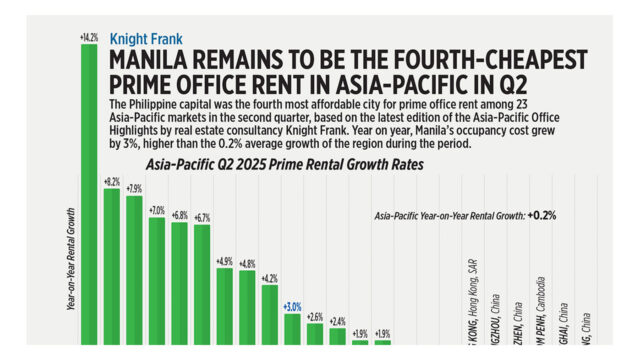
Knight Frank: Manila remains to be the fourth-cheapest prime office rent in Asia-Pacific in Q2

The Philippine capital was the fourth most affordable city for prime office rent among 23 Asia-Pacific markets in the second quarter, based on the latest edition of the Asia-Pacific Office Highlights by real estate consultancy Knight Frank. Year on year, Manila’s occupancy cost grew by 3%, higher than the 0.2% average growth of the region during the period.

Knight Frank: Manila remains to be the fourth-cheapest prime office rent in Asia-Pacific in Q2

Philippines’ average daily internet usage in 2024 reached 4.6 hours

DESPITE HIGHER cybersecurity awareness, the number of individuals who fell victim to cyber incidents, such as text scams, phishing, and hacking, in the country doubled in 2024, the Philippine Statistics Authority (PSA) reported. Read the full story.

Philippines’ average daily internet usage in 2024 reached 4.6 hours

Donald Trump’s lawsuit against Bob Woodward over audiobook is dismissed

AMAZON.COM

NEW YORK — A federal judge on Friday dismissed US President Donald J. Trump’s nearly $50-million lawsuit against the journalist Bob Woodward for publishing tapes from interviews for his 2020 best-seller Rage as an audiobook.

The decision by US District Judge Paul Gardephe in Manhattan is a victory for Mr. Woodward, his publisher Simon & Schuster and its former owner Paramount Global.

Mr. Woodward interviewed Mr. Trump 19 times between December 2019 and August 2020, and about 20% of Rage came from the interviews.

The book was released in September 2020, while the audiobook The Trump Tapes, including Mr. Woodward’s commentary, was released in October 2022.

In a 59-page decision, Mr. Gardephe said Mr. Trump did not plausibly allege that he and Mr. Woodward intended to be joint authors of The Trump Tapes, saying Simon & Schuster credited Mr. Trump as a “reader” while crediting Mr. Woodward as the author.

The judge, an appointee of Republican President George W. Bush, also said Mr. Trump did not show he had a copyright interest in his stand-alone responses to Mr. Woodward’s questions.

Mr. Gardephe also said federal copyright law preempted Mr. Trump’s state law-based claims. He gave Mr. Trump until Aug. 18 to amend his complaint a third time.

A spokesperson for Mr. Trump’s legal team said in a statement: “In another biased action by a New York Court, this wrongful decision was issued without even affording President Trump the basic due process of a hearing. We will continue to ensure that those who commit wrongdoing against President Trump and all Americans are held accountable.”

Lawyers for Mr. Woodward, Simon & Schuster and Paramount did not immediately respond to requests for comment.

WALTER CRONKITE, BARBARA WALTERS CITED
The defendants had argued that federal law barred Mr. Trump from copyrighting interviews conducted as part of his official duties, and that no president before him ever demanded royalties for publishing presidential interviews.

They also called Mr. Woodward the “sole architect and true author” of the interviews, just as journalists like the late Walter Cronkite and Barbara Walters were in interviews with other presidents.

Mr. Woodward also said his interviews reflected “classic news reporting” that helped convey accurate information to the public, and thus amounted to “fair use.”

Mr. Trump sued in January 2023, saying he told Mr. Woodward repeatedly that the interviews were meant solely for the book. Mr. Woodward said he never agreed to that restriction.

The $49.98-million damages request was based on what Mr. Trump’s lawyers called projected sales of 2 million audiobooks at $24.99 each.

Paramount sold Simon & Schuster in October 2023 to private equity firm KKR for $1.62 billion in cash. — Reuters

Maynilad, delaware Philippines team up on HR roadmap

DELAWARE PHILIPPINES

WEST-ZONE concessionaire Maynilad Water Services, Inc. has partnered with global ICT solutions provider delaware Philippines to assess its current human resource (HR) system and develop a roadmap for future improvements.

In a statement on Monday, delaware said that the initiative includes a comprehensive review of HR areas such as talent acquisition, employee engagement, and workforce management.

Using insights from the assessment, delaware Philippines will help create a roadmap that outlines potential enhancements, along with timelines and implementation priorities.

“This collaboration ensures that Maynilad’s HR team is actively engaged throughout the process to ensure alignment with operational realities,” the company said.

The assessment will run for three months and will include consultations, evaluations, and workshops with key stakeholders.

“This engagement is designed to provide Maynilad with a practical and structured view of how to evolve its HR systems in the coming years,” Maynilad Chief Information Officer and Head of Information Technology Services Francisco Castillo said.

At the end of the assessment, the water utility will receive a roadmap identifying priority areas for improvement, aimed at strengthening internal processes that support employee services and administrative efficiency.

“Our people are at the heart of our operations, and by refining internal processes, we aim to deliver better support to employees across the organization,” Maynilad Head of Human Resources Martin B. De Guzman said. — Sheldeen Joy Talavera

BSP approves 16 new bank branches

BW FILE PHOTO

THE BANGKO SENTRAL ng Pilipinas (BSP) approved 16 new regular bank branches in the first quarter.

The Monetary Board okayed the applications of seven banks — two universal and commercial banks and five rural and cooperative banks — to set up a total of 16 new banking offices in the period, according to a circular letter dated July 16.

The circular showed that the central bank allowed BDO Unibank, Inc. to open six new regular branches located in Caloocan City; Calumpit, Bulacan; Cebu City; Surigao City; Toledo City; and Zamboanga City.

The Monetary Board also approved the application of Security Bank Corp. to put up seven regular branches located in Cadiz City; Concepcion, Tarlac; Davao City; Naic, Cavite; Quezon City; San Mateo, Rizal; and Tagaytay City.

BDO Network Bank, Inc. (A Rural Bank) was also allowed to open a regular branch in Bongao, Tawi-Tawi.

Cebuana Lhuillier Rural Bank, Inc. was also allowed to set up a regular branch in Tanjay City, while Rural Bank of Solano (Nueva Vizcaya), Inc. got the BSP’s approval to open a branch in Diffun, Quirino.

BRANCH-LITE UNITS
Meanwhile, the BSP also approved applications for 31 new branch-lite units in the period.

BDO Unibank and Security Bank secured approval to open two branch-lite units each. BDO’s branch-lite units will be located in Sorsogon City and Tagum City, while Security Bank’s are both in Makati City.

The central bank also granted the application of Bayanihan Rural Bank, Inc. to open a branch-lite unit in Date, Camarines Norte.

It likewise approved BDO Network Bank’s proposal for 26 branch-lite units in several locations nationwide, including Tawi-Tawi, Cebu, Iloilo, Davao, North Cotabato, Bukidnon, Pangasinan, Aklan, and Negros Oriental, among others.

Lastly, CARD Bank, Inc. obtained BSP approval to open an Islamic branch in Marawi City.

Meanwhile, a total of eighteen lenders opened new banking offices during the first quarter. These offices included regular branches, branch-lite units, and a microfinance-oriented branch.

Bank of the Philippine Islands, BDO Unibank, BDO Private Bank, Inc., China Banking Corp., Development Bank of the Philippines, Rizal Commercial Banking Corp., and Security Bank were among the universal and commercial banks that opened new offices during the quarter. — Luisa Maria Jacinta C. Jocson

10 issues about CMEPA and US-PHL trade

Last week, lots of misconceptions (if not outright falsehoods) about the new Capital Markets Efficiency Promotion Act (CMEPA) circulated on social media. And today, President Ferdinand R. Marcos, Jr. is meeting with US President Donald Trump at the White House. Among the topics to be discussed between them is the 20% tariff on Philippine exports to the US. I will discuss both topics here.

PHL SAVINGS RATE AND CMEPA
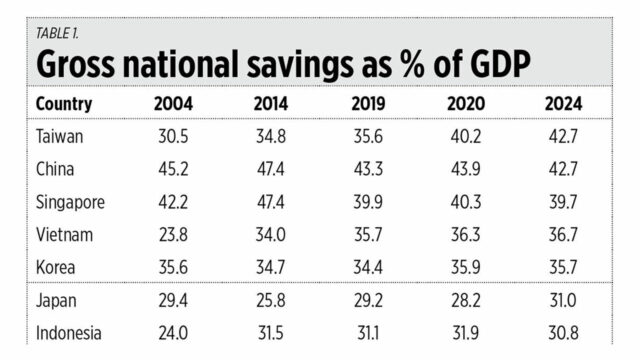
I checked the savings rate as a percentage of GDP (S/GDP ratio) and saw that the Philippines had somehow caught up with some East Asian neighbors like Hong Kong and Malaysia in 2019. But when the lockdown dictatorship happened in 2020, many people’s savings evaporated and now we have the lowest S/GDP ratio in Asia (see Table 1).

We need to devise ways to raise our S/GDP ratio. The newly enacted CMEPA (RA 12214) is one tool, and yet it encountered pushback due to misconceptions. Among these are the following:

1. The CMEPA taxes our bank savings. Wrong. It taxes only the interest income of our savings. For instance, savings of P100,000 in a bank earning, say, 0.8% a year, means an interest income of P800/year. A tax of 20% means a tax payment of only P160/year.

2. The 20% final withholding tax (FWT) on interest income is due to CMEPA. Wrong. That FWT is an old law under the National Internal Revenue Code of 1997 (28 years ago), charging a 20% final tax on interest earned from bank deposits with a maturity of less than three years. The tax on interest income for both savings and time deposits is now a uniform FWT of 20%. There is no more preferential treatment for wealthy depositors.

3. The CMEPA raises transaction costs for other investments. Wrong. It reduces transaction costs. Before, the Philippines had the highest Stock Transaction Tax (STT) on the sale or exchange of shares in the ASEAN at 0.6%. CMEPA reduced the STT to 0.1%, so investing in the Philippine Stock Exchange (PSE) becomes more cost-competitive.

My friend and fellow free marketer Eric Jurado, who owns The International Investor which manages the SeA (Southeast Asia) Focus Portfolio, has good data on the trading value in the stock markets of the ASEAN-6 in May this year. Looking at value in billion dollars and the number of listed companies, respectively, these are the results: Thailand, $25.2 billion, 857 companies; Singapore, $21 billion, 612; Vietnam, $17.9 billion, 699; Indonesia, $15.3 billion, 956; Malaysia, $12.1 billion, 1,056; and the Philippines, $3 billion, only 284 companies. With CMEPA, we hope that our country’s stock market would become as dynamic as Malaysia’s or Indonesia’s in a few years.

4. The CMEPA has raised other taxes. Wrong. It reduced the Documentary Stamp Tax (DST), or stamp duty on the original issuance of shares by corporations, from 1% to 0.75%. The equity side — sales tax has been reduced from 60 basis points to just 10 basis points.

5. The CMEPA discourages savings with new financial taxes. Wrong. The CMEPA encourages savings outside of time deposits, like the stock market or real estate investment trusts (REITs) where the tax is lower at 10% and is liquid, meaning the money can be pulled out any time and is not locked in for several years. Plus, there are other saving programs managed by the government like Pag-IBIG MP2 savings and Retail Treasury Bonds (RTBs), which are additional options for investment by the public.

6. Savings of OFWs like time deposit are taxed. Wrong. Savings of OFWs are exempted. In addition, the DST on Mutual Funds and Unit Investment Trust Funds (UITFs) — collective investment schemes which are popular among young professionals and middle-class savers, are now tax-exempt.

Bottomline, the CMEPA is a good law. It opens more savings and investment options for the public so they can build their wealth and retirement funds while removing the preferential rates for the very rich who can afford to park their money for several years at higher, untaxed, interest income.

US TARIFF AND PHILIPPINE EXPORTS
Continuing the 10 issues, here are the other four which are related to trade.

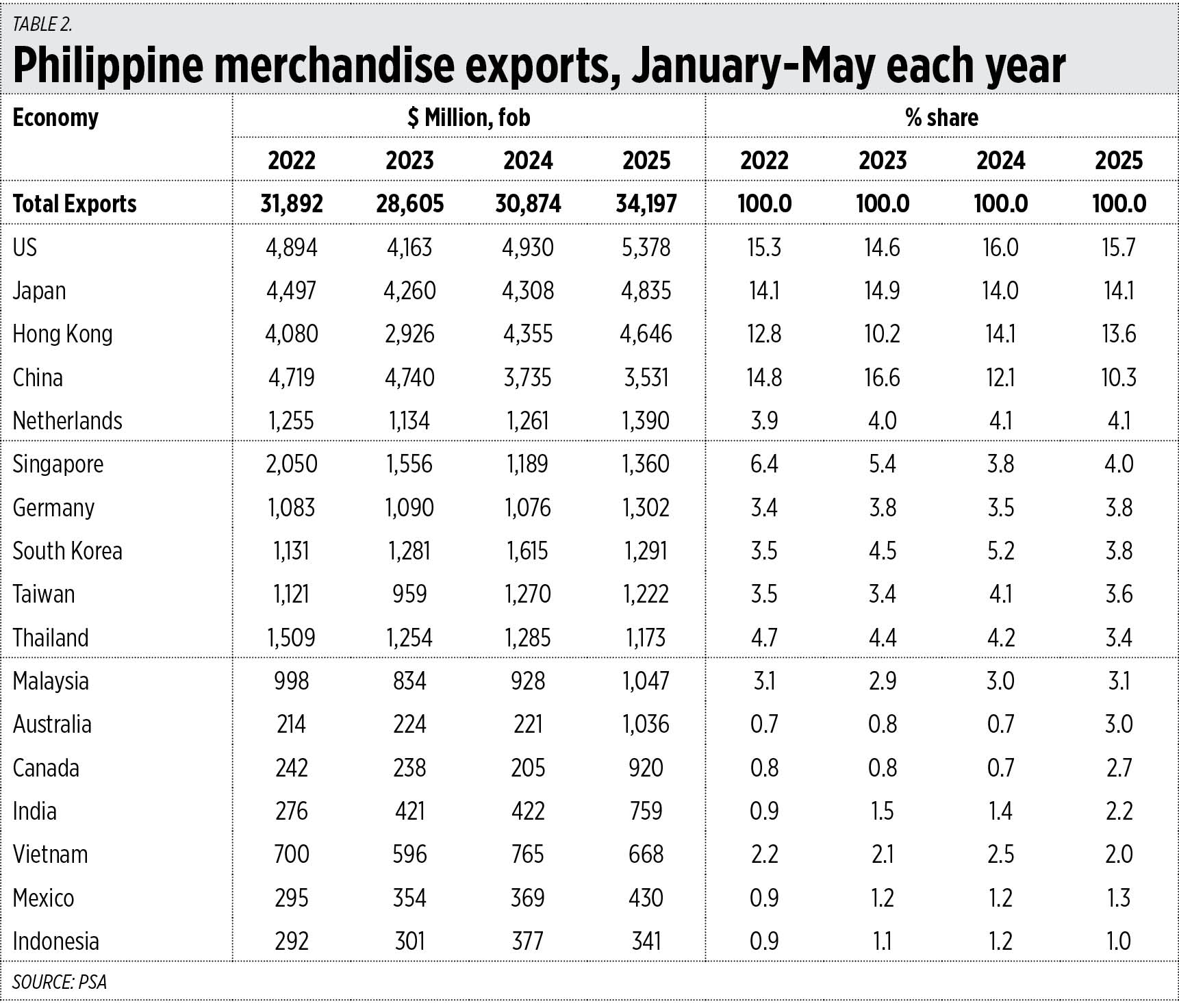
7. The US is the Philippines’ number one exports market. The latest data for January to May this year show that nearly 16% of our total exports went to the US, up from 15% in 2022 and 2023. Japan, Hong Kong, and China are the next three big destinations of our exports (see Table 2).

8. The US has imposed a 20% tariff on Philippine exports effective Aug. 1 which is next week. This is lower than the tariffs imposed on most East Asian nations but still high compared to the previous rate of below 10%.

9. The Philippines is ready to charge zero tariff on some US exports to us. Two recent reports in BusinessWorld are related to this: “Indonesia-US trade deal poses competition challenges for PHL” (July 16), and “PHL eyes zero tariffs on some US goods” (July 21).

Indonesia was earlier slapped with a 32% tariff, but after negotiations, this was brought down to 19% while US exports to Indonesia will be tariff-free. Finance Secretary Ralph G. Recto announced that we are ready to impose no tariffs for imports from the US as part of tariff negotiations with Washington. “Not for all products, but we have identified a set of products.” This is a good position.

10. Ultimately, we should push for free trade agreements (FTA) with the US and more countries, go for zero tariffs both ways and reduce non-tariff barriers.

There are net gains — the gains are larger than the pains — from lower taxes and from free trade. We should go for these.


Bienvenido S. Oplas, Jr. is the president of Bienvenido S. Oplas, Jr. Research Consultancy Services, and Minimal Government Thinkers. He is an international fellow of the Tholos Foundation.

minimalgovernment@gmail.com

Avida reports strong take-up, plans more suburban housing

AVIDA VERRA Settings Vermosa — AVIDALAND.COM

AVIDA LAND Corp., the mid-income residential brand of property giant Ayala Land, Inc. (ALI), is looking to build more homes outside Metro Manila amid stronger take-up at its ongoing developments there, it said.

“The company remains focused on launching more horizontal developments in high-demand areas across South and Central Luzon, prioritizing projects within ALI’s estates,” Aris Gonzales, Avida Land project and strategic management group head, said in an e-mailed reply to questions.

When expanding into a particular location, Avida Land ensures that the area is accessible via major transit routes, supports sustainable residential growth, and is close to essential lifestyle needs, according to Mr. Gonzales.

As of July, the 10-hectare (ha) Verra Settings Vermosa in Imus City, Cavite, is 97% sold, ALI said.

Parklane Settings Vermosa, Avida Land’s second residential development in the Vermosa area, has sold 92% of its inventory.

Under the 12-ha project, sectors one and two will be completed by June 2026, while sectors three and four will be finished by March 2027.

Likewise, Southdale Settings Nuvali in Laguna is 90% sold. The 20-ha residential development will be completed by January 2026.

Meanwhile, Crescela Nuvali, which offers modern contemporary homes within its 13.53-ha subdivision, has sold 38% of its inventory. Construction on the property will be finished by July 2028, Avida Land said.

“Crescela Nuvali, the newest residential project, has demonstrated robust demand, outperformed initial projections, and solidified the developer’s reputation for delivering high-value communities,” Mr. Gonzales said.

All four residential developments incorporate sustainability practices, he also said.

These include a 1:1 tree-planting ratio, where a new tree is planted whenever one is removed or affected.

To support waste management and urban greening, each development also features an eco-yard, composed of a plant nursery, composting facility, and materials recovery facility, Avida Land said.

Community layouts are also designed to optimize lot and amenity access, support residents’ well-being, and manage traffic flow, Mr. Gonzales said. Newer developments also have solar-powered streetlights in common areas.

“ALI estates are master-planned, mixed-use communities that emphasize connectivity, livability, and long-term value, making them ideal for future horizontal residential projects,” Mr. Gonzales said. — Beatriz Marie D. Cruz