Home Blog Page 9

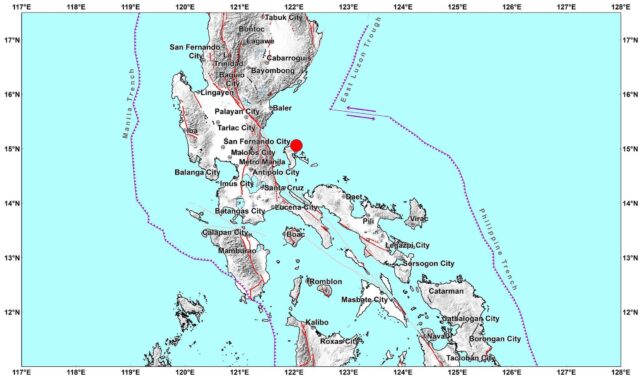
3.8-magnitude quake jolts Burdeos, Quezon

PHIVOLCS-DOST FB PAGE

A 3.8-magnitude earthquake was reported in Burdeos, Quezon province, with intensity recorded in one area, according to the Philippine Institute of Volcanology and Seismology (PHIVOLCS) on Thursday afternoon.

The earthquake occurred at 1:15 a.m., with the epicenter located about 24 kilometers north-northeast of Burdeos, Quezon.

PHIVOLCS said the quake had a depth of focus of three kilometers and was of tectonic origin.

Intensity I was recorded in General Nakar, Quezon, based on instrumental intensity data.

The agency said the earthquake is not expected to cause damage or aftershocks. — Edg Adrian A. Eva

Mastercard and FinVolution Group launch Luvit Card to expand access to digital credit in the Philippines

From left to right: Qian “Cecily” Zhang (Project Head of Luvit), Francisco “Coco” Mauricio (President and CEO of Wefund Lending Corporation), Jason Crasto (Country Manager of Mastercard Philippines), and Kent Tsang (Mastercard Account Director)

Mastercard and FinVolution Group have launched the Luvit Card, marking the latter’s expansion into card-based lending and bringing flexible, installment-based credit to more Filipinos through a widely accepted payment solution.

Available as both a virtual and physical card, the Luvit Card allows users to make purchases across Mastercard’s global network of merchants and repay in installments. The card is integrated within the Luvit app, enabling a streamlined application and payment experience for users who may not have access to traditional credit products. 

The launch comes as more Filipinos adopt digital financial services and explore alternative ways to manage spending. Digital payments continue to grow in the country as part of broader efforts to increase financial inclusion and shift more transactions into formal channels. As payment behaviors evolve, consumers are seeking options that offer greater control over how and when they pay, particularly for everyday transactions and planned purchases.

From online shopping and bill payments to travel bookings and essential expenses, installment-based payment options are becoming part of how consumers manage their cash flow. The Luvit Card supports these needs by offering a card-based experience that can be used across a wide range of merchants, both locally and internationally.

By combining FinVolution’s digital lending expertise with Mastercard’s global acceptance network, the Luvit Card enables users to transact across millions of merchants worldwide. It also supports individuals accessing formal credit for the first time, including younger consumers and those outside traditional banking systems, helping them engage more confidently in digital commerce.

“The Philippines has one of the most dynamic digital economies in Southeast Asia, yet millions of Filipinos still lack access to formal credit,” said Jason Crasto, Country Manager, Philippines, Mastercard. “The Luvit Card addresses this by giving users an access card accepted by millions of merchants globally, backed by a lending experience designed around how they manage money. That combination of access and flexibility makes it meaningful.”

Francisco Roberto Mauricio, CEO of WeFund, a subsidiary of FinVolution Group, said, “Luvit is an access card that provides financial access to underserved yet creditworthy Filipinos. Powered by Finvolution’s proprietary AI, users can be approved in minutes with minimal requirements. Luvit makes Filipino aspirations a reality: a reliable payment tool for their daily lives, from online shopping and bill payments to even larger purchases. This encourages fiscal discipline and confidence, leading to financial empowerment and enhanced quality of life.”

The Luvit Card forms part of ongoing efforts to broaden access to formal financial tools and support participation in the digital economy, particularly for consumers building their financial footprint for the first time. Users can apply for the Luvit Card through the Luvit app, available for download on major app stores.

To learn more about the Luvit Card and how it works, visit www.luvit.ph.

About Mastercard

Mastercard powers economies and empowers people in 200+ countries and territories worldwide. Together with our customers, we’re building a resilient economy where everyone can prosper. We support a wide range of digital payment choices, making transactions secure, simple, smart, and accessible. Our technology and innovation, partnerships and networks combine to deliver a unique set of products and services that help people, businesses, and governments realize their greatest potential.

www.mastercard.com

About FinVolution Group

FinVolution Group(NYSE: FINV) is a leading fintech company that connects millions of consumers as well as small-sized enterprises with financial institutions.

Founded in 2007 and listed on the New York Stock Exchange in 2017, we have been at the forefront of the pan-Asian credit technology industry, pioneering innovative technologies in credit risk assessment, fraud detection, big data, and artificial intelligence. With a proven track record of robust growth in pan-Asian countries, we have established leading fintech platforms in China, Indonesia, the Philippines, Pakistan, and Australia.

en.finvgroup.com


Spotlight is BusinessWorld’s sponsored section that allows advertisers to amplify their brand and connect with BusinessWorld’s audience by publishing their stories on the BusinessWorld Web site. For more information, send an email to online@bworldonline.com.

Join us on Viber at https://bit.ly/3hv6bLA to get more updates and subscribe to BusinessWorld’s titles and get exclusive content through www.bworld-x.com.

US optimistic of deal with Iran as it increases economic pressure

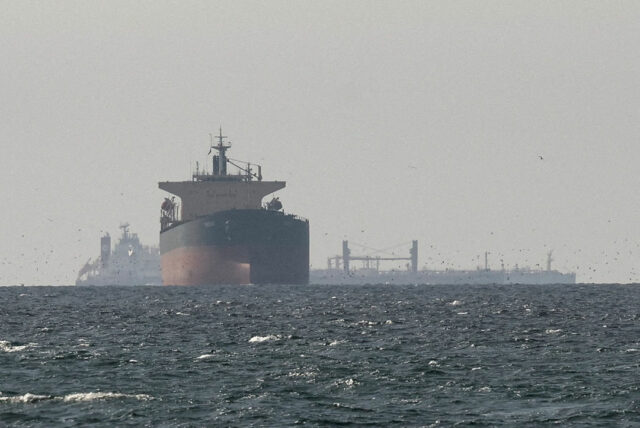
Tankers sail in the Gulf, near the Strait of Hormuz, as seen from northern Ras al-Khaimah, near the border with Oman’s Musandam governance, amid the US-Israeli conflict with Iran, in United Arab Emirates, March 11, 2026. — REUTERS

WASHINGTON/DUBAI — The Trump administration expressed optimism on Wednesday about reaching a deal to end the war with Iran, while also warning of increasing economic pressure against Tehran if it remains defiant.

President Donald Trump has said he believes the war he launched with Israel in late February is nearly over, even as a shipping blockade he announced came into effect and traffic through the Strait of Hormuz remained well below normal levels.

The US warned it could add secondary sanctions on buyers of Iranian oil in an apparent effort to gain leverage ahead of more negotiations, just weeks after Washington loosened the enforcement of some Iran energy sanctions.

US and Iranian officials were weighing a return to Pakistan for further talks as early as the coming weekend, after negotiations ended on Sunday without a breakthrough. Mediator Pakistan’s army chief arrived in Tehran on Wednesday to try to prevent a renewal of the conflict.

“We feel good about the prospects of a deal,” White House press secretary Karoline Leavitt said at a news conference, calling conversations mediated by Pakistan “productive and ongoing.” She denied reports that the US had formally requested an extension of a two-week ceasefire agreed by the two sides on April 8.

More in-person talks had not yet been confirmed but would likely take place in Pakistan again, Ms. Leavitt said.

Pakistan’s military confirmed Field Marshal Asim Munir had arrived in Tehran. A senior Iranian source told Reuters that Mr. Munir, who had mediated the last round of talks, would seek “to narrow gaps” between the two sides. Foreign Minister Abbas Araghchi posted on X welcoming Mr. Munir and said Iran was committed to “promoting peace and stability in the region.”

The talks last weekend broke down without an agreement to end the war, which Mr. Trump began alongside Israel on February 28, triggering Iranian attacks on Iran’s Gulf neighbors and reigniting a conflict between Israel and Iran-backed Hezbollah in Lebanon.

ECONOMIC PRESSURE ON IRAN
Treasury Secretary Scott Bessent, speaking alongside Ms. Leavitt, predicted that China’s purchase of Iranian oil would “pause” given the US blockade on vessels calling at Iranian ports. He said the US could impose secondary sanctions on countries that purchase Iranian crude.

The US Treasury had warned two Chinese banks not to process Iranian money or face sanctions, he said, without naming the banks. China previously bought more than 80% of Iran’s shipped oil.

“The Iranians should know that this is going to be the financial equivalent of what we saw in the kinetic activities,” Mr. Bessent said, referring to the US and Israeli campaign of airstrikes that killed a number of Iranian leaders and damaged its defensive capacities and navy.

He also said the US would not renew waivers that allowed the purchase of some Russian and Iranian oil without facing US sanctions. The moves signal an end to the Trump administration’s efforts to use the waivers to free up more oil supplies and lower soaring global energy prices.

The war has led Iran to effectively shut the Strait of Hormuz – a vital artery for global crude and gas shipments – to ships other than its own, sharply reducing exports from the Gulf and leaving energy importers scrambling for alternative supplies.

Iran could consider allowing ships to sail freely through the Omani side of the strait without risk of attack as part of proposals it has offered in negotiations with the US, providing a deal is clinched to prevent renewed conflict, a source briefed by Tehran said.

Finance ministers from almost a dozen countries led by Britain called on the US, Israel and Iran to implement their ceasefire in full and said the conflict would weigh on the global economy and markets even if it was resolved soon.

TANKERS INTERCEPTED
During the first 48 hours of the US blockade on ships entering and exiting Iranian ports, no vessels have made it past US forces, the US military said. Additionally, nine vessels complied with direction from US forces to turn around and return toward an Iranian port or coastal area.

However, Iran’s Fars News agency said an Iranian supertanker subject to US sanctions crossed the strait towards Iran’s Imam Khomeini port despite the blockade. Fars did not identify the tanker or give further details of its voyage.

Iran’s joint military command warned it would halt trade flows in the Gulf, the Sea of Oman and the Red Sea – which connects to the Suez Canal – if the US blockade continued.

Mr. Trump has also threatened to escalate if the war resumes.

“We could take out every one of their bridges in one hour. We could take out every one of their power plants, electric power plants, in one hour. We don’t want to do that…so we’ll see what happens,” he told Fox Business Network.

TALKS COMPLICATED BY NUCLEAR ISSUE, LEBANON
Iran’s nuclear ambitions were a key sticking point at last weekend’s talks. The US proposed a 20-year suspension of all nuclear activity by Iran – an apparent concession from longstanding demands for a permanent ban – while Tehran suggested a halt of three to five years, according to people familiar with the proposals.

Washington has also pressed for any enriched nuclear material to be removed from Iran, while Tehran has demanded that international sanctions against it be lifted.

One source involved in the talks said back-channel discussions had made progress in narrowing gaps, bringing the two sides closer to a deal that could be presented at a new round of talks.

Further complicating peace efforts, Israel has continued to attack Lebanon as it targets Iran-backed Hezbollah. Israel and the US say that campaign is not covered by the ceasefire, while Iran insists it is.

Israeli Prime Minister Benjamin Netanyahu said in a video statement on Wednesday evening that Israel was “prepared for any scenario” when it comes to the war with Iran. — Reuters

Iran offers proposal allowing ships to exit Oman side of Hormuz free of attack, source says

A 3D-printed oil pump jack and a map showing the Strait of Hormuz and Iran appear in this illustration taken March 2, 2026. — REUTERS

DUBAI — Iran could consider allowing ships to sail freely through the Omani side of the Strait of Hormuz without risk of attack as part of proposals it has offered in negotiations with the United States, providing a deal is clinched to prevent renewed conflict, a source briefed by Tehran said.

The US-Israeli war with Iran has resulted in the largest-ever disruption of global oil and gas supplies due to Iran’s interruption of traffic through the strait, which handles about 20% of the world’s oil and liquefied natural gas flows.

Hundreds of tankers and other ships and 20,000 seafarers have been stuck inside the Gulf since the war began on February 28. A two-week ceasefire came into effect on April 8 and US President Donald Trump said on Wednesday the war was close to over, but control over the Strait of Hormuz remains a key issue in negotiations.

The source, who declined to be identified due to the sensitivity of the matter, said Iran could be willing to let ships use the other side of the narrow strait in Omani waters without any hindrance from Tehran.

The source did not say whether Iran would also agree to clear any mines it may have placed in that stretch of water or if all ships – even those linked to Israel – would be allowed to pass freely.

But the source added that the proposal hinged on whether Washington was prepared to meet Tehran’s demands, a condition that was central to any potential breakthrough with the Strait of Hormuz.

The White House did not immediately respond to a request for comment. Iran’s Foreign Ministry was not immediately available to comment.

A Western security source said the proposal to let ships pass through Omani waters unhindered had been in the works although it was not clear if there had been any response from Washington yet.

The strait, a strip of water only 34 km (21 miles) wide between Iran and Oman, provides passage from the Gulf to the Indian Ocean and is a main route for energy supplies from the Middle East and other vital goods including fertilizers.

The proposal would be the first visible step by Tehran to pull back from more combative ideas floated in recent weeks, which included charging ships for passage through the international waterway and imposing sovereignty on the strait – seen by the global shipping industry as unprecedented unilateral steps in breach of maritime conventions.

Member countries of the UN’s International Maritime Organization agency meeting in London this week pushed back on the idea of a toll being imposed by Iran for ships using the strait, which the IMO has said would “set a dangerous precedent”.

Iran’s proposal would also be the first move towards restoring the status quo on sailing through the strait, which had been in place for decades despite periodic seizures by Iran of ships crossing the waterway.

A so-called two-way traffic separation scheme, which was adopted by the UN’s shipping agency in 1968 with agreement of countries in the region, created the current ship routing system that split sailing corridors through Iranian and Omani waters.

The US imposed a blockade on oil ships leaving Iranian ports on Monday and broader shipping traffic has remained muted since February 28. — Reuters

Sovereign borrowers launch platform to amplify voice in debt talks

US DOLLAR and euro banknotes are seen in this illustration taken on July 17, 2022. — REUTERS/DADO RUVIC/ILLUSTRATION

A GROUP of officials from developing economies launched on Wednesday the Borrowers’ Platform, an effort backed by the United Nations to give debt-hit nations a stronger collective voice in dealings with creditors.

United Nations Secretary-General Antonio Guterres said at the launch event that the platform is essential for power relations to change.

“Today, we launch a breakthrough in global financing, a platform in which borrowing countries sit together, learn from each other and speak with a collective voice,” Mr. Guterres said.

He said 3.4 billion people live in countries that spend more on debt service than on health or education.

The initiative is seen partly as a counter for institutions like the Paris Club, where official creditors meet to discuss negotiation strategies when a common debtor encounters problems with repayment.

“The Paris Club has got 70 years on the Borrowers’ Club,” said Penelope Hawkins, acting head at the Debt and Development Finance branch at UNCTAD. “This needs to be a permanent structure.”

It comes amid mounting frustration over the Common Framework, a G-20 initiative launched during the COVID-19 pandemic as a sort of expanded Paris Club that included China, the world’s largest official bilateral creditor. While it aimed to speed the process, it has produced just three full restructuring efforts.

The IMF and World Bank later set up the Global Sovereign Debt Roundtable, which includes some borrower countries and big private sector players, to help streamline and improve the process.

The GSDR, which also met on Wednesday, said in a statement that its work since the autumn meetings had helped advance solutions to accelerate restructuring of private, non-bonded debt, and that efforts to publish the “parameters against which comparability of treatment will be assessed” had “received broad support.”

The lack of information-sharing regarding comparability of treatment has been a key sore spot for bondholders.

The GSDR also backed some initiatives launched by the London Coalition, a British government-backed group of private sector and government created to tackle sustainable debt and investment in the developing world.

‘REBALANCING POWER INEQUALITIES’
The Borrowers’ Platform, for which UNCTAD will be the operational backbone, aims also to be an experience repository of sorts, where members share their knowledge and new governments, or new countries, avoid arriving at the table with a lack of preparedness.

“What was once a long-standing aspiration of developing countries has now become a concrete and a collective step forward,” said Ahmed Kouchouk, Egypt’s finance minister. “Today stands as a strong statement of intent that the voice of borrowing nations and countries belongs at the very center of the global financial dialogue.”

The event, presided over by Egypt as chair of the working group, is due to formally open an interim phase for the platform, establish interim leadership and adopt a work program running through October 2026, according to the launch agenda.

The working group included Egypt, Colombia, Honduras, Maldives, Nepal, Pakistan and Zambia. Pakistan served as vice chair.

Under the draft framework, full membership would be voluntary and limited to developing countries that are UN member states, net borrowers and not full members of creditor groupings. The proposed structure includes a Governing Council of finance ministers, central bank governors or equivalent officials, and a Steering Committee of senior technical officials.

“The launch of the Borrowers’ Platform is a major milestone in rebalancing power inequalities in global economic governance,” said Iolanda Fresnillo, policy and advocacy manager at the European Network on Debt and Development (Eurodad), in a statement.

“This long-overdue initiative is a first step towards breaking creditor domination over decision-making on sovereign debt issues.” — Reuters

Remolona: BSP has room to tighten

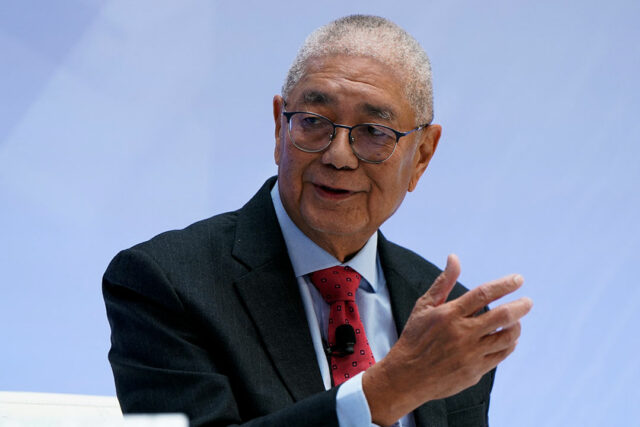
BANGKO SENTRAL NG PILIPINAS Governor Eli M. Remolona, Jr..— REUTERS/ELIZABETH FRANTZ

By Katherine K. Chan, Reporter

WASHINGTON, D.C. — The Bangko Sentral ng Pilipinas (BSP) said it has room to raise policy rates as the National Government’s planned catch-up spending is expected to cushion the economy from a sharper slowdown amid the energy crisis.

In an exclusive interview with BusinessWorld, BSP Governor Eli M. Remolona, Jr. said the country will see a wider negative output gap as inflation and economic growth face mounting pressures from the Middle East conflict and the lingering effects of last year’s flood control corruption scandal.

Still, he noted that the central bank will avoid any excessive tightening.

“We don’t want to tighten by too much,” Mr. Remolona said on the sidelines of the International Monetary Fund (IMF) and World Bank’s 2026 Spring Meetings here on Tuesday.

“But there’s room to tighten, especially because the concern about growth is not as big as before, given what we think will happen on the fiscal side,” he added.   

Last month, the BSP held policy rates steady in an off-cycle meeting as it sought to calm markets amid growing uncertainties, and cautioned that tightening immediately risks delaying economic recovery.

The latest off-cycle move marked the BSP’s first hold since June 2024, pausing its nearly two-year easing cycle where it slashed the policy rate by a total of 225 basis points. It last hiked its rates in an off-cycle announcement in October 2023.

The Philippine economy slumped last year as a corruption scandal involving flood control projects dampened investments, public spending and household consumption.

Philippine gross domestic product grew by 4.4% in 2025, the worst seen since the COVID-19 pandemic.

Mr. Remolona said faster and better government spending in the second half could help ease growth woes, allowing the central bank to focus on maintaining price stability.

“The output gap will be more negative, slightly more negative than before. But we also know that government spending will pick up in the second part of the year. And not only will it pick up, it will be better quality government spending,” he said.

“So that will help growth, which makes our job a little bit easier. Then we can worry more about the inflation side, especially with the second-round effects beginning to materialize,” he added.

Second-round price effects may also emerge sooner than expected after headline inflation breached the central bank’s target range a month ahead of their forecast, Mr. Remolona noted.

“Now we’re thinking maybe the spillover effects, and as you know we focus on spillover effects, may be happening… slightly sooner than we thought,” he said.   

In March, elevated oil prices amid the Middle East conflict drove inflation to a near two-year high of 4.1%, faster than the BSP’s 3.1%-3.9% forecast and 2%-4% target for the year.

The central bank had expected inflation to move past its target by April, though Mr. Remolona said the forecast miss was “not entirely unexpected.”

“The oil price shock itself is a global shock, and there’s very little we can do about that shock. But we worry about the spillover effects of that shock,” he said. “It would spill over into the price of transportation, the price of fertilizer, and then food prices.”

Mr. Remolona earlier said that the Monetary Board’s future policy decisions will center on tempering second-order effects.

Meanwhile, the central bank governor noted that inflation expectations remain anchored so far, adding that they intend to expand their monitoring of consumer and business expectations.

“(Inflation expectations are) so far so good. So far, they look anchored,” Mr. Remolona said. “We’re probably going to do more surveys of expectations and not just look at the next two years but maybe look at five years down the road.”

WAIT AND SEE
For now, the BSP chief said they are still assessing how long they will stick to a wait-and-see approach as they weigh more data, with core inflation and prices for the bottom 30% of households among their main focus for the April 23 policy review.

“We’re looking at the data as they come… There’s still data coming that will help us make a decision on the 23rd,” Mr. Remolona said.

“We’re not looking at just the headline inflation. We’re focusing a bit more on core inflation, which chips out the more volatile elements in prices. And then we’re also focusing on this inflation based on the consumer basket of the lowest 30% of households,” he added.

At the same time, the Intergovernmental Group of Twenty-Four (G-24), which the Philippines is a part of, noted that developing countries’ central banks now assume a “critical balancing role” as energy shocks heighten stagflation risks.

“The central banks have a balancing act,” Olawale Edun, G-24 chairman and Nigerian Finance minister, said at a press briefing on Tuesday. “They have a really important role to play in calibrating and helping to steer the economy safely through this current energy crisis and geopolitical tensions.”

However, Akhtar Javed, G-24 first vice-chairman and executive director of the State Bank of Pakistan, said growing pressures from the energy crisis are making it “really difficult” for monetary authorities to strike a balance between taming inflation and boosting growth. 

“(T)his is a challenging time for the central bank, and especially the G-24 countries, which were already facing some pressures because of the tariffs and other related things. But this regional conflict has also put further pressures, and it’s really difficult for the central banks to strike a balance,” Mr. Javed said. 

G-24 Secretary Iyabo Masha said central banks should continue to stand pat as monetary policy tightening will have limited effects on supply-driven shocks. 

“What we’re seeing is that it’s mainly supply-side constraints on oil production, and supply-side constraints do not respond well to monetary policy like interest rate hikes,” she said.

“So, I will say that unless central banks see that some of these inflationary pressures are going into wages (and) are showing up in real growth, they should, at least on balance, wait and see and see how things evolve. But of course, everything has to be in a data-dependent manner,” she added.


Cash remittances hit 9-month low in February

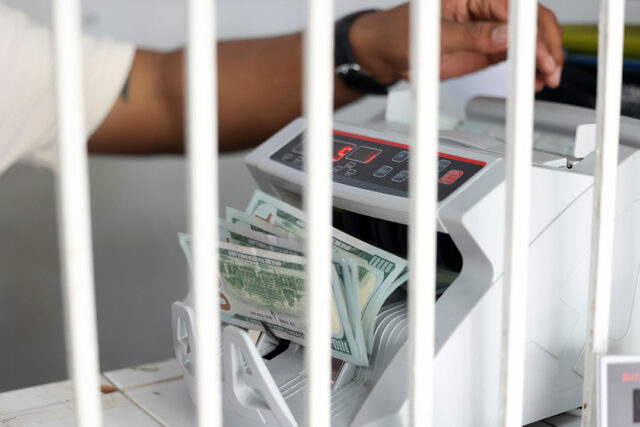
A man counts dollar bills at a money changer in Quezon City, Jan. 15. 2026. — PHILIPPINE STAR/MIGUEL DE GUZMAN

By Justine Irish D. Tabile, Senior Reporter

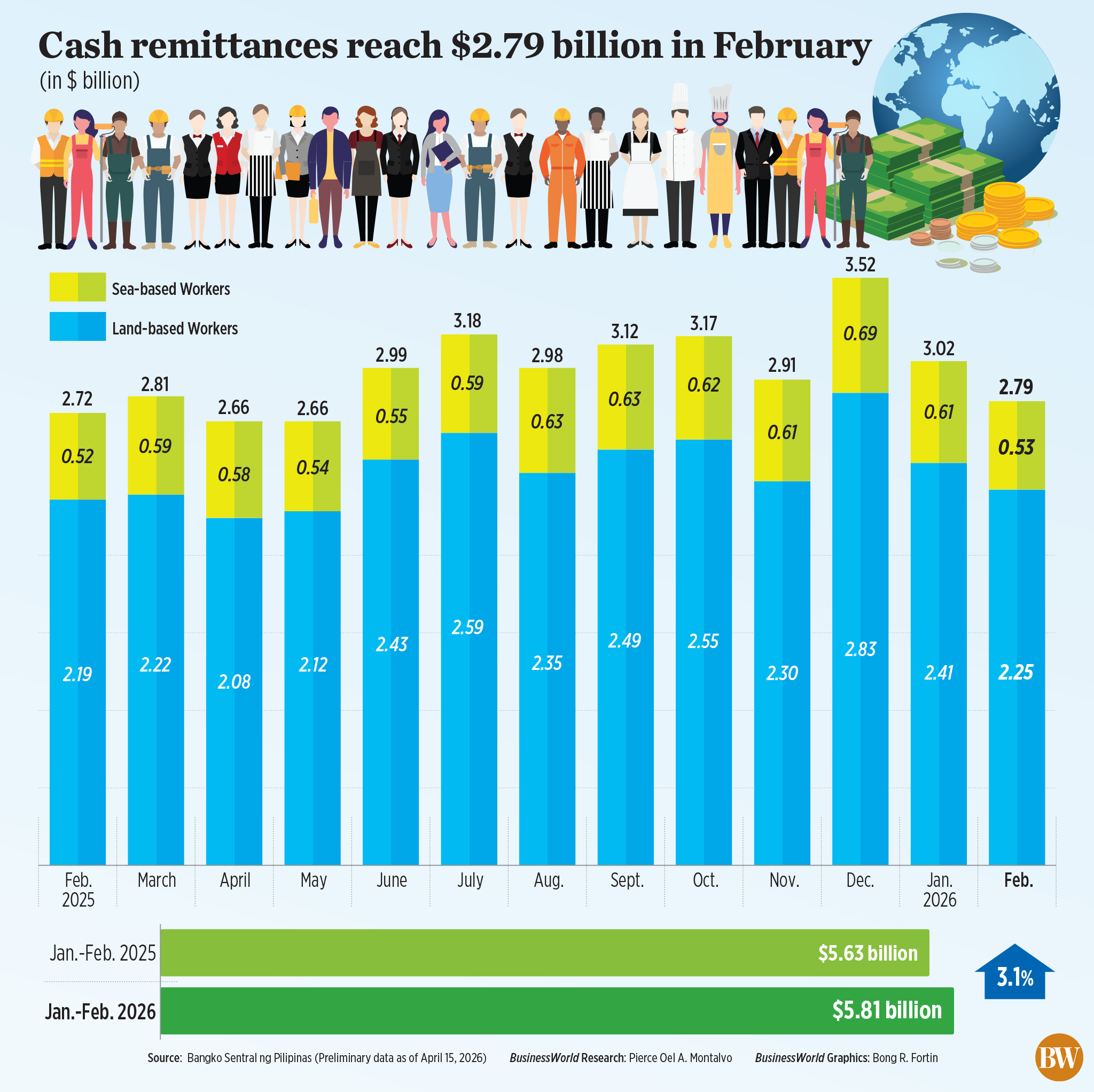
MONEY SENT HOME by overseas Filipino workers (OFWs) fell to its lowest level in nine months in February, the Bangko Sentral ng Pilipinas (BSP) reported.

Preliminary data from the BSP showed cash remittances coursed through banks rose by 2.6% to $2.79 billion from $2.72 billion logged in February 2025 but fell 7.7% from $3.02 billion in January.

However, this was the weakest level of remittances since the $2.66 billion in cash remittances in May 2025.

The annual remittance growth in February eased from 3.5% growth in January, and was the slowest since 2.5% in June 2024.

Cash remittances from land-based workers went up by 2.7% to $2.25 billion in February, while money sent home by sea-based workers increased by 2% to $530 million.

Union Bank of the Philippines (UnionBank) Chief Economist Ruben Carlo O. Asuncion said that the continued annual growth indicates “fundamentally stable” remittances.

“The (month-on-month) dip in February remittances largely reflects seasonal normalization rather than a weakening in overseas Filipino labor conditions,” he said in a Viber message, citing strong December and January inflows due to bonuses and holiday‑related transfers.

“This was also compounded by higher living costs abroad, which may have temporarily constrained the ability of some overseas Filipinos to send larger amounts,” he added.

Reyes Tacandong & Co. Senior Adviser Jonathan L. Ravelas said that the February remittance data reflect a “temporary dip, not a red flag.”

“February is usually a softer month due to seasonality, and higher living costs abroad mean OFWs are being more careful — even as remittances still grow year on year,” he said in a Viber message.

For the first two months of the year, cash remittances jumped by 3.1% to $5.81 billion from $5.63 billion a year ago.

Money sent by land-based workers rose by 3.1% to $4.67 billion, while money sent by sea-based workers went up by 2.8% to $1.14 billion.

“The United States remained the top source of cash remittances to the Philippines in January-February 2026, followed by Singapore and Saudi Arabia,” the BSP said.

The United States was the main source of cash remittances with a 40% share of the total so far this year. It was followed by Singapore (7.6%), Saudi Arabia (6.1%), Japan (5.3%), the United Kingdom (4.7%), the United Arab Emirates (4.2%), Canada (3.1%), Taiwan (3%), Qatar (2.9%), and Hong Kong (2.7%).

Meanwhile, personal remittances, which include inflows in kind, rose 2.6% to $3.1 billion in February from $3.02 billion a year ago.

In the January-February period, personal remittances grew by 3.1% to $6.46 billion from $6.27 billion a year earlier.

UnionBank’s Mr. Asuncion said that he expects remittance growth “to moderate but remain positive.” 

“Faster inflation and higher fuel prices — particularly those linked to geopolitical tensions in the Middle East — could weigh on disposable income in host countries, capping near‑term growth,” he said. 

Mr. Asuncion said remittances are historically resilient, as these are supported by the steady demand for Filipino workers in the healthcare, maritime, and services sectors.

“Overall, barring a sharp deterioration in global employment conditions, remittances should continue to grow at a low‑to‑mid single‑digit pace, providing a stable buffer for the Philippine external accounts,” he added.

The Asian Development Bank last week flagged remittances as a key vulnerability of the Philippines, noting that over 17% of total remittances come from OFWs in the Middle East.

“Looking ahead, inflation, slower global growth, and higher fuel prices linked to Middle East tensions may cap remittance growth in the near term, keeping it in low single digits,”  Mr. Ravelas said. “But structurally, remittances remain resilient — OFWs tend to step up support during tough times.”

The BSP projects cash remittances to climb by 3% to $36.7 billion by yearend, slower than the 3.3% seen last year.

Pump prices may drop further next week — DoE

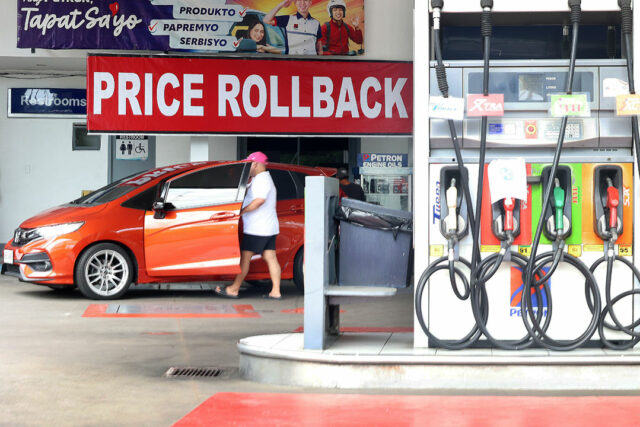
A “price rollback” sign is posted at a gas station along Katipunan Avenue in Quezon City, April 14. 2026. — PHILIPPINE STAR/MIGUEL DE GUZMAN

By Sheldeen Joy Talavera, Reporter

LOCAL PUMP PRICES may continue to decline next week based on early estimates, despite renewed upward pressure on global oil prices following the US blockade of Iranian ports, a Department of Energy (DoE) official said.

Energy Undersecretary Alessandro O. Sales said the two-day trading average of the Mean of Platts Singapore (MOPS), a benchmark for refined oil products, remains on a downward trend.

“Even with the pronouncement of President [Donald J.] Trump that he stationed his warships at the opening of the Strait of Hormuz, apparently the market is not pricing that in. The MOPS (prices) are still going down,” Mr. Sales said at a briefing on Wednesday.

“So, if this market reaction continues, potentially we will have a more stable price or maybe we will have a rollback,” he added.

An industry source told BusinessWorld that there may be another rollback in fuel prices based on the first two days of MOPS trading and foreign exchange averages.

The source estimated diesel prices may decline by P14 to P16 per liter, while gasoline prices may go down by P1 to P2 per liter.

“The ceasefire in the Middle East is holding, reducing some of the immediate risk premium on MOPS prices,” the source said.

This week, several oil companies implemented a price rollback, with diesel prices dropping by as much as P23 per liter. Gasoline and kerosene fell by up to P6.50 and P11.50 per liter, respectively.

Energy Secretary Sharon S. Garin expressed hope that there would be no sudden disruptions, as the Philippines remains vulnerable to price swings in the global market.

“Whatever happens in the international market is reflected in our prices the following week. So, that is the danger. It’s not that we don’t want prices to go down, but we just need the public to know how significant the war is in terms of our price here in the local market,” she said at the same briefing.

To cushion the impact of these external shocks, the government has moved to order at least two million barrels of diesel to boost the country’s oil stockpiles.

The DoE, through state-run Philippine National Oil Co., has secured 471,000 barrels of diesel, all delivered to the Philippines in two shipments from Japan and Malaysia.

Mr. Sales said that a third shipment is expected to arrive by the end of this week, followed by a fourth shipment which will be delivered to Davao.

As of April 10, the country’s average fuel inventory can sustain demand for approximately 50.31 days, covering an estimated 75.55 million liters of consumption.

The average inventory for gasoline is 54.38 days; 48.9 days for diesel, 104.73 days for kerosene, 67.65 days for jet fuel, 45.96 days for fuel oil, and 36.27 days for liquefied petroleum gas.

‘NO POWER INTERRUPTION’
Also, Ms. Garin allayed fears that rising fuel prices may affect supply stability and lead to potential power interruptions, especially in remote diesel-dependent areas.

“One thing I’m sure of is that there will be no power interruptions because of the diesel price, because we have supply,” she said.

While oil makes up only around 3% of the national power generation mix, it is crucial for remote and island areas that are not connected to the main grid. Since these areas are subsidized by on-grid consumers, any increase in oil prices can still impact electricity rates nationwide.

Ms. Garin said that the state-run National Power Corp. (NPC) is studying how to source diesel at a cheaper price to cushion the impact on its operating diesel-based plants.

“The NPC is assuring [us] that they will run their generation sets no matter what the prices,” she said.

TAX ON DIESEL UNDER REVIEW
Meanwhile, Finance Undersecretary Karlo S. Fermin Adriano said that discussions regarding the suspension of excise taxes on diesel are ongoing, with the Development Budget Coordination Committee (DBCC) technical board convening weekly to review the policy.

“The door has not closed on the suspension or reduction for diesel and gasoline,” he said in a mix of Filipino and English during the Legislative Energy Action and Development Joint Committee hearing on Wednesday.

Mr. Adriano said the DBCC did not recommend any reduction or suspension for diesel, as 85% of household diesel consumption is coming from the three richest deciles, according to the Philippine Statistics Authority’s Family Income Expenditure Survey.

“Similar story with diesel, if you remove the excise tax on gasoline, who will benefit from this mostly will be the three richest deciles,” he added.

The DoF estimates revenue losses of about P39 billion, or roughly P430 million a day, if excise taxes on diesel and gasoline are suspended for three months, assuming Dubai crude prices average $100 per barrel. 

Last year, excise tax collections reached P173 billion. Excise taxes on gasoline reached P83 billion, while taxes on diesel hit P71 billion. — with Justine Irish D. Tabile

Emerging Asia needs ‘narrowly targeted’ policies vs energy shocks — IMF

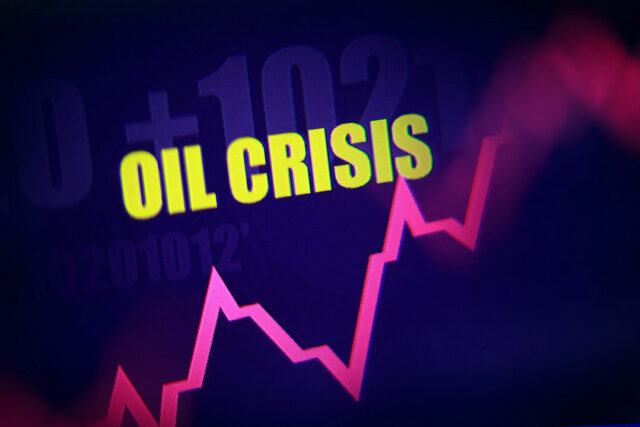
Rising stock graph and the words “Oil Crisis” are seen in this illustration taken March 23., 2026 — REUTERS/DADO RUVIC/ILLUSTRATION

By Katherine K. Chan, Reporter

WASHINGTON, D.C. — Policymakers in Emerging Asia markets such as the Philippines should implement “narrowly targeted” measures to weather current energy shocks from the Middle East war, the International Monetary Fund (IMF) said.

This, as officials from the multilateral lender noted that the ongoing crisis will test the region’s established resilience in the past decades, especially countries with high debt levels and limited fiscal space.

“The last 10, 15, 20 years have been a period where emerging market economies have really improved their macroeconomic policy making, their frameworks, and that resilience is likely to be tested,” IMF Economic Counselor and Research Director Pierre-Olivier Gourinchas told a press briefing on Tuesday.

“They don’t have a lot of room on the fiscal side,” he said. “And therefore, whatever measures they would need to deploy in order to protect the most vulnerable part of the population as a result of energy and food price increases will have to be very, very narrowly targeted and very much within their budgetary minimum.”

Based on its latest World Economic Outlook released on Tuesday, the IMF projects gross domestic product (GDP) growth for Emerging Asia to slow to 5% this year from 5.6% in 2025. It sees the region, which includes China, India, Indonesia, Malaysia, the Philippines, Thailand and Vietnam, growing by 4.8% in 2027.

Emerging Asian economies that rely heavily on oil imports have been hit by soaring oil prices and threats to their energy supply after the war in the Middle East, which erupted in late February, disrupted global oil trade and damaged key energy infrastructure.

In the Philippines, back-to-back pump price hikes and dwindling oil reserves prompted the National Government to declare a national energy emergency and suspend the excise tax on kerosene and liquefied petroleum gas (LPG).

The levies on gas and diesel were left unchanged as the Development Budget Coordination Committee said suspending it as well would bring insignificant relief to consumers compared with kerosene and LPG.

Similarly, the IMF earlier noted that domestic demand in several South and Southeast Asian economies will likely remain muted this year as the Middle East war is expected to dampen tourism and remittance flows to the region.

For the ASEAN-5, or Indonesia, Malaysia, the Philippines, Singapore and Thailand, the multilateral lender trimmed its growth forecast to 4.1% for this year from its 4.2% estimate in January. 

“In several South and Southeast Asian economies, disruptions in the Middle East are expected to reduce tourism and remittance inflows, thereby weakening domestic demand,” the IMF said.

Still, it kept its GDP growth projection for the region next year at 4.4%.

The IMF cut its Philippine GDP forecast to 4.1% from 5.6% in January and maintained its 2027 projection at 5.8%.

The regional slowdown mirrors the global trend, in which IMF Managing Director Kristalina Georgieva earlier noted that even their most optimistic scenario calls for a growth forecast cut due to the war’s toll on energy sectors worldwide.

According to the IMF, the world is losing about 13 million oil barrels daily as the Middle East war drags on, more than double the 5-6 million barrels recorded during the 1970s energy crisis.

Tobias Adrian, financial counselor and director of the IMF’s Monetary and Capital Markets Department, said Asia-Pacific (APAC) countries dependent on oil and food imports emerge as the most vulnerable to balance of payments or refinancing stress.

“It’s the most vulnerable countries that tend to be hit the hardest with this kind of shock,” he told a separate briefing on Tuesday. “And within those countries, you know, macro policies for stability are important, but it’s also first order to protect the most vulnerable among the population that are hit by the higher food and energy prices.”

However, Jason Wu, assistant director at the IMF’s Global Markets division, noted that there has not been any acute stress in APAC financial markets, even as the war caused volatility in the region’s foreign exchange market.

“There have been pronounced exchange rate movements, but those appear to be managed in an orderly fashion,” he added.

Safe-haven demand for the US dollar amid growing uncertainties from the war have weighed on most Asian currencies, including the Philippine peso.

Meanwhile, the World Bank has cautioned that the Philippines’ limited fiscal space leaves little room for broad tax relief, and called for more targeted approach to shield vulnerable households from rising oil prices.

“A targeted response, such as providing an additional P600 per month to 3.9 million 4Ps beneficiaries, could protect the most vulnerable without substantially widening the deficit,” the World Bank said in its Macro Poverty Outlook released on Monday.

“In contrast, a fuel excise pause is less targeted and could cost over 0.5% of GDP in foregone revenue if maintained through 2026,” it added.

The World Bank projects the country’s fiscal deficit to narrow from -5.6% of GDP in 2025 to -4.8% in 2026, -4.7% in 2027, and -4.4% in 2028.

The Development Budget and Coordination Committee (DBCC) projects the deficit to account for -5.3% of GDP in 2026, -4.8% in 2027, and -4.4% in 2028. It also sees the gap further narrowing to -3.7% in 2029 and -3.1% in 2030. — with reports from Justine Irish D. Tabile

Prime Energy eyes new gas blocks beyond Malampaya

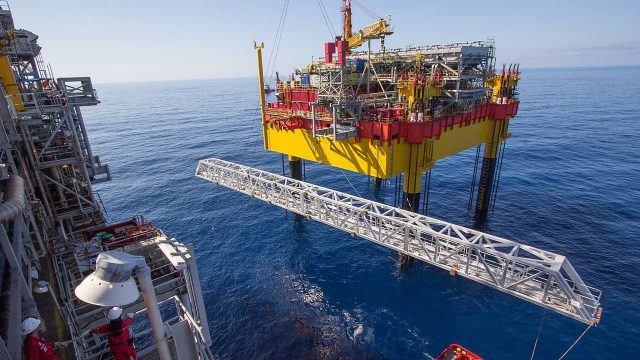
BW FILE PHOTO

RAZON-LED Prime Energy Resources Development B.V., operator of the Malampaya gas field, said it is exploring potential areas beyond the country’s main natural gas source to help firm up power supply.

Prime Energy President and Chief Executive Officer Donnabel Kuizon-Cruz said the company is studying opportunities to explore additional blocks aside from Malampaya.

“We were still looking at other blocks that we could potentially explore. So we’re not focused on just one area. And of course, every year, we refresh our work program budget to see where we want to go next,” Ms. Kuizon-Cruz told reporters on Tuesday.

The Malampaya consortium — composed of Prime Energy Resources Development B.V., UC38 LLC, Prime Oil & Gas, Inc., and state-owned PNOC Exploration Corp. — is undertaking an $893-million Malampaya Phase 4 (MP4) project to extend the life of the gas field.

The Malampaya Deep Water Gas-to-Power Project spans 337,676 hectares offshore Palawan and supplies up to 13% of Luzon’s electricity requirements.

Prime Energy earlier said it had completed drilling and testing two wells — Malampaya East-1 (MAE-1) and Camago 3 — confirming the presence of natural gas reserves.

MAE-1, located about five kilometers east of the existing Malampaya field, is estimated to contain about 98 billion cubic feet of gas, while Camago 3 is estimated to hold up to 60 billion cubic feet of gas.

The company said these wells could extend the operating life of the Malampaya gas field by about six years, supporting continued supply of indigenous natural gas to the Luzon grid.

“We’ve tested these wells and we’ve proven there’s gas that we can produce to maintain the Malampaya plateau for at least six years. So that is already a major milestone,” Ms. Kuizon-Cruz said.

“And now, immediately after that, we’ve started laying the pipes that would connect these wells to the platform,” she added.

Following the completion of the two wells, the consortium is preparing to drill the Bagong Pag-asa exploration well, located about 30 kilometers north of Malampaya.

Ms. Kuizon-Cruz said the company remains on track to deliver first gas from the MP4 development by the fourth quarter of 2026.

“It’s on track. It’s going very well so far. So as long as we continue on this track, we remain on schedule. We should be able to meet the Q4 2026 promise,” she said.

The MP4 project has been certified by the government as a project of national significance. Since its inception, the Malampaya project has generated more than $14 billion in revenues for the government and reduced reliance on imported fuels. — Sheldeen Joy Talavera

CLI says 2026 capex could reach P20B on consolidated basis

THE East Village is the first residential project of Cebu Landmasters, Inc. within the Davao Global Township. — COMPANY HANDOUT

CEBU Landmasters, Inc. (CLI) said its total capital expenditure (capex) for 2026 could reach around P20 billion on a consolidated basis, clarifying that an earlier P12 billion to P14 billion figure covered only the parent company.

In a disclosure on Wednesday, the listed developer said the higher capex includes spending by subsidiaries and joint venture projects, reflecting its broader development pipeline and expansion initiatives.

Of the total budget, about P12.7 billion, or 63%, is allocated for project development, while the remainder will fund land acquisitions and other capital expenditures across CLI and its related entities.

“As previously disclosed to regulatory authorities and in line with the company’s ongoing project pipeline and expansion initiatives, capital deployment covers both parent-level and project-level investments, including those undertaken through subsidiaries and joint ventures,” the company said.

The clarification follows CLI’s briefing on Tuesday, where it said it was setting aside P12 billion to P14 billion in capex for 2026.

In 2025, CLI posted a net income of P4.03 billion, while consolidated revenues reached P18.5 billion, supported by project completions and steady construction progress.

Excluding lot sales, real estate sales and related finance income rose 10% to P17.3 billion from P15.8 billion a year earlier, remaining the company’s main revenue driver.

CLI ended the year with residential reservations of P24.6 billion, up from P16.9 billion in 2024, supported by sustained demand across its portfolio.

The company has 132 projects across residential, office, hotel, co-living, co-working, mixed-use, and township developments in 18 cities in the Visayas and Mindanao.

At the local bourse, CLI shares fell by 0.40% to P2.49 each on Wednesday. — Alexandria Grace C. Magno

Rockwell Land profit jumps 28% on residential, leasing gains

E-ROCKWELL.COM

ROCKWELL LAND Corp. reported a 27.6% increase in attributable net income to P4.73 billion for 2025 from P3.71 billion in 2024, driven by higher residential revenues, growth in leasing income, and gains from the acquisition and consolidation of Alabang Commercial Corp. (ACC).

Total consolidated revenues rose 3.9% to P20.87 billion from P20.09 billion a year earlier, with residential sales accounting for about 75% of revenues, while commercial leasing contributed around 21%, the company said in its annual report released on Wednesday.

Residential revenues increased by 5% on higher project completion, while retail and leasing income grew 6% due to improved rental rates and occupancy.

Earnings were also supported by “the gain on the acquisition and consolidation of ACC” and increased contributions from affiliates.

Expenses rose during the period, with selling expenses increasing 9% due to higher sales bookings and project completions, while interest expense went up 11% on higher borrowing costs and loan balances.

Cost of real estate declined by 5%, partly offsetting the increase in expenses, while interest income fell 18% due to lower returns on contract receivables and short-term placements.

Income before tax rose to P6.72 billion from P5.30 billion in 2024. Provision for income tax increased to P1.41 billion, bringing net income to P5.31 billion for the year.

Reservation sales jumped 62% to P25.3 billion, driven by “strong demand for newly launched projects.”

The company’s commercial segment posted a 4% increase in revenues to P4.4 billion on higher leasing income supported by improved tenant sales and rental rates.

Shares of Rockwell Land rose 5.24% to close at P2.01 each, according to data from the Philippine Stock Exchange. — Alexandria Grace C. Magno

ADVERTISEMENT
ADVERTISEMENT