Home Blog Page 878

Beloved Chinese restaurant Lido Cocina Tsina rolls out brand and interior refresh

Lido Cocina Tsina Bacoor, Cavite branch Grand Opening

Updated store look; new menu items meant to delight customers

Well-loved Chinese heritage restaurant Lido Cocina Tsina, home of Chinese-style Asado, is steadily rolling out a refreshed look and feel to their dining outlets together with a new brand identity. This is part of the 89-year-old restaurant chain’s push to stay current without losing touch of its storied roots, dating back to 1936 on T. Alonzo in Binondo.

First to enjoy this all-new Lido look is their Molino, Bacoor, Cavite, branch that went on soft opening last May, 2025.

“We’re incredibly proud to unveil Lido’s brand refresh — a thoughtful evolution that honors our heritage while embracing a modern dining experience,” says Annie Wong, President of Lido Cocina Tsina. “For over 80 years, we’ve remained committed to delighting our customers, and this next chapter builds on that legacy. From our updated interiors that evoke warmth and comfort to a revitalized brand identity, we’re confident both loyal patrons and first-time guests will feel the same heartwarming Lido hospitality — now in a more contemporary setting.”

Lido Bacoor, Cavite branch

This was proudly celebrated through the recent grand opening of the Lido Bacoor branch, where the ribbon-cutting ceremony was led by distinguished guests and partners. In attendance were Bacoor Councilor Rey Fabian, Councilor-Elect Jefferson Lao, Honorable DILG Assistant Secretary Florencio Bernabe, and Lido Cocina Tsina Owners Annie Wong and Mark Wu, along with Architect Peter Ong. Set against a backdrop of festive Chinese lion dances and vibrant balloon arches, the event marked a significant milestone in Lido’s evolution while honoring its rich cultural heritage.

Updated look and feel

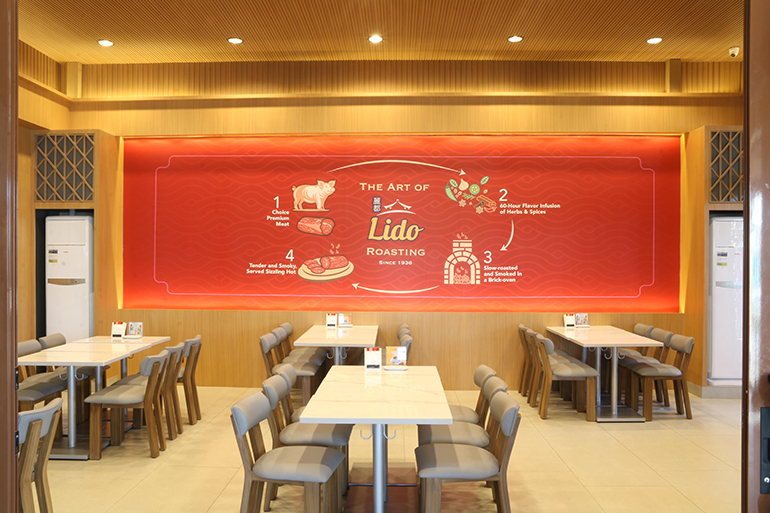
Lido’s newly opened Bacoor branch debuts the brand’s refreshed look — featuring cozy, minimalist interiors with warm tones and natural textures that create a relaxed, welcoming atmosphere. The new logo, with its clean lines and stylized pagoda icon, reflects Lido’s rich heritage and its modern evolution in Chinese dining.

New delightful dishes

Alongside these exciting changes are new menu offerings.

While all-time “Lido Legends” — dishes that feel like home — such as their Pugon Roasted Asado, Chami, Drunken Lechon Macau, and Shrimp Foo-Yong are always available to delight loyal patrons, new dishes have been added to further captivate lovers of Chinese cuisine.

Lido’s new products

“At the heart of Lido is our delicious, thoughtfully prepared dishes that people have really come to love,” Annie Wong further says. “Now, we’re excited and proud to introduce our new product offerings whose development I personally supervised.”

Among these include Roasted Asado in Plum Glaze, Beef Brisket Curry, French Beans in XO, Radish Cake in XO, Hot Shrimp Salad and Cantonese-Style Crispy Noodles — all of which are sure to whet the appetite of foodies. Add to that, all are MSG-free!

Management with team

With all the ongoing developments happening at Lido Cocina Tsina, longtime customers and new faces — families, officemates, and barkadas — will surely enjoy what Lido has in store.


Spotlight is BusinessWorld’s sponsored section that allows advertisers to amplify their brand and connect with BusinessWorld’s audience by publishing their stories on the BusinessWorld Web site. For more information, send an email to online@bworldonline.com.

Join us on Viber at https://bit.ly/3hv6bLA to get more updates and subscribe to BusinessWorld’s titles and get exclusive content through www.bworld-x.com.

Get ready: Nintendo Switch 2 launches exclusively on Nintendo Official Store on Shopee this June 26

The next generation of Nintendo gaming is finally here — exclusively on Shopee!

Launching on June 26 at Nintendo’s Official Shopee Store, grab your official units at these launch prices:

  • Nintendo Switch 2 Console₱31,990 (includes 2-year warranty)
  • Nintendo Switch 2 Mario Kart World Bundle₱35,500 (includes physical game + 2-year warranty)

What to Expect at Launch

2-Year Warranty on All Consoles
Whether you choose the base unit or the bundle, every Nintendo Switch 2 bought from the Shopee official store comes with a 2-year warranty.

Mario Kart World Bundle — Physical Game Included
Start playing instantly with the Mario Kart World Bundle, which includes a physical copy of Mario Kart right in the box — no need to wait or download.

Full Line of Games & Accessories Also Available
Stock up and customize your play — official games, Joy-Cons, controllers, and other accessories will also be available during launch.

Exclusive Launch Offers

Flexible Payment with SPayLater — 0% Interest
Upgrade now and pay later with flexible payment options via Shopee SPayLater — giving you more ways to own your Nintendo Switch 2.

Up to 25% OFF in Stackable Vouchers
Get up to ₱1,200 OFF (min. spend ₱2,500). Use vouchers on consoles, games, or accessories!

Free Shipping Nationwide
No shipping fees, just smooth and secure delivery right to your doorstep.

Be First in Line! 

Don’t miss your chance to own the Nintendo Switch 2 with official 2-year warranty, physical game bundles, and launch-exclusive Shopee deals. With games and accessories also available at launch, it’s the perfect time to upgrade or start your Nintendo journey.

Limited stocks only — be ready to add to cart and shop by midnight on June 26!

Shop Here:

Nintendo Official Store: https://bit.ly/ShopeeNintendoOfficialStore


Spotlight is BusinessWorld’s sponsored section that allows advertisers to amplify their brand and connect with BusinessWorld’s audience by publishing their stories on the BusinessWorld Web site. For more information, send an email to online@bworldonline.com.

Join us on Viber at https://bit.ly/3hv6bLA to get more updates and subscribe to BusinessWorld’s titles and get exclusive content through www.bworld-x.com.

“A scrap of paper”: Philippine VP Sara Duterte wants impeachment complaint dismissed

Vice President Sara Duterte arrives at the Department of Justice, May 9, 2025. — PHILIPPINE STAR/RYAN BALDEMOR

MANILA — Philippine Vice President Sara Duterte has described the impeachment complaint against her as “nothing more than a scrap of paper” in her formal response to the Senate, saying the case was baseless and should be dismissed for being unconstitutional.

The impeachment, widely seen as a test of political alliances, comes amid an acrimonious falling out between Duterte and President Ferdinand Marcos Jr that has sparked a broader power struggle ahead of the 2028 presidential election.

Marcos, who has distanced himself from the case, is limited to a single term but is expected to groom a successor to run. Duterte, the daughter of former President Rodrigo Duterte, is viewed as a strong rival contender if she avoids impeachment.

“The Vice President enters a plea of not guilty, without waiving any of her jurisdictional and other objections over the charges,” Duterte said in a submission dated June 23.

She dismissed the accusations against her as baseless, calling them “exaggerations and speculations that are not supported by evidence” in the 34-page response to the Senate.

In February, the House of Representatives voted to impeach Duterte for betrayal of public trust and high crimes, sending the case to the Senate. On June 11, the Senate returned the case to the House shortly after convening as an impeachment court.

The Senate also ordered Duterte to respond to the allegations in the case, including that she had plotted to assassinate Marcos and others based on a statement she made in November about hiring an assassin.

She is also accused of misusing public funds both as vice president and during her stint as education secretary.

As well as saying there was nothing substantive for her to answer in the case, Duterte argued the impeachment complaint was the fourth filed against her, with the three earlier ones not acted on by the lower house.

This, she said, violated a constitutional safeguard against more than one impeachment proceeding against the same official within a year, reiterating the arguments she used in asking the Supreme Court to dismiss the complaint. That case is ongoing.

“There are no statements of ultimate facts in the Fourth Impeachment complaint. Stripped of its ‘factual’ and legal conclusions, it is nothing more than a scrap of paper,” Duterte’s reply said.

She faces a lifetime political ban if convicted.

Congresswoman Gerville Luistro, a member of the impeachment prosecution panel, confirmed the lower house had received Duterte’s reply to the Senate on Monday.

“The entire prosecution team is currently studying each and every allegation contained in the answer. Certainly, we will be filing a reply within 5 days from receipt as provided in the rules,” Luistro said in a phone message. — Reuters

Trump tariff deadline spurs Asia export surge, wider trade gaps

Operations at a container terminal at Haiphong Port in Vietnam. -- Photographer: Linh Pham/Bloomberg

The US trade deficit with Asia is widening as importers stock up ahead of President Donald Trump’s “reciprocal” tariffs deadline.

Vietnam, Taiwan and Thailand all reported record exports to the US in May, according to data released in the past few weeks. South Korean shipments were near a record last month and look to have grown again in early June, data released on Monday showed.

Those highs flip the normal historical pattern, where trade is stronger in the latter part of the year as Asian suppliers ship to the US ahead of Christmas holidays. The threat of new US tariffs starting in early July is forcing companies to get goods onto vessels and to the US as quickly as possible.

Shipments from Vietnam and Thailand to the US both jumped 35% in May from a year earlier, while Taiwanese exports soared almost 90%. Those historic gains are likely to start showing up in the US data this week, when May data is released, and could complicate negotiations between Trump and economies across the region on the level of tariff the US will set.

The US trade deficit has blown out this year as firms try to deal with the sudden changes to Washington’s tariff and trade policy. While a sharp rise in pharmaceutical imports from Europe has contributed to the shortfall, Asian nations are the largest single contributor to the gap.

The forecast is for the US trade deficit to have been $91 billion in May, enough to take it to almost $643 billion so far in 2025 — well beyond the previous record for this stage of the year set during the pandemic.

If Trump imposes historically high duties on countries across Asia in early July as he is threatening to do, that surge in exports could quickly reverse, undermining economic growth across the region.

Last month, the Asia-Pacific Economic Cooperation organization slashed its forecast for GDP growth this year due to the trade tensions, with the economies of the 21 members seen expanding 2.6%, lower than the 3.3% forecast in March.

The policy volatility is already impacting trade with China, which saw shipments to the US drop in May, despite a tariff truce agreed in Geneva mid-month. Yet that might not be the whole picture: Even with the tariff reductions agreed in that deal, US import taxes are still at high levels, pushing some exporters to channel products via third economies in a process known as origin washing.

Chinese firms are also trying to shift their exports to other markets legitimately and sell more at home. Any sustained drop-off in exports risks undermining economic growth in China, which has been increasingly dependent on foreign demand to counteract the drag from a property slump and weak domestic consumption.

Other nations in Asia might start seeing a similar hit to their growth appearing soon if they can’t reach a deal with the US and escape hefty hikes in tariffs. — Bloomberg

Fed’s Bowman open to cutting rates at July policy meeting

REUTERS

NEW YORK – Federal Reserve Vice Chair for Supervision Michelle Bowman, recently tapped by President Trump as the U.S. central bank’s top bank overseer, said Monday the time to cut interest rates is getting nearer as risks to the job market may be on the rise.

“It is time to consider adjusting the policy rate,” Bowman told a gathering held in Prague, Czech Republic. The official’s shift was unexpected as she had in recent months appeared skeptical of the need to ease monetary policy.

Bowman said inflation appears to be on a sustained path back to 2% and she said she expects “only minimal impact” on inflation from trade policy. “Should inflation pressures remain contained, I would support lowering the policy rate as soon as our next meeting in order to bring it closer to its neutral setting and to sustain a healthy labor market,” Bowman said.

She noted the job market is still in a good place but that she is also increasingly worried about rising risks to the sector and said that such concerns might need to take more prominence in thinking about the outlook.

“We should also recognize that downside risks to our employment mandate could soon become more salient, given recent softness in spending and signs of fragility in the labor market,” Bowman said.

The central banker’s comments on the interest rate outlook caught the attention of financial markets, where stock prices got a hop and futures markets bolstered what are still low odds the central bank will cut rates when the rate-setting Federal Open Market Committee meets at the end of July.

Futures markets still believe rate cuts will start at the September policy meeting.

Bowman’s dovish take on monetary policy was followed later in the day by Chicago Fed President Austan Goolsbee.

The policymaker said that while tariffs carry big risks to the economy in the form of higher inflation and lower growth, which are very tricky for monetary policy to address, thus far some of his stronger worries have not been realized.

“Somewhat surprisingly, thus far, the impact of tariffs has not been what people feared” when huge tariffs were announced at the start of April, Goolsbee said in comments before the Milwaukee Business Journal Mid-Year Outlook.

The policymaker said that if the economy can get through this period of turbulence and uncertainty, the path toward rate cuts may open up again.

“If we do not see inflation resulting from these tariff increase, then, in my mind, we never left what I was calling the golden path,” and that’s a path that until recently heralded cuts in short-term borrowing costs, Goolsbee said.

The official described tariffs as throwing “dirt” in the air and said of that uncertainty, “if the dirt is out of the air, then I think we should proceed” with rate cuts.

STEADY STATE

Last week, the FOMC left its overnight target-rate range fixed between 4.25% and 4.5%.

Officials remained in a wait-and-see mode amid the considerable economic uncertainty created by President Donald Trump’s erratically implemented trade policy.

Most Fed officials are worried surging import taxes could depress growth while restarting what had been cooling inflation pressures. That said, they continue to pencil in two rate cuts for this year.

Even with Trump’s retreat on the most extreme tariff levels, the overall level of his current import taxes, which are currently facing a court challenge, is higher than anything Americans have seen in many years.

“Increases in tariffs this year are likely to push up prices and weigh on economic activity,” Fed Chairman Jerome Powell said on Wednesday following the FOMC meeting.

“It takes some time for tariffs to work their way through,” Powell noted, while adding that when it comes to the tariffs “we’re beginning to see some effects, and we do expect to see more of them over coming months.”

Bowman said in her speech that she supported the Fed’s decision to hold steady. But she also noted that she sees far fewer storm clouds ahead for the economy with more clarity arriving for the outlook.

Bowman’s openness to cutting rates soon is joined by that of Fed Governor Christopher Waller, who said in a television interview on Fridayhe would also consider a rate cut at the July 29-30 meeting. Waller is widely considered to be in the running to succeed Powell, whose term ends next year.

Trump has repeatedly pressured the Fed to pursue very large rate cuts akin to those taken in times of crisis amid regular insults to Powell. Observers believe any Fed chair would need to align with Trump’s desire for much lower short-term borrowing costs, although doing so could put the Fed’s inflation fighting credibility at risk.

Goldman Sachs economists said in a note that the next few months will be telling for the price pressure outlook, telling clients in a note on Monday that “we expect the largest tariff effects on monthly inflation to show up from June through August.”

Bowman was also quite sanguine on the inflation outlook, saying “it appears that any upward pressure from higher tariffs on goods prices is being offset by other factors and that the underlying trend in core (Personal Consumption Expenditures) inflation is moving much closer to our 2% target than is currently apparent in the data.”

She also said Trump’s policy mix is likely to have a positive impact on the outlook.

“Less restrictive regulations, lower business taxes, and a more friendly business environment will likely boost supply and largely offset any negative effects on economic activity and prices,” Bowman said. — Reuters

Israel and Iran agree on ceasefire to end 12-day war, Trump says

Israeli and Iranian flags are seen in this illustration taken, April 24, 2024. — REUTERS/DADO RUVIC/ILLUSTRATION

WASHINGTON/DOHA/ISTANBUL – U.S. President Donald Trump announced on Monday a complete ceasefire between Israel and Iran, potentially ending the 12-day war that saw millions flee Tehran and prompted fears of further escalation in the war-torn region.

Israel, joined by the United States on the weekend, has carried out attacks on Iran’s nuclear facilities, after alleging Tehran was getting close to obtaining a nuclear weapon.

“On the assumption that everything works as it should, which it will, I would like to congratulate both Countries, Israel and Iran, on having the Stamina, Courage, and Intelligence to end, what should be called, ‘THE 12 DAY WAR’,” Trump wrote on his Truth Social site.

There was no immediate comment yet from Israel. While an Iranian official earlier confirmed that Tehran had agreed to a ceasefire, the country’s foreign minister said there would be no cessation of hostilities unless Israel stopped its attacks.

Abbas Araqchi said early on Tuesday that if Israel stopped its “illegal aggression” against the Iranian people no later than 4 a.m. Tehran time (0030 GMT) on Tuesday, Iran had no intention of continuing its response afterwards.

There have been no reported Israeli attacks on Iran since that time.

“The final decision on the cessation of our military operations will be made later,” Araqchi added in a post on X.

A senior White House official said Trump had brokered the deal in a call with Israeli Prime Minister Benjamin Netanyahu and Israel had agreed so long as Iran did not launch further attacks.

Trump appeared to suggest that Israel and Iran would have some time to complete any missions that are underway, at which point the ceasefire would begin in a staged process.

Iran denies ever having a nuclear weapons program but Supreme Leader Ali Khamenei has said that if it wanted to, world leaders “wouldn’t be able to stop us”.

Israel, which is not a party to the international Non-Proliferation Treaty, is the only country in the Middle East believed to have nuclear weapons. Israel does not deny or confirm that.

Qatar’s Prime Minister Sheikh Mohammed bin Abdulrahman Al Thani secured Tehran’s agreement during a call with Iranian officials, an official briefed on the negotiations told Reuters on Tuesday.

U.S. Vice President JD Vance, Secretary of State Marco Rubio and U.S. special envoy Steve Witkoff were in direct and indirect contact with the Iranians, the White House official said.

Neither Iran’s U.N. mission nor the Israeli embassy in Washington responded to separate requests for comment from Reuters.

Hours earlier, three Israeli officials had signaled Israel was looking to wrap up its campaign in Iran soon and had passed the message on to the United States.

Netanyahu had told government ministers whose discussions ended early on Tuesday not to speak publicly, Israel’s Channel 12 television reported.
Markets reacted favorably to the news.

S&P 500 futures rose 0.4% late on Monday, suggesting traders expect the U.S. stock market to open with gains on Tuesday.

U.S. crude futures fell in early Asian trading hours on Tuesday to their lowest level in more than a week after Trump said a ceasefire had been agreed, relieving worries of supply disruption in the region.

END TO THE FIGHTING?

There did not appear to be calm yet in the region.

The Israeli military issued two evacuation warnings in less than two hours to residents of areas in the Iranian capital Tehran, one late on Monday and one early on Tuesday.

Israeli Army radio reported early on Tuesday that alarms were activated in the southern Golan Heights area due to fears of hostile aircraft intrusion.

Earlier on Monday, Trump said he would encourage Israel to proceed towards peace after dismissing Iran’s attack on an American air base that caused no injuries and thanking Tehran for the early notice of the strikes.

Iran’s handling of the attack recalled earlier clashes with the United States and Israel, with Tehran seeking a balance between saving face with a military response but without provoking a cycle of escalation it can’t afford.

Tehran appears to have achieved that goal.

Iran’s attack came after U.S. bombers dropped 30,000-pound bunker-buster bombs on Iranian underground nuclear facilities at the weekend, joining Israel’s air war.
Much of Tehran’s population of 10 million has fled after days of bombing.

The Trump administration maintains that its aim was solely to destroy Iran’s nuclear program, not to open a wider war.

“Iran was very close to having a nuclear weapon,” Vice President JD Vance said in an interview on Fox News’ “Special Report with Bret Baier.”

“Now Iran is incapable of building a nuclear weapon with the equipment they have because we destroyed it,” Vance said.

But in a social media post on Sunday, Trump spoke of toppling the hardline clerical rulers who have been Washington’s principal foes in the Middle East since Iran’s 1979 Islamic Revolution.

Israel, however, had made clear that its strikes on Evin prison – a notorious jail for housing political prisoners – and other targets in Tehran were intended to hit the Iranian ruling apparatus broadly, and its ability to sustain power. — Reuters

Supreme Court lifts limits on Trump deporting migrants to countries not their own

The US Supreme Court is seen in Washington, US, May 2, 2022. — REUTERS

The U.S. Supreme Court cleared the way on Monday for President Donald Trump’s administration to resume deporting migrants to countries other than their own without offering them a chance to show the harms they could face, handing him another victory in his aggressive pursuit of mass deportations.

In an action that prompted a sharp dissent from its three liberal justices, the court granted the administration’s request to lift a judicial order requiring that migrants set for deportation to so-called “third countries” get a “meaningful opportunity” to tell U.S. officials they are at risk of torture at their new destination, while a legal challenge plays out.

Boston-based U.S. District Judge Brian Murphy had issued the order on April 18.

The Supreme Court’s brief order was unsigned and offered no reasoning, as is common when it decides emergency requests. The court has a 6-3 conservative majority.

Justice Sonia Sotomayor, joined by the two other liberal justices, called the decision a “gross abuse” of the court’s power.

“Apparently, the court finds the idea that thousands will suffer violence in far-flung locales more palatable than the remote possibility that a district court exceeded its remedial powers when it ordered the government to provide notice and process to which the plaintiffs are constitutionally and statutorily entitled,” Sotomayor wrote.

Sotomayor called the court’s action “as incomprehensible as it is inexcusable.”

Murphy had found that the administration’s policy of “executing third-country removals without providing notice and a meaningful opportunity to present fear-based claims” likely violates the U.S. Constitution’s due process protections. Due process generally requires the government to provide notice and an opportunity for a hearing before taking certain adverse actions.

After the Department of Homeland Security moved in February to step up rapid deportations to third countries, immigrant rights groups filed a class action lawsuit on behalf of a group of migrants seeking to prevent their removal to such places without notice and to gain chance to assert the harms they could face.

Murphy on May 21 found the Trump administration violated his order requiring additional steps before attempting to send a group of migrants to politically unstable South Sudan, which the U.S. State Department has urged Americans to avoid “due to crime, kidnapping and armed conflict.”

The judge’s intervention prompted the U.S. government to keep the migrants at a military base in Djibouti.

After the U.S. Supreme Court ruling, Murphy in a court order made clear that his decision preventing the rapid deportation of eight men to South Sudan “remains in full force and effect.”

Trina Realmuto, executive director of the National Immigration Litigation Alliance, which helps represent the plaintiffs, called the ramifications of the court’s action “horrifying,” stripping away “critical due process protections that have been protecting our class members from torture and death.”

The administration told the Supreme Court that its third-country policy already complied with due process and is critical for removing migrants who commit crimes because their countries of origin are often unwilling to take them back. It said that all the South Sudan-destined migrants had committed “heinous crimes” in the United States including murder, arson and armed robbery.

“The Supreme Court’s stay of a left-wing district judge’s injunction reaffirms the president’s authority to remove criminal illegal aliens from our country and Make America Safe Again,” White House spokesperson Abigail Jackson said after Monday’s decision.

“Fire up the deportation planes,” said Department of Homeland Security Assistant Secretary Tricia McLaughlin.

A FLOOD OF CASES

The dispute is one of many legal challenges to Trump policies to have reached the nation’s highest judicial body since he returned to office in January.

The Supreme Court in May let Trump end humanitarian programs for hundreds of thousands of migrants to live and work in the United States temporarily. The justices, however, faulted the administration’s treatment of some migrants whom Trump targeted for removal under the Alien Enemies Act – a 1798 law that historically has been employed only in wartime – as inadequate under constitutional due process protections.

Sotomayor said that in sending migrants to South Sudan, and in another instance four others to the U.S. naval base at Guantanamo Bay, Cuba, and on to El Salvador, the administration “openly flouted two court orders” issued by Murphy. Sotomayor also pointed to the separate Alien Enemies Act litigation in which questions were raised about the administration’s compliance with an order issued by a judge in that case.

“This is not the first time the court closes its eyes to noncompliance, nor, I fear, will it be the last,” Sotomayor wrote. “Yet each time this court rewards noncompliance with discretionary relief, it further erodes respect for courts and for the rule of law.”

The administration asked the Supreme Court to intervene after the Boston-based 1st U.S. Circuit Court of Appeals on May 16 declined to put Murphy’s decision on hold.
Reuters has also reported that U.S. officials had been considering sending migrants to Libya, another politically unstable country, despite previous U.S. condemnation of Libya’s harsh treatment of detainees. — Reuters

Magnitude 6.3 earthquake strikes east of Philippine islands, GFZ says

PHILIPPINE STAR/EDD GUMBAN

An earthquake measuring 6.3 magnitude struck east of Philippine islands on Tuesday, the German Research Centre for Geosciences (GFZ) reported.

The quake was at a depth of 10 km (6.21 miles), GFZ said. — Reuters

US business activity moderates in June

REUTERS

WASHINGTON – U.S. business activity slowed marginally in June, though prices increased further amid President Donald Trump’s aggressive tariffs on imported goods, suggesting that an acceleration in inflation was likely in the second half of the year.

The anticipated rise in inflation has resulted in the Federal Reserve pausing its interest rate cutting cycle, putting pressure on the housing market. The existing home sales pace in May was the lowest for the month since 2009 as higher mortgage rates sidelined potential buyers, other data showed on Monday.

The risks of higher inflation and tepid economic growth or stagflation have risen amid the uncertainty caused by the constantly shifting tariffs policy. An escalation in tensions in the Middle East after the United States joined in the conflict between Israel and Iran with air strikes on Tehran’s nuclear facilities has added another layer of uncertainty.

“With tariff-induced price hikes already set to squeeze household spending power, higher gasoline prices would intensify the strain on consumer pockets, risking a more pronounced slowdown in the economy,” said James Knightley, chief international economist at ING.

S&P Global said its flash U.S. Composite PMI Output Index, which tracks the manufacturing and services sectors, slipped to 52.8 this month from 53.0 in May. A reading above 50 indicates expansion in the private sector.

The survey’s flash manufacturing PMI was unchanged at 52.0. Economists polled by Reuters had forecast the manufacturing PMI easing to 51.0. S&P Global noted a slight rise in optimism among manufacturers “in part reflecting hopes of greater benefits from trade protectionism.”

It, however, added that “companies generally remained less upbeat than prior to the inauguration of President Trump.” Its flash services PMI dipped to 53.1 from 53.7 in May. Economists had forecast the services PMI falling to 53.0.

At face value, the PMIs suggested the economy continued to expand at a moderate pace at the end of the second quarter.

But so-called hard data on retail sales, homebuilding and the labor market have painted a picture of an economy that was softening because of tariffs.

That was reinforced by a separate report from the National Association of Realtors showing existing home sales increased 0.8% in May to a seasonally adjusted annual rate of 4.03 million units. Despite the rise, the sales pace was the slowest for any May since 2009 when the economy was at the tail end of the Great Recession, triggered by the bursting of the housing bubble.

Sales dropped 0.7% on a year-over-year basis in May. Other metrics were consistent with tepid demand. The 4.6 months supply of houses on the market was the highest in nearly nine years and a 1.3% price rise from a year ago was the smallest since 2023.

“Softer housing sector activity should be an early sign that underlying demand is weakening this year,” said Veronica Clark, an economist at Citigroup.

SLOWING ORDER GROWTH

The S&P Global survey’s measure of new orders received by businesses declined to 52.3 this month from 53.0 in May.

A measure of prices paid by businesses for inputs fell to 61.6 from 63.2 last month. But manufacturers faced higher input costs, with this price gauge jumping to 70.0. That was the highest reading since July 2022 and followed 64.6 in May.

Prices paid for inputs by services businesses remained elevated, with tariffs, higher financing, wage and fuel costs cited. The pace of increase, however, slowed amid competition.

Nearly two-thirds of manufacturers reporting higher input costs attributed these to tariffs while just over half of respondents linked increased selling prices to tariffs, S&P Global said.

That supports economists’ expectations that inflation would surge from June following mostly benign consumer and producer price readings in recent months. Economists have argued that inflation has been slow to respond to Trump’s sweeping import duties because businesses were still selling stock accumulated before the tariffs came into effect.

The survey’s measure of prices charged by businesses for goods and services remained at lofty levels as manufacturers passed on the increased costs from tariffs to consumers. The prices charged gauge for manufacturers shot up to 64.5, the highest since July 2022, from 59.7 in May.

The strife in the Middle East could also help to fan inflation. Goldman Sachs has estimated Brent crude oil peaking at $110 per barrel if flows through the Strait of Hormuz were halved for a month and remained down by 10% for the next 11 months. Oil prices briefly touched a five-month high on Monday before erasing most gains as oil and gas transit continued on tankers from the Middle East.

Stocks on Wall Street were trading higher after Fed vice-chair Michelle Bowman said the central bank could resume rate cuts as soon as July. The dollar slipped against a basket of currencies. U.S. Treasury yields declined.

The Fed last week kept the U.S. central bank’s benchmark overnight interest rate in the 4.25%-4.50% range, where it had been since December. Fed Chair Jerome Powell told reporters he expected “meaningful” inflation ahead.

S&P Global’s employment picked up this month, mostly driven by manufacturing, where some factories are experiencing order backlogs. But some economists were skeptical of the improvement, noting the recent rise in the number of people collecting unemployment checks.

“The employment index has been a poor guide to payroll growth lately, raising questions about its accuracy,” said Samuel Tombs, chief U.S. economist at Pantheon Macroeconomics. “Other surveys … all suggest that businesses are slowing employment growth.” — Reuters

Oil firms roll out 2-phase price hikes

A gas station attendant fills a tank with gas in Manila, June 23. — PHILIPPINE STAR/RYAN BALDEMOR

By Sheldeen Joy Talavera and Chloe Mari A. Hufana, Reporters

OIL FIRMS have agreed to implement the pump price hike in two tranches this week to lessen the burden on consumers, the Department of Energy (DoE) said on Monday.

Seaoil Philippines, Shell Pilipinas Corp., Petron Corp., Caltex Philippines, PetroGazz Ventures Philippines Corp., Unioil Petroleum Phils., Inc., Jetti Petroleum Inc., and Cleanfuel said they will increase gasoline prices by P1.75 per liter, diesel by P2.60 per liter, and kerosene by P2.40 per liter, effective June 24.

A second round of price hikes will be implemented either on June 26 or June 27.

Seaoil, Shell, Caltex and Petron said they will raise gasoline prices by P1.75 per liter, diesel by P2.60 per liter, and kerosene by P2.40 per liter on June 26. Jetti and PetroGazz will hike pump prices by the same amount on June 27.

The DoE on Monday said it met with representatives of the downstream oil industry who agreed to a staggered implementation of the big-time price hike this week.

“Our dialogue with industry players today reflects our shared commitment to balance economic realities with the need to shield our people from sudden price shocks, and we are pleased to report that they have responded positively to our request,” DoE Officer-in-Charge Sharon S. Garin said in a statement.

Present during the DoE meeting were representatives from Petron, Shell Pilipinas, Caltex, Jetti Petroleum, PetroGazz, Phoenix Petroleum, PTT Philippines, Seaoil, Total, Unioil Petroleum Philippines, Filpride, and Cleanfuel.

The DoE earlier estimated that diesel prices to go up by P4.30-P4.80 per liter; and gasoline by P2.50-P3 per liter this week.

Global crude oil prices surged amid the escalating conflict in the Middle East. After the US struck several nuclear sites in Iran, the latter’s parliament is now considering the closure of the Strait of Hormuz, a waterway between Iran and Oman which around 20% of the world’s oil passes through, Reuters reported.

Energy Undersecretary Alessandro O. Sales said the recent volatility in oil prices is mainly due to speculative trading amid geopolitical uncertainty and not actual supply disruptions.

“We are closely monitoring global oil price benchmarks and foreign exchange trends, but we also urge them to exercise prudence in passing on cost changes to consumers,” he said.

“Much of the recent price volatility is being driven not by actual supply disruptions, but by speculative trading due to geopolitical uncertainties,” he added.

The DoE said that it is implementing measures “to ensure adequate domestic fuel supply, including compliance with mandatory inventory requirements for oil companies.”

Under existing regulations, oil companies are required to keep a 30-day inventory of fuel.

At the same time, Ms. Garin also urged oil companies to expand the number of their retail stations offering fuel discounts to the transport sector.

ECONOMIC TEAM MEETING
Meanwhile, President Ferdinand R. Marcos, Jr. called for a meeting with his economic team to discuss contingency plans amid fears that the potential closure of the Strait of Hormuz will disrupt global supply, Malacañang said.

Palace Press Officer Clarissa A. Castro declined to give further details about the meeting, but said the government is preparing to roll out a fuel subsidy for public utility vehicle drivers. The government has allotted P2.5 billion for this initiative.

Should global crude prices breach the $80-per-barrel threshold, fuel subsidies for public transport drivers and fisherfolk will be automatically triggered.

“It will cause a domino effect because even if we say that our drivers will have a fuel subsidy, it is inevitable that it will also be spread to logistics [and] to trading,” Ms. Castro said in Filipino.

At the same time, Ms. Garin is scheduled to meet with officials from the Transportation and Agriculture departments on Tuesday to discuss the timely rollout of targeted subsidies for public transport drivers and farmers.

As of June 23, the average price of Dubai crude oil stands at $75.16 per barrel.

According to Ms. Castro, Mr. Marcos assured Filipinos the government is doing everything to cushion the impact of the impending oil crisis.

“We are ready for anything that may happen, and the government will meet all the needs of the people, and they should not worry because the government is now working for all of us,” she said in Filipino.

OVERDEPENDENCE ON IMPORTS
Amid the escalating conflict in the Middle East, the government should focus on how to reduce dependence on imported oil by boosting local upstream exploration, according to Edgar Benedict C. Cutiongco, president of the Philippine Petroleum Association.

Mr. Cutiongco told BusinessWorld that there is a need to enhance incentives and support the DoE’s efforts to attract investment in oil and gas exploration and production, including “attractive fiscal terms and a stable regulatory environment.”

“To improve the overall landscape, incentives are being re-evaluated beyond their current upstream oil industry focus,” he said. “While the downstream sector inherently gains from a stable supply of indigenous fuel, further improvements include enhancing the one-stop shop for permitting and transitioning from net oil sharing to gross production sharing incentives.”

He added that the government should “prioritize and expedite exploration within clear Philippine jurisdiction while closely monitoring developments in the West Philippine Sea.”

The upstream sector of the oil and gas industry focuses on the exploration, drilling, and production of crude oil and natural gas.

The Philippines imported 3,476 million liters of crude oil during the first half of 2023, higher by 23.7% in 2022, according to the DoE.

At the same time, IBON Foundation Executive Director Jose Enrique “Sonny” A. Africa said the Philippines has limited room to maneuver as it is dependent on imported fuel.

“These make us very economically vulnerable from any escalation in the Israel-Iran conflict,” he said in a Viber chat.

Any increase in oil prices will stoke inflation and deepen inequality, according to Mr. Africa.

“Rice prices, for instance, are vulnerable to the effect of oil prices on diesel fuel, transportation, fertilizers and other production costs,” he added. “The government should realize that it’s long overdue to reduce dependence on volatile global markets and build a more resilient domestic economy with greater food and energy self-sufficiency.”

PHL remittances may fall 1.4% if Trump tax is implemented

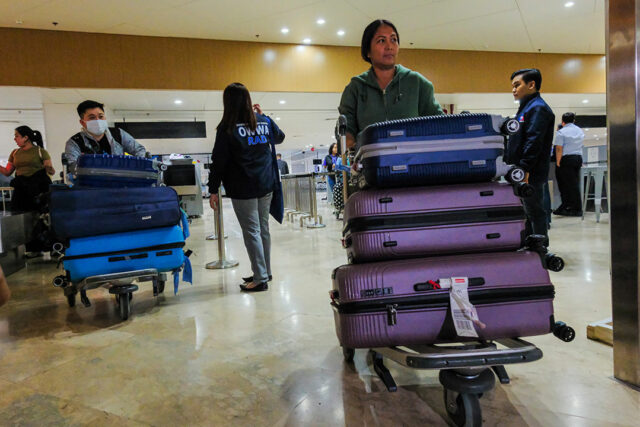
Overseas Filipino workers (OFWs) affected by the escalating tension in the Middle East arrive at the Ninoy Aquino International Airport, June 16. — PHILIPPINE STAR/RYAN BALDEMOR

REMITTANCE inflows to the Philippines may fall by 1.4% if US President Donald J. Trump’s proposed tax on money sent home by foreign workers is implemented, Deutsche Bank Research said.

In a June 20 note, Deutsche Bank Research said Philippine remittances have been “sluggish” in recent months and face more downside risks if the so-called “One Big Beautiful Bill” is signed into law in the US.

“The imposition of such a tax in the US could lead to a 1.4% decline in remittance inflow (0.1% of gross domestic product) to the Philippines,” it said.

“However, we believe that the impact of a tax on remittances is likely to be short-lived; structural shifts are more likely to affect the growth of remittances in the longer term.”

Mr. Trump is pushing for the passage of the “One Big Beautiful Bill,” which includes a provision imposing an excise tax of 3.5% on money sent abroad by foreign workers in the US. Remittances made by US citizens and nationals are exempted from the tax.

The bill was approved by the US House of Representatives in May, and is now being deliberated by the Senate.

Deutsche Bank Research noted the US makes up 41% of total remittance inflows to the Philippines.

In 2024, cash remittances jumped by 3% to $34.49 billion from the $33.49 billion registered in 2023. The US was the top country source of remittances, accounting for 40.6% of the total.

“However, we note that this could be an overestimate of the remittances that originate from within the US,” it said.

It noted that North and South America account for only 9.8% of overseas Filipino workers (OFWs), while the Middle East accounts for around half or 46% of all OFWs.

“While a remittance shock could weigh on the Philippines’ current account balance and household consumption in the short term, we argue that structural shifts in OFWs would influence longer-term trends in remittances to a greater extent,” Deutsche Bank Research said.

The deployment of OFWs has declined since the coronavirus disease 2019 (COVID-19) pandemic. Deutsche Bank Research noted the share of households with OFWs fell to 6.5% after the pandemic, as many OFWs opted to stay in the Philippines instead of working abroad again.

“This could partly explain why remittance growth post-COVID has been lower at ~3% year on year on average vs. 5.8% in the 2010s. Remittances also fell to 7.7% of gross domestic product during the same period from 8.4% prior to that,” it said.

Cash remittances from migrant Filipinos coursed through banks rose by 4% to $2.66 billion in April from $2.56 billion in the same month a year ago.

In the first four months of 2025, cash remittances went up by 3% to $11.11 billion annually from $10.78 billion a year ago.

“In the short term, remittances should remain a crucial source of funding for the Philippines, but push-pull factors make the long term more uncertain,” Deutsche Bank Research said.

It noted there could be increased demand for Filipino healthcare workers in countries with aging populations.

“On the other hand, continued growth of the domestic BPO (business process outsourcing) industry could lead to OFWs in the foreign BPO sector to choose to relocate back to the Philippines,” it said.

The BSP forecasts 2.8% growth in cash remittances to an estimated $35.5 billion this year. Next year, cash remittances are projected to grow by 3% to $36.5 billion. — A.R.A.Inosante

Wealthy Filipino empty nesters are moving to luxury condominiums

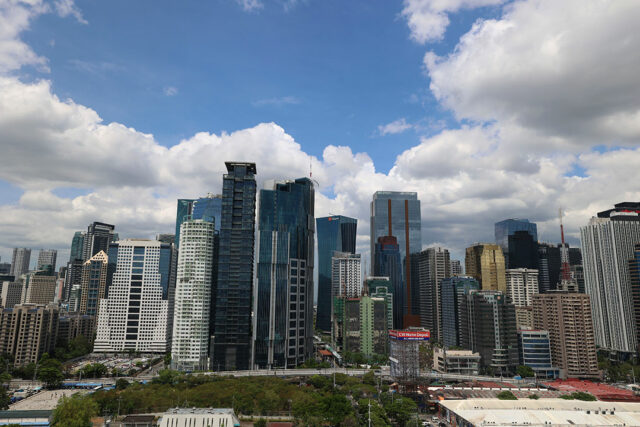
CONDOMINIUM and office buildings dominate the skyline of the Ortigas business district, April 4, 2025. — PHILIPPINE STAR/MIGUEL DE GUZMAN

By Joseph L. Garcia, Senior Reporter

THERE will be new fashionable addresses in town, away from the old-money enclaves that are the exclusive villages in Makati, Pasig and San Juan.

Condominium developers are building residences that cost P12 million to the hundreds of millions of pesos, as they try to attract wealthy empty nesters.

Ayala Land Premier’s Park Villas in Makati sit above P500 million; Federal Land, Inc., Japan’s Nomura Real Estate Development Co., Ltd. and Isetan Mitsukoshi Holdings Ltd.’s Seasons Residences complex have units that start at P23 million.

“For every luxury village, there’s always 5% to 6% (of homes) for sale,” Dan Ian dela Pasion, head of sales at Torre Lorenzo Development Corp., said in an interview with BusinessWorld.

Even boutique developers like Torre Lorenzo, known for building condominiums close to universities, are joining the luxury game with the Gallery at Torre Lorenzo Loyola, with units selling from P25 million to P75 million, targeting wealthy residents of Loyola Grand Villas and La Vista, which are home to several old families and politicians.

Joey Roi H. Bondoc, research director at property consulting firm Colliers Philippines, said the sale of luxury homes and the subsequent exodus to condominiums of matching price and caliber is driven by empty nesters — wealthy older people whose offspring have gone on to start careers or families, leaving the main family home empty.

“Anecdotally, it’s the empty nesters who are doing that,” he told BusinessWorld by telephone. “The decision is that usually, they just sell it and then acquire a luxury condominium unit.”

“They shift from horizontal to vertical [living]. Anecdotally, that’s what we get,” he added.

They move to a smaller condominium either to downsize because their kids are already grown-ups or they have faced a reversal of fortune and need to scale down, Mr. Dela Pasion said.

“They need funds,” he said, adding that others have decided to partition their wealth and convert the big house to cash.

More than that, the decision to move to vertical living is also a matter of physical practicality and the desire for unmatched comfort and lifestyle, he pointed out.

“Living in Metro Manila requires a lot of time for you to move in and out of the village, versus if you live in an urban area where everything is accessible,” he said.

At the Gallery, there are only four units per floor and a total of 36 residential units in the whole building, which provides security and exclusivity, Mr. Dela Pasion said.

Amenities and facilities include lounges, pools, function rooms and a pet park. “The concierge will conveniently and practically cater to the 36 apartments easily.”

Mr. Bondoc makes a case for vertical residences, as opposed to the large horizontal housing of the wealthy that the country has gotten used to.

“If you have a 500-square-meter lot, will you be able to maximize it?” he asked. “Even with the amenities of that village, will you be able to enjoy it?”

“But if you upgrade to a condominium, you’ll live in a relatively smaller unit, say 200 square meters, but you’ll have all the amenities tucked into a single floor, and you can enjoy and maximize them. I think that’s one of their major selling propositions,” he added.

IMMUNE FROM SHOCKS
While there are reports of a condominium surplus in the country, both assert that the people buying P12-million condo units — Mr. Bondoc’s baseline price for what constitutes a luxury condominium — are immune from the fluctuations of that market.

Mr. Dela Pasion counts the surplus at 35,000 units, a supply good for the next three years, while Mr. Bondoc places the surplus at eight years of supply.

“As long as the prices keep on [rising], as long as this market — the high-end market — keeps on growing, it will continue,” Mr. Dela Pasion said. “This market is untouchable.”

“They’re a recession-proof market. As long as the economy is doing well, and as long as people can afford trophy properties, it will keep on growing,” he added.

“This market is essentially shielded from elevated interest rates and mortgage rates because this market is awash with cash,” Mr. Bondoc said. “If they want to buy, they will buy.”

Mr. Bondoc said the eight-year surplus — not in luxury condominiums but in low- and mid-income housing — is not “etched in stone.”

In the central business districts of Makati, Bonifacio Global City in Taguig and Ortigas, where residential units are predictably highly priced, business is booming.

“They are doing much better compared with certain locations in Metro Manila,” he said. “There are green shoots here. It’s not all doom and gloom.”

“That eight-year [surplus projection] changes every quarter,” he said, adding that it could change depending on the number of unsold units.

Mr. Bondoc said luxury housing is “pretty isolated” from the projected surplus. “One of the major reasons is pretty evident. It is a small portion of the Metro Manila segment.”

He noted that only a tenth of the Metro Manila real estate market caters to these high-net worth individuals.

“This is an affluent market,” he said. “The equity — the downpayment required when they started to buy condos in the preselling sector — that’s a pretty heavy equity that they have to pay.”

WHO LIVES WHERE?
If the wealthy end up buying condos, who will live in the big house in the village? Are they buying these condominiums to actually live there or just for investment? If the rich do trade the big house for vertical living, who will end up living in these exclusive villages?

“What we’ve noticed is that they will still maintain their primary residence,” Mr. Dela Pasion said. “Since they still have funds to keep it, they just want to be practical, and just have another investment, where they can move easily.”

Mr. Bondoc sees a similar pattern, noting that a number of buyers of a recent luxury development in Pasig come from an exclusive village nearby.

He added that the wealthy buying these luxury condominiums aren’t after passive rental income; they really want to live there.

“They’re a bit wary of that (putting it up for rent) — the wear-and-tear and other costs,” he said. “They’d rather keep it or resell it to the secondary market.”

So who will eventually inhabit the exclusive villages? “They probably have other children — younger, or perhaps their grandchildren who will eventually live there,” Mr. Bondoc said.

“They have growing families, perhaps. It’s just the old couple who’s upgrading. But they have other friends, relatives or perhaps they will resell it to other buyers who would still prefer to live in a house and lot,” he added.

He predicts that the luxury condominium boom will expand outside the main business districts. The Gallery has started in Loyola Heights, after all, essentially a university community.

He also expects the luxury boom to move out of the city eventually, citing branded developments in Clark, Pampanga and Cebu.

Torre Lorenzo has started building properties with the Dusit Thani hotel group in both Davao in the country’s south and in Lipa, Batangas, which is less than two hours away from the Philippine capital.

“I wouldn’t be surprised that in the next five years, the launch of more upscale projects in these areas [outside Metro Manila] will be more aggressive,” Mr. Bondoc said.