Home Blog Page 841

mWell, DICT to integrate digital health services into eGov PH app

METRO PACIFIC Investments Corp.’s (MPIC) digital healthcare platform mWell has partnered with the Department of Information and Communications Technology (DICT) to integrate digital health services into the government’s eGov PH application.

In a statement on Wednesday, mWell said the partnership seeks to develop the country’s first national digital health integration within a government platform, enabling users to access doctors, medical records, and other health services online.

Under the memorandum of understanding, the DICT and mWell will collaborate to embed a digital Health ID into the eGov PH app, giving users access to primary care doctors, specialists, and mental health professionals. Patients will also be able to view and store their medical records securely.

“This collaboration supports the government’s Digital Philippines agenda by bringing healthcare closer to Filipinos wherever they are,” DICT Secretary Henry R. Aguda said.

mWell President and Chief Executive Officer Chaye Cabal-Revilla said the integration aims to establish a unified digital network linking government, providers, and patients.

mWell said it has been working with the DICT to reach geographically isolated areas through its OnTheGo Clinic-In-A-Bag program, which provides telemedicine services to remote communities, including indigenous peoples and soldiers in conflict zones. The company has also introduced drone-based medicine delivery and its BangkaHealth telemedicine service for coastal areas in Sulu.

mWell, part of the MPIC group, operates an artificial intelligence-powered digital clinic and electronic medical records platform. The company also recently acquired KonsultaMD to expand its telemedicine and e-prescription services.

MPIC Chairman, President, and Chief Executive Officer Manuel V. Pangilinan said the partnership will support efforts to expand mWell’s coverage nationwide.

MPIC is one of the key Philippine units of Hong Kong-based First Pacific Co. Ltd., which also holds interests in Philex Mining Corp. and PLDT Inc.

Hastings Holdings, Inc., a unit of the PLDT Beneficial Trust Fund subsidiary MediaQuest Holdings, Inc., holds a majority stake in BusinessWorld through the Philippine Star Group, which it controls. — Alexandria Grace C. Magno
Proposal to cut up to P400B out of proposed budget 2026

My hypothesis on the ongoing corruption scandal in the country: As the size of the budget goes up yearly, the extent of corruption and waste also increases at a proportional rate (if not at higher proportion) as the overall budget expansion.

The reason why I make this hypothesis — it is an unproven theory — is because the budget deficit and the public debt keep rising. Meaning past spending did not result in higher productivity of our people and government institutions that are supposed to “outgrow the debt.”

If past spending on public physical infrastructure (roads, bridges, irrigation canals, etc.) and social infrastructure (education, healthcare, monthly cash, free seeds, etc.) were not wasted or inefficient, the resulting productivity increase would have allowed our economy to grow faster, with revenues larger to control the deficit and pay back the debt. This did not happen.

See also recent reports in BusinessWorld on the subject: “Corruption issues hurting US investor interest in the Philippines — Romualdez” (Oct. 10), “Analysts call for more transparency in bicameral committee meetings for budget bill” (Oct. 13), “House approves P6.793-trillion budget bill on final reading” (Oct. 14), “Flood control scam derails S&P credit rating upgrade for Philippines” (Oct. 15), and, “Corruption scandal to slow Philippine growth, says Recto” (Oct. 15).

With the above hypothesis, I make this proposal — that the budget for 2026 and the next few years be curtailed so that the annual budget deficit is not larger than P1 trillion a year, and the deficit/GDP ratio move towards a maximum of 3.5% by 2028.

This is a tough goal since the current average budget deficit is around P1.55 trillion a year. So, I propose cutting the budget of certain agencies based on these considerations.

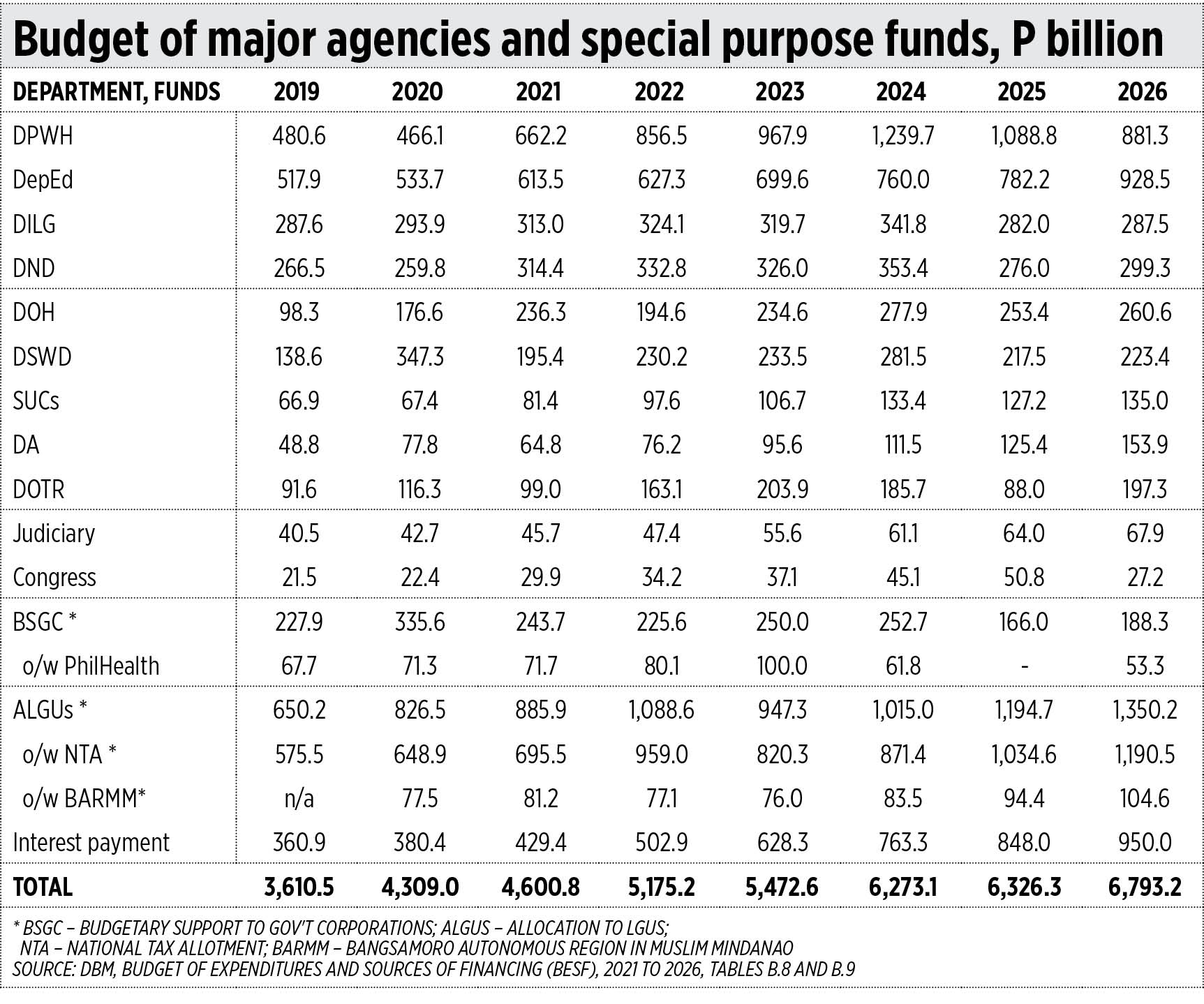
First, consider that the overall budget has nearly doubled from P3.61 trillion in the pre-lockdown year 2019 to P6.33 trillion in post-lockdown 2025. Interest payments alone for our public debt are projected to more than double from P361 billion to P848 billion over the same period.

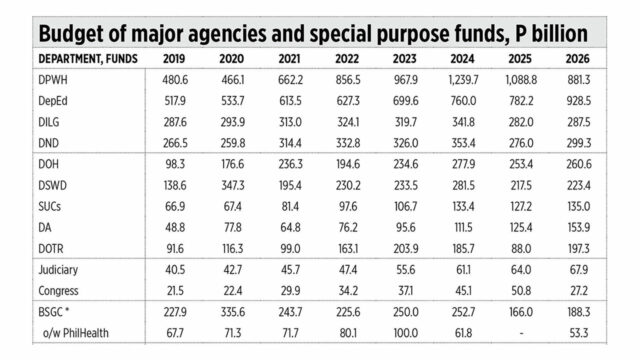
So, agencies and departments with 2025 budgets that are twice their 2019 level are candidates for spending cuts because the virus crisis, which was used as the basis for the huge rise in their budgets, is no longer here. These include the Departments of Public Works and Highways (DPWH), Health (DoH), Social Work and Development (DSWD), Agriculture (DA), and state universities and colleges (SUCs). See the table for details.

Thus for 2026, the Senate may consider limiting the budget of these agencies: the DoH to P230 billion while the Philippine Health Insurance Corp. or PhilHealth subsidy is kept at around P60 billion, leading to savings of P25 billion; the DSWD up to P200 billion, with savings of P23 billion; the DA up to P130 billion, with savings of P24 billion; the SUCs up to P130 billion, with savings of P5 billion; the Department of Transportation up to P190 billion, with savings of P7 billion. This leads to a savings sub-total of P84 billion.

The rest of the departments may have to deal with across-the-board reductions in their budgets of 5% to 8% — that would come to around P150-P200 billion in additional savings.

Then cut the subsidies to government corporations like the National Irrigation Administration (NIA) from an average of around P60 billion/year to only P30 billion; remove the Power Sector Assets and Liabilities Management Corp. (PSALM) subsidy of P8 billion/year; and the National Electrification Administration (NEA) subsidy of around P4 billion/year. This will result in around P42 billion in savings.

The Bangko Sentral ng Pilipinas’ cut in interest rate should help reduce our interest payment to not more than the programmed P950 billion.

Overall, a spending cut of up to P400 billion can be made in the 2026 budget. This will be a big respite in our budget deficit and annual borrowings.

I hope that President Ferdinand R. Marcos, Jr., Budget Secretary Amenah F. Pangandaman, and Senate President Tito Sotto would consider these proposals. Also, the rest of the economic team, and the House leadership when the Bicameral Committee is formed for this.

When agencies feel the tightness in overall spending and their agency budget, they will tend to be more careful, more efficient, and less wasteful in their spending to avoid another round of public backlash.


Bienvenido S. Oplas, Jr. is the president of Bienvenido S. Oplas, Jr. Research Consultancy Services, and Minimal Government Thinkers. He is an international fellow of the Tholos Foundation.

minimalgovernment@gmail.com

A Japanese Pinot Noir town blessed by climate change now worries about the weather

TAKAHIKO.CO.JP

YOICHI, Japan — Climate change has helped make the small Japanese town of Yoichi the toast of Pinot Noir connoisseurs, with gradually warming temperatures encouraging locals to try their hand at the delicate grape variety over the past two decades.

Yoichi was well known as the home of Nikka Whisky. But it burst into the viticultural limelight five years ago, when the 2017 Nana-Tsu-Mori Pinot Noir from the local Domaine Takahiko winery was featured on the wine list of Copenhagen’s globally acclaimed Noma restaurant.

A bottle of that prized wine, which once sold for around $30, is now offered by resellers in Japan for about $560. Other wines from the town, which is located on Japan’s northernmost island of Hokkaido and now has about 20 wineries and 70 vineyards, have also won their fair share of accolades.

But Yoichi’s farmers fret that even before the town’s reputation has had a chance to be embraced by mainstream consumers, recent rapid gains in temperatures and potentially more rain during the harvesting season could mean that it will become difficult to grow the Pinot Noir grape here.

“It’s like a roller coaster,” said Domaine Takahiko owner Takahiko Soga, who founded his winery in 2010.

Mr. Soga said he once thought Yoichi’s temperatures during the growing season were roughly similar to France’s Alsace region, but then they reached levels on par with Burgundy, which produces some of the world’s finest Pinot Noirs.

“Then, when I thought we were at Burgundy temperatures, we got closer to Loire or Bordeaux levels this year,” he said.

Climate change is roiling many farmers of all types of crops across the world, while blessing only some. Wine producers are no exception, but the Pinot Noir grape is particularly sensitive.

Known for producing elegant transparent wines, the grape can thrive in cool to temperate climates, but its thin skin and tight clusters make it extremely sensitive to even a bit too much sun or rain.

VEXED BY BIRDS
Climates of wine-growing regions around the world are classified under the Winkler Index, which is calculated by adding daily average temperatures above 10°C (50°F) or growing degree days (GDD) from April to October.

Hokkaido has generally been viewed as having a Region I climate — the coolest of the five Winkler climate groups.

But since 2023, Yoichi’s GDD sum has nudged up into Region II territory, according to data from Japan’s Meteorological Agency. That’s a temperature zone more commonly viewed as suited to medium-bodied reds such as Merlot and Cabernet Sauvignon.

And this year, Yoichi had its hottest summer since record-keeping began, with average temperatures of 22.1°C between June and August, about three degrees higher than the average for the three decades to 2020.

Yoichi’s warmer and longer summer seasons increase the chances that Pinot Noir grapes could ripen too quickly, leading to undesirably high sugar and low acid levels. Higher temperatures also make the fruit more prone to damage from rain.

Yuichi Hirotsu, an award-winning vineyard owner whose family was in 2006 among the first of the town’s farmers to plant the classic red, said his Pinot Noir grapes had suffered from rain damage this year.

And another variety he grows, the Austrian Zweigeltrebe, was also severely hit by a particularly heavy downpour in September — something Mr. Hirotsu says he hasn’t previously seen at the beginning of autumn.

“It took us forever to pick Zweigeltrebe this year because we had to remove damaged grapes one by one,” he said.

Also vexing Yoichi’s winegrowers has been a marked increase in the number of birds looking to feast on their grapes — a trend they also blame on climate change, saying it has reduced sources of nuts and seeds for the birds in nearby mountains.

Such is the scourge that the sound of firecrackers to scare them away is ever-present in Yoichi.

The need to gain knowledge about coping with climate change was one of the primary reasons behind Yoichi Mayor Keisuke Saito’s formation of a “wine accord” with the historic Pinot Noir commune Gevrey-Chambertin in Burgundy this year that will see the two groups exchange know-how on production methods.

In terms of immediate measures, as temperature and humidity control become increasingly challenging, Domaine Takahiko has built an underground wine cellar to store 100 barrels.

Trying new types of Pinot Noir or other kinds of grapes will also be necessary, the farmers believe.

“Pinot Noir might not be the ultimate goal for this town. Varieties like Merlot or Syrah might be what await us in the future,” said Mr. Soga. — Reuters

AI investment boom may lead to bust, but not likely systemic crisis, IMF chief economist says

STOCK PHOTO | Image by Rawpixel.Com from Freepik

WASHINGTON — The US artificial intelligence (AI) investment boom may be followed by a dot-com-style bust, but it is less likely to be a systemic event that would crater the US or global economy, the International Monetary Fund’s (IMF) chief economist, Pierre-Olivier Gourinchas, said on Tuesday.

There are many similarities between the late 1990s internet stock bubble and the current AI boom, with both eras pushing stock valuations and capital gains wealth to new heights, fueling consumption that added to inflation pressures, Mr. Gourinchas told Reuters in an interview.

Then, as now, the promise of a new, transformative technology ultimately may not meet market expectations in the near-term and trigger a crash in stock valuations, he said. But just as in 1999, investment in the sector is not built on leverage, but by cash-rich tech companies.

“This is not financed by debt, and that means that if there is a market correction, some shareholders, some equity holders, may lose out,” Mr. Gourinchas said at the start of the IMF and World Bank annual meetings in Washington.

“But it doesn’t necessarily transmit to the broader financial system and create impairments in the banking system or in the financial system more broadly,” he added.

UNREALIZED GAINS
Tech firms are pouring hundreds of billions of dollars into AI chips, computing power, data centers and other infrastructure in a race to deploy the technology that promises massive productivity gains.

Mr. Gourinchas said these gains have not yet been realized in the economy, just as the lofty valuations of internet stocks in the late 1990s were often not based on actual revenues, leading to the dot-com bust in 2000 and a shallow US recession in 2001.

But the current scale of the AI boom is smaller than the dot-com era, with AI-related investment increasing by less than 0.4% of US GDP since 2022 compared to the dot-com era’s investment increase of 1.2% between 1995 and 2000, according to data compiled by the IMF.

While the direct impact on financial stability may be limited, Mr. Gourinchas said there was a possibility an AI correction could trigger a shift in sentiment and risk tolerance that could lead to broader repricing of assets that could put stress on non-bank financial institutions.

“But it’s not a direct link. We’re not seeing enormous links from the debt channel,” Mr. Gourinchas added.

Excessive leverage at the height of the US property bubble in 2008 helped bring on the global financial crisis, causing multiple large bank failures and triggering the deepest recession since the Great Depression of the 1930s.

INFLATION EFFECT
The IMF’s World Economic Outlook, released on Tuesday, cited the AI investment boom as one of the factors propping up US and global growth this year, along with US tariff rates coming in lower than feared and easier financial conditions prompted in part by dollar depreciation.

But Mr. Gourinchas said the added investment and consumption is helping to elevate demand and inflation pressures without associated productivity gains, even as non-tech investment falls, due in part to uncertainty over President Donald Trump’s tariffs.

The IMF is forecasting a smaller decline in US consumer price inflation for 2025 to 2.7%, declining only to 2.4% in 2026, Mr. Gourinchas said. A year ago, the IMF had forecast that US inflation would be back to the Federal Reserve’s 2% target level this year.

Among other factors keeping inflation elevated are reduced US immigration that limits the labor supply and the delayed effect of tariffs on consumer prices.

“Now, the effect of tariffs is kind of trickling in. So far, the evidence suggests that importers have absorbed it in margins, and they have not transmitted as much to the ultimate customers,” Mr. Gourinchas said. “It has not been paid by the exporters.”

Mr. Trump famously predicted that foreign countries would pay the price of his protectionist policies, wagering that exporters would absorb that cost just to keep a foothold in the world’s largest consumer market.

Mr. Gourinchas’ assessment agrees with the view of academic studies, surveys and business leaders that companies on the US side of the border are eating the tariffs.

He said import prices have not declined, “so it’s not the case that the exporters have absorbed the tariffs.” — Reuters

How Powerful Is the Philippine Passport?

The Philippine passport ranked 79th out of 199 in the October update of the Henley Passport Index (HPI). Filipino citizens enjoy visa-free or visa-on-arrival access to only 64 out of 227 destinations worldwide. The country’s passport ranking ties with Sierra Leone. The HPI is an authoritative ranking of all the world’s passports measuring how freely citizens can travel without a prior visa based on the number of destinations.

How Powerful Is the Philippine Passport?

DITO Telecommunity sees higher investor interest

BW FILE PHOTO

DITO TELECOMMUNITY Corp. said it is attracting more investors amid its continued business expansion, with revenues expected to rise by as much as 27% this year.

“With all these positive milestones, I think we’re getting a lot more visibility and interest from investment quarters,” DITO Telecommunity President and Chief Executive Officer Ernesto R. Alberto told reporters on the sidelines of an event on Wednesday.

He said the company’s growth momentum and expanding subscriber base, alongside a strong fixed wireless access (FWA) business, are driving investor confidence.

The telecommunications company expects to close the year with 16 million subscribers after surpassing 14 million in July, supported by ongoing network expansion and about 500,000 FWA users.

Earlier, DITO said it targets to reach one million FWA subscribers within the next 18 months. As of July, its FWA service — which uses wireless signals to deliver broadband connectivity — had 250,000 subscribers. The company aims to grow this to 300,000 by yearend.

Meanwhile, parent firm DITO CME Holdings Corp. said Summit Telco Corp. remains committed to investing in the company.

“Summit Telco is still very committed to their investment. We are just waiting for them to complete the infusion,” Mr. Alberto said, adding that the transaction is expected to be completed within the year.

The deal involves the sale of up to nine billion DITO CME shares. This year, DITO CME is planning to raise up to P26.53 billion to support the expansion of DITO Telecommunity’s operations, with an additional P28.83 billion to be raised over the next five years through private placements.

DITO Telecommunity also launched its new brand, BizBayan, which aims to offer digital products and services tailored for micro, small, and medium enterprises (MSMEs).

“We are unveiling a new brand conceived to meet the dynamic and evolving demands of Filipino MSMEs — delivering scalable, cost-efficient, and high-performance digital services and solutions,” Mr. Alberto said.

“These are not mere offerings; they are imperative instruments of transformation, designed to empower businesses to transcend limitations and to enable them to grow in this digital age,” he added. — Ashley Erika O. Jose

Peso jumps on dovish Fed, trade woes

STOCK PHOTO | Image by iiijaoyingiii from Pixabay

THE PESO strengthened against the dollar on Wednesday following rate cut signals from US Federal Reserve Chair Jerome H. Powell and trade tensions between the United States and China.

The local unit closed at P58.055 versus the greenback, jumping by 16 centavos from its P58.215 finish on Tuesday, Bankers Association of the Philippines data showed. This was its best close in over week.

The peso opened Wednesday’s session stronger at P58.10 versus the dollar. Its intraday best was at P57.985, while its worst showing was at P58.15 against the greenback.

Dollars exchanged increased to $1.73 billion on Wednesday from $1.52 billion on Tuesday.

“The dollar-peso closed lower on dovish signals from the Fed and escalating trade tensions between US and China,” a trader said in a phone interview.

The US dollar slipped against a basket of peers on Wednesday after comments from Mr. Powell bolstered bets on a series of rate cuts in coming months, while a broader improvement in risk sentiment took the shine off the greenback, Reuters reported.

The dollar index, which measures the US currency against six major peers, fell 0.3% to 98.796 as of 0806 GMT, extending a 0.2% decline from the prior session.

Mr. Powell in a speech on Tuesday left the door open to rate cuts by saying the US labor market remained mired in low-hiring, low-firing doldrums. He said the absence of official economic data due to the government shutdown has not prevented policymakers from being able to assess the economic outlook, at least for now.

Markets are currently priced for a quarter-point cut at the Oct. 28-29 Fed gathering and another at the following meeting in December, followed by three more cuts next year, according to LSEG data.

US Trade Representative Jamieson Greer helped to calm some nerves on Tuesday when he told CNBC that there was still a plan for President Donald J. Trump to meet with Chinese leader Xi Jinping.

The peso was also supported by data showing continued growth in remittances, Rizal Commercial Banking Corp. Chief Economist Michael L. Ricafort said in a Viber message.

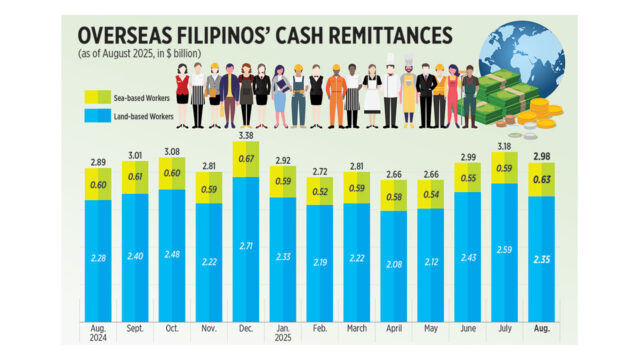
Cash remittances coursed through banks inched up by 3.2% year on year to $2.977 billion in August, central bank data showed.

For Thursday, the trader sees the peso moving between P57.90 and P58.20 per dollar, while Mr. Ricafort expects it to range from P57.95 to P58.15. — Aaron Michael C. Sy with Reuters

Old dogs and old tricks

STOCK PHOTO | Image by DC Studio from Freepik

IS ADVANCED AGE a barrier to providing value to an organization?

CEOs appointed in their mid-forties to take over a company under an orderly succession plan may not bother to challenge the enigma — Can you teach an old dog new tricks? Is it easier to just retire them? Aren’t they likely to be resistant to change? A recruited leader from outside the company wants to justify his signing bonus and disrupt the status quo on Day One.

Even when the selection committee of the board does not specify an age limit for new leadership positions, it has in mind a person south of 50 years of age. Attributes like dynamic, energetic, even disruptive attach more naturally to a youthful person, not someone who routinely gets a senior discount even when he doesn’t present any proof of age. (Do you want warm water?)

Business organizations have a mandatory retirement age as part of their corporate governance practice. After an executive blows out the one fat candle on his cake to represent 65, he may already be out of breath by the time he leaves the party. The much younger ones who stay on to eat the cake don’t have to worry about blood sugar levels.

There can be exceptions to this exit tradition, usually reserved for those in charge of the rules. Unlike the academic tradition, those past the retirement age don’t need to use the suffix of “emeritus.”

Bias against age (sometimes called “ageism”) is pernicious when used to dismiss somebody in a discussion simply by describing him as old without bothering to refute the points he is making. (Can you wait for your turn?) Age can sometimes be enough reason for being ignored — let’s hear what the others have to say.

Certain occupations revere old age.

High priests in the Aztec culture in charge of human sacrifice were old, but the tribe paid careful attention to what they were saying — is he asking me to come forward? Most religions too respect age in their leader.

In ancient Rome, the senate (Senatus) was intentionally composed of “senex” or old people. They were presumed to lack ambition and could therefore be impartial in their deliberation. Of course, they could still promote conspiracies including assassination, as in the case of Julius Caesar. (Note, we are referring here to the Roman senate.) Budget insertions are a relatively modern development of a different group of senators.

In listed companies, wise old men and women are relegated to the board level to provide oversight and corporate governance to the organization. They nod and ask occasional clarificatory questions — Is that for this year or last?

Billionaires, among the top 20 wealthiest in the world, can have hair growing out of their nostrils and still be accorded respect punctuated by genuflections. Warren Buffet at 95 years old is still taken seriously, even quoted by business media. Just for laughs, Buffet can post online a duet with Paul Anka singing “My Way” with different lyrics.

Is there still the compulsion to brag in one’s old age? There’s no need to post foreign outings with much younger colleagues in front of the Eiffel Tower. What about expensive watches on a display rack being rotated for winding, or a lavish home in a foreign country? And an umbrella is just an umbrella. It doesn’t come with a car.

Still, ageism can infect even its own targets.

Old people don’t like to look too old. The need to look even just a bit younger has spawned a whole industry promoting the fountain of youth. Anti-aging pills, organic diets, body massages (not necessarily with soap and water), hair dyes, and surgical enhancements are available. Stem cell regeneration is also becoming an option for those who can afford it.

John Cleese roots for a higher number of years in the battle between the ages when he says, “Age and treachery will always overcome youth and skill.” This can be quite comforting for old dogs and their old tricks. Unfortunately, age doesn’t always trump youth, when the rules of engagement have already changed… as well as those who declare winners and losers.


Tony Samson is chairman and CEO of TOUCH xda

ar.samson@yahoo.com

UnionDigital deploys liveness solutions to improve protection vs cyberthreats

UNIONDIGITAL Bank, Inc., the digital bank subsidiary of Union Bank of the Philippines, has partnered with identity verification provider iProov to help protect its customers against account takeover and money mule activities.

UnionDigital has deployed iProov Dynamic and Express Liveness solutions for its risk-based authentication strategy to ensure secure online transactions in a frictionless manner, it said in a statement.

“As we shift toward risk-based authentication, we need a flexible and future-ready solution. iProov’s internationally proven ability to deliver ease of use, speed, and high security assurance — backed by reliable vendor support — ensures we can evolve our fraud defenses while sustaining customer trust and confidence,” UnionDigital Bank Chief Information Security Officer Russell Hernandez said.

UnionDigital said it has upgraded its previous device-based biometrics technology as part of its efforts to improve consumer protection, especially amid the rise in cyberthreats targeting the financial services sector that have become more sophisticated with the help of artificial intelligence.

iProov’s dual liveness solutions, in particular, give the bank flexibility in terms of identity assurance and fraud detection for any type of transaction, UnionDigital said. Express Liveness provides quick verification for transaction limit increases, while Dynamic Liveness heightens fraud resilience for new device log-ins.

“This enhances security and deepens customer confidence while maintaining a seamless user experience, a model the bank plans to expand in the future,” it said.

“Proving that someone is who they claim to be online is at the heart of digital trust. Our technology provides the highest level of identity assurance on virtually any device to provide that protection. This ensures UnionDigital Bank can secure all its customers with an effortless and resilient solution, which is especially crucial for underbanked communities who rely on mobile devices for their financial needs,” iProov founder and Chief Executive Officer Andrew Bud said.

The Anti-Financial Account Scamming Act signed in July 2024, aims to help prevent and penalize digital financial cybercrime like money mule activities.

As part of the law’s implementation, the Bangko Sentral ng Pilipinas has required its supervised financial institutions to implement stricter information technology risk management measures to protect their customers from fraudulent schemes done online. These include adopting fraud management systems, as well as safeguards like the limitation on the use of interceptable authentication mechanisms like one-time passwords.

UnionDigital booked a net loss of P3.13 billion in 2024, a reversal from the P155.31-million net income recorded in 2023, its financial statement posted on its website showed. — A.M.C. Sy

D’Angelo, trailblazing neo-soul singer, dies at 51, reports say

COMMONS.WIKIMEDIA.ORG

WASHINGTON — Grammy-winning R&B artist D’Angelo, a pioneer of neo-soul music, died at the age of 51 on Tuesday “after a prolonged and courageous battle with cancer,” according to media reports citing a family statement.

“We are saddened that he can only leave dear memories with his family, but we are eternally grateful for the legacy of extraordinarily moving music he leaves behind,” his family said in a statement to multiple media outlets, adding that “the shining star of our family has dimmed his light for us in this life.”

News of his death sent shockwaves across social media, with fans and fellow artists sharing tributes reflecting on the influence he had on their lives and music.

American rapper Doja Cat described him as “a true voice of soul and inspiration to many brilliant artists of our generation and generations to come.”

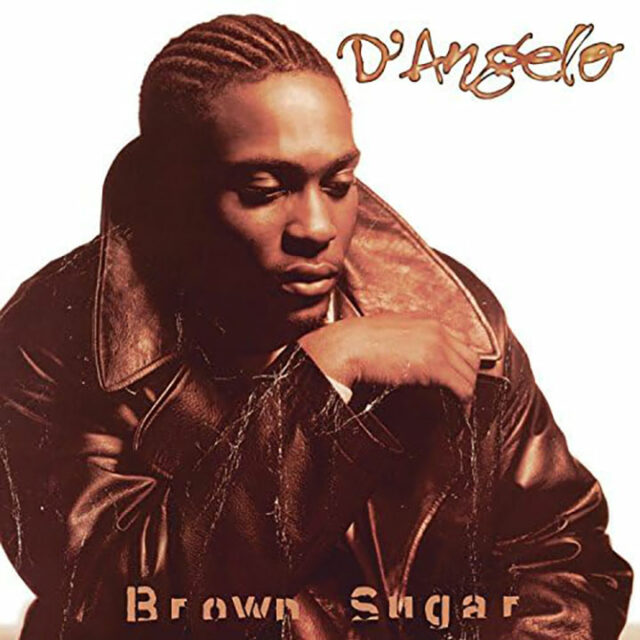
D’Angelo, who was born Michael Eugene Archer, launched his career in the 1990s with his debut album Brown Sugar, which peaked at number four on the Billboard’s Top R&B/Hip-Hop Albums in 1995. The album’s song, “Lady,” reached the top 10 of Billboard’s Hot 100, with songs “Cruisin’” and the title track, “Brown Sugar,” gaining critical acclaim.

In 2020, Rolling Stone hailed Brown Sugar as one of the greatest albums of all time, calling it “a visionary fusion of seventies soul and nineties R&B that paved the way for neo-soul.” It ranked the album 183 out of 500.

D’Angelo released two other studio albums during his lifetime: Voodoo in 2000 and Black Messiah in 2014. His sophomore album spent two weeks at No. 1 on Billboard’s Top 200 list. Throughout his career he collaborated with other notable R&B and neo-soul artists such as Erykah Badu and Lauryn Hill on her critically acclaimed 1998 debut album, The Miseducation of Lauryn Hill.

D’Angelo also became known as a sex symbol for his 2000 hit, “Untitled (How Does It Feel),” in which he released a popular video that featured him shirtless. It was a title D’Angelo largely rebuffed, instead often saying he preferred to focus on his music.

A four-time Grammy Award winner and 14-time nominee, D’Angelo is considered by many critics to be one of the greatest singers of all time.

“Few modern singers so freely display their church roots — but rather than a showboat, his phrasing is often understated, building patiently to torrid screams that could make the stoutest church lady feel positively sinful,” The Rolling Stone wrote of him in 2023. “And with arrangements that mirror and embellish his vocal melodies, D’Angelo’s subtle phrasing makes his music deeply durable, just like his gorgeous natural instrument.”

D’Angelo, who had become more reclusive in recent years, died months after the death of singer Angie Stone, with whom he shared a son. He had two other children. — Reuters

Water-resistant HONOR X7d now available in PHL

HONOR PHILIPPINES

HONOR Philippines on Tuesday launched the latest entry-level device in its X Series lineup, the water-resistant HONOR X7d.

Pricing for the new smartphone starts at P7,299, with the pre-order period set to run until Oct. 24. Customers can get a free HONOR camping light speaker worth P4,999.

The phone comes in three colors, namely Desert Gold, Ocean Cyan, and Velvet Black.

“The HONOR X7d represents HONOR’s dedication to providing practical, feature-rich smartphones catering to the needs of budget-conscious consumers who still desire AI interaction in their mobile devices,” HONOR Philippines Vice-President Stephen Cheng said in a statement.

“Setting a benchmark as a powerful budget phone with enhanced durability and brand-new AI experience in the market, the HONOR X7d brings five-star premium drop protection, IP65 water resistance, a robust 6,500mAh dual-cell battery, 108MP ultra-clear main camera and stunning instant AI Button,” he said.

The brand said the HONOR X7d has drop protection with SGS Premium Performance Certification of Drop & Crush Resistance. It has reinforced corners with cushioning and fall protection for durability.

“This device has been tested to function after being submerged in water for up to 1 minute at a depth of 0.5 meter, making it a dependable companion in various settings and situations. Meanwhile, with the Wet-hand Touch Enhancement, users can also have smooth experience even with wet or greasy fingers,” it added.

Meanwhile, the AI Button allows users to instantly access AI features. It also runs on the latest MagicOS 9.0 based on Android 15, offering intelligence features including Magic Capsule, Magic Portal, Circle, and Google Gemini Assistant, as well as AI editing functions.

“Equipped with a 108MP ultra-clear camera, the HONOR X7d captures images with exceptional details and enhanced brightness, empowering users to have the best photography experience even at night. With 3x lossless zoom and three distinct portrait modes — 1x environmental portrait, 2x atmospheric portrait, and 3x close-up portrait — users can create stunning portrait shots with diverse focal lengths,” it said.

“Furthermore, the HONOR X7d integrates AI photography features like HONOR AI Eraser, AI Remove Reflection and AI Style, improving image quality and promoting users’ photo editing experience on smartphones.” — BVR

Overseas Filipinos’ Cash Remittances

MONEY SENT HOME by overseas Filipino workers (OFW) went up by 3.2% year on year in August, as the weaker peso drove up the value of remittances, data from the Bangko Sentral ng Pilipinas (BSP) showed. Read the full story.

Overseas Filipinos’ Cash Remittances

ADVERTISEMENT
ADVERTISEMENT